

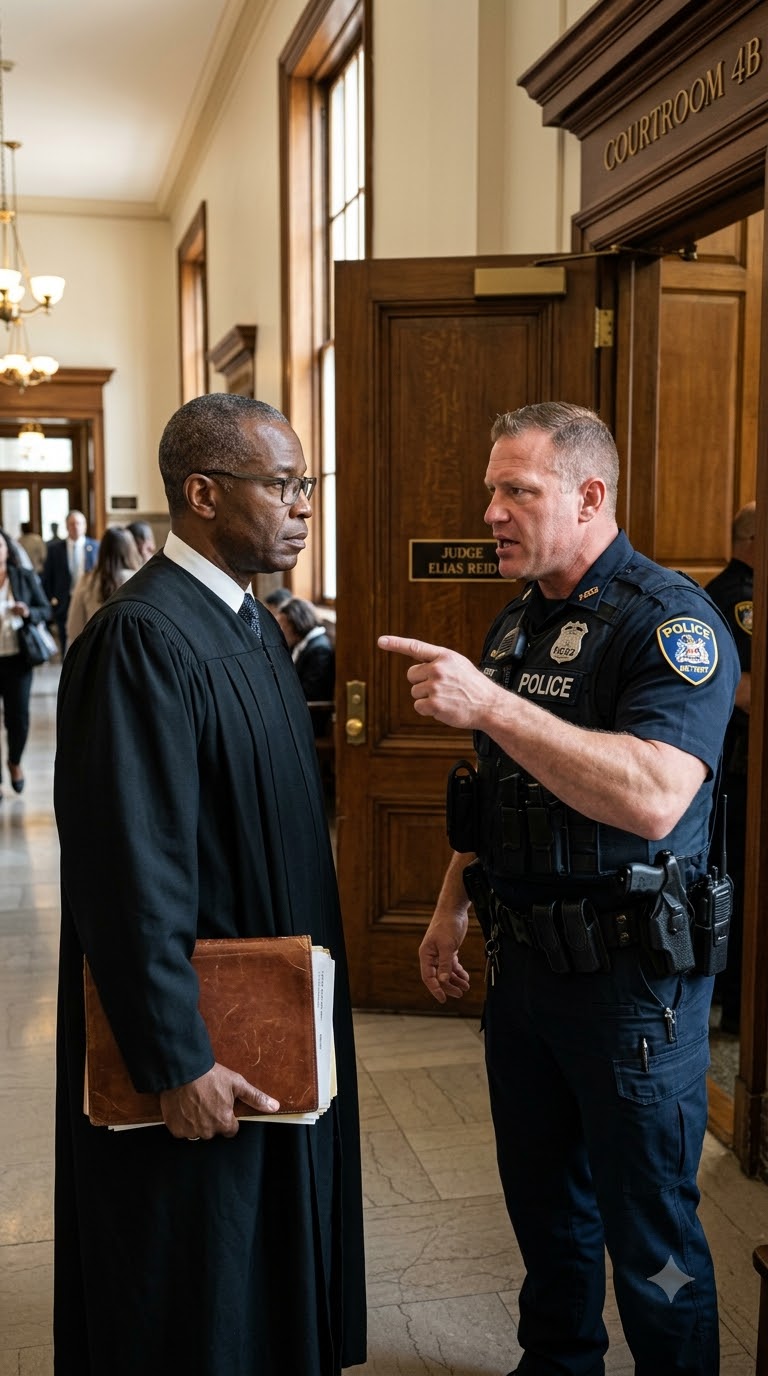
“Take off the costume.” Officer Daniel Whitmore delivered the words with such confidence that, for a moment, nobody in the third-floor corridor of the Franklin County Courthouse seemed sure they had heard him correctly.
Fifty-two-year-old Marcus Bennett stopped less than 20 feet from courtroom 3. A black judicial robe draped over his shoulders. A leather folder packed with case notes rested beneath his left arm.
His reading glasses sat low on his nose, and behind him, mounted beside a polished wooden door, was a brass plaque large enough to read from halfway down the hallway.
Judge Marcus Bennett.
Marcus looked at Whitmore. Then he slowly glanced over his shoulder at the plaque before turning back toward the officer.
“Excuse me.”
Whitmore stepped directly into his path.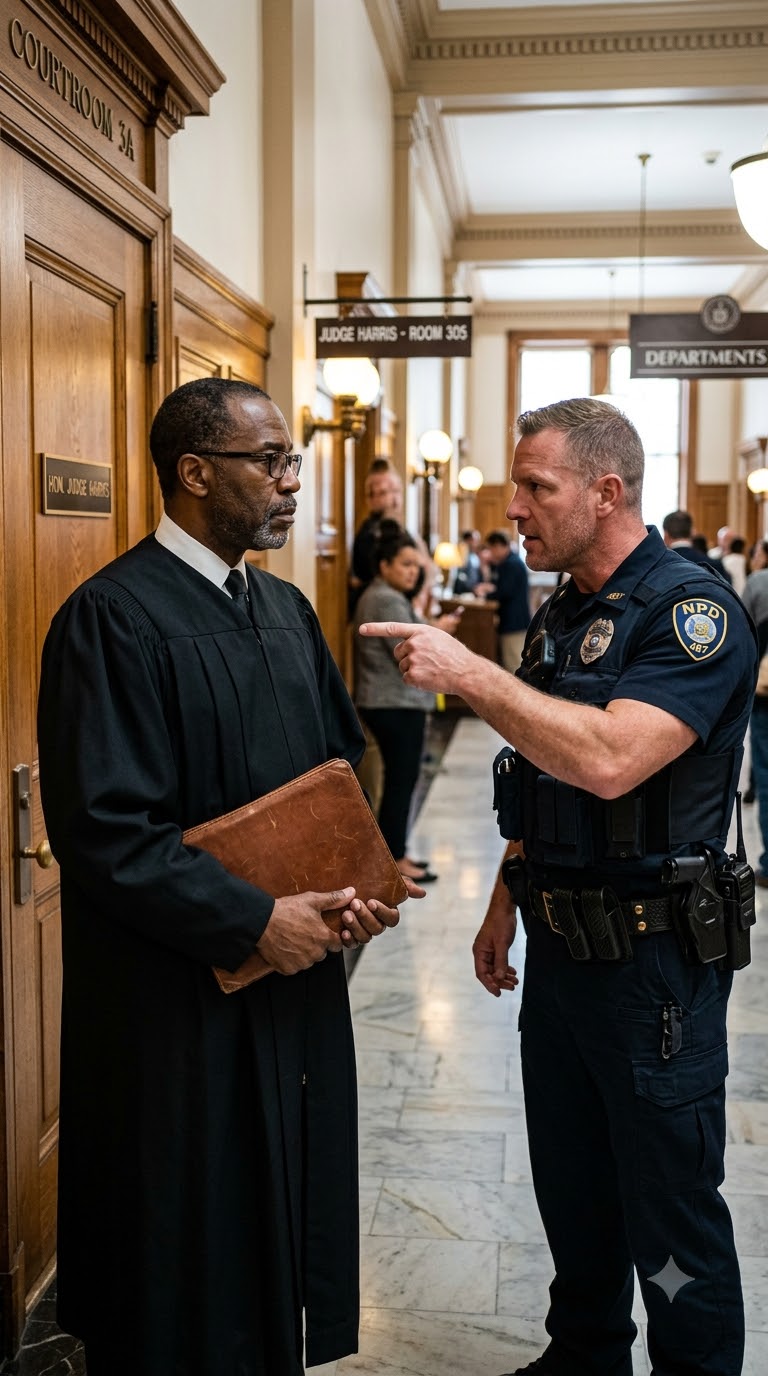
I said, “Take off the costume.”
The hallway immediately began to fall silent. Two attorneys near the elevators stopped their conversation. A courthouse clerk carrying a stack of files slowed down.
Marcus kept his voice steady.
“Officer, do you know where you are?”
Whitmore gave a brief laugh.
“I know exactly where I am. This is a courthouse, not a costume party.”
Marcus observed him for several seconds.
Whitmore was white, somewhere in his mid-40s, with a courthouse security badge clipped above his uniform pocket. Marcus had never encountered him before. That was not particularly unusual. Officers regularly rotated through courthouse assignments.
What was unusual was the certainty written across Whitmore’s face.
Not confusion. Not caution.
Certainty.
Marcus turned slightly and gestured toward the brass plaque.
“Before you make another decision, I suggest you look at the door behind me.”
Whitmore followed Marcus’s hand with his eyes.
They landed on the plaque.
Judge Marcus Bennett.
For half a second, Marcus expected the officer’s expression to shift.
It did not.
Whitmore looked back at him.
“Standing beside a judge’s name does not make you one.”
Something inside Marcus became completely still.
Not angry. Not surprised.
Still.
He had spent enough years recognizing the difference between someone who lacked information and someone who had already decided which information he was willing to accept.
“My chambers are behind that door,” Marcus said.
Whitmore crossed his arms.
“Sure they are.”
“My identification is inside.”
“You’re not going in there.”
Marcus looked once more at the plaque.
“You’re asking me to prove who I am while preventing me from reaching the identification you are asking for.”
“Do not tell me how to do my job.”
Marcus looked down the corridor. Several people were watching now. He recognized nearly every one of them.
A young assistant district attorney stood beside the elevator. Linda Parker, a senior courthouse clerk who had worked in the building for nearly 15 years, stood near the records office.
Marcus turned back toward Whitmore.
“Call courthouse administration.”
“I do not need to call anybody.”
“Call your supervisor.”
“I said, I have this handled.”
Marcus slowly nodded.
There it was.
The sentence people in positions of authority often used right before demonstrating that they did not have anything handled at all.
Linda Parker stepped forward. Officer Whitmore sharply turned toward her.
“Stay out of this.”
Linda stopped.
Marcus looked at her.
She understood the expression on his face.
Do not argue. Do not escalate. Let him make his own decisions.
Marcus turned back to Whitmore.
“That woman has worked here for 11 years.”
“I do not care.”
“She knows me.”
“I did not ask her.”
“That is my point.”
Whitmore’s jaw tightened.
Marcus remained composed.
“You have a question about my identity. There are at least five people within 20 feet who can answer it. My name is on the door behind me.
“My identification is inside the room you are blocking. You have access to courthouse administration security records and your radio.”
Whitmore stepped closer.
“And yet you still have not shown me identification.”
Marcus removed his glasses. He carefully folded them and placed them inside his robe.
“You are not looking for identification.”
Whitmore narrowed his eyes.
“What is that supposed to mean?”
“It means you have been given several ways to learn the truth, and you have rejected all of them.”
The corridor grew even quieter.
Whitmore glanced toward the small gathering of onlookers.
For the first time, Marcus noticed something beyond suspicion in the officer’s expression.
Embarrassment.
But rather than correcting himself, Whitmore seemed to become even more determined.
Marcus had witnessed that many times from the bench.
Some people were more afraid of being wrong than they were of making the situation worse.
Whitmore pointed down the corridor.
“Public access is downstairs.”
“I’m not a member of the public.”
“You do not belong in this restricted corridor.”
A young Black clerk named Emily Ross stepped forward before Marcus could stop her.
“Officer, that is Judge Bennett.”
Whitmore turned toward her.
“Keep moving.”
Emily froze.
“I work for him.”
“I said, “Keep moving.”
Marcus watched her expression change. She looked embarrassed, then angry.
“Emily,” Marcus said gently.
She looked at him.
“It is all right.”
It was not all right.
Both of them knew that.
But Marcus had spent more than a decade on the bench learning that sometimes the clearest evidence came from allowing someone to keep talking.
Emily slowly stepped backward.
Marcus looked at Whitmore.
“That is the second person who has identified me.”
“I do not know her.”
“You do not know me either.”
“Exactly.”
Marcus almost smiled, but there was no humor behind it.
“You realize that argument works both ways.”
Whitmore ignored him.
A voice came from near the elevators.
“Good morning, Judge Bennett.”
Everyone turned.
Harold Wilson, a 64-year-old maintenance worker, stood beside his cart. Harold appeared confused by the silence. He looked from Marcus to Whitmore.
“What is going on?”
Whitmore pointed toward him.
“Sir, move along.”
Harold frowned.
“I was just saying good morning to the judge.”
Marcus looked at Whitmore.
“That makes three.”
Whitmore’s face reddened.
People often said things when they believed someone was in trouble.
Marcus studied him.
“So now the courthouse employees are lying.”
“I did not say that.”
“You are refusing to believe them.”
“I’m trying to determine who you are.”
“No,” Marcus said. “You were trying to protect the conclusion you already made.”
Whitmore’s right hand moved toward his belt.
Marcus noticed the body camera positioned near the center of his uniform. A red light was glowing.
Marcus nodded toward it.
“Is that recording?”
Whitmore almost smiled.
Every second, Marcus looked directly into the camera.
“Good.”
The single word changed the atmosphere.
Whitmore’s smile disappeared.
Marcus continued staring at the camera.
“For the record, my name is Marcus Bennett.
“I am a presiding judge assigned to courtroom 3. My name is displayed on the chambers door behind me. My identification is inside those chambers. Officer Whitmore has refused to allow me to retrieve it. Three courthouse employees have identified me in his presence.
“He has refused to verify my identity through courthouse administration or his supervisor.”
Whitmore stepped forward.
“That is enough.”
Marcus turned his eyes back toward him.
“I agree.”
“Turn around.”
Nobody moved.
Marcus looked at him.
“Excuse me.”
Whitmore reached toward the handcuffs attached to his belt.
“I said, “Turn around.”
Linda Parker spoke again.
“Officer Whitmore, please.”
He pointed toward her without looking.
“Do not interfere with an arrest.” Marcus’s eyes narrowed.
“An arrest?”
“Unauthorized access to a restricted area and failure to comply with a lawful order.”
Marcus glanced toward the door of his own chambers, then toward the courtroom where he was scheduled to begin hearing cases in less than 10 minutes. Finally, he looked back at Whitmore.
“What lawful order have I failed to follow?”
“I ordered you to leave.”
“You order a judge to leave the hallway outside his own courtroom.”
“You have not proven you are a judge.”
Marcus drew a slow breath. He had spent years telling defendants not to allow one bad moment to determine the next 10 years of their lives.
Now he understood just how difficult that advice could be.
“You still have time to stop,” Marcus said.
Whitmore pulled out the handcuffs.
The metallic click echoed down the corridor.
Marcus placed his leather folder on a wooden bench.
“For the record,” he said, once again looking toward the body camera, “I am not resisting.”
Whitmore pointed toward the wall.
“Turn around.”
Marcus did.
A young employee raised her phone.
Whitmore noticed her.
“Put the phone away.”
Marcus immediately turned his head.
“No.”
Whitmore looked at him.
Marcus continued.
“She is standing in a public corridor. Let her record.”
“You do not give orders here.”
Marcus looked directly at the camera.
“That statement may be worth remembering.”
Whitmore took Marcus’s left wrist, then his right.
The handcuffs snapped closed.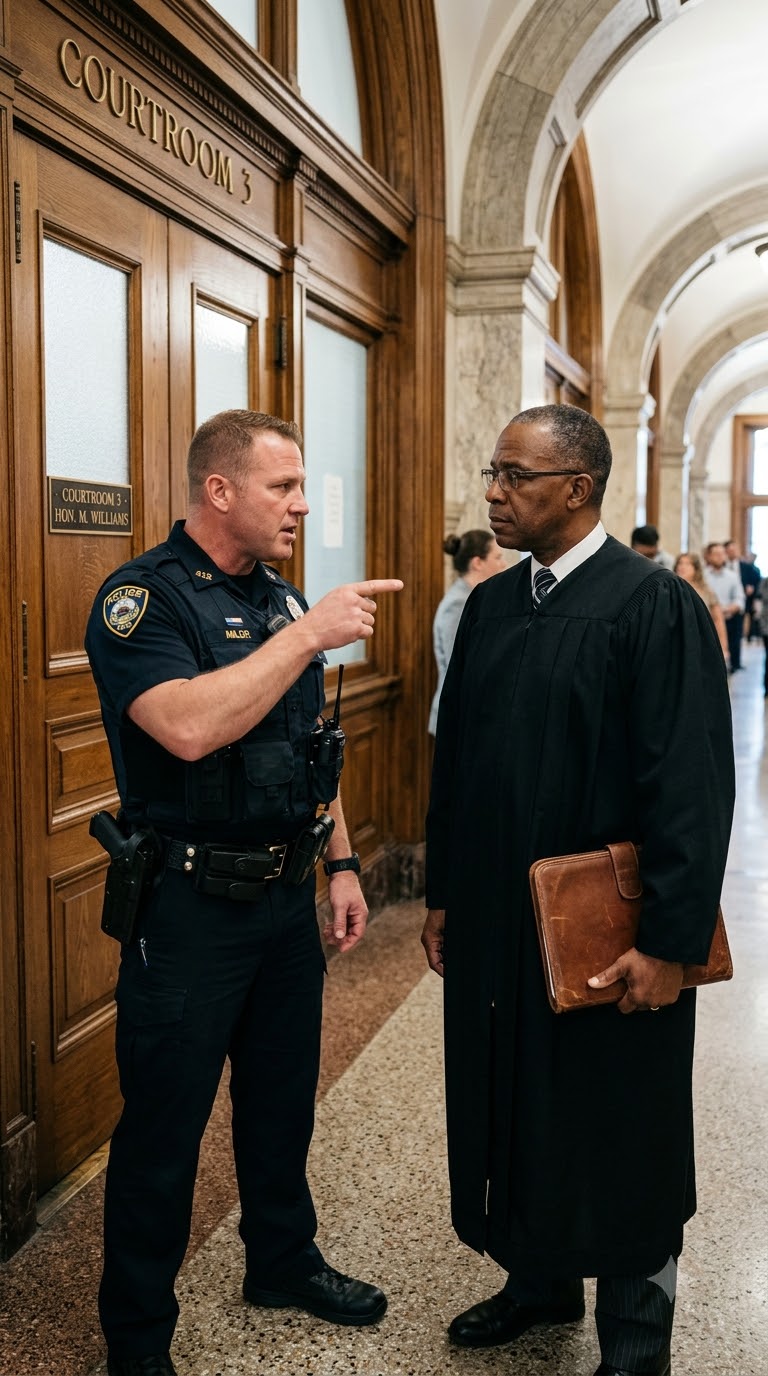
The sound was not loud, but to Marcus, it seemed to carry through the entire building.
Nobody spoke.
For 3 seconds, the only sound was the faint hum of the courthouse lights.
Then the doors to courtroom three opened.
Chief Bailiff Sarah Collins stepped into the hallway carrying the morning docket.
She was 61 years old and had worked in courthouse security longer than Whitmore had been a police officer.
She took two steps, then stopped.
Her eyes moved across the people gathered in the corridor, then to Whitmore, and finally to Marcus.
Her expression changed.
“Officer Whitmore.”
Whitmore turned.
Sarah looked at Marcus’s hands.
“What exactly are you doing?”
Whitmore straightened.
“Handling an unauthorized person in a restricted area.”
Sarah stared at him.
Marcus said nothing.
Whitmore continued.
“He refused to leave and could not provide identification.”
Sarah slowly placed the docket on the bench beside Marcus’s folder.
“Take those handcuffs off Judge Bennett.”
Whitmore froze.
“What?”
Sarah stepped closer.
“You heard me.”
Whitmore looked at Marcus, then back at Sarah.
“Judge.”
Sarah pointed directly over his shoulder.
“The judge whose name is on the door you’re standing beside.”
Whitmore turned.
For the second time, he looked at the plaque.
But this time, he actually read it.
Judge Marcus Bennett.
His eyes shifted from the plaque to Marcus, then back again.
The color drained from his face.
“That is…”
His voice disappeared.
Marcus waited.
Whitmore swallowed.
“Judge Bennett.”
Marcus did not respond.
He did not have to.
Sarah’s voice hardened.
“Remove the handcuffs.”
Whitmore moved behind Marcus.
His fingers trembled slightly as he reached for the key.
The cuffs opened.
Marcus slowly brought his hands forward and adjusted the sleeves of his robe.
Whitmore cleared his throat.
“Judge Bennett, I apologize. This was a misunderstanding.”
Marcus looked at him.
“A misunderstanding ends when the truth arrives.”
Whitmore said nothing.
Marcus glanced toward Linda.
Then Emily.
Then Harold.
Then the chambers plaque.
“You were given the truth six times.”
Whitmore shifted his weight.
“You did not have visible identification.”
Marcus nodded.
“And what did you do when three people identified me?”
There was no answer.
“What did you do when I asked you to call administration?”
Whitmore looked away.
“What did you do when I pointed to my name on the door?”
Whitmore’s jaw tightened.
Marcus looked directly into the body camera.
“Do not turn that camera off.”
Whitmore’s eyes returned to him.
Marcus turned toward Sarah.
“Secure the footage.”
Sarah nodded.
Marcus picked up his folder.
Whitmore spoke quickly.
“Judge, I really am sorry.”
Marcus stopped for several seconds.
He faced the courtroom doors without turning around.
Then he looked back.
“I’m not interested in an apology from someone who is still trying to explain why the truth was difficult to believe.”
Whitmore said nothing.
Marcus entered courtroom 3.
The doors closed behind him.
Only then did Daniel Whitmore understand that the most dangerous part of the morning was not that he had handcuffed a judge.
It was that the judge had never once lost control.
Forty-seven minutes earlier, Franklin County Courthouse had appeared like any other ordinary weekday morning.
Sunlight streamed through the tall front windows, casting pale rectangles across the marble floor. Attorneys checked their watches. Clerks carried files. Families searched directories for room numbers that all seemed identical.
Marcus Bennett had entered through the employee entrance shortly before 8:00, carrying coffee in one hand and a leather briefcase in the other.
He had worked within the Franklin County court system for nearly 20 years. He had been a judge for more than a decade, but Marcus had never developed the habit of expecting people to stop when he entered a room.
“Morning, Judge.”
Marcus turned.
Harold Wilson was pushing a maintenance cart toward the elevators.
“Good morning, Harold.”
Marcus stopped.
“Oh, is her daughter.”
Harold’s face brightened.
“She got the scholarship.”
Marcus smiled.
“I told you she would.”
“She was crying when the letter came.”
“I hope those were good tears.”
“The best kind.”
Marcus nodded.
“Tell her I said congratulations.”
He continued toward the elevators.
Near the courthouse directory, an elderly woman stood with a young boy.
She appeared lost.
Marcus stopped.
“Can I help you find something?”
The woman exhaled.
“Family court, room 312, second floor.”
“Turn right after the elevators.”
“The clerk’s desk will be at the end.”
The young boy noticed the robe folded over Marcus’s arm.
“Are you a judge?”
Marcus glanced down at it.
“Only when court is in session.”
The boy laughed.
Marcus continued walking.
That was how he preferred authority.
Quietly.
His father had taught him that long before Marcus understood what authority truly meant.
Inside his chambers, beside a stack of case files, sat a framed photograph of his father.
Marcus was 12 years old when his father first brought him into a courthouse.
His father had spent 22 years working for the city water department.
He wore work boots nearly every day of his adult life.
He had never studied law, but Marcus often believed his father understood justice better than many of the lawyers he would meet later.
That afternoon, when 12-year-old Marcus had stared up at the judge’s bench, his father leaned close.
“The law is powerful, son.”
Marcus remembered turning toward him.
“But the people holding it are still human.” At 12, Marcus believed his father was simply saying that judges could make mistakes.
At 52, he understood the warning had been much deeper.
People could hold authority and still carry fear. They could wear uniforms while carrying assumptions. They could honestly believe they were fair while treating certain people as suspicious before those people ever had the chance to speak.
That morning, Marcus looked at his father’s photograph before putting on his judicial robe.
He had no idea that less than 10 minutes later, another man in another kind of uniform would look directly at him and decide that the robe could not possibly belong to him.
By 10:30, Whitmore’s body camera footage had been secured.
Captain Robert Keller sat in an administrative conference room with Sarah Collins and two internal affairs investigators.
Keller had spent 27 years in law enforcement.
He had witnessed poor judgment. He had seen arrogance. He had watched officers make mistakes that appeared much worse on video than they had seemed in the moment.
When he first learned that the new courthouse officer had failed to recognize a judge, Keller expected embarrassment.
Serious embarrassment, perhaps, but still something that could potentially be explained as a mistake.
Then the video started.
“Take off the costume.”
Nobody in the room moved.
They watched Marcus point toward the plaque.
They watched Whitmore look at it.
They heard him say, “Standing beside a judge’s name does not make you one.”
Keller leaned forward.
The footage continued.
One employee identified Marcus.
Then another.
Then a third.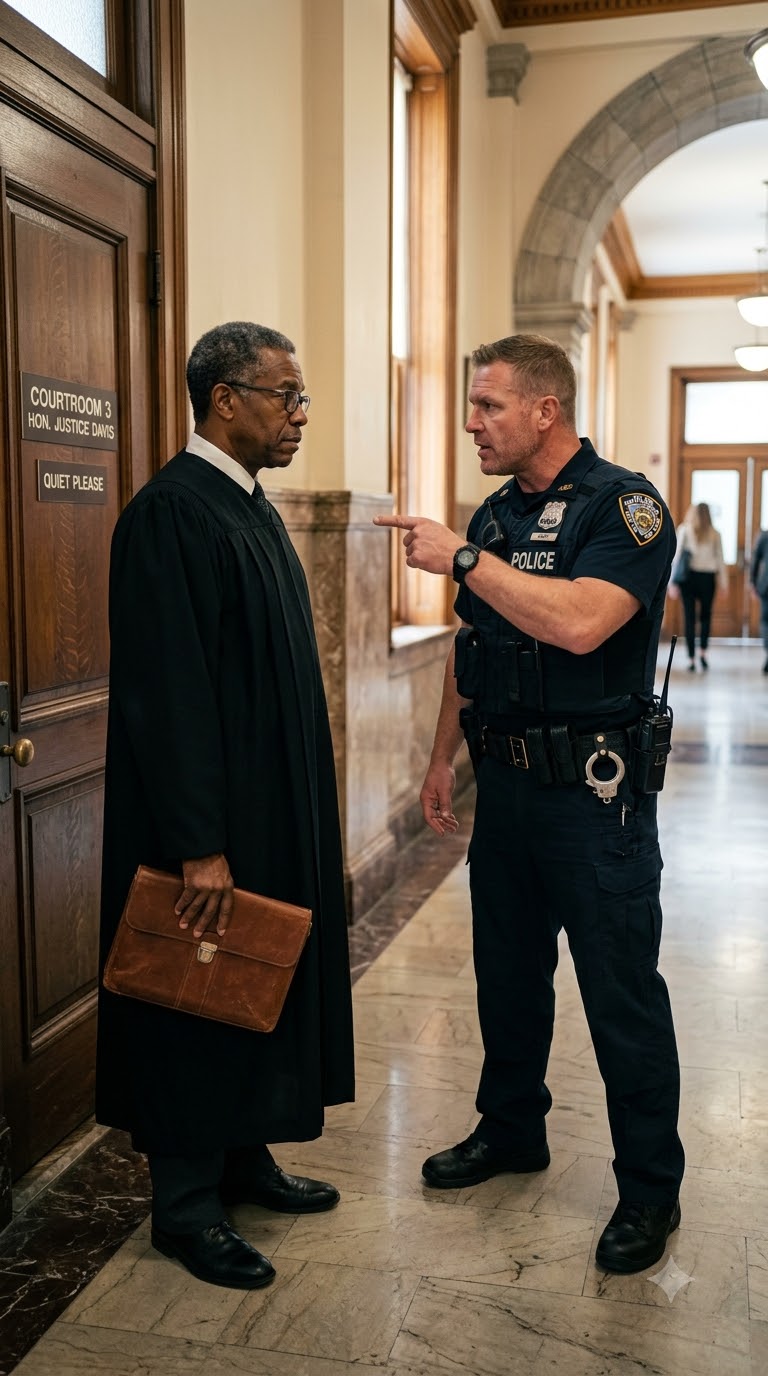
Marcus asked for administration.
Whitmore refused.
Marcus asked for a supervisor.
Whitmore refused.
Marcus offered his identification.
Whitmore stopped him from retrieving it.
When the footage reached the handcuffing, Keller paused the video.
“Play the last five minutes again.”
They did.
The second viewing was worse.
Not because they noticed something new, but because they could no longer pretend they had overlooked anything.
When the video ended, investigator Rachel Moore folded her arms.
“Why did he refuse verification?”
Keller rubbed his forehead.
“He says he believed Bennett was manipulating employees.”
Sarah stared at him.
“Three different employees.”
Keller gave no answer.
Moore looked down at Whitmore’s personnel file.
“How long has he been with the department?”
“17 years.”
She turned several pages.
“Has he done this before?”
The room fell quiet.
Keller looked at her.
“What do you mean?”
“I mean exactly what I said.”
Moore opened the complaint database.
“Has Daniel Whitmore ever been accused of refusing to believe somebody belonged somewhere?”
Keller’s eyes shifted toward the screen.
That question changed everything.
The first complaint they opened belonged to Samuel Price.
Samuel was 69 years old, a Black Vietnam veteran.
Two years earlier, he had been walking home from a neighborhood grocery store carrying a paper bag filled with bread, canned soup, and coffee.
Whitmore stopped him less than 100 yards from his front porch.
“What are you doing around here?”
Samuel had looked at the uniform.
“Walking home.”
“You live here?”
“Yes.”
Whitmore asked for identification.
Samuel handed it over.
The address matched a house three doors away.
The encounter should have ended.
It did not.
According to Samuel’s complaint, Whitmore continued questioning him.
“Why are you walking around here?”
Samuel stared at him.
“Because I live here.”
Whitmore asked why he had not driven.
Samuel explained that the grocery store was less than half a mile away.
The questioning continued.
Samuel eventually filed a complaint.
The final disposition was one word:
“Miscommunication.”
Moore opened the second file.
Denise Carter, Black woman, 60 years old, registered nurse.
Denise had worked night shifts at the same hospital for 9 years.
One evening, Whitmore was assisting hospital security after reports of people entering restricted employee areas.
Denise approached the staff entrance wearing hospital scrubs. Her identification badge was clipped to her chest.
Whitmore stopped her.
She showed him the badge.
He questioned whether it was genuine.
Denise explained that she was due upstairs for a shift.
Whitmore refused to let her through.
Only after a white nursing supervisor arrived and confirmed Denise’s employment was she allowed to pass.
Denise complained.
The disposition cited officer discretion.
Keller’s expression changed.
Moore opened another file.
Andre Lewis.
Twenty-one years old at the time.
College student questioned near a private parking garage.
Valid parking permit.
Valid student identification.
No crime.
Whitmore’s report contained four words.
Subject appeared out of place.
Moore read the sentence twice.
Then she looked at Keller.
“Out of place according to what?”
Nobody answered.
The investigators continued.
Different years.
Different neighborhoods.
Different buildings.
Different people.
But the rhythm was the same.
A Black person appeared somewhere.
Whitmore did not immediately expect to see them.
Whitmore formed a conclusion.
The person provided information.
Whitmore did not accept it.
Then someone else arrived—a supervisor, a homeowner, a manager, someone Whitmore considered more believable.
Only then did the truth become acceptable.
Keller leaned back.
“The complaints were all investigated.”
Moore looked at him separately.
Keller said nothing.
Sarah closed one of the files.
“The pattern was there.”
Moore nodded.
“The files just never met each other.”
That afternoon, Keller and Sarah entered Marcus’s chambers carrying six folders.
Marcus had already completed a shortened court session.
The redness around his wrists had faded.
The morning had not.
Keller placed the folders on the table.
“Judge Bennett, we are taking what happened very seriously.”
Marcus looked at the files.
“What are those?”
“Previous complaints.”
Marcus opened the first one.
Samuel Price.
He read it slowly.
Then Denise Carter.
Then Andre Lewis.
By the time he finished the sixth file, Keller was no longer speaking.
Marcus closed the final folder.
“Were these taken seriously?”
Keller hesitated.
The pause answered the question.
Marcus rested his hand on the stack.
“This cannot become a story about what happened to a judge.”
Sarah looked at him.
Marcus continued.
“If the only reason this matters is because Officer Whitmore finally did it to someone with a title, then nothing has changed.”
Keller pulled out a chair.
“What are you asking us to do?”
Marcus looked at him.
“Has any disciplinary decision been made?”
“No.”
“Good.”
Keller appeared surprised.
Marcus pointed toward the files.
“Do not punish him yet.”
Sarah studied him.
Marcus continued.
“Investigate him first.”
Keller frowned slightly.
“You do not want immediate action.”
“I want accurate action.” Marcus leaned back.
“If you suspend him today because he embarrasses the judge, everyone will know exactly how this story ends.”
Keller waited.
An angry judge, a humiliated officer, a political decision.
Marcus tapped Samuel’s complaint.
“But if this man has done what these people said he did, then the evidence does not need my anger.”
He looked directly at Keller.
“Find them.”
Keller glanced toward the files.
“All of them.”
Marcus nodded.
“Especially the ones nobody believed the first time.”
The first person investigators contacted was Samuel Price.
He was sitting on his front porch when Rachel Moore arrived. He did not immediately invite her inside.
He listened through the screen door while she explained why she had come.
When she mentioned Daniel Whitmore, Samuel’s expression changed.
“That man still working?”
Moore hesitated.
“He is currently under investigation.”
Samuel gave a quiet laugh.
“Under investigation now?”
Moore nodded.
“We are reviewing your complaint.”
“You already reviewed it.”
“We are reopening it.”
Samuel stared at her.
“For what?”
“Because new information may show a pattern.”
Samuel opened the screen door.
“A pattern?”
“Yes, sir.”
He stepped onto the porch.
“You know what I told your people 2 years ago?”
Moore waited.
“I told him he looked at me like I was a question that needed answering.”
She said nothing.
Samuel pointed toward the house behind him.
“I bought this place in 1998.”
His voice remained calm.
“My wife and I raised two children here. I buried her from this house.”
“I have paid taxes on this property for more than 20 years.”
He pointed toward the sidewalk.
“That officer stopped me right there.”
Moore looked toward the street.
Samuel continued.
“I gave him my license. Address said this house.”
His voice tightened.
“And somehow that still was not enough.”
Moore asked softly.
“Why did you file the complaint?”
Samuel looked at her.
“Because I’d spent half my life teaching my children that when something wrong happens, you put it on the record.”
He looked back toward his front door.
“Then your department taught me something else.”
“What?”
“That putting something on the record does not mean anybody will read it.”
Denise Carter was less patient.
Investigators met her in a hospital conference room after her shift ended.
When they told her that her complaint was being reopened, she stared at them for several seconds.
Then she asked,
“What happened?”
Moore explained the courthouse incident.
Denise listened.
“A black judge?”
“Yes.”
“And the officer did not believe he was a judge.”
“That is correct.”
Denise leaned back.
Then she gave a bitter smile.
“So somebody finally important enough had to experience it before you believe the rest of us.”
No one answered.
Denise folded her arms.
“I showed him my badge.”
Moore nodded.
“I know.”
“My name was on it.”
“Yes.”
“My photograph was on it.”
“Yes.”
“I was wearing hospital scrubs.”
Moore nodded again.
Denise’s eyes hardened.
“And none of that was enough until a white supervisor came downstairs and repeated what I had already told him.”
Silence.
Denise looked toward the investigators.
“You know what stayed with me?”
“What?”
“He did not apologize to me.”
Moore waited.
“He apologized to the supervisor.”
That sentence remained in the room long after Denise stopped speaking.
Andre Lewis was 24 now.
He met investigators at the University Law Library.
When they showed him Whitmore’s original report, he read the phrase again.
Subject appeared out of place.
Andre laughed once, but not because it was funny.
“Can I ask you something?”
Moore nodded.
“Out of place compared to who?”
Nobody answered.
Andre continued.
“I had a student identification card, a parking permit, my name was in the university system.”
He placed the report on the table.
“But somehow the most important fact was that I looked wrong standing next to a garage.”
Over the next 3 weeks, investigators reopened more files.
Not every complaint against Whitmore was confirmed. Some genuinely involved confusion. Others lacked enough evidence to reach a conclusion.
But enough followed the same pattern that coincidence became increasingly difficult to defend.
A Black homeowner questioned outside his own house after Whitmore insisted the property could not be his.
A retired schoolteacher detained beside a car registered in her own name.
A city employee whose identification was rejected until a supervisor arrived.
In every case, Whitmore had received accurate information early.
In every case, he treated the person providing that information as less trustworthy than his own initial impression.
The investigation expanded.
Then it moved beyond Whitmore.
Rachel Moore noticed something else.
The complaints had been assigned to different investigators across different years.
One file was kept in patrol review. Another was in professional standards. Another remained in an old internal database.
No investigator had been required to compare similar allegations across an officer’s entire career.
Each complaint had been handled as a separate event.
A misunderstanding.
An isolated decision.
An unfortunate interaction.
But once the files were placed beside one another, they revealed something no individual file could show on its own.
Marcus learned this during another meeting with Keller.
Keller spread the complaints across the conference table.
Marcus studied them.
“The pattern was always here.”
Keller nodded.
“We did not connect it.”
Marcus looked up.
“Why?”
“Our system reviews incidents individually unless there’s already an active pattern investigation.”
Marcus leaned back.
“And how does a pattern investigation begin?”
Keller did not answer immediately.
“Usually when somebody notices repeated similar complaints.”
Marcus looked at the files.
“So, the system waits for someone to see a pattern while keeping the evidence of that pattern in separate boxes.”
Keller lowered his eyes.
Marcus nodded slowly.
“The files were never allowed to meet each other.”
Three weeks after the courthouse incident, Daniel Whitmore entered a disciplinary hearing on the fourth floor of the Franklin County Administration building.
His attorney sat beside him.
Whitmore expected to answer questions about Judge Marcus Bennett.
Then he noticed the back row.
Samuel Price.
Denise Carter.
Andre Lewis.
And his mother, a retired teacher, a city employee, a Black homeowner Whitmore had stopped four years earlier.
People he had questioned.
People he had dismissed.
People whose names he barely remembered.
They remembered him.
The hearing began with the courthouse footage.
The screen came on.
Whitmore’s own voice filled the room.
“Take off the costume.”
Nobody looked away.
They watched Marcus point toward his name.
They watched courthouse employees identify him.
They watched Whitmore reject every opportunity to verify the truth.
Then came Samuel’s complaint.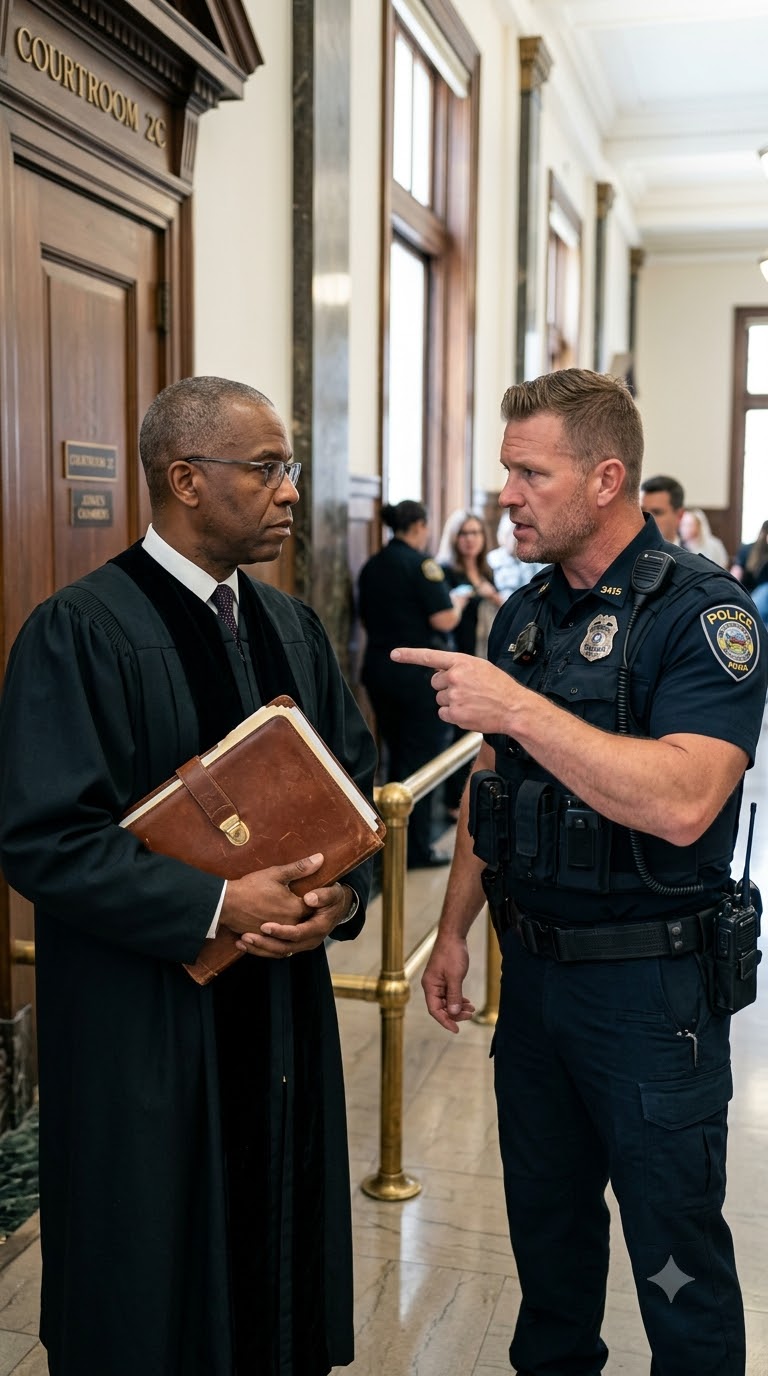
A radio recording.
Whitmore’s voice asking why an older Black man was walking through his own neighborhood.
Then Denise.
Security footage from the hospital entrance.
Then Andre.
The written report appeared on the screen.
Subject appeared out of place.
Each incident alone had once seemed explainable.
Together, they sounded different.
Whitmore’s attorney stood. Officer Whitmore had conducted thousands of interactions during his 17-year career. A limited number of disputed incidents could not fairly define every decision he had made.
The panel chair nodded.
“That is why we are reviewing the evidence rather than assuming guilt.”
Whitmore’s attorney sat down.
Then Marcus was called.
He entered wearing a dark suit, his judicial robe folded over one arm.
Whitmore watched as he took the witness seat.
The panel chair asked,
“Judge Bennett, what do you believe is the central issue before us?”
Marcus looked toward the panel.
“The central issue is not that Officer Whitmore failed to recognize me.”
Whitmore looked up.
Marcus continued.
“People make mistakes. I have made mistakes from the bench. Every person in this room has made assumptions that turn out to be wrong.”
He paused.
“The question is, what happens after the facts challenge the assumption?”
The room became still.
“My identification was nearby.
“My name was on the door. Courthouse employees identified me. I asked for verification repeatedly.”
Marcus looked toward Whitmore.
“The mistake was not the first assumption.”
Whitmore held his gaze.
“The mistake was treating every fact that contradicted that assumption as less credible than the assumption itself.”
The panel chair nodded.
Marcus continued.
“One wrong conclusion can be an error.”
He looked toward Samuel, then Denise, then Andre.
“But when the same kind of conclusion appears repeatedly affecting the same kinds of people in similar circumstances, responsibility requires more than explanation.”
Whitmore was later given an opportunity to speak.
He stood slowly.
His voice was quieter than it had been in the courthouse hallway.
“I have never considered myself prejudiced.”
No one reacted.
“I have never gone to work intending to treat somebody differently because of race.”
Whitmore swallowed.
“I believed I was doing my job.”
The panel chair turned toward Marcus.
“Judge Bennett. Do you wish to respond?”
Marcus could have said no.
Instead, he looked at Whitmore.
“I believe you.”
A murmur moved through the room.
Even Whitmore looked surprised.
Marcus continued.
“I believe that you did not wake up planning to treat anyone unfairly.”
He paused.
“But intent explains what you believed you were doing.”
Marcus looked toward the people seated in the back row.
“Impact shows what you actually did.”
Then he returned his eyes to Whitmore.
“And patterns show what you refused to learn.”
Nobody spoke.
The investigation continued for several more weeks.
In the end, the department concluded that Daniel Whitmore had repeatedly failed to follow verification procedures, had demonstrated a documented pattern of biased enforcement, and had continued similar conduct despite previous complaints that should have prompted greater scrutiny.
His employment was terminated, but Marcus refused to regard the termination as the end of the story.
Samuel Price received a formal notice acknowledging that his original complaint had not been adequately investigated.
Denise Carter’s complaint was reopened and sustained.
Andre Lewis received a written correction to the previous findings in his case.
Franklin County changed its review procedures.
Repeated complaints involving similar allegations would no longer automatically be treated as unrelated events.
Investigators would be required to search for patterns across an officer’s record.
Marcus knew the policy would not fix everything.
No policy could return the afternoon Samuel spent standing near his own house while being treated like a stranger.
No letter could give Denise back the dignity of being believed before someone else spoke for her.
No corrected report could erase the phrase Andre had carried for years.
Out of place.
But for the first time, their stories existed together, rather than as isolated misunderstandings.
As a record.
When reporters gathered outside the courthouse after the department announced its decision, Marcus stood at the top of the steps in a dark suit.
One reporter raised her hand.
“Judge Bennett, do you believe justice was served?”
Marcus considered the question.
“This was never about watching one man lose a badge.”
The reporters grew quiet.
“It was about making sure people who were ignored finally had their voices entered into the record.”
Another reporter called out,
“Did your position as a judge save you?”
Marcus looked toward her, then toward the courthouse doors.
“My title made people listen faster.”
He paused.
“That is not the same thing as justice.”
A third reporter asked,
“Then what is justice?”
Marcus looked down the courthouse steps.
“Justice is when Samuel Price does not need a robe for you to believe that he belongs in his own neighborhood.”
Several reporters lowered their microphones slightly.
“Justice is when Denise Carter does not need a supervisor to prove that she belongs at the hospital where she has worked for 9 years.”
Marcus continued,
“Justice is when Andre Lewis can stand beside a parking garage without someone deciding his presence requires explanation.”
He paused.
“Justice is when the person without a title receives the same benefit of the truth.”
Several weeks later, morning light once again stretched across the marble floors of Franklin County Courthouse.
Clerks carried files. Attorneys hurried toward elevators. Families stood near the directory, searching for unfamiliar room numbers.
To almost everyone entering the building, nothing appeared different.
Marcus noticed the small things.
Near the elevators, a new courthouse security officer was speaking with an elderly Black man who looked confused.
Marcus slowed.
The man pointed toward a paper in his hand.
The officer listened.
He did not order him to move.
He did not ask why he was there.
He did not treat confusion like suspicion.
He checked the directory, then pointed toward the correct elevator.
“Second floor.
“Sir, someone at the clerk’s desk can help you from there.”
The older man smiled.
“Thank you.”
A tiny moment.
Almost invisible.
Most people walking through the courthouse never noticed it.
Marcus did.
Sarah Collins approached from the opposite end of the hallway.
“You ready, Judge?”
Marcus looked toward courtroom 3.
Emily Ross came hurrying from his chambers, holding his judicial robe.
“You forgot this.”
Marcus smiled.
“Thank you.”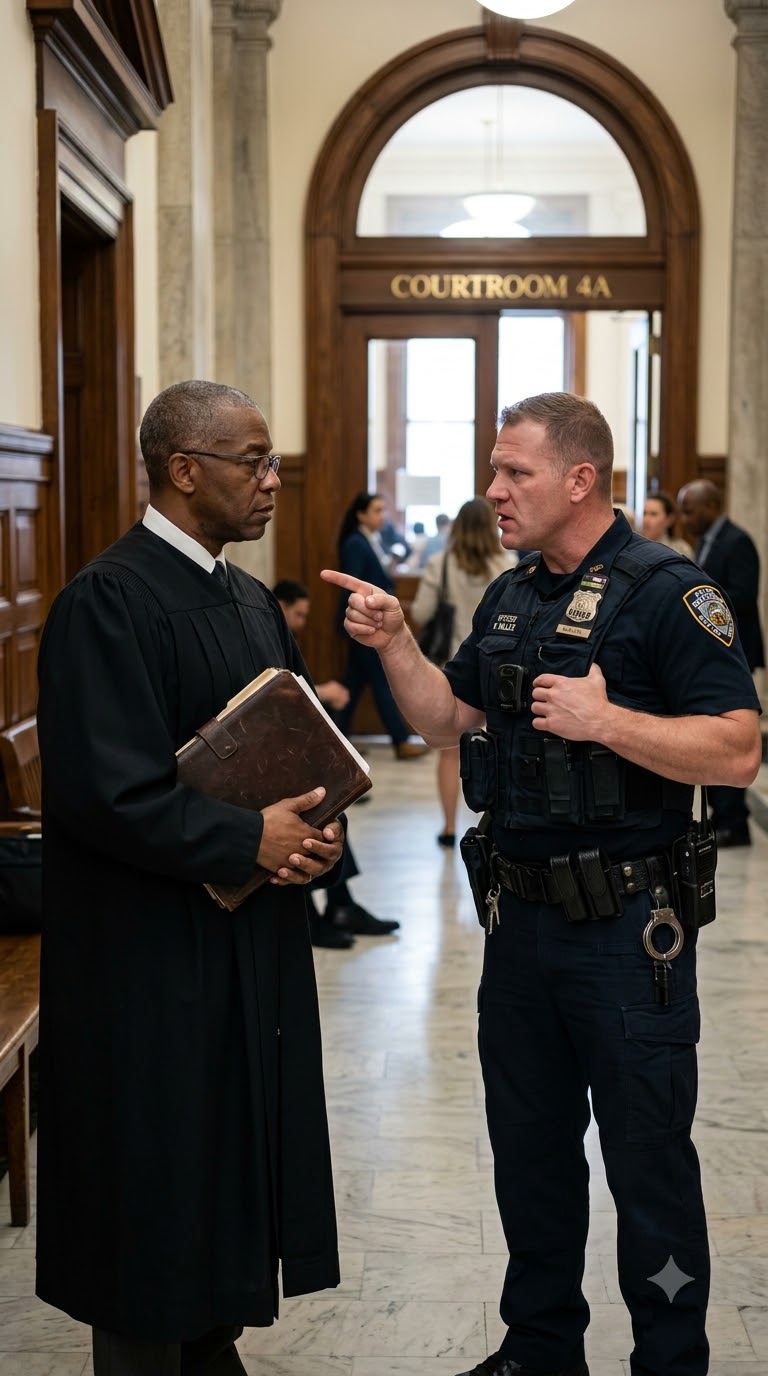
He took the robe and looked at it for a moment.
Ordinary black fabric, heavy enough to hold its shape.
Simple enough to mean nothing without the responsibility carried by the person wearing it.
Weeks earlier, Daniel Whitmore had looked at a Black man in that robe and decided the robe had to be fake.
Marcus had spent a long time thinking about that moment.
The real problem had never been the cloth.
It had never been whether Marcus was important enough to deserve dignity.
Marcus had a title.
Samuel did not.
Denise did not.
Andre did not.
That was exactly why their stories mattered more than his.
Because dignity was not something a person should receive only after proving they were powerful.
It was not a reward for becoming a judge.
It was not something attached to a badge, a uniform, a degree, a bank account, or a job title.
It belonged to the person before anyone knew their name.
Marcus slipped the robe over his shoulders.
Sarah opened the courtroom doors.
Everyone inside stood.
Marcus walked toward the bench.
Different ages, different backgrounds, different lives.
Each person carrying a story that deserved to be heard before conclusions were made.
Marcus sat.
The room became quiet.
He lifted the gavel.
“This court is now in session.”
The gavel struck once.
Clean.
Final.
Daniel Whitmore had worn a badge and believed his first impression deserved more trust than the people standing in front of him.
Marcus Bennett had worn a robe that Whitmore called a costume.
But Marcus eventually understood that the most dangerous disguise in that courthouse had never been black cloth.
It was prejudice hiding behind certainty.
It was assumption disguised as experience.
It was bias protected by the belief that good intentions made harmful patterns impossible.
Marcus’s title had made people listen faster.
But justice would only exist when nobody needed a title to be heard.
