

Chapter 1: The Fracture
“Hand over the chest, sweetheart.”
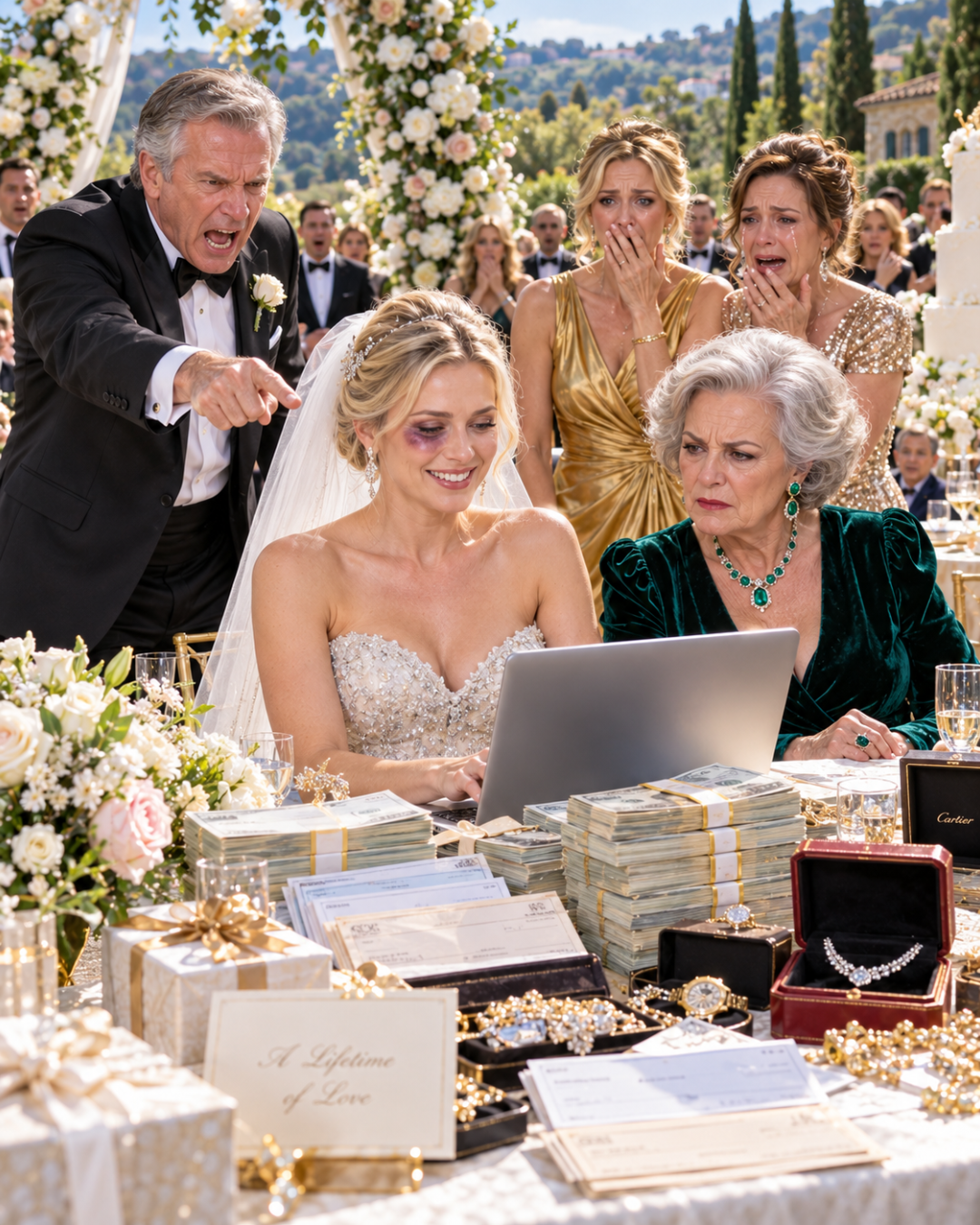
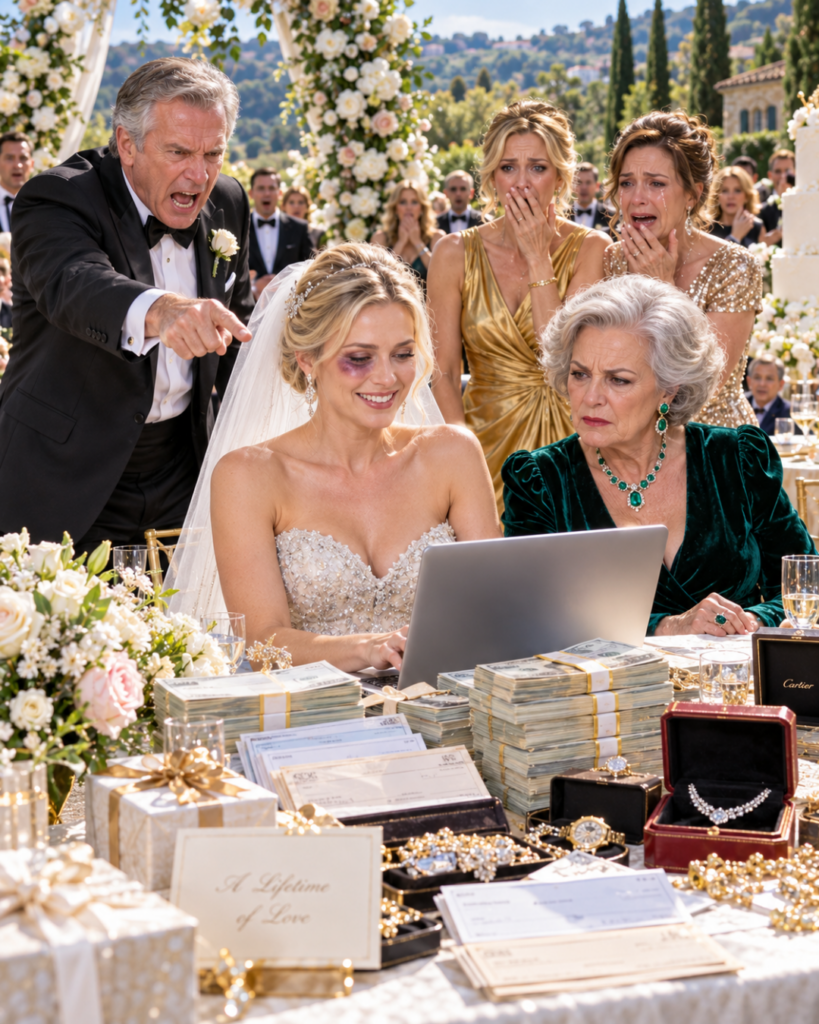
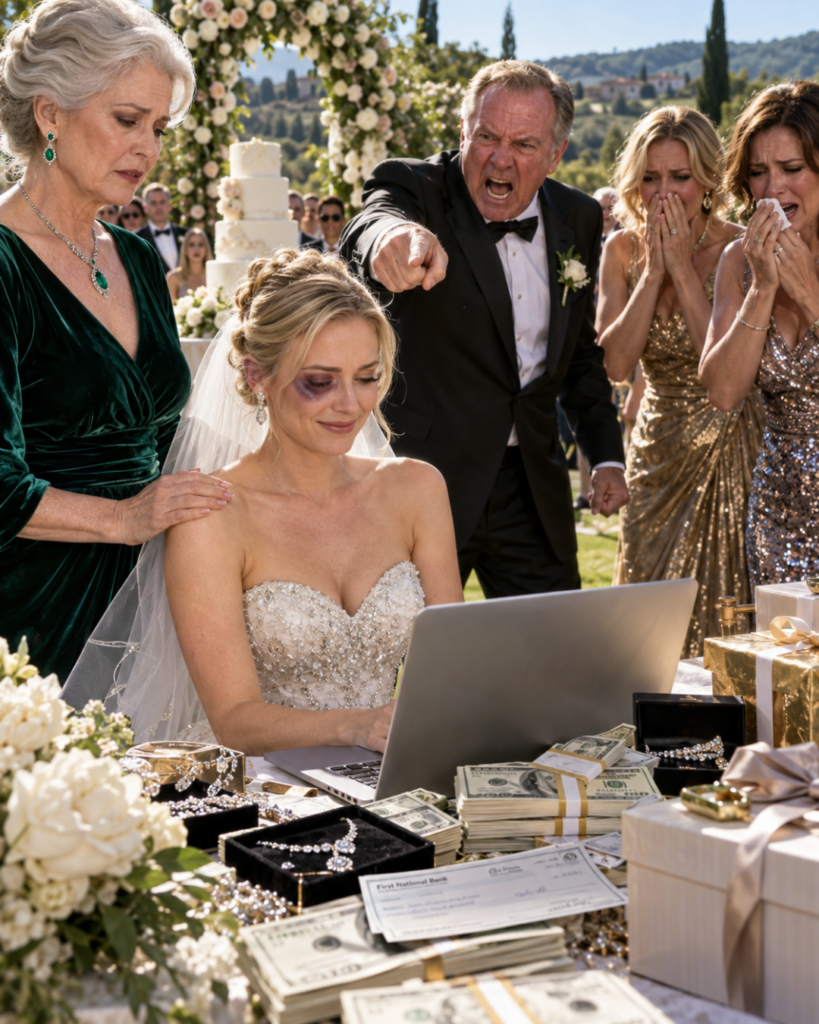
He made the demand again. My answer stayed exactly the same, one unshakable word: no. The third time, my father’s hand flew through the space separating us. His palm struck my cheekbone—a vicious, explosive crack of flesh against bone that rang through my own wedding reception. We were ninety minutes into the celebration. One hundred and eighteen guests stared in breathless shock because the envelopes packed with cash and checks sitting on that walnut gift table were not going into my younger sister’s bank account.
My mother did nothing to stop him. From across the gleaming floor, she watched me with the tired irritation of a parent confronting a difficult toddler. Your sister is drowning, her expression seemed to say. Stop being so incredibly selfish. Beside her, my sister gave the slightest, briefest smirk. She had known about the planned theft since Thursday.
The silence inside Harrow Lake Lodge was complete. It was the sort of silence where one chair leg scraping across hardwood sounded like an earthquake.
Before the burning in my cheek could fully become pain, my new husband, Ellis Brennan, appeared. He didn’t lift his fists. Instead, he moved directly in front of me, blocking me with his broad shoulders while his hands remained casually inside his suit pockets. “You just made this remarkably simple,” Ellis said, his voice terrifyingly calm.
My father, Vaughn Stark, tipped his head backward and laughed dismissively. He was still amused by the idea of a high school English teacher daring to challenge him when someone moved at the opposite end of the room. Someone my parents had deliberately kept away from me for half a decade behind an endless collection of supposedly compassionate explanations.
What happened after my father understood exactly who was making her slow journey across that dance floor is why I will never trust my family with so much as one copper coin again. And what I later discovered about the dark years leading to that night explains why their poisonous performance of love collapsed spectacularly before we had even finished serving the cake.
My name is Esther Stark. I’m thirty-one, and this is the story of my own coup d’état. But to grasp the scale of the betrayal, you first need to understand the structure of my life before that night. You need to understand that I’m a woman who fixes things. And my father had profoundly underestimated how much damage I would tolerate in a broken ledger.
I just didn’t know yet how deeply in the red my own family was.
Chapter 2: The Architect of Order
I need to step away from the sting of that slap for a moment, because my family’s deception makes absolutely no sense unless you understand how my mind works. I manage a busy four-chair dental clinic on the rough west side of Grand Rapids. Nothing about the position was handed to me. I started at twenty-two behind the front desk, fighting through the Byzantine nightmare of rejected insurance claims while phones rang constantly around me. I spent four exhausting years attending night classes, finished my degree at twenty-six, and moved into the manager’s office the following year.
During the wet spring of 2023, the clinic owner, Dr. Karen Ashby, summoned me into her private office. She closed the door—something she almost never did—and a cold stab of adrenaline immediately hit my stomach. The manager before me had disappeared without warning, leaving behind both digital and physical evidence of catastrophic neglect.
Buried inside a bottom drawer beneath brittle rubber bands were $68,400 worth of insurance claims that had never been submitted. Some were so old they were decaying beyond their filing deadlines. The practice had already spent that money on payroll, sterilized equipment, and rent. Now it had effectively evaporated.
Recovering it consumed five brutal months. I stayed after the fluorescent lights dimmed and the doors were locked. One claim at a time, I fought hostile insurance adjusters, reconstructed dead chart notes from digital fragments, and submitted appeal after appeal. I recovered enough money to keep Dr. Ashby from liquidating the practice. When it was finally over, she dropped a heavy ring of brass keys onto my desk. “Two managers before you, Esther,” she had said, her voice thick with relief. “And neither of them ever bothered to figure out what kept me awake at night. You did.”
I’m exceptionally good at cleaning up other people’s catastrophes. I possess an almost unnatural ability to sit before a chaotic mountain of paperwork and refuse to move until the numbers finally submit to logic.
Inside my family, however, that relentless competence was never celebrated. It became a weapon used against me. I was labeled the “stubborn” daughter, fiercely independent and supposedly requiring no care at all. For almost ten years, I completed my parents’ complicated tax returns every spring without receiving a cent. When my mother’s insurance abruptly denied her physical therapy, I fought the bureaucracy and won on my second appeal.
Nobody celebrated. Nobody offered meaningful thanks. It was simply the normal climate inside the Stark household. Whenever I admitted that I was tired, my mother answered with the same chilling refrain. “You’ll figure it out, Esther. You always do.” Then, almost without pausing, she would add: “But your sister… Bridget is the one who keeps me up at night.”
It took twenty years for me to understand that this wasn’t praise for my strength. It was a permanent excuse to overlook me.
I met Ellis in the fall of 2022 among the sweat and sawdust of a housing project in Kentwood. During the week, he taught literature to indifferent teenagers; on weekends, he built beautiful hardwood furniture. Within our first hour together, he asked me three thoughtful questions and genuinely listened to my answers—a sensation so unfamiliar that it nearly shocked me.
By October 2024, he proposed. We paid for the wedding ourselves, accumulating $21,800 over fourteen months from two entirely ordinary salaries. We intentionally scheduled the ceremony for mid-March. A Michigan lakeside venue during the ugly, unpredictable late-winter thaw cost dramatically less than booking the same place in July.
As the wedding drew closer, we began looking at houses. Eventually, we found a charming but weathered three-bedroom property on a corner lot only six minutes from my parents. I pushed hard for the location, explaining to Ellis that my father’s knees were deteriorating and living nearby would make my inevitable caregiving responsibilities easier.
Ellis stood inside the empty, echoing kitchen of that potential house with both hands buried inside his coat pockets. “Six minutes, Esther,” he murmured, his eyes dark with an unreadable emotion. “That’s so close they won’t even call it a visit. They’ll just call it Tuesday.”
He folded the real estate listing into tight quarters and carried it around for weeks. Eventually, the once-crisp paper became soft and ragged from being repeatedly unfolded and folded again. The deadline for submitting an offer was the Monday immediately after our wedding.
It remained the only unresolved argument in our entire relationship. Ellis understood something I was still refusing to recognize. He knew those six minutes represented a trap. And he was about to prove it by uncovering a ghost I thought I had buried.
Chapter 3: The Fortress of Good Intentions
The foundation of my childhood was my paternal grandmother, Marin Stark. She possessed a formidable mind, consumed two newspapers every day, and completed crosswords permanently in ink. She was the only adult around me who consistently asked what I wanted instead of telling me what I owed everyone else. She alone called me Essie.
My grandfather spent three decades working in a furniture factory before dying in 2016, leaving her with a modest pension and a house without a mortgage. For four years, she lived independently and happily. Then, during the bitter February of 2020, she fractured her hip. That injury became the beginning of a six-year exile.
The walls built around my grandmother weren’t initially presented as cruelty; they were disguised as terrifyingly sensible practicality. After rehabilitation, returning to her multistory house was physically impossible. The property was sold in May for $184,000. After realtors, contractors, taxes, and other expenses took their share, $171,000 remained and was deposited into an account specifically designated for her care.
She moved into Bellweather Grove, an assisted living facility forty minutes southeast of the city, during the exact suffocating period when the world was locking its doors. For almost a year, she essentially disappeared. Visitors were forbidden. A curling, sun-faded notice taped against the facility’s glass entrance dictated the severe conditions of isolation.
As her only child, my father assumed complete control over her affairs. Her mail, banking records, Social Security deposits—everything passed through his rough hands. “I’ve got the perimeter secured,” he announced to my mother and me that summer, puffing his chest. “You two focus on your own lives. That’s what Ma would want.”
Yet when the outside world gradually reopened, the gates surrounding my grandmother somehow stayed closed.
By fall 2021, my mother introduced a new explanation: the medical staff supposedly believed visitors overwhelmed Grandma. “Grandma gets severely agitated by a crowd,” my mother explained, her voice saturated with artificial sadness. “She loses her bearings. She stops sleeping. They asked us to restrict access to her primary anchors.”
Apparently, her “primary anchors” consisted solely of my mother and Bridget.
I didn’t fight them. My entire emotional conditioning had taught me that I was supposed to be the uncomplicated daughter. Challenging this arrangement felt dangerously close to becoming “difficult.” So I returned to what I knew best: administration.
When my mother casually mentioned that Grandma’s left hearing aid had stopped functioning, I established a recurring transfer. Precisely $200 went directly into my mother’s digital wallet every month, always accompanied by the same memo: For Grandma. I requested no accounting. I demanded no receipts. I understand now how painfully naive that sounds, but certain levels of trust simply don’t occur to you to question.
I sent other gifts as well. A thick wool blanket. A delicate gold-leaf brooch from a vintage shop that immediately reminded me of her. Across four years, not one of those gifts was ever acknowledged.
The final time I saw her before my wedding came during an oppressive twenty-minute Christmas visit, eleven weeks before the ceremony. We sat inside the sterile common room. My mother remained perched aggressively on the sofa arm for the entire visit, like a hawk monitoring its prey.
Grandma Marin was… courteous. She called me “dear.” Never Essie.
“You must be drowning in your schedule, dear,” she said softly, staring toward the snow-covered window. “Your mother tells me you rarely have a moment to breathe.” Then, still avoiding my eyes, she added, “Bridget has been an absolute angel to me.”
Afterward, I sat trembling in the frozen parking lot for ten minutes, squeezing the steering wheel until my knuckles whitened. I surrendered. I persuaded myself that Grandma had chosen, and I simply hadn’t been enough.
I had begun structuring my life around my father’s eventual failures the way a city prepares itself around a river that regularly floods. Two weeks before the wedding, he called twice, casually but repeatedly questioning me about the gift table. Not the flowers. Not the food. Specifically the table where checks would accumulate. “Do folks still use paper checks?” he asked, sounding suspiciously cheerful.
Several days later, while sitting in the passenger seat of his truck, I noticed a spotless white business envelope lying across the dashboard. A cellophane window covered part of its front. Without thinking, I shifted it aside.
If I had bothered to read the postmark on that envelope, I could have stopped the bomb before it detonated in the middle of my wedding.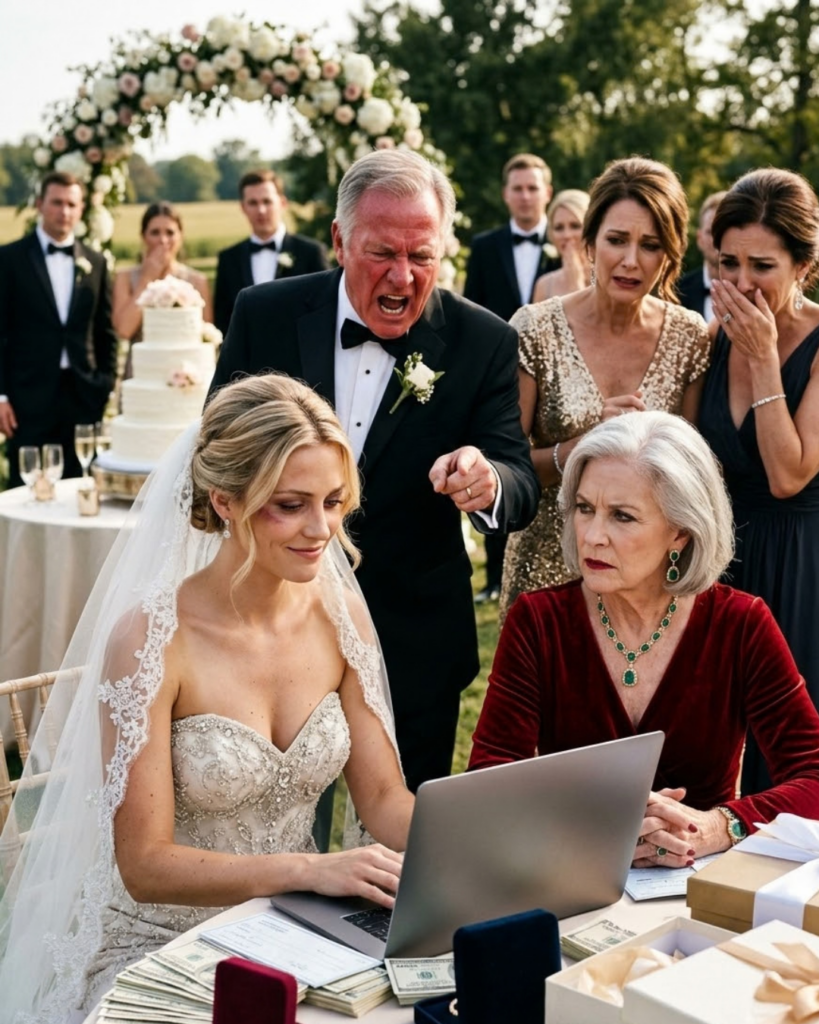
Chapter 4: The Ticking Clock
What I didn’t know—and what Ellis intentionally kept from me to preserve my sanity—was that he had launched a private mission of his own on a gloomy Saturday near the end of February.
Ellis is the kind of man who constructs seating charts on graph paper with near-architectural accuracy, and he had spotted an obvious absence. My grandmother’s name appeared nowhere. She wasn’t among the confirmed guests or the declined invitations. Within the wedding’s entire ecosystem, she simply didn’t exist.
When he carefully questioned me about it in January, I repeated my mother’s explanation. She can’t endure the car ride. Crowds induce panic. She wouldn’t recognize anyone. My mother’s exact, poisonous words replayed inside my mind: “You’d only be dragging her there to make yourself feel better, Esther.”
Ellis stared at the heavily edited seating chart for one long, weighted minute. Then he silently picked up his car keys and drove forty minutes to Hastings.
He discovered her sitting beside a window streaked with frost, her newspaper folded neatly and the crossword thoroughly conquered by her pen. They talked for an hour. She challenged his interpretation of a classic novel. She was lucid, funny, and razor-sharp, though dependent on her single functioning hearing aid.
Then she asked something that made Ellis stare down at the linoleum. “Is Esther furious with me, Ellis? I keep wishing someone would just tell me what unforgivable thing I did.”
Ellis drove home furious but told me absolutely nothing. Back in January, while exhausted and crying over flower expenses, I had forced him to promise me something. “Let me manage my family,” I had pleaded. “I’ve navigated their landmines my whole life. One more day won’t kill me.”
He had agreed. “Okay. Until it does.”
Rather than break that promise, Ellis quietly accessed his bank account and spent $180 arranging a private non-emergency medical transport van and an off-duty aide to accompany Grandma. He kept the entire plan secret until 9:40 PM on March 14th.
The lodge carried the scent of burning oak mixed with citrus floor polish. One hundred and eighteen chairs were occupied. Against the enormous northern window stood the gift table, topped by a beautiful sliding-lid card chest Ellis had handmade from leftover walnut. Whenever the lid shut, it produced a distinctive, weighty wooden thud.
Before the celebration began, our veteran wedding coordinator, Trish Donnelly, pulled me aside inside the bridal suite. She had one absolute rule: “Every item of monetary value leaves this building in my custody, or yours. Never with a relative. That is my personal law.”
At the time, I thought she was excessively suspicious. Six hours later, that rule saved me.
The first warning came during the receiving line. I turned around, and my mind simply stopped functioning. My grandmother was there, sitting in a transport chair beside a severe-looking woman wearing a navy cardigan.
I immediately looked toward my father. His face lost every trace of color, becoming a sick, chalky gray. For a split second, naked terror flashed through his eyes. Then his expression reset; he slapped one guest across the shoulder and exploded into exaggerated laughter.
Grandma Marin reached for my trembling hand and squeezed it. “You look like a vision, dear,” she whispered. “Your young man went to great lengths to bring me out here. It’s been ages since anyone went out of their way for me.”
While she spoke, my attention dropped toward the lapel of her emerald sweater. There sat the gold-leaf brooch. The exact brooch I had mailed two years earlier, the one I had assumed disappeared somewhere in the postal system.
Before I could ask anything, my mother appeared almost like a phantom and abruptly wheeled Grandma toward the tables, speaking in a high, unnaturally cheerful voice.
The second warning arrived shortly before the salad course. Trish approached and slipped a thick envelope into my hand. It had fallen from the gift table, and its flap had merely been tucked closed in the manner older relatives sometimes used. Inside was a $250 check from my Great Aunt Loretta.
The ‘Pay to the Order of’ line didn’t name Esther and Ellis. Written carefully in cursive was: Vaughn Stark.
But the memo line exposed the intention: For Esther and Ellis.
I stood motionless beside the dessert station, feeling as though the paper itself were burning my palm. Two names sat innocently inside the memo line while one different name possessed the actual financial authority. I found Aunt Loretta beside the coffee urns. My face remained deliberately cheerful, a smiling bride concealing the nausea building underneath.
“Oh, your dad insisted it was the most efficient route,” Loretta explained, blinking behind her spectacles. “Said he’d act as the treasurer and disburse it to you kids so you wouldn’t have to deal with the bank on your honeymoon. Was that incorrect?”
I told her everything was fine and returned to the gift table. I examined the envelopes. At least three more displayed the same distinctive elderly handwriting.
I caught my mother beside the towering wedding cake and casually asked about Dad having guests write checks to him.
She instantly erupted into an anxious stream of explanation. “Oh, you know your father, Esther! Always needing to be the hero, always managing logistics. It’s just his way of showing love. Please, do not turn this into a federal case tonight.”
Years of battling insurance adjusters had taught me one invaluable rule: when a straightforward yes-or-no question receives a four-sentence speech, whatever is hidden usually lives inside the unnecessary words.
Across the darkened room, Bridget sat at the family table, her face lit by the cold blue glow of her phone. She was reading something with a small, hungry smile stretching across her face. She looked like someone watching a long-awaited ship finally arrive. Our eyes met, and her smile widened.
I didn’t know it yet, but my father was about to make his final, fatal miscalculation.
Chapter 5: The Collision
The champagne speeches were finished. The wedding cake had become a crumbling wreck of frosting. The jazz band had shifted into a low, pulsing rhythm, and the flower girls were already asleep beneath linen-covered tables.
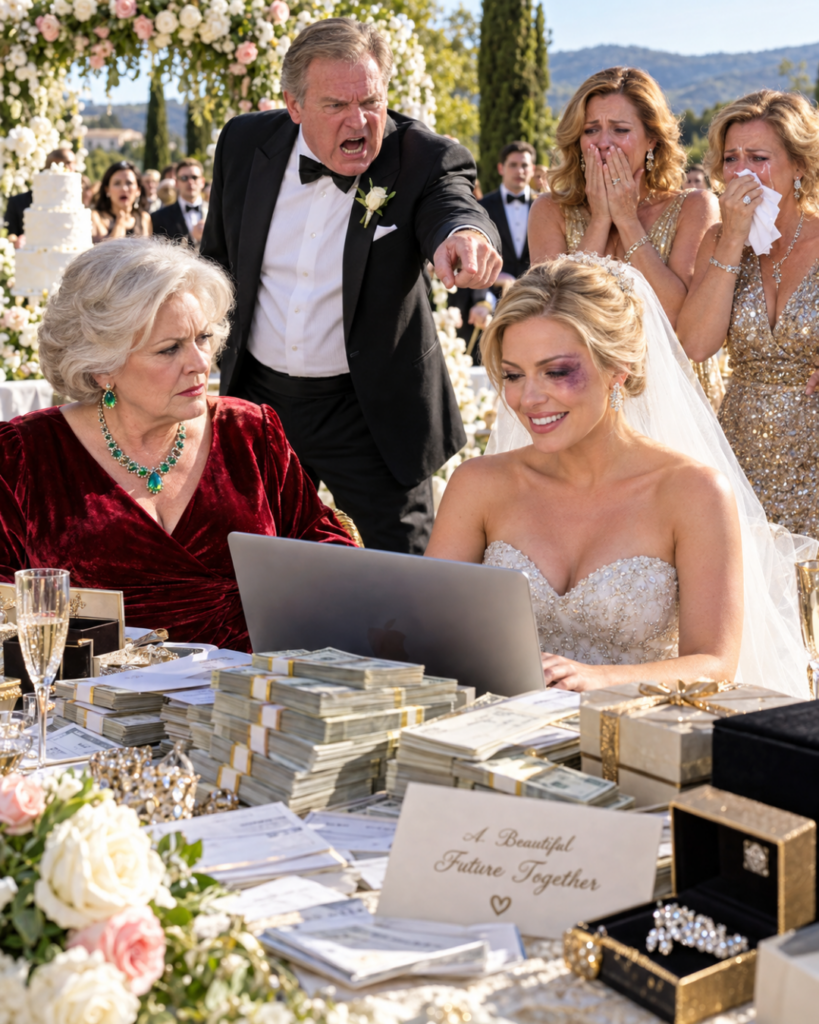
My father walked toward the gift table. He didn’t linger nearby; he took possession of it, placing his broad palm firmly across the walnut lid of Ellis’s handmade chest.
“Hand over the chest, sweetheart,” he said. His voice remained maddeningly casual, as though he were volunteering to carry out the garbage. “You’ve got a long drive to the hotel. I’ll run interference with the bank on Monday.”
That was what made his control so effective. He rarely issued direct commands; instead, he disguised them as ‘help.’ He had buried me beneath that exact form of suffocating assistance since childhood.
“No,” I replied.
The word felt strange leaving my mouth. Standing in the center of my own wedding reception, I suddenly realized I had never openly refused my father as an adult.
He laughed, dry and abrasive, glancing around as though inviting others to appreciate some private joke. He muttered something about branch managers and early banking hours. Then he insisted I was simply overwhelmed.
I moved closer and lowered my voice into a dangerous whisper. “Why exactly is Aunt Loretta’s check made out to your personal account, Dad?”
He didn’t hesitate. Instead, he intensified the confrontation.
“This is family capital, Esther,” he hissed, leaning close enough that I could smell expensive scotch on his breath. “It’s always been pooled resources.”
At the edge of my vision, a heavy silver fork struck a porcelain plate with a loud clang. The conversations nearest us began fading away. People were starting to watch.
My father pushed harder. “Bridget is drowning,” he muttered, his voice suddenly thick with ugly resentment. “You’re sitting here finalizing luxury honeymoon itineraries while your sister can’t scrape together a basic security deposit.”
Then he used a phrase that meant nothing to me in that instant but would unravel the entire conspiracy nineteen days later: “This has to be neutralized by the end of the month.”
“I said no,” I repeated, raising my voice.
That was when my mother joined him. She wasn’t there to calm anyone down. She had come to finish the job.
“Your sister is drowning; don’t be so selfish,” she said. Her voice remained quiet, delivered with the exact exhausting cadence someone might use to reprimand a wild animal. It was a vicious public correction.
Bridget passed behind us on her way toward the bar. She didn’t address anyone else. Instead, she leaned close to my ear and whispered, “Don’t make a scene and ruin this, Est.”
My father reached for the chest.
I jerked the walnut box away from him. The sudden force sent it sliding through my fingers and crashing against the table’s edge. Its sliding lid jumped open slightly, exposing the thick stack of cash-filled envelopes and checks within.
Then his hand flew.
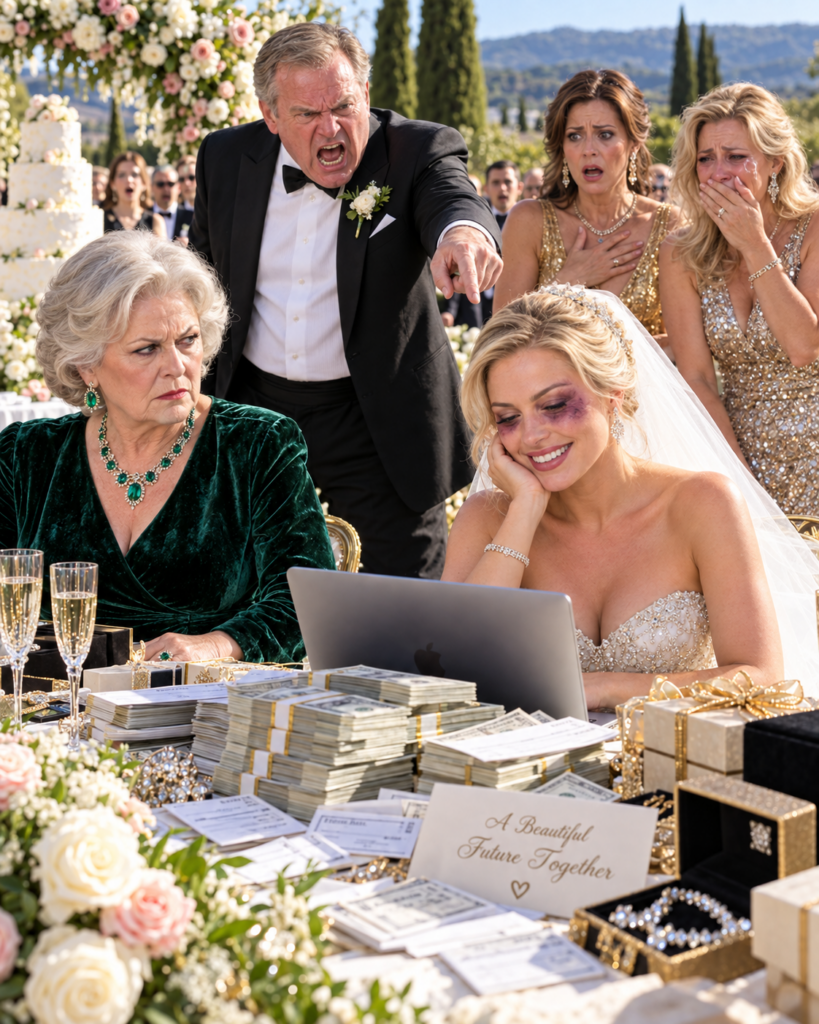
The slap exploded through the reception like a gunshot inside a cathedral.
All one hundred and eighteen conversations stopped at once. Nobody screamed. None of the dramatic chaos you might imagine followed. Instead, the room collapsed into a terrible vacuum of silence. I could hear the fireplace crackling. I could hear a high ringing in my left ear, a shrill sound that irritated me with completely irrational intensity.
Ellis placed his highball glass onto a cocktail table with frightening care. In one smooth movement, he crossed the space between us. He didn’t raise his fist. Both hands stayed inside his pockets as he positioned himself like an immovable wall between my father and me.
“You just made this remarkably simple,” Ellis stated, his voice a low, lethal rumble.
My father scoffed and expanded his chest. “Big words from a guy who grades sophomore essays.”
The entire room remained trapped in a grotesque tableau. For eleven agonizing seconds, everyone participated in the oldest ritual of dysfunctional families: nobody did anything at all.
Then a chair scraped against the floor near Table 12.
The sound came slowly, laboriously. My grandmother, Marin Stark, was rising. The aide, Ivy Kesler, quickly positioned an aluminum walker before her, locked its brakes with a crisp click, then moved backward, giving her dignity rather than unnecessary assistance.
Only about twenty-five feet separated Table 12 from the gift table. Marin required nearly two minutes to cross them. Nobody dared interrupt. The only rhythm inside the room came from the steady, patient thwack, thwack of rubber walker feet against hardwood.
My father abandoned his aggressive posture and stepped toward her with one arm extended.
Marin raised one thin, age-spotted hand.
Vaughn stopped instantly.
In that tiny moment, my father exposed the entire six-year deception. He wasn’t surprised that Grandma could stand. He wasn’t astonished she had managed the forty-minute journey. His panic existed for one reason: she was there, physically present as a witness to the kingdom he had constructed.
“Ma, you’re exhausted,” he announced loudly enough for the confused guests to hear. “Let’s get you out to the van. You’ve missed your medications.”
“She is not prescribed any sedatives, sir,” Ivy Kesler interjected, her tone as flat and unforgiving as a steel blade.
He reached forcefully toward his mother’s elbow.
Marin ripped her arm away with startling strength.
Then she faced the stunned room. “I did not travel here to sabotage my granddaughter’s celebration,” she announced, her voice thin but possessing a tensile strength. “I came because I just heard my son hurl three specific words at her—words he has weaponized against me for half a decade.”
Slowly, she turned toward her son.
“Family capital. That is your favorite phrase, isn’t it, Vaughn?” she demanded, her voice devoid of any tremor. “I liquidated my home. I survive on $2,240 a month from the government and $610 from a furniture plant. And I have not been permitted to view a single bank ledger since the spring of 2020. Tell me, Vaughn, what blood sacrifice is required for a woman to see her own godforsaken accounting?”
The trap was sprung. The predator was cornered, and the room was about to demand a reckoning.
Chapter 6: The Audit of Souls
Marin carried no organized binder of proof. All she had was an old leather clutch beneath one arm and the golden leaf attached to her sweater. Yet together they formed an arsenal of devastating truth.
At Table 6, Great Aunt Loretta stood abruptly, raising her reading glasses almost like a prosecutor holding a gavel.
“Vaughn!” Loretta barked. “You phoned me three weeks ago and explicitly instructed me to leave the payee blank, or ink your name in. You claimed it was to grease the wheels!” She swept her gaze across the room. “To grease the wheels for whom?”
A woman two chairs away nervously confirmed the same thing. Then a man beside the bar admitted receiving identical instructions. Eleven envelopes. Two thousand, nine hundred dollars in hijacked affection.
Trish Donnelly emerged from the edge of the room and positioned herself directly beside the walnut chest. Folding her arms, she became a living barricade.
With sudden, freezing clarity, I realized the situation was escaping my control. The night was becoming a chaotic public trial centered around eleven stolen checks. It was turning into a spectacle, but none of it answered the question that had been tearing at me since I noticed Grandma’s brooch.
I refused the instinct to disappear.
I stepped forward, grabbed the heavy walnut chest, carried it straight to Trish, and pushed it against her chest.
“No one opens this vault tonight,” I declared, my voice echoing off the timbered ceiling. “Not him. Not me. That was your mandate, Trish. Execute it.”
Trish slammed the wooden lid shut with one decisive, echoing crack.
Then I turned away from my parents.
I approached Grandma carefully and bent slightly until our eyes were level. “Grandma,” I asked softly, “when was the exact last time I provided you with financial support?”
The room seemed confused by the question. Everyone had just witnessed an assault over money, and suddenly I was asking about years-old financial support. But three people standing within arm’s reach understood exactly why the question mattered.
Marin tilted her head. Her confusion was genuine, without even a trace of defensiveness. “From you, Essie?” She pondered it with genuine effort. “I don’t believe you ever have, sweetheart.”
I didn’t shout. I didn’t cry for effect. I simply reached into the hidden pocket of my wedding gown, removed my phone, and opened my banking app.
Then I scrolled.
An endless, brutal chain of identical transfers appeared. For Grandma. For Grandma. For Grandma.
I turned the glowing screen toward my mother and held it inches from her drained face.
“Two hundred dollars,” I stated, my voice a deadened flatline. “Every thirty days. Sixty consecutive times. Read the sum aloud, Mom.”
She said nothing. Her eyes desperately shifted toward Bridget.
Marin had been watching my devastated expression instead of the phone. Slowly, she lifted two trembling fingers toward the leaf brooch pinned to her sweater.
“Bridget gifted me this,” Marin whispered, her voice cracking. The room was a graveyard. “Bridget smuggled in the heavy blanket. Bridget delivered the hearing aids in the little velvet box.” Marin paused, the gears of betrayal grinding to a halt in her mind. She looked at her youngest granddaughter. “Bridget… did you purchase a single one of those items?”
My sister stared silently into the white tablecloth.
She didn’t deny it.
My mother was the one who finally broke, releasing years of poisonous justification in one frantic rush. “She possessed nothing, Esther!” she spat, her words tumbling out in a frantic rush. “You had secured the degree, the lucrative career, the stability! You held all the cards! I just… I just needed her to be someone’s favorite, for once in her miserable life.”
And there it was.
The blueprint beneath the entire machine.
I remembered the sterile common room. My isolated grandmother praising the granddaughter she believed had lovingly cared for her, while I—the person actually sending the support—had been presented as a distant, indifferent ghost. For six years, my father had quietly siphoned away my money while my mother stole my identity and used it to purchase affection for her preferred daughter.
Marin turned toward her son with a stare that seemed capable of stripping flesh from bone. “Where did my capital go, Vaughn?”
My father, accustomed to commanding warehouses and controlling every room he entered, committed the worst tactical mistake available to him.
He tried explaining theft with numbers.
He threw figures at the silent guests. He cited Bellweather Grove’s outrageous costs, weak Social Security payments, co-pays, podiatry expenses. Standing directly in front of a professional care worker, he lied about the arithmetic.
Ivy Kesler’s expression tightened with deep professional disgust at the inflated amounts.
“Do you possess any concept of what that facility bleeds from a wallet?” he roared, pacing the floor. “Six years! Six years I have carried that crippled woman on my back!”
Marin visibly flinched at the word. She seemed to taste it before answering. “Carried. That is the verdict. And what is my designation in your ledger, Vaughn? What line item do I occupy?”
“You’re an expense, Ma!” he screamed, throwing his arms wide in a theatrical display of martyrdom. “That’s the brutal reality of it! You want it draped in poetry? You are a massive, depreciating expense!”
Then he spun toward me and drove the final nail into his own coffin. “I funded your existence for eighteen years, Esther! Eighteen! And you have the unmitigated gall to stand here and audit me over a handful of wedding envelopes?”
He had openly admitted that he viewed his own daughter as a financial investment whose returns were now violently overdue.
Then people began leaving.
Ellis’s mother, Colleen, rose without saying a word and placed her linen napkin on her plate. Loretta Fisk collected her coat. Deb Hollis, a distant cousin, walked over, squeezed my forearm, and whispered, “My check was meant for you. Remember that.”
Within twenty minutes, one quarter of our guests had disappeared into the freezing Michigan night. Not one person leaving bothered to say goodbye to my parents.
It was a silent, devastating excommunication.
Before the room emptied further, I issued my final decree. “I am keeping the box,” I told my father, cutting off his sputtered protests. “On Monday, I assume control of Bellweather Grove’s communications. You will never funnel a dime, a gift, or a greeting card through me again. You may remain at this reception. But you have lost everything.”
I lowered myself into a chair and emptied a water goblet.
My grandmother placed her thin, aged hand over mine. “I wish to leave now, Essie,” she murmured. “And I want you to be the one driving.”
The night was far from over. Because the real horror was waiting in a cardboard shoe box in Hastings.
Chapter 7: The Final Ledger
Still wearing my wedding gown, I drove my husband’s sedan along the salt-streaked highway, the enormous skirts crushed between the center console and the door. Marin sat beside me while Ivy quietly occupied the back seat. Ellis followed behind us in my car.
Outside, darkness swallowed everything, leaving only frozen mud and remnants of snow. Ten minutes into the drive, Marin began questioning me. She demanded an account of the previous half-decade.
Within ninety seconds, the extent of the manipulation became nauseatingly clear. She knew nothing about my promotion to practice manager. She had never heard that I earned my degree. She didn’t know I had spent two years engaged. Everything she understood about my life had been compressed into one poisonous sentence repeatedly supplied by my parents: Esther is just too busy.
I talked until my throat hurt.
When we eventually wheeled her into her cramped room, she pointed a trembling finger at the lowest drawer of her composite dresser. “There is a shoe box in there, Essie. It holds every scrap of paper they ever permitted me to touch.”
Ellis and I finally returned to my apartment at 2:00 AM. We collapsed onto the cold kitchen linoleum with our backs against the cabinets. In front of us lay the real estate listing for the house six minutes from my parents.
Ellis said nothing.
He picked up the listing, crushed it tightly in his fist, and dropped it into the trash beneath the sink.
By the following Thursday, the shoe box had exposed its poison.
Marin personally called Bellweather Grove’s business office, using her sharpest voice to insist that I be added to her authorized contacts. Once the digital authorization went through, I attacked the box. Beneath yellowed Medicare statements and old birthday cards, I found what we needed.
A spotless white envelope.
Still sealed.
Addressed to Vaughn Stark, care of Marin’s room number. Someone had carelessly pushed it into her mail slot, and she had never opened it because her own name wasn’t on the envelope.
Inside was a formal 30-Day Notice of Discharge for Non-Payment.
It was dated Friday, March 6th.
Exactly eight days before my father tried taking my wedding checks.
My finger traced the postmark, and suddenly every strange event from March locked into place. The repeated questions about checks. The white envelope on his truck dashboard. His frantic determination to seize the gift chest.
I contacted Wendy Proser in billing. “Three months of arrears,” Wendy confirmed, her voice laced with the weary sympathy of someone who witnesses elder financial abuse daily. “January, February, March. The discharge date is April 5th.”
My grandmother had exactly seventeen days before they threw her into the street.
So I did what I had always done best.
I created a ledger.
$171,000 from the sale of her house. Monthly facility expenses of $3,650 against $2,850 in income. The genuine shortfall was $800 every month. Across seventy months, that totaled $56,000.
Her account should still have contained a healthy $115,000.
Instead, the March statement showed only $2,300.
One hundred and twelve thousand, seven hundred dollars cannot simply disappear through inflation or bookkeeping mistakes. I stared into that financial void until the scattered pieces assembled themselves into an obscene portrait of theft.
$14,600 in 2023: Bridget’s shiny, “gently used” SUV that she proudly drove into the family driveway.
$19,300 in 2023: my parents’ expensive kitchen renovation. The quartz island where I had eaten Thanksgiving turkey while complimenting their new backsplash.
$16,800 spread across three years: private preschool tuition for my niece.
$30,400 withdrawn through consistent $950 increments: a hidden subsidy covering my sister’s rent.
They had consumed Grandma’s future to pay for their present.
I called the eleven wedding guests whose checks had been compromised. I never asked them to replace the money. “Void it,” I instructed them. “If you wish to honor the gift, write it directly to Bellweather Grove. Put Marin’s name in the memo.”
Nine agreed immediately.
The consequences finally pulled Bridget out of hiding. She demanded that I meet her at a greasy diner and brought my young niece, Nell, along as a human shield.
Bridget wasn’t apologetic. She was furious. “I drove down there twice a month for six years!” she hissed, clutching her coffee cup like a weapon. “I trimmed her nails! I changed her watch batteries! Where were you, Esther?”
“Who specifically informed you that I was banned from visiting?” I countered.
Her mouth opened.
Then closed again.
Her visits were real. The work she had done was real. But the story built around those facts had been manufactured.
I showed her the discharge notice. I explained that $7,300 of my wedding money had already been earmarked to cover our father’s embezzlement a full week before Bridget even learned about his scheme. Then I explained that the mysterious $950 rent assistance that vanished in January—the missing money that left her drowning—had actually been stolen from our grandmother.
Bridget went motionless as her understanding of her own life shattered into pieces. The walls of our mother’s carefully constructed lie collapsed around her.
As I walked away, little Nell hurried after me, breathless. “Are you still my Aunt Essie? Mom said maybe not anymore.”
“That isn’t up to your mother,” I said fiercely. “It’s just a fact.”
I had dismantled the siblings’ war. But the architect of the grand deception had one final, desperate play.
Chapter 8: The Ledger Balances
I found another facility: Alder Court. It was smaller, with only twenty-two residents, and stood just twelve minutes from the new house Ellis and I were pursuing.
Admission required a demanding nursing evaluation. Marin performed so well that the admitting nurse openly questioned whether assisted living was even necessary. Financially, everything was straightforward: her monthly income covered all but $350 of the fee. Sitting inside the director’s office, I looked directly at Grandma and promised that I would pay the remaining amount. Every month.
Marin immediately used a pen and the necessary paperwork to legally remove my father as her Representative Payee.
The financial connection was severed.
When moving day arrived in early April, Vaughn Stark appeared in the Bellweather parking lot driving a borrowed box truck. He hadn’t come to yell. Instead, he resorted to the classic Stark strategy.
He offered labor in exchange for forgiveness.
Make yourself essential. Essential morphs into debt. Debt solidifies into control.
I let him work.
He carried heavy furniture and maneuvered through narrow corners, talking endlessly about the truck’s transmission as he desperately tried to fill the silence. He never apologized to the woman he had called an ‘expense.’ When the director requested emergency contacts, I provided my name and Ellis’s.
Vaughn disappeared from the paperwork.
The $11,400 owed to Bellweather didn’t transfer with Marin to Alder Court. It remained attached to the account my father had legally mismanaged for six years.
His most significant punishment wasn’t legal. It was social starvation.
Aunt Loretta stopped speaking to him. Cousins stopped attending annual memorial gatherings. My sixty-one-year-old mother took a demanding part-time scheduling job simply to keep their utilities running, while Bridget began working double shifts at a supermarket.
Then came one final attack.
Late April. Thursday afternoon.
My mother’s sedan sat ominously outside my apartment. She carried a large taped moving box into my kitchen and began systematically excavating my childhood.
Fourth-grade report cards. An awkward clay pot from Girl Scouts. A yellow cotton dress she had sewn by hand when I was nine.
She wielded nostalgia with sniper-like accuracy.
Then she cried.
The tears were real and agonizing. She admitted how the blanket deception had begun. She cried about the loneliness of the pandemic, standing outside in freezing parking lots and waving through glass windows without receiving recognition. She cried about wanting Bridget, damaged by a difficult divorce, to feel important.
For thirty minutes, she wept.
She never once said Marin’s name.
“I’m sorry for what I did to you, Esther,” she sobbed.
“To me,” I repeated, allowing the staggering narcissism of those words to remain between us.
Then came the turn.
The true reason she had entered my kitchen.
“There is an $11,400 debt sitting at Bellweather, Esther,” she whispered, her eyes pleading. “It bears her name. Not your father’s. They will send her to collections. At eighty-four years old. You can despise me, but you must fix this. For her.”
It was manipulation executed perfectly.
She knew I fixed things.
She knew how fiercely I loved Marin.
I walked toward the sink, filled a glass with cold water, drank it, and remained standing.
Thirty-one years of conditioning fought its way toward my throat.
It’s only money. You can solve this. Be the bigger person.
I placed the glass down.
“I already send the money, Mom.”
She froze.
“Three hundred and fifty dollars a month, wired to Alder Court. My name is on the ledger. She receives the paper statement, and she reads it.” I stared down at her, feeling a terrifying, exhilarating weightlessness. “I have been doing exactly what you demanded this entire time. The only difference is, now she knows my name.”
The silence afterward felt even heavier than the silence at my wedding.
I took a neon sticky note and wrote Wendy Proser’s direct extension along with two words: Hardship Plan.
Then I pressed it onto the box containing my childhood memories. “They will arrange a payment plan in twenty minutes,” I informed her coldly. “But someone from your household has to make the call. It will never be me.”
She collected her purse and hurried away, abandoning the remains of my childhood on the kitchen table.
At the doorway, she stopped and proved just how pointless the conversation had been. “What am I supposed to tell your father?”
I allowed the heavy door to close as my only answer.
We finalized the purchase of our house in late May. It has a cracked driveway, an enormous maple tree, and sits exactly twelve minutes from Alder Court.
My dental clinic doesn’t open on Thursday mornings. Every week at exactly 9:00 AM, I pick up Marin. We drive to a run-down diner with cracked vinyl booths, where she aggressively orders the exact same breakfast each time.
We don’t talk about Vaughn or the mother who enabled him.
That toxic capital is bankrupt.
Instead, we argue over the crossword. We criticize Ellis’s students.
In mid-May, Grandma pushed a wrinkled envelope across the sticky diner table toward me. Alder Court gives her a small monthly allowance of $60 for miscellaneous expenses. Inside were eighteen crumpled dollar bills she had carefully saved while still insisting on purchasing her own black coffee every Thursday.
“Take the eighteen dollars, Essie,” she commanded, her jaw set. “I have spent six years being someone’s burden. Do not deny me this.”
I accepted the envelope.
I never completed the formal wedding thank-you cards. After everything that happened that night, the task felt contaminated. But two weeks ago, I carried the stationery box into the diner.
Marin immediately grabbed a pen.
Her handwriting has become jagged and chaotic, and she feels absolutely no embarrassment about it. At eighty-four, trembling handwriting across a wedding envelope is its own declaration of survival.
I wrote the messages inside. She aggressively addressed the envelopes.
We finished eleven before our coffee became lukewarm.
“Who is next?” she demanded, pen hovering like a lance.
“Aunt Loretta,” I smiled.
The envelope containing those eighteen dollars isn’t stored inside a safe. It leans against the sugar caddy on my kitchen table, functioning as my daily ledger.
For three decades, I believed envelopes were containers for obligation and extortion.
Now that envelope represents Thursday mornings and the presence of a woman who spent six years believing I had abandoned her.
My family tried to teach me that love wasn’t something I needed—that usefulness should be enough. I’m still unraveling where they learned such a poisonous lesson.
But sitting in my new kitchen, twelve minutes away from the only blood relative who truly knows me, I finally understand that my ledger is beautifully, completely balanced.
