

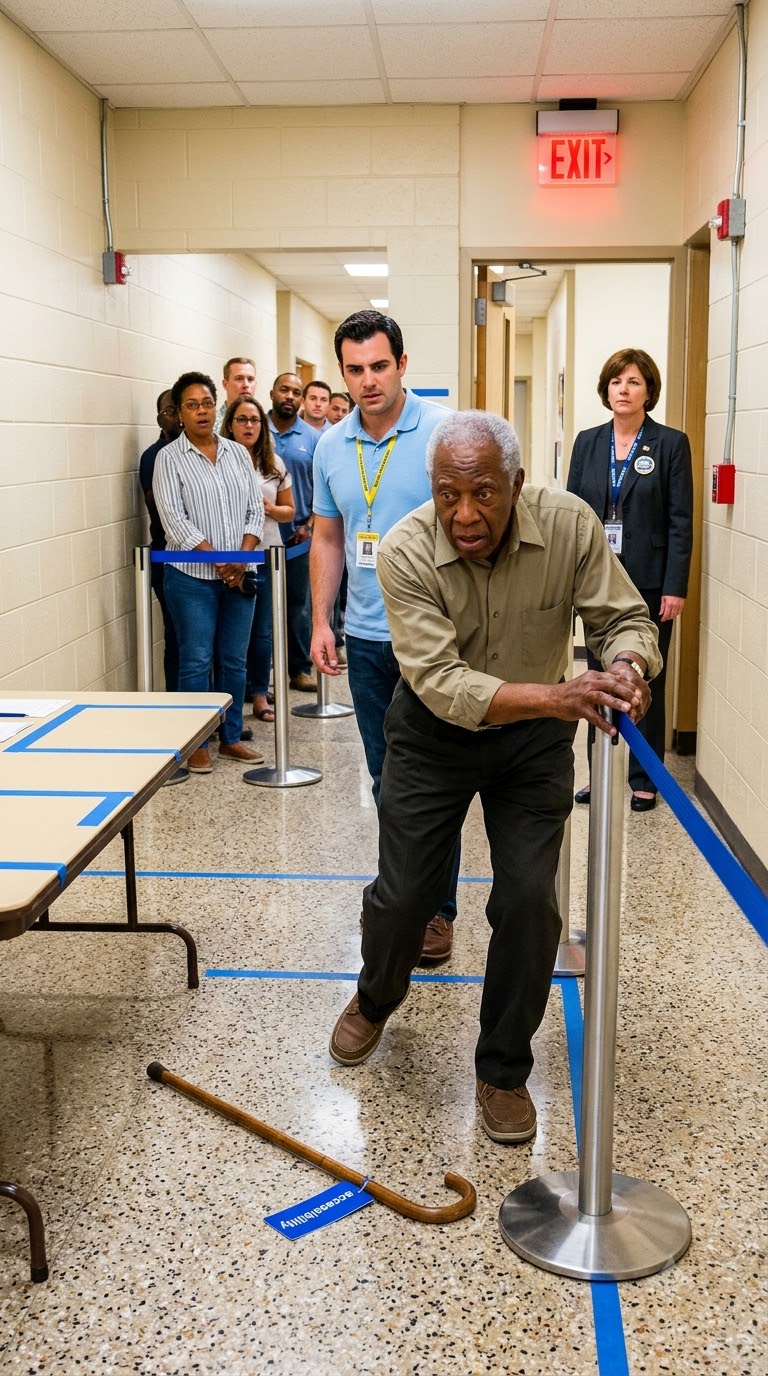
The county supervisor did not blink.
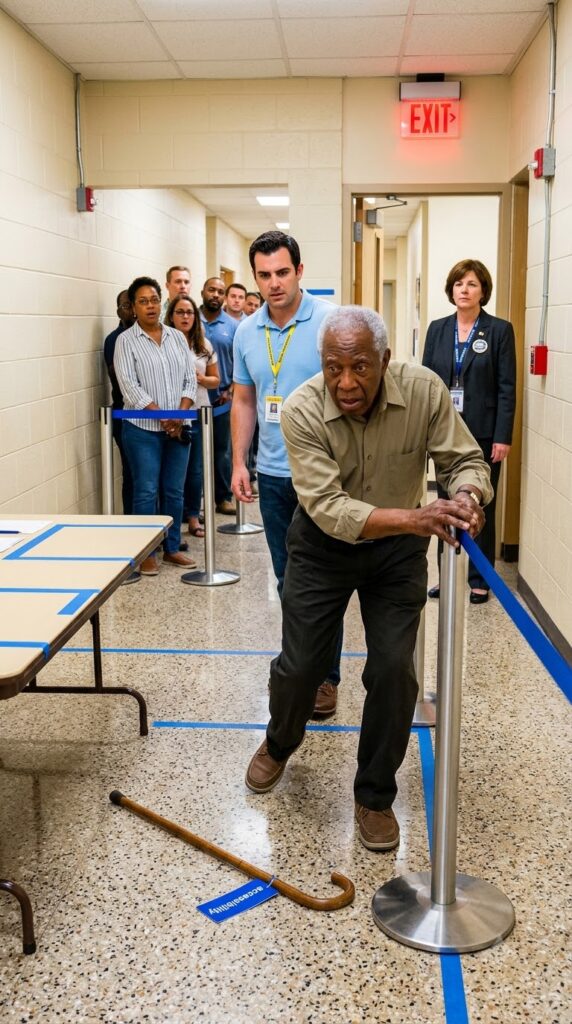
He stepped past the folding check-in table, his dress shoes squeaking slightly on the polished gymnasium linoleum. The entire room held its breath. When he reached the center of the walkway, he bent down, his knees popping audibly in the quiet space, and picked up my cane by its scuffed wooden handle.
He didn’t look at Greg. He didn’t look at the security guard who was still jogging toward us.
Instead, the supervisor lifted the cane and brought the bright yellow tag right up to his eye level. He stared at the heavy red ink of the precinct stamp. He stared at my signature right beneath it. He held it there for five long seconds, letting the reality of the situation settle over the room like a heavy blanket.
Then, he turned and extended the cane toward me.
“Are you injured, Mr. Coordinator?” the supervisor asked. His voice wasn’t loud, but in the dead silence of the gymnasium, it carried effortlessly to the back walls.
The title hung in the stale, gym-class air.
I reached out with a slightly trembling hand, took my cane, and leaned my weight onto it. A sharp ache flared in my left knee where I had twisted it to keep from falling, but I refused to wince. Not here. Not in front of them.
“I will be fine, Mr. Davis,” I said, keeping my tone perfectly level.
Behind the table, Greg physically flinched. The smug, victorious smirk he had been wearing just seconds ago shattered. His eyes darted between the supervisor and me, his brain desperately trying to process the words he had just heard.
“Mr.… what?” Greg muttered.
The security guard finally reached us. He was a young guy, maybe in his twenties, his hand resting on his radio. He took one look at the county election supervisor, then looked at the heavy red stamp on my yellow tag, and immediately took his hand off his heavy black belt. He stepped backward, crossing his arms and planting himself in a neutral stance. He instantly knew the power dynamic in the room had shifted, and he wanted no part of Greg’s sinking ship.
Greg swallowed hard, his Adam’s apple bobbing above his tight collar. He realized he was losing control of the room. He puffed out his chest, trying to project the fake authority he had been wielding all morning.
“Sir,” Greg said to the supervisor, forcing a laugh that sounded like dry leaves scraping across pavement. “This man was causing a disturbance. He became aggressive when I asked for his ID. He tried to skip the general line with fake medical equipment to get special treatment. I was just following your protocols to secure the voting area and protect the integrity of the line.”
I didn’t argue. I didn’t raise my voice. I didn’t need to. I just gripped the handle of my cane and watched Greg dig his own grave deeper.
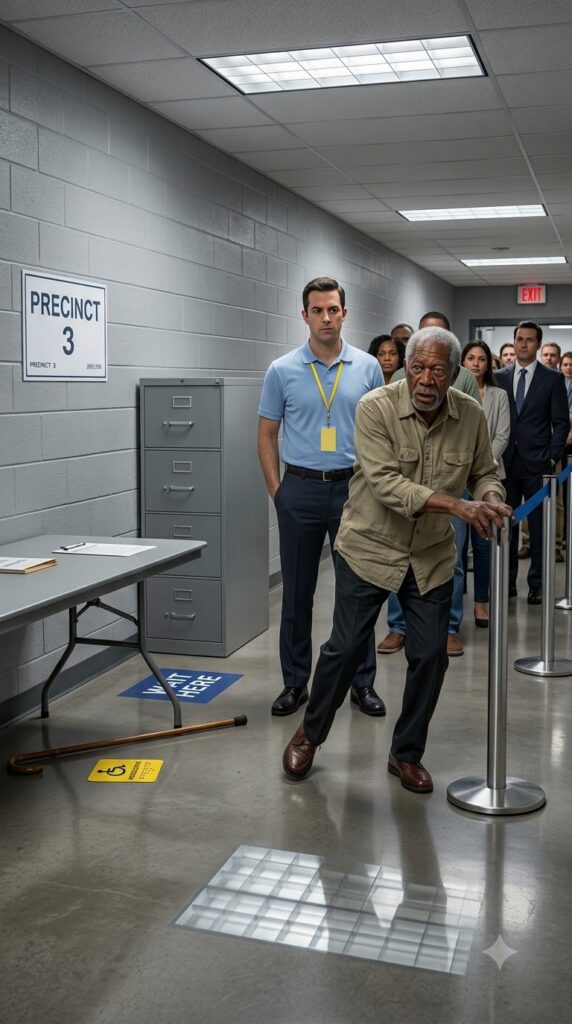
The supervisor slowly turned his head to look at Greg. His expression was completely blank, which made it far more terrifying than if he had been yelling.
“Fake medical equipment,” the supervisor repeated, his voice dangerously flat.
“Yes, sir,” Greg said, nodding quickly, sweat beginning to bead on his forehead. “People print those tags off the internet all the time. I was just doing my job.”
“You are telling me,” the supervisor said, taking one slow step toward the table, “that the lead accessibility auditor for this entire district—the man who personally wrote the ADA accommodation protocols you were supposed to be trained on last Tuesday—is using fake equipment?”
The remaining color drained completely from Greg’s face. He looked like he was going to be sick.
“He’s… he’s the auditor?” Greg stammered.
“He is the man who spent the last three months organizing the community transport vans for every disabled voter in this precinct,” the supervisor said, his voice dropping an octave. “And you just shoved him. In front of a room full of witnesses.”
Panic set in. Greg’s eyes widened, and he immediately scrambled for a lifeline. If he couldn’t blame me, he had to blame the technology.
“It was the machine!” Greg blurted out, grabbing the electronic check-in tablet from the table and holding it up like a shield. “The system! The tablet flagged him as ineligible for the priority lane. It didn’t show his accommodation on the screen. I was just following the prompt, I swear. If he’s the auditor, his file must be glitched.”
It was a desperate, sloppy lie. The system didn’t flag voters; it simply displayed their registration status. But Greg was banking on the fact that most people in the room didn’t understand how the election software worked.
Before the supervisor could dismantle that lie, a voice rang out from the general admission line.
“That is a lie!”
Everyone turned. A middle-aged Black woman wearing faded blue nursing scrubs stepped out of the winding general line. She was pointing a rigid finger directly at Greg.
“He did the exact same thing to my mother an hour ago!” the woman shouted, her voice shaking with rage. “My mother is eighty-one years old and uses a walker. He pushed her right out of the blue line and told her she was faking her arthritis to skip ahead. He made her stand against the wall until her legs gave out and I had to take her back to wait in the hot car!”
A collective murmur erupted through the gymnasium.
I looked over at the far wall. Through the gaps in the crowd, I saw them. Three other older Black men and women, leaning heavily against the painted cinderblock walls, clutching their coats, looking exhausted and humiliated. They had been standing there for nearly two hours.
They weren’t random voters. I recognized two of them from my transport logs. I had arranged for the community van to pick them up this morning.
Greg hadn’t just made a mistake with me. He had been quietly, systematically filtering accommodated minority voters out of the priority lane all morning, forcing them to stand in the longest, slowest line, hoping they would just give up and go home. He was speeding up the priority lane for his preferred demographic by purging the people he deemed unworthy.
The murmurs in the gym turned into angry voices.
“He told me my oxygen tank wasn’t a valid excuse!” an older man in a veteran’s cap called out from the back.
“He threatened to call the police on us if we didn’t move!” another woman yelled.
The general line realized what had been happening right in front of them. The exhausted elders leaning against the walls started nodding, their shoulders squaring as the room finally validated their pain.
Greg looked at the angry crowd, his chest heaving. He looked at the security guard, who took another deliberate step backward, making it clear he was not going to protect him.
“The system made an error,” Greg stammered, pulling the tablet tight against his chest. His voice was shrill now. “It’s a glitch. The software has been glitching all morning. That’s why the lines are messed up.”
“Is that right?” the supervisor said. He stepped right up to the folding table, towering over Greg. “Show me.”
“I’ll… I’ll reboot it. Give me a second to restart the app—”
“Do not reboot that device,” the supervisor commanded, pointing a finger at the screen. “Hand it to me. Right now. I want to see the history log of every single voter you’ve processed and every manual override you’ve keyed in since the polls opened at 7:00 AM.”
Greg froze.
His hands started visibly shaking. He knew exactly what those logs would show. The tablet recorded everything. Every time a voter’s profile was pulled up, every time a valid accommodation was manually rejected by the worker, it left a permanent digital footprint. It would show exactly who he denied, what time he denied them, and that he had used his own employee passcode to override the system’s approved status.
I glanced up. Mounted directly above the check-in desk, attached to the steel rafters of the gymnasium, was a black dome security camera. Its little red light was glowing steadily. It had a perfect, unobstructed view of the desk, the tablet, the priority lane, and the exact spot where Greg had shoved me.
He was trapped, and he knew it.
“I need the tablet, Greg,” the supervisor said, holding his hand out, palm flat and demanding.
But Greg didn’t hand it over.
Instead, his eyes darted wildly around the room. He took a clumsy step backward, bumping into his folding chair. He gripped the tablet tightly in both hands, his knuckles turning white, his thumb pressing frantically against the glass screen, desperately trying to find the system delete button before the supervisor could take it away.
“Give me the tablet, Greg,” the supervisor said, his voice flat and dangerous.
But the worker kept mashing his thumb against the glass, his breath coming in shallow, panicked gasps as he tried to wipe the morning’s digital record.
Tap. Tap. Tap.
The sound of his heavy thumb hitting the screen echoed over the silent gym. He was sweating completely through his light blue collared shirt. He was looking for the master reset sequence, the one they taught in orientation for when a machine completely froze. If he could trigger a factory reset, the local cache would wipe, and he could claim the system crashed.
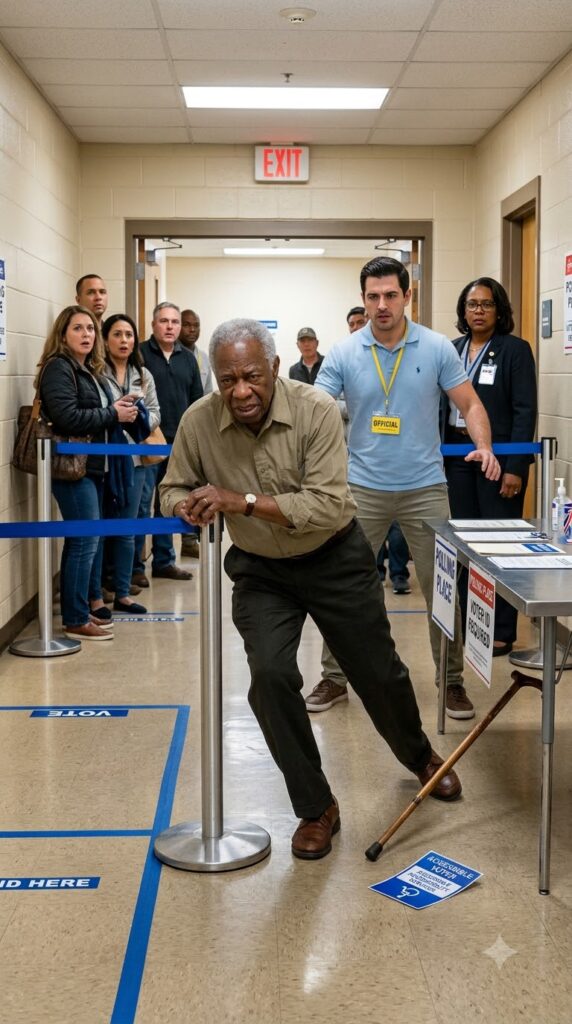
He almost had it. His finger hovered over the final red confirmation button.
But before he could press it, a bright blue banner flashed across the top of his screen.
ADMIN OVERRIDE INITIATED. DEVICE LOCKED.
Greg froze, staring at the screen in horror.
Mr. Davis, the county election supervisor, stood on the other side of the folding table, holding his own master administrative smartphone in his left hand. With one tap, he had frozen every check-in tablet in the precinct.
Without another word, Mr. Davis reached across the table and yanked the tablet out of Greg’s hands.
“You can’t do that!” Greg shouted, his voice cracking like a terrified teenager’s. “I’m the precinct captain for this lane! I have authority over this station!”
“You have nothing,” Mr. Davis said softly, his eyes scanning the frozen screen.
Greg looked around wildly, realizing his technological escape hatch was gone. So, he pivoted. He puffed out his chest, trying to appeal to the crowd, trying to frame his systemic racism as heroic vigilance.
“I was securing the vote!” Greg yelled, gesturing toward the general admission line. “Do you know how much fraud happens with these mail-in requests and ADA exceptions? People print those yellow tags at home! They fake limps! They borrow their grandmother’s walker to skip the line! I was just asking for secondary verification. I am protecting the integrity of this election!”
He pointed a shaking finger directly at me. “He wouldn’t show me his medical ID! I was following protocol!”
I had heard enough.
I stopped leaning heavily on my cane. I stopped acting like the helpless old man he thought I was.
I reached into my left jacket pocket and pulled out my smartphone. I didn’t open a medical app. I didn’t open my voter registration.
I opened the master county transportation and ADA compliance spreadsheet—a secure document I had spent the last three months building from the ground up.
I held the phone up, the screen glowing brightly in the gym’s fluorescent light.
“This isn’t just about me, Greg,” I said, my voice carrying steady and clear. “I didn’t just come here to cast a ballot. I came here to audit this specific location because the county office received three anonymous complaints within the first two hours of the polls opening.”
Greg swallowed hard, his eyes dropping to my phone.
“Last election cycle,” I continued, turning to address the silent crowd watching us, “the wait times for minority voters in this specific precinct were over four hours. We had elderly people collapsing in the heat. We had people leaving without voting because their knees couldn’t take the concrete floor. So this year, the county approved a priority lane and a free shuttle service for anyone with a registered physical limitation.”
I looked back at Greg.
“And you decided to play god with that list.”
“I didn’t—I don’t know what you’re talking about,” Greg stammered, stepping back until the back of his knees hit his folding chair.
“Let’s find out,” I said.
I turned away from the desk and began walking slowly down the length of the general admission line. The people who had been waiting for an hour parted slightly to let me pass.
I stopped about thirty feet down the line, right next to the cinderblock wall where the exhausted older Black folks were leaning. They were sweating. Their feet ached. But they hadn’t left. They had stayed because their vote meant too much to abandon, no matter how much humiliation this man put them through.
I looked down at the digital manifest on my phone screen.
“Martha Higgins,” I called out loudly.
A frail, eighty-one-year-old Black woman holding onto a standard aluminum walker with tennis balls on the feet slowly raised her trembling hand.
“Present,” she said, her voice thin but full of dignity.
I looked back toward the desk. “Mr. Davis, does the system show Martha Higgins arriving at 8:15 AM?”
The supervisor scrolled down on the locked tablet.
“It does,” Mr. Davis said, his voice echoing in the quiet gym. “Registration pulled up at 8:15 AM. System showed her as pre-approved for the priority ADA lane.”
“And what happened next?” I asked.
“Manual override,” Mr. Davis read, his jaw tightening. “Override authorized by User ID 4409. Status changed to ‘General Admission.’ Tag marked as: Insufficient Documentation.”
“That’s your ID, Greg,” I said.
Greg said nothing. He looked like he was suffocating.
I looked back at my phone. “Elias Vance.”
The older Black man in the faded military veteran’s cap raised his hand. The clear plastic tubing of his portable oxygen tank ran over his ears, connected to a heavy green cylinder in a rolling canvas bag. He was leaning against the wall, his chest heaving slightly with the effort of just standing there.
“Present, sir,” Elias said, giving me a weak but sharp nod.
“Mr. Davis?” I called out.
“Vance, Elias,” the supervisor read, his voice growing noticeably colder. “Registration pulled at 8:42 AM. Pre-approved for priority lane. Manually overridden at 8:43 AM by User ID 4409. Tag marked as: Improper Equipment.”
A low, angry rumble started to vibrate through the gymnasium.
The white voters in the general line, the ones Greg had been eagerly pushing through all morning, were finally realizing exactly how their line had moved so fast. They weren’t just looking at Greg with annoyance anymore. They were looking at him with disgust.
“Sarah Washington.”
A woman in her late sixties with a thick knee brace raised her hand.
“Manual override,” Mr. Davis confirmed before I even had to ask. “9:11 AM. Same user ID.”
“Marcus and Helen Cole.”
A husband and wife, both leaning on canes, raised their hands.
“Manual override. 9:35 AM,” the supervisor announced.
I didn’t need to read any more names. The master transport log on my phone perfectly mirrored the timestamps of Greg’s manual system overrides. Every single older Black voter who had stepped off the county shuttle van with their yellow tags had been systematically intercepted by Greg, rejected, and pushed into the two-hour general line.
He hadn’t made a mistake.
He hadn’t misunderstood the protocol.
He had spent his morning actively and intentionally committing federal election interference.
“This is a setup!” Greg suddenly screamed, his voice breaking in sheer panic. He pointed a shaking finger at Mr. Davis, then at me. “You’re trying to ruin my life! I’m a volunteer! I don’t get paid for this! You can’t do this to me over a clerical error!”
“A clerical error?” the woman in the nursing scrubs shouted from the line, stepping forward to support her eighty-one-year-old mother. “You pushed an old man! You kicked his cane! We all saw you do it!”
“He assaulted me!” Greg lied, his eyes wide and wild, realizing the entire room had turned against him. “He was swinging that stick around! I was defending myself!”
“Mr. Davis,” I said calmly, pointing the rubber tip of my cane straight up toward the steel rafters.
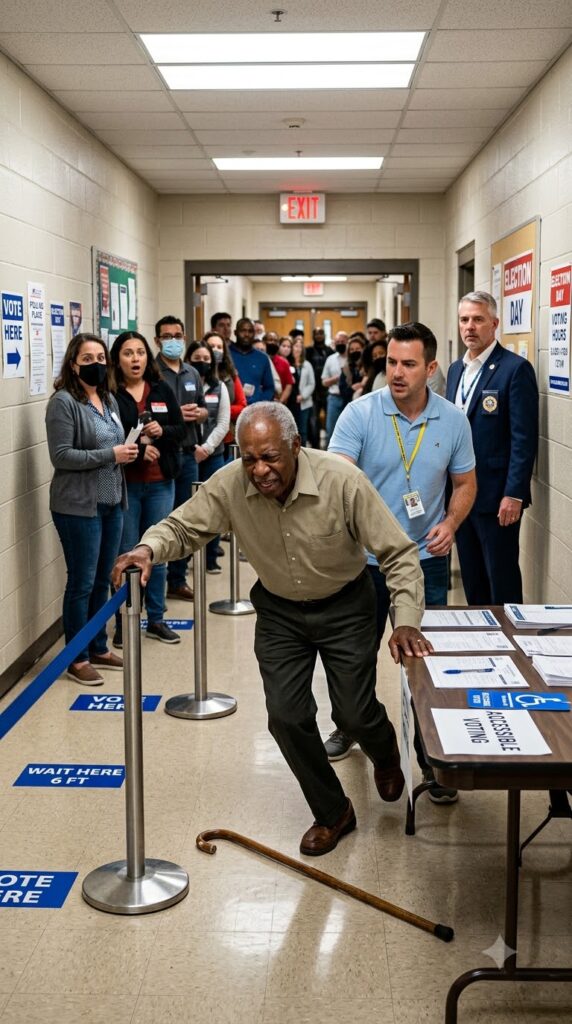
The supervisor followed my cane.
Right above Greg’s head, mounted securely to the ceiling, was the black dome of the gymnasium’s security camera. The solid red light on the side indicated it was actively recording, feeding directly to the county server.
“That camera,” Mr. Davis said, looking back down at Greg, “has a 4K lens. It doesn’t blink. It doesn’t lie. And it has recorded every single interaction you’ve had at this table since 7:00 AM.”
Greg looked up at the black dome.
The fight instantly drained out of him, replaced by a hollow, sickening terror. The reality of his situation finally crashed down on him. This wasn’t a disagreement he could talk his way out of. This wasn’t a customer service complaint. He was standing on federal property, systematically denying civil rights, and assaulting a state auditor on high-definition video.
He was going to prison.
“No,” Greg whispered, shaking his head. “No, no, no. I’m not doing this. I’m not playing this game with you people.”
He reached up and grabbed the plastic county lanyard around his neck. He yanked it hard, snapping the breakaway clasp, and threw his badge onto the linoleum floor.
“I quit,” Greg declared, his chest heaving. “I revoke my volunteer status. You can’t hold me here. I’m leaving.”
He grabbed his jacket off the back of his chair and took a fast step away from the table, heading straight for the main double doors leading out to the parking lot.
“You are a sworn election official, Greg,” Mr. Davis barked, his voice echoing loudly. “You do not have the right to abandon a secure terminal, and you are not leaving this building until the authorities arrive.”
“Watch me!” Greg yelled, speed-walking down the center aisle, pushing past a startled voter.
He was twenty feet from the exit. Then ten.
He reached out to push the metal crash-bar on the glass double doors.
But he didn’t make it.
The young security guard, the one Greg had tried to weaponize against me just ten minutes earlier, stepped perfectly into the center of the double doors.
The guard planted his heavy black boots shoulder-width apart. He didn’t draw his weapon. He didn’t reach for his handcuffs. He just crossed his muscular arms over his chest, completely blocking the exit.
Greg stopped so fast his cheap dress shoes squeaked on the floor.
“Step aside,” Greg hissed at the security guard, his face red with rage and fear.
The guard didn’t blink. He didn’t even look at Greg.
Instead, the young guard looked over Greg’s shoulder, making direct eye contact with me, and waited for my next move.
The guard didn’t move an inch.
Instead of stepping aside, he reached down to the heavy black radio clipped to his utility belt. He pressed the transmission button, his eyes never leaving Greg’s terrified, sweating face.
“Front desk,” the guard said, his voice calm and authoritative. “Lock down the main lobby. Kill the exterior automatic doors. Nobody leaves this building.”
A second later, the heavy magnetic locks on the glass double doors engaged with a loud, echoing clack that sounded like a gunshot in the silent gymnasium.
Greg grabbed the metal crash-bar and shoved it with all his body weight. The doors didn’t budge. He hit the glass with his open palms, panic completely taking over his rational thought.
“You can’t hold me here!” Greg screamed, his voice cracking. He spun around, pointing a trembling finger at the guard. “This is kidnapping! Open these doors right now!”
“Sir, I’m going to ask you to step away from the exit,” the guard said, dropping his hand from his radio to rest naturally near the center of his belt.
“I’m leaving!” Greg yelled. He lowered his shoulder and tried to violently shove his way past the young guard to reach the manual override switch on the wall.
It was the worst mistake he could have made.
The guard didn’t even flinch. He simply pivoted on his heavy boots, caught Greg by the back of his collar with one hand, and grabbed the thick leather of his belt with the other. Using Greg’s own clumsy momentum against him, the guard marched him ten feet backward, right past the dumbstruck voters in the general line, and shoved him hard into one of the metal folding chairs behind the check-in desk.
“Sit there,” the guard commanded, his voice dropping all pretense of customer service. “And do not stand up again.”
Greg hit the chair hard, knocking the wind out of his lungs. He slumped forward, gripping his knees, his chest heaving as he realized he was completely trapped.
The gymnasium fell into a suffocating silence. The only sound was the low, steady hiss of Elias Vance’s oxygen tank from the cinderblock wall.
Nobody moved. The hundreds of people in the general admission line just watched. The elderly voters leaning against the wall watched. Mr. Davis, the county supervisor, stood with his arms crossed, staring down at Greg with absolute disgust.
Five minutes later, the flashing red and blue lights of local law enforcement bounced against the frosted glass windows of the gymnasium.
The front desk buzzed the doors open. Two police officers stepped into the lobby. The heavy clink of their gear echoed as they walked down the center aisle. The crowd naturally parted for them, creating a wide path leading straight to the check-in desk.
The moment Greg saw the uniforms, he jumped up from the folding chair. He instantly reverted to the same playbook he had been using all morning—weaponizing his position to make himself the victim.
“Thank God you’re here!” Greg shouted, stepping toward the officers and pointing a shaking finger directly at me. “Arrest him! Arrest that man right now!”
The lead officer, a tall man with graying hair at his temples, held up a gloved hand to stop Greg’s approach. “Calm down, sir. Who called security?”
“I did,” the young guard said, stepping forward. “We have a poll worker attempting to flee after assaulting a voter and interfering with the check-in process.”
“That is a lie!” Greg shrieked. He turned to the police, his eyes wide, playing the part of a terrified public servant perfectly. “I was just doing my job! That old man came in here looking for a fight! He got aggressive when I asked for his ID. He swung that wooden cane at me, and then he started riling up the crowd, trying to incite a riot! Look at them! They were going to attack me!”
The two officers looked at the crowd. The crowd was completely silent.
Then the officers looked at me.
I was seventy-two years old, wearing a faded corduroy jacket, leaning heavily on a scuffed wooden cane, with a bad left knee. I didn’t look like a rioter. I looked exactly like what I was—a tired old man who just wanted to cast his ballot.
The lead officer frowned. He turned to me. “Sir, did you threaten this poll worker?”
I didn’t raise my voice. I didn’t try to shout over Greg. I didn’t even defend myself.
I just lifted the rubber tip of my cane and pointed it straight up at the ceiling.
Both officers followed the line of my cane. They looked up at the steel rafters. Sitting directly above the check-in desk, blinking with a steady red light, was the county’s high-definition security camera.
“Officers,” Mr. Davis said, stepping out from behind the desk. “My name is Arthur Davis. I am the County Election Supervisor. I have administrative access to the live security feed. Would you like to see exactly what happened?”
Greg’s mouth fell open. He let out a small, pathetic whimper.
“Yes, Mr. Davis,” the lead officer said, his tone shifting immediately to professional courtesy. “We would.”
Mr. Davis tapped the screen of his master tablet. He didn’t turn it around for the crowd. He held it up for the two police officers.
I stood there and watched the officers’ faces.
I saw the exact moment the video played. I saw the officers’ eyes narrow as they watched a silent, high-definition replay of me standing peacefully at the desk. I saw their jaws tighten as they watched Greg raise his hand and violently shove me backward.
The second officer let out a low, angry breath as he watched my cane skitter across the floor on the screen. He watched Greg step forward and kick it under the table. He watched Greg laugh.
“Is that enough, officers?” Mr. Davis asked quietly.
“Keep playing it,” the lead officer said, his eyes glued to the screen.
Mr. Davis backed the footage up to 8:00 AM. He pulled up the split-screen view, syncing the video with the digital timestamps of Greg’s manual overrides.
He showed the police Martha Higgins walking up with her walker. He showed Greg turning her away. He showed Elias Vance struggling with his oxygen tank. He showed Greg sending him to the back of the room. He showed the timestamps, one after another, matching the line of exhausted Black elders leaning against the far wall.
The officers didn’t need to be election lawyers to understand what they were looking at. They were looking at a systematic, intentional deprivation of civil rights, punctuated by the physical battery of a senior citizen.
The lead officer reached up and tapped the top of his body camera to ensure it was recording. He handed the tablet back to Mr. Davis.
Then, he turned around to face Greg.
Greg was backing away, his hands raised in front of his chest. “You’re taking it out of context,” Greg pleaded, his voice breaking into a sob. “The software glitched! I was just asking for secondary ID! You can’t arrest me, I’m a volunteer! I know my rights!”
“Turn around, Greg,” the lead officer said, his voice hard as iron.
“No, please, listen to me—”
“Turn around and put your hands behind your back. Right now.”
Greg looked at the officers. He looked at the security guard. He looked out at the hundreds of voters staring at him with absolute contempt. The reality of the situation finally crushed the last bit of fight out of him.
He slowly turned around and put his shaking hands behind his back.
The sharp, metallic click-click of the handcuffs echoed through the gym.
“You are under arrest for the battery of a senior citizen,” the officer said, checking the tightness of the cuffs. “Furthermore, this precinct is officially forwarding this camera footage and system logs to the federal election commission and the state attorney general’s office for criminal voter suppression charges.”
The second officer took Greg by the bicep.
They didn’t take him out the back door. They marched him straight down the center aisle of the gymnasium, right past the general admission line he had been trying to manipulate all morning.
As Greg was walked toward the doors in handcuffs, his head hung low in absolute disgrace, the silence in the gym finally broke.
Someone started clapping.
Then someone else.
Within seconds, a wave of applause rippled through the general line. The very people Greg had been trying to speed through the process were clapping to see him dragged out of the building. The woman in the blue nursing scrubs gave a loud, triumphant cheer.
When the exterior doors closed behind the police, the gym felt lighter. The oppressive, manufactured tension of the morning vanished.
Mr. Davis stood at the center of the walkway. He cleared his throat, projecting his voice to the entire room.
“On behalf of the county election board,” Mr. Davis announced, his voice filled with genuine regret, “I want to formally apologize to every single person in this room. What happened here this morning was a disgusting abuse of power and a violation of everything this process stands for. It will not happen again.”
Mr. Davis turned to the remaining poll workers, who were standing frozen at their stations.
“Open stations three and four,” Mr. Davis commanded. “Convert them both to priority accessibility lanes immediately. Nobody with a yellow tag waits another minute.”
The poll workers scrambled to unlock the extra scanning machines.
Mr. Davis turned back to me. He held out his hand.
I took it. His grip was firm.
“Thank you, Mr. Coordinator,” Davis said quietly, just between us. “If you hadn’t been here, he might have gotten away with this all day.”
“I was just doing my audit,” I said.
“Are you ready to cast your ballot, sir?” he asked, gesturing to the newly opened priority scanner.
I looked at the open machine. Then, I looked over my shoulder, toward the cinderblock wall.
“Not yet,” I said.
I turned my back to the desk. I gripped my cane firmly, ignoring the throbbing ache in my knee, and walked back down the aisle. I stopped in front of the older Black men and women who were still leaning against the wall. They looked at me, their eyes wide with relief and exhaustion.
I stopped in front of Martha Higgins. I reached out and gently rested my hand on the cold aluminum of her walker.
“Martha,” I said softly. “I believe it’s your turn.”
Tears welled up in the eighty-one-year-old woman’s eyes. She nodded, gripping the handles of her walker.
I turned to Elias Vance. “Elias. Let’s go.”
The old veteran adjusted his military cap, stood up straight, and grabbed the handle of his rolling oxygen tank.
“Sarah. Marcus. Helen,” I called out, looking down the line. “Follow me.”
I turned around and began the slow walk back to the front of the gym.
Behind me, the sound of rubber tennis balls scraping the floor, the rolling wheels of oxygen tanks, and the heavy tapping of canes formed a beautiful, rhythmic march.
As we approached the front, something incredible happened. The general admission line—the people who had been waiting for two hours—did not complain. They didn’t sigh. They didn’t look at their watches.
They physically stepped back, widening the aisle, giving these elders the space and the respect they had been brutally denied all morning.
I stopped at the edge of the blue velvet rope and held it open.
Martha Higgins walked past me, handing her yellow tag to a terrified new poll worker. She was handed her ballot.
Elias Vance walked past me, giving me a sharp, trembling salute before stepping up to the machine.
Sarah, Marcus, and Helen followed.
I stood by the rope, leaning on my cane, watching every single one of them cast their votes. I watched the paper ballots feed into the secure scanners. I watched the green lights flash, confirming their voices had been heard, recorded, and protected.
Only when the last elder from my community transport list had safely secured their “I Voted” sticker on their lapel did I finally step forward.
I handed my yellow tag to the worker.
I took my ballot.
I filled in my choices with a steady hand.
When I slid the paper into the machine and saw the green confirmation light flash, the ache in my knee suddenly didn’t feel so bad anymore.
I took my sticker, peeled the backing off, and pressed it firmly against the lapel of my corduroy jacket, right above my heart. I grabbed my cane, turned my back on the folding tables, and walked out of the double glass doors into the bright, morning sunshine.
THE END
