


I thought five decades would have erased a promise four teenagers made beside a lake. Instead, three boxes were sitting on our old bench, each bearing my name, and nothing inside was what I expected.
I knew something was wrong before I reached our old bench.
I could see it through the trees, exactly where we’d left it 55 years ago.
Nobody was sitting there.
I’d accepted that possibility. Three old friends scattered across three countries had countless reasons to forget a promise we’d made at 17.
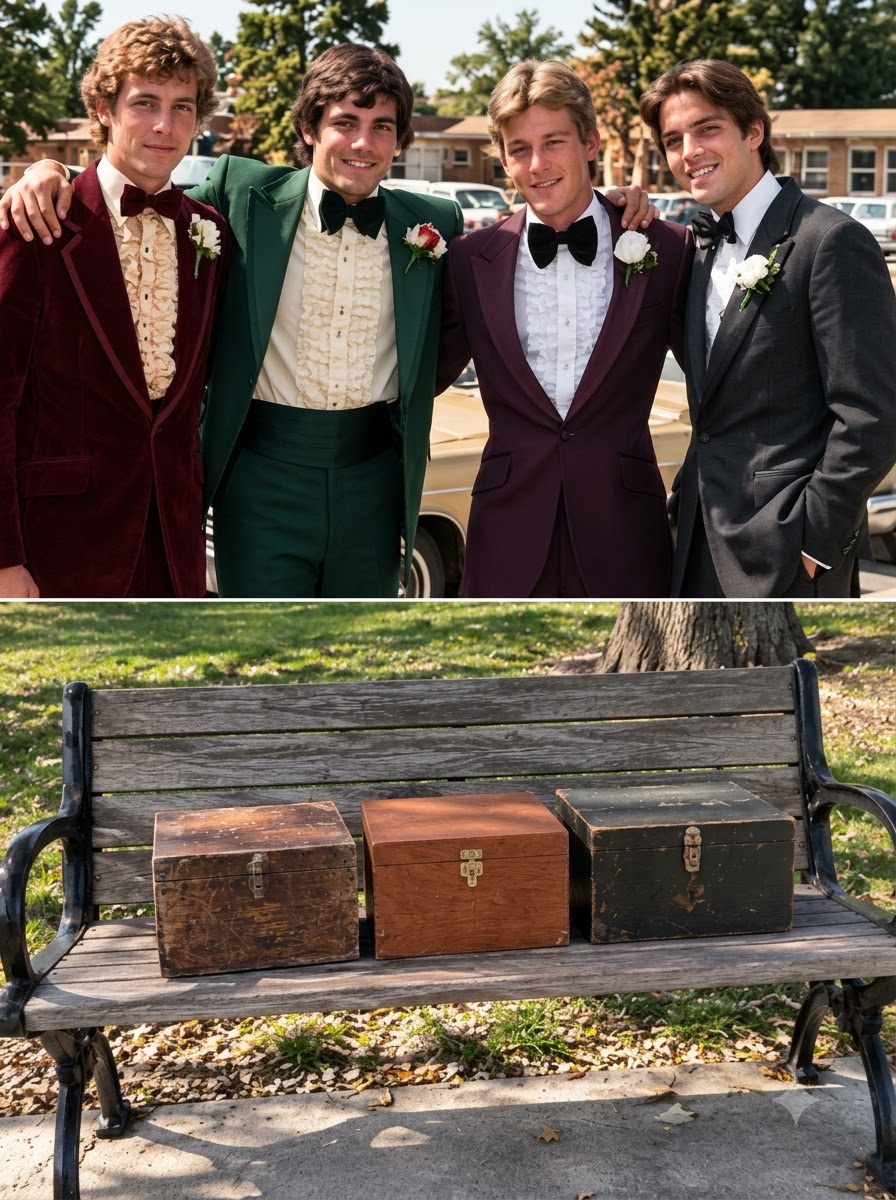
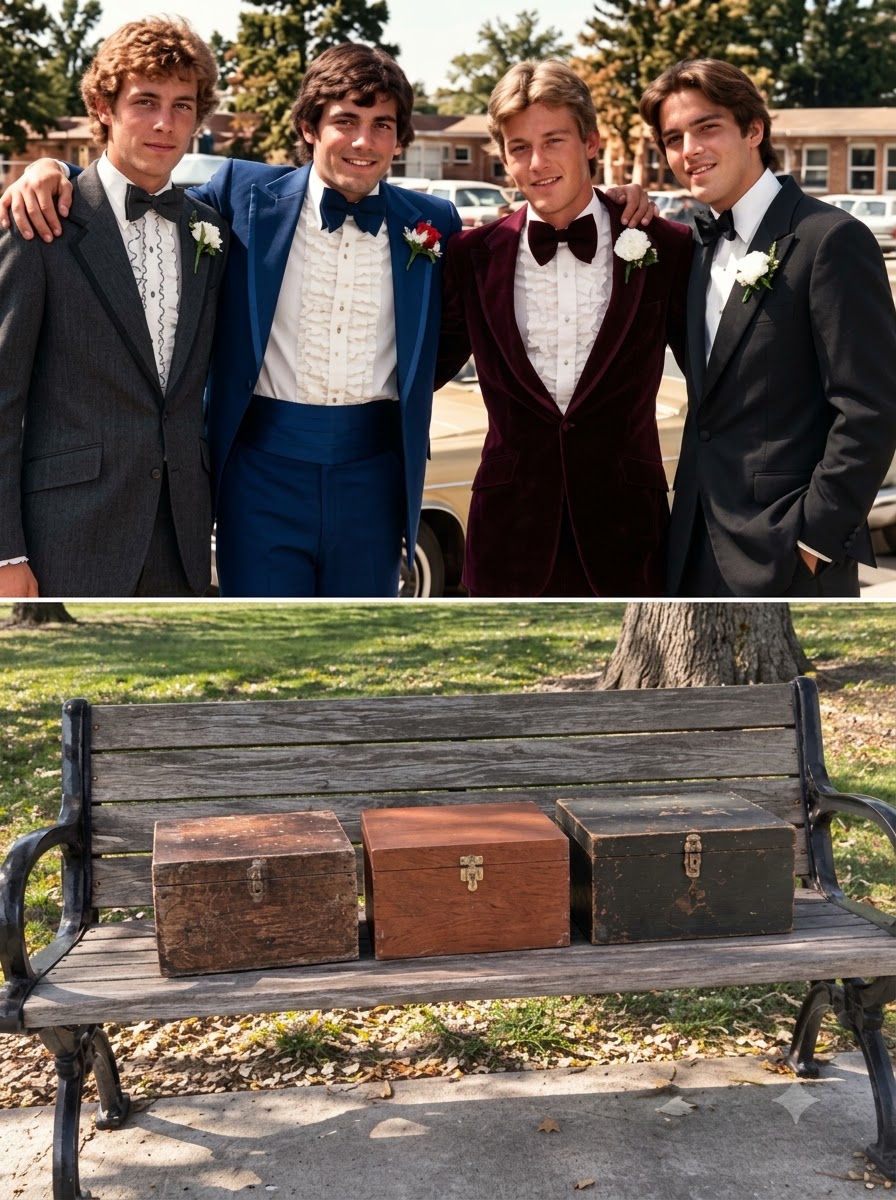
What I hadn’t expected were the three boxes sitting on the bench.
Each one had my name on it.
“HAROLD.”
I peered through the clear lid of the first box.
Inside was something I hadn’t seen since the summer of 1970.
A red fishing lure.
The bench looked smaller than I remembered, its boards gray and worn, but four initials remained carved into one end.
“H. T. R. N.”
I traced them with my thumb.
We’d carved those initials there on the night we graduated high school in 1970.
Tommy, Ray, Nick, and me.
That night, we’d stayed beside the lake until almost midnight, talking about everything we planned to do with our lives.
Tommy’s family was moving to Australia. Ray wanted to see Europe.
Nick swore he’d marry the first beautiful woman who laughed at his terrible jokes.
I wasn’t going anywhere. My father owned a hardware store in town and expected me to work alongside him.
I’d talked about joining Tommy in Australia someday. My father always changed the subject.
Before we left the lake, Tommy made us promise something.
“Fifty-five years,” he said. “Same day. Same bench.”
Ray laughed.
“We’ll be 72.”
“Then bring your walking stick.”
We piled our hands together like excited children.
Fifty-five years later, we’d return.
At 17, none of us questioned that we would.
For a while, we remained close.
Tommy wrote from Australia. Ray mailed letters from Germany. Nick eventually settled in Portugal.
Then the letters became fewer.
Then they stopped.
I wrote too.
At first, I’d leave my letters on the hall table for my father to mail when he went into town for the store. After a while, when nothing came back, I stopped giving him any.
Eventually, silence starts to feel like an answer.
I married, raised two children, buried my parents, lost my wife six years ago, became a grandfather, and grew old in the same town where we’d all begun.
But I never forgot the lake. Over the years, I returned many times.
Sometimes I’d sit on our bench and trace those four initials, remembering the boys we’d been and wondering where life had carried them.
And every time, I’d think about our promise and hope that somehow, when the 55 years were finally over, they’d remember it too.
Apparently, they had.
The boxes came in different sizes.
My hands trembled as I opened the first one.
I lifted out the red fishing lure and laughed before I could stop myself.
Tommy had bought it when we were 16.
He’d spent three weeks boasting that it would catch the biggest bass in the lake.
It never caught anything.
Beneath it was an envelope.
The handwriting was unfamiliar, but the first sentence wasn’t.
“Harold,”
“If you’re sitting on our bench, you remembered.”
I sat down.
The letter was from Tommy.
He had written it only seven months earlier.
He wrote about Australia, his wife, his children and grandchildren. He wrote that he’d spent years imagining the four of us as old men sitting beside the lake. Then came the sentence that stopped me.
“I wish we’d had the courage to ask you why you stopped writing.”
“But if you came back to that bench, maybe I was wrong about you.”
I read it twice.
Stopped writing?
Tommy said the three of them had stayed in contact.
Not constantly, but enough.
Christmas cards. Phone calls. Eventually emails.
And apparently my name had never vanished from their conversations.
For years, they’d wondered what they’d done that made me cut them out of my life.
My stomach tightened.
I opened the second box. Inside was a cheap silver compass. Ray had carried it everywhere when we were teenagers, despite being unable to read it properly. Beneath it was a thick bundle of papers tied with string.
Letters.
The first was dated August 1971.
“Dear Harold,”
“Germany is colder than I expected. Tommy says Australia is too hot, so between us we chose badly.”
I smiled, then noticed the final paragraph.
“You haven’t answered my last two letters. Everything okay?”
The next letter was from October.
Then December.
Then March 1972.
“Harold,”
“If you’re angry about something, tell me. Nick hasn’t heard from you either. Tommy thinks maybe your father is keeping you busy at the store.”
Another.
“We miss you, idiot.”
Another.
“Please write back, even if it’s only one sentence.”
I stared at the pages. I’d never seen a single one.
There were copies of 11 letters in that bundle.
Eleven.
I remembered checking the mailbox after work when I was 18.
Then 19.
I remembered pretending I didn’t care.
My father had noticed once. “Waiting for something?”
“No.”
“Those boys have their own lives now, Harold. You should get on with yours.”
Eventually, I did.
At the bottom of Ray’s box was a letter written by his daughter.
“My father kept almost everything from those years, including carbon copies of letters he typed before mailing them. When we found these after his death, I finally understood why he sometimes talked about you with such sadness.”
After his death.
I covered my mouth.
Ray was gone.
He had died three years earlier.
His daughter wrote that one of the last things he’d asked her to do was make sure his box reached the bench if he couldn’t.
I sat there for several minutes before reaching for Nick’s box.
I almost didn’t want to open it.
A photograph of an old pocketknife lay across the top.
I recognized it immediately. The four of us had used that knife to carve our initials into the bench.
Beneath it was another bundle.
But these weren’t letters written to me. They were copies and originals Tommy, Ray, and Nick had exchanged with one another over the years, collected together for me.
One from Tommy in 1973 mentioned me.
“Maybe we should stop bothering him. If Harold wanted us in his life, he would answer.”
Nick had replied.
“I don’t understand it. He was the one crying when we left.”
Another, years later, “Do you think we did something?”
And finally, from Ray, “I think we have to accept that Harold doesn’t want us anymore.”
I lowered the page.
For 55 years, I’d believed exactly the opposite.
They hadn’t abandoned me.
They thought I’d abandoned them.
I was still trying to comprehend how we’d all gotten it so wrong when a shadow fell across the letters.
I looked up.
Two young men and a woman stood several yards away.
The older man stepped forward. “Harold?”
“Yes.”
He smiled, but his eyes were wet.
“I’m Oscar. Tommy’s son.”
The woman beside him introduced herself as Ray’s daughter, Anna.
The younger man was Nick’s son, Luis.
Suddenly, I understood. “You brought these?”
Oscar nodded.
“They made us promise we’d come, even if they couldn’t.”
Something in the way he said it made my stomach drop.
“Couldn’t?”
His expression changed.
Tommy had died eight months earlier.
Cancer.
He’d known he probably wouldn’t make it to the lake, so he’d prepared his box.
Ray had already been gone.
I looked at Luis.
I couldn’t ask, and he seemed to understand that.
“My father’s alive.”
The breath left me.
“Nick?”
“He’s alive. He’s ill, though. Traveling this far wasn’t possible.”
I looked down at the photograph of the pocketknife.
“Does he know I’m here?”
Luis smiled.
“He’s been asking me every hour.”
Something inside me finally broke apart right then.
I’d spent decades teaching myself not to miss three people because I believed they’d stopped missing me.
“Did they ever talk about me?” I asked.
Anna looked almost surprised. “Mr. Harold, I’ve known your name since I was a child.”
Oscar nodded. “Same.”
Luis smiled.
“Dad used to tell us about the lake. He said you were the only person who could beat him swimming.”
“He cheated.”
“I’ve heard that too.”
I laughed, then started crying. And nobody tried to stop me.
Eventually, Anna sat beside me.
“There is something else,” she said.
She pointed toward the letters.
“Dad never understood why you didn’t receive them.” Neither had I.
But during the drive home, one question kept circling in my mind.
What had happened to all those letters?
I hardly slept.
Early the next morning, I went down into my basement.
After my father passed away, I’d boxed up whatever remained of his office. Most of those boxes hadn’t been opened in decades.
I found his old desk tucked away in the back.
The bottom drawer was locked.
I nearly left it alone.
Then I remembered something.
My father kept a tiny brass key inside an old tobacco tin.
The tin was still inside one of the boxes.
The key fit.
Inside the drawer were tax records, receipts, and photographs.
And beneath them sat a stack of envelopes.
The first one had my name on it.
So did the second and third.
Some carried Australian stamps.
Some were from Germany.
Some were Portuguese.
I sat down on the basement floor.
Twenty-three letters.
Most were unopened letters my friends had sent me.
But near the bottom were three envelopes I recognized immediately.
My handwriting.
My stamps.
The letters I’d handed my father to mail.
He hadn’t just kept their words from reaching me.
He’d kept mine from ever reaching them.
I opened the oldest one. Near the bottom, 18-year-old me had written, “Don’t forget about me over there.”
Suddenly, I was 18 again, standing beside our mailbox while my father told me those boys had their own lives.
My father hadn’t simply watched me wait. He’d known exactly what he was doing.
Beneath the letters was an envelope with my name written in my father’s hand.
It wasn’t sealed.
Inside was a letter he’d apparently begun years later but never found the courage to give me.
“You were going to leave. First Australia, then wherever the others went.”
“The store needed you.”
“Your mother needed you. I told myself that one day you’d understand why I kept those letters.”
I read it until the words became blurry.
My father had been afraid I’d leave.
Rather than telling me, he’d made the choice for me.
He didn’t have to hide the letters forever.
Only long enough.
By the time I moved out, the damage had already been done.
My friends thought I’d rejected them.
I thought they’d forgotten me.
After enough unanswered letters, the hurt did exactly what my father had expected. We stopped trying.
I was furious.
But there was nowhere for that anger to go.
My father had been gone for 26 years.
Tommy was gone, and Ray was too.
Some things can’t be repaired by an apology because everyone who should hear it is already gone.
But Nick was still alive.
And I wasn’t going to let whatever time we had left disappear.
Three weeks later, I stepped off a plane in Portugal.
Luis was waiting for me at the airport.
Nick lived with his wife in a small house overlooking the sea.
I barely spoke during the drive.
“What if he doesn’t recognize me?” I finally asked.
Luis laughed.
“He will.”
Nick was sitting beside a window when I entered the room.
He was thin.
Far thinner than the boy I remembered.
His hair was white, his hands covered in age spots, and an oxygen tube rested beneath his nose.
For several seconds, neither of us said anything.
Then his eyes traveled across my face.
A small smile appeared. “You took your time.”
I laughed.
It came out as a sob.
Nick’s smile trembled.
Then he extended his hand.
I crossed the room and took it, but that wasn’t enough.
I leaned down and hugged him.
Nick’s arms wrapped around me.
And suddenly, 55 years vanished.
Not entirely. Nothing could ever return them.
But for a moment, I could smell lake water and summer grass, and I could hear Tommy arguing with Ray while four boys promised each other something none of us understood would one day matter so much.
“I’m sorry,” I whispered.
Nick pulled back.
“For what?”
“For not finding you.”
He shook his head.
“We didn’t find you either.”
“My father took the letters.”
Nick became completely still as I told him everything.
About the drawer.
The 23 envelopes.
The note.
When I finished, Nick stared out through the window for a long time.
“So you didn’t leave us.”
“No.”
He squeezed my hand.
“We didn’t leave you either.”
I’d brought the old letters with me to Portugal.
I took out one of my own unsent letters and gave it to Nick.
He read the line I’d written at 18. “Don’t forget about me over there.”
Nick shut his eyes.
“Harold,” he said quietly, “we never did.”
Those words hurt more than anything else I’d discovered in those boxes.
Because they gave me exactly what I’d wished for at 18.
Only 55 years too late.
We talked for hours. About Tommy, about Ray.
About marriages, children, careers, and mistakes.
Nick told me Tommy had kept that useless red lure through six different house moves.
Ray had taken his compass with him to Germany, then kept it in his desk for the rest of his life.
Nick still had the knife.
“I wanted you to have it,” he said.
I reached into my bag.
“I brought something too.”
His eyebrows rose.
I placed a small wooden object in his hand.
A carved fish.
I’d made it in shop class when I was 16.
We used to joke that it was the only fish Tommy’s lure would ever catch.
I’d held onto it for more than half a century.
Nick stared down at it.
Then he laughed so hard that Luis came in to check on him.
We had 55 years of friendship to catch up on, and we still weren’t finished.
A month later, we arranged one final meeting.
Not at the lake because Nick couldn’t travel.
So we brought the lake to him.
Oscar flew in with Tommy’s red lure.
Anna brought Ray’s compass.
I brought the carved fish.
Nick’s pocketknife was already there.
We set all four objects on the table beside his window.
Four pieces of four boys’ lives. Together again.
We took a photograph.
Oscar said his father would have loved it.
Anna said hers would have complained that we’d placed the compass upside down.
Nick looked at me.
“Fifty-five years,” he said.
“We kept the promise.”
I looked at the empty chairs around us.
“Not exactly.”
Nick shook his head.
“They sent their children, Harold. I’d say that counts.”
I cannot get back the years my father took from us.
I can’t sit beside that lake with Tommy or listen to Ray complain about getting old. But now I know they remembered me.
They missed me.
They wanted me.
And somewhere in Australia and Germany, children grew up hearing stories about a fourth boy beside a lake.
A boy their fathers never stopped calling their friend.
Before leaving Portugal, Nick handed me the pocketknife.
“Take it back,” he said.
“Where?”
He looked at me like the answer was obvious.
“The bench.”
So yesterday morning, I went back to the lake alone.
I sat where four boys had once sat and placed Nick’s knife against the faded initials we’d carved in 1970.
I didn’t carve anything new.
I simply traced the old marks.
“H. T. R. N.”
They were still there.
So were we.
Enjoyed the read? Here is another story you will love: I was confused when my MIL put 51 candles on my husband’s cake instead of 50, but she insisted she wasn’t mistaken. What was meant to celebrate a major milestone soon turned into a search for the truth, uncovering a family secret that had been hidden for half a century.
