

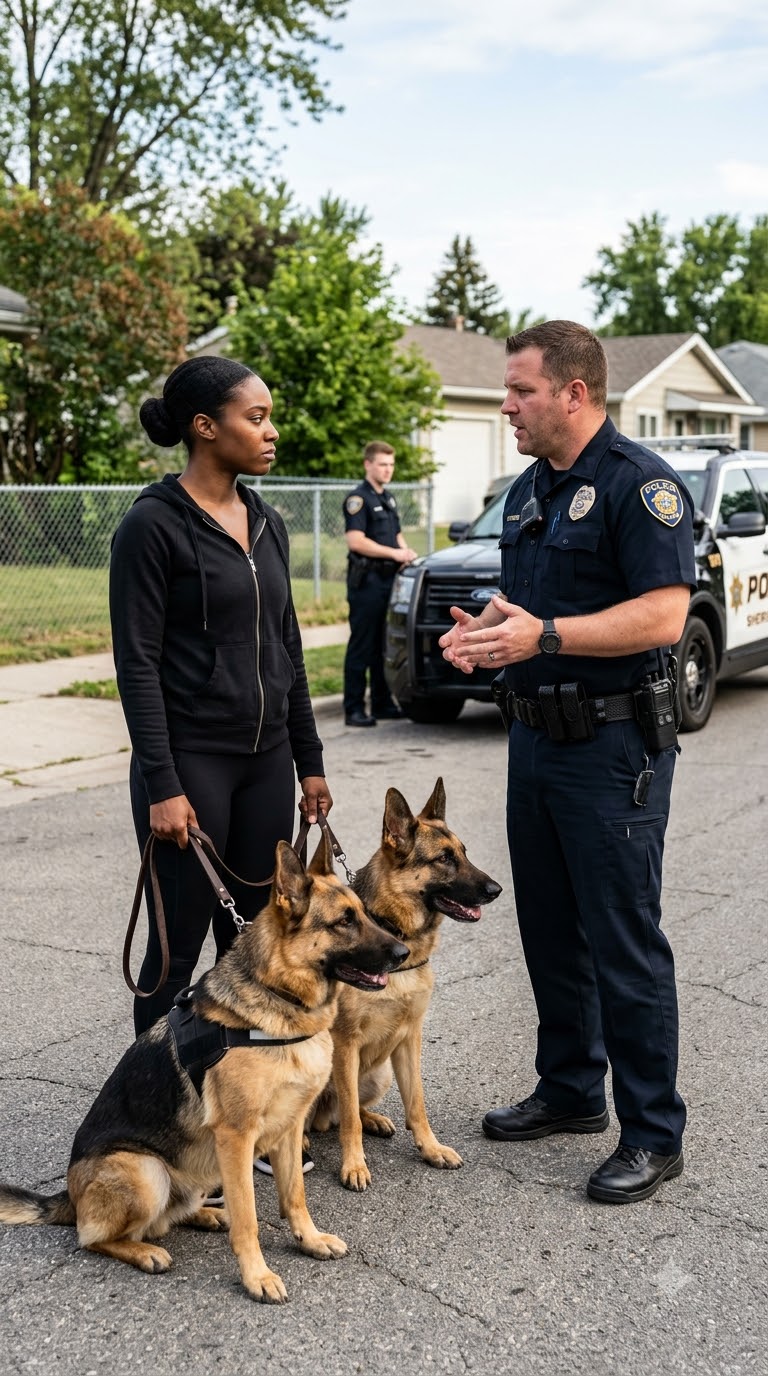
“Let go of those leashes and move away from the dogs.”
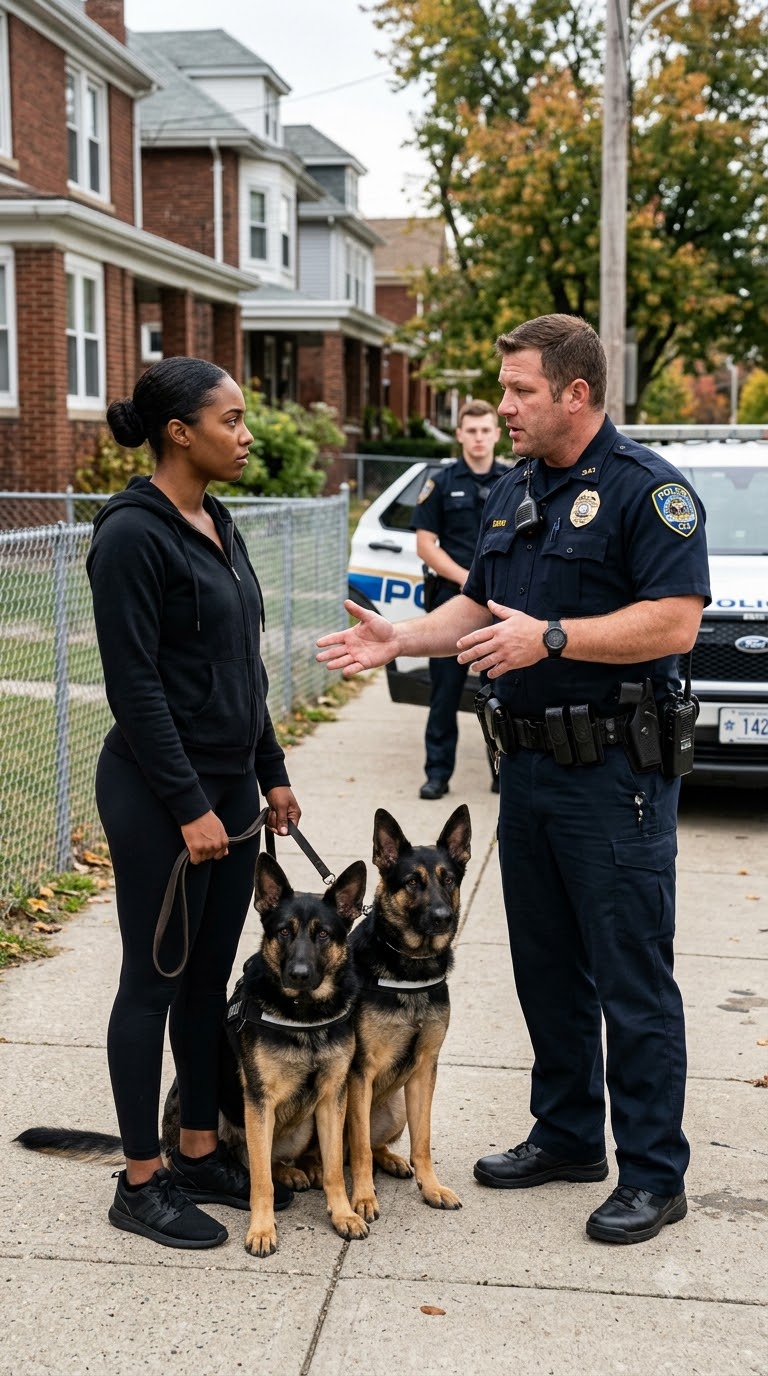
Captain Raymond Pike said it as though the decision had already been made before he ever arrived. His right hand hovered near the radio attached to his vest while his eyes moved from Simone Carter’s running clothes to the two German Shepherds sitting quietly beside her.
Simone tightened her grip on the braided tactical leads but remained exactly where she was.
What Pike could not have known by looking at her was that Simone had spent nearly fifteen years working with military dogs for the United States Army. He had no idea that the two animals beside her had traveled overseas with her, worked around explosives and gunfire, and learned to interpret the slightest movement of her shoulders before most people could react to a shouted command.
Most importantly, he did not know that neither dog had been given permission to do anything except sit.
That morning had begun with cereal.
Nine-year-old Noah Carter took feeding Ranger and Atlas seriously. When Simone and Noah moved into their modest brick home in Brookhaven Glen outside Savannah, he announced that breakfast for the dogs would be his responsibility.
Simone agreed.
After everything the two of them had endured, she was grateful whenever her son wanted responsibility instead of another reason to be afraid.
At six-thirty, Noah carried two stainless-steel bowls onto the back porch.
Ranger was eight, broad-chested, dark across the saddle, and possessed amber eyes that initially made strangers nervous. Atlas was six, leaner and quicker, with one ear that tilted whenever Noah spoke to him.
“Sit.”
Both dogs sat.
Noah poured the food.
“Wait.”
Neither animal moved.
Noah glanced toward the kitchen window to see whether his mother was watching.
She was.
He grinned.
“Okay.”
Both heads dropped into the bowls.
Simone smiled.
At thirty-seven, Simone Carter had already lived several different lives.
She joined the Army at eighteen because college money was limited and remaining in the Alabama town where she grew up felt like accepting a future somebody else had designed.
By twenty-two, she was working with military dogs.
By twenty-nine, she had completed deployments she rarely discussed outside rooms filled with people who understood without explanation.
She eventually became a senior handler and trainer.
Between assignments, she earned an undergraduate degree and later a master’s in animal behavior, studying late into the night because she had decided that when the uniform eventually came off, she needed to know who she would become afterward.
A blast during her final deployment injured her left knee and left a scar along the outside of her thigh.
But that wasn’t what ultimately ended her military career.
Grief did.
Her husband, Andrew Carter, had been an Army medic.
Three years before Simone retired, he died in a vehicle accident during a stateside training exercise.
Noah was six.
Some losses arrive like explosions.
Others quietly rearrange your entire life.
Andrew’s death had done both.
Simone continued working because stopping seemed impossible.
Eventually, she stopped because continuing seemed worse.
Brookhaven Glen was supposed to be quiet.
The neighborhood had tree-lined streets, decent schools, a small park, and enough distance from downtown Savannah to make mornings sound more like sprinklers and birds than traffic.
Simone had signed a civilian consulting contract with a regional federal K9 training center about forty minutes away.
The work paid well.
It kept her connected to the animals she understood.
And it allowed her to be home before Noah finished most of his homework.
Ranger and Atlas had retired with her through an approved handler-placement program.
They were no longer active military assets.
At home, they were simply dogs.
They slept beside Noah’s bed.
They stole socks.
They stared shamelessly at anyone eating chicken.
But at dawn, the years of training showed.
Simone clipped their leads and checked every fastener.
“Ready?”
Ranger stood.
Atlas stretched.
Then the three of them headed into the Georgia morning.
Simone followed the same route most weekdays.
Maple Crest Drive.
Grayson Avenue.
Crescent Park.
Behind the community tennis courts.
Then through a narrow service lot connecting the park to the subdivision.
The entire route covered a little more than three miles.
She liked repetition.
After years when roads changed because an explosive device had been discovered or a checkpoint had suddenly closed, knowing exactly where the sidewalk cracked felt luxurious.
She knew which sprinkler sprayed too far across one lawn.
She knew where the terrier behind the wooden fence barked every morning.
She knew which old pecan tree had roots pushing through the concrete.
Ranger ran on her left.
Atlas ran on her right.
Neither pulled.
That precision was why the two patrol cars blocking the service-lot entrance immediately caught her attention.
They were positioned nose-to-nose, leaving almost no clean passage.
Simone slowed from a jog to a walk before either officer opened a door.
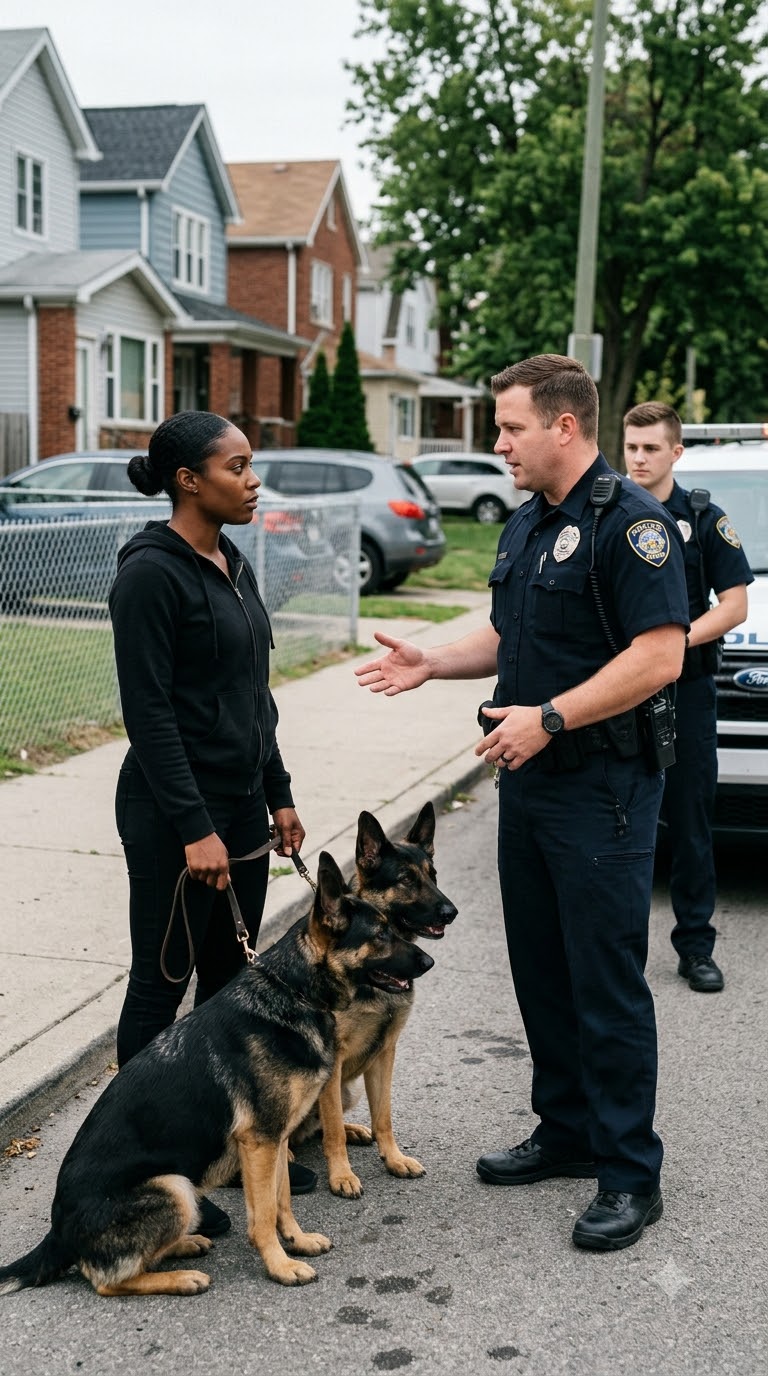
The first officer was heavyset, perhaps fifty-three, with closely cropped gray hair and the rigid posture of someone accustomed to controlling conversations through authority.
His nameplate read PIKE.
The younger officer remained several feet behind him.
Pike looked at Simone.
Then at the dogs.
“We got a call about dangerous dogs running loose.”
Simone looked down.
Both German Shepherds were visibly leashed and standing in heel position.
“These two?”
Pike’s expression barely changed.
“I said we got a report.”
“They aren’t loose.”
“Ma’am, step away from them.”
Something old stirred inside Simone.
Not fear.
Recognition.
She knew when a conversation had stopped being about the words being spoken.
“My dogs are leashed and under control.”
Pike moved closer.
“I need you to listen carefully.”
“I am listening.”
“Then release the leashes.”
“No.”
The younger officer, Mills, shifted several feet to Simone’s right.
She noticed immediately.
There was a fence behind her.
A cruiser blocked the left side.
Pike stood ahead.
Mills was closing the remaining space.
Simone’s breathing remained steady.
“Captain Pike, my name is Simone Carter. I am a retired Army military working-dog handler and currently hold a federal K9 training contract. Ranger and Atlas are documented retired military working dogs placed legally in my care.”
Pike gave a short smile.
“Everybody has a story when police show up.”
Simone stared at him.
“That isn’t a story.”
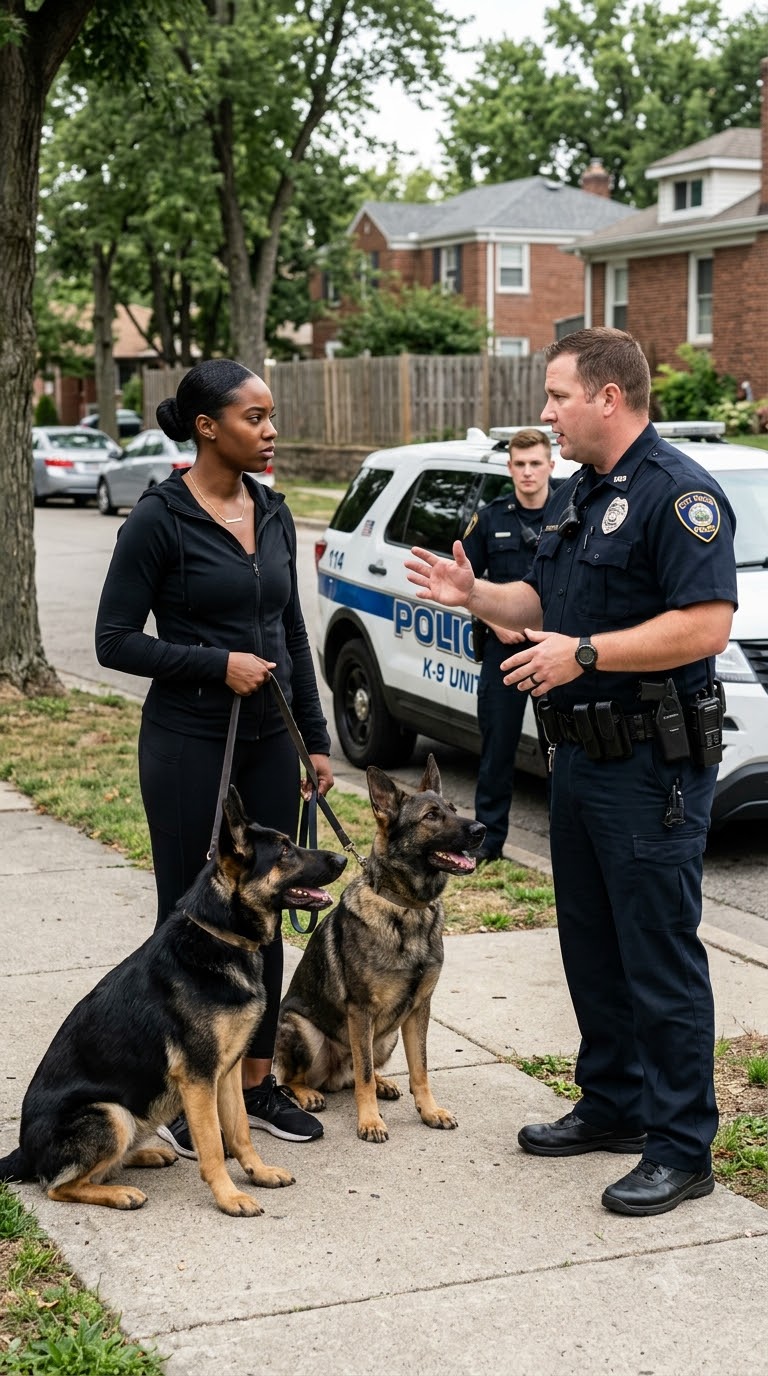
“I don’t need your résumé.”
“No, but you may need their records before you decide to confiscate them.”
Something changed in his expression.
Simone had guessed correctly.
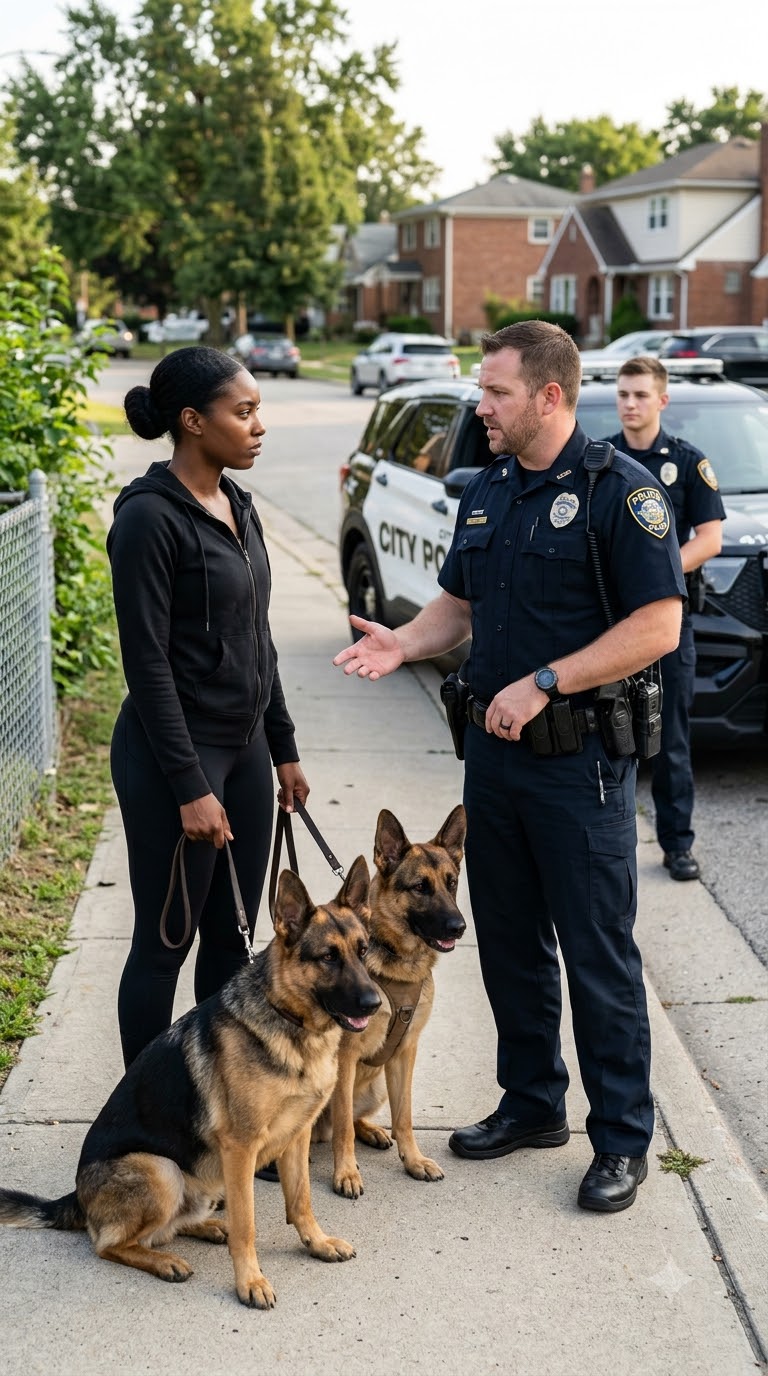
Pike lifted his radio.
“Animal control is already on the way.”
“For what?”
“The animals have been reported as aggressive.”
“By whom?”
“That isn’t your concern.”
“It becomes my concern when you are threatening to take animals standing peacefully on leashes.”
Pike’s jaw tightened.
“You people always want to argue everything.”
The sentence hung between them.
Mills glanced at his captain.
Simone didn’t respond to the insult.
“Show me the complaint.”
Pike stepped closer.
“I do not need to show you anything right now.”
“Then we can wait for animal control.”
“I said drop the leashes.”
“And I said no.”
For the first time, Pike’s composure cracked.
He reached toward Simone’s left hand.
Ranger moved before Simone did.
The dog surged forward one step, positioning his body between Pike and Simone.
Atlas immediately mirrored him.
Neither animal made contact.
Neither lunged beyond the length of the lead.
Neither ignored Simone’s control.
But Ranger’s low growl came from deep in his chest.
Pike jumped backward.
His hip struck the cruiser.
His radio hit the hood.
Mills stumbled toward the fence.
For a moment, both officers looked like men who had forgotten exactly what they were dealing with.
Simone’s voice remained calm.
“Ranger.”
The dog’s ears shifted.
“Atlas.”
Both animals focused on her.
“Down.”
Both dogs dropped beside her boots.
No barking.
No lunging.
No chaos.
Just silence.
Simone looked at Pike.
“That is control.”
Mills lowered his eyes.
Pike recovered.
“You think this is funny?”
“No.”
“You just threatened law enforcement with attack dogs.”
“I gave no attack command.”
“They came at me.”
“They moved between you and me when you reached for my hand.”
Pike’s face reddened.
“I can have those animals destroyed.”
That was the first moment Simone felt genuine anger.
Not loud anger.
Cold anger.
She looked directly at him.
“You should be very careful about what you say next.”
Pike took another breath.
Then he pointed toward her street.
“Get out of here.”
Simone shortened both leads.
“Gladly.”
She stepped around the cruiser.
Pike called after her.
“This isn’t finished.”
She didn’t turn.
“It should have been before it started.”
Simone walked home.
She didn’t run.
Her shoulders remained straight until she reached her porch.
Then her hands began shaking.
Noah was standing behind the railing with his tablet.
He looked pale.
“Mom.”
Simone climbed the steps.
“You okay?”
He nodded too quickly.
“You?”
“I’m fine.”
His eyes moved toward the dogs.
“They didn’t do anything.”
“I know.”
“I recorded it.”
Simone stopped.
“What?”
“I saw the police cars from the porch.”
Noah held up the tablet.
“I recorded everything.”
Simone looked at him for several seconds.
“You recorded the whole thing?”
“Yes.”
“Did you go into the street?”
“No.”
“Did you talk to anybody?”
“No.”
She exhaled.
“Good.”
Then another voice came from next door.
“I recorded it too.”
Mrs. Lorraine Bishop stood behind her screen door.
Lorraine was seventy-two, widowed, and had lived on Maple Crest Drive since much of the neighborhood was still pine forest.
She held up her phone.
“I got most of it from my window.”
Simone looked between her son and her neighbor.
Two recordings.
Two angles.
That changed everything.
Inside the house, Simone gave Ranger and Atlas water before sitting at the kitchen table.
Ranger rested his shoulder against her leg.
Her hands were still trembling.
She called Malcolm Reid.
Malcolm had been Andrew’s closest friend before becoming the attorney Simone trusted with everything from contracts to property paperwork.
He had spent twelve years practicing civil and administrative law.
More importantly, he knew when to let Simone finish speaking.
She explained the encounter chronologically.
The time.
The location.
The officers’ names.
Their statements.
The dogs’ behavior.
The attempted seizure.
The witnesses.
When she finished, Malcolm asked one question.
“Where is the footage?”
“Two devices.”
“Make three copies of each before anybody posts anything.”
Simone stood.
“I’m doing it now.”
“No edits.”
“Obviously.”
“No social-media captions.”
“Malcolm.”
“I know you know.”
“Then stop talking to me like I’m nineteen.”
He laughed.
“Good. You sound like yourself.”
They preserved everything.
One copy went to encrypted cloud storage.
One went to Malcolm.
One remained offline.
Then Lorraine knocked on Simone’s door carrying banana bread.
“I figured if the police come back, nobody should be hungry.”
Despite everything, Simone laughed.
The department initially issued a brief statement saying the incident was under review.
Then the recordings appeared online.
Lorraine’s grandson had received permission to share the footage with a neighborhood accountability group.
By evening, thousands of people had watched the encounter.
By the next morning, local television stations were calling.
Simone hated the word “hero” appearing in the comments.
She wasn’t a hero.
She had simply refused to surrender two dogs that had been under her control.
But then Malcolm called.
His voice was different.
“Simone, you need to see something.”
“What?”
“I requested the dispatch record.”
“And?”
“The original call doesn’t match the police report.”
Simone sat down.
“What does the report say?”
“That the caller reported two dangerous dogs running loose and an unidentified woman refusing to control them.”
“And what did the dispatcher actually receive?”
“Something very different.”
Malcolm sent her the transcript.
Simone read it twice.
The caller had reported “two large dogs.”
There was no statement that they were attacking anyone.
No claim that anyone had been bitten.
No report that they had escaped.
And there had been no request for immediate police intervention.
The caller had simply complained that the dogs made her uncomfortable.
Simone looked up.
“Who made the call?”
Malcolm paused.
“That is the part we don’t have yet.”
Then he sent another document.
A property-management complaint.
Submitted two weeks earlier.
The complainant was a neighborhood resident.
Marjorie Phelps.
Simone’s stomach tightened.
Marjorie.
The woman who had complained about Ranger and Atlas barking even though the dogs hadn’t been outside.
The woman who had told Simone that “animals like that” didn’t belong in a family neighborhood.
The woman who had once asked whether Simone needed permission to keep “military dogs” in a residential property.
Simone had assumed the comments were merely prejudice.
Now she wondered whether there was more.
Malcolm found another connection.
Marjorie was on the neighborhood architectural committee.
The committee had recently proposed new restrictions regarding “large animals, security animals, and commercial training activities.”
Simone’s consulting work had made her property more visible.
Her retired military dogs made her an easy target.
But Malcolm wasn’t finished.
“There’s something else.”
“What?”
“The committee’s chair is married to a county animal-control supervisor.”
Silence.
Simone stared at the screen.
“That could be nothing.”
“It could.”
“But?”
“But Captain Pike’s wife works in the same county department.”
Simone leaned back.
The pieces weren’t proof.
Not yet.
But they were enough to explain why the threat of animal seizure had appeared so quickly.
Malcolm asked, “Do you want to go public?”
Simone looked toward Noah’s bedroom.
“No.”
“Good.”
She frowned.
“Why?”
“Because you don’t need to win the internet. You need to win the facts.”
That sentence stayed with her.
The following week, the department opened a formal internal investigation.
Animal control confirmed that Ranger and Atlas were properly documented.
Their vaccination records were current.
Their ownership records were valid.
Their retired-service documentation was intact.
Most importantly, the responding officers had not been presented with evidence that either dog had committed an offense.
Then the department reviewed the body-camera footage.
The footage contradicted several statements in Pike’s report.
Pike had written that Simone “became verbally confrontational.”
The recording showed her speaking evenly.
He wrote that the dogs “advanced aggressively.”
The footage showed both animals moving only after Pike reached toward Simone.
He wrote that Simone “refused multiple lawful commands.”
The recording showed her repeatedly explaining that the dogs were leashed and controlled.
Then investigators discovered something else.
Pike had requested animal control before he approached Simone.
That meant he had already decided the dogs should be removed before the encounter escalated.
The question became:
Why?
A second investigation followed.
This time, county officials examined the relationship between the neighborhood committee, animal control, and several previous complaints.
They found a pattern.
Residents who owned large dogs had received unusually aggressive warnings.
Several complaints had been escalated without evidence of an actual attack.
One family had surrendered a dog after being threatened with seizure.
Another homeowner had paid thousands of dollars for a fence modification after being told the county could remove his animals.
Then investigators found an email.
It had been sent by the neighborhood committee chair to a county official.
The subject line read:
SIMONE CARTER PROPERTY
The email contained photographs of Simone’s home and the dogs.
It also contained a sentence that made Malcolm stop reading.
“She will be difficult, so approach this through official channels.”
Simone stared at the screen.
“She knew.”
Malcolm nodded.
“Someone knew.”
The investigation eventually determined that the officers had acted improperly and that the animal-control process had been improperly influenced by private complaints.
No evidence established that the entire department was involved.
Most officers had never heard of Simone.
Most were simply doing their jobs.
But several individuals had allowed personal assumptions and outside pressure to influence an encounter that should have been routine.
Pike was placed on administrative leave pending disciplinary proceedings.
The county animal-control supervisor was reassigned.
The neighborhood committee conducted its own review.
Marjorie resigned before the review was completed.
She never apologized.
Simone didn’t expect one.
The apology she cared about came from somewhere else.
Three months later, Captain Pike requested a meeting.
Simone almost refused.
Malcolm advised her to attend.
The meeting took place in a conference room at the police headquarters.
Pike entered without the confidence he had carried in Brookhaven Glen.
He sat across from Simone.
For several seconds, neither spoke.
Finally, he said:
“I was wrong.”
Simone looked at him.
Pike continued.
“I made assumptions about you and the dogs before I had the facts.”
Simone’s expression remained neutral.
“You did.”
“I shouldn’t have reached for that leash.”
“No.”
“I shouldn’t have said what I said.”
“No.”
Pike nodded.
“I know.”
Simone looked toward the window.
“You scared my son.”
Pike’s face changed.
“I didn’t know he was watching.”
“That doesn’t make it better.”
“No.”
For the first time, his voice sounded less like an officer giving instructions and more like a man accepting responsibility.
“I am sorry.”
Simone believed that he meant it.
But forgiveness wasn’t the same as forgetting.
She stood.
“Then make sure the next person doesn’t have to record you to be treated fairly.”
Pike nodded.
“I will.”
Simone left.
Outside, Malcolm waited beside the car.
“Well?”
She opened the passenger door.
“He apologized.”
“Did it help?”
She thought for a moment.
“A little.”
Then she smiled.
“But Noah’s still the one who changed everything.”
Malcolm laughed.
“That kid has a future.”
“He already thinks he’s a lawyer.”
“He learned from his mother.”
Several weeks later, Simone took Ranger and Atlas back to Crescent Park.
The same route.
The same sidewalk.
The same pecan tree.
No police cruisers blocked the service lot.
No one ordered her to surrender the dogs.
No one questioned whether she belonged there.
Noah came along that morning.
He carried a small camera on a strap around his neck.
Simone noticed.
“You bringing that everywhere now?”
He smiled.
“Just in case.”
She laughed.
Ranger and Atlas sat beside them.
Noah looked at the dogs.
Then at his mother.
“Mom?”
“Yeah?”
“Were you scared?”
Simone considered lying.
She didn’t.
“Yes.”
Noah nodded.
“But you didn’t look scared.”
“I was trained not to let fear make decisions for me.”
He thought about that.
“Is that why you stayed calm?”
“Partly.”
“What was the other part?”
Simone looked down at Ranger and Atlas.
“Because they were counting on me.”
The dogs looked back at her.
Noah smiled.
Then Simone started running.
Ranger moved beside her.
Atlas moved beside her.
Noah followed behind.
Three lives moving forward together.
The encounter had begun with an officer assuming Simone was someone who needed to be controlled.
It ended with records, witnesses, and one nine-year-old boy proving that the truth could survive an assumption.
Simone never wanted fame from the incident.
She never wanted strangers calling her courageous.
She wanted something much simpler.
To walk her dogs without being treated like a threat.
To raise her son without teaching him that he had to accept unfairness quietly.
And to make sure that the next time someone saw two trained German Shepherds beside a Black woman, they judged what was actually happening instead of what they expected to see.
Ranger and Atlas had spent years learning one lesson above all others:
Listen to the person you trust.
That morning, Simone had done the same.
She trusted her training.
She trusted her records.
She trusted the witnesses.
And most of all, she trusted the little boy standing on the porch with a camera in his hands.
Because sometimes the person everyone overlooks is the one who sees everything.
And sometimes, the quietest voice in the room is the one that changes the entire story.
