

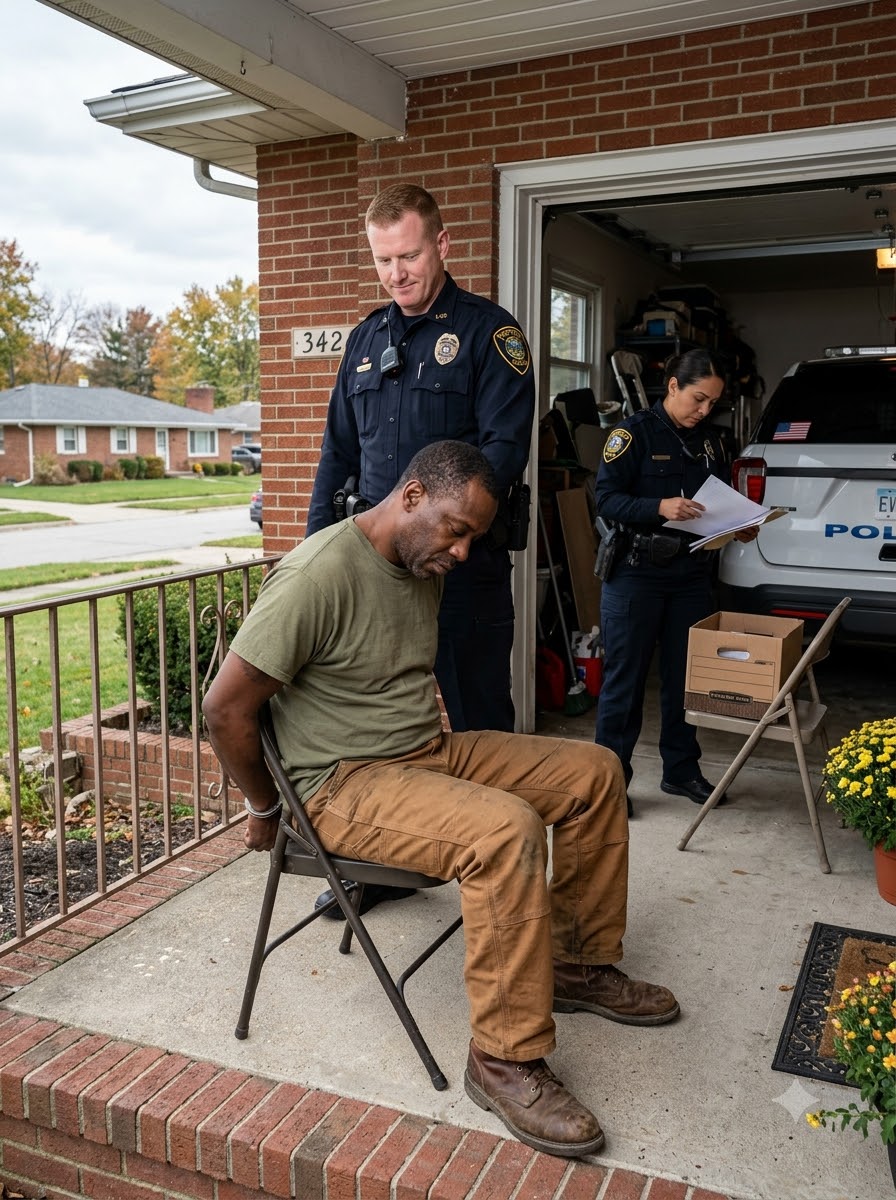
Marcus Johnson had just finished mowing the front lawn of his own home when three police cars came screaming down the quiet street.
The sound tore through Maple Ridge Lane like an alarm.
One moment, the neighborhood was peaceful.
Birds in the trees.
Sprinklers clicking across trimmed lawns.
A lawn mower cooling in the driveway.
The next, red and blue lights flashed across white porch columns and polished windows, bouncing off the largest brick colonial on the block.
Marcus set down his rake.
He wiped sweat from his brow with the back of one hand.
He was fifty-six years old, tall, Black, broad-shouldered, wearing a faded T-shirt, grass-stained work pants, and boots he had owned long enough for the leather to remember him.
He looked, to the wrong kind of eyes, like hired help.
That was the problem.
A neighbor had called in a report of a suspicious man trying to break into a mansion that did not belong to him.
Nobody on that street had believed the tall Black man standing in the yard, dirty from cutting grass, could possibly own the biggest house on Maple Ridge Lane.
Marcus watched the officers step out of their cruisers.
He did not run.
He did not shout.
He did not even look surprised.
A man who had spent more than twenty-five years in military service learned early that panic rarely improved a dangerous moment.
He lifted both hands slowly.
“Officers,” he said, calm and clear, “this is my home.”
The first officer, Sergeant Paul Whitaker, approached with one hand near his belt.
“Keep your hands where we can see them.”
Marcus kept them raised.
“I understand. My identification is in my wallet. My keys are in my pocket. The deed to the property is inside the house, but I have a copy on my phone if you allow me to show it.”
Whitaker glanced at the house behind him.
The brick facade.
The wraparound porch.
The manicured flower beds.
The expensive windows.
Then he looked back at Marcus’s stained clothes.
Suspicion hardened in his face.
“You expect us to believe you own this place?”
Marcus breathed once through his nose.
“Yes,” he said. “Because I do.”
A second officer, Ray Dobbins, gave a short laugh.
“Then why are you dressed like the gardener?”
Marcus looked down at his own clothes, then back at the officer.
“Because I was gardening.”
A few neighbors had already stepped onto their porches.
Phones came out.
Curtains shifted.
Across the street, Diane Carver stood with both arms folded, her face tight with the certainty of someone who believed fear was the same as judgment.
She had moved in next door only three weeks earlier.
She had never spoken to Marcus beyond a brief introduction at her housewarming, where he had politely declined a slice of cake because he had been on his way to help an elderly widow down the street repair a loose railing.
In those three weeks, Diane had built an entire story about him in her mind.
A large Black man.
Plain clothes.
Gray pickup truck.
Quiet.
Too quiet, in her opinion.
He came and went early.
Worked around the yard himself.
Rarely had visitors.
Never explained himself.
To Diane, that silence became suspicious.
That morning, she had watched him through her kitchen window as he moved confidently around the property. He unlocked the side gate, entered the garage, moved tools, crossed the front lawn, and climbed the porch steps like a man who belonged there.
And because she could not picture him belonging there, she called the police.
She described a suspicious individual attempting to break into a large home.
She gave every detail that made Marcus sound like a stranger.
Not once did she ask whether he might simply be the owner.
Now she stood watching the result of her call unfold.
Marcus reached slowly toward his pocket.
Whitaker’s voice snapped.
“Don’t move.”
Marcus froze.
“My wallet is in my right pocket,” he said. “You asked who I am. I am trying to show you.”
A younger officer stepped forward then.
Officer Elena Cruz.
Twenty-seven years old.
Eight months on the force.
Still new enough to notice details before habit buried them.
“Sergeant,” she said quietly, “maybe we should let him show ID before this escalates.”
Whitaker did not look at her.
“People breaking into houses have smooth explanations ready.”
Marcus heard that.
He kept his hands raised.
“Officer, I am not breaking into anything. I live here. My name is Marcus Johnson. The utilities, the deed, the tax records, the insurance, all under my name.”
Dobbins looked toward Diane.
“She called it in.”
Diane raised her voice from her porch.
“I know what I saw. He was going around the side of the house with tools. I’ve never seen him before.”
Marcus turned his head slightly.
“Ma’am, you met me three weeks ago.”
Her face flushed.
“I met a man named Marcus. I didn’t know you lived there.”
A murmur ran through the neighbors.
The distinction was not as innocent as she wanted it to sound.
Marcus looked back at the officers.
“May I show you my identification now?”
Whitaker hesitated.
Then nodded.
“Slowly.”
Marcus reached into his pocket with deliberate care. He removed his wallet, opened it, and held out his driver’s license.
The address matched the house.
He then took out a folded copy of the property deed, worn at the creases because he had carried it in his truck after closing on the house and never bothered to remove it.
Whitaker barely glanced at it.
Marcus pressed the remote clipped to his belt loop.
The garage door rose behind him.
Inside was a neatly organized space.
Tools along the wall.
A workbench.
A gray pickup truck.
And on a shelf near the back, folded with quiet pride, an American flag that had once flown over a base where Marcus had commanded soldiers through some of the most dangerous years of his life.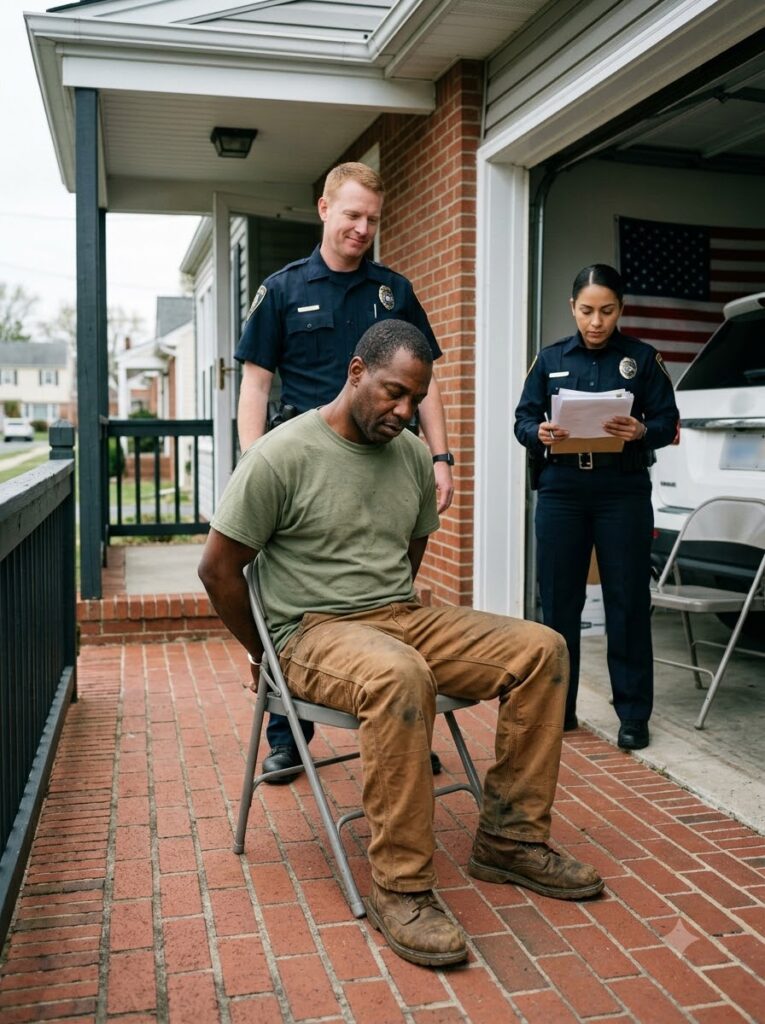
Cruz saw it.
So did Whitaker.
But Dobbins spoke first.
“Could have stolen the remote with the keys.”
The theory made little sense.
But suspicion rarely needs logic once pride has joined it.
Marcus’s expression remained calm.
“Officers, you have my license. You have a copy of my deed. You have my keys. The garage opened because I own the house. Please call the county property office. They will confirm it.”
Whitaker looked at the neighbors.
More phones were up now.
More people watching.
His authority had become a performance, and performances are dangerous when the performer fears embarrassment more than truth.
“Turn around,” he said.
Marcus looked at him.
“Excuse me?”
“Turn around. Hands behind your back.”
Cruz stepped forward.
“Sergeant, wait—”
“Stand down, Cruz.”
Marcus stared at Whitaker for one long second.
Not in defiance.
In disappointment.
Then he turned around.
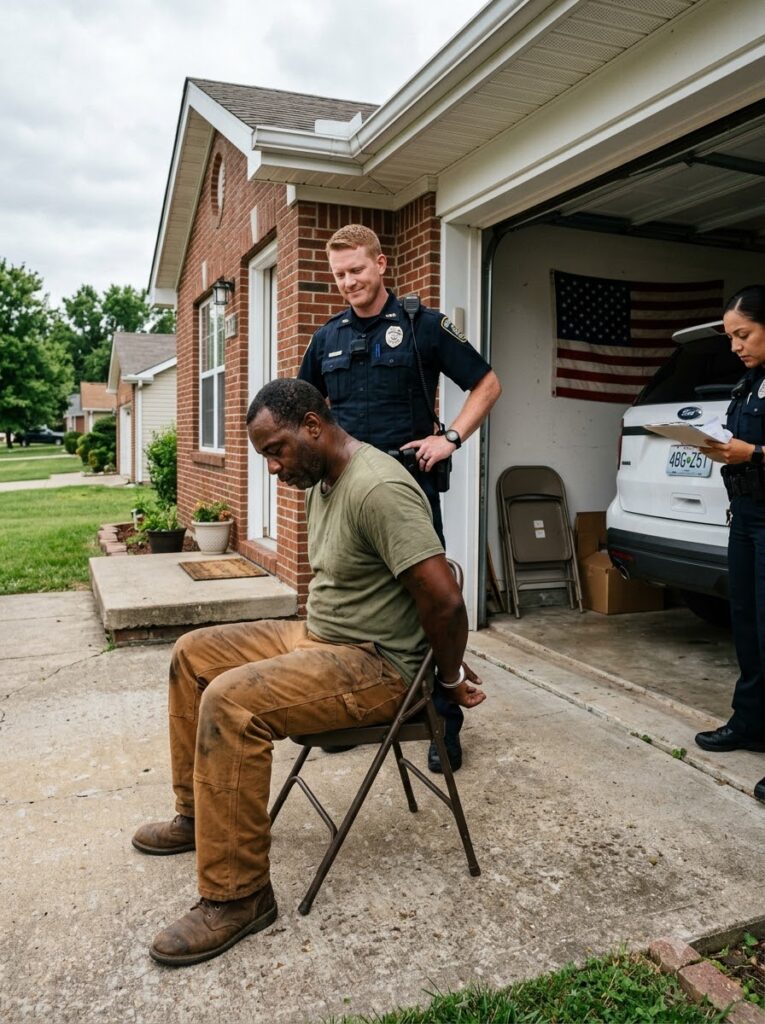
Cold metal closed around his wrists with a sharp click that seemed to echo down the quiet street.
For the first time that morning, something flickered across Marcus’s face.
Not fear.
Not anger.
A brief wound.
Then stillness returned.
He did not resist.
He did not pull away.
He understood with painful clarity that resistance would only make things worse for a man who looked like him.
As the cuffs tightened, more neighbors gathered on the sidewalk like spectators at a strange public trial.
Some whispered.
Some recorded.
One man across the street said, loud enough to be heard, “That’s what happens when people pretend to own things that aren’t theirs.”
A ripple of uncomfortable laughter passed through part of the crowd.
Marcus lowered his eyes for one moment.
Not in shame.
In the quiet effort of controlling emotions that had every right to rise.
Then he lifted his gaze again.
Steady.
Composed.
The morning that had begun with mowing his lawn had become another test of a discipline he had spent a lifetime building.
Six months earlier, almost nobody on Maple Ridge Lane knew much about the quiet man who lived at number fourteen.
Marcus had moved in a little over two years before, purchasing the brick colonial with savings built through more than twenty-five years in uniform.
He kept to himself.
He woke before dawn because his body still obeyed a schedule the military had written into his bones.
He tended his garden with the same precision he had once used to keep a forward operating base running.
He fixed his own gutters.
Repaired his own fence.
Mowed his own lawn every Saturday.
Most of his neighbors hired landscaping crews.
Marcus preferred doing the work with his own hands.
When Mrs. Adelaide Porter, the elderly widow two doors down, needed her driveway shoveled after a snowstorm, Marcus was there before sunrise with a shovel and a thermos of coffee.
He never mentioned it afterward.
When a teenager’s bike chain snapped near the corner, Marcus fixed it in ten minutes and refused the twenty-dollar bill the boy’s father tried to hand him.
When a storm knocked a branch across Diane Carver’s driveway during her second week in the neighborhood, Marcus quietly moved it before she woke up.
She never knew.
He was polite when spoken to, but he rarely volunteered information about himself.
Something about that reserve made people curious.
And not always kindly.
Some assumed he worked downtown.
Maybe logistics.
Maybe maintenance.
A few guessed security.
Nobody guessed the truth.
Inside Marcus’s home, in a study he rarely showed anyone, hung photographs of men in uniform standing in deserts, mountains, and places most Americans would never visit.
Medals rested in a shadow box.
Not displayed in the front hall.
Not arranged to impress visitors.
Simply preserved.
On a shelf in his garage sat a folded flag that had flown over a base where he had once commanded soldiers through nights so dangerous they still sometimes returned to him in sleep.
He kept it there not from shame, but from humility.
A soldier’s understanding that honor did not need to announce itself.
Marcus had grown up in a small town in Ohio, raised by a mother who worked double shifts at a diner and a father who had served twenty years in uniform before an injury forced early retirement.
His father had repeated one lesson so often it became part of Marcus’s bones.
Respect is earned through action, not noise.
Marcus enlisted the summer after high school.
He chose discipline and purpose because the future in front of him had been too uncertain to trust.
Over the decades, he rose steadily through the ranks. Not because he chased title for its own sake, but because men and women around him kept trusting his judgment in moments when judgment mattered most.
He missed birthdays.
Holidays.
Funerals.
Anniversaries.
Quiet ordinary milestones other families took for granted.
By the time he hung up his uniform for good, he had given more of his life to service than most people gave to anything.
Then he bought a house on Maple Ridge Lane, hoping for peace.
Not applause.
Not admiration.
Peace.
He hoped that in this chapter, a man in his fifties with a well-kept home and a quiet routine might be judged by what he did instead of how he looked doing it.
He was wrong.
Not entirely.
There were good people on the street.
Mrs. Porter adored him.
A mail carrier named Ben waved every afternoon.
Officer Cruz, standing in his driveway that morning, clearly understood something was off.
But an undercurrent had been building for months.
Suspicious glances.
Stiff nods.
Neighbors who crossed the street when Marcus approached.
A retired accountant across the road who watched him work in the yard with narrowed eyes.
Marcus noticed.
A man who had spent decades reading the mood of rooms did not miss suspicion when it was aimed at him.
But he said nothing.
He kept mowing.
Kept repairing.
Kept waving politely at people who did not wave back.
Dignity, to Marcus, meant refusing to let other people’s fear change who he was.
Now that dignity was being tested on his own front porch.
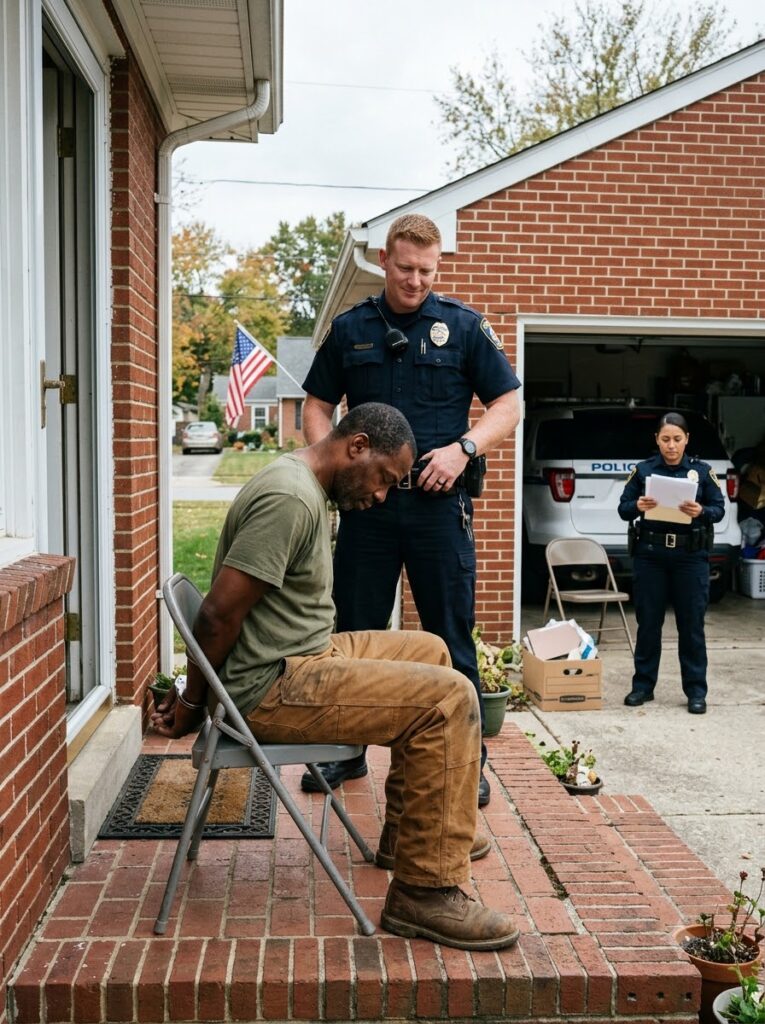
Whitaker guided Marcus down onto the top step.
He sat there cuffed, wrists behind him, spine straight, face composed.
Phones continued recording.
A teenager whispered something and laughed.
Another neighbor shook his head as if the scene confirmed something he had believed all along.
Dobbins looked down at Marcus.
“What do you do for a living?”
Marcus answered simply.
“I’m retired.”
“Retired from what?”
“The military.”
Dobbins gave a short, disbelieving laugh.
“Everybody served when it’s convenient.”
Marcus did not correct him.
He did not list assignments.
He did not name operations.
He did not speak of lives saved, missions completed, soldiers carried, letters written to families, nights spent awake because command did not end when the shooting stopped.
He simply sat in silence, absorbing an insult deeper than any of them understood.
Officer Cruz stood several feet away, hands tense at her sides.
She kept looking at the deed.
Then the license.
Then Marcus.
Then the cuffs.
Nothing about this made sense.
But she was young.
Whitaker was her sergeant.
And too many new officers learn quickly that being right and having the authority to act on it are not always the same thing.
Diane Carver watched from near the front of the crowd.
Her certainty had started to crack.
She had told herself she had done the responsible thing.
She had protected the neighborhood.
She had called the police because something looked wrong.
But Marcus’s calm face did not match the panic in her call.
His documents did not match her story.
His garage did not match the image of an intruder.
Still, she pushed the doubt away.
The police would sort it out.
That was what people told themselves when the system did something ugly in front of them and they wanted to remain clean.
Then a new sound reached the street.
A low, heavier engine.
Distinct from the idling patrol cars.
Heads turned.
A dark, unmarked military SUV rolled onto Maple Ridge Lane with unhurried authority. It slowed as it approached the gathered crowd, tinted windows revealing nothing.
Several officers exchanged uncertain glances.
Marcus lifted his head slightly.
Recognition passed through his eyes.
The SUV stopped directly in front of the house.
For a second, nobody moved.
Then the rear door opened.
A broad-shouldered man in a colonel’s uniform stepped out.
His posture immediately changed the air.
Even the officers straightened instinctively.
The colonel’s eyes moved quickly across the scene.
Patrol cars.
Neighbors.
Phones.
Then Marcus, seated in handcuffs on the steps of his own porch.
The colonel’s face changed.
Shock first.
Then anger held tightly behind discipline.
He strode forward.
“Who gave the order to restrain this man?”
No one answered.
Whitaker opened his mouth, then closed it.
Dobbins looked away.
Cruz looked at her sergeant.
Diane felt something cold settle in her stomach.
Before the colonel could repeat the question, another engine sounded at the end of the street.
Slower.
Heavier.
A long black limousine bearing military markings turned onto Maple Ridge Lane.
The crowd went silent.
The colonel turned toward it and snapped into a posture even more rigid than before.
The limousine stopped behind the SUV.
The rear door opened.
A tall man stepped out.
His uniform carried four silver stars.
Four.
The kind of rank that made rooms stand straighter before anyone said a word.
The effect on the street was immediate.
Every officer froze.
The colonel saluted sharply.
Neighbors who had been whispering minutes earlier now seemed afraid to breathe too loudly.
The general did not look at the crowd.
He did not look at the patrol cars.
His eyes fixed entirely on Marcus Johnson.
Cuffed.
Seated.
Humiliated on his own porch.
He crossed the lawn with long, purposeful strides.
Sergeant Whitaker felt his stomach twist.
He had spent fifteen years believing he could read a situation quickly.
That confidence had led him to dismiss every piece of evidence Marcus had calmly offered.
Now, watching a four-star general move with urgency toward the very man he had cuffed, Whitaker began to understand how badly he had misjudged the morning.
The general stopped in front of Marcus.
Then, to the shock of everyone watching, he knelt.
He brought himself eye level with the man in handcuffs.
His voice came low, thick with something almost like grief.
“Marcus,” he said. “I am sorry I kept you waiting.”
Marcus nodded once.
His expression softened only slightly, the way old friends acknowledge each other without needing many words.
“You were always late, Thomas.”
The general gave a small, painful smile.
“Only when the Pentagon gets involved.”
Then the smile vanished.
He turned sharply toward the nearest officer.
“Remove those cuffs. Now.”
Hands fumbled for keys.
Metal clicked.
The cuffs fell away from Marcus’s wrists and hit the porch step with a sound that seemed far too small for the moment.
Marcus rubbed the marks on his skin.
The general remained kneeling beside him.
Then he stood.
The four stars on his shoulders caught the morning light.
“Do you people know who this man is?”
No one answered.
The general did not wait.
“This is Command Sergeant Major Marcus Johnson, United States Army, retired. He commanded men in places most of you have only seen in filtered news footage. He saved soldiers under fire. He carried wounded men through terrain no helicopter could reach. He turned down promotion more than once because he refused to leave his unit when they still needed him.”
The crowd seemed to shrink.
The general’s voice grew quieter, but no less firm.
“He is one of the finest leaders I have ever known. And long before I wore these stars, I served under him. I learned from him what command was supposed to mean.”
Marcus looked down slightly.
He had never liked praise.
Especially public praise.
But the general continued because the street needed to hear what it had refused to see.
“There was a night many years ago when my convoy was ambushed in rugged terrain. We were pinned down. Wounded. Cut off from quick rescue. Marcus led the recovery effort. He guided the frightened, carried the injured, and refused to leave until every last soldier was accounted for.”
The general paused.
“Three men owed their lives directly to decisions he made that night. I was one of them.”
A sound moved through the crowd.
Not speech.
Realization.
Diane Carver covered her mouth.
Dobbins stared at the ground.
Whitaker could not look at Cruz.
The general turned toward the officers.
“This man showed you identification. He showed you ownership documents. He opened his garage. He complied with every command. And you still put him in cuffs because you decided the truth did not look the way you expected it to look.”
No officer spoke.
The colonel stepped beside the general, face hard.
“We came today because General Hayes requested a private visit with Mr. Johnson. He wanted to invite him to a small military ceremony honoring former special operations leaders.”
The colonel looked at the handcuffs on the porch step.
“It appears we arrived at a different ceremony entirely.”
Marcus rose slowly.
He did not rush.
He stood with the same straight spine he had maintained while seated.
The red marks around his wrists showed clearly.
The general looked at them, and pain moved across his face.
Marcus noticed.
“Thomas,” he said quietly, “I’m all right.”
The general looked back at him.
“No,” he said. “You are controlled. That is not the same thing.”
The words hit harder than anger would have.
Because they were true.
The local police department launched an internal review that afternoon.
Security footage from a neighbor’s camera showed Marcus driving into his own driveway at seven that morning, exactly as he did every Saturday.
Property records confirmed within minutes that Marcus Johnson had owned the house at number fourteen for more than two years.
There were no irregularities.
No suspicious transactions.
No evidence of a break-in.
No evidence of a crime.
The original call from Diane Carver had been based entirely on assumption.
Interviews with the officers showed what the footage already suggested. Marcus’s calm explanations had been dismissed almost immediately. His documents had been treated as suspicious rather than clarifying. His clothing had been judged more heavily than the deed in his hand.
Officer Cruz told internal affairs that she had asked her sergeant to slow down and verify the facts before making an arrest.
She had been overruled.
That detail mattered.
Not because it erased the harm.
Because it proved someone at the scene had seen the wrong thing happening while there was still time to stop it.
The department’s report used careful language, but the conclusion was clear.
Procedure failed.
Bias influenced judgment.
A homeowner had been restrained on his own property despite producing evidence of ownership.
News reached local reporters within a day.
By the next morning, the story of a decorated Black veteran handcuffed outside his own home had traveled far beyond Maple Ridge Lane.
The police chief came to Marcus’s porch without cameras.
That mattered to Marcus.
He did not want a performance.
The chief stood on the same steps where Marcus had been cuffed and offered a formal apology on behalf of the department. He acknowledged that the officers involved had failed to follow procedure and had allowed assumption to override basic investigation.
Marcus listened patiently.
Then thanked the chief for coming in person.
He did not ask for anyone to be humiliated.
He did not demand cameras.
He did not speak with revenge in his voice.
That surprised some people.
It did not surprise those who understood him.
Marcus’s restraint was not the absence of pain.
It was the presence of discipline.
The military released a brief statement confirming Marcus’s service record.
It verified every detail the general had spoken aloud on the lawn.
Decorations.
Assignments.
Years of service.
Leadership roles.
Acts of courage that Marcus had never discussed with his neighbors.
After that, the videos people had taken on their phones began disappearing quietly.
The teenager who had laughed deleted his clip.
The man who had mocked Marcus from across the street made his account private.
Several neighbors who had watched and said nothing now found it difficult to look at the porch when they passed.
A handful came to Marcus’s door to apologize.
He accepted some.
He listened to others.
He did not pretend apologies erased the morning.
But he also refused to turn his pain into a weapon.
Veterans began arriving at number fourteen.
Some drove hours.
Men and women Marcus had served with.
Others who had simply heard what happened and wanted to shake his hand.
One of them was Walter Higgins, gray-haired, walking with a slight limp, carrying a photograph in a plastic sleeve.
He stood on Marcus’s porch for a long time before he could speak.
“You carried me out of that ravine,” Walter finally said.
Marcus looked at him, and memory crossed his face.
“Walter.”
“I have a daughter now,” Walter said. “She’s married. Two kids. None of them exist if you didn’t come back for me.”
Marcus opened the door wider.
“Come in.”
They sat for hours over coffee, talking about men whose names were rarely spoken outside certain rooms, remembering things that belonged only to the people who had survived them together.
Walter admitted that watching the footage online had filled him with rage.
Marcus listened.
When Walter finished, Marcus said, “Anger is fair. But it is rarely the thing that changes people for the better.”
A community meeting was held within a week in the gymnasium of the local elementary school.
The room was packed.
Neighbors.
Police representatives.
Veterans.
Reporters waiting outside because Marcus requested the meeting itself remain for the community.
The department admitted publicly that its procedures had failed.
A new training program would be implemented, focused on recognizing and correcting assumption-based policing.
Verification would be required before restraining someone on their own property when ownership documentation was available.
Calls based solely on suspicion would be documented with clearer standards.
Sergeant Whitaker was suspended pending final disciplinary review.
Officer Dobbins received suspension and retraining.
Officer Cruz was commended for raising concern, though she accepted that recognition with visible discomfort.
Diane Carver stood near the back of the gym for most of the meeting.
Her hands shook.
Finally, she walked to the front.
She faced Marcus.
“I made that call,” she said.
The room went still.
“I told myself I was protecting the neighborhood. But I did not know you. I did not ask. I saw a Black man in work clothes at a house I assumed he could not own, and I turned that assumption into a police emergency.”
Her voice cracked.
“I am sorry for the pain I caused you.”
Marcus stood.
He walked toward her.
For a moment, Diane looked as if she expected him to condemn her publicly.
He did not.
He stopped in front of her and nodded once.
“I accept your apology,” he said. “I hope you learned something lasting.”
She cried then.
Not loudly.
Not for attention.
Because shame had finally become honest.
Marcus turned to the room.
“What happened to me was not created by one phone call alone,” he said. “It was created by everyone who watched assumption become action and treated it as normal.”
No one moved.
“I have worn uniforms most of my life. I respect duty. I respect law. But any uniform, military or police, means nothing if the person wearing it forgets that authority is not ownership over another person’s dignity.”
He looked around the gym.
“I do not want this community to remember me because a general came to my house. I want you to remember that before he arrived, you had already been given enough evidence to know I belonged there.”
Several people wiped their eyes.
Marcus continued.
“Real change does not come from punishment alone. It comes from choosing, again and again, to see people more clearly before fear gets to finish the story.”
When he sat down, the room did not applaud immediately.
It simply sat with what he had said.
That was better.
After the meeting, Officer Elena Cruz waited near the door until the crowd thinned.
“Mr. Johnson,” she said.
Marcus turned.
“I should have pushed harder that morning.”
He studied her.
“You noticed something was wrong.”
“I didn’t stop it.”
“No,” he said. “You didn’t.”
She looked down.
Marcus let the truth remain there for a moment.
Then he added, “Now decide what that discomfort will teach you.”
Cruz looked up.
“You think that matters?”
“I think moral courage usually begins before rank catches up with it.”
Later that year, Officer Cruz helped rewrite portions of the department’s training manual. She cited the events of that Saturday morning as the reason she pushed so hard for the changes.
Several weeks later, the military organized a small private ceremony.
Not to award Marcus another medal.
He had refused that immediately.
The gathering was meant simply to honor a lifetime of service that had remained almost entirely unknown to the community where he now lived.
Former soldiers.
Officers.
A few close neighbors.
Walter Higgins.
Mrs. Porter.
Diane Carver, standing quietly in the back.
General Thomas Hayes stood to speak.
“There are people who defend their country while wearing a uniform,” he said. “And there are people who continue defending its honor long after they take the uniform off.”
He looked at Marcus.
“Marcus Johnson belongs unmistakably to the second category. He guarded soldiers in war. And in retirement, he has guarded a quieter standard: what integrity looks like when no one is applauding.”
The room applauded warmly.
Marcus shifted uncomfortably in his seat.
He would have preferred to be home tending the garden.
After the ceremony, he declined several offers for a ride and drove himself home.
As he turned onto Maple Ridge Lane, neighbors were outside watering plants, walking dogs, collecting mail.
This time, they did not look away.
One by one, they raised their hands.
Simple greetings.
Respectful.
Quiet.
Not enough to undo what had happened.
But enough to begin something else.
Marcus lifted his hand in return.
The same way he always had.
He parked his truck, stepped out into the evening air, and walked toward the garage to retrieve his mower.
Saturday was Saturday.
The grass still needed cutting.
In the months that followed, Marcus’s life settled back into routine, though not exactly the same one.
Diane Carver began stopping by occasionally with cookies or cuttings from her garden. Small gestures neither of them discussed directly, but both understood as an ongoing act of repair.
Walter Higgins became a regular weekend visitor.
Other old friends from Marcus’s years of service found their way back into his quiet life.
What had begun as one of the worst mornings of his retirement became, unexpectedly, a bridge back to people and parts of himself he had placed gently aside.
The police department invited Marcus to speak with new recruits.
He declined most invitations.
He accepted a few.
Only small rooms.
No cameras.
No applause.
He never used those conversations to embarrass anyone by name. Instead, he spoke about evidence, restraint, humility, and the danger of deciding who someone is before letting facts speak.
“A badge,” he told one group of recruits, “is not proof that your first thought is correct. It is a reminder that your first thought carries consequences.”
By autumn, the story had faded from the news cycle.
Other headlines came.
Other outrages.
Other people’s pain.
But on Maple Ridge Lane, something permanent had shifted.
Neighbors who once crossed the street now stopped to talk about the weather, gardens, gutters, local school fundraisers, nothing special.
That was the point.
Ordinary conversation had become possible.
Marcus never brought up the incident unless someone else did.
Even then, he kept his answers brief.
He was more interested in moving forward than reopening what could not be undone.
He understood better than most that real change rarely announces itself with dramatic music.
It arrives quietly.
A neighbor asks before assuming.
An officer verifies before restraining.
A rookie speaks one sentence louder next time.
A woman who once called the police brings over tomato seedlings and learns the name of the man next door.
Trust is rebuilt one honest moment at a time.
And so Marcus kept mowing his lawn every Saturday morning.
He kept waving to every neighbor, whether they waved first or not.
He kept living the disciplined, unassuming life he had always lived, trusting that the truth of who a person is eventually finds its way into the light, even when the world is slow to see it.
One evening, as the sun dropped low over the rooftops, Marcus stood in his front yard after finishing the grass.
The American flag in his open garage stirred slightly in the breeze.
Diane Carver watched from her porch.
Not with suspicion anymore.
With quiet respect.
She did not call out.
He did not either.
Some repairs do not require speeches once the work has begun.
Marcus turned off the mower.
The street settled into the ordinary sounds of evening.
A dog barking two houses away.
A child laughing near a driveway.
A screen door closing.
A sprinkler clicking.
He looked at the houses around him, at the people who now saw him differently than they had only months before.
It was not applause he had ever wanted.
And it was not applause he received.
Only acknowledgment.
Quiet.
Steady.
Late.
But real.
Years later, people still told the story of Marcus Johnson.
Some told it like a dramatic reversal.
A Black man was handcuffed on his own porch, and then a four-star general stepped out of a military vehicle.
Some told it like a lesson in hidden greatness.
The quiet neighbor everyone underestimated turned out to be a decorated commander.
Some told it like humiliation for the officers and the neighbor who called.
Marcus never liked those versions.
They missed the deeper truth.
The lesson was not that the police cuffed the wrong Black man.
There should never have been a right Black man to treat that way.
The lesson was not that Marcus deserved respect because a general knew his name.
He deserved basic dignity before the SUV arrived.
Before the four stars caught the sunlight.
Before anyone learned about the medals, the missions, the lives saved, or the flag folded in his garage.
He deserved it when he was just a man mowing his lawn.
A homeowner with grass on his boots.
A neighbor doing ordinary work on an ordinary Saturday morning.
That should have been enough.
The general’s arrival did not create Marcus’s worth.
It only forced the street to recognize what had been standing in front of it all along.
Marcus Johnson had spent his life protecting others.
In war.
In service.
In quiet retirement.
But on Maple Ridge Lane, his final lesson to the people around him was not about combat, medals, or rank.
It was about the discipline of seeing clearly.
Not assuming.
Not shrinking another person to fit your fear.
Not waiting for authority to confirm someone’s humanity.
Because true honor asks for nothing.
It does not beg to be noticed.
It does not announce itself from the porch.
It stands steady in grass-stained boots, with keys in one hand and proof in the other, waiting for the world to become honest enough to see it.
And in the end, even on a street that had misjudged him, Marcus’s honor found its way into the light.
