

Rain swept off Interstate 75 in gray curtains that Tuesday night, blowing sideways beneath the canopy lights of Laam’s Gas and Go at Exit 41 in Mcketric County, Georgia. It was 11:40 p.m. in October. The sodium lamp above pump 6 had a faulty ballast, buzzing and flickering as though it couldn’t decide whether to stay alive.
Later, everyone would remember that light.
It appeared in the footage, flashing across the wet concrete seconds before everything changed.
A woman wearing a high-visibility vest stood beside the diesel island, holding a clipboard protected by a plastic grocery bag. She was in her mid-40s, medium height, with braids pulled beneath a Delmare Freight cap whose brim had softened from months of use.
Her name tag read Rey.
She drove a 2009 Silverado with a cracked windshield and a rosary dangling from the rearview mirror. She had bought it at a truck stop in Chattanooga because it looked exactly like something Ray Turner would drive.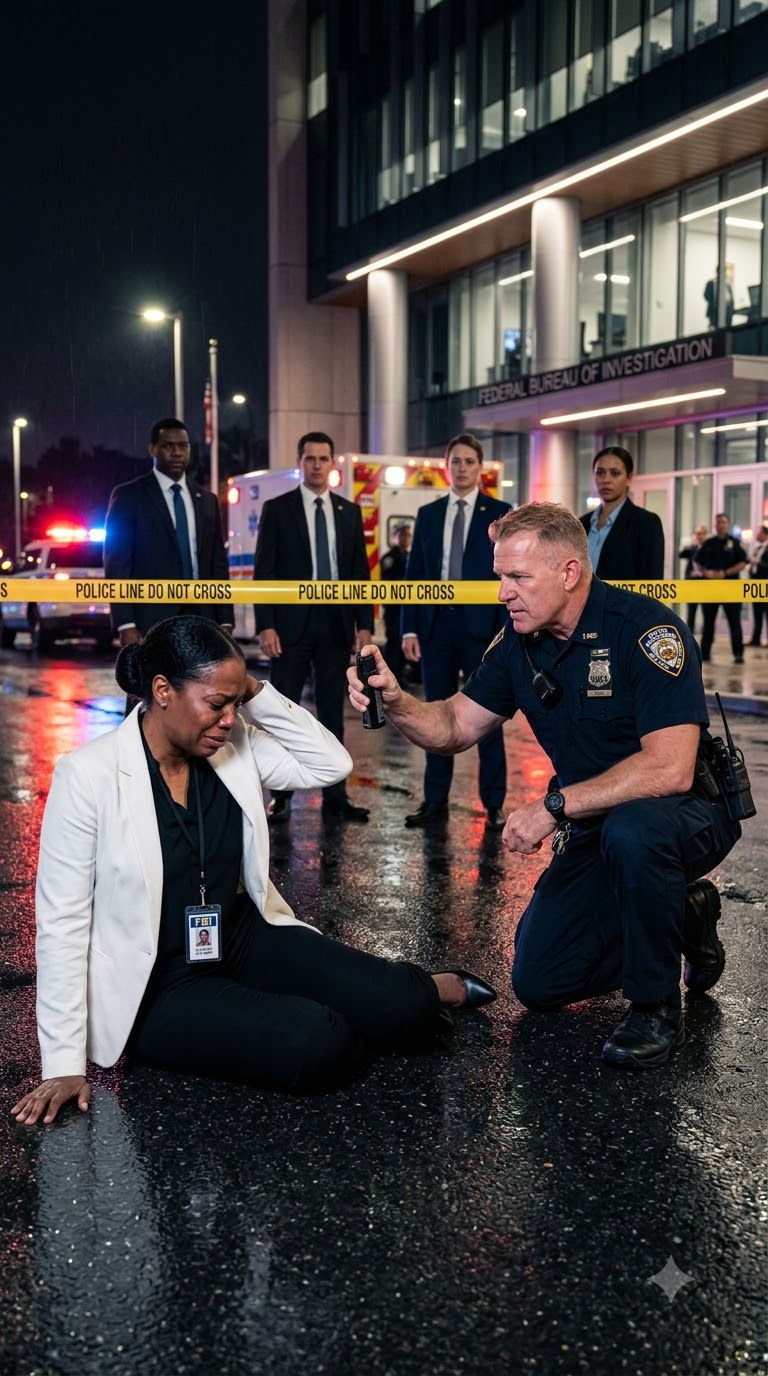
She smelled of diesel and burnt gas-station coffee.
That was deliberate.
She had smelled like diesel and burnt coffee for 26 months.
She checked her clipboard.
She recorded a fuel receipt that meant nothing.
And roughly every 40 seconds, without appearing to look, her eyes drifted toward the silver Peterbilt 389 parked at the far edge of the lot.
The engine was running.
The lights were on.
The wipers were off.
The door carried the words Ashlin Produce.
There was no produce inside that truck.
There never had been.
Inside the store, Denny Laam, a 19-year-old clerk, would later tell reporters that she came in most nights, ordered the same coffee, left a dollar tip, and rarely spoke.
Just another tired woman working overnight, he thought.
At 11:44 p.m., a Calder Police Department cruiser came down the exit ramp, its headlights streaking across the rain. Unit 12 turned into the lot.
The officer behind the wheel had eleven years on the job and a piece of cinnamon gum between his teeth.
Over the next 19 minutes, he would make the worst decision of his life.
His name was Derek Sloan.
Sloan parked crookedly across two spaces near the air pump, as he always did because nobody had ever made him stop. He sat inside the cruiser for several seconds while the windshield wipers moved back and forth.
Then he keyed his radio.
He told dispatch he was checking on a suspicious person at Laam’s.
Dispatch asked, “Suspicious how?”
There was a pause.
Then Sloan answered, “Just checking it out.”
There had been no complaint.
No emergency call.
Denny hadn’t contacted the police.
The only people paying serious attention to the lot were the woman by the diesel island, the men inside the silver Peterbilt, and Officer Derek Sloan, who had just noticed a Black woman standing alone beside a fuel pump late at night and decided she was a problem that required his attention.
He stepped from the cruiser.
He put his hat on against the rain and walked toward her slowly, thumbs hooked into his belt.
The defective light over pump 6 stretched his shadow across the concrete, swallowed it, then threw it forward again.
“Evening,” he said.
It wasn’t really a greeting.
It was an opening move.
The woman turned.
She kept both hands visible. The clipboard remained in her left hand, while her right hung loosely at her side.
“Evening, officer.”
Her voice was calm, warm, and completely untroubled.
Anyone trained to recognize it would have noticed how practiced that calm sounded.
Sloan didn’t know what he was listening for.
“You work here?”
“I work the lot for Delmare Freight. Dispatcher and yard check. We got contract trucks fuel here overnight. I log them in and out.”
She tapped the vest.
That’s why she was dressed like that.
Sloan looked at the vest.
Then the clipboard.
Then the Silverado with its cracked windshield.
Something had already settled behind his eyes.
Now he was searching for a reason to justify it.
“Delmare Freight,” he said. “Never heard of it.”
“Out of Marietta. We’re small.”
“You got some ID on you?”
“I do. It’s in the truck in the glove box along with my worksheet. You want, I can walk over there with you and get it. Slow and easy. Everything in plain view.”
She delivered the sentence exactly as she had delivered similar sentences hundreds of times during training and dozens of times in real situations.
Because in her line of work, staying alive often meant never surprising another person.
Sloan didn’t approach the truck.
Instead, he moved half a step closer.
Rain ran steadily from the brim of his hat.
“Here’s my problem,” he said. “I’ve worked this exit 11 years. 11 years. I know every trucker comes through here, every clerk, every tow driver, every dispatcher. I know Ray Laam and I knew his daddy.”
“And I have never once seen you.”
“I work nights. Started in the spring.”
“Uh-huh.”
He smiled without warmth.
“See what I usually find this hour. Somebody hanging around a fuel island who doesn’t buy fuel. They’re working all right, just not the kind of work goes on a clipboard.”
She let the words sit between them.
Rain drummed against the canopy.
Fifty yards behind Sloan, the Peterbilt’s lights remained steady through the curtain of rain.
Inside that truck, a man named Vasco was watching.
Every second that the uniformed officer remained beside her was another second of risk to an operation that had consumed 26 months of her life.
Still, she remained composed.
“Officer,” she said, “I understand you’ve got a job to do. Mine’s in the glove box. Let’s go look at it.”
“Did I ask you to tell me my job?”
His voice sharpened.
The gum stopped moving.
“Did I ask for your input?”
“No, sir.”
“No, sir is right.”
He pulled out his flashlight and directed the beam straight at her face even though the canopy lights already illuminated the area.
It was the kind of thing that made a person feel smaller.
“What’s your name?”
“Ray Turner.”
“Date of birth.”
She gave him one.
It matched a Georgia driver’s license sitting in a glove box.
It matched a lease for a one-room apartment in Calder.
It matched a Delmare Freight employee record.
It matched a nearly empty Facebook profile.
It matched a carefully constructed identity built by people whose entire profession was constructing identities.
It would have survived any routine records check.
But Sloan didn’t run it.
Running it would have ended the encounter.
And some part of him—the same part that had accumulated nine civilian complaints in eleven years without a single sustained finding—didn’t want the encounter to end.
This was the part of the job he enjoyed.
“Turn out your pockets,” he said.
“Am I being detained?”
That question changed everything.
Those four quiet words from a Black woman standing in the rain hit Derek Sloan like an electric shock.
Denny saw the change through the store window.
He reached for his phone.
He began recording.
That decision meant the world would eventually see what happened from two different angles.
“Am I being?” Sloan repeated.
He laughed and looked around the nearly empty lot as though he had an audience.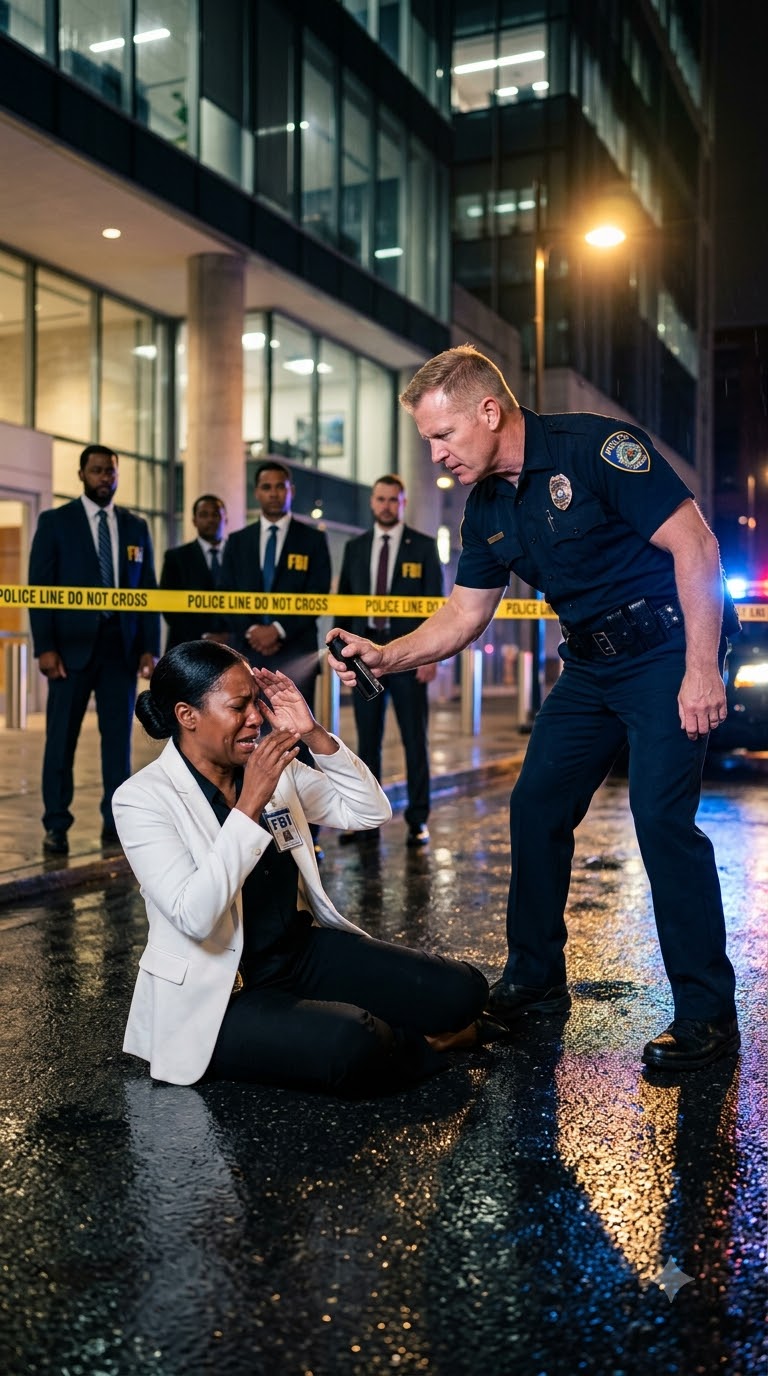
“You watch that on YouTube. You get that off a video.”
He stepped close enough for her to smell cinnamon gum and wet polyester.
“Let me educate you on how it works out here. This is my exit.”
“Midnight comes, I decide who’s suspicious, and I’ve worked this lot long enough to know exactly what your kind comes out here at midnight to sell.”
There it was.
The ugly truth beneath everything.
And he had said it aloud.
The cameras caught every word.
The woman who wasn’t really Ray Turner inhaled slowly through her nose.
Diesel.
Rain.
Cinnamon gum.
She thought about the nine faces pinned to a corkboard in a windowless room in Atlanta.
The youngest was fifteen.
Then she made the same decision she had made every night for 26 months.
The operation mattered more than her pride.
More than her anger.
And, if necessary, more than her own safety.
“Officer,” she said, “I’m going to reach into my vest pocket slowly with two fingers and take out my phone. I’d like to call my dispatcher. He can verify my employment in about 30 seconds, and we can both get out of this rain.”
She deliberately announced every movement.
Her hand rose toward the vest pocket at the speed of a minute hand.
Two fingers extended.
Palm angled outward.
Textbook.
She was still explaining the movement when Derek Sloan seized her wrist.
He twisted her sideways toward the pump.
“Stop reaching.”
“Stop reaching.”
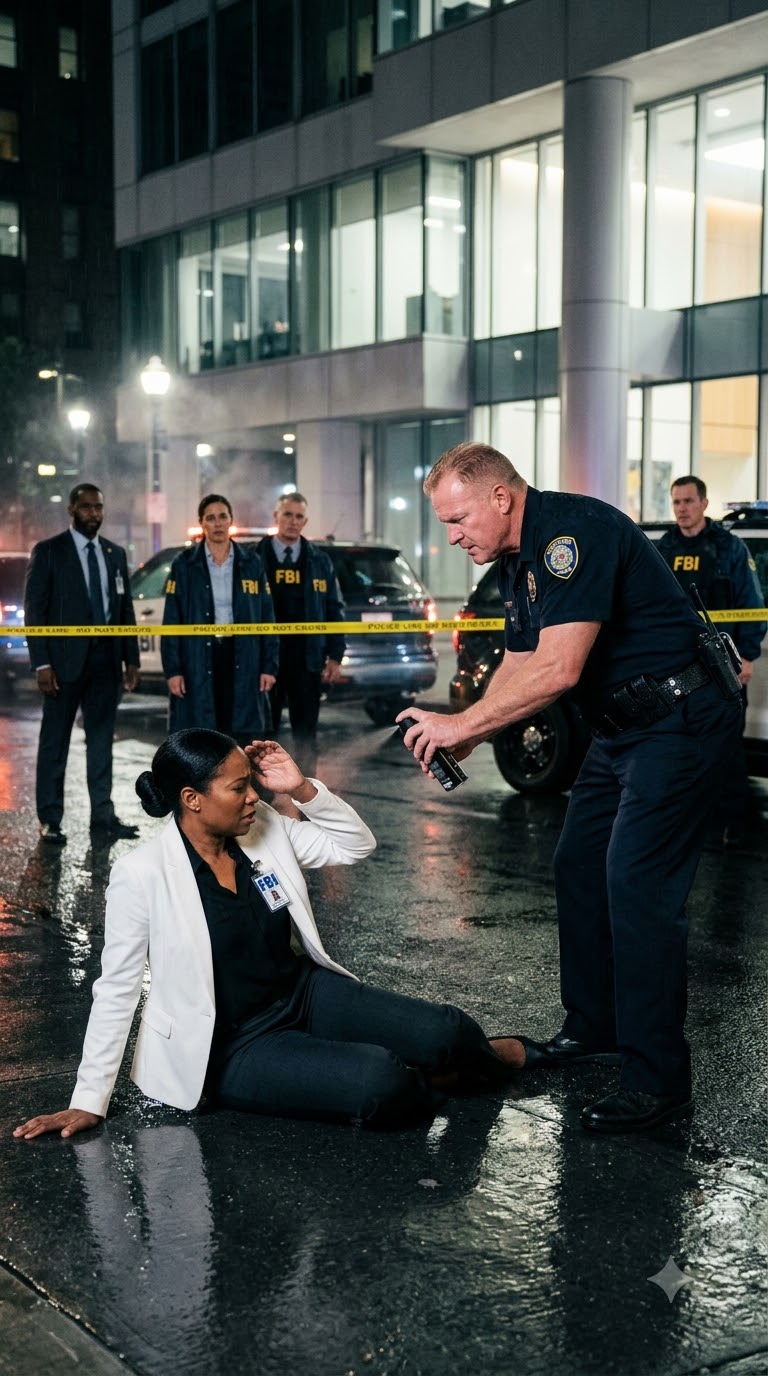
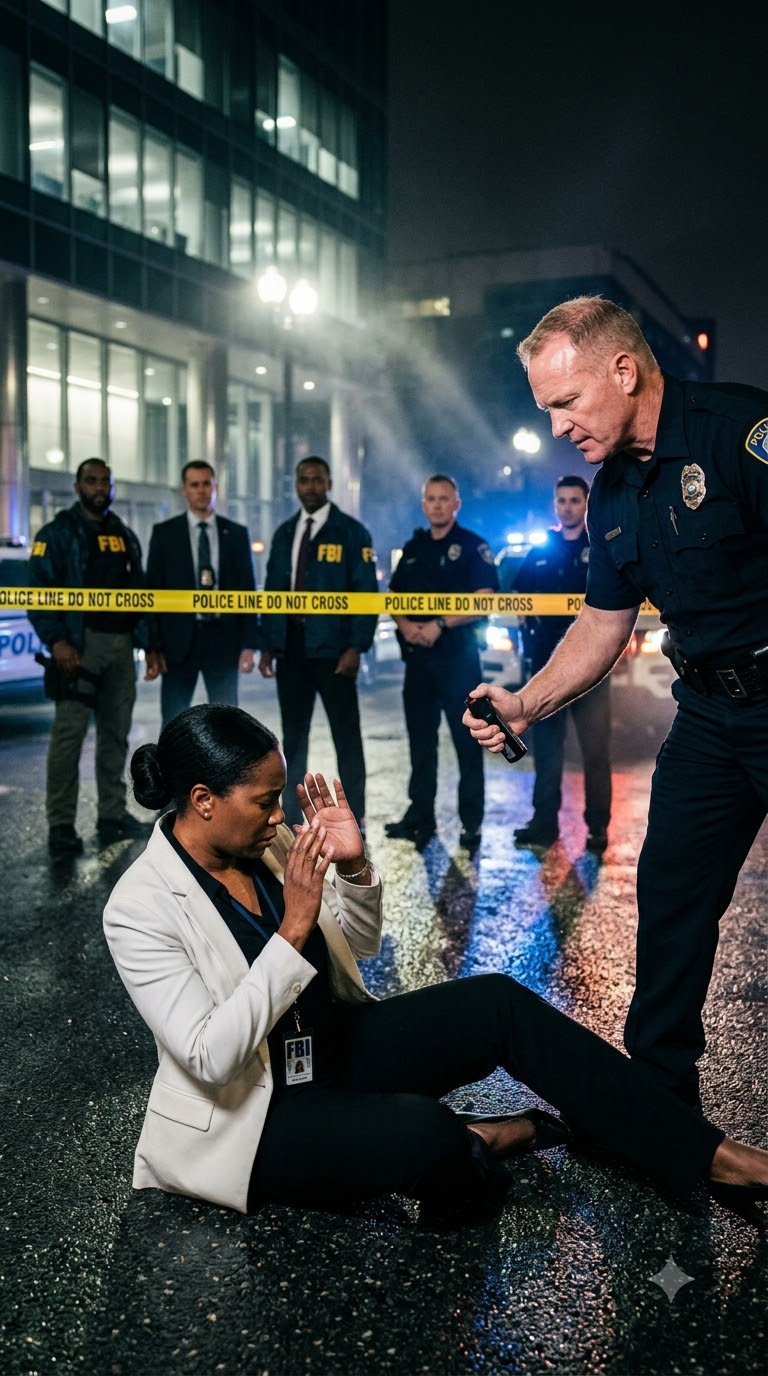
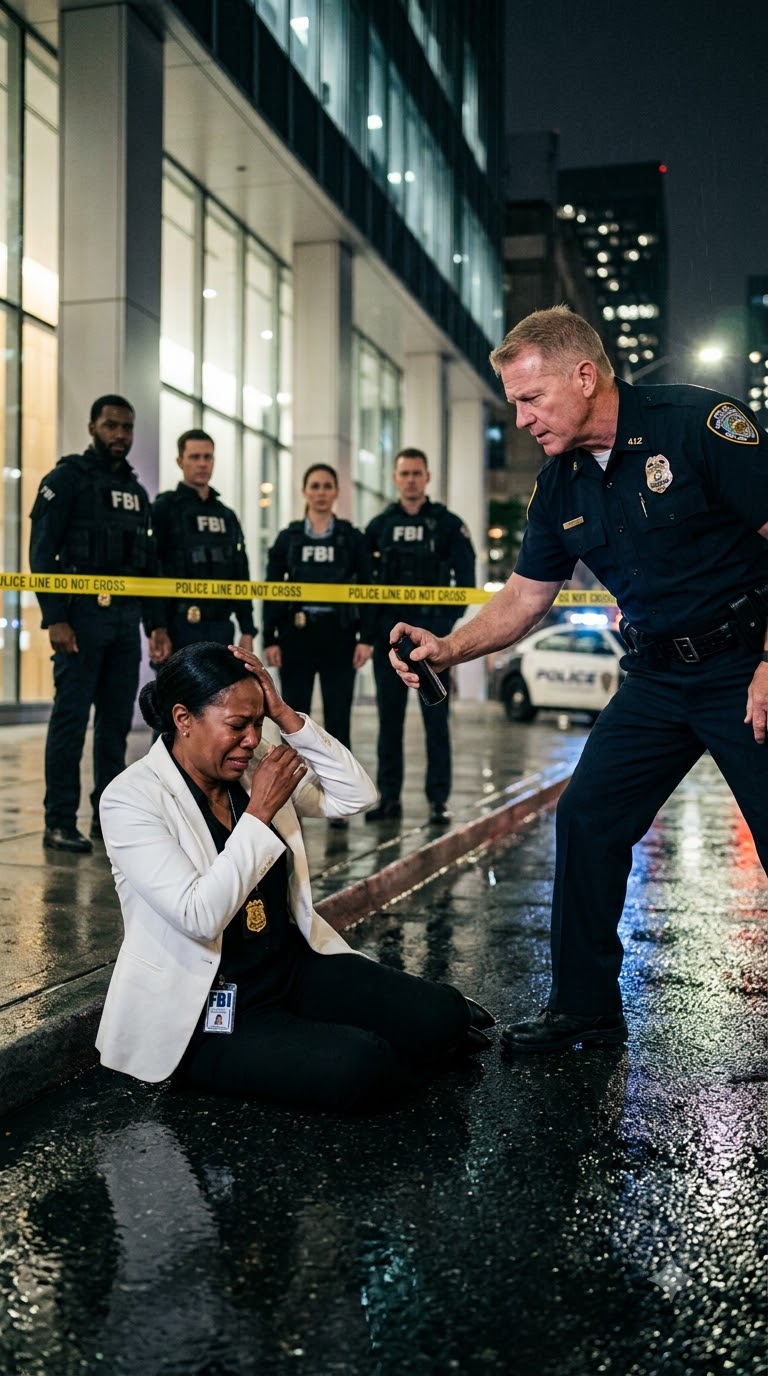
Then he fired pepper spray from roughly eight inches away.
There is no dignified way to describe what oleoresin capsicum does to a human being, and later, under oath, she would insist that nobody soften the description.
The world became orange.
Then it disappeared.
Her eyes slammed shut and refused to open.
No matter how fiercely her mind ordered them open, her body overruled everything to protect them.
Fire tore down her throat.
Her chest tightened.
Every breath felt like broken glass.
She dropped onto both knees on the wet concrete.
Coughs ripped through her in long, painful bursts.
Her nose ran.
Her eyes streamed.
Rain mixed with mucus across her face.
Somewhere above her, a man’s voice shouted:
“Stop resisting at a blind kneeling woman.”
Then her arms were pulled behind her.
The handcuffs clicked shut.
They ratcheted twice past snug.
Cold concrete pressed through her jeans.
The light above pump 6 flickered.
Buzz.
Dark.
Buzz.
But through the burning and blindness, one part of her mind remained completely cold.
The trained part.
The part that had kept her alive in stash houses, truck cabs, motel parking lots, and dozens of dangerous meetings.
That part listened for one sound.
An engine shifting into gear.
The Peterbilt was leaving.
She heard the air brakes release.
The diesel engine rose in pitch.
Eight tires rolled slowly past the fuel island.
The ground trembled beneath her knees.
She understood exactly what that meant.
Vasco was looking down from the cab.
He was seeing the lot worker arrested in the rain.
Whatever conclusion he reached during the next quarter mile could determine whether Operation Night Jar had a future by morning.
The truck reached the ramp.
Its turn signal clicked.
Absurdly lawful.
The silver Peterbilt with the Carolina blue stripe merged onto Interstate 75 and disappeared into the rain, carrying 26 months of her work away at a careful 60 miles per hour.
Officer Derek Sloan stood over his prisoner.
He felt the way he always felt afterward.
Tall.
He keyed his radio.
“One in custody, female, resisting.”
Dispatch acknowledged.
Sloan chewed his gum.
He looked down at the woman coughing on the pavement.
Then he said the sentence that would later be played again and again inside a federal courtroom.
“Should have just shown me some ID, sweetheart. Out here, your kind gets exactly one warning.”
That was it.
It was 11:58 p.m.
He had been there for fourteen minutes.
At that moment, he had roughly six minutes of his old life remaining.
The collapse began quietly.
The phone inside her vest started ringing.
Not her personal phone.
The other one.
The one with exactly four numbers stored inside it.
The ringtone was an ordinary factory chime.
It rang once.
Stopped.
Rang again.
Stopped.
Then rang a third time.
Anyone trained in federal operations knew what three consecutive calls on that phone meant.
Your people are watching.
Stand by.
Sloan pulled the phone from her vest.
He looked at the screen.
“Your dispatchers real eager.”
He silenced the call and placed the phone on the hood of his cruiser.
Then his radio crackled.
“Unit 12, Mcketric 12.”
Sloan lifted the radio.
“Go ahead.”
A pause.
Radio pauses have textures.
This one felt different.
Then dispatch said, “Unit 12, confirm the identity of the female you have detained.”
Sloan looked toward the woman on the pavement.
“Ray Turner.”
Another pause.
“Run the name again.”
Sloan frowned.
“I already did.”
“Run it again.”
He glanced toward the cruiser.
For the first time, something inside him shifted.
He walked to the driver’s door, opened it, and pulled up the computer terminal.
He typed the name.
RAY TURNER.
The system returned a valid Georgia driver’s license.
Delmare Freight.
Calder address.
Everything appeared normal.
He leaned closer.
Then he noticed the small notation at the bottom of the screen.
His eyebrows tightened.
He clicked it.
The system asked for authorization.
He entered his credentials.
The screen refreshed.
And the name disappeared.
Not because the record was fake.
Because the record had been restricted.
Sloan stared at the screen.
Behind him, the woman was still coughing.
He turned toward her.
“Who are you?”
She didn’t answer.
Not yet.
His radio came alive again.
“Unit 12, step away from the subject.”
Sloan froze.
“Repeat?”
“Step away from the subject. Do not remove her restraints. Do not question her further.”
He looked toward the store.
Denny was still standing behind the counter.
His phone was still raised.
Then headlights appeared at the entrance.
Not one vehicle.
Three.
Unmarked SUVs entered the lot without sirens.
They stopped behind Sloan’s cruiser.
Doors opened.
Men and women stepped out wearing dark jackets.
One of them held a federal credential wallet.
Sloan’s stomach dropped.
A tall Black man in his late 40s walked directly toward him.
He didn’t hurry.
He didn’t shout.
He simply held up his credential.
“Federal Bureau of Investigation.”
Sloan’s mouth opened.
The man looked past him toward the woman on the ground.
“Is she still cuffed?”
Sloan swallowed.
“Yes.”
“Remove them.”
Sloan hesitated.
The agent’s voice remained level.
“Now.”
Sloan crouched.
His hands suddenly didn’t feel as steady as they had ten minutes earlier.
He unlocked the first cuff.
Then the second.
The woman slowly brought her arms forward.
Her eyes were still squeezed shut.
Her breathing remained ragged.
The agent knelt beside her.
“Agent Turner.”
Her expression didn’t change.
But her head moved slightly.
“Can you hear me?”
She nodded.
The agent looked at Sloan.
“Get medical personnel.”
Sloan stared at him.
“You said Agent Turner.”
The FBI agent stood.
“That’s correct.”
The silence that followed seemed louder than the rain.
Denny’s phone remained pointed toward the scene.
Another agent took the phone from Sloan’s cruiser hood.
A second retrieved the undercover agent’s identification.
And then the tall agent turned toward Sloan.
“You have any idea who you just pepper-sprayed?”
Sloan looked at the woman.
She had finally managed to open one eye.
She looked exhausted.
Angry.
Controlled.
And unmistakably alert.
The agent answered for her.
“She’s been embedded in Operation Night Jar for twenty-six months.”
Sloan’s face went pale.
Night Jar.
He knew the name.
Everyone in the department knew the name.
It was the federal investigation into a trafficking network that had moved people and contraband through interstate freight routes.
But what Sloan didn’t know was that the woman standing beside him wasn’t merely an undercover agent.
She was the person federal prosecutors had identified as one of the operation’s key field investigators.
And the Peterbilt he had watched leave?
That wasn’t carrying an ordinary truck driver.
Vasco wasn’t a random suspect.
He was the central target.
Sloan looked toward Interstate 75.
The truck was gone.
The agent followed his gaze.
“Because of your stop, our target is now aware that something is wrong.”
Sloan’s voice cracked.
“I didn’t know.”
“No,” the agent said. “You didn’t.”
Behind them, another FBI agent approached with a tablet.
“We have the truck.”
Everyone turned.
“Where?”
“Northbound. They’re tracking it now.”
The agent looked toward the undercover woman.
“Vasco hasn’t abandoned the route.”
She slowly pushed herself upright.
Her eyes were red and swollen.
Her voice was barely above a whisper.
“He’s heading to the secondary transfer point.”
The lead agent nodded.
“Then Night Jar isn’t dead.”
He looked at Sloan.
“But this scene is.”
By 12:17 a.m., paramedics had arrived.
Sloan stood several yards away while the undercover agent was treated.
Nobody spoke to him.
Nobody needed to.
His body camera was already evidence.
Denny’s recording was evidence.
The cruiser camera was evidence.
The dispatch logs were evidence.
And the words Sloan had spoken were evidence.
Every single one of them.
At 1:03 a.m., an FBI supervisor arrived.
She walked directly to Sloan.
“Officer Sloan.”
He turned.
“Yes, ma’am.”
“You’re going to surrender your firearm and remain here.”
His hand moved automatically toward his duty belt.
Then stopped.
He removed the weapon.
The supervisor took it.
“Am I under arrest?”
“Not at this moment.”
Sloan exhaled.
“Then what happens now?”
She looked toward the ambulance.
“What happens now is that you stop talking until your attorney arrives.”
The words landed harder than he expected.
He looked down at the wet pavement.
For eleven years, he had been the person standing over someone else.
The person giving instructions.
The person deciding who was suspicious.
Now he was the one being watched.
At dawn, Operation Night Jar moved forward.
The Peterbilt was intercepted nearly two counties away.
Vasco was arrested.
The secondary transfer point was secured.
Several members of the trafficking network were taken into custody.
And the operation survived.
But something else began that morning.
An internal investigation.
Then a state investigation.
Then a federal civil-rights inquiry.
The footage from Laam’s Gas and Go became impossible to dismiss.
There was no question about what had happened.
The body camera showed Sloan approaching without a complaint.
The store video captured his comments.
The cruiser footage captured the pepper spray.
The audio captured his statements after the arrest.
And the dispatch records showed that he had never been responding to an actual call.
Within weeks, Derek Sloan was placed on administrative leave.
The nine prior civilian complaints were reopened.
Several witnesses came forward.
Former detainees described encounters that suddenly sounded very different when placed beside the footage from that rainy October night.
The phrase “Out here, your kind gets exactly one warning” became one of the most damaging pieces of evidence in the entire case.
Sloan eventually faced federal civil-rights charges and departmental disciplinary proceedings.
He pleaded not guilty.
His attorney argued that Sloan had believed the woman was reaching for something dangerous and that the use of force had been a split-second decision.
But the video showed something else.
It showed a woman announcing exactly what she was doing.
It showed two fingers.
It showed her hand moving slowly.
It showed Sloan grabbing her before she reached the pocket.
And it showed the spray.
The federal case against him became public months later.
By then, Agent Turner had returned to work.
Her undercover identity was officially retired.
The name Ray Turner disappeared from every operational file.
She never went back to Laam’s Gas and Go.
Denny did.
He kept the original recording on three separate drives.
When reporters asked why he had filmed that night, he always gave the same answer.
“I saw something wrong.”
He never called himself a hero.
He said he had simply pressed record.
But that recording changed everything.
Six months after the arrest, Agent Turner testified during a federal proceeding connected to the broader Night Jar investigation.
She walked into the courtroom wearing a dark navy suit.
No vest.
No fake name.
No clipboard.
No truck-stop rosary.
Her FBI badge remained clipped discreetly at her waist.
The prosecutor asked her about the night at the gas station.
She described the rain.
The broken light.
The Peterbilt.
The conversation.
The pepper spray.
The handcuffs.
And the moment she realized Vasco had seen her arrest.
Then the prosecutor asked the question everyone had been waiting for.
“Agent Turner, when Officer Sloan stopped you, did he know you were an FBI agent?”
“No.”
“Did you identify yourself as an FBI agent?”
“No.”
“Why not?”
She paused.
“Because I was undercover.”
The courtroom remained silent.
Then the prosecutor asked:
“Was your badge important that night?”
Agent Turner looked toward the jury.
“No.”
She took a breath.
“The badge wasn’t what mattered.”
“What did matter?”
“The fact that I was a human being who told him exactly what I was going to do, and he chose not to listen.”
Nobody moved.
She continued.
“I didn’t need special treatment because I was an FBI agent. I needed the same restraint and judgment anyone else should receive.”
The prosecutor nodded.
That sentence stayed with the jury.
And later, it stayed with the public.
Derek Sloan eventually lost his badge.
Not because Agent Turner had been a federal agent.
Not because the FBI arrived.
Not because Night Jar was a major operation.
He lost it because the evidence showed what he had done when he believed nobody important was watching.
But somebody had been watching.
Denny had been watching.
The cameras had been watching.
Dispatch had been listening.
And the woman on her knees in the rain had been remembering every detail.
The broken light.
The cinnamon gum.
The wet concrete.
The words.
All of it.
And when the case finally ended, Agent Turner returned to Atlanta, walked into the same windowless room where nine faces had once covered a corkboard, and removed the last photograph.
Operation Night Jar was over.
Twenty-six months were finally finished.
She stood there for a moment, holding the photograph in both hands.
Then she placed it in the evidence archive.
Her supervisor appeared in the doorway.
“You all right?”
She nodded.
“Yeah.”
“Going home?”
She looked at the empty board.
“In a minute.”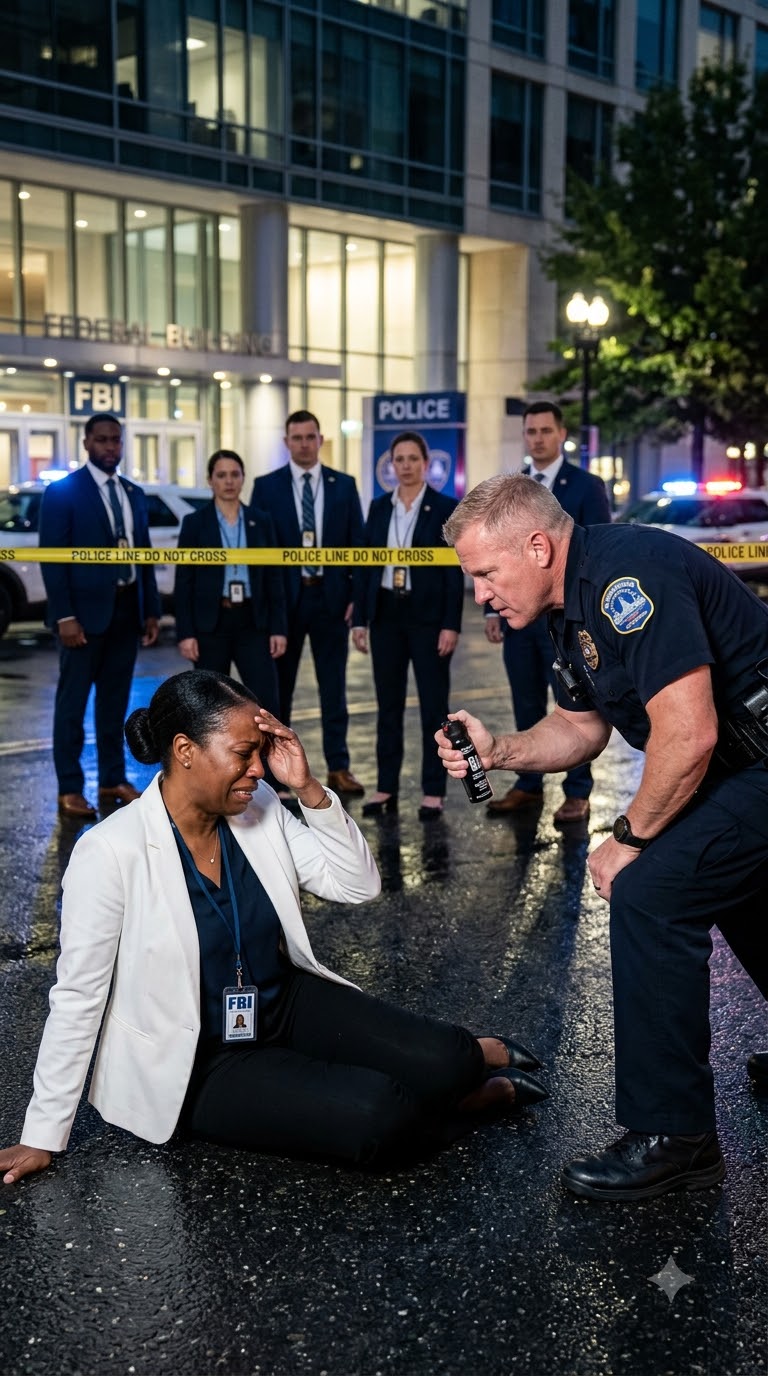
Outside, Atlanta was beginning another ordinary morning.
Traffic moved.
People bought coffee.
Trucks rolled along the interstate.
And somewhere on I-75, another driver passed Exit 41 without ever knowing what had happened there.
The broken light over pump 6 had been replaced.
The canopy was brighter now.
Denny still worked at the store.
And every time rain came sideways across the pavement, he remembered the night a woman everyone thought was just another tired employee had been forced to her knees.
He also remembered what happened afterward.
The truth didn’t arrive loudly.
It arrived through a phone call.
Then a radio transmission.
Then three unmarked SUVs.
Then a federal credential.
Then a camera recording every word.
Derek Sloan had believed the badge gave him the final word.
He had believed the woman in front of him was powerless.
He had believed nobody important would ever care.
He was wrong on all three counts.
Because her badge had never been the most dangerous thing he faced that night.
The evidence was.
