

Chapter 1: The Invisible Daughter
My father, Richard Whitmore, had invited the entire family to Thanksgiving dinner as though we were the kind of family that gathered around a mahogany table with genuine smiles and warmth.
We weren’t.
By five in the afternoon, the dining room of my parents’ sprawling Westchester, New York, estate was glowing beneath the warm light of silver candelabras. The air carried the rich scent of roasted turkey, sage stuffing, and the expensive perfume of people who had never worked a day in their lives. Crystal glasses chimed like wind chimes, creating a soundtrack of wealth and pretense that I had spent my entire life trying to escape.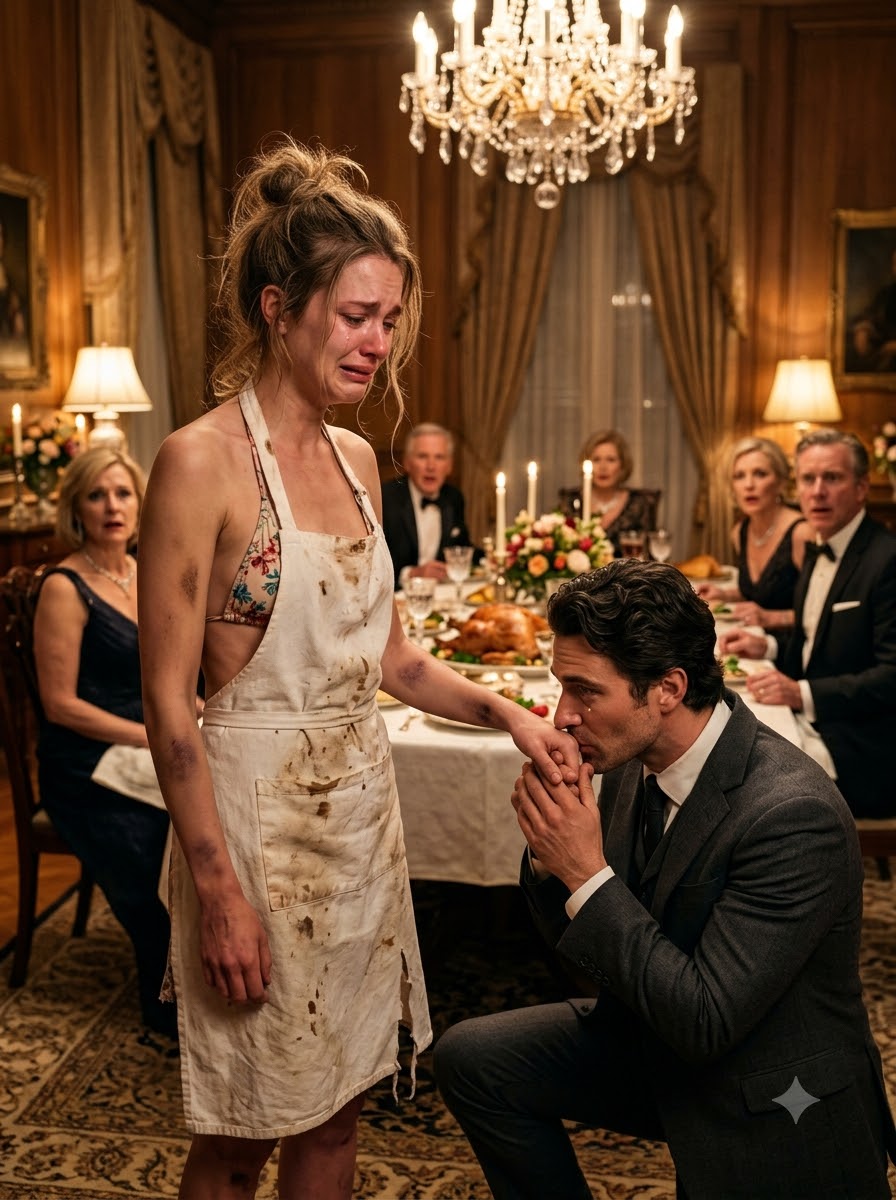
My older sister, Vanessa, had arrived an hour earlier in a cream cashmere dress, a diamond tennis bracelet sparkling every time she moved her wrist. She entered with her husband, a quiet finance professional, and their two children, whom my mother immediately showed off like prized family trophies.
My older brother, Logan, came soon after, laughing far too loudly and already holding an open bottle of three-thousand-dollar bourbon. He was the golden boy, the presumed heir to Whitmore Enterprise, a real estate development company that had been losing money for three straight years.
Aunts, uncles, and distant cousins filled the mansion with hollow laughter and relentless networking.
And I, Emma Whitmore, was sitting alone in the kitchen.
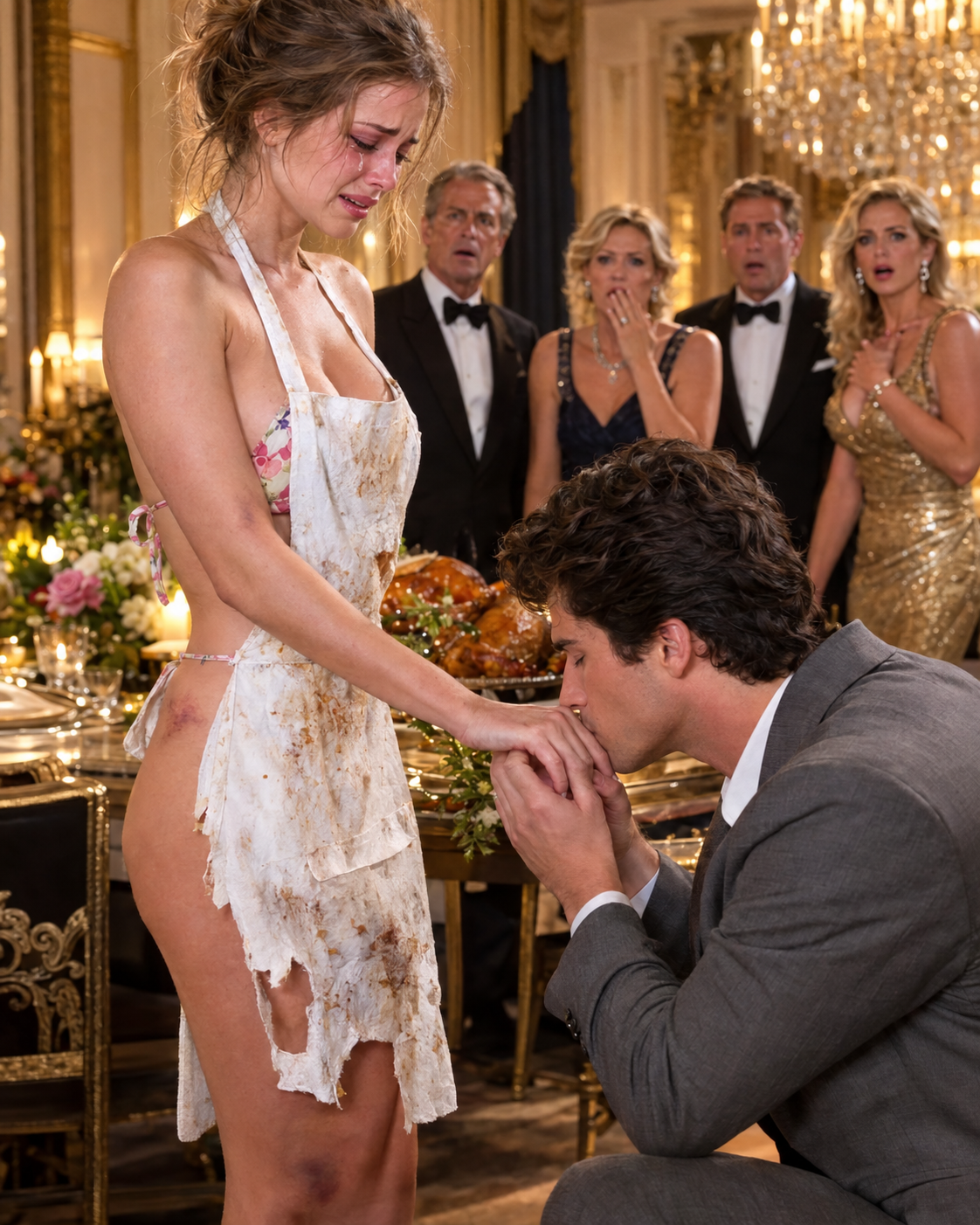
The heat from the industrial ovens pushed against my face, leaving my skin slick with sweat. My mother, Diane, had cornered me as soon as I walked through the front door. She pointed a manicured finger toward the stained linen apron hanging from the pantry door, her expression cold and calculating.
“You know the kitchen better than anyone, Emma,” she had hissed, keeping her voice low enough that the early guests wouldn’t hear. “Don’t embarrass us by sitting out there looking miserable in whatever discount rack dress you’re wearing. Cook, serve, and stay useful.”
Useful.
That was the word they had stamped onto my identity since I was eighteen. That was the year my father’s business encountered its first major obstacle, and my mother suddenly decided my college fund was the ideal sacrifice to protect the family’s public image. While Vanessa was prepared to marry well and become “the beautiful one,” and Logan was pampered and groomed to become “the future,” I was pushed aside.
I became the daughter who worked two exhausting jobs, paid my own way through community college, helped with the mortgage when money was tight, and was still placed near the trash cans at family weddings.
So I put on the apron.
I cooked.
I basted a twenty-pound turkey until its skin turned perfectly golden. I stirred the gravy until my arm ached. I carried heavy porcelain platters into the dining room, moving like a ghost among my own family. Whenever I placed a dish on the table, my mother effortlessly introduced Vanessa’s children as “the pride of the family,” speaking over me as though I were hired help.
Nobody asked why I wasn’t sitting at the table.
Nobody asked whether I had eaten.
Two hours went by. The thick oak door between the kitchen and dining room muffled the sounds of their feast. I stood at the deep porcelain sink, scrubbing a roasting pan as the hot water reddened my knuckles. Through the kitchen window, I stared into the dark November night. Cold, relentless rain struck the glass, obscuring the manicured lawns.
Just endure it, I told myself, allowing the steady scraping of the sponge to keep me grounded.
Just a little longer.
Then the heavy brass doorbell rang.
The sound traveled through the enormous house. Even behind the thick walls, I heard the dining room suddenly fall silent. The clinking of silverware stopped.
A moment later, heavy, deliberate footsteps moved across the marble hallway.
They weren’t going toward the dining room.
They were coming toward the kitchen.
The swinging door opened.
A rush of cold, rain-scented air entered the stifling room.
A man in a bespoke black suit stood in the doorway.
He was tall, with dark hair swept back, sharp features, and calm storm-gray eyes. He carried the kind of presence that shifted the atmosphere around him, a quiet authority that made people instinctively lower their voices. His wool overcoat was damp from the storm, droplets of water clinging to his broad shoulders.
He ignored the extravagant ovens, the towering piles of dirty plates, and even the swinging door where my mother had just appeared, her face pale with shock.
He looked beyond all of it.
He walked directly toward me.
I stood motionless, the soapy sponge slipping from my hand and splashing into the water.
Before I could speak, he reached for my wet, soap-covered hand.
He didn’t care about the grease or suds.
He lifted my hand, brushed his thumb over my raw knuckles, and pressed his lips against my skin.
“Sorry, darling,” he said in a low, steady voice that sent a shiver down my spine. “I was late.”
It felt as though every breath in the kitchen disappeared.
I looked past his broad shoulder and saw the heavy wooden doors to the dining room standing wide open.
My entire family was there, frozen in disbelief.
Vanessa had risen so quickly that she knocked over her wine glass, red liquid spreading across the white tablecloth. Logan’s mouth had actually dropped open, his expensive bourbon still forgotten in his hand. My mother had gone completely pale, her jaw clenched with panic.
Because the man standing in my parents’ kitchen, holding the hand of their servant-daughter, was far from ordinary.
He was Alexander Hayes, the billionaire real estate titan, CEO of The Hayes Conglomerate, and sole owner of the luxury hotel chain where my father had spent the past six months begging, pleading, and practically groveling for a development contract.
And he had just called me darling.
My father slowly stood from his chair at the head of the table, his napkin fluttering onto the floor.
“Emma,” Richard stammered, his normally booming voice trembling with a pathetic, desperate shake. “Do you… know Mr. Hayes?”
Alexander didn’t release my hand.
He slowly turned his head, his piercing gray eyes moving across my trembling father before dropping to the stained, pathetic apron tied around my waist.
His expression hardened into something terrifying.
“She is my fiancée,” Alexander said, the words striking the tiled walls like a gunshot. “And I’d like to know why she is serving dinner instead of eating it.”
The silence that followed was so complete and suffocating that it felt as though all the air had been pulled from the room.
But as my mother stepped forward, her eyes darting frantically, I knew the illusion of our perfect family was about to shatter in ways they could never have anticipated. CHAPTER 2: THE UNVEILING
For one long, agonizing moment, nobody moved. The only sound was the relentless rain pounding against the kitchen window.
My mother, Diane, was the first to regain her composure. She was an expert at saving face, a woman who had spent three decades covering the cracks in our family’s foundation with expensive makeup and forced smiles. She released a high, breathless laugh that sounded like breaking glass.
“Oh, Mr. Hayes! Alexander, please,” she stepped into the kitchen, her hands fluttering anxiously. “This is… this must be some sort of misunderstanding. Or a joke! Emma, really, what kind of game are you playing with our esteemed guest?”
She reached toward me, trying to seize my arm and pull me away from him. “Emma has been under a lot of stress lately. She works these terrible little jobs, you know, and her imagination gets the better of her. She’s just the help for tonight—”
Alexander’s arm moved so quickly I barely saw it. He didn’t strike her, but he firmly caught her wrist before she could touch me, his grip refusing to yield.
“Do not touch her,” Alexander said softly. His voice was quiet, but the authority behind it was unmistakable.
Diane jerked back as though burned, stumbling a step into my father, who had hurried up behind her.
“Mr. Hayes,” Richard said, sweating heavily, his eyes jumping between Alexander and me. “Please, come into the dining room. Let me pour you a drink. We can clear this all up. Emma is… well, she’s our daughter, yes, but she prefers to be in the kitchen. She likes to help.”
She likes to help.
The lie tasted bitter just hearing him say it.
Alexander finally released my hand and turned fully toward me. His eyes, normally so calculating and cold in the boardroom, softened when they met mine. He reached around my waist, his long fingers locating the knot of the damp, stained apron. With one swift, deliberate pull, he untied it.
He lifted the apron over my head, revealing the simple, tailored black dress underneath. Without breaking eye contact, Alexander tossed the filthy apron away. It flew through the air and landed with a wet smack in the middle of the extravagant dining table, covering the golden skin of the turkey I had spent hours basting.
Vanessa gave a muffled shriek of horror.
“My fiancée,” Alexander said, turning his deadly gaze toward my father, “does not serve people who do not recognize her worth. Now, you invited my future wife to Thanksgiving dinner. I suggest you find her a seat.”
Richard swallowed hard, his Adam’s apple moving in his throat. He stared at the ruined centerpiece, then at Alexander, clearly calculating what offending the man holding the keys to his financial survival would cost him.
“Of course. Of course,” Richard stammered, stepping aside and motioning toward the dining room. “Please. Both of you.”
Alexander placed a firm, protective hand against the small of my back and led me out of the suffocating kitchen. The dining room, which had always felt like forbidden territory, suddenly seemed like a stage, and I was its leading actress.
He took me directly to the head of the table. He pulled out my father’s heavy, carved mahogany chair—the seat of unquestioned authority in this house—and motioned for me to sit.
I hesitated for only a fraction of a second, glancing at my father, whose face was turning a furious shade of purple.
Then I looked at Alexander.
He gave me the slightest nod.
Take it, his eyes seemed to say.
I smoothed my skirt and sat in my father’s chair.
Alexander pulled a chair beside me, forcing Logan to hurriedly move out of the way. The golden boy of the Whitmore family stared at me as though I had suddenly grown a second head.
“Alexander,” Logan began, putting on his best fraternity-brother grin. “Man to man, this is wild. Emma? Really? I mean, she’s my sister, I love her, but she’s just… she’s Emma. She’s a waitress.”
“She is the woman I am going to marry,” Alexander corrected calmly, pouring sparkling water and placing it in front of me. “And if you refer to her with that tone again, Logan, I will personally ensure that the only real estate you ever manage is a cardboard box in the Bronx.”
Logan immediately closed his mouth, his face turning crimson.
The entire balance of the room had reversed.
For thirty years, my family had determined my value. They had decided I would be the sacrifice, the worker ant, the invisible foundation they could walk over just to keep themselves above water.
Now, sitting in my father’s chair with the most powerful man in the state standing beside me as my shield, I watched them scramble.
Vanessa, however, was not willing to surrender the spotlight. She sat across from me, her eyes narrowed into poisonous slits. Her flawless facade was beginning to crack, exposing the ugly, jealous core I had known all my life.
She leaned forward, resting her elbows on the table and completely ignoring the ruined turkey.
“Fiancée,” Vanessa said, the word saturated with venom. “That’s quite a leap, Mr. Hayes. Has she told you everything about herself? Because I find it hard to believe a man of your stature would willingly attach himself to a criminal.”
“Vanessa, stop!” my father hissed, terrified of losing the contract.
But Vanessa ignored him. She stared at Alexander with a triumphant, malicious gleam.
“I don’t know what lies she’s spun to get her hooks into you, Mr. Hayes,” Vanessa sneered. “But you should know the truth before you put a ring on that finger. When Emma was eighteen, she stole fifty thousand dollars from our father’s company accounts. She is a thief. We kept it quiet to protect her, but that is the kind of woman you’re sitting next to.”
The dining room dropped into a deadly silence.
My mother lowered her eyes to her plate.
My father shut his eyes in despair.
Logan smirked.
They had played their trump card—the dark family secret they had intended to keep me chained to the floor forever.
A cold knot tightened in my stomach.
I looked at Alexander, waiting for disgust to spread across his face.
Instead, Alexander reached inside the inner pocket of his suit jacket.
He didn’t look angry.
He looked profoundly bored.
He pulled out a thick, leather-bound dossier and dropped it onto the table with a heavy thud.
“A thief, you say?” Alexander mused, his voice dripping with lethal velvet. “How fascinating. Because according to the forensic accountants I hired to audit your father’s company, that isn’t quite the narrative the numbers tell.”
He opened the dossier, and the real nightmare for the Whitmore family was about to begin. CHAPTER 3: THE GHOST OF THE PAST
The leather dossier remained spread across the table, standing out sharply against the ruined linen and spilled wine. My heart pounded so hard against my ribs that I was convinced Alexander could hear it.
I remembered those fifty thousand dollars. I remembered the shouting match in my father’s study, my mother’s fake tears, and the way they had cornered me. I was eighteen and getting ready to leave for college. The money had disappeared from a reserve account I had administrative access to—a position my father had given me to “learn the ropes.” When the funds vanished, they accused me. They said I had been careless, or worse, rebellious. My mother cried and threatened to call the police unless I took the blame internally, signed a confession for the company records, and gave up my college fund to “repay” the money.
I had been young, frightened, and desperate for their love. So I signed it. And I had carried that burden ever since.
“Forensic accountants?” Richard choked out, his eyes fixed on the documents. “Alexander, you had no right to audit my private ledgers without a signed letter of intent!”
“When you come to me begging for a fifty-million-dollar lifeline, Richard, I have the right to look through your garbage if I so choose,” Alexander replied coldly. He turned to a page marked with a red tab. “Let’s talk about this fifty thousand dollars. Disappeared twelve years ago. Blamed on the youngest daughter.”
Vanessa folded her arms, lifting her chin defensively. “It’s documented. She confessed.”
“Coerced confessions are rarely admissible in the real world, Vanessa,” Alexander didn’t even glance at her; his eyes remained fixed on Logan. “Isn’t that right, Logan?”
Logan recoiled as though he had been slapped. Every trace of color disappeared from his face, leaving his frat-boy smirk twisted into a sickly grimace. “I… I don’t know what you’re talking about.”
“Don’t you?” Alexander pushed a sheet of paper across the table. It came to rest directly in front of Logan’s plate. “That is a bank statement from a holding account in the Cayman Islands. An account opened under a shell corporation, the sole beneficiary of which is you, Logan. Strangely enough, twelve years ago, exactly fifty thousand dollars was wired from your father’s reserve account into this offshore account. And from there, it was funneled directly into the Bellagio in Las Vegas to cover a rather embarrassing roulette debt.”
The silence that followed was heavy and poisonous.
I looked at Logan. My brother, the golden child, the one who was never allowed to do wrong. He refused to meet my eyes. Instead, he stared at the document, his hands shaking.
“Logan?” my father whispered, his voice cracking. “Is this… is this true?”
“Dad, I can explain—” Logan began, his voice rising with panic.
“There is nothing to explain!” Alexander’s voice snapped through the room like a whip, instantly silencing everyone. He shifted his terrifying stare toward my mother. “You knew, didn’t you, Diane? You knew your precious son had gambled away company funds, and to protect his pristine reputation, you forced your eighteen-year-old daughter to take the blame. You stripped her of her college fund, her future, and her dignity, all to cover for a degenerate gambler.”
Diane opened her mouth, but nothing came out. She looked like a fish gasping on dry land. Her eyes turned toward me, panic written across her face, silently pleading for me to rescue her, just as I always had.
For the first time in my life, I felt absolutely nothing for her. No pity. No duty. The guilt they had wrapped around my neck for twelve years shattered in an instant. The crushing pressure in my chest disappeared, replaced by a cold, burning clarity.
“You ruined my life for him,” I said, my voice eerily calm. Hearing myself speak almost startled me. It wasn’t the voice of the timid kitchen maid. It was the voice of a woman who had survived them. “You stole my education. You made me work double shifts to pay back money he lost on a roulette wheel.”
“Emma, sweetie, you have to understand,” Diane whimpered, reaching toward me. “He’s the heir. He carries the family name. We had to protect the legacy!”
“What legacy?” I snapped, bringing my hand down against the table. The crystal glasses shook. “This house is mortgaged to the hilt. The company is weeks away from bankruptcy. You have nothing left but lies!”
“Which brings us to the present,” Alexander smoothly interrupted, taking control of the room once again. He shut the dossier. “Your father has been hounding my office for months, desperate for my firm to acquire his failing development projects and pump capital into Whitmore Enterprise. He pitched it as a lucrative partnership. In reality, it’s a bailout. You are drowning, Richard.”
My father sank into an empty chair beside him, covering his face with his hands. He looked aged and defeated. The great patriarch had been reduced to a beggar at his own ruined Thanksgiving table.
“Please, Alexander,” Richard pleaded, his voice muffled by his hands. “I know we made mistakes. Terrible mistakes. But the company… it’s all we have. If you walk away now, we lose the house. We lose everything. I’ll fire Logan. I’ll give you whatever terms you want. Just sign the acquisition contract. Please.”
Vanessa was crying silently now, mascara streaking down her cheeks. Logan stared blankly at the wall, his secret exposed and his future shattered.
Alexander stared at my father for a long, painful moment. Then he reached into his jacket once more and produced a sleek black fountain pen. He placed it beside a thick stack of legal documents that had been sitting underneath the dossier.
“I brought the contract, Richard,” Alexander said quietly. “The terms are brutal. We assume all debt, we take ninety percent equity, and we strip you of your board seats. You get a modest payout, enough to pay off this house, and you walk away.”
Richard raised his head, tears filling his eyes. It was a devastating deal for a businessman, but to a drowning man, it was a lifeboat. “I’ll sign it. Right now. I’ll sign it.”
“There is just one detail you should be aware of before we conclude this transaction,” Alexander said, a slow, dangerous smile spreading across his face.
He placed a hand on my shoulder, his grip warm and grounding.
“You see, Vanessa was right about one thing,” Alexander continued, looking directly at my sister. “I didn’t just fall in love with a waitress. And she didn’t lie to me to get her hooks into me. You see, while you all thought Emma was just scrubbing floors and waiting tables, she was doing something else.”
He stopped, allowing the suspense to fill the room, thick and suffocating.
“Tell them, Emma,” Alexander whispered, his eyes gleaming with pride. “Tell them who you really are.”
I looked around at my family, a slow, victorious smile spreading across my face. The trap had been sprung, and they hadn’t even realized they were already inside the cage. CHAPTER 4: THE DATA ANALYST
The bewilderment on my family’s faces was almost intoxicating. They stared at me as though they were trying to piece together a puzzle with half the pieces missing.
“What is he talking about, Emma?” my father asked, his brow furrowed. “You work at the diner on 4th Street, and you do bookkeeping for that little auto shop.”
“I did work at the diner, Dad,” I said, settling back into his chair and folding my hands on the table. “I worked there from 6:00 AM to 2:00 PM. But from 3:00 PM to midnight, I worked somewhere else. Remotely.”
My eyes moved toward Alexander, and remembering how we had truly met warmed the coldness inside my chest.
Three years earlier, I had realized that saving every penny from the diner would never be enough to break free from the financial prison my family had created for me. I needed real money, but more importantly, I needed leverage. With what remained of the education I had pieced together at community college, along with thousands of hours spent teaching myself coding and financial modeling, I created an alias: E.W. Analytics.
I began accepting freelance data analysis contracts. I was good. Very good. I could recognize patterns in financial ledgers that other people overlooked. I could uncover hidden liabilities, offshore shell schemes, and weaknesses buried within corporate mergers.
“Two years ago,” I continued, turning my attention toward my father, “The Hayes Conglomerate was finalizing a massive acquisition of the Kensington Group. It was a billion-dollar deal. Everyone said it was foolproof.”
Alexander gave a slow nod. “My entire legal team, my board of directors, they all green-lit the merger. It was going to double our market share.”
“But they missed a hidden clause,” I said. “A toxic debt trap buried under three layers of subsidiary holding companies. If Alexander had signed that deal, the Kensington debt would have triggered a default on his primary commercial loans. It was a setup. A corporate assassination attempt.”
My father’s eyes widened. As a businessman, he understood exactly what that meant. Total ruin.
“I caught it,” I said simply. “I was doing freelance risk assessment for a third-party auditor. I saw the trap. I compiled a seventy-page dossier detailing exactly how the Kensington Group was planning to gut The Hayes Conglomerate from the inside. I sent it directly to Alexander’s private encrypted email.”
“I canceled the merger the next morning,” Alexander stepped in, his voice filled with quiet reverence. “I saved my empire because a nameless, faceless analyst named E.W. saw what fifty of my highest-paid lawyers missed. It took me a year to track down the IP address, to break through the firewalls E.W. had set up.”
He looked down at me, his gray eyes soft.
“I expected to find a retired Wall Street veteran,” Alexander said. “Instead, I found her. Sitting in a cramped studio apartment, typing on a second-hand laptop, exhausted but brilliant. I offered her a job as my lead risk analyst. She refused. She said she wanted to remain a contractor. So, I started visiting her. We talked about markets, about architecture, about survival. I fell in love with her mind long before I fell in love with the rest of her.”
Vanessa gave a scoff that sounded like a dying bird. “So what? You’re his glorified accountant. That doesn’t change the fact that this company—our company—is going under!”
“Vanessa, you really aren’t listening,” I sighed, exhaustion washing over me. I was tired of their ignorance. I was tired of playing their games.
I turned toward Alexander. He gave me a brief nod, picked up the acquisition contract, and pushed it across the table toward my father.
Richard seized it as though it were a lifeline. He struggled to pull his reading glasses from his breast pocket, his hands shaking violently. “Where do I sign, Alexander? Tell me where to sign.”
“Page forty-two, Richard,” Alexander said coolly. “But I highly recommend you read the header on page one first.”
Richard frowned and turned back to the first page of the thick document. He traced his finger along the heavy black lettering at the top. He squinted. He adjusted his glasses. Then he read it again.
All at once, the color drained from his face. He dropped the document as though it were burning him. He stared at me, his mouth opening and closing in wordless horror.
“Dad? What is it?” Logan asked, his voice trembling. He reached for the document and pulled it toward himself.
Logan read the header aloud, his voice cracking on the final word.
“Asset Purchase and Total Acquisition Agreement between Whitmore Enterprise LLC and… E.W. Capital Holdings.”
Logan looked up, his eyes jumping between Alexander and me. “Who is E.W. Capital?”
I reached for the heavy black fountain pen Alexander had set on the table. I slowly rolled it between my fingers, feeling the cool weight of the metal.
“For the last two years, I haven’t just been analyzing data, Logan,” I said quietly, finally letting the truth come out. “I’ve been investing my contractor fees. Alexander taught me how to leverage the market. I bought undervalued assets, flipped them, and reinvested. I built a private equity fund under my initials.”
I held my father’s gaze.
“Alexander isn’t buying your company, Dad,” I said, the words dropping like an executioner’s blade. “He’s just here for moral support.”
I uncapped the pen and leaned forward, drawing the contract toward me.
“I am buying the company,” I declared.
And as I lowered the pen to the paper and prepared to sign my name, the full magnitude of my revenge finally became clear to my family, setting the stage for the final act. CHAPTER 5: THE COUP D’ÉTAT
The scratch of the gold nib against the thick parchment sounded deafening in the absolute silence of the dining room. I signed Emma Whitmore with a flourish I had never known myself capable of before tonight.
I pushed the contract back across the table toward my father.
“Sign it, Richard,” Alexander commanded, dropping the familial title completely.
My father stared down at the document. Signing meant admitting defeat to the daughter he had treated like dirt beneath his shoe. It meant surrendering his legacy, his position, and his pride to the one person he had believed he had completely broken.
But refusing meant bankruptcy, federal audits, and public humiliation by Monday morning.
His hand trembled so violently that he could barely grip the pen. A tear rolled down his cheek and landed on the signature line, smearing the ink as he finally scrawled his name.
It was over.
I drew a deep breath, a strange emptiness settling inside my chest. I had imagined this moment would feel like an explosion of happiness, but instead, it felt like finally putting down a boulder I had carried up a mountain for twelve years.
I was just… relieved.
I rose from my chair. Its legs scraped sharply against the hardwood floor.
“What happens now?” Diane whispered, her voice shaking. The fierce, demanding matriarch was gone, replaced by a frightened old woman. “Emma, sweetie… you wouldn’t throw your own mother out onto the street, would you?”
I looked at her, really looked at her. I saw the expensive botox, the perfectly tailored silk blouse, and the desperate fear in her eyes. I no longer felt anger. Only a deep, cold pity.
“No, Mother. I won’t throw you on the street,” I said, my voice steady. “The buyout terms give you and Dad enough cash to pay off this house’s mortgage and live comfortably, provided you learn how to budget. But there will be no more private jets. No more country club memberships. And no more charging your lavish lifestyles to the company.”
I turned toward Logan, who was still staring at the offshore bank statement.
“Logan, your corporate credit cards are already canceled. You are officially terminated from Whitmore Enterprise, effective immediately. I suggest you start updating your resume. Though, with a twelve-year gap in actual work experience, you might want to look into entry-level retail.”
Logan’s head jerked upward, his face twisting with fury. “You bitch! You can’t do this to me! I’m your brother!”
“You ceased being my brother the day you let me take the fall for your gambling addiction,” I replied coldly, remaining steady as Alexander stepped protectively closer to me. “Be grateful I’m not forwarding that dossier to the IRS.”
At last, I faced Vanessa. She clutched her cashmere dress, staring at me with a mixture of hatred and fear.
“Vanessa,” I said softly. “You can keep your husband and your perfect life. But you are cut off from the family trust. It belongs to the company now. You’re on your own.”
“You’re a monster,” Vanessa spat, tears streaming down her face. “You planned this. You set us up.”
“I didn’t set you up, Vanessa,” I said, moving around the table and stepping over the spilled wine. “I just stopped saving you from yourselves.”
I reached Alexander, who was waiting beside the door. He didn’t spare my family a glance. To him, they were already ghosts. His eyes remained fixed only on me, filled with deep, unwavering respect.
He extended his arm. I took it, feeling his solid warmth beneath the expensive wool of his suit.
“Let’s go home, darling,” he murmured.
“Yes,” I agreed.
We left the dining room behind, abandoning the wreckage of Thanksgiving dinner. We crossed the grand marble foyer, passed the portraits of ancestors who would have been horrified by my rebellion, and stepped through the front door.
The rain continued to pour, washing the world clean. A sleek black town car waited in the circular driveway, its engine purring quietly.
Alexander opened the door for me. Before getting inside, I looked back at the sprawling estate one final time. For twenty-six years, it had been a prison built from guilt and obligation. Tonight, I had bought the prison, dismissed the guards, and thrown away the key.
I slipped into the warmth of the car. Alexander climbed in beside me and pulled me against his side. The car drove away, its headlights slicing through the darkness and carrying me toward a future I had built with my own two hands.
The coup was complete. The invisible daughter had disappeared, and the queen had finally claimed her throne.
If you want more stories like this, or if you’d like to share your thoughts about what you would have done in my situation, I’d love to hear from you. Your perspective helps these stories reach more people, so don’t be shy about commenting or sharing.
