

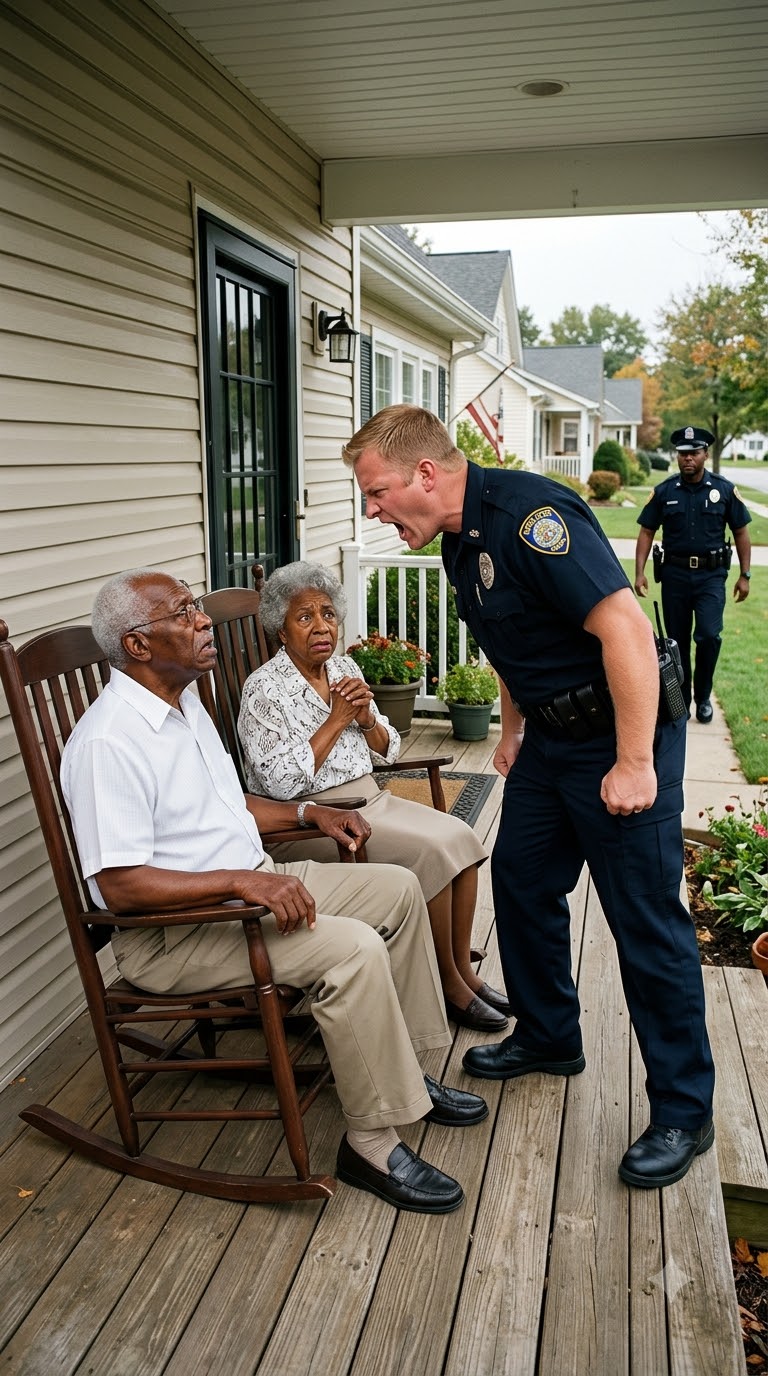
The evening had been quiet until a patrol cruiser turned hard onto Magnolia Crest Drive and stopped in front of the same brick house Walter Holloway and his wife, Bernice, had owned for thirty-nine years. Walter, seventy-five, sat in a wooden porch chair with a glass of sweet tea balanced on one knee while Bernice watered a row of geraniums beside the steps. The neighborhood outside Norwood, Virginia, had changed around them over the decades, but the Holloway house remained much the same, right down to the porch swing Walter had repaired three times rather than replace. Neither of them had any reason to believe the police car stopping at their curb had anything to do with them.
Officer Glenn Mercer stepped out before the engine fully settled. He had been with the Norwood Police Department for nineteen years and had developed the kind of reputation that depended entirely on who was describing him: reliable to certain supervisors, aggressive to younger officers, and intimidating to more than a few residents who had encountered him on bad nights. His sunglasses remained on even though the evening light had begun to soften, and one hand rested near his duty belt as he crossed the lawn. “Both of you need to go inside,” he said without introducing himself.
Walter glanced toward Bernice. “Officer, is something happening on the block?” Mercer kept walking and told them police had received a complaint about suspicious people near the houses on Magnolia Crest. Bernice looked around at the porch furniture, the flowerpots, and the little brass plaque beside the door displaying their family name, as if the absurdity might somehow explain itself.
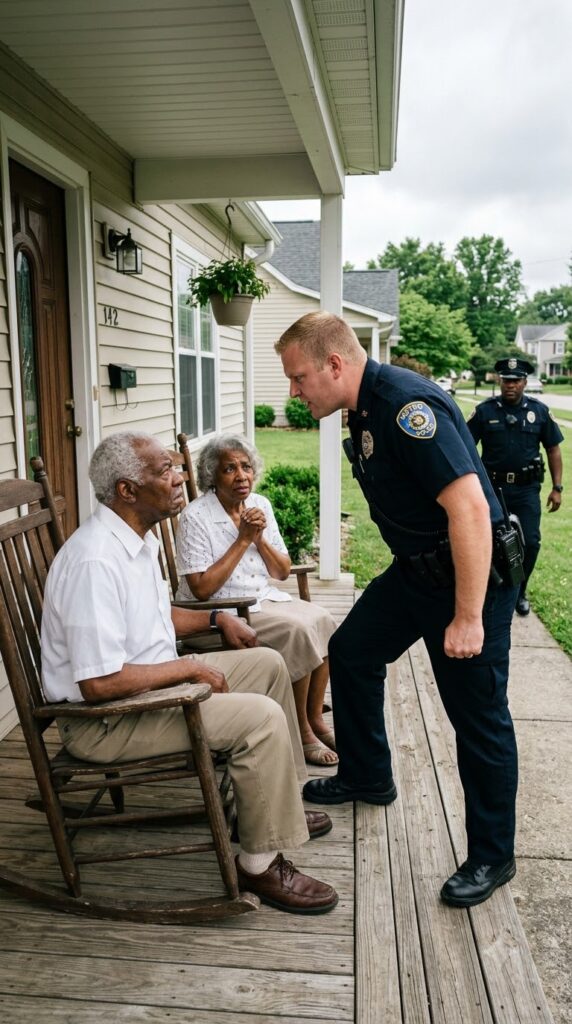
“We live here,” Walter said. Mercer’s gaze traveled across the couple and then toward the house, but nothing in his expression suggested the information mattered. “I didn’t ask where you say you live,” he answered. “I told you to get inside.”
Bernice straightened slowly. She had spent much of her early twenties volunteering with voter-registration campaigns and still carried the quiet impatience of someone who had heard authority confuse obedience with respect more than once. “Young man,” she said, “we were paying taxes on this property before you were old enough to have a driver’s license.” Mercer’s jaw tightened instantly.
Across the street, Margaret Simmons stepped onto her porch after noticing the cruiser. Two teenagers riding bicycles slowed near the corner, and another neighbor paused while carrying groceries from his SUV. Walter saw Mercer notice the audience and lifted one hand in a calming gesture. “Nobody wants trouble here.”
“Then stop making trouble,” Mercer said. He stepped onto the first porch stair. Walter remained seated and calmly offered to show identification if the officer needed it.
Mercer ignored the offer. “Stand up.” Bernice looked toward her husband’s knees.
“He has severe arthritis.” Mercer glanced toward her. “Then he should have thought about that before refusing a lawful order.”
Walter’s expression changed. “What law am I breaking?” Mercer reached for his arm.
The movement happened quickly enough that several neighbors initially thought Walter had stumbled. Mercer grabbed him above the elbow and pulled him forward before Walter had time to get both feet underneath him. Bernice reached toward her husband instinctively, and Mercer swatted her arm away hard enough that her wrist struck the small table beside the porch swing. Her glass of tea hit the wooden boards and shattered.
Margaret shouted from across the street. One of the teenagers pulled out his phone immediately. Walter caught himself against the porch column and turned toward Bernice, who was holding her wrist against her chest. “Are you hurt?”
Mercer moved between them. “Nobody move.” Walter stared at him.
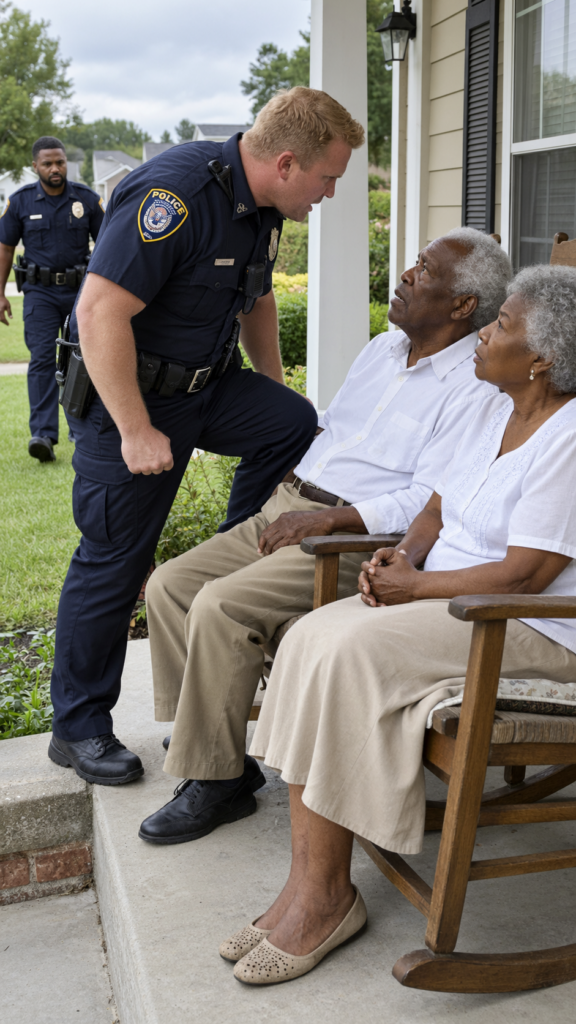
“You just shoved my wife.” Mercer pointed one finger toward Walter’s face. “Keep challenging me and you’ll be in cuffs.”
Bernice stood carefully. “We were sitting outside our own house.” Mercer looked toward the growing audience along the street, and instead of slowing down, he seemed to become more determined to control the scene. “Everybody go back inside.”
Nobody moved. Phones appeared in more hands. Even people who had not heard the original conversation could tell something was wrong.
Walter looked directly at Mercer. “You need to call your supervisor.” Mercer laughed once.
“I know how to do my job.” Walter nodded. “Then start.”
Mercer’s face hardened. His hand closed on Walter’s shoulder, and this time he pushed the older man backward toward the wooden porch post. Walter struck it near the side of his head, opening a small cut along his temple.
Bernice cried out. Margaret began walking across the street. Then another voice came from the sidewalk.
“Officer Mercer.” It was not loud.
Something in the tone caused Mercer’s hand to come away before he even turned. A tall Black man in his mid-forties was coming quickly up the walkway wearing dark trousers and a pale gray dress shirt with the sleeves rolled to his forearms. A police identification wallet was already open in his left hand.
His name was Chief Adrian Holloway. Nine days earlier, Norwood’s city council had sworn him in as the department’s new police chief. He had spent the evening at a community meeting only three blocks away and decided to walk past his childhood home before heading back to headquarters.
Mercer recognized him immediately. Almost everyone in the department did. “Chief Holloway.”
The aggression disappeared from Mercer’s voice so quickly that people watching from the street noticed. Adrian kept walking until he stood between Mercer and the porch. “Step away from them.”
Mercer obeyed. Adrian looked first at Bernice’s wrist, then at the blood near Walter’s temple. “Mom?”
That single word changed the entire street. Mercer’s face lost color.
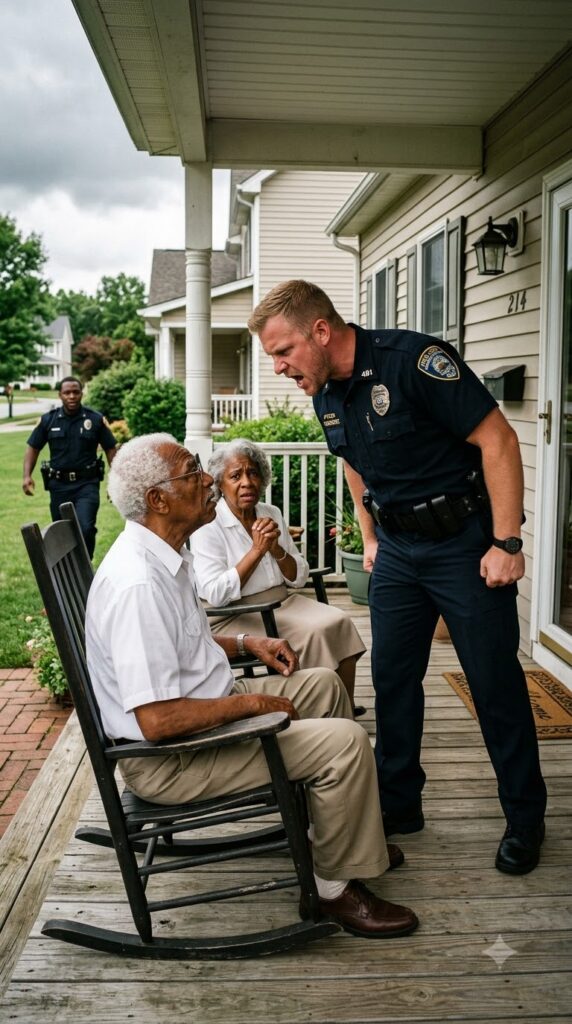
Bernice held her bruised wrist against her chest. Walter leaned against the porch column, visibly angry but steady. Adrian looked back toward Mercer.
“These are your parents?” Mercer asked. Adrian’s expression did not soften.
“They are citizens you just put your hands on.” He took one more step. “Their relationship to me is not the reason that matters.”
The teenagers kept recording. Margaret had crossed into the street now, while other neighbors stood at the ends of driveways watching Norwood’s new police chief confront one of the department’s longest-serving officers outside the house where Adrian himself had grown up. Mercer seemed to realize that nothing he said next would remain private.
“Chief, we got a report about suspicious activity,” Mercer began. “They were refusing instructions.” Adrian looked toward Walter.
His father gave a small shake of the head. “We were drinking tea.”
Adrian turned back toward Mercer. “What suspicious activity?” Mercer said dispatch had reported people lingering near a residence after an argument elsewhere on the block.
“You found two elderly people sitting on a porch.” Mercer said the situation became hostile.
“Did either one threaten you?” Adrian asked. Mercer said no.
“Any weapon?” No again.
“Did you ask their names before using force?” Mercer said nothing.
Adrian waited. Eventually, Mercer looked toward the street. “No.”
The word seemed louder than it should have. Adrian looked toward a second patrol car turning onto Magnolia Crest.
“You are relieved from field duty effective immediately.” Mercer’s head snapped back.
“Chief, come on.” Adrian’s voice remained level. “I’m not discussing this.”
Mercer lowered his voice. “You’re only doing this because they’re your parents.” Adrian stepped closer.
“No.” He glanced toward the phones recording them. “If anything, their being my parents means I will not make the final disciplinary decision.”
Mercer looked confused. Adrian continued. “I personally watched you use physical force on two unarmed elderly residents without establishing a crime, and that requires immediate removal from duty while the incident is independently reviewed.”
The second cruiser stopped. Sergeant Dana Ruiz stepped out. Adrian told her to secure Mercer’s body camera, take possession of his duty weapon and department access under policy, and notify Professional Standards.
Mercer looked at Dana as though hoping she would hesitate. She did not. “Officer Mercer, please remove your duty belt.”
For the first time that evening, he looked uncertain. Adrian turned away from him and walked onto the porch. “Mom, let me see your wrist.”
Bernice scowled. “It’s bruised.” Adrian touched it carefully. “It needs to be checked.”
“I need ice.” Adrian gave her the same expression he had used as a teenager when she refused medical advice. She returned the exact same look.
Walter touched his son’s shoulder. “Handle your department first.” Adrian glanced toward the cut near his father’s temple.
“You’re bleeding.” Walter shrugged. “I’ve had worse.”
“That’s not the standard.” The sentence came out more sharply than Adrian intended.
Paramedics arrived several minutes later. Bernice’s wrist was badly bruised but not fractured, while Walter required two stitches near his temple. They refused ambulance transport but agreed to see their physician the following morning.
By then, three different cellphone videos were already circulating online. One showed Mercer pulling Walter from the chair, another captured Bernice striking the table, and the clearest clip contained the moment Adrian walked onto the sidewalk and called her Mom.
Norwood’s quiet Saturday evening became national content before midnight. The first headlines focused almost entirely on the reversal: Veteran Cop Manhandles Elderly Couple, Then Learns Their Son Is the New Police Chief. Adrian hated the framing from the moment he saw it.
His parents did not become worthy of lawful treatment when their son appeared. Walter was already a citizen before Adrian said a word. Bernice’s wrist mattered before anybody recognized the chief.
The badge Adrian carried created consequences. It did not create rights. He repeated that distinction until reporters became tired of hearing it.
Monday morning, Adrian formally asked the city manager to bring in an outside agency rather than allowing Norwood’s own Internal Affairs division to investigate Mercer’s use of force against his parents. The city manager agreed, and investigators from neighboring Carter County took control of the incident review. Adrian recused himself from any final disciplinary or prosecutorial recommendation involving Walter and Bernice.
He did not recuse himself from another question. Why was Glenn Mercer still in uniform after nineteen years? That question belonged to him as chief whether the Saturday complainants were his parents or complete strangers.
Adrian asked for every misconduct complaint involving Mercer, including cases that had been closed as unfounded, unsubstantiated, withdrawn, or administratively resolved. By Tuesday afternoon, two archive boxes sat on his conference table beside a set of digital files requiring more storage space than he expected. The oldest complaint dated back almost thirteen years.
A Black college student reported that Mercer pulled him from a car during a traffic stop because the officer believed the vehicle could not belong to him. The student produced registration and insurance in his own name. Mercer’s report described the encounter as necessary because the driver displayed “unusual nervousness.”
The complaint was closed. No outside witness existed. Supervisors concluded Mercer had acted within discretion.
Another complaint came from a Latino restaurant employee walking home after midnight. He said Mercer stopped him, demanded identification, and shoved him against a brick wall after the man asked why he was being searched. Mercer wrote that the resident became verbally confrontational.
The body microphone supposedly malfunctioned during the critical three minutes. The complaint was listed as unable to substantiate. No supervisor followed up on why Mercer’s audio had failed.
There were more. A mother said Mercer screamed at her seventeen-year-old son during a bicycle stop and threatened jail when the boy asked whether he was free to leave. A Black contractor said Mercer detained him outside a remodeled house where he had been hired to install cabinets.
An elderly resident alleged Mercer called him “boy” during a parking dispute. Several complaints involved physical force that supervisors labeled technically permissible but unnecessary. Adrian kept reading.
By Thursday afternoon, he had identified twenty-three complaints involving Mercer over sixteen years. Only two had resulted in written reprimands. None produced suspension.
Five had been formally withdrawn by the complainants. Adrian asked why. Nobody had a clear explanation.
Then an Internal Affairs clerk named Rosa Bell quietly told him to check contact logs. Adrian did. The entries disturbed him more than the complaint numbers.
Several residents received repeated calls from supervisors asking whether they were sure they wanted to continue. One mother was told investigators might have to examine her teenage son’s entire history if she insisted on a force complaint. Another resident said a sergeant warned that “turning a misunderstanding into something official” could become inconvenient for everyone involved.
Adrian leaned back in his chair. The problem was no longer one aggressive veteran officer. It was a complaint system built to exhaust people until they disappeared.
Deputy Chief Thomas Reddick came into Adrian’s office that evening. He had spent twenty-eight years in Norwood and survived four different chiefs. “You keep pulling threads like this, and you’re going to tear this department apart.”
Adrian closed the file. “Maybe somebody should have checked why the fabric was ripping.” Thomas did not smile.
“There are good cops here.” Adrian nodded. “Most of them.”
“You make everybody feel accused, you lose them.” Adrian looked directly at him. “If an honest officer hears that complaints were buried and decides I’m attacking him personally, that tells me something too.”
Thomas crossed his arms. “Mercer messed up Saturday.” Adrian shook his head.
“Stop calling it that.” The deputy chief frowned.
“What would you call it?” Adrian opened one of the oldest folders. “A pattern that people tolerated long enough to become a system.”
The conversation traveled through headquarters almost immediately. By Friday, officers were whispering that the new chief intended to purge anyone connected to the previous administration. Anonymous posts accused Adrian of using his parents as an excuse to settle ideological scores.
One radio host asked whether a chief whose own family had been involved could remain impartial. Adrian expected the question. He answered during his first formal press briefing.
“My parents will be treated exactly like any other complainants in the criminal and disciplinary process.” He stood alone behind the podium. “But their involvement does not prevent me from examining whether this department ignored similar allegations for years.”
A reporter shouted, “Do you think Officer Mercer is racist?” Adrian paused.
“That conclusion should be evidence-based, not emotion-based.” He glanced toward his notes. “What I can say is that the records show repeated allegations involving race, unnecessary force, questionable stops, and reporting problems that did not receive the scrutiny they deserved.”
Another reporter asked whether Mercer would be fired. Adrian shook his head. “I will not announce a result before an investigation and then call that accountability.”
Some activists disliked the restraint. They wanted immediate punishment. Adrian understood.
He wanted something that would survive an appeal. More importantly, he wanted to know whether Mercer’s history was unique. Nothing he had seen suggested it was.
Adrian established a confidential reporting line outside the department’s normal chain of command. Former complainants, former officers, current officers, witnesses, and residents could contact the outside review team directly. Within two days, the calls began.
A Black nurse described Mercer stopping her near her own apartment complex and demanding to know whose Lexus she was driving. A retired schoolteacher said Mercer threatened him with arrest when he asked why his grandson was being searched on a sidewalk. Two former officers separately reported hearing Mercer use racial language inside headquarters.
Then retired lieutenant Calvin Dorsey called. He had left Norwood eight years earlier after three decades in policing. His statement widened the case beyond Mercer.
“We taught young officers that protecting the department meant protecting the officer,” Calvin told investigators. “Those are not always the same thing.” He agreed to sit for a recorded interview.
Calvin described force reports being rewritten because supervisors thought certain phrases would create liability. Complaints were downgraded before reaching formal review. Command staff sometimes called residents privately and convinced them that proceeding would only create more trouble.
Adrian listened to nearly seven hours of interviews over one weekend. By Sunday night, he had filled a legal pad with names, dates, complaint numbers, and questions. Several people mentioned in the statements still held supervisory positions.
Monday morning, Adrian ordered an outside audit of every serious use-of-force complaint from the previous decade. Thomas Reddick objected immediately. “You are putting the whole department on trial.”
“No.” Adrian looked toward him. “I’m checking records.”
“You know what this does to morale.” Adrian replied, “Morale built on nobody asking questions is not morale.”
Resistance grew. Somebody leaked internal emails showing Adrian discussing reforms before he was sworn in. The leak was presented online as proof he entered office with an anti-police agenda.
Adrian released the full email chain. It contained proposals for better officer wellness resources, more staffing, improved field training, and independent review of major force incidents. The partial leak lost much of its effect.
That did not stop everything. Walter and Bernice started receiving letters from strangers. Some thanked them.
Others accused them of destroying the reputation of a good officer and embarrassing an entire department. One envelope contained only three words: YOU STARTED THIS. Walter read it once and dropped it into the trash.
Bernice was angrier. “We were drinking tea.” Adrian sat with them at the kitchen table.
“I know.” Bernice shook her head. “No, listen to how ridiculous that sounds.”
Walter placed one hand over hers. “Bernie.” She looked at him.
“We were sitting on our own porch drinking tea, and somehow strangers think we created all this.” Adrian had no answer that made it less absurd.
Bernice turned toward her son. “Do not let anybody make this important because we are your parents.” Adrian nodded.
“I won’t.” She continued. “And don’t let the newspapers turn your father into some gentle saint because he got hurt.”
Walter smiled immediately. “Thank you.” Bernice pointed at him.
“You are stubborn, cheap, and occasionally impossible.” Adrian laughed for the first time in nearly a week.
Then Bernice became serious. “But Glenn Mercer did not need to know whether your father was educated, respected, important, nice, or related to anybody.” She looked toward Adrian. “He needed to know he was human.”
The sentence stayed with Adrian. He wrote it on the last page of his notebook that night. He never used it publicly.
The external review of the Magnolia Crest incident concluded first. Mercer’s body camera showed he arrived without identifying any criminal conduct. He ordered Walter and Bernice into the house before even determining whether they lived there.
The investigation found the encounter escalated after Walter asked why the order was lawful. It also concluded Mercer’s use of force against both residents was unjustified. The county prosecutor charged him with assault, official misconduct, and falsification of portions of an official report.
The report created its own problem. Mercer wrote that Walter “advanced aggressively” from the porch chair. Every cellphone video and body-camera angle showed Walter remaining near the chair until Mercer pulled him forward.
Mercer also wrote that Bernice “physically interfered with an arrest.” No arrest had occurred at the time she reached for her husband. She had simply reacted when Mercer grabbed him.
Prosecutors noticed. So did the public. Demonstrations began outside city hall.
Some marches were organized by long-standing civil-rights organizations. Others came from younger residents who had learned about older complaint files only after Mercer’s arrest. Signs carried Walter and Bernice’s names alongside those of residents whose accusations had been dismissed years earlier.
Adrian never led the demonstrations. His responsibility as chief was to protect the demonstrators’ rights and ensure officers did not treat criticism as hostility. He issued one instruction repeatedly: insults directed at police were not criminal threats.
That became important during the second weekend. A young patrol officer wanted to arrest a teenager screaming profanity toward a police line. Captain Lena Morris stopped him.
“You don’t have to like the First Amendment,” she told him. “You still work under it.” Adrian heard about the exchange later and asked the academy to use the sentence.
Inside headquarters, the audit continued. Investigators found altered narratives, missing body-camera segments, delayed complaint intake, and files closed without interviewing obvious witnesses. Several officers who had stayed silent for years finally agreed to speak.
One detective told investigators, “We were taught that speaking up made you disloyal.” Adrian asked whether he still believed that.
The detective looked toward the table. “I think staying silent made us disloyal to everybody else.” The line later appeared in the public report.
Three supervisors were placed on administrative leave. One retired rather than complete a disciplinary interview. Another gave up his supervisory rank and returned to patrol.
Thomas Reddick, who had fought the audit from the beginning, walked into Adrian’s office one evening carrying a worn folder. He placed it on the desk and did not sit. “You need this.”
Inside were handwritten notes from meetings stretching back almost nine years. Complaint numbers. Officer names.
Short descriptions. Several involved Mercer.
Adrian looked up. “Why do you have these?” Thomas stared through the office window.
“Because every time I told myself something wasn’t serious enough to fight about, I wrote it down.” Adrian closed the folder halfway.
“Why?” Thomas took a long time answering. “Some part of me knew we were lying to ourselves.”
“Why didn’t you act?” Thomas finally looked at him.
“Because I wanted to become deputy chief.” The honesty was ugly enough to be useful.
Thomas continued. “I kept telling myself I could change things when I had more authority.” Adrian said nothing.
“Then I got more authority.” Thomas looked toward the folder. “And found another reason to wait.”
Adrian removed Thomas from any Professional Standards oversight but allowed him to remain while investigators evaluated his role. Thomas accepted the decision without argument. Months later, his testimony would become important in multiple administrative cases.
The city established a joint accountability task force made up of outside investigators, neighborhood representatives, civil-rights attorneys, current officers, former officers, and training experts. Meetings were rarely comfortable. Residents arrived carrying years of distrust, while officers arrived feeling blamed for decisions made before some of them entered the academy.
Adrian refused to turn the meetings into a public-relations performance. If residents made claims unsupported by evidence, he said so. If officers defended policies clearly contradicted by records, he said that too.
“You do not build trust by agreeing with everybody.” He looked around the room during one especially hostile session. “You build it by making the rules of truth the same for everybody.”
That frustrated union representatives and activists in almost equal measure. It also kept both sides attending. Slowly, the task force produced recommendations.
Any use-of-force incident causing significant injury would trigger automatic outside review. Body-camera deactivation during enforcement activity would result in mandatory investigation rather than being dismissed as technical failure. Complaint intake would move partly outside police headquarters.
Repeated similar complaints against the same officer would trigger early intervention even when no single complaint had yet resulted in formal discipline. Supervisors would have to explain patterns rather than approve reports one incident at a time. Officers who reported misconduct internally would receive explicit anti-retaliation protections.
Command evaluation changed too. Sergeants would no longer be judged mainly on arrest numbers and call-clearing speed. Complaint quality, intervention, mentoring, report accuracy, and force reduction became measurable responsibilities.
The union fought several provisions. Litigation followed. Negotiations stretched into winter.
Adrian expected resistance. Reform sounded easy when it meant speeches and apologies. It became harder when it changed paperwork, promotions, schedules, authority, and who got to make decisions.
Mercer’s criminal trial began nine months after the porch confrontation. The courthouse filled before opening every morning. Walter and Bernice entered through the public entrance and waited like everyone else.
Adrian attended only selected days. He did not want the chief’s uniform sitting directly behind his parents where jurors could see it. When he went, he wore a plain navy suit and sat several rows behind the prosecution.
The state opened with the cellphone videos. There was no dramatic narration. Jurors simply watched Mercer approach two elderly people on a porch, order them inside, refuse explanations, grab Walter, shove Bernice away, and then push Walter into the post.
Margaret Simmons testified next. She had watched nearly the entire encounter from across the street. “Mr. Holloway never threatened that officer.”
One teenager testified that neither Walter nor Bernice moved aggressively. His phone video captured the clearest view of Walter being pulled from the chair. The prosecutor paused the footage moments before Mercer made contact.
“What is Mr. Holloway doing here?” “Sitting.”
“What is in his hand?” “Nothing.”
The video continued. Mercer reached. Walter’s body moved because Mercer pulled it.
Bernice took the stand on the third day. The prosecutor asked what she remembered most clearly. She thought for several seconds.
“The way he looked at us before he knew anything.” The courtroom quieted.
She described how Mercer seemed to decide they were a problem before asking their names. She remembered the broken glass, Walter’s face striking the porch column, and the moment she realized asking questions was making the officer angrier rather than helping. She did not exaggerate.
The defense attorney asked about her history in civil-rights activism. Bernice smiled faintly.
“I marched when I was younger.” The attorney asked whether that history affected her view of police.
“It affected my view of dignity.” Several jurors looked toward her.
Walter testified the following morning. He admitted telling Mercer to start doing his job. The defense suggested his words were disrespectful and could have escalated tension.
Walter leaned toward the microphone. “I was disrespectful.”
The courtroom shifted. The attorney looked surprised.
Then Walter added, “Being disrespectful is not a crime.” Even the judge had to pause before giving the jury a neutral instruction.
Former complainants were allowed to testify within strict limits. The most damaging evidence still came from Mercer’s report compared directly against video. The language did not match reality.
A former Professional Standards investigator testified that Mercer had previously been coached about accurate reporting after force incidents. The prosecutor argued the false statements were not confused memory but justification written after the fact. The defense called them imperfect recollection during stress.
Then retired Lieutenant Calvin Dorsey testified. He described a department culture where certain phrases could turn questionable behavior into acceptable paperwork. Officer safety. Furtive movement. Noncompliance.
“The words themselves aren’t bad,” Calvin told the jury. “The problem is when nobody asks what they actually mean in the specific case.” The defense tried to paint him as a bitter former employee.
Calvin nodded. “I am bitter.” The attorney paused.
“I’m bitter because I helped create the culture I’m describing.” The answer changed the atmosphere immediately.
Calvin admitted approving complaint closures he should have challenged. He admitted wanting younger officers to respect him. He admitted protecting colleagues because questioning them felt like betrayal.
His testimony transformed the case from one man’s conduct into something larger. Adrian listened from the rear bench and wished that kind of honesty had arrived a decade earlier. Still, late truth was better than permanent silence.
The jury deliberated nearly twelve hours. Mercer was found guilty of assault, official misconduct, and falsifying an official report. A separate count involving the force against Bernice ended in a lesser conviction under state law.
Outside the courthouse, reactions split immediately. Some demonstrators celebrated. Others said one conviction did not address the people whose complaints had been ignored for years.
Police supporters argued Mercer had been sacrificed to political pressure. Walter and Bernice went home. Neither attended the evening rally.
Adrian visited after work. Walter was watching baseball. Bernice was making soup.
“You two don’t look happy.” Walter muted the television.
“A jury confirmed what happened that night.” He looked toward his son. “That’s not the same thing as fixing why it was allowed to happen.”
Adrian smiled slightly. “You’ve been listening to my speeches.”
Bernice called from the kitchen, “Absolutely not. Your speeches are too long.”
The Norwood Justice and Accountability Initiative launched the following spring. Adrian deliberately refused every suggestion to name it after his parents. Walter and Bernice would have hated that anyway.
The program created civilian complaint intake, independent investigation of serious force, stronger de-escalation standards, mandatory review of repeated officer complaints, and formal protection for officers who challenged misconduct. Recruits began studying real Norwood cases instead of sanitized fictional scenarios.
Mercer’s porch encounter became one of the first. Adrian attended a class months later. The instructor froze the body-camera footage before Mercer touched Walter.
“What do you see?” recruits offered answers about distance, officer positioning, available cover, sight lines, and potential exits. Then one young recruit raised her hand.
“Two old people sitting down.” The instructor nodded.
“What do you not see?” Another recruit answered.
“A crime.” Adrian remained silent near the back.
That was the lesson. Before the confrontation escalated, the image already contained almost everything Mercer needed. Nothing significant entered the scene later except his pride.
Culture did not transform after one training session. Some officers resigned. Others transferred.
Several complained they were now afraid to act. Adrian challenged that every time he heard it.
“I want you cautious about acting carelessly.” He told supervisors. “I do not want you afraid of doing your job.”
The distinction became part of leadership training. Confidence should come from facts, not from refusing to reconsider. Supervisors were instructed to ask one question during scenario reviews: What fact would make you change your mind?
If the answer was nothing, Adrian argued, the officer was no longer investigating. He was defending a conclusion. That was dangerous in any profession and especially dangerous while carrying state authority.
Community meetings continued every month. Some were productive. Others were miserable.
Residents shouted. Officers became defensive. People left angry.
Then many returned the following month. Adrian began to understand that trust was not applause. Sometimes trust was simply people choosing to come back to the room.
Walter attended several meetings. He never sat beside Adrian. He preferred the folding chairs among everybody else.
When residents called him brave, Walter shrugged. “I was sitting on my porch.” That sentence became his favorite correction.
Bernice became more active. She volunteered with a local network helping residents understand misconduct complaint procedures, preserve original videos, request body-camera records, photograph injuries, and maintain timelines. She refused to let organizers introduce her as the chief’s mother.
“My name is Bernice Holloway.” She would smile. “It worked just fine before Adrian got promoted.”
Adrian loved hearing that. He never told her. She would accuse him of getting sentimental.
Two years after Magnolia Crest, Norwood released its first independent accountability report. Serious complaints had not disappeared, but processing times improved sharply. Body-camera compliance increased.
Use-of-force incidents declined, particularly during low-level nonviolent calls. Trust surveys among Black residents improved, though they remained well below the citywide average.
The mayor wanted to celebrate the numbers. Adrian resisted. “A percentage going up does not mean the person who was mistreated last Tuesday suddenly trusts us.”
He used the data as direction, not redemption. Improvement mattered. So did honesty about how much remained.
Thomas Reddick retired three years after the incident. At his final command meeting, he surprised everyone by speaking about his own failures rather than his accomplishments. Adrian sat in the back.
“I thought loyalty meant protecting the department from embarrassment.” Thomas looked around at younger supervisors. “I understand now that embarrassment is sometimes the first useful warning.”
Nobody moved. Thomas continued.
“Every organization eventually creates people who know where the problems are.” He tapped the table. “Your culture is defined by whether those people get rewarded for telling you or trained to become quiet.”
Several supervisors wrote the sentence down. Adrian did too.
Magnolia Crest changed more slowly than headquarters. For months, neighbors treated Walter and Bernice like public symbols. People delivered food they had not asked for.
Strangers stopped by to shake their hands. Walter became irritated by the third week.
“I have lived here thirty-nine years and suddenly everybody thinks I need baked ziti.” Bernice opened the container. “You complain too much.”
“You hate baked ziti.” “Not this one.”
Gradually, the attention faded. Children went back to riding bicycles. Neighbors waved rather than stopping.
Walter returned to sitting outside every evening. Bernice replaced the shattered side table but kept the porch swing.
The wooden column still carried a small mark from where Walter’s temple struck it. Adrian once offered to have the porch refinished. Bernice refused.
“I don’t want a monument.” She touched the scar in the wood. “I want the porch to remain a porch.”
“Then why keep the mark?” Adrian asked. Bernice looked toward him.
“Because ordinary places remember things too.” Adrian understood.
National reporters occasionally returned for anniversary stories. Most wanted the dramatic version: veteran officer mistreats elderly Black couple, learns their son is police chief, entire department reforms. Adrian corrected the framing every time.
“Nothing became wrong when Mercer learned who my parents were.” Reporters usually paused.
“It was wrong before I reached the sidewalk.” Adrian continued. “The cameras simply made it harder for the institution to ignore.”
Five years after the incident, Norwood opened a new Community Public Safety Center six blocks from Magnolia Crest. The building housed neighborhood officers, youth programs, mental-health response teams, civilian complaint staff, victim advocates, and meeting rooms available to local organizations. Adrian hated ribbon-cutting ceremonies but understood that sometimes institutions needed visible reminders of new expectations.
Walter and Bernice attended. Walter used a cane now. Bernice wore a dark blue blouse and corrected anyone who offered to help her climb the steps.
The mayor introduced Adrian with a long list of accomplishments. He looked uncomfortable. Then she introduced his parents.
The applause lasted considerably longer. Walter leaned toward Bernice and whispered something that made her laugh.
Adrian took the microphone. “This building is not proof that Norwood solved policing.” The applause faded.
“It is proof that accountability deserves a permanent address.” He glanced toward officers standing beside residents.
“The real test happens when there are no cameras.” Another pause. “No chief walking up a sidewalk.”
“No reporters.” He looked toward Walter and Bernice. “Nobody important watching.”
“That is where character lives.” The crowd remained quiet for a moment before applauding again.
After the ceremony, Adrian walked home with his parents. Magnolia Crest looked almost exactly as it had years earlier. Trees had grown taller and several houses had new owners.
Margaret Simmons still lived across the street. She still knew more about everybody’s life than anyone officially admitted. Bernice considered that comforting.
When they reached the house, Walter lowered himself onto the porch swing. Bernice sat beside him. Adrian remained near the steps.
Walter looked up. “You planning to supervise us?” Adrian smiled.
“Just making sure nobody reports two suspicious seniors sitting outside.” Bernice rolled her eyes.
“You have become less funny with authority.” Adrian sat beside them.
For a while, nobody spoke. Cars passed. A lawn mower started somewhere down the block.
Walter looked toward his son. “You think it worked?”
Adrian knew what he meant. “Some of it.”
Walter nodded. “Probably as much as anybody gets.” Bernice immediately disagreed.
“No.” Both men looked toward her.
“We do not lower the standard because the work is difficult.” Adrian smiled.
“There she is.” Bernice nudged him with one elbow.
Adrian had spent years explaining reform to city councils, police unions, activists, reporters, lawyers, and officers. His mother could compress most of it into one sentence while holding lemonade on a porch. Do not lower the standard because progress is hard.
People continued telling the story long after Mercer finished his sentence and disappeared from public view. Most versions opened with the reveal that Walter and Bernice’s son was the new police chief. Adrian understood why.
Reversal makes satisfying storytelling. An arrogant officer suddenly discovers the people he dismissed are connected to somebody powerful. Consequences arrive immediately.
But Adrian never considered that justice. If Walter had been a retired mechanic with no influential son, the force would still have been wrong. If Bernice had spent forty years cleaning hotel rooms instead of organizing voters, her wrist would still have mattered.
If nobody on Magnolia Crest had recorded the incident, the truth would still have existed. The frightening part was that the system might not have cared enough to preserve it. Adrian’s position did not create the injustice.
It exposed the cost of ignoring it. That difference shaped the rest of his career.
Years later, a new academy recruit asked Adrian about the famous Holloway porch case. “Chief, what was Mercer’s biggest mistake?” The class expected an answer about excessive force, racial bias, or falsifying reports.
Adrian thought for a moment. “He stopped being curious.”
The recruit looked confused. Adrian continued.
“He decided what he was seeing before he learned anything.” He walked slowly across the front of the room. “After that, every question sounded like defiance.”
“Every correction sounded like disrespect.” He looked toward the recruits. “And every new fact became a threat to his pride.”
No one wrote for several seconds. Adrian let the silence work.
“Once an officer stops being willing to change his mind, authority becomes dangerous very quickly.” Pens began moving.
He left the academy that afternoon and drove to Magnolia Crest. Walter and Bernice were sitting outside. His father had fallen asleep with a newspaper folded across his chest.
Bernice held a pitcher of lemonade. She saw Adrian park and smiled.
“Chief Holloway.” Adrian walked toward the porch.
“Mrs. Holloway.” She handed him a glass.
No cameras. No uniforms.
No demonstrations. No reporters.
Just three people sitting on a porch that had once become the center of a citywide argument about authority. Adrian preferred it that way.
Because the best ending was never Mercer’s conviction. It was not the audit, the reforms, the accountability center, or the improved statistics. Those things mattered, but none were the final measure.
The best ending was simpler. Walter and Bernice could sit outside their own home again expecting an ordinary evening.
That should never have required their son becoming police chief. It should never have required a trial. It should never have required strangers filming from the curb.
It should have required only the thing Glenn Mercer forgot before he ever stepped onto the porch.
Seeing two people clearly before deciding what they were.
