

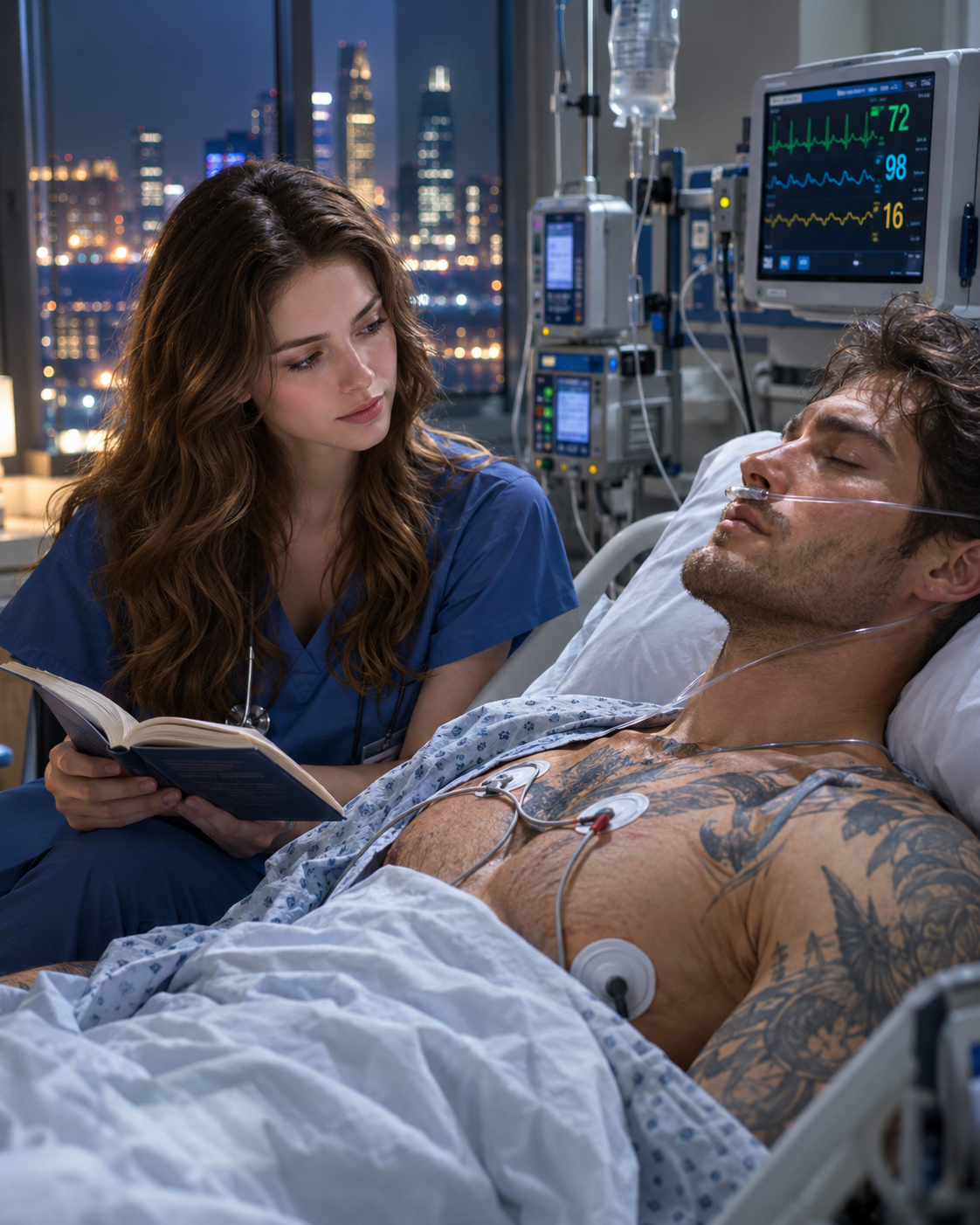
At 3:17 a.m., Mercy West Medical Center felt colder than normal. Rain streamed down the ICU windows, machines clicked in their familiar rhythms, and the fluorescent lights made everyone appear even more exhausted than they already were.
My patient in room 412 had been unconscious for almost three months.
His chart identified him as Jonathan Vale, thirty-four, traumatic brain injury, multiple gunshot wounds, post-operative complications.
Nobody believed the name.
Two men dressed in dark suits stood outside his room around the clock. A private neurologist flew in from New York twice every week, and even the hospital CEO made personal visits in the middle of the night.
By my twelfth shift caring for him, I knew the truth.
Dominic Vale.
Shipping billionaire. Port king. Philanthropist in the newspapers.
According to federal investigators, something much darker.
But to me, he was simply the man in the bed who had not spoken, moved, or opened his eyes for eighty-nine days.
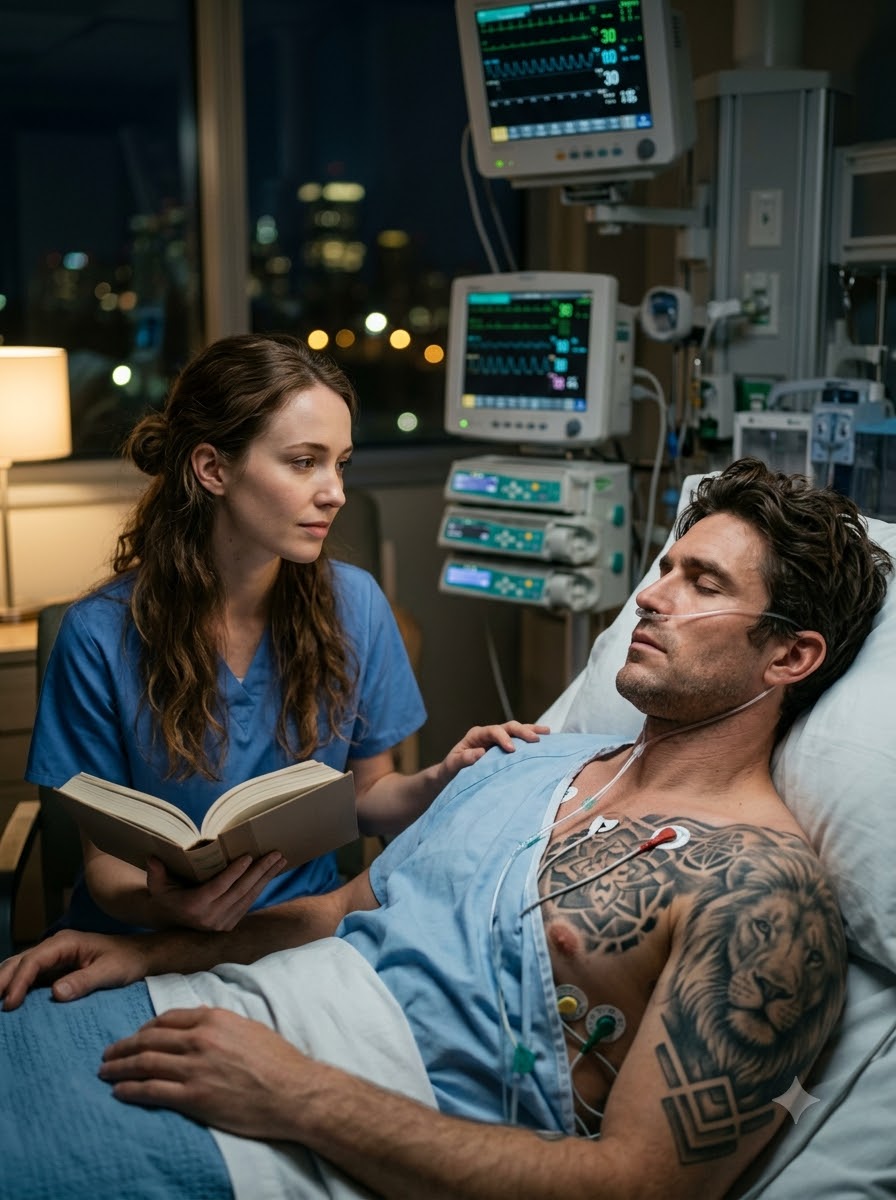
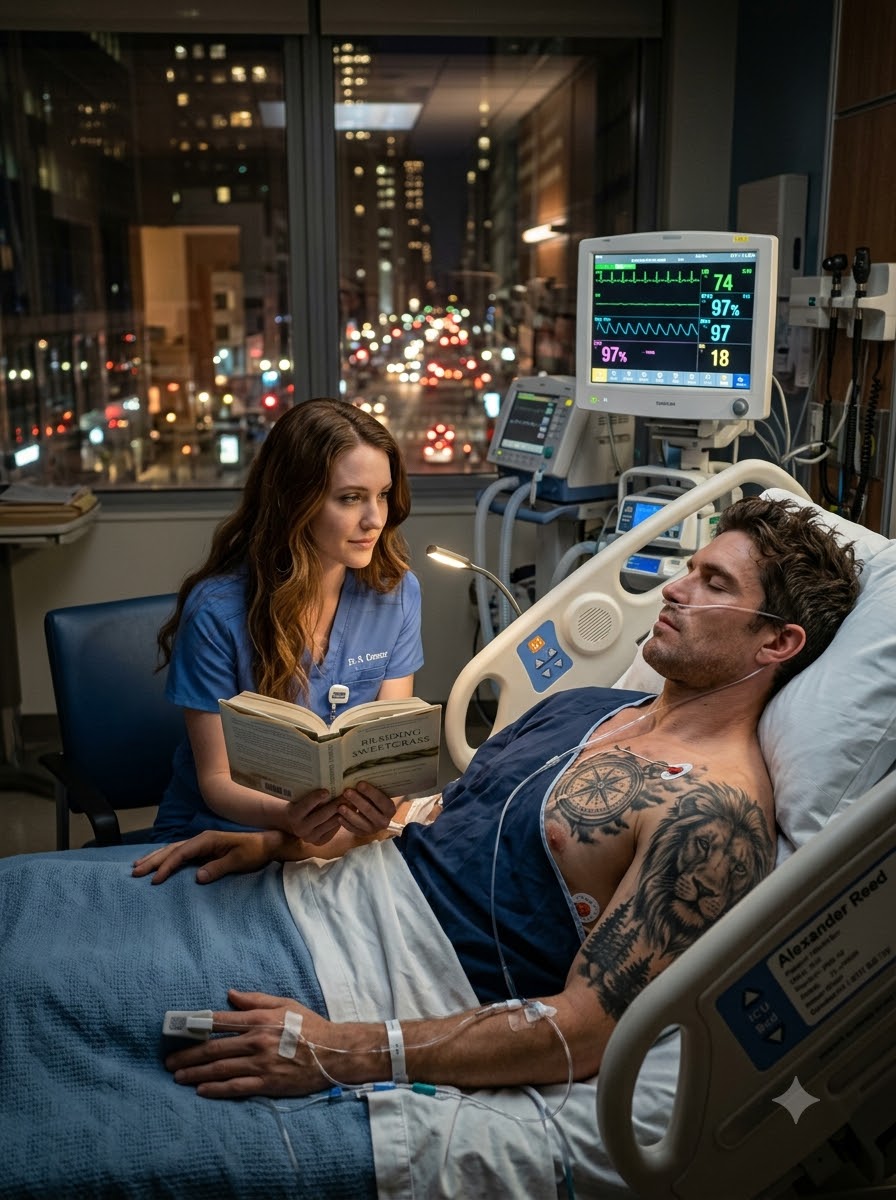
I washed his scarred hand with a warm cloth and spoke to him as I always did.
“You missed some excitement tonight,” I murmured. “One of the residents nearly fainted during a central line.”
The senior nurses thought talking to him was useless. Neurology maintained there was no indication he could process language.
I continued anyway.
Growing up in foster homes had taught me exactly what silence could do to a person. People could stop speaking to you long before they stopped looking at you, until eventually you felt less like a human being and more like a piece of furniture.
I would not allow that to happen to him.
I straightened his blanket, inspected his feeding tube, brushed his dark hair away from his forehead, and studied the scar running along his jaw.
Even unconscious, Dominic Vale looked dangerous.
There was something severe in his features, even in sleep, as if violence had shaped him so thoroughly that unconsciousness could not soften it.
Then I pulled the old paperback from my scrub pocket.
The Art of War.
“You seem like the kind of man who appreciates strategy,” I whispered, sitting beside him. “Or maybe the kind who should have appreciated it sooner.”
For the next twenty minutes, I read aloud while thunder rolled across Boston.
Nobody knew I did this every night.
Nobody knew I had read nearly the entire book to a man doctors believed was incapable of hearing anything.
When I finished the chapter, I rose and checked the monitors.
Heart rate stable.
Oxygen stable.
Everything normal.
I should have walked away.
Instead, I leaned over the bed and did something I never allowed anyone else to see.
I placed my palm gently against his forehead.
“Stay,” I whispered. “Whatever is waiting for you out there… stay.”
His skin was warm beneath my hand.
Then the monitor beeped.
Once.
Twice.
Faster.
I froze.
“Dominic?”
His heart rate climbed again.
I withdrew my hand and stared at his face.
For eighty-nine days, those eyelids had never moved.
Now they did.
A tiny twitch.
Then another.
My breath caught.
I reached for the call button.
Before my fingers touched it, Dominic Vale’s hand suddenly closed around my wrist.
Hard.
My entire body went rigid.
His eyes opened.
Dark and unfocused at first.
Then they found me.
And the first words he rasped after eighty-nine days in a coma were not a question about where he was.
They were about me.
“Don’t let her leave.”
I stared at him.
For one impossible second, neither of us moved.
Then every alarm in the room erupted.
His oxygen saturation dropped sharply before climbing again. His heart rate surged. The cardiac monitor flashed warnings across the screen.
“Doctor!” I shouted.
Dominic’s grip tightened around my wrist.
“Stay,” I whispered automatically.
His eyes remained fixed on mine.
The ICU doors burst open.
Two nurses rushed in first, followed by the resident and respiratory therapist. Someone pushed me aside. Someone else began checking his airway.
“Pressure is changing.”
“Get the attending.”
“Call neurology.”
“Mr. Vale, can you hear me?”
Dominic didn’t answer.
His eyes closed.
“No,” I whispered.
I stepped forward, but a nurse caught my shoulder.
“Let us work.”
I stood frozen beside the wall as the room filled with people.
The monitors slowly settled.
The alarms stopped.
And then Dominic opened his eyes again.
This time, they were clearer.
He looked directly at the attending physician.
“Where is she?”
Everyone turned toward me.
The doctor frowned. “Who?”
Dominic’s gaze moved across the room until it found mine.
“Her.”
The attending looked at me.
I swallowed.
“I’m right here.”
Something almost imperceptible changed in Dominic’s expression.
Relief.
The doctor moved closer.
“Mr. Vale, do you know where you are?”
“Hospital.”
“Do you know your name?”
A pause.
“Dominic Vale.”
The room went completely still.
One of the nurses glanced toward the glass doors.
The two men in dark suits were already moving.
Within seconds, the hospital corridor filled with security personnel.
Dominic noticed.
His eyes hardened.
“Lock the door.”
The attending stared at him. “Why?”
Dominic’s breathing became heavier.
“They know I’m awake.”
Nobody asked who “they” were.
Because everyone in that room understood what his name meant.
The hospital CEO arrived less than ten minutes later.
Then came his private neurologist.
Then the men from outside his room.
The atmosphere changed instantly.
Dominic Vale was no longer an unconscious patient.
He was awake.
And apparently, someone had been waiting eighty-nine days for that moment.
I remained near the wall while doctors examined him. He answered their questions slowly. His speech was weak, but his memory appeared intact.
Then the neurologist asked something that made my stomach tighten.
“Mr. Vale, do you remember the shooting?”
Dominic stared at the ceiling.
“Not all of it.”
“What do you remember?”
“Rain.”
The doctor waited.
“A warehouse.”
Another pause.
“Someone I trusted.”
His eyes shifted toward the doorway.
“Then nothing.”
The neurologist nodded and began explaining the likely recovery process.
I barely heard him.
Because Dominic was still watching me.
Finally, he said, “You.”
I looked behind myself.
“Me?”
“You’ve been here.”
It wasn’t a question.
I nodded.
“Eighty-nine days.”
His brow tightened.
“You talked.”
I felt heat rise into my face.
The nurse beside me smiled faintly.
“Yes.”
“What did you say?”
“Mostly nonsense.”
His mouth moved.
Not quite a smile.
But close.
“Read.”
My eyes widened.
“You heard me?”
His eyelids lowered briefly.
“Not everything.”
I felt something inside my chest loosen.
“What did you hear?”
His voice came out rough.
“Enough.”
The doctors exchanged glances.
One of them asked, “What did she read?”
Dominic ignored him.
His attention remained on me.
“The book.”
“The Art of War?”
He gave the smallest nod.
“You told me I should have appreciated strategy sooner.”
I stared at him.
“You remember that?”
“Some of it.”
Then his expression changed.
The warmth disappeared.
“Who knew I was here?”
The question silenced the room.
The attending looked confused.
“The hospital records are private.”
Dominic’s eyes narrowed.
“That’s not what I asked.”
One of the men in the hallway stepped inside.
“Boss.”
Dominic looked at him.
“Call Adrian.”
The man hesitated.
“Now.”
He left.
I had never seen the hospital staff look so uncomfortable.
I suddenly remembered all the whispers I’d heard during my shifts. The rumors about Dominic Vale. The investigators. The men outside his door.
I had spent eighty-nine nights talking to a stranger.
Now that stranger was awake.
And the entire hospital seemed afraid of him.
A nurse came to adjust his IV.
Dominic watched her carefully.
Then he looked at me.
“What’s your name?”
“Clara.”
“Clara what?”
“Clara Bennett.”
He repeated it quietly.
“Clara Bennett.”
I don’t know why hearing my name in his voice made my heart beat faster.
Maybe because he said it as though he intended to remember it.
Later that morning, after the doctors finally ordered everyone except essential staff out of the room, I returned to check his medication.
Dominic was awake.
Still weak.
Still pale.
But unmistakably present.
“You shouldn’t be awake without someone here,” I told him.
“You were here.”
“That isn’t what I meant.”
“I know.”
I checked his IV.
His gaze followed me.
“Why did you talk to me?”
I stopped.
“Because nobody else did.”
His expression became unreadable.
“I was told you couldn’t hear.”
“I didn’t know that.”
“You kept talking anyway.”
“Yes.”
“Why?”
I looked at him.
“Because I know what it feels like when people decide you’re not worth talking to.”
For the first time, Dominic had no immediate response.
His eyes softened.
Then he said quietly, “I’m glad you did.”
Before I could answer, someone knocked.
One of his security men entered.
“Adrian is here.”
Dominic’s face changed.
“Send him in.”
A tall man in a charcoal suit entered the room. He looked exhausted and angry.
His eyes went immediately to Dominic.
“You’re awake.”
“So it seems.”
Adrian approached the bed.
“We have a problem.”
Dominic’s expression hardened.
“Tell me.”
“The police reopened the investigation.”
“They should.”
Adrian glanced at me.
Dominic noticed.
“Speak.”
“Someone accessed your medical file two nights ago.”
My hands went cold.
“Two nights ago?”
Adrian nodded.
“They were looking for one thing.”
“What?”
“The identity of the nurse assigned to you most frequently.”
Dominic went completely still.
His eyes moved toward me.
“Why?”
Adrian hesitated.
“We don’t know.”
Dominic’s voice became dangerously calm.
“Find out.”
Adrian nodded.
Then Dominic looked at me.
“You leave through the east entrance.”
I frowned.
“I finish my shift at seven.”
“Not tonight.”
“I have patients.”
“You’re not my only patient.”
“No.”
His eyes narrowed.
“No?”
“I don’t abandon patients because someone tells me to be afraid.”
For the first time, Adrian looked almost amused.
Dominic stared at me for several seconds.
Then the corner of his mouth lifted.
“You’re difficult.”
“I’ve been told.”
He closed his eyes briefly.
“Good.”
I thought that was the end of it.
It wasn’t.
At 6:42 that evening, my phone buzzed.
Unknown number.
I almost ignored it.
Then a message appeared.
STOP TALKING TO HIM.
My stomach dropped.
Another message arrived.
YOU DON’T KNOW WHO YOU’RE PROTECTING.
I looked through the ICU window.
Dominic was asleep.
Two security men stood outside his room.
I locked my phone.
Then I walked inside.
Dominic’s eyes opened immediately.
“You’re late.”
I stared at him.
“How did you know?”
“You walk differently when you’re angry.”
I almost laughed.
“Someone sent me a message.”
His expression changed.
“Show me.”
I handed him the phone.
He read it once.
Then again.
“Who has your number?”
“The hospital.”
“Anyone else?”
“My sister. A few coworkers.”
“Anyone connected to me?”
“No.”
He handed the phone back.
“Don’t respond.”
“I wasn’t planning to.”
“Good.”
I looked at him.
“Dominic.”
“Yes?”
“Why are they interested in me?”
He was silent for a long moment.
“Because you were the only person who stayed.”
“That doesn’t make sense.”
“It does to people who understand leverage.”
I didn’t like the answer.
“Am I leverage?”
His eyes hardened.
“No.”
The word came immediately.
Then he added, quieter, “You’re a witness.”
“To what?”
“To the fact that I woke up.”
The next morning, investigators arrived.
They asked me questions for nearly an hour.
What time I entered the room.
What I said.
What I touched.
Whether Dominic responded before that night.
I told them everything.
Except one thing.
I didn’t tell them how often I had spoken to him.
Not because I was hiding something.
Because it suddenly felt private.
By afternoon, Dominic’s condition had improved enough for him to sit upright.
His first request was not for his lawyers.
Not for his company.
Not for his family.
He asked for me.
When I entered his room, he looked toward the chair beside his bed.
“Sit.”
I sat.
He studied me.
“You saved my life.”
“I changed your sheets.”
“You kept talking.”
“I read you a terrible book.”
“The book wasn’t terrible.”
“You were unconscious. You had no standards.”
A faint smile appeared.
Then he became serious.
“Clara.”
“Yes?”
“I don’t know what happened the night I was shot.”
“I know.”
“But I know someone wanted me dead.”
I waited.
“And now someone wants you frightened enough to disappear.”
My throat tightened.
“I can take care of myself.”
“I believe you.”
That surprised me.
“But?”
“But you shouldn’t have to do it alone.”
The words settled between us.
For months, Dominic Vale had been surrounded by people paid to protect him.
Yet somehow, the only person he seemed determined to protect was me.
Three weeks later, he walked out of Mercy West Medical Center.
He was thinner.
Weaker.
Still recovering.
But alive.
The investigation eventually uncovered the person behind the shooting: a trusted executive who had been stealing from Dominic’s company and believed Dominic’s death would erase the evidence.
The person who accessed my medical file had worked for him.
They had wanted to know whether Dominic had spoken.
Whether he remembered.
Whether I had heard anything.
I hadn’t.
But Dominic had.
He remembered the warehouse.
The rain.
The betrayal.
And eventually, the name.
The case became national news.
Dominic’s reputation changed almost overnight.
The federal investigation continued, but several accusations against him collapsed when evidence revealed that much of what had been attributed to him had actually been orchestrated by the people trying to take control of his empire.
I never asked how much of the darker part of his reputation was true.
He never volunteered the answer.
Instead, months after that stormy night, he came back to Mercy West.
Not as a patient.
He stood outside the ICU holding something behind his back.
“You’re working tonight,” he said.
I looked at him.
“Yes.”
He brought out a new copy of The Art of War.
I laughed.
“You finished it?”
“Eventually.”
“And?”
He looked at me for a long moment.
“I learned something.”
“What?”
He stepped closer.
“Strategy is useless if you don’t know what you’re trying to protect.”
I didn’t answer.
He held the book toward me.
“For you.”
I took it.
There was a note written inside the cover.
Two words.
Stay.
I looked up.
“You’re stealing my line.”
“I’ve been unconscious for eighty-nine days. I think I’ve earned it.”
I laughed.
And for the first time since I met Dominic Vale, he laughed too.
Not the feared man from Boston.
Not the billionaire.
Not the man everyone whispered about.
Just Dominic.
The man who had opened his eyes because someone had refused to treat him like he was already gone.
And sometimes, even now, when thunderstorms roll over Boston and the ICU windows turn black with rain, I think about that night.
Eighty-nine days.
One old paperback.
One whispered word.
“Stay.”
And somehow, it was enough.
