

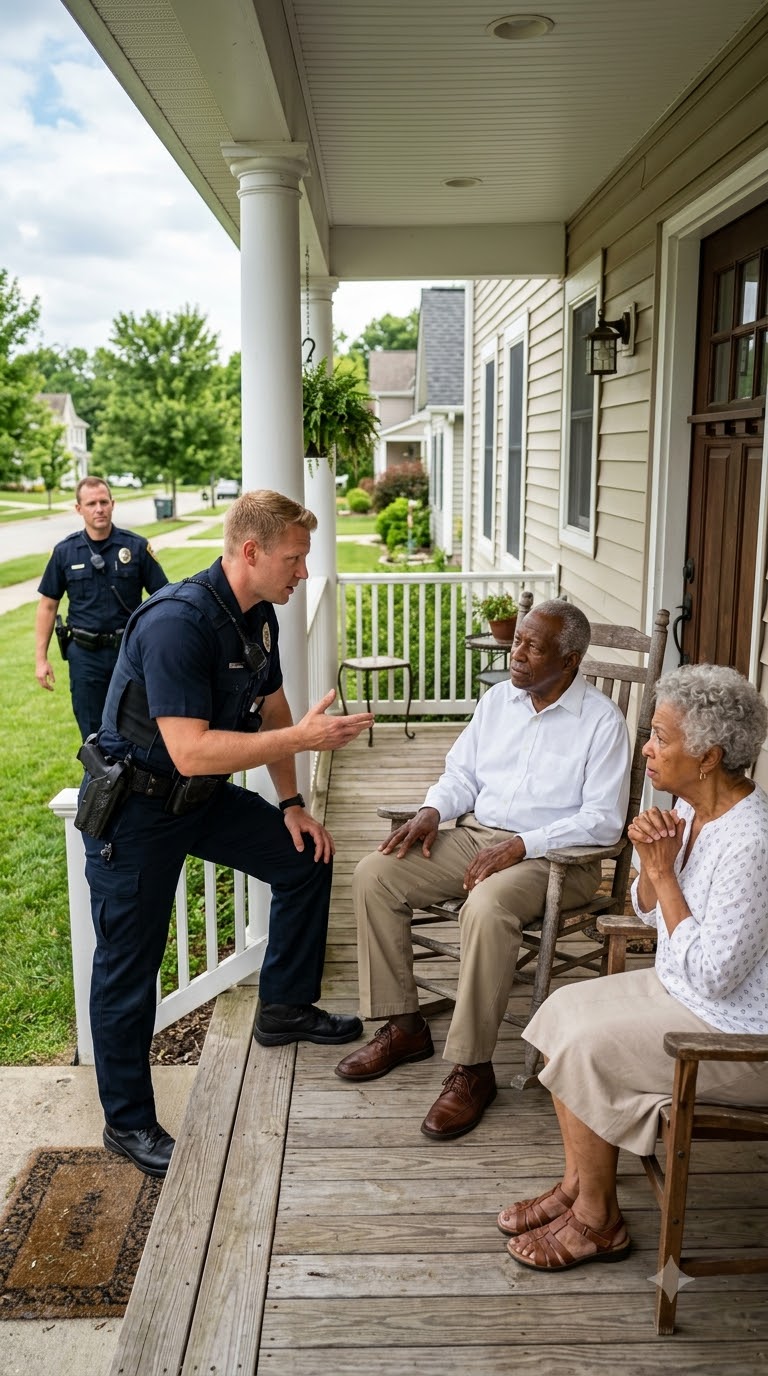
The peaceful evening was interrupted when a patrol cruiser swung sharply onto Magnolia Crest Drive and stopped outside the same brick house Walter Holloway and his wife, Bernice, had called home for thirty-nine years. At seventy-five, Walter sat comfortably in a wooden porch chair, a glass of sweet tea balanced on one knee, while Bernice watered the row of geraniums beside the steps. The neighborhood outside Norwood, Virginia, had transformed around them over the decades, yet the Holloway home remained almost unchanged, including the porch swing Walter had repaired three times rather than replace. Neither had any reason to suspect that the police vehicle stopping at their curb had anything to do with them.
Officer Glenn Mercer stepped from the cruiser before the engine had fully settled. He had served with the Norwood Police Department for nineteen years and had developed a reputation that depended largely on who was describing him: dependable to certain supervisors, aggressive in the eyes of younger officers, and intimidating to numerous residents who had encountered him during difficult moments. His sunglasses remained in place despite the fading evening light, while one hand hovered near his duty belt as he crossed the lawn.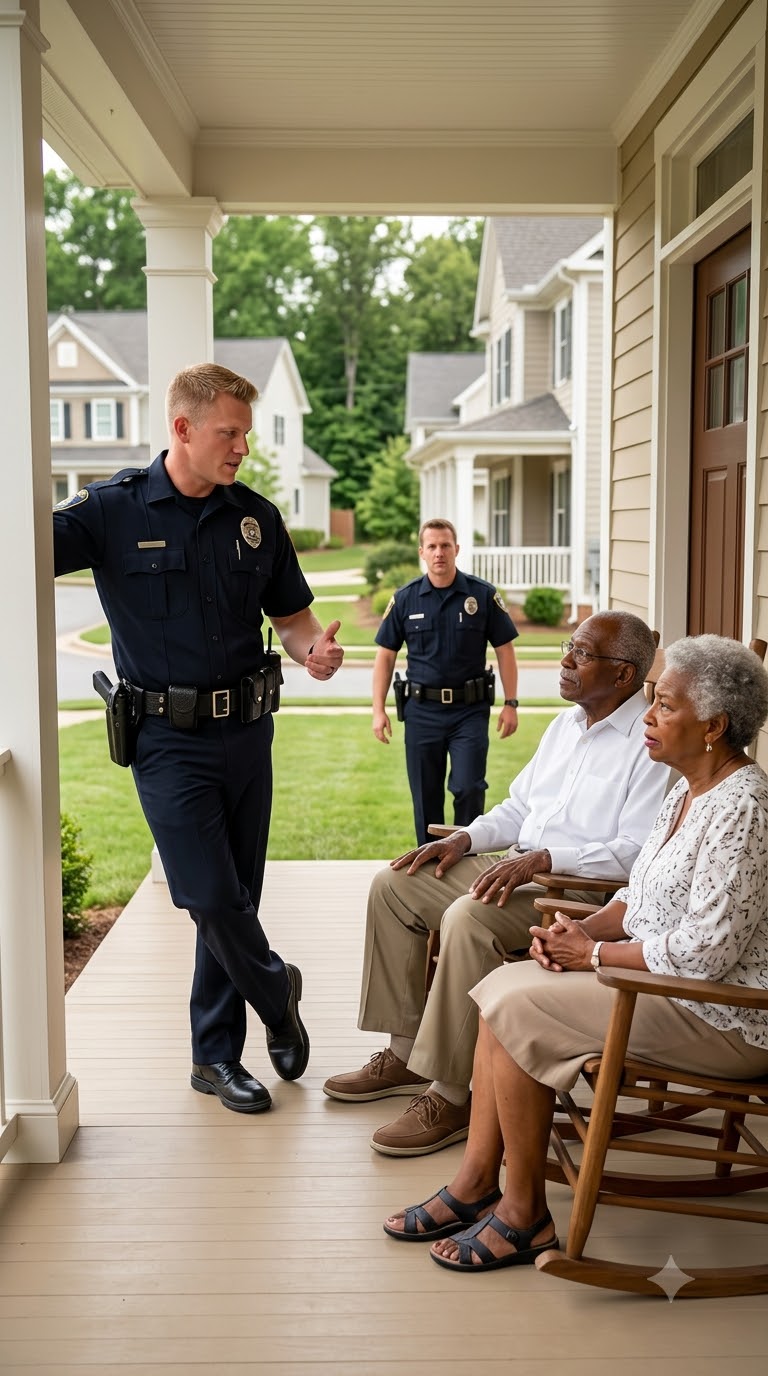
“Both of you need to go inside,” he said without bothering to introduce himself.
Walter glanced toward Bernice.
“Officer, is something happening on the block?”
Mercer continued toward them, explaining that police had received a complaint about suspicious people near the houses on Magnolia Crest.
Bernice looked around at the porch furniture, flowerpots, and small brass plaque beside the door bearing their family name, as if the ridiculousness of the situation might somehow make sense.
“We live here,” Walter said.
Mercer’s eyes moved across the couple and then toward the house, but there was no indication that the information had made any difference.
“I didn’t ask where you say you live,” he answered. “I told you to get inside.”
Bernice slowly straightened.
During her early twenties, she had spent years volunteering with voter-registration campaigns, and she still possessed the quiet impatience of someone who had witnessed authority repeatedly mistake obedience for respect.
“Young man,” she said, “we were paying taxes on this property before you were old enough to have a driver’s license.”
Mercer’s jaw tightened immediately.
Across the street, Margaret Simmons stepped onto her porch after noticing the cruiser. Two teenagers riding bicycles slowed at the corner, and another neighbor stopped while carrying groceries from his SUV.
Walter noticed Mercer looking toward the growing audience and raised one hand calmly.
“Nobody wants trouble here.”
“Then stop making trouble,” Mercer said.
He stepped onto the first porch stair.
Walter remained seated and calmly offered to show identification if the officer required it.
Mercer ignored him.
“Stand up.”
Bernice looked at her husband’s knees.
“He has severe arthritis.”
Mercer glanced at her.
“Then he should have thought about that before refusing a lawful order.”
Walter’s expression changed.
“What law am I breaking?”
Mercer reached for his arm.
The movement was so quick that several neighbors initially believed Walter had simply lost his balance. Mercer grabbed him above the elbow and pulled him forward before Walter had enough time to properly plant his feet.
Bernice instinctively reached toward her husband.
Mercer swatted her arm away with enough force that her wrist struck the small table beside the porch swing.
Her glass of tea crashed onto the wooden boards.
Margaret shouted from across the street.
One of the teenagers immediately raised his phone and began recording.
Walter caught himself against the porch column and turned toward Bernice, who was clutching her wrist against her chest.
“Are you hurt?”
Mercer stepped between them.
“Nobody move.”
Walter stared at him.
“You just shoved my wife.”
Mercer pointed directly at Walter’s face.
“Keep challenging me and you’ll be in cuffs.”
Bernice carefully rose to her feet.
“We were sitting outside our own house.”
Mercer looked at the growing crowd. Instead of calming down, he seemed even more determined to establish control.
“Everybody go back inside.”
Nobody moved.
More phones appeared.
Even the neighbors who had missed the beginning of the confrontation could see that something was wrong.
Walter looked straight at Mercer.
“You need to call your supervisor.”
Mercer laughed once.
“I know how to do my job.”
Walter nodded.
“Then start.”
Mercer’s face hardened.
His hand closed around Walter’s shoulder, and this time he shoved the older man backward toward the wooden porch post.
Walter struck the post near his temple, opening a small cut.
Bernice cried out.
Margaret started crossing the street.
Then another voice came from the sidewalk.
“Officer Mercer.”
It was not loud.
Yet something about the voice made Mercer’s hand fall away before he even turned.
A tall Black man in his mid-forties was walking quickly up the path. He wore dark trousers and a pale gray dress shirt with the sleeves rolled to his forearms.
A police identification wallet was already open in his left hand.
His name was Chief Adrian Holloway.
Nine days earlier, Norwood’s city council had sworn him in as the department’s new police chief. He had spent the evening attending a community meeting only three blocks away and had decided to walk past his childhood home before returning to headquarters.
Mercer recognized him instantly.
Almost everyone in the department did.
“Chief Holloway.”
The aggression disappeared from Mercer’s voice so quickly that everyone watching noticed.
Adrian continued forward until he stood between Mercer and the porch.
“Step away from them.”
Mercer obeyed.
Adrian first looked at Bernice’s wrist and then at the blood near Walter’s temple.
“Mom?”
That single word changed the atmosphere on the entire street.
Mercer’s face went pale.
Bernice held her bruised wrist against her chest.
Walter leaned against the porch column, visibly angry but steady.
Adrian turned toward Mercer.
“These are your parents?” Mercer asked.
Adrian’s expression did not soften.
“They are citizens you just put your hands on.”
He took another step.
“Their relationship to me is not the reason that matters.”
The teenagers continued recording.
Margaret had reached the street, while other neighbors stood at the ends of their driveways watching Norwood’s new police chief confront one of the department’s longest-serving officers outside the home where Adrian had grown up.
Mercer seemed to understand that nothing he said next would remain private.
“Chief, we got a report about suspicious activity,” Mercer began. “They were refusing instructions.”
Adrian looked toward Walter.
His father gave a small shake of his head.
“We were drinking tea.”
Adrian turned back toward Mercer.
“What suspicious activity?”
Mercer explained that dispatch had reported people lingering near a residence after an argument elsewhere on the block.
“You found two elderly people sitting on a porch.”
Mercer said the situation had become hostile.
“Did either one threaten you?”
Mercer said no.
“Any weapon?”
Again, no.
“Did you ask their names before using force?”
Mercer said nothing.
Adrian waited.
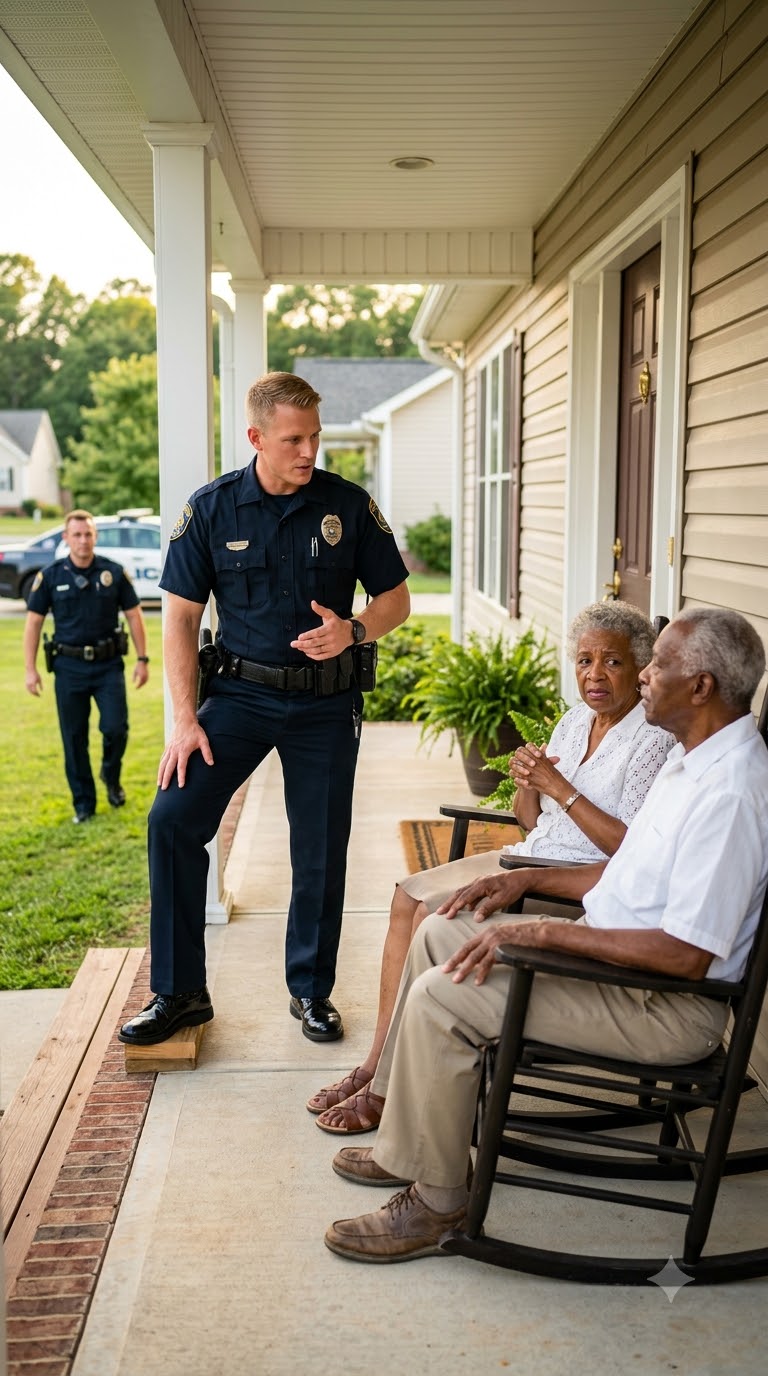
Eventually, Mercer looked toward the street.
“No.”
The word seemed to carry farther than it should have.
Adrian glanced toward a second patrol car turning onto Magnolia Crest.
“You are relieved from field duty effective immediately.”
Mercer’s head snapped toward him.
“Chief, come on.”
Adrian’s voice remained level.
“I’m not discussing this.”
Mercer lowered his voice.
“You’re only doing this because they’re your parents.”
Adrian stepped closer.
“No.”
He glanced toward the phones still recording.
“If anything, their being my parents means I will not make the final disciplinary decision.”
Mercer looked confused.
Adrian continued.
“I personally watched you use physical force on two unarmed elderly residents without establishing a crime, and that requires immediate removal from duty while the incident is independently reviewed.”
The second cruiser stopped.
Sergeant Dana Ruiz stepped out.
Adrian instructed her to secure Mercer’s body camera, take possession of his duty weapon and department access according to policy, and notify Professional Standards.
Mercer looked toward Dana as though hoping she might hesitate.
She did not.
“Officer Mercer, please remove your duty belt.”
For the first time that evening, uncertainty appeared on Mercer’s face.
Adrian turned away and walked onto the porch.
“Mom, let me see your wrist.”
Bernice scowled.
“It’s bruised.”
Adrian touched it carefully.
“It needs to be checked.”
“I need ice.”
Adrian gave her the same expression he had worn as a teenager whenever she refused medical advice.
She returned the exact same look.
Walter touched his son’s shoulder.
“Handle your department first.”
Adrian glanced at the cut near his father’s temple.
“You’re bleeding.”
Walter shrugged.
“I’ve had worse.”
“That’s not the standard.”
The words came out more sharply than Adrian intended.
Paramedics arrived several minutes later.
Bernice’s wrist was badly bruised but not fractured, while Walter required two stitches near his temple.
They refused ambulance transport but agreed to see their physician the following morning.
By the time the paramedics left, the street had become unusually quiet.
Nobody seemed willing to go back inside.
Mercer stood beside the second cruiser without his duty belt, his face tight with humiliation. Adrian did not look at him again.
Instead, he turned toward the neighbors.
“Thank you for staying.”
Margaret stepped closer.
“I recorded everything.”
Adrian nodded.
“Please preserve the original recording. Don’t edit it.”
“I will.”
The teenagers also promised to keep their footage.
Adrian looked at them seriously.
“Do not post anything you are not comfortable sharing. Give the original files to the investigators when they request them.”
The younger of the two nodded.
For the first time, the neighbors understood something important.
The new chief was not trying to control the story.
He was trying to preserve the truth.
By the following morning, the incident had spread far beyond Magnolia Crest Drive.
Three cellphone videos circulated online. One showed Mercer pulling Walter from his chair. Another captured Bernice’s wrist striking the table. The clearest recording showed Adrian arriving and calling her “Mom.”
Local reporters began calling the Holloway house.
Adrian refused to turn his parents into a media spectacle.
He also refused to let their injuries disappear into a convenient internal report.
Instead, he formally requested that an outside agency investigate the use of force. Because his own parents were involved, he recused himself from making the final disciplinary determination against Mercer.
But he did not recuse himself from examining the department’s broader practices.
That distinction became important.
On Monday morning, Adrian requested every misconduct complaint involving Mercer.
The records filled multiple boxes.
The oldest complaint was more than a decade old.
A Black college student had reported that Mercer pulled him from his vehicle during a traffic stop because the officer believed the vehicle could not belong to him. The student had produced registration and insurance in his own name. Mercer’s report described the encounter as necessary because the driver had displayed “unusual nervousness.”
The complaint had been closed.
Another resident had accused Mercer of stopping him while walking home after midnight, demanding identification, and shoving him against a wall after he questioned the search.
Mercer had written that the man became verbally confrontational.
There were complaints from parents, contractors, elderly residents, and young drivers.
Several described unnecessary physical force.
Several involved racial language.
Most had gone nowhere.
Adrian read every file.
Then he noticed something more troubling.
Some complaints had not simply been dismissed.
They had been quietly discouraged.
Residents had received calls from supervisors asking whether they were certain they wanted to continue. Some had been told that formal complaints could make matters “more complicated.”
Adrian closed one folder and sat back.
The problem was larger than Glenn Mercer.
Mercer was a symptom.
The real question was why the system had repeatedly allowed him to behave that way.
That afternoon, Deputy Chief Thomas Reddick entered Adrian’s office.
“You keep pulling threads like this, and you’re going to tear this department apart.”
Adrian looked up.
“Maybe somebody should have checked why the fabric was ripping.”
Thomas frowned.
“There are good cops here.”
Adrian nodded.
“Most of them.”
“You make everybody feel accused, you lose them.”
Adrian closed the folder.
“If an honest officer hears that complaints were buried and decides I’m attacking him personally, that tells me something too.”
Thomas crossed his arms.
“Mercer messed up Saturday.”
Adrian shook his head.
“Stop calling it that.”
“What would you call it?”
Adrian opened the oldest complaint.
“A pattern.”
The word stayed between them.
“A pattern that people tolerated long enough to become a system.”
Within days, Adrian established an independent reporting process so residents and officers could speak directly with outside investigators.
The calls began almost immediately.
A nurse described being stopped by Mercer near her own apartment complex.
A retired teacher described an encounter involving his grandson.
Two former officers separately reported hearing inappropriate racial comments inside the department.
Then a retired lieutenant named Calvin Dorsey agreed to speak.
He had spent three decades with Norwood Police before retiring.
“We taught young officers that protecting the department meant protecting the officer,” Calvin said.
He paused.
“Those are not always the same thing.”
His statement changed the investigation.
Other former officers began speaking.
Records were reopened.
Old reports were compared with dispatch logs and available recordings.
Several accounts that had once appeared unrelated began forming a pattern.
Adrian refused to announce conclusions before investigators finished their work.
That restraint frustrated some residents.
Others appreciated it.
He understood both reactions.
He wanted accountability.
But he wanted accountability that could not be dismissed as revenge.
Meanwhile, Walter and Bernice began receiving letters.
Some were supportive.
Others blamed them for what was happening to Mercer.
One letter contained only three words:
YOU STARTED THIS.
Walter read it once before dropping it into the trash.
Bernice was furious.
“We were drinking tea.”
Adrian sat with them at the kitchen table.
“I know.”
“No, listen to how ridiculous that sounds.”
Walter placed his hand over hers.
“Bernie.”
She looked at him.
“We were sitting on our own porch drinking tea, and somehow strangers think we created all this.”
Adrian had no answer that could make it less absurd.
Bernice turned toward him.
“Do not let anybody make this important because we are your parents.”
Adrian nodded.
“I won’t.”
“And don’t let the newspapers turn your father into some gentle saint because he got hurt.”
Walter immediately smiled.
“Thank you.”
Bernice pointed at him.
“You are stubborn, cheap, and occasionally impossible.”
Adrian laughed.
It was the first time he had laughed in nearly a week.
But the investigation was far from finished.
Three weeks later, the outside investigators returned their preliminary findings to the city.
The evidence was overwhelming.
The original complaint about suspicious people had not described Walter and Bernice as suspects.
The dispatch record contained no instruction authorizing Mercer to remove them from their property.
There was no documented threat.
No weapon.
No assault against Mercer.
And the video contradicted several important parts of his preliminary report.
Most damaging of all, Mercer had written that Walter resisted physically.
The recording showed otherwise.
The investigators also discovered that Mercer had attempted to characterize the destruction of the bonsai as accidental property damage during the confrontation.
The video showed something different.
He had deliberately struck it.
The city suspended Mercer pending the completion of disciplinary proceedings.
Chief Langford, who had defended Mercer privately, was also investigated after records showed that several previous complaints had received inadequate review during his tenure.
The case no longer belonged to one officer.
It belonged to an institution.
At a public meeting, Adrian stood before residents and officers together.
“I know some people want one person to be blamed and the story to end there.”
He looked around the crowded room.
“But if the system allowed misconduct to survive for years, removing one person is not enough.”
Nobody interrupted him.
“We need transparent complaint procedures. We need proper review. We need supervisors who understand that protecting the badge does not mean protecting misconduct.”
An officer near the back raised his hand.
“Chief, what do you want from us?”
Adrian answered without hesitation.
“Do your job.”
He paused.
“And if you see another officer doing something wrong, do not look away.”
The room remained silent.
Then Sergeant Dana Ruiz stood.
“I saw what happened on Magnolia Crest,” she said. “And I want to say something publicly.”
Adrian nodded.
Dana looked toward Walter and Bernice.
“I should have gotten there sooner.”
Walter shook his head.
“You weren’t there.”
“But I am here now.”
Bernice looked at her for several seconds before nodding.
“That matters.”
Months passed.
The disciplinary investigation eventually concluded that Mercer had violated department policy and committed serious misconduct. The city terminated his employment after the formal process concluded.
Other officers received discipline for failing to properly review earlier complaints.
Some supervisors retired.
Others remained and helped rebuild the department.
The reforms were slow.
They were not perfect.
But they were real.
And on Magnolia Crest Drive, life gradually returned to normal.
Walter repaired the porch table.
Bernice planted new geraniums.
Margaret still crossed the street regularly to visit.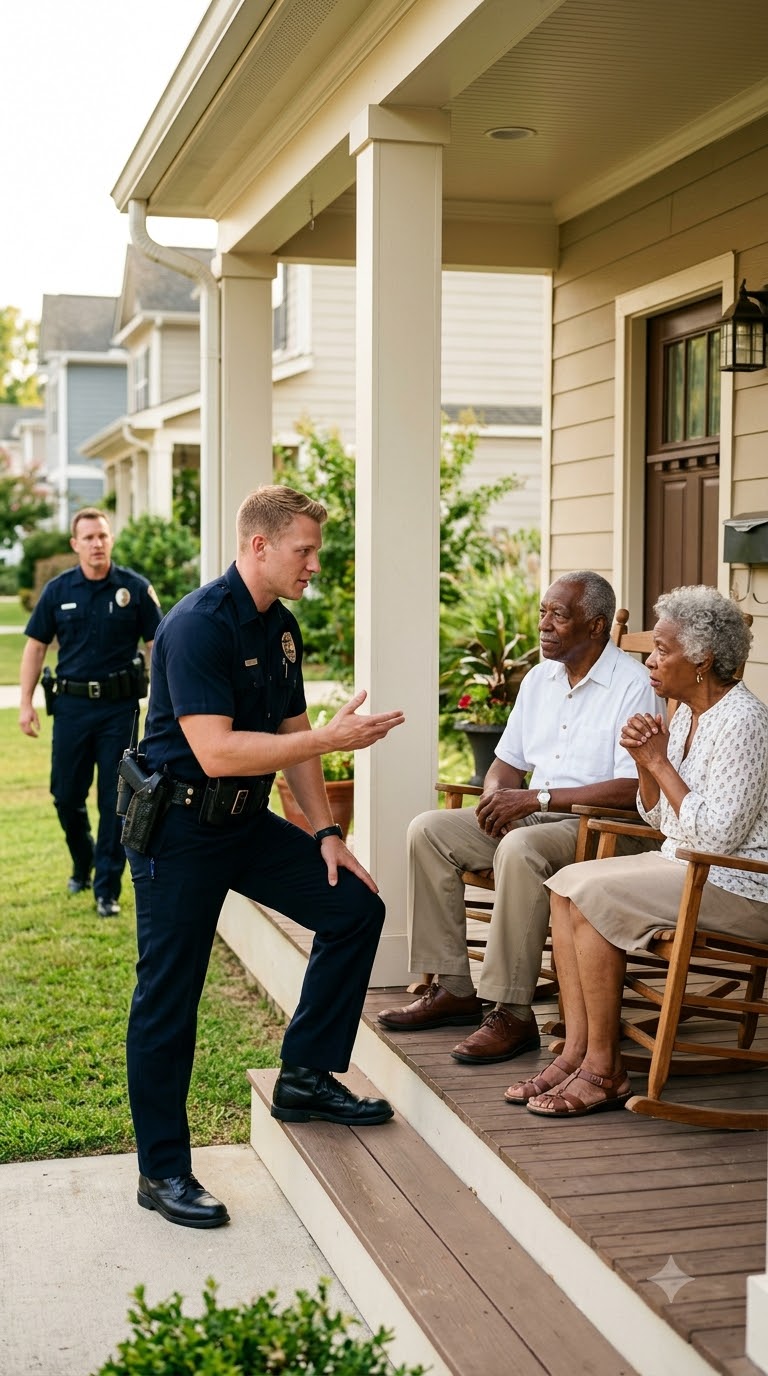
The teenagers who had recorded the incident eventually graduated high school, but they never deleted the original videos.
As for Adrian, he kept returning to his parents’ porch whenever his schedule allowed.
One evening, months after the incident, he sat beside Walter while Bernice watered the flowers.
Walter looked at him.
“You know what I remember most?”
Adrian smiled.
“What?”
“The tea.”
Adrian laughed.
“You were worried about tea?”
Walter shook his head.
“No. I’m saying that before that cruiser showed up, it was just another evening.”
Bernice joined them.
“And that’s what people forget.”
She looked toward the street.
“Ordinary people deserve ordinary peace.”
Adrian nodded.
He had spent his career learning how to handle crises.
But that evening, sitting between his parents, he understood something his military and police training had never fully taught him.
Power was not proven by how many people you could command.
It was proven by whether you used it to protect people who had no power at all.
Walter lifted his glass.
“To quiet evenings.”
Bernice raised hers.
“To knowing your neighbors.”
Adrian lifted his own glass.
“And to doing the right thing when nobody is watching.”
Walter smiled.
“Somebody was watching.”
They all looked toward the street.
Margaret stood on her porch, watering her flowers.
She raised one hand.
They laughed.
For the first time in months, Magnolia Crest Drive felt peaceful again.
And the porch where an elderly couple had once been treated like strangers became something else entirely.
A reminder that dignity did not belong to a badge.
It did not belong to a title.
It did not belong to whoever shouted the loudest.
It belonged to everyone.
And sometimes, the most powerful thing a person could do was simply refuse to look away.
