

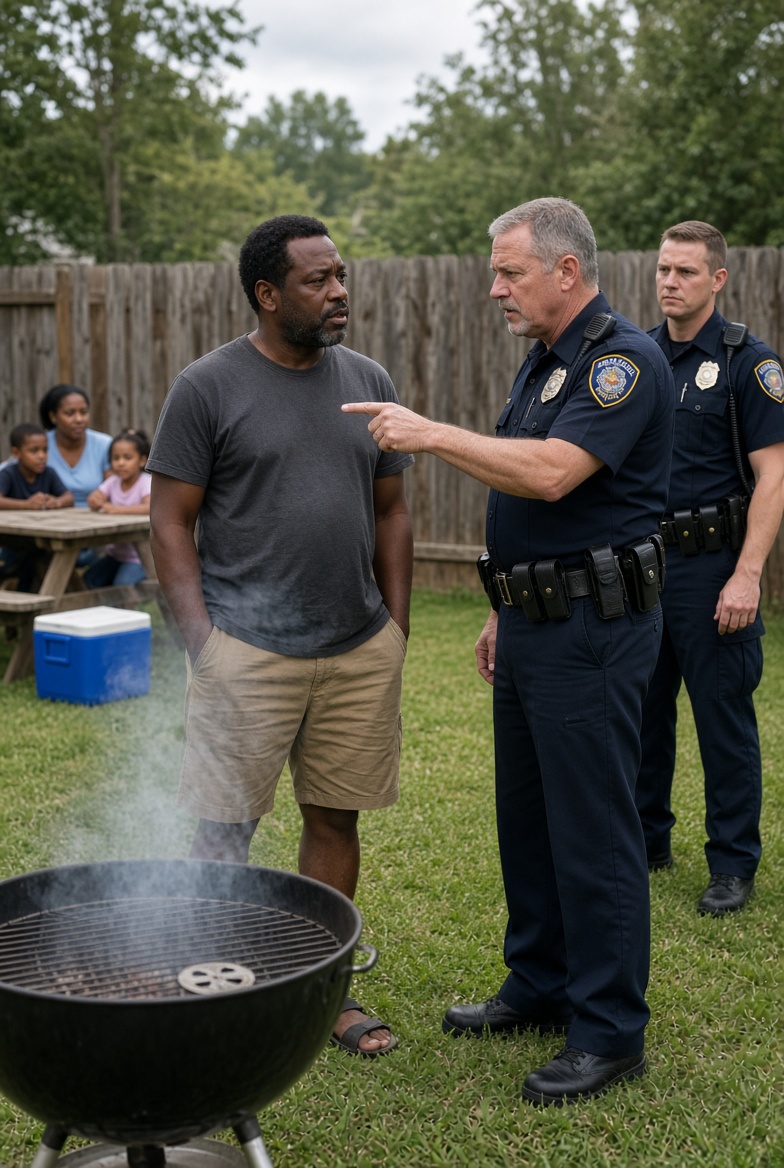
The first thing Officer Eric Danner did after stepping into Calvin Mercer’s backyard was knock a paper plate out of his hand.
Smoked brisket landed on the grass, baked beans splattered across Calvin’s sneakers, and a piece of cornbread rolled beneath a folding chair where his eight-year-old granddaughter had been sitting a minute earlier.
For several seconds, nobody in the yard said anything, because almost fifty people had just watched a police officer turn an ordinary family cookout into something nobody understood.
Calvin looked down at the food, then slowly lifted both empty hands where the officer could see them.
“Keep them up,” Danner said. “You’re a big guy, and I don’t know what you’re about to do.”
Calvin was fifty-six years old, six-foot-four, around 255 pounds, and built like the defensive lineman everyone assumed he had once been.
In reality, he had spent twenty-eight years behind desks, courtroom tables, conference-room doors, and government lecterns, although he still woke at five most mornings to lift weights because the habit had followed him out of the Army.
That Saturday he wore faded jeans, an old gray T-shirt, white running shoes, and a black apron that said MERCER’S SMOKEHOUSE — IF YOU’RE STILL HUNGRY, THAT’S YOUR FAULT.
Barbecue smoke drifted across his patio while old Motown played softly from a speaker near the pool.
“This is my house,” Calvin said.
Danner gave him a dry smile.
“Sure.”
“It is.”
“Then you won’t mind sitting down while we sort out who belongs here.”
Calvin looked at him for a long second before pulling out a patio chair and sitting.
His daughter, Tessa, had already started toward him from the deck, but Calvin raised one finger in her direction and gave the smallest possible shake of his head.
Tessa stopped because she knew her father’s expressions well enough to understand the message.
His nephew Malik, standing near the drink coolers, quietly lifted his phone and began recording.
Danner noticed.
“Tell him to put that away.”
Calvin looked toward Malik.
“Keep recording.”
The officer’s jaw tightened.
“I just told him to stop.”
“And I told him he doesn’t have to.”
“What exactly are you trying to prove?”
“Nothing.”
Calvin rested both hands on his thighs.
“That’s the point.”
The backyard had been loud and happy twenty minutes earlier.
Tessa had just returned from Boston after passing the Massachusetts bar exam, and Calvin had spent the entire week pretending the celebration would be small while ordering enough meat to feed a church convention.
There were cousins, neighbors, retired judges, old military friends, law-school classmates, children running near the pool, and enough folding tables that Calvin had borrowed half of them from a community center.
Tessa had threatened to leave when she saw the banner.
CONGRATULATIONS COUNSELOR MERCER — OBJECTION OVERRULED
“Dad, this is humiliating.”
“You graduated Harvard Law.”
“So?”
“So humiliation is part of your reward.”
“I hate you.”
Calvin opened his arms.
“Come hug the man you hate.”
She did.
He held her slightly longer than usual because her mother should have been standing beside him.
Monica Mercer had died seven years earlier after a three-year battle with ovarian cancer.
She was forty-nine and still telling Calvin how to season ribs from a hospital bed during her final summer, which was probably why he now cooked enough food for every celebration as though proving something to the universe.
Tessa’s graduation was one of those milestones he had pictured Monica seeing, and throughout the morning he kept catching himself looking toward the kitchen door as though she might walk outside carrying a bowl and telling him he had added too much brown sugar.
By noon, the sadness had softened into gratitude.
At 12:40, an old friend named Evelyn Shaw arrived carrying two bakery boxes.
She wore jeans, a loose linen shirt, sunglasses, and no makeup, which made her almost unrecognizable to people accustomed to seeing her behind a podium in full uniform.
Calvin had known Evelyn for more than twenty years, back before either of them had enough authority to make anyone nervous.
She opened the first box.
Peach cobbler.
Calvin nodded approvingly.
“You may stay.”
“I wasn’t asking.”
“What’s in the second?”
“Lemon cake.”
“Now you can definitely stay.”
Evelyn smiled.
“I’m honored.”
She disappeared into the house looking for Tessa.
Across the street, a woman named Marjorie Phelps watched cars arrive.
Marjorie was sixty-two, divorced, retired from a property-management company, and had moved into the neighborhood eight months earlier.
By Christmas she had already emailed the homeowners association about garbage cans being visible after sunset, teenagers parking too close to driveways, lawn crews beginning before eight, and one neighbor who left inflatable holiday decorations outside until January 4.
Most residents treated her as an annoyance.
Calvin had tried being polite.
Twice.
The second time occurred three months earlier after she walked into his driveway while he was trimming hedges and told him “whoever owns this house” needed to stop placing yard-waste bags near the curb before pickup day.
Calvin reminded her the neighborhood ordinance allowed bags after five in the afternoon.
She asked whether he worked for the homeowner.
“No.”
“Then who are you?”
“Calvin Mercer.”
She stared.
He pointed toward the house.
“I live here.”
Marjorie looked unconvinced.
Apparently the information did not stick.
At 1:18 that Saturday, she called the non-emergency police number.
“There’s an enormous party across from me.”
The dispatcher asked whether there was fighting.
“No.”
“Loud music?”
“It’s noticeable.”
“Any threats?”
“I don’t know.”
The dispatcher paused.
“Then what is the concern?”
“There’s a very large Black man going in and out of the house and yelling at people.”
Calvin had been yelling at his brother for stealing burnt ends.
The dispatcher asked whether the man might live there.
Marjorie answered, “I know the homeowners around here. He doesn’t look like one of them.”
That sentence sent Officers Eric Danner and Luke Brenner to Willow Brook Lane.
They arrived at 1:31.
One guest’s sedan was parked a little too close to a hydrant, which would have been the only clear issue if anyone had approached the situation normally.
Brenner noticed it as soon as he stepped from the cruiser and suggested they simply ask someone to move the car.
Danner was already watching Calvin.
“Who’s the big guy?”
Brenner shrugged.
“Probably host.”
“Doesn’t look like it.”
“What does a host look like?”
Danner glanced at him.
“Relax.”
They walked toward the side gate.
Calvin stood nearby carrying a plate he had just made for himself after spending three hours feeding everyone else.
Danner called out.
“Hey.”
Calvin turned.
“Yes?”
“What’s happening here?”
“Graduation cookout.”
“Whose?”
“My daughter’s.”
“You live here?”
“Yes.”
“Identification.”
Calvin balanced the plate in one hand.
“Wallet’s inside.”
Danner immediately looked at his hands.
“Don’t reach.”
“I wasn’t.”
“You just said you needed your wallet.”
“I said it’s inside.”
Brenner looked toward the house.
“What’s your name, sir?”
“Calvin Mercer.”
Danner asked, “Owner’s name?”
Calvin stared at him.
“Calvin Mercer.”
“Rental property?”
“No.”
“You own this house?”
“Yes.”
Danner smiled slightly.
“Expensive place.”
Calvin’s expression changed.
“So?”
“Just making conversation.”
“Then you should probably get better at it.”
Brenner looked away because he nearly smiled.
Danner did not.
“What do you do?”
Calvin asked, “What does that have to do with a noise complaint?”
“Who said it was only noise?”
“You did thirty seconds ago.”
Danner shifted.
“We also received a suspicious-person complaint.”
Calvin looked toward the neighboring houses.
“About who?”
“You.”
For a moment, Calvin genuinely thought he had misunderstood.
“I’m suspicious at my own house.”
“We don’t know it’s your house.”
“You asked.”
“People lie.”
“Check the property record.”
Danner’s face tightened.
“Do not tell me how to conduct an investigation.”
Calvin nodded once.
“All right.”
He had spent enough of his career watching officers create bad facts with good intentions, and enough time prosecuting officers who created bad facts intentionally, to understand how quickly tone became a second case.
Nothing he said now would be remembered as simply a homeowner speaking.
So he became careful.
Very careful.
“My identification is inside.”
Danner nodded toward the open side gate.
“Go get it.”
Calvin shifted the plate.
“You’ll need to stay here.”
“Why?”
“Because I haven’t invited you into my home.”
Danner stared.
“We need to verify your identity.”
“I can bring it out.”
“Why are you making this difficult?”
“I’m not.”
Danner stepped closer.
“Put the plate down.”
Calvin looked at him.
“Why?”
“I gave you an instruction.”
“There’s a table right there.”
“Then put it down.”
Calvin set the plate on a small stand beside the gate.
Brenner looked toward the parked cars.
“Eric, I can check the hydrant and run the address while he gets ID.”
Danner ignored him.
Then Marjorie called from across the street.
“Officer!”
Everyone turned.
She stood on her lawn with both arms folded.
“That’s the man.”
Calvin looked at her.
“The man doing what?”
Marjorie spoke toward the officers.
“He’s been going in and out all afternoon.”
Calvin almost laughed.
“I live here.”
She shook her head.
“I’ve never seen you before.”
“Marjorie.”
She stared.
“You argued with me about my yard-waste bags in March.”
Her face changed.
“I talk to a lot of people.”
“You were standing six feet from me.”
Danner raised one hand.
“Enough.”
Calvin looked toward him.
Danner’s voice hardened.
“Hands on the fence.”
“For what?”
“Suspicious behavior and failure to cooperate.”
“I’ve answered every question.”
“You’re challenging everything.”
“That isn’t a crime.”
Danner took one step forward.
“You see, that attitude?”
Calvin’s voice lowered even further.
“I am not raising my voice.”
“You’re a big man.”
“That doesn’t make my volume louder.”
“You want to test me?”
“No.”
Tessa reached the gate.
“Dad?”
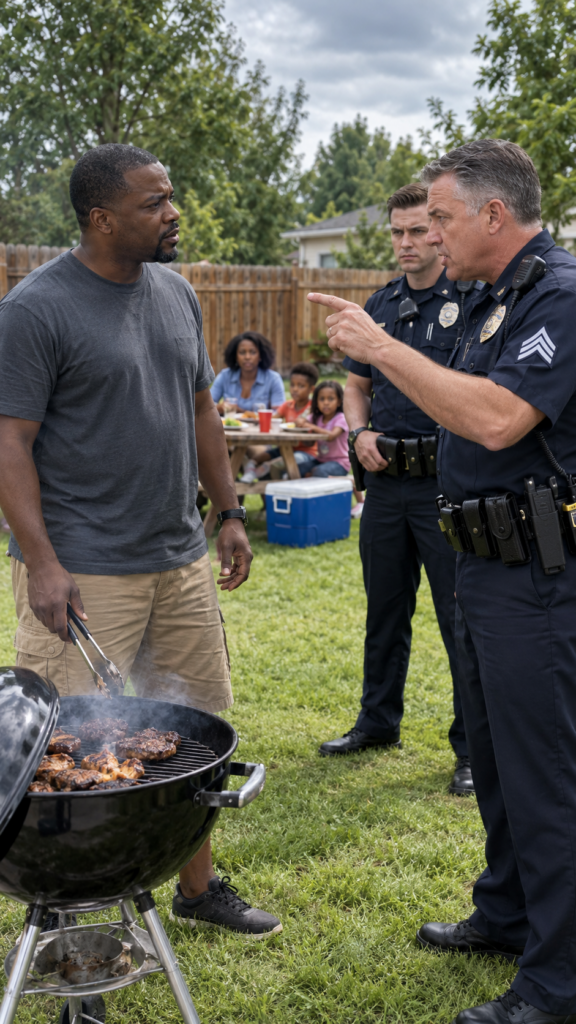
Calvin immediately looked toward her.
“Stay there.”
Danner turned.
“Who are you?”
“His daughter.”
“You live here?”
“This is my family’s house.”
“Go back inside.”
Tessa’s expression hardened.
“I’m an adult.”
“Then act like one and follow instructions.”
Calvin’s eyes changed.
“Officer.”
Danner looked back.
“Don’t speak to her like that.”
“There.”
Danner pointed.
“That aggression.”
Tessa stared.
“My father is sitting there talking.”
Danner ignored her.
Calvin understood what was happening.
The word had arrived.
Aggressive.
Once written, it could do enormous work.
A large Black male became aggressive.
The subject’s physical size increased officer concern.
The subject began challenging commands.
The subject caused fear.
People often imagined police reports as neutral documents.
Calvin knew better.
Language could turn uncertainty into certainty faster than facts.
So he lifted his hands.
“I am not threatening anyone.”
Danner’s voice rose.
“Then do what I’m telling you.”
“What exactly are you telling me?”
“Move into the backyard.”
“I haven’t given you permission to enter.”
Danner stepped through the gate.
“So now you have.”
Brenner paused.
“Eric.”
“Come on.”
Calvin followed because Tessa and the rest of his family were already there.
That was how the patrol officers ended up standing in the middle of a barbecue filled with lawyers, judges, veterans, doctors, teachers, and one police chief who had not yet come outside.
Children were moved toward the deck.
Music stopped.
Calvin’s brother Anthony stepped closer.
Calvin looked at him.
“Stay back.”
Anthony spread his hands.
“I’m not doing anything.”
“Exactly.”
Danner surveyed the coolers.
“Everybody drinking?”
“Adults.”
“Anyone smoking?”
“Brisket mostly.”
Brenner covered a cough.
Danner stared.
“Funny.”
Calvin shook his head.
“No.”
“Drugs?”
“No.”
“Any fights?”
“No.”
“Arguments?”
“Only about basketball.”
“You check everybody?”
Calvin looked at him.
“This is not a nightclub.”
Danner noticed the plate near the smoker that someone had carried in from the gate.
“Yours?”
“Yes.”
“Pick it up.”
Calvin frowned.
“Why?”
“Because I said so.”
He picked up the plate.
Danner swatted it downward.
Food hit the lawn.
Tessa gasped.
Anthony took one step forward.
Calvin pointed at him.
“Don’t.”
Danner said, “Keep your people back.”
Calvin looked directly at him.
“My people?”
Danner hesitated.
“You know what I mean.”
“No.”
“I don’t.”
Danner pointed toward a chair.
“Sit.”
Calvin sat.
Brenner approached his partner.
“Eric, this is going nowhere.”
“I’m handling it.”
“We can verify the property.”
“He keeps challenging commands.”
“He hasn’t threatened us.”
Danner lowered his voice.
“A guy his size can turn dangerous fast.”
Calvin heard every word.
Danner realized it.
“You got something to say?”
“No.”
That seemed to bother him more.
“Why are you so calm?”
Calvin looked toward the security camera beneath the roof.
Then another beside the pool house.
Then Malik’s phone.
Finally back to Danner.
“Because I don’t need your version of this later.”
Danner frowned.
“What does that mean?”
“It means the afternoon is recording itself.”
The officer glanced around.
Only then did he notice the first camera.
The green indicator light blinked.
Another camera covered the patio.
Another faced the gate.
Calvin’s home system had six exterior cameras, all with audio, and all backed up remotely.
Danner’s expression changed slightly.
Not enough.
“Stand up.”
Calvin stood.
“Turn around.”
“Am I being arrested?”
“You’re being detained.”
“For what?”
“I’ll tell you once you cooperate.”
Calvin almost smiled.
“That’s backwards.”
Danner grabbed his wrist.
Tessa gasped.
Calvin did not resist.
The second wrist moved behind him.
Metal closed.
Nearly fifty people watched the cuffs lock.
Danner leaned toward his ear.
“You still calm?”
Calvin’s jaw tightened.
“Yes.”
“Why?”
“Because eventually you’re going to need facts.”
The kitchen door opened.
Chief Valerie Knox stepped outside carrying a glass of iced tea.
She had changed nothing about her appearance.
Jeans.
White cotton blouse.
Hair pulled loosely behind her head.
No uniform.
No badge visible.
At first Danner barely looked at her.
Valerie stopped on the deck.
Her eyes moved across the yard.
The discarded food.
Tessa crying.
Guests frozen.
Calvin standing in cuffs.
Her face changed.
“What happened?”
Danner turned.
“Police matter, ma’am. Please stay inside.”
Brenner closed his eyes.
“Eric.”
Valerie descended the stairs.
“Excuse me?”
Danner extended one hand.
“You need to move back.”
Brenner finally said it.
“Chief.”
Danner looked toward him.
“What?”
Luke Brenner’s face had gone pale.
“Chief Knox.”
Danner looked at Valerie again.
Recognition arrived slowly.
Then violently.
“Chief.”
Valerie stopped.
She looked at Calvin.
Then at his wrists.
“Why is Calvin Mercer handcuffed?”
Danner swallowed.
“Suspicious-person complaint.”
Valerie looked around.
“At his daughter’s graduation party?”
“Yes, ma’am.”
“There was uncertainty about whether he belonged at the property.”
Someone near the deck muttered, “You’ve got to be kidding.”
Valerie ignored it.
“Calvin.”
“Yes?”
“You own this house?”
“Seventeen years.”
A few people laughed nervously.
Valerie did not.
She looked at Danner.
“Remove the cuffs.”
“Chief, I need to—”
“Now.”
Danner unlocked them.
Calvin brought his wrists forward.
Red marks had already formed.
Valerie saw them.
“What crime did you suspect?”
“Possible trespass.”
“Who was trespassing?”
“The caller wasn’t sure he lived here.”
Valerie stared.
“What did he tell you?”
“That he owned it.”
“His daughter?”
“Confirmed it.”
“Did you verify?”
“No.”
“Why?”
“He became confrontational.”
Calvin said quietly, “No.”
Danner turned.
“You challenged instructions.”
Tessa spoke.
“Everything is on video.”
Malik raised his phone.
“All of it.”
Anthony pointed toward the eave.
“Six cameras.”
Danner looked upward again.
Valerie turned to Brenner.
“Did Mr. Mercer threaten you?”
“No, ma’am.”
“Raise his voice?”
“No.”
“Refuse to identify himself?”
“He gave his name and said his wallet was inside.”
“Resist?”
“No.”
“Did you recommend verifying the address?”
Brenner hesitated.
Danner stared at him.
“Luke.”
Valerie’s voice sharpened.
“Officer Brenner.”
Luke looked toward her.
“Yes, ma’am.”
Danner whispered something under his breath.
Valerie heard.
“So both body cameras are recording?”
Brenner touched his chest.
“Yes.”
Danner did not answer.
Valerie looked toward his camera.
Red light.
“Good.”
Then she looked at Calvin.
“Did they ask what you do?”
He nodded.
“I declined to answer.”
Danner looked confused.
Valerie’s expression hardened slightly.
“They should probably know now.”
Calvin shook his head.
“It shouldn’t matter.”
“I agree.”
Danner looked between them.
“Know what?”
Valerie turned toward him.
“Mr. Mercer spent fourteen years as an Assistant United States Attorney.”
Danner froze.
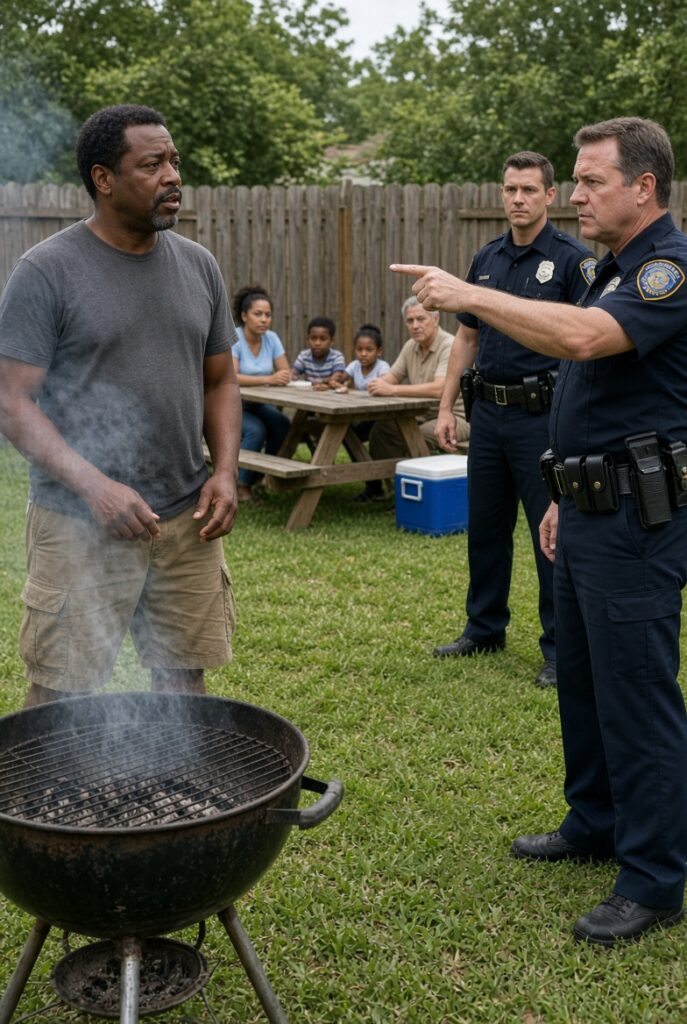
Valerie continued.
“Most of that time was in civil rights and public corruption.”
Brenner looked at Calvin differently.
The guests remained silent.
“He later served eight years as Inspector General counsel for the state.”
Danner swallowed.
“And three months ago,” Valerie added, “the mayor appointed him chair of the Metropolitan Law Enforcement Review Board.”
The same man stood there.
Same barbecue-stained T-shirt.
Same muscular frame.
Same Black skin.
Same backyard.
Only the résumé had changed.
Calvin raised both wrists.
“That right there is the problem.”
Danner blinked.
“What?”
“My job suddenly changed your face.”
“No, sir.”
“Yes.”
Calvin stepped slightly closer.
“When you thought I was nobody, you knocked food out of my hand.”
“When you learned I chaired the board that reviews officer misconduct, you started calling me sir.”
Danner’s mouth opened.
Calvin stopped him.
“Do not apologize yet.”
Everyone stared.
“You don’t know what you’re apologizing for.”
Valerie looked toward Danner.
“He’s right.”
Danner looked trapped.
“I was acting on a complaint.”
Valerie answered.
“A complaint is information.”
“It is not a verdict.”
“She said he didn’t belong.”
“He told you he did.”
“She said he was aggressive.”
Valerie gestured toward Calvin.
“What behavior did you observe?”
Silence.
“Not adjectives.”
“Behavior.”
Danner stared at the grass.
“He questioned instructions.”
“That is speech.”
“He’s physically intimidating.”
Calvin almost laughed.
“I have been this height since college.”
Someone chuckled.
Valerie did not.
“Professional Standards is coming.”
Danner’s eyes widened.
“Chief.”
“No.”
“This can be handled on scene.”
“It is being handled on scene.”
She pulled out her phone.
“You simply don’t control the scene anymore.”
The barbecue continued after Internal Affairs left.
Calvin insisted.
Guests tried.
Nobody really succeeded.
Tessa remained near him until sunset.
At one point she pulled him into the kitchen.
“Why didn’t you tell them?”
“Tell them what?”
“Your job.”
Calvin leaned against the counter.
“Would it have helped?”
“Yes.”
“Exactly.”
She stared.
“I don’t understand.”
“The grocery-store clerk three houses over doesn’t chair a police review board.”
“That contractor replacing Mrs. Jamison’s roof doesn’t.”
“The kid borrowing his father’s BMW doesn’t.”
He paused.
“If officers need an impressive biography before they recognize somebody’s rights, then rights aren’t doing much work.”
Tessa’s eyes filled.
“You could have gotten hurt.”
“I know.”
“You looked like you weren’t scared.”
Calvin looked through the window.
Danner stood beside the cruiser speaking with an Internal Affairs lieutenant.
“I was terrified.”
She stared.
“You?”
“Yes.”
“Of him?”
“Of what he could decide my fear looked like.”
That sentence stayed with her.
The investigation began with video.
Six home cameras.
Two body cameras.
Three phone recordings.
Dispatch audio.
Property records.
Everything matched.
Calvin answered questions calmly.
Identified himself.
Offered access to identification.
Tessa confirmed he lived there.
Brenner repeatedly recommended verification.
No fight.
No threat.
No reason for handcuffs.
Investigators then listened to Marjorie Phelps’s call.
Her description raised obvious concerns.
But something else mattered more.
She said she had never seen Calvin before.
Investigators searched neighborhood records.
Within six months, Marjorie had filed three HOA complaints specifically naming Calvin Mercer of 214 Willow Brook Lane.
One concerned garbage bins.
One concerned a political yard sign.
The third concerned branches overhanging a sidewalk.
She knew his name.
She knew the address.
She knew he lived there.
When investigators interviewed her, Marjorie first said she forgot.
Then said she had dealt with “so many service people and workers” that she could not be expected to remember every resident.
The investigator asked why she assumed Calvin was a worker.
Marjorie stopped answering.
Her attorney ended the interview soon afterward.
Media discovered the story.
That was the part Calvin dreaded.
The headline almost wrote itself.
BLACK CIVIL RIGHTS LAWYER HANDCUFFED AT HIS OWN HOME WHILE POLICE CHIEF WATCHED
Calvin disliked it immediately.
Reporters camped near his driveway.
Tessa wanted him to talk.
He refused for several days.
Finally, he agreed to one local interview.
The reporter asked whether he believed the call was racially motivated.
“Yes.”
“Do you blame Mrs. Phelps?”
“For the call, yes.”
“Then why have you repeatedly said the officer’s conduct matters more?”
Calvin leaned back.
“Because police receive unreliable calls every day.”
“Some are mistaken.”
“Some malicious.”
“Some biased.”
“Some confused.”
He paused.
“The uniform exists partly because officers are supposed to separate allegation from fact.”
The reporter nodded.
“So Officer Danner failed because he believed her?”
“No.”
Calvin shook his head.
“He failed because once he believed her, he stopped checking.”
That line circulated everywhere.
But the internal investigation went deeper.
Professional Standards reviewed Danner’s previous complaints.
Five appeared concerning.
One involved a twenty-four-year-old Black college graduate detained while unlocking a Mercedes registered to his father.
Another involved a Mexican-American contractor forced to sit on a curb while officers verified that he had permission to enter a renovation property.
A third involved a Black postal supervisor questioned outside a luxury apartment building where she lived.
Each case had been closed.
Different supervisor.
Different explanation.
Same language.
Subject appeared evasive.
Subject became argumentative.
Officer safety concerns due to physical presence.
High-crime inference.
Calvin asked to see the actual footage.
The review board had authority to request it.
In one case, “argumentative” meant the citizen asked:
“Why am I being detained?”
In another, “evasive” meant the person refused to answer where he worked.
Physical presence meant tall.
Threatening posture meant standing.
Calvin sat through three hours of footage.
Then turned toward Valerie.
“This is not one barbecue.”
She nodded.
“No.”
The department’s training division reviewed the language.
Danner’s reports showed a habit of reaching conclusions before documenting behavior.
Not every stop was unconstitutional.
Not every citizen was innocent of anything.
That was not the point.
His descriptions consistently made his own escalation sound inevitable.
The person became aggressive.
The situation deteriorated.
Officer safety concerns emerged.
Calvin kept asking:
“How?”
What happened physically?
What words were used?
Who moved first?
What changed?
Specifics stripped away the protection of vague adjectives.
Officer Brenner accepted formal discipline for failing to intervene sooner.
He initially appealed.
Then withdrew the appeal.
A month later he requested a meeting with Calvin.
They sat in a small city conference room.
Luke wore plain clothes.
No union representative.
No supervisor.
“I knew he was wrong.”
Calvin waited.
Luke continued.
“I knew when you told him the property was yours.”
“Then why follow him through the gate?”
“I didn’t want to contradict him in front of civilians.”
Calvin looked toward the window.
“Why not?”
“He was senior.”
“So?”
Luke sighed.
“I thought undermining him would make the situation worse.”
“Worse for who?”
The officer looked down.
“That’s the part I keep thinking about.”
Calvin leaned back.
“You were protecting the relationship between officers.”
“Yes.”
“More than the person being detained.”
“Yes.”
“No excuses?”
Luke shook his head.
“No.”
That mattered.
Calvin did not forgive him dramatically.
He did not need to.
“Then next time, interrupt it earlier.”
Luke nodded.
“I will.”
“Make sure.”
Eric Danner’s case became more complicated.
His attorney argued he had responded to a valid citizen complaint and reasonably considered Calvin’s size when assessing safety.
The disciplinary panel asked whether size alone justified restraint.
“No.”
“Then what behavior did?”
Danner said Calvin repeatedly challenged commands.
The panel chair asked:
“Which lawful command did he refuse?”
Danner paused.
“Identification.”
The video played.
Calvin giving his name.
Offering to retrieve his wallet.
Danner preventing movement.
Then ordering him into the yard.
The panel moved on.
“Why did you knock food from his hand?”
“For control.”
“Control of what?”
Danner looked toward his attorney.
No answer.
Then came the sentence captured on Brenner’s camera.
Guys his size get dangerous fast.
The panel asked what training supported that statement.
None.
Danner said he meant large suspects could create greater safety concerns if encounters turned physical.
The panel chair replied:
“The encounter had not turned physical until you made it physical.”
Danner lost his badge six weeks later.
Not only because of Calvin.
Because the investigation established a pattern the department had failed to examine.
He appealed.
The dismissal stood.
Marjorie faced no criminal charge for the phone call.
Calvin opposed efforts by angry residents to publicly harass her.
Tessa did not understand.
“She lied.”
“Yes.”
“About you.”
“Yes.”
“And you’re defending her?”
“No.”
He looked toward his daughter.
“I’m defending the difference between accountability and revenge.”
The HOA censured Marjorie and documented her false report in connection with future complaints.
Several neighbors stopped speaking to her.
She sold the house the following spring.
Calvin never celebrated that either.
People kept asking why.
Because winning had never been the point.
The city adopted new suspicious-person response guidelines the next year.
Calls based mainly on a person “not looking like they belong” required officers to identify actual conduct before escalating.
Ownership disputes at private residences were verified through available records when practical.
Body-camera review training became more specific.
Most importantly to Calvin, vague report language required factual support.
Aggressive had to be followed by what the person did.
Threatening required observed conduct.
Suspicious required something beyond clothing, race, neighborhood assumptions, or economic appearance.
Some officers complained.
Calvin expected that.
At one training session, an officer raised his hand.
“This makes report writing harder.”
Calvin nodded.
“Yes.”
The officer looked surprised.
“You agree?”
“Absolutely.”
Calvin leaned against the desk.
“Taking away someone’s freedom should be harder than choosing a convenient adjective.”
Nobody argued after that.
Valerie Knox stayed chief another four years.
She and Calvin sometimes laughed privately about the ridiculous fact that one of the worst professional situations of her tenure began because she wanted peach cobbler.
Calvin did not find the incident funny quickly.
For months, the sight of a patrol car near his house tightened his shoulders.
That embarrassed him.
Then he stopped being embarrassed.
Fear does not ask permission from résumés.
He started seeing a therapist recommended by an old Army friend.
The first session annoyed him.
“You have prosecuted police misconduct,” the therapist said.
“Yes.”
“You have watched bodycam footage of people being detained.”
“Yes.”
“You chaired review hearings.”
“Yes.”
“And this felt different.”
Calvin looked at her.
“I was in the chair.”
She nodded.
That was it.
He went back.
Tessa passed the bar that fall and joined a civil litigation firm in Boston.
She considered specializing in civil rights.
Calvin discouraged her from making the decision solely because of what happened.
“You do not owe my bad Saturday your career.”
She smiled.
“It wasn’t only your Saturday.”
He understood.
Eventually, she joined a public-interest litigation group anyway.
Not because of Danner.
Because she liked the work.
That made Calvin proud.
The following June, he hosted another barbecue.
This one celebrated nothing.
Calvin claimed he needed no reason to smoke twelve pounds of brisket.
Anthony said that sounded like denial.
The same backyard filled again.
Smaller crowd.
No reporters.
No banners.
Well, one banner.
Tessa was home visiting and had ordered it herself.
CALVIN MERCER — STILL OWNS THIS HOUSE
He stood beneath it staring.
“You are dead to me.”
Tessa hugged him.
“Worth it.”
Around three, a police cruiser slowed near the house.
The yard became quieter.
Not completely.
Enough.
Calvin felt it.
His body remembered before his thoughts did.
The cruiser stopped.
Officer Luke Brenner stepped out.
He was alone.
No uniform hat.
Paper bakery box in his hands.
Calvin walked toward the gate.
Luke looked uncomfortable.
“I can leave.”
“What’s in the box?”
“Peach cobbler.”
Calvin stared.
“Did Valerie send you?”
“She said it worked once.”
Calvin laughed despite himself.
Luke lifted the box.
“I wasn’t sure whether showing up was inappropriate.”
“It probably is.”
“I figured.”
“You hungry?”
“Yes.”
Calvin opened the gate.
“Come in.”
Luke entered slowly.
Nobody applauded.
That would have ruined it.
Anthony handed him a plate.
Malik challenged him to cornhole.
Luke lost badly.
Tessa remained distant for an hour.
That was her right.
Later, she spoke with him near the drink table.
Calvin did not listen.
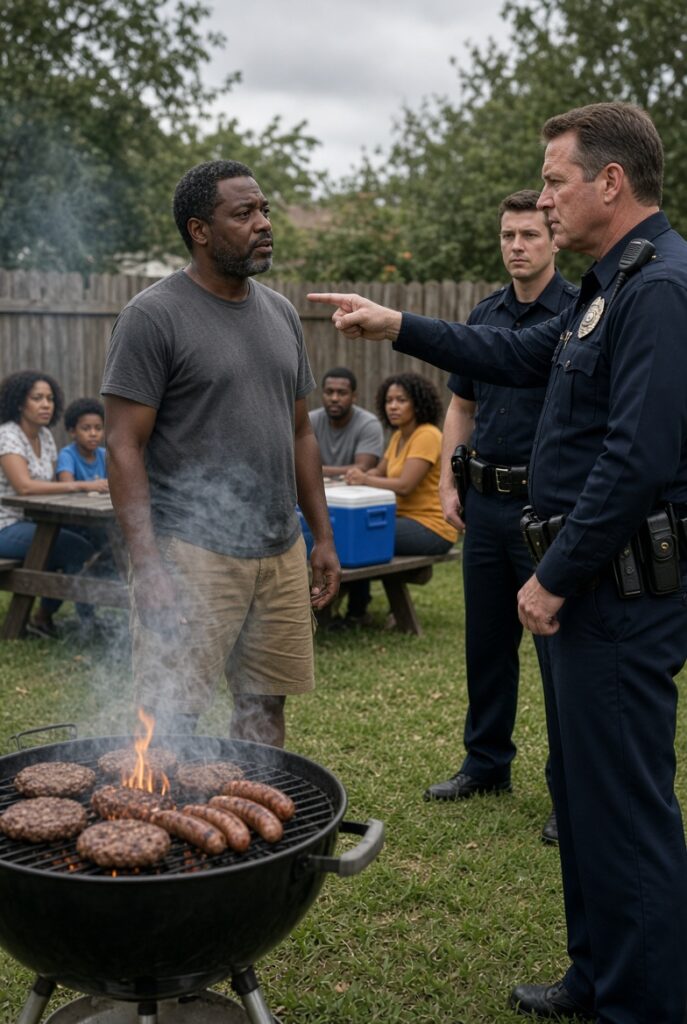
That was theirs.
As sunset approached, children ran across the lawn with water balloons.
One hit Calvin in the back.
He turned.
His granddaughter Olivia hid behind Anthony.
“Traitor.”
“She’s eight.”
“She knows what she did.”
Everyone laughed.
Calvin carried a plate toward the chair where Danner had ordered him to sit the previous year.
He stopped.
Looked down.
Nothing marked the spot.
Grass grew.
Chair moved.
Life had no interest in preserving crime scenes forever.
Tessa joined him.
“You thinking about it?”
“Yes.”
“Still angry?”
“Sometimes.”
She nodded.
“Still afraid?”
Calvin considered.
“Less.”
He sat.
Tessa sat beside him.
Across the yard, Luke Brenner was laughing at one of Anthony’s stories.
A patrol car passed outside.
Did not slow.
Calvin watched it disappear.
“I used to think the most important part was Chief Knox walking out that door.”
Tessa looked toward the kitchen.
“Wasn’t it?”
“No.”
“Then what?”
Calvin looked around.
“The part before.”
She waited.
“When nobody knew who I was.”
He lifted his fork.
“I was already supposed to matter.”
Tessa smiled slowly.
“That sounds like something you’d put on a plaque.”
“Don’t.”
“Too late.”
“I mean it.”
She laughed.
The story followed Calvin for years.
Reporters liked the dramatic version.
Black homeowner handcuffed at barbecue.
Police chief emerges.
Officer learns homeowner is former federal civil-rights prosecutor and accountability-board chair.
Career ends.
Calvin always thought that version missed the uncomfortable truth.
If Evelyn or Valerie or any powerful person had not been inside, Danner’s conduct would still have been wrong.
If Calvin had been a plumber, the cuffs would not have become more lawful.
If he rented the house, the humiliation would not become reasonable.
If he worked construction, taught middle school, drove a bus, or collected unemployment, his questions would still have been questions rather than threats.
Power did not make him innocent.
Evidence did.
Years later, at a law-enforcement conference, Calvin was asked what advice he would give officers responding to suspicious-person calls.
He expected the usual policy question.
Instead, a young sergeant asked:
“How do we keep from bringing a caller’s bias into the stop?”
Calvin thought.
“You probably can’t completely.”
The room shifted.
“That’s not a failure.”
He continued.
“People absorb assumptions.”
“Officers do too.”
“The job is not pretending you have none.”
“It’s forcing your assumptions to compete with facts before you use authority.”
The sergeant wrote that down.
Calvin added:
“And if the facts lose, slow down.”
Someone laughed.
He smiled.
“I’m serious.”
A decade after the barbecue, Calvin retired from public service entirely.
The review board had consumed more of his life than expected.
Tessa had married.
Olivia was a teenager.
Anthony had finally learned not to steal brisket directly from the cutting board.
Calvin spent more mornings fishing.
More afternoons cooking.
Less time explaining government to people who believed certainty was proof.
One Saturday, he stood in the same backyard preparing ribs.
Music played.
Smoke moved toward the maple trees.
Olivia sat at the patio table doing homework.
A delivery truck stopped out front.
A young Black man in a uniform walked through the side gate carrying two heavy packages.
He paused.
“Mr. Mercer?”
“That’s me.”
The driver looked toward the house.
“Nice place.”
“Thanks.”
He set down the packages.
Then smiled at the smoker.
“That smells ridiculous.”
“You eat pork?”
“Yes, sir.”
Calvin handed him a rib wrapped in foil.
The driver laughed.
“You serious?”
“Very.”
He left holding food in one hand and his scanner in the other.
Calvin watched him walk toward the truck.
A patrol car passed.
The officer glanced toward the young man.
Then continued.
Nothing happened.
Calvin stood beside the smoker for several seconds.
That ordinary moment meant more to him than the headline, the firing, the reform package, or any apology.
A young Black man walked away from an expensive home carrying something given to him by the homeowner.
Nobody decided the picture required investigation.
No one asked him to prove he belonged near the property.
No camera became evidence.
No chief had to walk outside.
Nothing happened.
That was what Calvin had wanted all along.
The barbecue incident did not teach him that every officer was dangerous.
It did not convince him that every complaint was racist or every suspicious-person call illegitimate.
It taught him something narrower and more useful.
Authority becomes dangerous when curiosity ends too early.
Danner heard suspicious Black man and stopped asking questions.
Marjorie believed he does not look like he belongs and treated appearance as knowledge.
The department saw earlier complaints described as misunderstandings and failed to compare them.
Every failure had the same shape.
Somebody decided they already knew enough.
Calvin spent the rest of his public career trying to make institutions less comfortable with that feeling.
He did not always succeed.
No policy eliminates arrogance.
No training removes bias.
No camera guarantees justice.
But cameras preserve moments.
Policies create friction.
Supervisors can ask questions.
Partners can intervene.
Citizens can record.
Small things matter before a situation becomes a scandal.
Sometimes the difference between harm and restraint is one person saying:
“Wait.”
Luke Brenner eventually told Calvin that was the word he wished he had said.
Not a speech.
Not a confrontation.
Just:
Wait.
Wait before entering the gate.
Wait before calling questions aggression.
Wait before putting hands on someone.
Wait until the address is checked.
Wait long enough for assumptions to become evidence or disappear.
Calvin understood.
Years after the incident, Luke became a training sergeant.
He used the barbecue bodycam with recruits.
Calvin agreed on one condition.
“Stop the video before Chief Knox comes outside.”
Luke frowned.
“Why?”
“Ask the class whether Danner is wrong before they know anything about me.”
Luke smiled.
“That’s good.”
“I know.”
The training did exactly that.
Recruits watched Calvin sitting in a chair.
Danner escalating.
The plate hitting the ground.
Handcuffs.
Then the instructor paused the screen.
“What do you know about Mr. Mercer?”
Answers varied.
Homeowner, probably.
Large man.
Black.
Middle-aged.
Cooperative.
Calm.
Maybe wealthy.
Then Luke asked:
“What do you need to know about his career before deciding whether this detention is justified?”
Eventually someone always answered:
“Nothing.”
Luke would resume the video.
Valerie appeared.
The résumé came out.
Former federal prosecutor.
Inspector General counsel.
Review-board chair.
Then Luke paused again.
“What changed?”
The best classes answered:
“Nothing.”
That became the lesson.
Not:
Be careful who you disrespect.
Not:
The homeowner might be powerful.
Not:
Your suspect might know the chief.
The lesson was:
The facts do not become more important when the person has status.
Calvin heard about that training years later and smiled.
That was enough.
One Sunday evening, long after he stopped appearing at city meetings, Olivia asked him about the incident for a school project.
She had been too young to remember the original barbecue.
“Were you mad when he knocked your food down?”
“Yes.”
“Why didn’t you yell?”
“Because I wanted to stay alive.”
The answer shocked her.
“You really thought he might shoot you?”
“I thought it was possible.”
“But there were people everywhere.”
“Yes.”
“And cameras.”
“Yes.”
“And Chief Knox.”
“Yes.”
Olivia frowned.
“Then why?”
Calvin looked toward his granddaughter.
“Because people do not always know who is watching when they make a decision.”
She wrote something in her notebook.
He continued.
“And because I knew he already thought my body was part of the threat.”
Olivia looked up.
“That’s unfair.”
“Yes.”
“What did you learn?”
Calvin smiled.
“That your mother was right about the banner being embarrassing.”
She rolled her eyes.
“Grandpa.”
He became serious.
“I learned that being prepared can protect you.”
“Documentation matters.”
“Witnesses matter.”
“Good officers speaking early matter.”
He paused.
“But I also learned something else.”
“What?”
“You should never confuse surviving a bad encounter with proving the encounter was acceptable.”
Olivia wrote that too.
Calvin looked across the yard.
Same deck.
Same grill.
Different chairs.
Life had continued.
That was the part most stories never captured.
The afternoon did not end when cuffs came off.
Tessa still had to process seeing her father restrained.
Calvin still felt his shoulders tighten around police lights for months.
Luke still had to decide whether shame would make him defensive or better.
Valerie still had to examine a department whose officer had given her a problem no press conference could explain away.
Marjorie still had to live with knowing one phone call revealed something about herself she had spent years dressing up as “standards.”
Danner still had to decide whether losing his badge meant everyone else was unfair or whether his own judgment had brought him there.
Consequences continued after cameras stopped.
That was real life.
Calvin never learned whether Danner changed.
He hoped he did.
Not because he wanted reconciliation.
Because people who leave law enforcement still remain neighbors, fathers, husbands, coaches, strangers, citizens.
Accountability should protect more than institutions.
It should create the possibility that a person becomes less dangerous outside them too.
Calvin did not need an apology.
The only apology he ever cared about came indirectly, years later, when a young recruit watched the old footage and asked:
“Why didn’t the officer just check the house?”
Exactly.
That was the entire story compressed into one question.
Why not check?
Why not listen?
Why not believe facts over the feeling that somebody did not look right?
Why not slow down before turning suspicion into authority?
Nobody needed a courtroom to answer those questions.
The answers were ordinary.
Ego.
Habit.
Bias.
Impatience.
Fear.
And the assumption that power would protect the decision afterward.
Calvin spent his life learning how dangerous ordinary reasons could become when a badge multiplied them.
That was why he remained proudest not of the disciplinary case or the policy changes but of the moment he stayed seated.
Not because submission was noble.
Because he understood his goal.
He wanted to walk back into his kitchen afterward.
He wanted Tessa’s graduation to remain the biggest event in the family.
He wanted Malik’s phone to record evidence rather than tragedy.
He wanted enough time for facts to arrive.
Facts did.
Eventually.
Years later, when people still asked what Officer Danner’s biggest mistake had been, Calvin never said handcuffing a former federal prosecutor.
He never said disrespecting the chair of the accountability board.
He never said failing to recognize the chief’s friend.
His answer was always the same.
“He decided what I was before he found out what was happening.”
Then Calvin would usually smile.
“And once he decided, every question I asked became evidence supporting the decision.”
That was the dangerous part.
Not the mistaken first impression.
Everyone has those.
The danger begins when authority becomes emotionally invested in proving its first impression correct.
A person who believes you are suspicious interprets calm as calculation.
Questions as defiance.
Silence as guilt.
Fear as aggression.
Cooperation as strategy.
Soon every possible behavior confirms the conclusion.
That is how people become trapped inside someone else’s story.
Cameras helped Calvin escape his.
Status accelerated it.
Friends with power exposed it.
But none of those things created the truth.
The truth existed before the first patrol car entered Willow Brook Lane.
Calvin Mercer lived at 214.
He was cooking for his daughter.
His family belonged in the yard.
The music was legal.
The street remained passable.
One car needed to move a few feet from a hydrant.
That was all.
Everything else had been invented.
At eighty, Calvin still cooked.
Less meat.
Doctor’s orders.
He ignored half of them.
Tessa visited one summer with her own daughter.
Olivia had children too by then.
The backyard looked smaller than it once had.
Calvin sat near the smoker while grandchildren ran through sprinklers.
A patrol car passed.
Nobody noticed.
Calvin did.
For one second, memory returned.
Food on grass.
Metal on wrists.
A man asking why he was calm.
Then the cruiser disappeared.
The music continued.
A child screamed because another child stole a water balloon.
Someone asked whether the ribs were done.
Calvin smiled.
That was the ending.
Not a firing.
Not a headline.
Not a policy.
Not Chief Valerie Knox walking out of the kitchen and changing the balance of power.
The ending was a backyard becoming only a backyard again.
A Black man growing old in a house no stranger needed to believe he owned before it became true.
Family laughing without checking the street.
Food staying on plates.
Police passing without inventing a reason to stop.
And no one in the yard needing an impressive title before the world decided they belonged there.
