

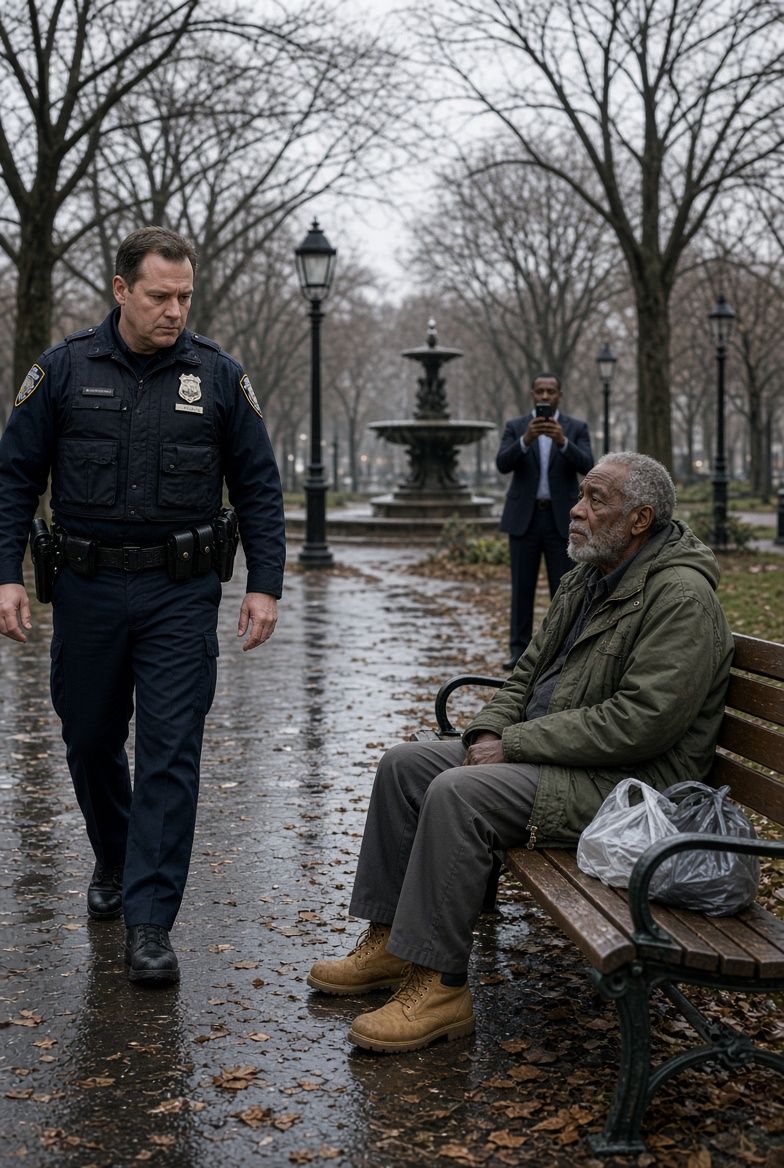
The first kick landed against the homeless man’s ribs just as the church bells downtown struck seven.
It was not a hard kick by the standards of war or prison or street violence.
Not hard enough to break bone.
Not hard enough to make the watching officers gasp.
That was part of what made it cruel.
Officer Derek Walsh knew exactly how to hurt a man without leaving an injury that photographed cleanly.
He used the side of his boot.
Low.
Fast.
Angled beneath the arm.
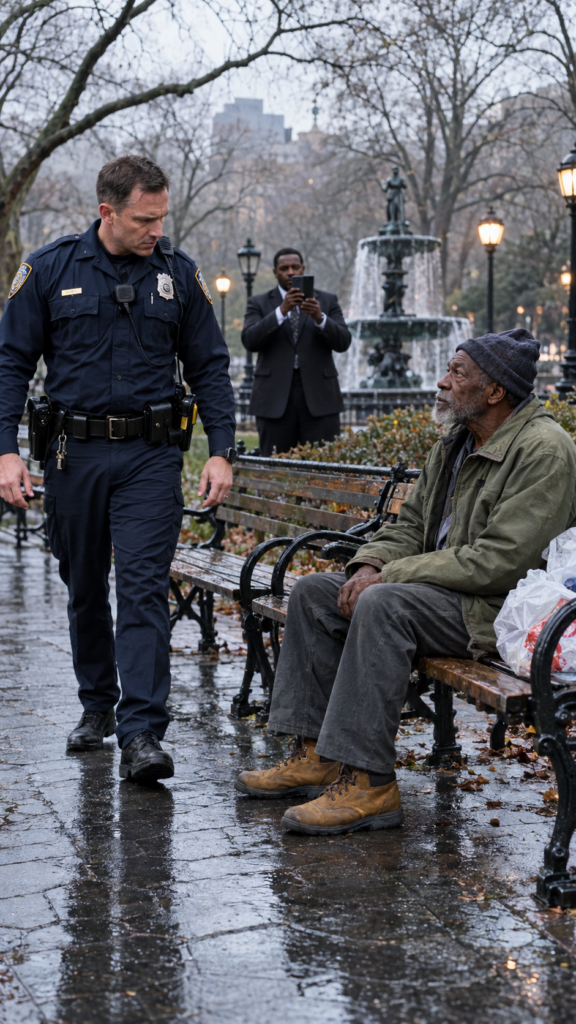
The homeless man rolled onto his side on the park bench, clutching a torn army-green coat to his chest as if the coat could protect what dignity he had left.
“Get up,” Walsh snapped.
The man did not answer right away.
His beard was gray and tangled.
His hair curled beneath a faded knit cap.
A shopping cart stood beside the bench, holding two blankets, a dented thermos, a plastic bag of cans, and a cardboard sign folded neatly between the bars.
The sign read:
Veteran. Hungry. Trying.
Walsh hated that sign.
He had told himself he hated it because too many people lied.
Because anyone could write veteran on cardboard.
Because parks were for families, not men who smelled like rain, smoke, and old sorrow.
But the truth was simpler and uglier.
Officer Walsh hated anyone who made him feel inconvenience and guilt at the same time.
“Did you hear me?” Walsh said.
The homeless man opened his eyes.
They were pale blue.
Clearer than expected.
That irritated Walsh too.
“I heard you,” the man said.
His voice was rough but steady.
“Then move.”
“It’s public property.”
Walsh laughed once.
Behind him, Officer Kyle Benton shifted his weight but said nothing.
He was twenty-six, new enough to still feel wrongness before habit buried it, old enough to know that speaking against a senior officer could turn the rest of the shift cold.
Officer Paula Reyes stood near the patrol car with a clipboard tucked under one arm.
She watched the bench, jaw tight.
They had been assigned to clear the park before the mayor’s weekend festival.
No tents.
No encampments.
No visible poverty near the walking trail, the fountain, or the war memorial where television cameras would arrive by noon.
The official order was called a sanitation and safety sweep.
Everyone knew what it really meant.
Move them out before donors see them.
Most officers did it with warnings, outreach cards, and weary repetition.
Walsh did it like he was collecting debts.
The homeless man sat up slowly.
Too slowly for Walsh.
So Walsh kicked him again.
This time the boot caught his thigh.
The man grunted and slid half off the bench.
A woman walking a golden retriever stopped near the path.
A teenage boy with a skateboard raised his phone.
A city worker raking leaves looked away.
That was when a voice cracked across the park.
“Stop!”
It came from near the war memorial.
Strong.
Female.
Commanding enough that every officer turned before thinking.
Captain Elaine Mercer stepped forward from behind a row of bare maple trees, one hand lifted, her face drained of color and fury held so tightly in check it made her look carved from stone.
Walsh froze.
The homeless man stayed half-crouched beside the bench, one hand pressed to his ribs.
Captain Mercer walked across the wet grass.
Not quickly.
Not dramatically.
But with the kind of authority that made the younger officers straighten without being told.
She was fifty-two years old, with silver in her dark hair, a navy overcoat buttoned over her uniform, and captain’s bars on her collar that caught the morning light.
She looked first at Walsh’s boot.
Then at the man on the ground.
Then at the phone in the teenager’s hand.
Then back at Walsh.
“What did you just do?” she asked.
Walsh tried to recover.
“Captain, this individual refused lawful orders to vacate—”
“I asked what you did.”
His mouth tightened.
“He was noncompliant.”
Mercer looked at Officer Benton.
“Did he threaten anyone?”
Benton glanced at Walsh.
Then at the homeless man.
“No, ma’am.”
Walsh shot him a look.
Mercer turned to Reyes.
“Did he resist?”
Reyes took one breath.
“No, ma’am.”
The park seemed to hold still.
The woman with the dog stood frozen.
The teenager kept recording.
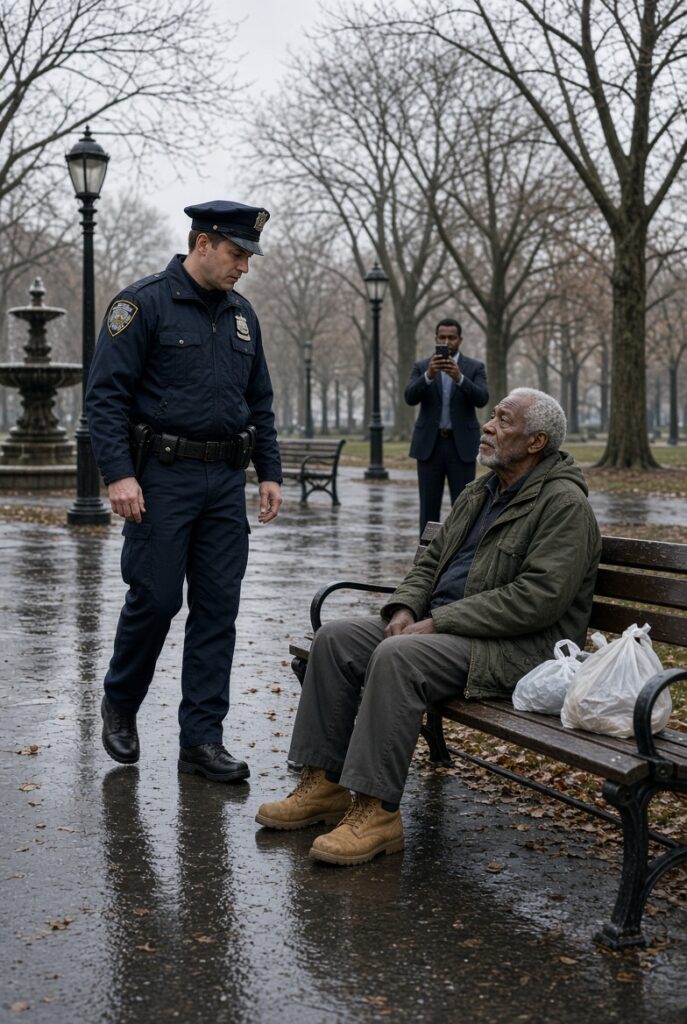
The homeless man slowly pushed himself upright, but he did not speak.
He kept his eyes on Captain Mercer.
Something in those eyes made her face change.
At first, she saw only a man weathered by exposure and years of bad luck.
Then she looked again.
The scar near his left eyebrow.
The slight bend in his nose.
The pale blue eyes.
The old army coat.
The way he held his body, not like a man broken by the street, but like someone who had learned to become smaller so the world would stop hitting him.
Her breath caught.
“Thomas?” she whispered.
Walsh frowned.
The homeless man looked down.
Captain Mercer stepped closer.
“Thomas Hale?”
The man closed his eyes.
For one long second, nothing moved except the leaves skidding along the path.
Then he opened them again.
“Hello, Elaine.”
Officer Walsh’s face shifted from irritation to confusion.
“You know this guy?”
Captain Mercer did not look at him.
She was staring at a ghost.
Twenty-four years earlier, Thomas Hale had been one of the best detectives in the city.
Not the loudest.
Not the most political.
The best.
He had a reputation for remembering details other officers missed.
A tire track in wet clay.
A witness who used the wrong tense.
A missing second coffee cup in a motel room.
A child’s drawing on a refrigerator.
A hesitation in a suspect’s story that did not sound like fear but rehearsal.
He had joined the force at twenty-seven after eight years in the Army.
Three deployments.
A Silver Star nobody in the department knew about because Thomas never spoke of it.
When Elaine Mercer was a young patrol officer, Thomas had trained her.
He taught her how to stand beside a grieving mother without filling the silence with useless words.
He taught her that a badge was not a crown.
He taught her that writing a clean report mattered because lies in official language outlived everyone.
Most of all, he taught her one sentence she had carried her entire career.
Power shows its character when no one important is watching.
Then Thomas disappeared.
Officially, he resigned.
Unofficially, rumors spread.
A breakdown.
Alcohol.
Misconduct.
A missing evidence file.
A bribery investigation that never produced charges but stained his name enough that nobody wanted to stand near him.
Elaine had been too young then.
Too afraid.
Too ambitious.
She heard pieces but never pushed hard enough.
Thomas Hale walked out of the precinct one rainy Thursday evening and never came back.
Now he was sitting in the park with a cracked thermos, two blankets, and Officer Walsh’s boot print on his pants.
Captain Mercer turned slowly toward Walsh.
“Put your body camera status on the record.”
Walsh blinked.
“What?”
“Is your body camera active?”
“Yes.”
Reyes looked at him sharply.
Mercer saw the look.
“Officer Reyes?”
Reyes swallowed.
“His camera light is not on, Captain.”
Walsh snapped, “Battery issue.”
Captain Mercer’s voice went cold.
“Officer Benton?”
Benton checked his own camera as if needing something to do with his hands.
“Mine is active.”
“Reyes?”
“Active.”
Mercer nodded once.
“Officer Walsh, step away from Mr. Hale.”
“Captain, I was following the sweep order.”
“You were kicking a man sitting on a bench.”
“He refused to leave.”
“So you kicked him.”
Walsh’s jaw worked.
He looked around and realized, too late, that the park was no longer a place where his version would stand alone.
Captain Mercer pointed toward the patrol car.
“Step away. Now.”
For a moment, Walsh looked like he might argue.
Then he saw the teenager still recording.
He stepped back.
Mercer knelt beside Thomas.
The movement startled everyone.
Captains did not kneel in wet grass beside homeless men during public sweeps.
But Elaine Mercer knelt.
“Are you hurt?”
Thomas gave a humorless half-smile.
“Less than I’ve been.”
“That is not an answer.”
“It is the one I’ve got.”
She looked at his ribs.
“Medical is coming.”
“I didn’t ask for medical.”
“I did.”
He studied her face.
“You became captain.”
“You disappeared.”
His eyes lowered.
“I had help.”
The words sat between them.
Not accusation exactly.
Something older.
Something unfinished.
Mercer stood and turned to Reyes.
“Call EMS. Then call Lieutenant Graves. I want Internal Affairs notified immediately. This scene is frozen. Nobody clears another bench, tent, bag, or cart until I say so.”
Walsh’s face reddened.
“Captain, the mayor’s office wants the park cleared by nine.”
Mercer turned toward him fully.
“The mayor’s office can wait.”
“Captain—”
“One more word, and your weapon and badge come off in front of every phone in this park.”
Walsh stopped.
That was the first time fear touched his face.
Not remorse.
Fear.
Thomas saw it and looked away.
He knew that kind of fear.
The fear of consequence, not conscience.
EMS arrived within ten minutes.
Thomas refused the stretcher twice before Mercer leaned close and said, “Do not make me arrest you for being stubborn.”
He gave her a tired look.
“You would.”
“I learned from the best.”
Something flickered in his face.
A memory.
A wound.
Then he allowed the paramedics to examine him.
Bruised ribs.
No fracture.
Dehydration.
Old injuries.
Cold exposure.
A blood pressure reading high enough to make the paramedic frown.
While they worked, Mercer ordered Reyes to inventory Thomas’s belongings carefully.
Not as trash.
As property.
Every blanket.
Every bottle.
Every folded paper.
Every photograph.
That was when Reyes found the envelope.
It was wrapped inside two plastic grocery bags beneath the thermos.
Old.
Water-stained.
Sealed with duct tape.
On the outside, in careful block letters, was written:
FOR CAPTAIN E. MERCER — IF I AM TAKEN OR FOUND DEAD
Reyes froze.
“Captain.”
Mercer turned.
Reyes held up the envelope.
Thomas sat up too fast and winced.
“Give that back.”
Mercer took the envelope gently.
“What is this?”
Thomas’s face hardened.
“Insurance.”
“Against what?”
He looked toward Walsh.
Then past him.
Toward the precinct downtown.
“Against the people who buried me.”
Walsh laughed before he could stop himself.
“This is crazy. He’s a homeless drunk with a conspiracy envelope.”
Thomas looked at him.
For the first time since the kick, something sharp entered his eyes.
“I have been called worse by better men.”
Captain Mercer did not open the envelope in the park.
She understood evidence.
She understood chain of custody.
She also understood that whatever Thomas had carried for years was likely the reason he was on that bench in the first place.
She handed it to Reyes.
“Evidence bag. Logged under my direct supervision. Officer Benton, you are a witness to transfer.”
Benton nodded quickly.
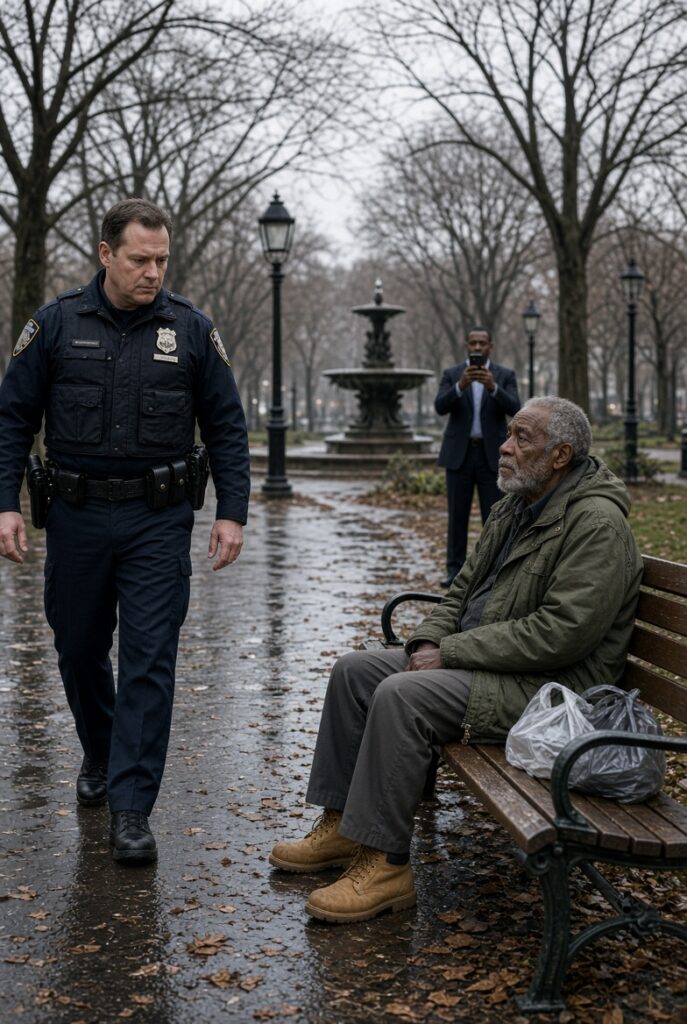
Walsh looked from one officer to another.
“You’re actually treating this like evidence?”
Mercer stepped close enough that he lowered his voice by instinct.
“I am treating everything you touched today like evidence.”
Within the hour, Officer Derek Walsh was relieved of duty pending investigation.
By noon, the park sweep was suspended.
By one-thirty, Thomas Hale was in a hospital room with a police guard outside, not to detain him, but to make sure no one could reach him without Mercer knowing.
By three, Captain Mercer sat in a secure conference room at headquarters with Internal Affairs Lieutenant Nora Chen, Deputy Chief Alan Briggs, a city attorney, and the envelope Thomas had carried through rain, winter, hunger, and years of being ignored.
The room smelled of coffee and old carpet.
Nobody spoke while Chen cut the duct tape with a evidence knife.
Inside were three flash drives.
A folded letter.
Two photographs.
A motel receipt from twenty-four years earlier.
And photocopies of police reports Mercer had not seen since she was a rookie.
The letter was addressed to her.
Elaine read it standing up.
By the second page, she had to sit down.
Thomas had not resigned because he broke.
He had not disappeared because he was guilty.
He had been investigating a group inside the department tied to evidence theft, protection payments, and wrongful case closures.
It started with missing narcotics from the property room.
Then cash.
Then weapons.
Then witness statements that vanished before trials.
He had gathered proof.
Names.
Dates.
Case numbers.
Badge numbers.
He had planned to take it to federal investigators.
Then his partner, Detective Martin Voss, accused him of stealing evidence.
A packet of cash appeared in Thomas’s locker.
Anonymous complaints appeared in his file.
A woman he had never met claimed he took money from her son to lose a drug charge.
The union backed away.
Command told him resignation would protect his pension.
Then his pension paperwork stalled.
His bank account was frozen during a “financial review.”
The department never charged him.
That was the trick.
They did not need to convict him.
They only needed to ruin him enough that nobody would believe him.
Thomas wrote that he tried to fight for two years.
Then his wife died.
Then the house went.
Then the calls stopped being returned.
Then survival became smaller than justice.
But he never threw away the evidence.
He carried pieces of it because he knew one day someone might finally ask why a good detective vanished.
Elaine Mercer read the last line twice.
If you are reading this, Elaine, then maybe the department still has one person left who remembers what the badge was supposed to mean.
Nobody spoke when she finished.
Deputy Chief Briggs cleared his throat.
“This is twenty-four years old.”
Lieutenant Chen looked at him.
“Corruption does not expire because it gets old.”
The first flash drive contained scanned reports.
The second contained audio recordings.
The third contained a video file so grainy it looked like it had been copied from an old camcorder.
In the video, Detective Martin Voss stood in a storage room with two uniformed officers and a man Mercer recognized immediately.
Not from the past.
From the present.
Chief Raymond Kessler.
Back then, Kessler had been a lieutenant.
On the video, younger Kessler counted bundles of cash on an evidence table while Voss laughed and said, “Hale keeps sniffing. We need to put him down before he bites.”
Then Kessler’s voice.
Clear enough.
“Make him dirty. Clean cops drown fastest when you throw mud in both hands.”
Captain Mercer felt something inside her go cold.
Chief Kessler had promoted her.
Mentored her.
Praised her reforms.
Smiled beside her at community events.
All these years, the man who helped bury Thomas Hale had been running the department.
Lieutenant Chen stopped the video.
The room sat in the silence after truth arrives and makes everyone present responsible for what happens next.
Briggs stood abruptly.
“We need to be careful.”
Mercer looked at him.
“No. We needed to be careful twenty-four years ago. Now we need to be honest.”
“Elaine—”
“Captain Mercer,” she said.
Briggs stared at her.
She had never corrected him like that before.
She continued, “We secure every copy. We notify the state attorney general and federal public corruption unit. We place Walsh’s incident under the same umbrella because if Thomas was targeted today after being identified, I want to know by whom.”
“Walsh didn’t know who he was.”
“Maybe not.”
Mercer looked at the frozen video image of young Kessler counting cash.
“But someone may have known where Thomas slept.”
That night, Mercer went to the hospital.
Thomas was awake, sitting upright in bed, untouched dinner tray beside him.
He looked cleaner now.
A nurse had helped him wash.
His beard was still long, but the dirt was gone from the lines of his face, and for the first time Elaine could see the man she remembered beneath the years.
“You opened it,” he said.
“Yes.”
“Then I’m sorry.”
“For what?”
“For handing you a ghost.”
Mercer pulled the chair close and sat beside him.
“You should have come to me.”
Thomas laughed softly.
“You were twenty-eight and trying to survive patrol. They would’ve crushed you too.”
“I might have helped.”
“You might have. Or you might have looked away like everyone else.”
The words hurt because they were possible.
Mercer looked at the floor.
“I did look away.”
Thomas said nothing.
“I heard rumors after you left,” she continued. “I heard you were in trouble. I heard you were drinking. I heard you lost the house. I told myself there was nothing I could do because I was too low, too young, too uninformed.”
She looked up.
“But the truth is, I was afraid.”
Thomas’s face softened.
“Fear is human.”
“So is cowardice.”
He turned toward the window.
“Maybe. But you shouted stop today.”
“That was twenty-four years late.”
“Late is not nothing.”
For a while, they sat in quiet.
Then Mercer asked, “Why stay in the city?”
Thomas smiled faintly.
“Where was I going to go?”
“Somewhere they didn’t know you.”
“They didn’t know me here either by the end.”
That sentence stayed with her.
The investigation moved faster than anyone expected because the evidence did not stand alone.
Once the federal public corruption unit entered, old witnesses reappeared.
Retired clerk Marjorie Wells admitted she had copied files for Thomas in secret because she knew evidence was being altered.
Former Officer Samuel Price confirmed that Walsh’s current cruelty had been shaped under older officers who called men like Thomas “park trash” and “ghosts.”
Two retired detectives admitted they heard Voss brag about setting Thomas up but said nothing because Kessler was rising fast and nobody wanted to be next.
The motel receipt led to an old manager who remembered Thomas hiding there after receiving threats.
The audio recordings matched voices.
The reports matched missing case files.
The past, it turned out, had not disappeared.
It had been waiting in boxes, memories, and guilt.
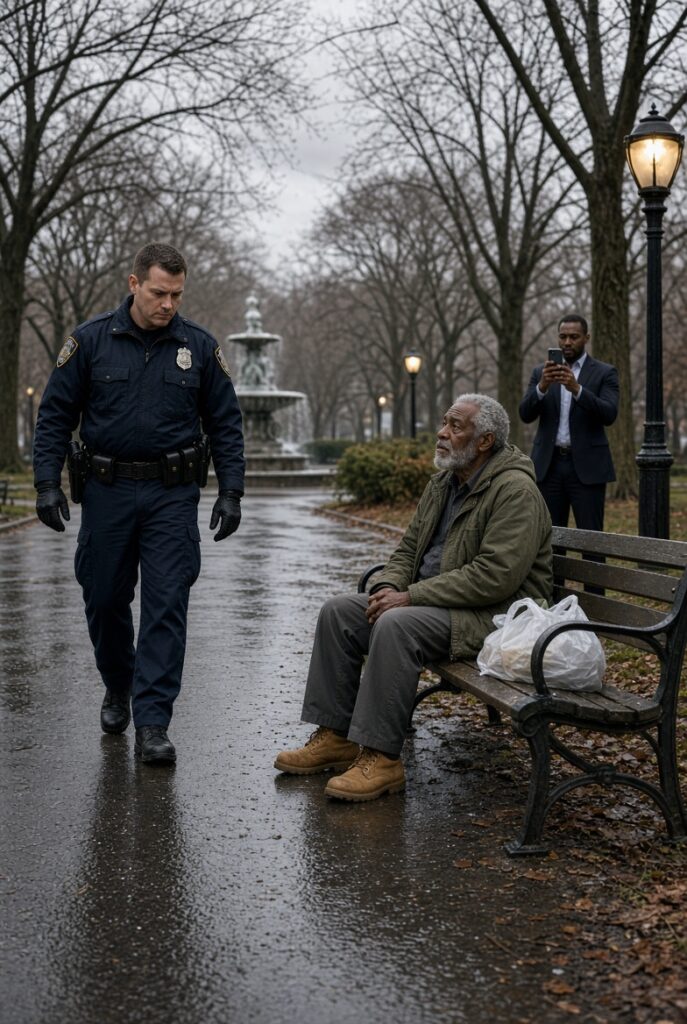
Chief Kessler denied everything for three days.
On the fourth, federal agents executed a warrant at his house.
They found an old lockbox in the basement.
Inside were property room tags, cash, and a notebook with names and payments from cases spanning decades.
Kessler resigned before sunset.
He was arrested before midnight.
Martin Voss, long retired and living in Florida, was arrested two days later.
The news broke open the city.
Former Detective Living Homeless After Department Frame-Up
Police Chief Indicted in Decades-Old Corruption Case
Park Assault Leads to Federal Investigation
That was the headline people liked most.
Park assault leads to federal investigation.
It sounded almost accidental.
As if justice had stumbled upon itself.
But Elaine Mercer knew better.
Thomas Hale had carried the truth for twenty-four years because no one else had been brave enough to hold it.
Officer Walsh’s kick did not create the truth.
It exposed the kind of department where the truth had once been buried.
Walsh was terminated within a week.
Not only for kicking Thomas, but for deactivating his body camera, falsifying initial notes, and using force during a noncriminal park sweep.
His disciplinary hearing was ugly.
He blamed policy.
He blamed the mayor’s office.
He blamed homelessness.
He blamed “the environment.”
He blamed Thomas for refusing to leave.
Captain Mercer let him talk.
Then she played the teenager’s phone video.
The kick.
The command.
The second kick.
Her own voice shouting, “Stop!”
Walsh looked smaller on video.
Not less guilty.
Just smaller.
Cruelty often does, once stripped of authority.
“You made a choice,” Mercer said. “Nobody ordered your boot into his ribs.”
Walsh said nothing.
His badge was taken before the hearing ended.
But Mercer did not let the department pretend firing one officer fixed the disease.
She suspended park sweeps until outreach workers, medical teams, and housing advocates could be included.
She ordered body camera audits.
She reopened every complaint tied to Walsh.
Then every complaint tied to officers trained under Kessler’s command group.
She created a policy requiring officers to document offers of shelter, medical aid, property inventory, and legal basis before removing unhoused individuals from public spaces.
The mayor resisted.
Mercer invited him to stand with her at the next press conference and explain on camera why festival optics mattered more than constitutional rights.
He stopped resisting.
Thomas hated the attention.
He hated hospital food.
He hated reporters most.
A week after Kessler’s arrest, Mercer found him sitting outside the hospital entrance in a donated coat, trying to leave.
“Where do you think you’re going?” she asked.
“Out.”
“You were discharged twenty minutes ago.”
“Exactly.”
“You have a temporary apartment waiting.”
“I didn’t ask for one.”
“You also didn’t ask to get kicked in a park, but here we are.”
He sighed.
“You got bossy.”
“You trained me.”
That made him smile.
The apartment was small.
One bedroom.
Clean.
Second floor.
Over a bakery on Marshall Street.
A nonprofit arranged it quietly, funded partly by officers who remembered Thomas and partly by citizens who read the story and wanted to help.
At first, Thomas slept on the floor.
The bed felt too soft.
The room too quiet.
The locked door too strange.
Elaine visited every evening the first week, though she pretended each visit had a practical reason.
Paperwork.
Medical forms.
Case updates.
Groceries.
Coffee.
On the fifth night, she found him standing by the window, looking down at people leaving the bakery.
“I don’t know how to be inside anymore,” he said.
Elaine set a bag of groceries on the counter.
“Then learn slowly.”
“I was good once.”
“I know.”
“No,” he said, turning. “I need you to understand. I was good at the job. I wasn’t perfect. I was proud. Stubborn. I made enemies. But I was good.”
Elaine walked closer.
“You still are.”
He laughed without humor.
“I sleep with my shoes beside the door.”
“You kept evidence alive for twenty-four years while surviving on benches and under bridges. Do not confuse injury with failure.”
The words hit him harder than she expected.
His eyes filled.
He turned back to the window.
She did not force him to face her.
That was another thing he had taught her once.
Let people keep dignity while they break.
The official exoneration came three months later.
The city cleared Thomas Hale of all misconduct allegations.
His pension was restored with back pay.
The mayor issued an apology.
The department held a ceremony.
Thomas refused to attend at first.
“I don’t need a plaque,” he said.
Elaine said, “It’s not for you.”
He frowned.
“It’s not?”
“It’s for every officer in that room who needs to see what happens when a department protects power instead of truth.”
So he came.
The ceremony took place in the same precinct where he had once cleaned out his desk under suspicion.
The room was full.
Officers.
Reporters.
City council members.
Families from the park outreach program.
Former colleagues who looked older and ashamed.
Elaine stood at the podium.
Thomas sat in the front row wearing a dark suit that hung a little loose on him.
His beard was trimmed now.
His hair was combed back.
He still looked weathered, but not erased.
Captain Mercer did not make a long speech.
She said only what mattered.
“Twenty-four years ago, Detective Thomas Hale tried to expose corruption inside this department. For that, he was framed, abandoned, and forgotten by an institution that should have protected him. Today, we cannot return the years stolen from him. We cannot undo the nights he spent outside. We cannot erase the silence of those who knew enough to ask questions and chose comfort instead.”
Her voice tightened.
“But we can tell the truth publicly. Detective Hale served this city with honor. The allegations against him were false. His evidence helped expose crimes that should shame this department for generations. And his life reminds us that the people we walk past, move along, or dismiss may be carrying truths we do not deserve but desperately need.”
She stepped away from the podium.
Then she did something no one expected.
She saluted him.
For one second, Thomas did not move.
Then he stood, slowly, and returned the salute.
Several officers began clapping.
Then the whole room stood.
Thomas did not smile.
But his shoulders, which had seemed rounded for years under invisible weight, straightened slightly.
Not because applause healed him.
It did not.
Because truth, when spoken in the place where the lie began, has a different kind of power.
After the ceremony, Officer Reyes approached him.
She was nervous.
“I inventoried your cart that day,” she said.
“I remember.”
“I’m sorry I didn’t stop Walsh before the captain did.”
Thomas looked at her.
“Did you know he would kick me?”
“No.”
“Did you know it was wrong after he did?”
“Yes.”
“Then next time, be earlier.”
Reyes nodded, eyes wet.
“Yes, sir.”
He almost smiled.
“Don’t call me sir. Makes me feel ancient.”
She laughed through tears.
“Okay.”
Benton came too.
His apology was quieter.
“I told the truth,” he said. “But only after Captain asked.”
Thomas studied him.
“Truth that has to be summoned is still better than a lie. But don’t make people drag it out of you next time.”
Benton nodded.
“I won’t.”
Thomas believed him.
Or wanted to.
Sometimes wanting to believe was the first step toward letting the world become less dangerous.
The reforms that followed were not perfect.
Nothing involving institutions ever is.
Some officers resented them.
Some called Mercer political.
Some said homelessness had nothing to do with policing.
Some said Thomas Hale became a symbol because people loved dramatic stories.
Mercer accepted the criticism she deserved and fought the rest.
She partnered the department with housing outreach teams.
She ended cosmetic sweeps before public events.
She required officers to treat personal belongings as property, not trash.
She disciplined officers who used force to solve inconvenience.
She invited formerly unhoused residents to training sessions so officers could hear what being “moved along” felt like when every place you were moved from was the only place you had left.
Thomas attended one session.
He did not speak at first.
He sat in the back, arms crossed, eyes lowered.
Then a young officer asked, not cruelly but honestly, “What should we do when someone refuses shelter?”
The room turned to Thomas.
He looked annoyed to be made useful.
Then he answered.
“Ask why.”
The officer blinked.
“What?”
“Ask why. Maybe the shelter separates him from his wife. Maybe he has a dog. Maybe he was assaulted there. Maybe his meds got stolen. Maybe he has trauma that makes crowded rooms impossible. Maybe he’s stubborn. Maybe he’s wrong. But ask why before you turn refusal into defiance.”
The room stayed quiet.
Thomas added, “A bench can be a bad place and still be the safest option someone believes they have.”
That sentence ended up in the department’s training manual.
He hated that.
Elaine loved it.
A year later, the park looked different.
Not because poverty vanished.
It had not.
But the city stopped pretending that clearing visible suffering was the same as solving it.
There were outreach tables twice a week near the community center.
A mobile medical van.
Lockers for people without safe storage.
A winter shelter program with smaller rooms for veterans and trauma survivors.
A legal clinic for people whose documents had been lost during encampment removals.
A bench near the war memorial carried a small bronze plaque, paid for by private donations.
It did not mention Walsh.
It did not mention the kick.
Thomas insisted on that.
The plaque read:
Power shows its character when no one important is watching.
Under it:
Detective Thomas Hale
He argued about the word detective.
“I’m retired,” he told Elaine.
“You earned it.”
“I lost it.”
“It was stolen. Different thing.”
He had no answer for that.
Years later, people still told the story of the morning in the park.
Some told it like a dramatic rescue.
A cop kicked a homeless man, and the police captain stepped forward and shouted, “Stop!”
Some told it like a twist.
The homeless man was actually a framed detective carrying evidence that brought down a corrupt chief.
Some told it like justice finally catching up.
A bad officer fired.
A corrupt chief arrested.
A forgotten man restored.
Thomas never liked those versions by themselves.
They made the story too neat.
Too satisfying.
Too easy.
The truth was harder.
The real story was not that Thomas Hale had once been a detective.
He should not have needed a badge in his past to deserve protection in the present.
He should not have needed evidence in his cart to make people care that he was kicked.
He should not have needed Captain Mercer to recognize his face before the park remembered he was human.
That was the part that mattered most.
Before the envelope.
Before the flash drives.
Before the old video.
Before the indictments.
Before the ceremony.
Before the restored pension.
Thomas Hale was a man on a bench trying to survive the morning.
That should have been enough.
His ribs should have mattered before his name did.
His coat should have been inventoried before anyone knew he had once worn a badge.
His refusal to leave should have been met with questions before it was met with a boot.
A society tells the truth about itself by how it treats people who cannot easily punish it.
That was what Thomas had meant all those years ago.
Power shows its character when no one important is watching.
But someone was watching that morning.
A teenager with a phone.
A woman with a dog.
Two officers who had to decide whether loyalty meant silence.
A captain who recognized a man she had failed once and refused to fail him again.
And Thomas himself.
A man the city had tried to erase, still carrying truth in a taped envelope because some part of him, buried under cold nights and hunger and humiliation, had not stopped believing that truth might matter one day.
The last time Elaine visited him at the apartment above the bakery, Thomas was sitting by the window drinking coffee.
Below, people walked past with paper bags of bread and morning pastries.
He looked healthier.
Older, still.
But present.
“You ever miss the job?” Elaine asked.
Thomas watched a young officer help an elderly man cross the street near the corner.
“No,” he said.
Then, after a moment, “Sometimes.”
She smiled.
“That sounds honest.”
He looked at her.
“You made it better.”
“I made it less bad.”
“That counts.”
She sat across from him.
For a while, neither spoke.
Then Thomas said, “You know, when Walsh kicked me, I wasn’t surprised.”
Elaine looked down.
“I was.”
“That’s why you shouted.”
She met his eyes.
“And you?”
“I was tired,” he said. “But when I heard your voice, I remembered who I used to be.”
Elaine’s throat tightened.
“You were always him.”
Thomas looked out the window again.
“Maybe.”
Below, near the corner, the young officer opened the door of a patrol car, took out a blanket, and handed it to a woman sitting beside a bus stop.
No cameras.
No crowd.
No captain shouting.
Just a small act done when nobody important seemed to be watching.
Thomas nodded toward the street.
“There,” he said.
Elaine followed his gaze.
The officer spoke gently to the woman.
The woman accepted the blanket.
The world did not change.
And yet, in a way too quiet for headlines, it did.
Thomas lifted his coffee.
“That’s the job.”
Elaine nodded.
“Yes,” she said. “It is.”
And for the first time in many years, Thomas Hale smiled like he believed the sentence might still be true.
