

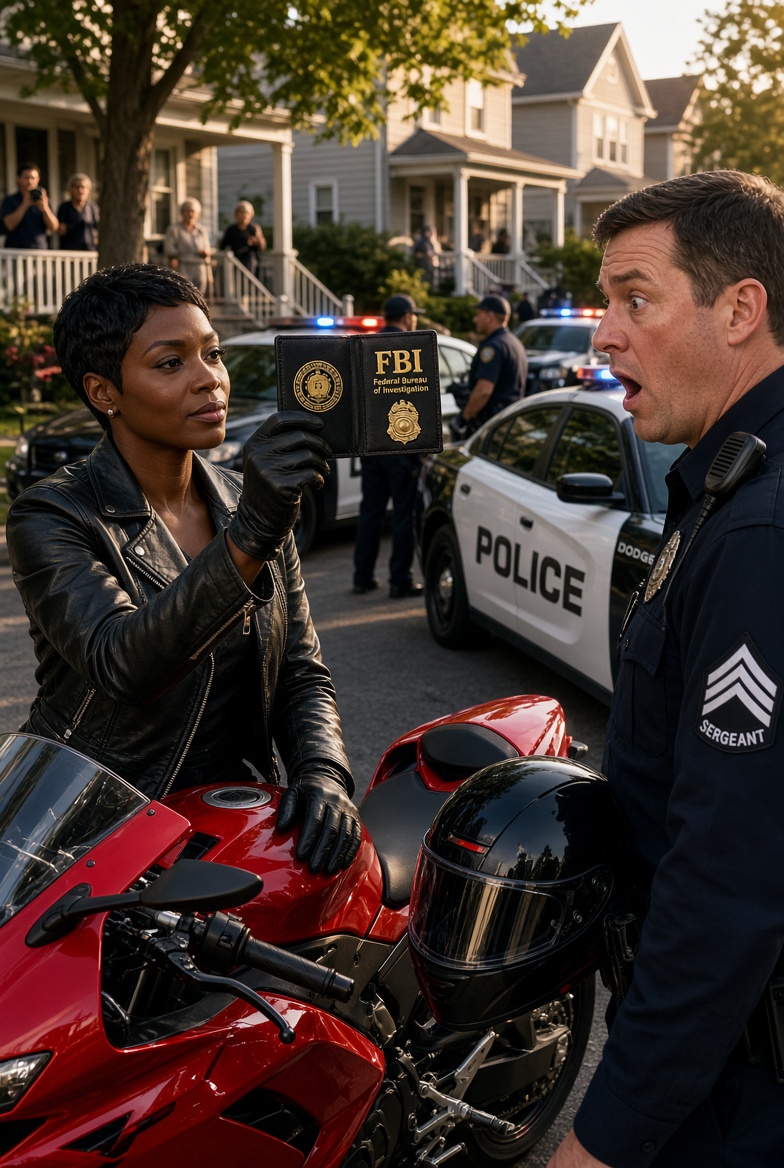
“Step away from the motorcycle.”
Sergeant Gordon Weston’s voice had changed.
Five minutes earlier, he had been asking questions.
Now he was giving commands.
Florence Osborne stood beside her red superbike on Maple Street, three police cruisers positioned around her, neighbors watching from porches and windows.
Weston pointed toward the motorcycle.
“We’re taking it in.”
Florence looked at him.
“Under what violation?”
For the first time since the stop began, Weston had no immediate answer.
That silence told her more than anything he had said.
But Florence did not raise her voice.
She did not argue.
She did not reach for her phone.
She simply kept both hands visible and said:
“Sergeant, you should be very careful about what you do next.”
Weston’s eyes narrowed.
“Is that a threat?”
“No.”
Florence answered calmly.
“It’s advice.”
Twenty minutes earlier, none of this had seemed possible.
The Saturday afternoon sun hung low over Maple Street, turning the windshields of parked cars into sheets of gold.
It was the kind of quiet neighborhood where children rode bicycles between driveways, homeowners waved while checking the mail, and the loudest sound was usually a lawn mower or a barking dog behind a wooden fence.
Florence liked streets like this.
She had spent the morning helping her older sister assemble furniture for a new apartment across town.
Afterward, instead of taking the highway home, she chose the slower neighborhood route.
She was in no hurry.
Her motorcycle—a red Italian superbike she had owned for three years—was powerful enough to become dangerous in careless hands.
Florence was not careless.
She wore a black leather riding jacket, reinforced gloves, boots, and a full-face helmet.
She stopped fully at the intersection of Maple and Grant.
A patrol cruiser sat across from her.
Florence noticed the officer behind the wheel watching the motorcycle.
She had seen that look before.
Sometimes admiration.
Sometimes suspicion.
Sometimes both.
The traffic light changed.
Florence accelerated normally.
No racing.
No sudden lane changes.
No weaving.
Nothing that should have drawn attention.
Less than thirty seconds later, she checked her mirror.
The cruiser was behind her.
Another twenty seconds.
Red and blue lights.
Florence felt her shoulders tighten for half a second.
Then she breathed.
Signal.
Slow down.
Pull safely to the curb.
Engine off.
Hands visible.
She had spent enough years around law enforcement to understand that the beginning of an encounter could shape everything after it.
Sergeant Gordon Weston stepped out.
Broad-shouldered.
Mid-forties.
Fifteen or more years in uniform judging from the service marks on his sleeve.
His posture was controlled.
His expression less so.
He approached from Florence’s left.
“License and registration.”
Florence removed one glove slowly.
“My wallet is in my jacket.”
“Go ahead.”
She retrieved her driver’s license, then opened the motorcycle’s registration compartment.
Weston studied the license.
Florence Marie Osborne.
Local address.
Valid motorcycle endorsement.
Nothing unusual.
He looked at the bike again.
“Is this yours?”
“Yes.”
“Registered to you?”
“Yes.”
He glanced at the paperwork.
Then back at the red fairings.
“That thing isn’t cheap.”
Florence gave a small nod.
“No.”
Weston looked at her.
“Must cost more than some people make in a year.”
There it was.
Not a traffic question.
Florence ignored the implication.
“Can I ask why you stopped me?”
Weston’s jaw shifted.
“I’m asking the questions right now.”
Florence remained still.
She had no interest in turning irritation into escalation.
“All right.”
Another officer stepped out from the passenger side of Weston’s cruiser.
Younger.
Late twenties.
Nameplate:
DECKER.
He stayed several feet behind Weston.
Weston asked:
“Where’d you get the money for the motorcycle?”
Florence looked at him.
“I work.”
“What kind of work?”
“That’s personal.”
Weston gave a short laugh.
“Personal?”
“Yes, Sergeant.”
No sarcasm.
No raised voice.
That seemed to irritate him more.
Across the street, a man watering his lawn stopped moving.
A curtain shifted in a nearby house.
Two teenagers walking along the sidewalk slowed.
Florence could feel the encounter developing an audience.
She looked toward Weston.
“If there’s a problem with my license, registration, or driving, I’ll cooperate. I’d just like to understand the reason for the stop.”
This time Weston answered.
“We received a reckless-driving complaint involving a red sport motorcycle in this area.”
That changed the legal picture.
Florence nodded.
A reported reckless driver could give an officer a legitimate reason to investigate if the description, location, timing, and other details matched sufficiently.
She did not pretend otherwise.
“What did the caller report?”
Weston looked at her.
“You don’t need the whole dispatch log.”
“I’m not asking for the whole log. I’m asking whether the description was more specific than a red motorcycle.”
Weston did not answer.
Florence noticed Decker glance toward him.
That interested her.
“Did you personally observe me speeding?”
she asked.
Weston’s expression hardened.
“I observed you operating the motorcycle.”
“That isn’t what I asked.”
“Ma’am.”
Florence stopped.
Not because the question was unreasonable.
Because she could see the conversation had reached the point where repeating it would accomplish little.
Weston stepped back toward his cruiser.
Then spoke into his radio.
“Send another unit to Maple and Grant.”
Florence looked toward Decker.
He seemed surprised too.
Within minutes, a second cruiser arrived.
Then another.
Three police vehicles for one cooperative motorcycle rider.
Florence turned off the bike completely and removed her helmet.
Dark hair fell loosely around her shoulders.
She rested the helmet against the tank.
Three officers.
Several neighbors.
Multiple phones now visible.
Weston returned.
“Step off the bike.”
Florence complied.
She stood beside it.
“Am I under arrest?”
“No.”
“Am I being detained?”
“Yes.”
“For investigation of the reckless-driving complaint?”
Weston hesitated.
“Yes.”
Florence nodded.
Good.
At least now the basis had been stated.
She could dispute facts later.
The street was not the place to litigate a stop.
Then Weston pointed toward the small saddlebag mounted behind the seat.
“What’s inside?”
“Motorcycle tools.”
“Open it.”
Florence looked at him.
“No.”
He blinked.
“What?”
“I don’t consent to a search.”
Weston stepped closer.
“If there’s nothing illegal inside, why do you care?”
Florence almost sighed.
“Because privacy isn’t evidence of a crime.”
Officer Decker shifted.
“Sergeant…”
Weston looked toward him.
“Trevor.”
One word.
Decker stopped.
Florence noticed.
So did several people recording.
Weston turned back.
“Open the bag.”
“No, Sergeant.”
“You’re making this harder than it has to be.”
“I’m trying to make it very simple.”
Florence answered.
“You may do whatever the law allows you to do. I’m not giving you consent beyond that.”
Across the street, a young woman held up her phone.
Weston noticed.
“Put the phone down.”
The woman stayed on her porch.
“I’m recording from my property.”
Weston stared at her.
Florence said nothing.
She was not going to direct the witness.
But she was glad the camera existed.
Weston returned his attention to the motorcycle.
Then he did something Florence had hoped he would not do.
He opened the saddlebag himself.
She did not physically interfere.
That would accomplish nothing and increase risk.
But she said clearly:
“For the record, I do not consent to this search.”
Decker looked down.
Inside the bag were exactly what Florence had described.
A tire-repair kit.
Compact tool roll.
Replacement brake components she had picked up that morning.
A second pair of gloves.
And beneath them, a small locked metal case.
Decker reached toward it.
Florence spoke.
“Please leave that where it is.”
He stopped.
“What is it?”
“Personal property.”
Weston stepped beside him.
“Open it.”
“No.”
“What’s inside?”
“Nothing related to a traffic complaint.”
“You don’t get to decide what’s related.”
Florence looked at him.
“Neither does curiosity.”
That sentence changed his face.
Weston straightened.
“Call a tow.”
Decker stared.
“For what?”
Weston looked at him.
“Impound pending investigation.”
Florence’s eyes narrowed.
“Based on what offense?”
Weston looked toward her.
“We’re sorting that out.”
“No.”
Florence’s voice remained calm.
“If the motorcycle is evidence of an offense, identify the offense. If there’s a lawful reason to impound it, state it. But ‘we’re sorting that out’ isn’t a traffic violation.”
Weston stepped closer.
“You’ve been difficult from the minute I stopped you.”
Florence held his gaze.
“I gave you my license.”
“My registration.”
“I stepped off the motorcycle when ordered.”
“I kept my hands visible.”
“I answered questions related to the stop.”
“The only thing I refused was a voluntary search.”
She paused.
“Refusing consent is not obstruction.”
Decker looked toward Weston again.
One of the other officers, a woman named Officer Hannah Collins, remained near the second cruiser.
She had not participated much.
Now she asked:
“Sergeant, do we have a plate hit?”
“No.”
“Stolen return?”
“No.”
“Warrant?”
“No.”
Florence listened.
The facts were beginning to separate themselves from Weston’s theory.
That was important.
An initial theory could be reasonable.
It was what happened after contradictory facts arrived that mattered.
Weston turned toward Florence.
“Here’s what I know.”
“You’re riding a motorcycle worth a small fortune.”
“We have a reckless-driving complaint.”
“You’ve got a locked case.”
“You won’t let us search it.”
“And you’ve got an answer for everything.”
Florence looked at him.
“Those are observations.”
“Only one of them even relates to a possible traffic offense.”
Silence.
Weston’s face reddened.
“Last chance.”
“Tell me who you are, where you got the motorcycle, and what is in that case.”
Florence studied him.
Then made a decision.
She had not wanted to reveal her occupation.
She was off duty.
This was personal time.
And more importantly, who she worked for should not determine whether she received lawful treatment.
But the situation had moved beyond a routine stop.
Three cruisers.
An unauthorized search already underway.
Threatened impoundment.
Officers increasingly uncertain.
Florence slowly moved one hand toward the inside of her riding jacket.
Weston reacted instantly.
“Keep your hands where I can see them.”
She froze.
Raised the empty hand.
“I’m reaching for additional identification.”
“What identification?”
Florence looked at him.
“My credentials.”
Weston stared.
She waited.
“May I retrieve them?”
That question forced him to make a conscious decision.
He nodded.
“Slowly.”
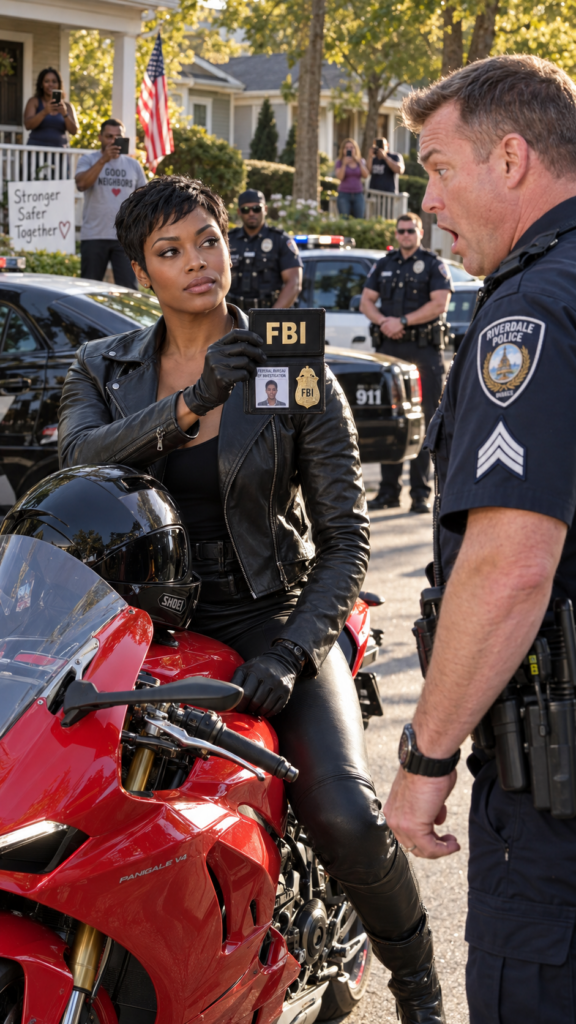
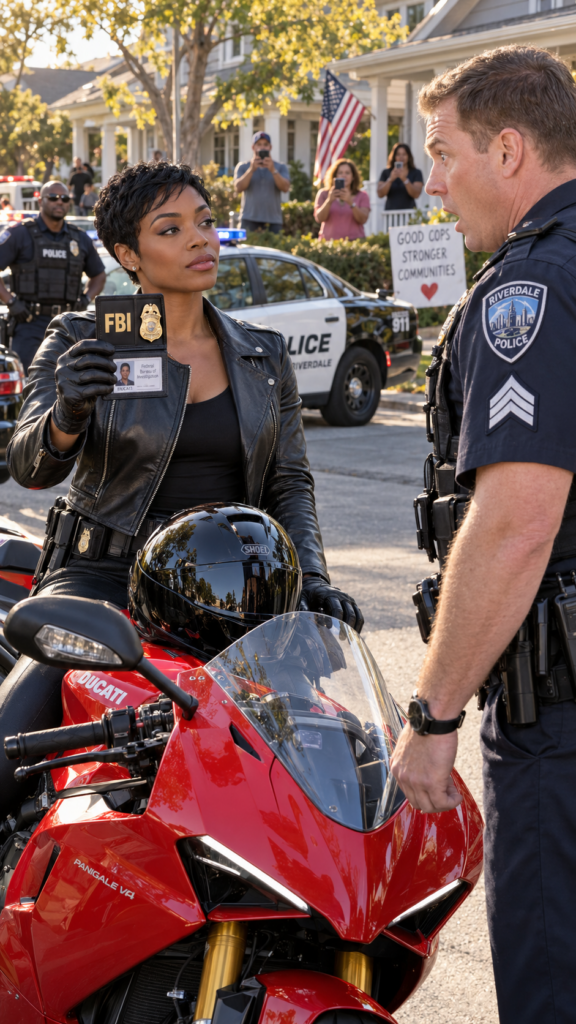
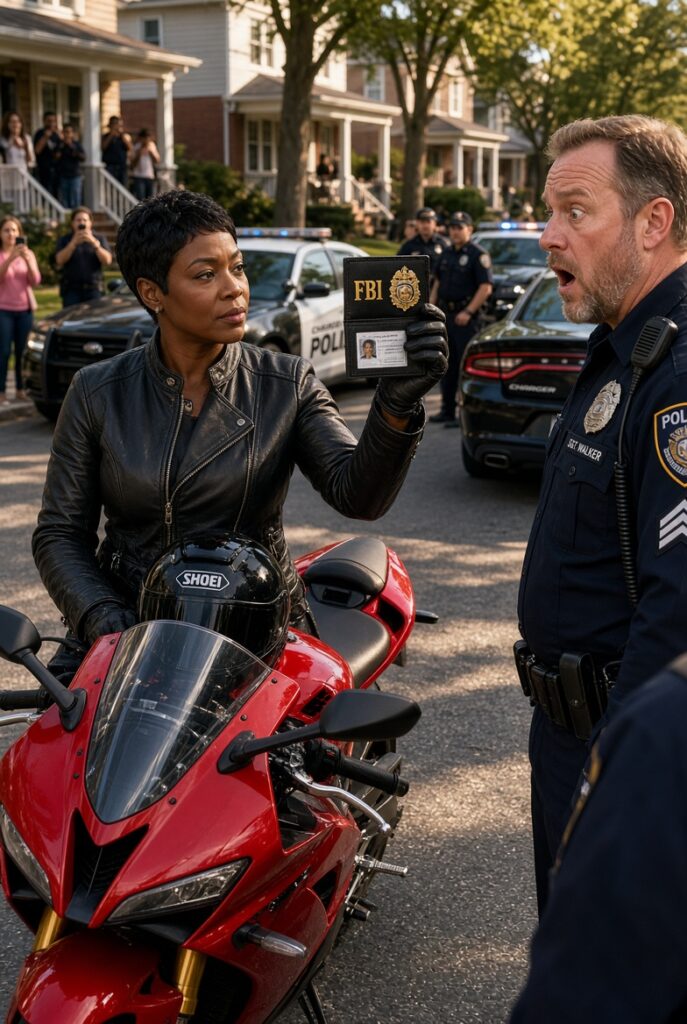
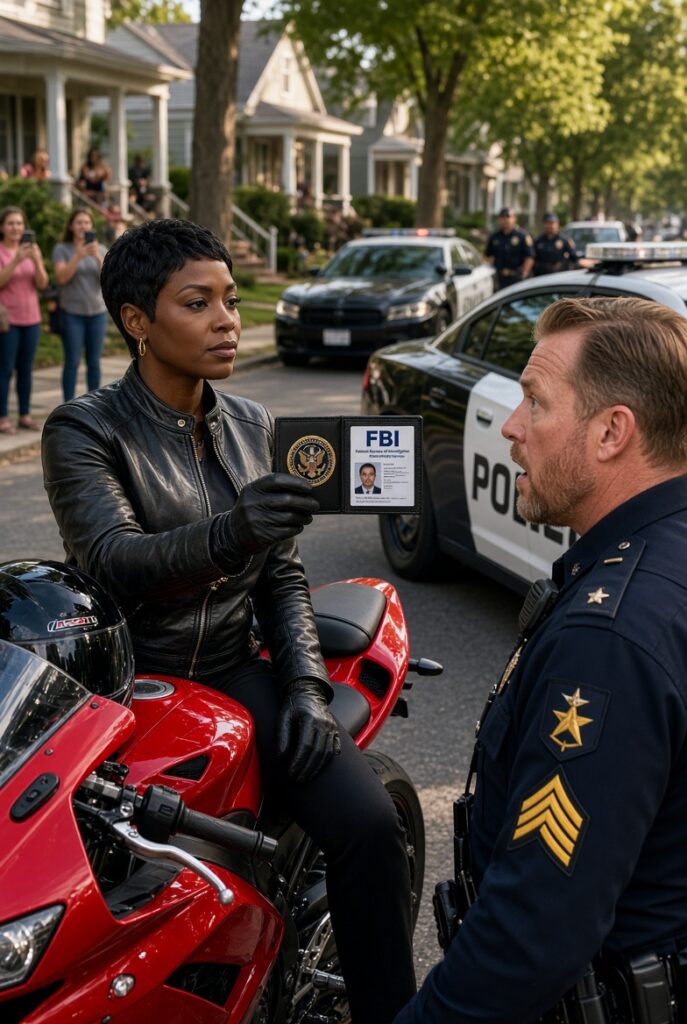
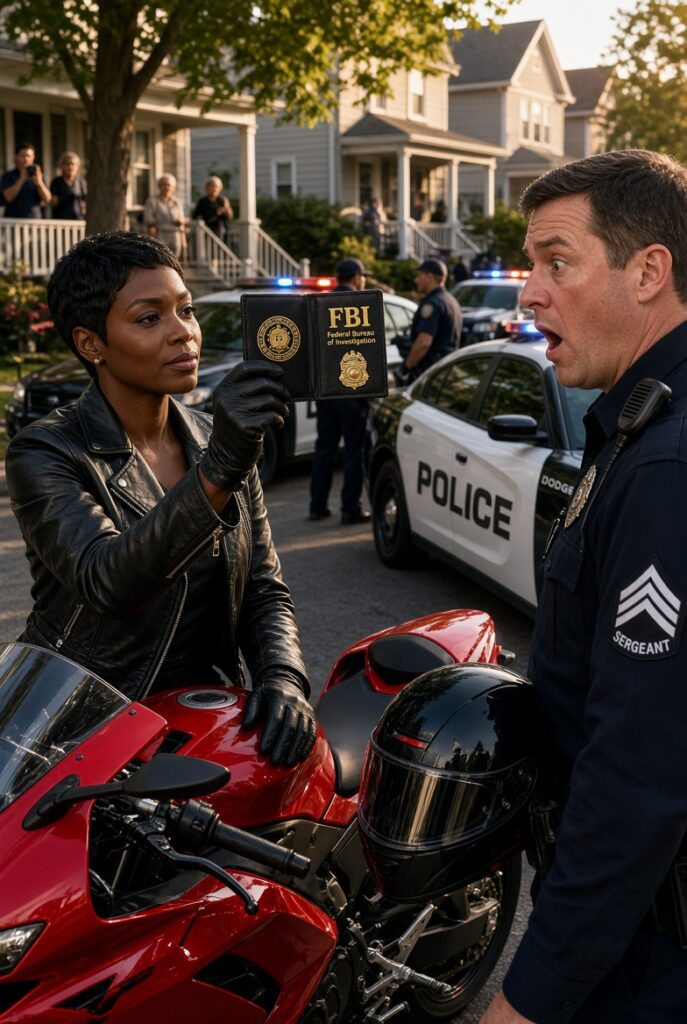
Florence reached into the jacket and removed a black leather credential case.
She opened it.
The gold badge caught the afternoon light.
Beside it:
her federal identification.
FLORENCE M. OSBORNE
SPECIAL AGENT
FEDERAL BUREAU OF INVESTIGATION
Nobody spoke.
Decker’s eyes widened.
Officer Collins looked from Florence to Weston.
Across the street, someone whispered:
“Oh my God.”
Weston stared.
“You’re FBI?”
Florence closed the credential case.
“Yes.”
His posture changed immediately.
Florence saw it.
She did not enjoy it.
That was exactly the problem.
Nothing about the facts had changed.
She had still made the same stop.
Presented the same license.
Declined the same search.
The badge had not traveled backward and made her rights more real.
Weston said:
“Why didn’t you tell me?”
Florence looked at him.
“Why should my job have been necessary?”
No one answered.
She continued:
“I was off duty.”
“I was riding home.”
“You had every opportunity to conduct a normal traffic investigation.”
Weston glanced toward the people recording.
“We were responding to a complaint.”
Florence nodded.
“And that may have justified an initial stop.”
That surprised him.
She continued:
“I am not disputing that you may have had a reason to investigate.”
“But an initial theory is rented, Sergeant.”
“Evidence decides whether you get to keep it.”
Decker looked at her.
Florence continued:
“My registration matches.”
“The motorcycle isn’t stolen.”
“You have not identified any traffic violation you personally observed.”
“I have cooperated.”
“And your own officers are now asking what legal basis exists for further detention, search, or impoundment.”
She glanced toward the open saddlebag.
“My employment does not create those facts.”
Weston’s shoulders lowered slightly.
“Close the bag.”
he told Decker.
Decker immediately zipped it.
Florence looked toward him.
“Officer Decker.”
“Yes, ma’am?”
“Did you personally see me commit any traffic violation before the stop?”
He hesitated.
Weston looked at him.
Florence noticed.
So did Officer Collins.
Decker finally answered:
“No, ma’am.”
Florence nodded.
“Thank you.”
Then she turned toward Weston.
“That doesn’t automatically mean your initial stop was unlawful if dispatch information provided sufficient suspicion.”
Weston seemed surprised again.
Florence continued:
“But it does mean you have to keep reassessing.”
She paused.
“Being allowed to stop someone is not the same as being allowed to stop thinking.”
The street went completely quiet.
Weston looked away first.
Then toward Decker.
“Cancel the tow.”
Decker reached for his radio.
That should have been the end.
Instead, Florence noticed something.
Weston’s cruiser trunk had been left partially open.
Probably after he retrieved equipment earlier.
From where Florence stood, she could see inside without approaching.
A tactical vest.
Road kit.
Evidence transport containers.
And behind one of them, a dark sealed evidence bag.
Nothing unusual by itself.
Police transport evidence.
But the adhesive evidence strip carried a color and alphanumeric prefix Florence knew.
She had seen it repeatedly during the previous four months.
Not because she memorized every case number in the Bureau.
Because she had been assigned to a joint federal-state narcotics investigation involving diverted prescription opioids, illegal fentanyl distribution, and suspected theft from controlled evidence storage.
One batch of seized evidence had vanished months earlier.
Local records said part had been mistakenly destroyed after a chain-of-custody error.
The task force had never been satisfied with that explanation.
Florence could not read the entire number from where she stood.
She did not need to.
She recognized enough of the task-force evidence prefix and the distinctive secondary seal.
Her heartbeat changed.
Her face did not.
She did not walk toward the cruiser.
Did not demand the trunk be opened.
Did not announce:
That is federal evidence.
Doing that would have been reckless.
She was off duty.
Alone.
And a visual observation was not yet proof of anything.
The bag might have been properly transferred.
The identifier might have been similar.
There could be an innocent explanation.
Facts first.
Always.
Florence looked back at Weston.
He had not noticed where her eyes had gone.
“Am I free to leave?”
she asked.
Weston hesitated.
Then:
“Yes.”
Florence nodded.
“Thank you.”
She put on her helmet.
Then stopped.
Looked toward Decker and Collins.
“Officers.”
Both looked at her.
“Your body cameras are running?”
“Yes, ma’am.”
Decker answered.
“Good.”
She looked toward Weston.
“This encounter needs to be preserved.”
His face tightened.
“I’ll be filing a formal complaint.”
Not:
I’ll have your badge.
Not:
You’re finished.
Not:
Do you know who I am?
A complaint.
Evidence.
Process.
Weston said nothing.
Florence zipped her jacket.
Mounted the motorcycle.
Started the engine.
Then rode away.
Nobody stopped her.
She did not go home.
Three blocks later, she pulled into the parking lot of a grocery store.
Parked beneath a security camera.
Removed her helmet.
And called her supervisor.
Supervisory Special Agent David Chen answered on the fourth ring.
“Osborne?”
“I need you to start a preservation request.”
His tone changed immediately.
“For what?”
Florence gave him the department name.
Patrol unit number.
Weston’s name.
Approximate time.
Intersection.
Then:
“And David…”
“Yes?”
“I saw something in the open trunk of Weston’s cruiser.”
“What?”
“A sealed evidence package.”
“What kind?”
“I could see our joint-task-force prefix.”
Silence.
“You sure?”
“No.”
That answer mattered.
“I’m sure enough that the video and vehicle need preservation before anyone moves anything.”
David became very quiet.
“Do not go back.”
“I wasn’t planning to.”
“Do not contact the officer.”
“I know.”
“I’m calling counsel and the task-force supervisor.”
“Good.”
Florence continued:
“There should also be neighborhood video.”
“Several people recorded the stop.”
“Bodycams?”
“Yes.”
“CAD?”
“There was a dispatch complaint.”
“Good.”
David paused.
“You okay?”
Florence finally looked down at her hands.
They were shaking slightly.
Now.
Not on Maple Street.
“Yeah.”
Then corrected herself.
“I will be.”
The next seventy-two hours were nothing like the internet story that would eventually circulate.
No convoy of federal vehicles surrounded the police department.
No agents stormed Weston’s house that evening.
No chief dropped to his knees apologizing.
Real investigations moved slower.
And because they moved slower, they could survive scrutiny.
The police department’s Professional Standards unit received Florence’s complaint Monday morning.
By then, her attorney and FBI supervisor had already sent formal preservation notices requesting body-camera footage, dash-camera recordings, CAD logs, dispatch audio, vehicle GPS history, tow communications, and any reports generated from the stop.
The department voluntarily placed Sergeant Weston on administrative duty while it reviewed the incident.
Not fired.
Not arrested.
Administrative duty.
Officer Trevor Decker and Officer Hannah Collins remained on patrol but were separately interviewed.
The neighborhood recordings became important immediately.
One video clearly captured Florence saying:
“I don’t consent to a search.”
Then Weston opening the saddlebag.
Another captured Collins asking whether there was a warrant, stolen-vehicle return, or plate hit.
There was none.
The dispatch audio added nuance.
At 4:08 p.m., a caller had reported:
“A red racing motorcycle flying down Maple, maybe seventy.”
No plate.
No rider description.
No direction beyond “toward Grant.”
At 4:11, Weston saw Florence’s red sportbike approximately five blocks away.
That gave investigators a legitimate question.
Was the initial stop reasonable based on proximity, timing, vehicle description, and the nature of the report?
Attorneys disagreed over how strong the justification had been.
But that was not where the case became clearest.
The recordings showed Florence traveling normally before Weston activated his lights.
His own dash camera showed no speeding, weaving, or reckless maneuver.
Within minutes, her registration and license were confirmed valid.
Nothing linked her specifically to the reported rider beyond a red sport motorcycle.
Yet the investigation did not narrow.
It expanded.
Questions about price.
Employment.
A locked case.
A refusal to consent.
Then the saddlebag search.
Then the threatened impoundment.
Professional Standards focused on that progression.
An initial suspicion had become a personal theory.
And when facts failed to strengthen the theory, Weston treated Florence’s questions as evidence against her.
Decker told investigators:
“I thought we should have ended it earlier.”
They asked why he had not said more.
He stared at the table.
“Because he was my sergeant.”
That answer became another part of the investigation.
Hierarchy could silence people even when everyone wore the same uniform.
Officer Collins had done slightly better.
She had raised the warrant and vehicle-status questions.
But she also admitted she had not directly challenged the saddlebag search.
“I was thinking it.”
she said.
The investigator answered:
“Thinking and intervening are different.”
She nodded.
“I know.”
The evidence bag became a separate matter.
That investigation was removed from the department almost immediately.
The local chief did not want his own agency examining an allegation connected to a joint narcotics case.
State investigators and the federal task force took over.
The cruiser was secured.
The evidence package Florence had seen was documented before removal.
She had been right about the prefix.
But not about everything.
The bag had not been listed as destroyed.
It belonged to a related seizure entered under a supplemental number.
For several hours, investigators wondered whether the entire twist had disappeared.
Then they checked the chain of custody.
The bag should not have been in Weston’s patrol cruiser.
It had been checked out from controlled storage three days earlier for transfer to a county evidence facility.
The transfer had never been completed.
The log contained a signature from a property technician who had been off duty that day.
That changed everything.
Investigators expanded the audit.
Not because Florence was FBI.
Because the records demanded it.
Over the next four months, they found seventeen evidence entries requiring review.
Most had innocent explanations.
Clerical errors.
Late updates.
Duplicate records.
Three did not.
One package of seized cash was short by $4,800.
Another drug-evidence transfer contained a false receiving signature.
And the package Florence had seen had spent nearly seventy-two undocumented hours outside controlled storage.
Weston was not alone in the problem.
A civilian evidence technician named Mark Ellison had manipulated transfer records.
Another officer had signed one form without actually witnessing the movement of evidence.
The investigation eventually established that Weston had used his patrol vehicle on multiple occasions to transport evidence outside normal procedures at Ellison’s request.
His explanation was convenience.
Investigators did not accept that as sufficient.
The deeper question was whether he knew evidence was being diverted.
That took nearly a year to resolve.
Florence was interviewed three times.
Each time she gave the same answer.
“I saw what I saw.”
“No more.”
She refused to exaggerate.
When asked whether Weston had seemed nervous after she looked toward the trunk, she said:
“I can’t tell you what he felt.”
“Describe behavior.”
The investigator nodded.
Good answer.
Florence described behavior.
Nothing more.
Eleven months after the traffic stop, the county prosecutor announced charges against Ellison for evidence tampering, falsification of records, and theft.
Weston was charged with one count related to knowingly submitting a false transport certification.
Not narcotics trafficking.
Not conspiracy to run a criminal empire.
One provable count.
His attorney argued he had trusted Ellison and signed paperwork carelessly.
The prosecution argued that rank and experience made the explanation less credible.
Weston eventually entered a plea to falsifying an official record and resigned from the department.
He received probation, community service, and loss of his law-enforcement certification under the agreement.
Some people thought that was too lenient.
Others thought a single documentation offense should never have destroyed a fifteen-year career.
The internet argued.
Florence did not.
Her traffic-stop complaint produced separate departmental findings.
Sustained:
failure to adequately reassess reasonable suspicion.
Improper expansion of the detention.
Unauthorized search of the saddlebag.
Inadequate basis for threatened impoundment.
Unprofessional questioning unrelated to the stated traffic investigation.
The department did not sustain a finding that Weston had stopped Florence solely because of the motorcycle’s value.
There was not enough evidence to prove motive.
Florence accepted that distinction.
She cared about what could be established.
Officer Decker received counseling and additional supervisory-response training for failing to intervene earlier.
Officer Collins received no formal discipline but participated in the same training review.
She later asked Professional Standards to include one of her own statements in the training materials:
“I knew something was wrong before I knew exactly what rule was being crossed. I treated uncertainty as a reason to stay quiet. Sometimes uncertainty should be the reason you ask the next question.”
That was useful.
The department changed its traffic-stop review policy.
Supervisors were required to articulate the basis for prolonged detention when a stop extended significantly beyond the original investigation.
Impound decisions required documented statutory or policy authority.
And officers received scenario training built around one question:
What new fact would make you abandon your first theory?
Florence liked that question.
Two years later, she was invited to speak to a joint academy class.
She almost refused.
Then agreed on one condition.
“No hero story.”
The training captain looked confused.
“What do you mean?”
“I don’t want this taught as ‘officers stopped the wrong woman because she turned out to be FBI.’”
He nodded slowly.
Florence continued:
“That would teach the exact wrong lesson.”
On the day of the class, nearly eighty recruits sat in rows.
Local police.
Sheriff’s deputies.
Several federal trainees.
Florence stood at the front.
No motorcycle jacket.
No badge displayed dramatically.
She began:
“You’ve probably heard a version of Maple Street.”
Several hands shifted.
They had.
She smiled.
“The internet version says three local cops surrounded an innocent woman, she flashed an FBI badge, and everybody suddenly realized they had made a terrible mistake.”
She paused.
“That version is satisfying.”
“It is also dangerous.”
The room became quiet.
“The badge did not make the search unlawful.”
“The facts did.”
“My job did not make my questions reasonable.”
“The questions either were reasonable or they were not.”
“And Sergeant Weston’s conduct would not have become acceptable if I had been a waitress, teacher, unemployed, homeless, or riding a motorcycle worth two thousand dollars instead of twenty thousand.”
A recruit raised his hand.
“Ma’am, should he never have stopped you?”
Florence smiled.
“Good question.”
“Maybe the initial stop was defensible.”
Several people looked surprised.
She continued:
“Dispatch had a reckless-driving complaint involving a red sport motorcycle in the area.”
“The description was weak.”
“But weak is not always nothing.”
She paused.
“The important failure came after.”
“My plate returned clean.”
“My license was valid.”
His dash camera showed ordinary driving.
No officer personally observed reckless behavior.
“And instead of shrinking the theory, Sergeant Weston expanded it.”
“Expensive motorcycle.”
“Locked case.”
“Questions.”
“Refusing consent.”
She looked across the room.
“Being allowed to form an initial suspicion is not the same as being allowed to become loyal to it.”
Then she wrote on the board:
AN INITIAL THEORY IS RENTED. EVIDENCE DECIDES WHETHER YOU GET TO KEEP IT.
The recruits copied it.
Florence continued:
“There’s another lesson.”
She wrote:
STATUS CHANGES CONSEQUENCES. STATUS DOES NOT CHANGE FACTS.
“My credentials changed what happened afterward.”
“Of course they did.”
“They gave me access to supervisors, counsel, preservation procedures, and people who knew how to move quickly.”
“That is real.”
She looked around.
“But status should not change whether dignity existed before the reveal.”
“If you remember me only as the FBI agent on the motorcycle, you’ve missed the woman who was standing there before the badge came out.”
The room stayed quiet.
Years passed.
Florence remained with the Bureau.
She eventually moved from narcotics and public-corruption work into supervisory assignments.
Not because of Maple Street.
Careers are larger than one story.
She trained younger agents.
Reviewed cases.
Made mistakes.
Corrected them.
One new agent once came into her office convinced a subject was lying because the man had refused consent to search his phone.
Florence asked:
“Is refusal evidence?”
The agent stopped.
“No.”
“Then take it out of your reasoning.”
The agent nodded.
“What do I use?”
“Facts.”
Simple.
Officer Trevor Decker stayed in policing.
Five years after Maple Street, he became a field-training officer.
He used the incident with recruits.
Not proudly.
Accurately.
“I saw the stop moving away from its purpose.”
he told them.
“I kept waiting for certainty before challenging my sergeant.”
He would pause.
“You often don’t get certainty.”
“You get enough discomfort to ask:
‘What are we doing now, and what fact allows us to do it?’”
That question prevented more than one bad decision.
Hannah Collins later became a patrol supervisor.
Her rule was simple.
If one of her officers called for a tow during a disputed stop, she asked:
“Cite me the authority before the truck arrives.”
Sometimes there was clear authority.
Sometimes there was not.
Either answer was useful.
Florence kept the red superbike for another eight years.
She never sold it because of Maple Street.
She sold it because her knees eventually disliked long rides and she wanted something more comfortable.
The buyer was a twenty-seven-year-old engineer who spent nearly an hour examining the maintenance records.
Before leaving, he recognized Florence’s name.
“Wait.”
“You’re that FBI motorcycle woman.”
Florence closed her eyes.
“Unfortunately.”
He laughed.
“I saw the video.”
“Which one?”
“The one where they realize who you are.”
Florence looked at the motorcycle.
“That wasn’t the important moment.”
“What was?”
She thought.
Then:
“Before they knew.”
The buyer frowned.
Florence explained:
“If the story only works because I turned out to have a badge, then the story says there was somebody else they could have treated that way.”
He became quiet.
“That’s not what happened?”
“It’s what people remember.”
She handed him the key.
“Try to remember better.”
Years later, Maple Street looked almost the same.
Different cars.
Some renovated houses.
The tree near the intersection had grown large enough to cast shade across both lanes.
Florence drove through once in an ordinary sedan.
No reason.
She had been nearby.
At the corner where Weston stopped her, she waited at the red light.
A police cruiser pulled up in the opposite lane.
Young officer.
Florence did not know him.
He did not know her.
The light changed.
Both vehicles continued.
Nothing happened.
Florence smiled.
That was good.
No badge.
No confrontation.
No federal investigation.
No crowd.
Just two people using the same street.
The Maple Street stop eventually became one story among many in her life.
People always preferred the dramatic pieces.
Three cruisers.
The red superbike.
The unauthorized search.
The moment she reached inside her jacket.
The gold badge catching sunlight.
Sergeant Weston’s face changing.
And the evidence bag visible in the trunk.
Those were the twists.
They were not the point.
The point came earlier.
A woman asked why she had been stopped.
A supervisor had a theory.
New facts arrived.
And instead of allowing those facts to narrow the theory, he treated her calm refusal to surrender privacy as confirmation that something must be wrong.
That was the real danger.
Not that Gordon Weston had stopped an FBI agent.
He had stopped a person.
He had authority.
She had rights.
Both facts existed before anyone knew her profession.
Florence never forgot that.
Whenever someone told her:
“They really picked the wrong woman that day,”
she corrected them.
“No.”
Then she would pause.
“They didn’t pick the wrong woman.”
“They stopped updating.”
And that was the lesson she carried long after the red motorcycle was gone.
Authority can begin an investigation.
Evidence must decide where it goes.
A badge can change consequences.
It cannot change facts.
And dignity should never have to wait for identification.
