

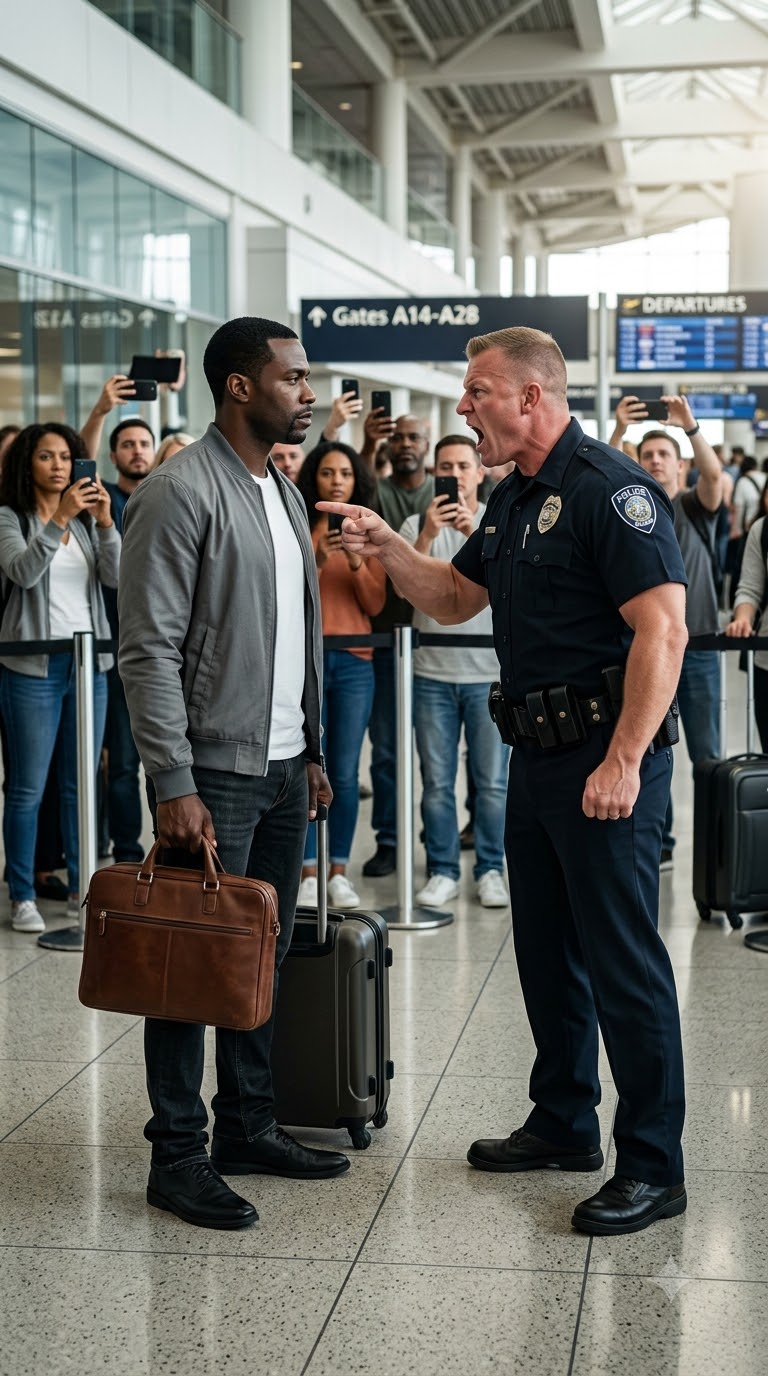
Officer Connor Vale had already decided the charcoal suitcase likely did not belong to the man carrying it before he even reached baggage claim. First, he noticed the expensive leather briefcase, then the casual black jacket, dark jeans, and the Black face above them, and the rest of the story seemed to form itself in his mind. “Step away from the carousel,” Vale said as he stepped directly into the man’s path toward the exit.
“Guys dressed like you don’t usually walk out of here carrying luggage like that.”
The remark was quiet enough that most travelers near Carousel 12 did not hear it at first. Vale had spent sixteen years with the Meridian Capital Airport Police Department and had learned that authority could sound more effective when delivered without raising his voice. At forty-six, broad-shouldered and permanently skeptical around the eyes, he had earned a reputation for discovering cash, narcotics, and suspicious travelers that other officers supposedly missed. What airport leadership rarely questioned was how often Vale seemed to determine who looked suspicious before anything suspicious actually happened.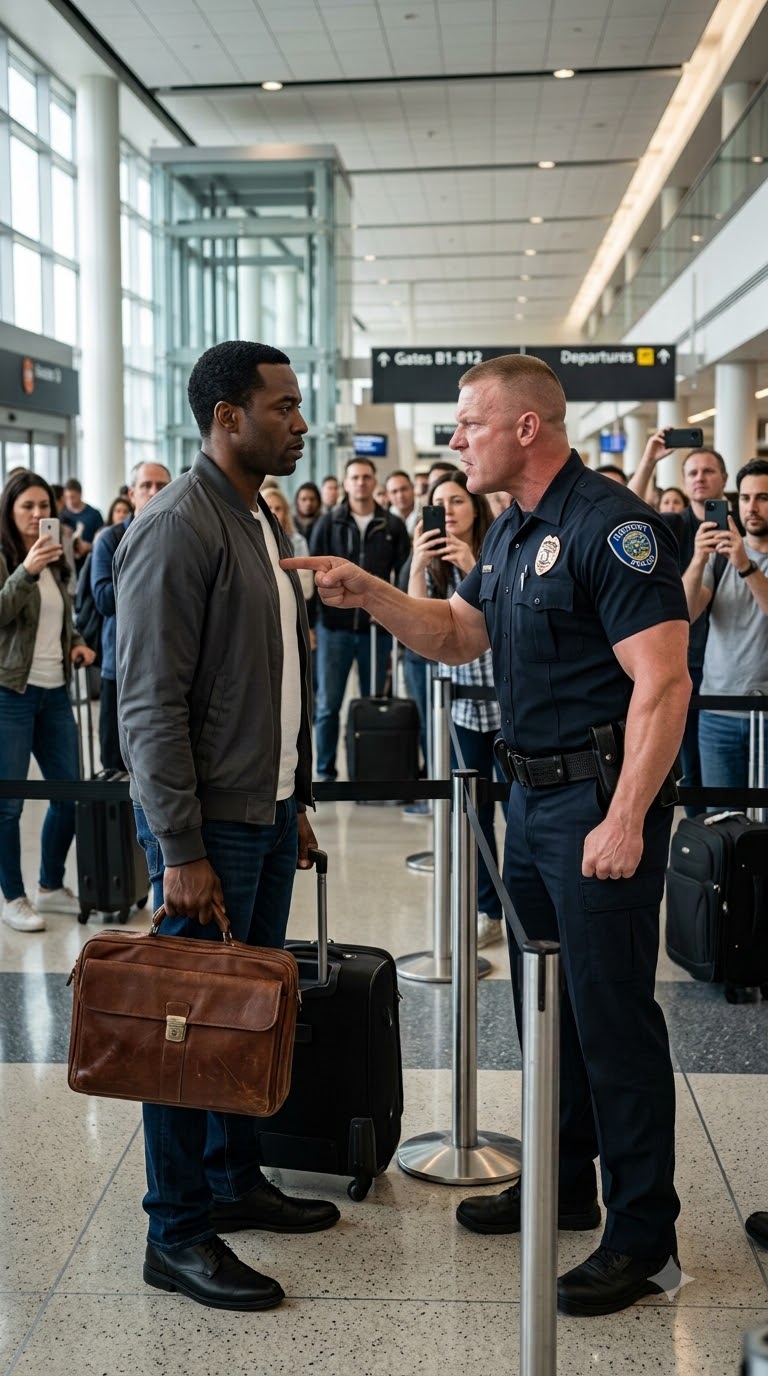
Two steps behind him was Officer Luis Ortega, forty years old and nearly ten years into airport policing. Luis was shorter, quieter, and more observant than Vale, but he had also learned that silence could become cowardice when it was used to avoid challenging a stronger personality. From his position, he could already see the burgundy identification tag hanging from the suitcase handle. Large silver initials were stamped across the leather: A.J.M.
Those initials belonged to Adrian Joseph Mercer, fifty-six, thirty-four years into a career with the Federal Bureau of Investigation and currently serving as Deputy Director. His federal credentials were tucked inside the left inner pocket of his jacket, close enough to resolve any legitimate identity question almost immediately. His briefcase contained an encrypted government laptop, several secure briefing files, and a small walnut box holding a birthday gift for his mother. Nobody gathered around Carousel 12 knew any of that yet.
To the travelers waiting for their luggage that Tuesday morning, Adrian appeared to be another exhausted passenger. He was tall, leaner than he had been a decade earlier, dressed comfortably after two days of meetings in Chicago, and carried himself with the restrained confidence of someone who had learned not to let being watched dictate his movements. Seventeen minutes later, FBI agents would shut down every secure service exit along Meridian Capital International Airport’s east terminal because of what Connor Vale chose to do. The incident that ultimately exposed years of unlawful airport policing began with something far less dramatic: one officer deciding a suitcase looked too expensive for the man standing beside it.
Meridian Capital was located almost directly between Baltimore and Washington, busy enough to handle millions of travelers annually but compact enough that experienced employees eventually recognized one another. At 8:26 that morning, Carousel 12 was packed with families, consultants, college students, military personnel, and business travelers beneath fluorescent lights as recorded announcements echoed throughout the baggage level. Coffee from a nearby kiosk smelled burnt, children perched on carry-on bags, and a maintenance worker wrestled with a vending machine that refused to accept dollar bills. Nothing in the room suggested that one of the airport’s largest federal civil-rights investigations had already begun.
Thirteen minutes before Vale confronted Adrian, both Vale and Luis had switched off their body-camera video feeds. The cameras remained powered, their GPS modules continued recording location data, and the internal systems logged every activation command, but the actual video sensors had been deliberately shut down using a two-button sequence. Vale did it first. Luis followed nine seconds later.
Neither officer reported a malfunction. Neither contacted dispatch, filed an equipment note, or informed a supervisor. More importantly, this was not the first undocumented encounter of their shift. Before eight that morning, they had already stopped two Black male travelers in separate parts of the terminal and questioned them about luggage ownership before searching one backpack and one roller bag.
Nothing illegal had been discovered. Neither encounter appeared in the official activity database. Luis had remained beside Vale during both stops and said nothing while the cameras stayed off.
At 8:11, Vale used his personal phone to send a message to a private chat shared by several members of the airport interdiction team. Solo premium at Twelve. Black male, no family, expensive hard case. Looks easy before shift change. He attached a still image from an internal airport camera showing Adrian coming down an escalator toward baggage claim. At that moment, Adrian had done nothing suspicious beyond walking through the airport with luggage.
There had been no stolen-bag report. No airline employee had contacted police. No passenger had accused Adrian of touching someone else’s property. Vale had singled him out from a video image, turned off his body camera, and approached him before any criminal event existed.
Adrian knew none of this. He had spent the previous forty-eight hours in Chicago attending an interagency briefing on international cybercrime and wanted nothing more than to return home. His wife, Dana Mercer, worked as a cardiologist and had texted that morning that she might miss dinner because of an emergency procedure. Adrian’s mother, Evelyn Mercer, would turn eighty-four the following day.
Inside the walnut box was a silver bracelet engraved with one word: Steady. Adrian’s father had used that word throughout his childhood, not as praise but as instruction. When fear arrived, be steady. When anger arrived, be steady enough to decide what happens next.
His father, James Mercer, had spent nearly three decades working for the postal service in Annapolis. He had raised Adrian and his two sisters in a narrow brick house where arguments were permitted but excuses rarely lasted more than a few minutes. Adrian intended to visit Evelyn’s home before sunrise the next morning and leave the bracelet beside her coffee machine. The gift was what occupied his thoughts when his suitcase appeared on the carousel.
Ninety seconds after reaching Carousel 12, the charcoal case came toward him. Adrian lifted it from the belt, checked the burgundy tag, then opened the airline application on his phone and confirmed the baggage tracking number out of habit. He had traveled too often to rely on memory when identical suitcases filled airports. Then he took hold of the handle and turned toward the exit.
Vale stepped in front of him after three paces. Adrian stopped and placed the suitcase beside his right leg, keeping both hands visible. “Can I help you, Officer?”
“Move away from the luggage.” Adrian glanced down.
“This is mine.” Vale’s eyes shifted from the suitcase to the leather briefcase.
“We’ve had expensive bags disappearing around this terminal.” Adrian looked at the identification tag.
“My initials are on the handle.” He kept his voice neutral. “I also have the airline receipt on my phone.”
Vale did not even check the tag. “Step away.”
Adrian studied him. Years of interviews had taught him that the opening seconds of an encounter could reveal more than explanations given later. A professional officer investigating an actual luggage theft would want the baggage tag, receipt, flight number, and identifying information immediately. Vale seemed unusually uninterested in all four.
“What is the theft report number?” Adrian asked. Vale’s expression tightened.
“You don’t need that.”
“If there’s a reported stolen bag, there should be an incident number.” Adrian said it without accusation. “I’m asking because my identification and receipt can resolve this quickly.”
Vale moved one step closer. “You ask a lot of questions.”
“That tends to happen when police stop people without explaining why.” Adrian remained calm.
Luis watched from behind his partner. He knew there was no theft call. He had heard the radio all morning.
Vale looked at the briefcase again. “Open that.”
“No.” Vale looked surprised.
Adrian continued. “It contains federal equipment, and I’m not consenting to a search.”
“Federal equipment?” Vale gave a short laugh.
“Yes.” Adrian’s tone did not change.
“My identification is inside the left side of my jacket.” He slowly raised both hands to chest height. “I’m going to open the jacket with my left hand, then reach into the inner pocket with my right.”
It was exactly the kind of movement announcement Adrian had taught younger agents for years. Clear. Predictable. Slow.
His left fingers had barely reached the zipper when Vale slapped his arm aside. The briefcase dropped from Adrian’s right hand and struck the polished floor hard enough to make nearby passengers turn. The brass corner bounced once before the case slid beneath the edge of a metal bench.
Adrian did not reach for it. He immediately raised both palms. “My name is Adrian Joseph Mercer.”
A woman in a flight-attendant uniform stopped near the carousel. Two men heading toward ground transportation slowed down. Luis shifted his weight.
Adrian looked directly at Vale. “I am the Deputy Director of the Federal Bureau of Investigation.”
For a moment, Vale’s face changed. Adrian had spent decades interviewing witnesses, suspects, diplomats, and criminals. He knew the difference between disbelief and recognition.
Vale knew what the title meant. Then he decided the title had to be false.
“Sure.” He smiled. “And I run Homeland Security.”
Luis spoke quietly. “Connor.” Vale looked over his shoulder.
Luis stopped speaking. That silence would trouble him later.
Adrian continued. “Contact the FBI Baltimore Field Office or Washington headquarters.”
He named a person. “Executive Assistant Director Valerie Price can verify my identity.”
Vale ignored him. “Put the suitcase down.”
“It’s already on the floor.” Adrian looked toward it. Vale’s jaw tightened.
Nearby, off-duty flight attendant Grace Nolan began recording. She was forty-three, had spent twenty years working commercial routes, and had developed a strong instinct for recognizing when an ordinary disagreement became something more serious. Her phone clearly captured the burgundy luggage tag. Then she zoomed toward the two officers.
Both body-camera indicators were dark. Grace frowned and continued filming. Six feet away, middle-school principal Rebecca Sloan stood from a bench and pulled out her own phone.
“Officer.” Rebecca pointed toward the luggage. “His initials are on the tag.”
Vale turned toward her. “Ma’am, stay out of this.”
“I can read them from here.” Rebecca raised her phone higher. “Why haven’t you looked?”
“That’s enough.” Vale’s voice sharpened. Rebecca did not move.
Retired mechanical engineer Harold Finch had been waiting near the exit for his daughter. His initial reaction when police approached Adrian was the same assumption many people make when authority enters an unfamiliar situation: the officers probably knew something everyone else did not. He watched for another half minute. That belief became increasingly difficult to maintain.
Adrian provided evidence. Vale dismissed it. Witnesses confirmed visible facts. Vale became more irritated.
Harold stepped closer without entering the officers’ space. “I’ve watched this from the beginning.”
Vale looked at him. “Then keep watching from farther back.”
Harold crossed his arms. “That’s exactly what I’m doing.”
A twenty-seven-year-old consultant named Jason Reed started livestreaming from across the baggage area. He had originally taken out his phone because he expected the confrontation to end quickly and thought it would make an interesting story for his friends. Within ninety seconds, more than two thousand viewers were watching. Comments appeared faster than he could read.
Why are both cops’ cameras off?
The bag literally has his initials.
Did he say FBI Deputy Director?
Vale lifted his radio. “Possible luggage-theft suspect at Carousel 12.”
Adrian waited. Vale continued. “Male refusing instructions, potentially using fraudulent federal credentials.”
Luis looked toward his partner. There had still been no theft report. Vale was now creating one as the encounter unfolded.
When he finished, Adrian said, “Ask dispatch for the original call.” Vale’s eyes narrowed.
“You don’t know what we have.”
“I know there was no theft dispatch before you approached me.” Adrian’s voice remained steady. “And I know both your cameras were deliberately disabled before this contact.”
Luis instinctively touched his body camera. That small movement was captured by Grace’s recording. Adrian noticed.
“Two functioning cameras don’t stop recording seconds apart accidentally.” He looked from Vale to Luis. “Your audit logs will show exactly when you turned them off.”
The atmosphere shifted. Witnesses who had been uncertain suddenly understood that Adrian was not simply objecting to the officers’ tone. He was pointing to technical evidence.
Jason turned his livestream toward the officers’ dark camera units. The viewer count passed six thousand. Grace repositioned herself so the luggage tag remained visible in her frame.
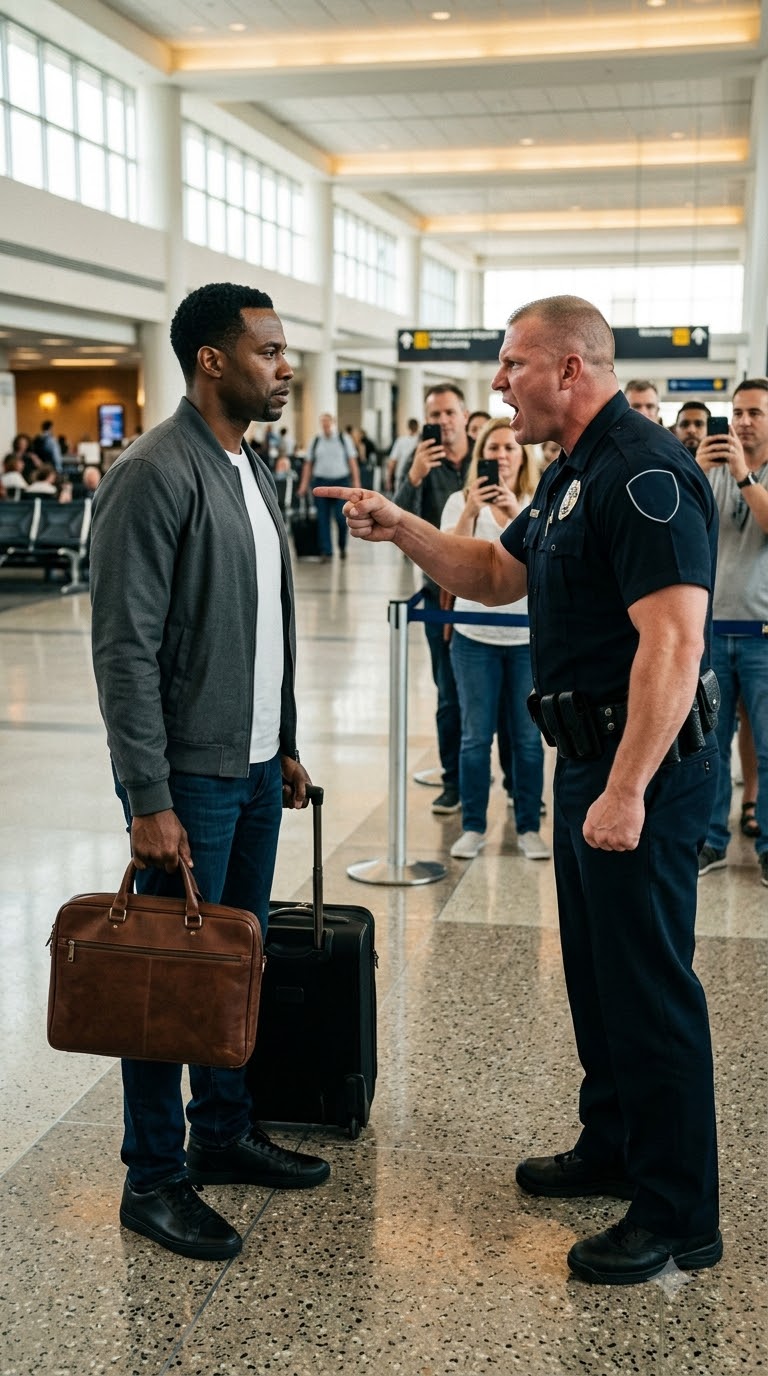
Vale looked around. Eight phones were now aimed in his direction. Whatever control he thought the darkness of his body camera would provide had already disappeared.
Adrian saw the calculation in his face. That concerned him more than the earlier arrogance. Officers frightened by evidence sometimes escalated because backing down could suddenly feel like an admission.
“Look at the bag tag.” Adrian spoke quietly. “Compare it with my airline receipt.”
Vale ignored him. “Move over there.”
“Call the Bureau.” No response.
Rebecca called from behind the phones, “Why won’t you verify anything?”
Vale pointed at her. “You are interfering with an active police investigation.”
“I’m recording from ten feet away.” Rebecca answered. “That’s witnessing.”
Harold spoke next. “The easiest explanation is sitting right in front of you.”
Vale turned toward Luis. “Take him to secondary.”
Luis hesitated. “Connor.”
“I said secondary.” Adrian looked toward Vale. “Am I under arrest?”
“You’re being detained.” Vale grabbed his upper arm.
The crowd reacted before Adrian could. Grace said, “Don’t do that.”
Rebecca called, “He hasn’t moved.”
Jason’s livestream camera shook as he moved closer. Vale tightened his grip.
Adrian remained completely still. “Officer Vale, you are making a decision that every recording here will preserve.”
“You people always think cameras scare us.” Vale pulled him toward the secured corridor.
Adrian answered, “Evidence should scare anyone who plans to lie.”
Luis followed behind. A third officer appeared near the gray service door.
Officer Noah Bennett, thirty-two and relatively new to airport interdiction, stopped the moment he saw what was happening. His body camera was active. He noticed Adrian’s raised hands, Vale’s grip, the luggage tag, and the dark indicators on the other officers.
Noah did not participate in the restraint. Investigators would later spend considerable time examining that decision. For the moment, it simply kept another pair of hands from making the situation worse.
Inside the service corridor, Vale took out his handcuffs. Adrian turned without resistance and placed both hands behind his back. The cuffs closed painfully tight around his wrists.
He did not twist or pull. After decades of teaching agents that discipline mattered once someone else controlled the physical environment, he knew uncontrolled anger could become useful evidence for another person’s version of events. His breathing stayed slow even as humiliation rose through his chest.
Grace recorded the cuffs closing from the corridor entrance. Jason’s livestream captured the same moment. Rebecca shouted that everyone there had watched Adrian cooperate.
Vale led him toward a gray security door. Before they passed through, Vale’s boot hit the fallen briefcase and sent it farther across the floor. The lid stayed shut, but the walnut gift box slipped from a side compartment that had been jolted loose.
Grace noticed it. She continued filming with one hand while reaching down with the other. The wooden box had opened.
The silver bracelet rested inside. STEADY reflected under the terminal lights.
Grace shut the box and held onto it. She had no idea who Evelyn Mercer was. She only knew the item clearly belonged to the man being taken away.
The gray door closed. For three seconds, Carousel 12 fell almost completely silent.
Then everyone began talking at once. Jason turned his phone toward himself.
“They just took him through the service hallway.” He sounded different now, no longer amused. “Both body cams were off.”
He turned the camera toward the suitcase. “His initials are on the bag.”
Grace immediately uploaded her entire recording to two cloud accounts. Then she sent a copy to her sister, who happened to practice law in northern Virginia. She did not know whether someone might later attempt to remove the footage.
She simply knew original files mattered. Rebecca opened a notes application and began recording everything she remembered before discussing the details with anyone else.
Harold did the same. Neither wanted one person’s recollection to influence the other’s. Facts first.
Beyond the door, the airport noise faded. Vale led Adrian down a fluorescent corridor with one hand pressing against the cuffs. Adrian’s right shoulder began aching from the angle.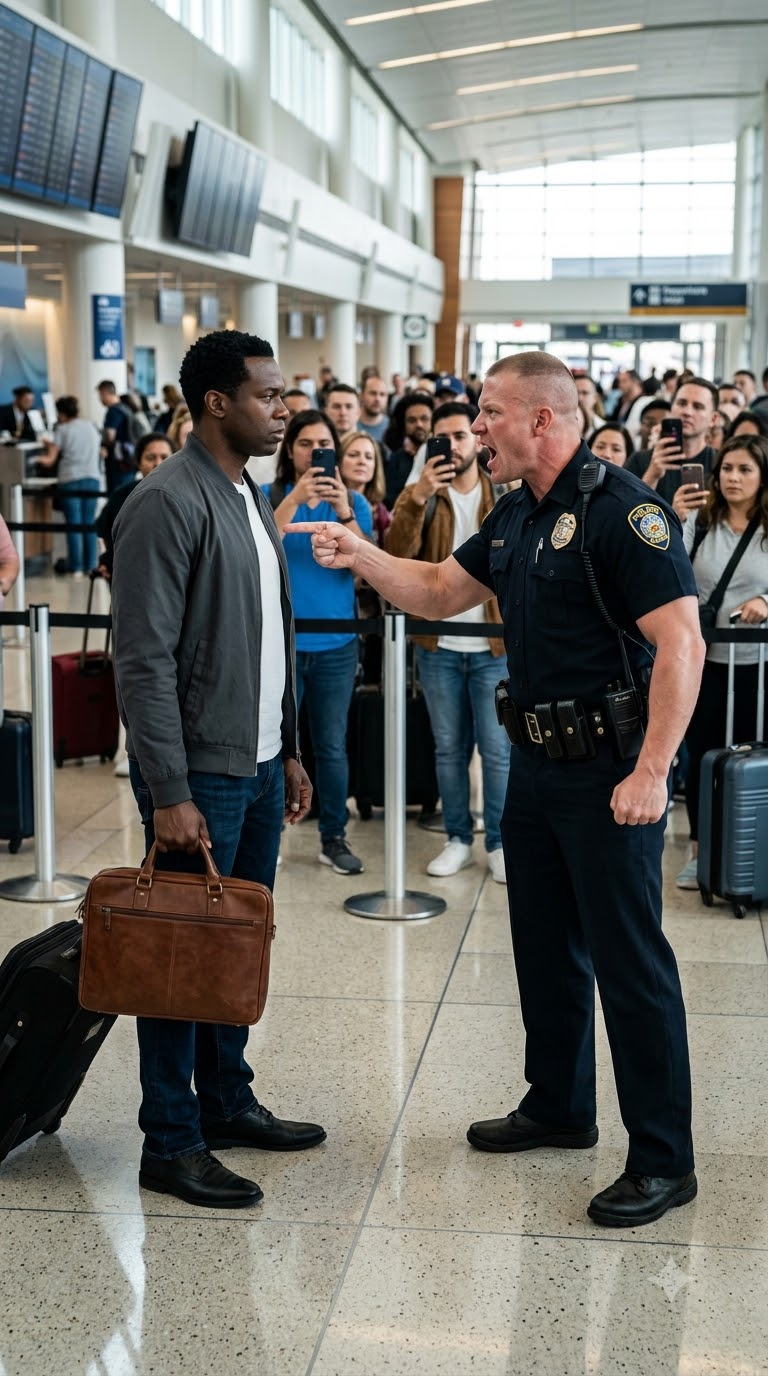
He adjusted his stride slightly. Vale tightened his grip. “Stop pulling.”
“I’m balancing.” Adrian looked straight ahead. “Luis saw it.”
Luis said nothing. Each step made his silence feel heavier. He had started the morning telling himself he was simply following his senior partner’s lead.
That explanation was becoming harder to accept. Adrian noticed.
The institutional corridors were familiar to him. White walls, badge-controlled doors, metal furniture, cameras that made authority seem permanent. As an investigator, he had walked through hundreds of places like this.
Being led through one in handcuffs created a completely different perspective. Authority felt very different when it operated directly on your body.
Adrian remembered another airport from nearly thirty years earlier. He had been a young FBI agent traveling through Atlanta when security stopped him near a restricted vehicle area and questioned whether he belonged there. His credentials ended the encounter almost immediately.
His training supervisor, Daniel Mercer, no relation despite the shared name, later asked him one question. “Did the badge fix what happened?”
Adrian answered that it ended the stop. Daniel nodded.
“That’s not the same thing.” Adrian had carried that sentence with him ever since.
His father understood the difference too. James Mercer once delivered mail to an office building where a property manager forced him to use the service entrance while white carriers were permitted through the front lobby. There was no written policy.
When management changed, the rule quietly vanished. James told Adrian that power often showed itself most clearly through rules people refused to acknowledge were rules. “A badge might make them treat you differently,” he said. “Pay attention to what that tells you about how they were willing to treat you before they saw it.”
Interview Room 3 contained a steel table, two chairs, a ceiling camera, and no windows. Vale attached one of Adrian’s cuffs to a metal ring secured beneath the tabletop. Then he emptied Adrian’s pockets.
Phone. Wallet. Watch.
Wedding ring. Federal credential case.
Vale arranged each item on the table. The federal credential wallet finally opened.
Luis leaned forward without meaning to. The gold FBI badge reflected beneath the fluorescent light. Adrian’s photograph sat beside his name.
ADRIAN JOSEPH MERCER — DEPUTY DIRECTOR, FEDERAL BUREAU OF INVESTIGATION.
Luis whispered, “Connor, verify it.”
Vale stared at the credential. Three seconds passed.
Then he said, “People counterfeit federal credentials.”
Luis looked at him. “Not like that.”
Vale turned sharply. “You suddenly an expert?”
Adrian spoke. “Call Valerie Price.”
Vale walked toward a computer terminal. “You’re not directing my investigation.”
“Verification isn’t direction.” Adrian leaned slightly against the chair.
“What flight reported the stolen luggage?”
Vale ignored him.
“What color was the missing bag?” There was no response.
“What passenger reported it?”
Keys clicked.
“What is the complaint number?” Vale continued typing.
Adrian looked toward Luis. “Every legitimate theft report would answer at least one of those questions.”
Luis swallowed. “There wasn’t a dispatch.”
Vale’s hands stopped. “What?”
“There was no baggage-theft call.” Luis’s voice was quiet but clear.
Vale stared at him. “Stay out of this.”
“I was there.” Luis looked toward Adrian. “He’s right.”
Something had changed. One man had finally spoken the truth everyone already knew. Truth often entered institutions through surprisingly small openings.
Vale went back to the computer. Adrian watched him type. He could not see the screen.
Several minutes went by. Then Adrian asked, “Are you writing the initial report now?”
Vale did not answer. Luis could see part of the monitor from his position.
A sentence appeared. Anonymous female passenger advised officers she observed male removing luggage from multiple carousels. Witness departed before identification obtained.
Luis looked at the timestamp. No anonymous woman had existed. Adrian had been restrained for nearly twenty minutes before Vale typed the sentence.
Luis touched his body camera. He activated it.
The indicator turned red. Vale did not notice immediately.
Adrian did. He said nothing.
Vale continued writing. “Subject became verbally combative when asked for identification.”
Adrian said, “I offered identification before you touched me.”
Vale ignored him. Luis’s camera was now recording the terminal screen from an angle.
The text might not be completely readable later. The timing would be. So would the fact that Vale created the report after the arrest.
Adrian looked toward Luis. Luis’s expression revealed enough.
“You’re building the justification now.” Vale stopped typing.
“Shut up.” Adrian leaned back as far as the table cuff allowed.
“That means the justification did not exist when you detained me.”
Vale stood abruptly. Before he could cross the room, three electronic tones sounded from the corridor. A secure-radio frequency activated.
“All East Terminal units hold current positions.” Another voice followed. “Federal protective detail entering controlled area.”
Vale looked toward Adrian. For the first time, Adrian saw fear instead of annoyance. Footsteps drew closer. Luis glanced at his active body camera.
Vale noticed. “Why is that running?”
Luis looked back. “Because it should’ve been running before.”
Silence stretched between them. Adrian spoke quietly.
“You could’ve made that decision at the carousel.”
Luis lowered his eyes. “I know.”
“What matters now is what you do after knowing.” Luis nodded once.
The magnetic lock disengaged. The door opened.
Executive Assistant Director Valerie Price entered first. She was fifty, composed, and carried the kind of authority that came from knowing exactly how little volume was needed. Two FBI agents followed.
Behind them stood Airport Duty Commander Stephen Mallory, who looked as though the morning had already aged him several years. Valerie assessed the room within seconds.
Adrian cuffed to the table. Federal credentials open.
Encrypted laptop removed from the briefcase. Red marks visible around his wrists.
Vale beside the computer. Luis’s camera running.
“Release Deputy Director Mercer.” Vale responded immediately.
“We have a possible luggage thief using suspected counterfeit federal credentials.”
Valerie looked at him. “Who reported the theft?”
Vale opened his mouth. Nothing came out.
“What is the incident number?” Silence again.
Valerie turned toward Luis. “Were you dispatched to a theft before approaching Mr. Mercer?”
“No, ma’am.”
“Was his luggage tag inspected?” “No.”
“Did he offer proof of identity?” Luis nodded.
“Before physical contact?” Another nod.
“Yes.”
Valerie turned toward Mallory. “Preserve every camera covering Carousel 12, the east service corridor, this room, and every route between them.”
Mallory began to respond. Valerie continued.
“Preserve dispatch beginning at seven-thirty.” Another instruction. “Body-camera audit logs for both officers.”
“Every version of every incident report.” She looked toward the computer. “Every keystroke and login session associated with that terminal.”
Mallory said airport police normally conducted the initial internal review. Valerie looked directly at him.
“Your department will preserve evidence.”
She paused. “It will not control the investigation.”
Vale asked, “Am I being arrested?”
“Not right now.” Valerie’s expression stayed neutral.
“Right now, you stop touching evidence.” One of the federal agents moved toward Adrian.
Luis unlocked the table restraint first. Then he removed Adrian’s second cuff.
Adrian rose slowly. His shoulder hurt. Deep red marks circled both wrists.
Valerie photographed them before anyone cleaned the skin. Then she sealed the encrypted laptop inside an evidence sleeve. Adrian put his wedding ring back on.
He picked up his credentials. Vale stood across the room.
“He refused lawful commands.” Vale’s voice sounded weaker now. “He obstructed an airport security contact.”
Adrian looked at him. “My title brought federal agents through that door.”
Vale stared. Adrian continued.
“That is exactly why this matters.” He slipped the credentials into his jacket.
“If I had been a contractor, teacher, student, or ordinary traveler without institutional power, you would already be finishing the report that turned your suspicion into my guilt.” Nobody answered.
Adrian picked up his briefcase. Valerie handed him the walnut box Grace had given to the federal agents outside.
He opened it. The bracelet was still undamaged. STEADY.
Adrian closed the lid. “My mother would’ve been angry if you lost this.”
For the first time, Valerie almost smiled. Then they walked out.
Carousel 12 was still crowded when Adrian returned to the public area. The baggage belt had stopped. Travelers stood holding phones instead of luggage.
Nobody applauded. Adrian preferred it that way. The silence carried recognition without turning the moment into a spectacle.
Grace waited near the corridor entrance. Adrian approached her. She looked toward the walnut box.
“I kept it when the case hit the floor.” Adrian nodded.
“Thank you.”
“I also kept the video.” Grace lifted her phone slightly. “Original file.”
“Backups?”
“Three.” Adrian smiled faintly.
“You’ve either dealt with lawyers or watched too many crime shows.”
“My sister is a lawyer.” Adrian nodded.
“That explains it.” Then his expression became serious. “Thank you for staying.”
Grace looked down. “I almost left.”
Adrian understood. “Most people do.”
Rebecca approached next and said she wanted to provide a formal statement. Harold followed. Jason continued livestreaming from farther away.
Harold admitted something immediately. “My first thought was that the officers probably knew more than we did.”
Adrian listened. Harold continued.
“I’ve used that thought my whole life.” He looked toward the corridor. “Sometimes maybe they do.”
“But today it almost became an excuse to leave.” Adrian nodded slowly.
“That’s worth remembering.” Harold looked relieved without having earned relief.
Nobody needed absolution yet. They needed records.
The airport clinic documented Adrian’s wrist bruising and shoulder strain. Nothing was broken. He could move both hands normally.
That did not make the use of force harmless. Physical injury and constitutional harm were different measurements.
Before Adrian departed, Meridian Capital Airport Authority released a statement. It said officers had responded to reports of suspicious luggage activity and that the matter was under internal review.
Adrian read the statement once. Then he called Valerie.
“They’re already building cover.” Valerie answered, “I noticed.”
“Independent prosecutor.” Adrian looked toward the terminal windows.
“Already contacting one.” Valerie paused. “You should go home.”
“Start with the dispatch logs.”
“I know how to investigate, Adrian.” He smiled slightly.
“Right.” Another pause. “And camera deactivation history.”
“Go home.” Adrian finally did.
By ten that night, Grace’s attorney released the original four-minute video. No music. No slow motion.
No dramatic commentary. Just what happened.
Vale refused to inspect Adrian’s luggage tag. Adrian announced every movement before reaching toward his jacket. Vale knocked the briefcase away.
Both police body-camera indicators remained dark. Rebecca asked why visible proof was being ignored.
Near the end of Grace’s recording, Vale said something that was absent from his preliminary report. “Men dressed like this carrying cases like that usually mean stolen money or worse.”
The clip spread nationwide overnight. By sunrise, the airport had stopped calling the incident a routine internal misunderstanding. The Justice Department appointed former civil-rights prosecutor Margaret Ellison as independent special counsel.
Margaret was sixty-one, silver-haired, patient, and known for beginning investigations when official narratives seemed unusually clean. She did not begin with Adrian. She began in the body-camera equipment room. A digital examiner connected Vale’s unit to an isolated forensic system. The audit records showed that video had been disabled at 8:10:42 a.m.
Luis’s camera stopped at 8:10:51. Nine seconds apart.
Margaret asked whether accidental deactivation was possible. The technician shook his head.
“One could happen from mishandling.” He enlarged the sequence. “Two units using the same command within nine seconds is intentional.”
Margaret ordered thirty days of camera logs preserved. Then sixty. By the end of the week, investigators were examining six months.
She moved next to dispatch. There had been no luggage-theft complaint at Carousel 12. No call from an airline employee.
No passenger report. Nothing existed before Vale radioed a “possible theft suspect” after contacting Adrian. The alleged crime appeared only after the target had already been chosen.
Margaret then opened the report-history system. The anonymous female witness appeared eighty-six minutes after Adrian was handcuffed.
The sentence had been entered at Vale’s terminal while Commander Mallory’s administrative credentials were active. Margaret stared at the timestamps.
“Save every version.”
The records analyst nodded.
“Not PDFs.” Margaret pointed toward the workstation. “I want revision history.”
“Keystrokes too?” the analyst asked.
“Everything.” She closed the file. “The cameras explain how they planned not to be seen.”
She tapped the report. “This explains how they planned what people would see afterward.”
Neither revealed why Adrian had been selected. That answer came through a civilian analyst named Monica Shah.
Monica was thirty-six and had spent nearly six years working for airport police, creating performance reports for interdiction teams. She arrived at the federal evidence office carrying an encrypted external drive. Margaret asked what it contained.
“There are two databases.” Margaret looked toward Valerie.
“Two?”
“One is what leadership publishes.” Monica connected the drive. “The other is what the unit actually uses.”
The public system contained stops, searches, arrests, seizures, complaints, and case dispositions. It displayed clean numbers arranged for airport leadership meetings. The private system went much further.
It tracked race. Estimated income.
Clothing. Luggage type.
Travel origin. Whether the traveler appeared alone.
Whether they mentioned legal counsel. Whether officers believed they had local connections or enough resources to challenge a seizure. One column was labeled challenge risk.
Margaret asked what that meant. Monica answered carefully.
“How difficult the traveler was expected to be after an encounter.”
Low-risk targets were alone, from out of state, dependent on flights, unlikely to know local lawyers, or assumed to have limited money. High-risk targets included public officials, attorneys, affluent executives, union members, journalists, and anyone whose family appeared likely to pursue complaints.
“What role did race play?” Valerie asked. Monica shook her head.
“No document says target Black travelers.” She opened a graph. “The outcomes do.”
Black passengers made up far fewer travelers than interdiction contacts. They were stopped and searched disproportionately. Contraband was found less often than among white travelers.
The unit still appeared productive because searches themselves counted as activity. Seizures counted even when property was eventually returned. Nobody had measured how much genuine public-safety benefit came from these encounters.
Monica had finished the racial comparison four months earlier. She sent it to Airport Police Chief Derrick Lawson. He ordered the comparison removed before the presentation reached the airport board.
Monica refused. The slide disappeared anyway.
Her access permissions were reduced two weeks later. Her performance review criticized her for limited alignment with operational priorities. Monica kept copies.
“Why didn’t you come forward earlier?” Margaret asked.
Monica looked ashamed. “I told myself keeping the files meant I was protecting the truth.”
She swallowed. “Then I watched Carousel 12.”
Monica opened Adrian’s hidden profile. His terminal photograph appeared.
Beneath it was Vale’s entry from thirteen minutes before contact. Solo Black male. Premium luggage. No visible escort. Executive look unlikely. Low challenge expected. Good seizure chance.
The room fell silent. Margaret read it twice.
“He wasn’t investigating behavior.”
Monica shook her head. “He was picking inventory.”
The phrase changed the case. Investigators were no longer examining a single officer making a biased mistake. They were uncovering an organized method.
“How many contacts are in this system?” Margaret asked. Monica answered, “At least one hundred forty-three that I can verify over twenty months.”
Margaret closed Adrian’s file. “Start with names.”
Monica looked up. “Not statistics?”
“We’ll use statistics later.” Margaret nodded toward the drive. “I want to know what happened to people.”
Halfway through the forensic imaging, the workstation flashed an alert. Someone had initiated a remote deletion of the private database.
The examiner said the transfer could be frozen temporarily. Margaret immediately called Commander Mallory.
“Lock the data center.” Mallory began explaining that airport counsel had not approved federal control of internal servers.
“This is not federal control.” Margaret’s voice remained calm. “It is preservation under active investigation.”
Mallory said he needed the chief’s authorization. Margaret answered, “Then I will put your refusal and its timestamp into the obstruction affidavit I file this morning.”
The server room locked less than a minute later. Investigators traced the deletion request to Chief Lawson’s administrative account.
Two-factor authorization had been approved from Lawson’s personal phone. A systems manager then arrived carrying an emergency maintenance order signed by the chief.
Beneath Lawson’s signature was a handwritten instruction: Archive creates unnecessary exposure. Purge legacy operational notes before external duplication.
Margaret stared at it. Bad policy could be debated.
Poor supervision could be defended. A written order to erase records after preservation demands could not be dismissed as a misunderstanding.
The attempted deletion failed because Meridian’s infrastructure automatically mirrored the database to an off-site disaster-recovery server. Chief Lawson apparently did not know that. Investigators recovered everything.
The failed destruction attempt became evidence itself. Then one hidden entry led investigators to Richmond.
His name was Terrence Brooks, thirty-six years old, owner of a small electrical contracting company with twelve employees. Three years earlier, Terrence had landed at Meridian after meeting leaders from a Baltimore church renovating a community center.
He carried $9,200 in cash. The church had paid an emergency materials deposit because demolition work was scheduled to begin Monday and a wire transfer could not clear in time.
Terrence had a signed contract. He had receipts.
He had invoices. He had the church treasurer’s phone number and a written explanation of the payment.
Vale stopped him near ground transportation. The body camera began recording eleven minutes after the initial contact.
Those eleven missing minutes existed only in the hidden database. Vale later claimed a drug-detection dog had alerted to Terrence’s bag.
There was no canine handler. No dog assignment.
No alert record. No narcotics were found.
Terrence was never charged with a crime. Airport police seized the entire $9,200 through civil asset forfeiture.
The justification described the cash as currency of uncertain origin consistent with illicit transport patterns. It named no underlying crime. Terrence spent nearly eleven months fighting to recover his money.
Attorney fees consumed more than three thousand dollars. He borrowed payroll money from his brother twice. The church postponed its original project because Terrence could not purchase the materials.
His company survived, but only barely. Terrence filed a complaint against Meridian Airport Police. It was closed as a disagreement over forfeiture procedures.
Nobody interviewed the church treasurer. Nobody examined the missing dog record. Nobody reviewed the camera gap.
The public database showed one line: Administrative property dispute; no verified misconduct.
The hidden notes told a different story. Small contractor. Cash business. Out-of-state counsel unlikely. Recovery expensive. Low challenge.
When federal investigators showed Terrence the entry, he remained silent for almost a minute. “They knew what I did for work?”
“Yes.” The investigator nodded.
“They knew where the money came from?”
“Yes.”
Terrence leaned back. “Then they knew taking it could shut me down.”
He opened a filing cabinet. “Good.”
The investigator looked confused. Terrence pulled out a thick folder.
“I kept everything.”
Contracts. Receipts.
Legal bills. Complaint letters.Email threads. Bank statements.
Then Terrence played a voicemail. Vale’s voice filled the room.
“If your money is legitimate, prove it through the process.” Terrence stopped the recording.
“That sentence ate at me for three years.” He looked toward the investigator.
“They took my money, and innocence became something I had to buy back.” The investigator showed him the low-challenge note.
Terrence read it slowly. “Everybody told me maybe he made a mistake.”
His expression hardened. “A mistake is grabbing the wrong suitcase.”
He tapped the paper. “This was budgeting.”
Federal investigators reopened every asset-forfeiture case tied to Vale’s unit. Over several years, forty-two travelers had money seized without criminal charges.
Many lived outside Maryland. Several gave up their attempts to recover the money because legal fees cost more than what had been taken. That was not an accidental outcome.
The hidden database had specifically measured that likelihood. The financial incentive was impossible to dismiss.
Luis Ortega requested another federal interview. This time, he arrived without his police-union attorney. He had hired private counsel, who told him cooperation might reduce his sentence but would not erase his participation.
Margaret asked why he had finally chosen to speak. Luis stared at the table.
“My daughter saw Grace Nolan’s video.” Margaret waited.
“She’s twenty-two.” He rubbed both hands together. “She asked why I stood there.”
“What did you tell her?”
“That there was context.”
Margaret remained silent. Luis looked up.
“She asked what context turns a lie into truth.”
“Did you have an answer?” Margaret asked.
“No.”
Luis explained the body cameras. Officers sometimes turned them off before supposedly consensual contacts because recorded consent often sounded much less voluntary once outsiders watched.
Two officers would position themselves around a traveler. One asked questions. The other stood behind them, creating pressure without saying much.
Travelers agreed to searches because refusing felt unsafe. If nothing illegal was discovered, the encounter still counted toward productivity. If cash appeared, forfeiture became possible.
Then the traveler faced the expense of getting the property back. Margaret asked whether supervisors explicitly directed officers to target Black passengers.
“No.” Luis shook his head.
“What terms did they use?”
Luis thought. “Outside expected profile.”
Another. “Premium property, limited visible means.”
Another. “Unanchored passenger.”
He looked toward Margaret. “Everybody understood once you saw the pictures.”
Luis admitted disabling his camera dozens of times. He admitted signing reports he knew were incomplete. He admitted watching Vale use unnecessary force without stepping in.
Then Margaret asked about the private phone chat. Luis described another phone Vale kept hidden at home.
The group chat was called Easy Numbers. Four airport officers shared passenger photographs, seizures, cash, comments about expected legal resistance, and jokes about how long people would keep fighting for their property.
Some messages used coded language. Combined with the photographs, their meaning was unmistakable. Margaret asked where the phone was kept.
“Garage.” Luis swallowed. “Storage bin under old uniforms.”
Federal agents obtained a warrant the following morning. Every agent’s body camera remained active during the search. They presented Vale with the warrant.
They allowed him to contact counsel. The entire search was documented from beginning to end.
The phone was exactly where Luis had said. The Easy Numbers chat contained Adrian’s terminal photograph.
Solo premium. Leather case. Low challenge. Good numbers before shift change.
Another photograph showed Terrence Brooks’s $9,200 spread across a patrol-car hood. The caption read, Nine grand from an electrician who can’t afford the fight.
Then investigators discovered messages from Chief Lawson. One read, No clean camera, no clean complaint. Close the file.
That sentence showed how far up the chain the conduct went. Vale had not acted alone. Luis’s silence was not an isolated failure.
Camera manipulation was known. Complaint management was coordinated. Productivity incentives rewarded the behavior.
Margaret placed the second phone on the evidence table. “Now we have selection, method, victims, reporting, and supervision.”
Valerie nodded. “And the attempt to destroy it.”
Margaret looked toward Adrian’s file. “Everybody keeps saying his title made the case extraordinary.”
She closed it. “His title only made disappearing him impossible.”
A federal grand jury returned indictments six weeks after the Carousel 12 incident. Connor Vale faced charges for willful deprivation of civil rights, conspiracy, obstruction, falsification of records, and evidence-related offenses.
Chief Derrick Lawson faced conspiracy and obstruction counts. Commander Stephen Mallory was charged in connection with report manipulation and attempted destruction of evidence. Luis faced false-statement and civil-rights charges, with cooperation reserved for sentencing.
Vale was arrested at 6:10 the following morning. Federal agents wore working cameras.
They showed him the warrant. They explained the charges.
They let him contact an attorney. His handcuffs were properly fitted.
Nobody invented resistance. Nobody created an anonymous witness. He received the process he had repeatedly denied others.
Trial began seven months later. Adrian entered federal court with Dana beside him. His mother stayed home.
Evelyn told him she had spent enough years watching her son walk into dangerous government buildings. The silver bracelet remained around her wrist. Steady faced outward.
Margaret’s opening statement avoided drama. “Police officers can make mistakes.”
She looked toward the jury. “This case is not about a mistake.”
She listed choices instead. Turning off cameras before a contact.
Selecting a traveler before observing wrongdoing. Rejecting every available verification. Creating evidence afterward.
“None of those decisions were made in one frightened second.” The defense argued that airport policing required rapid security judgments and that sophisticated criminals could carry convincing credentials.
Both things were true. Airports faced threats. Federal credentials could theoretically be forged.
Neither point explained the camera logs. Neither explained the hidden profile.
Neither explained the private chat. Neither explained why no theft report existed. Neither explained why the report changed after the arrest.
Grace testified first among the civilian witnesses. Margaret played her video once at normal speed. No freeze frames.
No music. No repeated dramatic angles.
The jury watched Vale ignore the baggage tag. They heard Adrian announce his movements. They watched the briefcase strike the floor.
They saw both body cameras dark. Margaret asked why Grace continued recording after Vale told people to step away.
“Because I realized what happened might only survive if someone refused to leave.” Rebecca Sloan testified about the visible luggage tag.
Harold Finch admitted that he initially believed the police probably knew information he did not. “That assumption almost became permission for me to walk away.”
He looked toward the jury. “Eventually the facts were too simple to ignore.”
Monica Shah explained the two databases. She showed the jurors the public reports.
Then she showed them the hidden columns. Race.
Clothing. Luggage.
Estimated means. Legal access.
Challenge risk. She displayed Adrian’s pre-contact profile.
The photograph appeared before Vale ever spoke to him. Beneath it were the words Low challenge expected.
Margaret asked Monica what misconduct Adrian had committed when the profile was created. “None.”
“What suspicious behavior?”
“None.” Monica’s answer remained quiet.
“He had just walked toward baggage claim.”
Then Terrence Brooks testified. He brought the church contract, receipts, bank documents, legal bills, and original complaint.
He played Vale’s voicemail. If your money is legitimate, prove it through the process.
Margaret asked what Terrence believed Vale thought at the time. Terrence looked toward the jury.
“He didn’t think I was dangerous.” “What did he think?” Terrence paused.
“He thought I was affordable.”
The courtroom fell silent. Even Adrian lowered his gaze. That single sentence captured the system more clearly than most legal arguments ever could.
Luis testified next. He admitted that he had lied.
He admitted turning off his camera. He admitted signing false records.
He admitted watching Vale escalate encounters while remaining silent. Defense counsel asked why anyone should trust him after years of dishonesty.
Luis replied, “Don’t believe me because I finally decided to talk.”
He motioned toward the evidence screens. “Believe the records we made when we thought nobody else would ever see them.”
Adrian testified near the end of the government’s case. He had spent much of his career inside federal courtrooms.
Never before had he been there as the person in handcuffs. Margaret began by asking what he felt when Vale ignored the baggage tag.
“I recognized the experience before I named it.”
“What experience?”
“Being treated as a category before being treated as a person.”
Margaret asked when he first became afraid. Adrian considered the question carefully.
“When every easy way to resolve legitimate uncertainty became something Officer Vale refused to use.” He turned toward the jury. “Once facts stop protecting you, what remains is the armed person who has already decided what your actions mean.”
During cross-examination, defense counsel froze Grace’s video at the moment Adrian began reaching toward his jacket. “Could that movement have looked sudden?”
Adrian answered, “Play the audio.”
The courtroom heard his voice. My identification is inside my left jacket pocket. I’m going to reach for it slowly.
Adrian looked toward defense counsel. “I described the movement before making it.”
The lawyer shifted tactics. “Would this investigation have moved this quickly if you weren’t Deputy Director of the FBI?”
Adrian answered immediately. “No.”
The defense attorney paused, perhaps expecting resistance. Adrian continued.
“My title brought federal agents through the door faster.” He looked toward the jury.
“That is part of the problem.” Then he counted the evidence.
“My title did not switch off Officer Vale’s camera.”
Another point. “It did not invent a luggage complaint.”
Another. “It did not build the hidden database.”
Another. “It did not create Easy Numbers.”
He looked toward Vale. “All that existed before anyone confirmed who I was.”
The defense had little meaningful ground left. The jury deliberated for almost eleven hours across two days.
Adrian waited in a conference room with Dana, Terrence, Monica, and several members of the prosecution team. Nobody discussed the evidence. Instead, Terrence talked about the church renovation.
His company had eventually completed a later phase after recovering financially. He described the lighting system and new auditorium panel as though every detail mattered enormously. Adrian understood why.
Life needed subjects larger than injustice. Then a television on mute displayed Adrian’s photograph beneath a headline calling him the man whose arrest uncovered airport corruption.
Terrence looked at it. “That isn’t really right.”
Adrian nodded. “No.”
“You had complained three years earlier.” He looked toward Monica. “She had the data before me.”
Terrence folded his arms. “So what did your case do?”
Adrian thought. “It made ignoring everybody else more expensive.”
The courtroom clerk entered. The jury had reached a verdict.
Vale was found guilty on the major civil-rights, obstruction, conspiracy, and falsification counts. With each verdict, his shoulders lowered slightly. Adrian felt relief.
Not triumph. Dana squeezed his hand.
Across the room, Vale’s sister began to cry. Adrian noticed. Consequences rarely stayed neatly contained around one person.
That did not lessen responsibility. It simply reminded him that justice and revenge were not the same emotional experience.
Vale eventually received a substantial federal prison sentence and a permanent ban from law-enforcement work. At sentencing, he spoke about stress, airport threats, difficult decisions, and the pressure of interdiction assignments.
He never directly acknowledged choosing Adrian from a camera feed. He did not acknowledge creating the false witness after the arrest. The judge noticed.
“Encounters do not manufacture themselves.” Her voice remained firm.
“You prepared not to be recorded.” She looked toward Vale.
“You selected targets based partly on expected vulnerability.” Another pause. “You fabricated support after the detention.”
“You trusted your uniform to make the official story stronger than the person challenging it.” She closed the file.
“Regret for losing your career is not the same as remorse for how you used it.”
Chief Lawson pleaded guilty to obstruction and conspiracy. Commander Mallory was convicted on evidence-related charges. Luis received a reduced sentence because of his cooperation but permanently lost his police certification.
Federal and state authorities reopened every questionable forfeiture connected to the unit. Terrence received formal confirmation that his money had never been tied to criminal activity.
His legal expenses were reimbursed with interest. Forty-two other travelers recovered seized funds or received compensation.
The final public report did something Adrian had insisted upon. It identified people by name instead of reducing them to percentages.
Each entry listed the amount seized. The number of days the property remained held.
Whether criminal charges existed. Why the original justification eventually failed. Some names belonged to people whose cases had been forgotten for years.
Adrian spent an entire evening reading them. Dana asked why.
“Because hiding people inside totals is part of how this survived.”
Meridian Capital changed its body-camera system. Video now activated automatically whenever interdiction officers left assigned posts to initiate traveler contacts. Manual deactivation immediately alerted an independent civilian review office.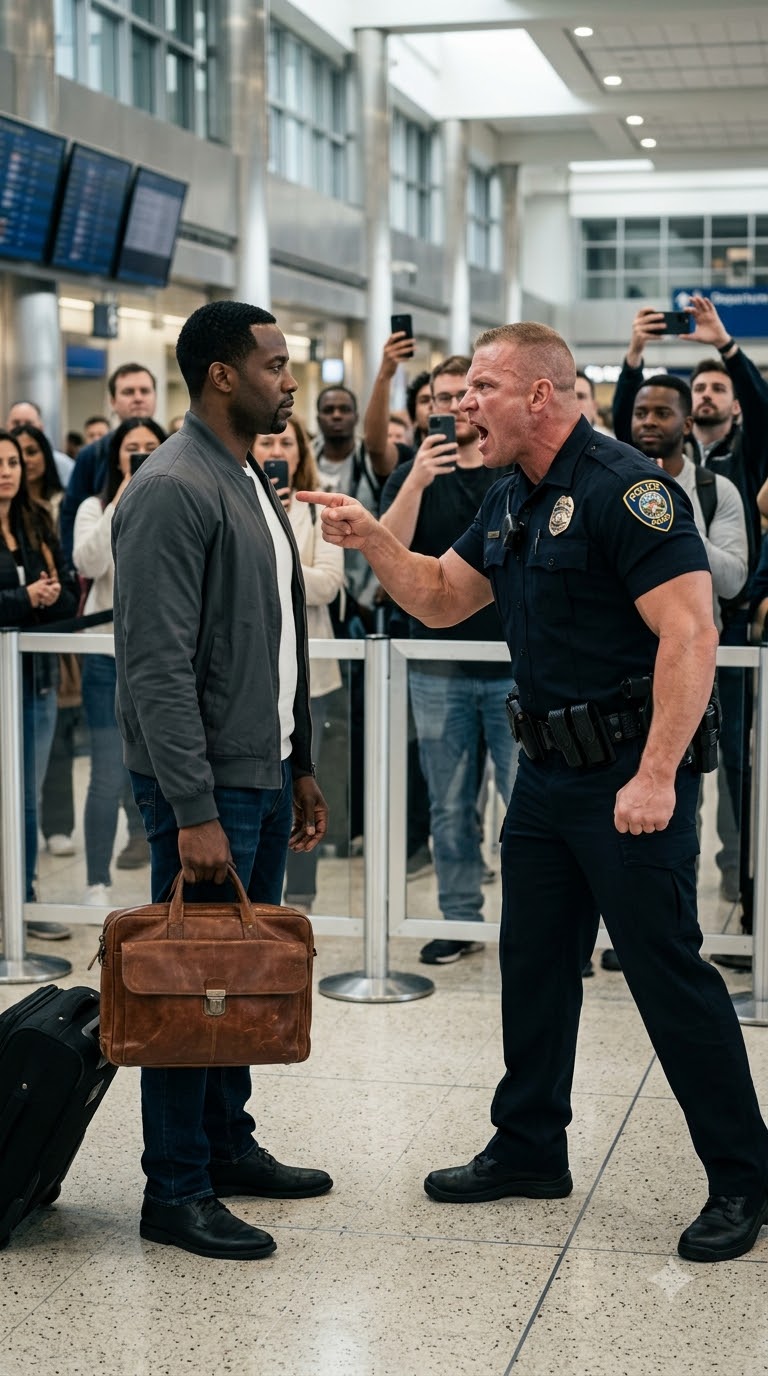
Airport officers could no longer classify searches as voluntary unless recordings captured clear notice that travelers could refuse. Camera audit logs were permanently stored outside the police department.
Civil-forfeiture revenue could no longer flow directly back into airport police budgets. That removed a major incentive. Complaint files went to civilian oversight before command review.
Monica Shah became chief analyst for the new oversight office. Her first public report placed one sentence above every table: Activity is not performance when the conduct producing it is unlawful.
Some officers hated the reforms. They argued that paperwork was replacing intuition. Adrian heard that argument repeatedly.
“Instinct has value.” He said during one oversight hearing. “But instinct without evidence is preference carrying a badge.”
Union representatives argued that automatic cameras proved leadership did not trust officers. Adrian answered that reliable video protected good officers as much as civilians. Others claimed independent oversight weakened command.
“Hidden misconduct weakens command more.” He said. The reforms were slow, technical, and boring.
Adrian trusted that more than press conferences. Outrage disappeared quickly. Procedure had a chance to remain.
Grace Nolan returned to Meridian months later during a flight connection. She bought coffee near Carousel 12. The baggage level looked completely ordinary.
Travelers complained about delays. Children climbed onto luggage. Nobody recognized her.
She preferred it that way. Harold eventually volunteered with a civil-rights observation group.
Rebecca began teaching school administrators how to preserve evidence and document official encounters without escalating them. Jason never became an activist or journalist.
He simply kept the original livestream file in two places. Adrian appreciated that too. Not everyone had to turn one decision into an identity.
Evelyn finally received her birthday bracelet one day late. Adrian drove to Annapolis the morning after the verdict instead of going home first. She sat at the kitchen table wearing a blue cardigan while sunlight moved through thin curtains.
The silver bracelet rested around her wrist. Steady faced upward. Adrian sat across from her.
Evelyn looked toward his wrists even though the bruises had disappeared months earlier. Mothers often remember where injuries were after bodies stop showing them. “Do you remember why you joined the Bureau?”
Adrian smiled faintly. “You’ve asked that question before.”
“I’m not television.” She lifted one eyebrow. “Answer your mother.”
Adrian looked toward the bracelet. “When I was younger, I thought carrying a federal badge might mean people like Dad had to prove themselves one fewer time.”
Evelyn nodded. “Did it?”
“Sometimes.” Adrian paused.
“Not enough.” Evelyn placed her hand over his.
“Then stop asking the badge to finish a job it can only begin.” Adrian looked toward her.
“The badge opened one door faster.” She smiled. “You still had to walk through it.”
Outside, a delivery van stopped across the street. Someone walked a dog. Morning traffic moved toward downtown.
The world looked completely ordinary. Evelyn brought out the birthday cake they had missed eating together. The frosting had become slightly dry around the edges. Adrian ate two pieces. Being one day late was still a birthday.
He remembered his father telling him that credentials only revealed who changed their behavior after recognizing power. He remembered Daniel Mercer asking whether the badge actually fixed the problem or merely ended the encounter. He remembered Terrence refusing to apologize for caring that Adrian’s influence had finally made ignored complaints costly.
They had all been saying the same thing. Power mattered. But justice could not be judged by how quickly a system corrected itself once it discovered the victim was powerful.
The real test was still the stranger at Carousel 12 with no title, no Washington office, no federal protection, and no attorney able to file an emergency preservation motion before lunch. Adrian spent the final years of his Bureau career working on that problem.
He supported independent audits of federal-local airport teams. Data systems were redesigned to distinguish observable behavior from officer assumptions.
Leadership reviews no longer started with seizure totals. They examined how many searches produced actual evidence and what happened to property after it was seized. Complaints no longer vanished simply because each one was inconvenient on its own.
Some officers said the new system made them hesitant. Adrian considered the criticism. “Hesitation before using government power is not always weakness.”
He told supervisors something else. “Confidence is useful after facts.”
“Before facts, it becomes imagination.” That sentence eventually became part of leadership training.
Years later, Adrian addressed a class of new FBI supervisors. He displayed one still image from Grace’s video. Not the handcuffs.
Not Vale’s face. Not the federal badge.
The image showed the burgundy luggage tag. A.J.M.
“What was the first failure?” Adrian asked. One supervisor said profiling. Another said camera deactivation.
A third said unlawful detention. Adrian shook his head.
“The first failure was refusing information.” He pointed toward the tag.
“Everything necessary to begin correcting the encounter was already visible.” The next slide showed his airline receipt.
Another displayed his credentials. Another showed the empty dispatch record. Adrian looked across the room.
“At every stage, facts gave Officer Vale an exit.” He paused.
“He treated each exit like a threat to his authority.” One student said that sounded like confirmation bias.
“Yes.” Adrian nodded.
“Confirmation bias plus government power.” Another pause. “That combination is dangerous because power can force reality to behave like the theory long enough for someone else to pay.”
The room fell quiet. Adrian gave them the lesson he cared about most.
“Never become more loyal to your first explanation than to the next fact.” The sentence later became part of Bureau training materials.
Adrian requested that his name be removed. The principle mattered more than the biography. He had learned to distrust reforms built around heroic individuals.
Terrence Brooks’s company eventually expanded to twenty-five employees. He opened a second location outside Richmond. Years later, the same church hired him for another expansion.
He kept the old forfeiture file inside a locked cabinet. Not because he expected another trial. Because documents had once preserved his reality when official language tried to replace it.
Monica continued publishing airport disparity reports. Some years improved. Others did not.
She never again allowed anyone to remove comparison columns simply because leadership found them uncomfortable. “Discomfort is information too.” She told the board.
Luis almost completely disappeared from public life after serving his sentence. He never returned to law enforcement. Years later, Adrian received a one-paragraph letter.
I knew the luggage was probably yours before the cuffs. I knew the theft report did not exist. I chose loyalty to Connor over duty to the truth, and everything afterward grew from the moment I decided silence was safer. I am sorry.
Adrian read the letter once. Then he placed it inside a file.
He did not respond. Luis’s apology belonged to Luis.
Adrian’s recovery did not require him to supervise someone else’s remorse. That realization brought him more peace than any reply could have.
Vale appealed his conviction. The verdict remained. His attorneys continued arguing that the federal government had transformed a routine airport encounter into a national scandal simply because Adrian Mercer held a powerful office.
The courts rejected the argument. The hidden database existed before Adrian arrived.
The camera logs came first. Terrence’s seizure had happened years earlier. Easy Numbers existed before anyone knew Adrian’s name.
The system was already functioning. Adrian simply became the person it could not quietly absorb.
He disliked hearing commentators say Vale had picked the wrong Black man. The phrase sounded satisfying. It was also wrong.
Vale did not choose the wrong traveler. He made the wrong decision about a traveler. That distinction mattered deeply to Adrian.
If he had been unemployed, the baggage tag still deserved checking. If he had been a mechanic, the airline receipt still mattered.
If he had been a graduate student, a fabricated witness would still be a fabricated witness. If nobody had filmed the encounter, intentionally disabling cameras would still be wrong.
Justice could not depend on victims having impressive biographies. Eventually, Adrian retired after thirty-eight years with the Bureau. His colleagues organized a reception in Washington.
Valerie Price spoke. Dana spoke. Monica attended.
Grace sent a video because she was working overseas. Terrence stood near the back. Evelyn, now ninety-one, sat in the front row wearing the silver bracelet.
Adrian disliked speeches. His mother loved every second. When he finally reached the microphone, he promised to keep his remarks short.
Nobody believed him. He surprised them by keeping that promise.
“Most important cases do not survive because one powerful person saves them.” Adrian looked toward Monica.
“They survive because somebody keeps the original file.” Then toward Terrence.
“Because somebody keeps every receipt.” He glanced toward Valerie.
“Because someone insists on an independent chain of custody.” Then toward the screen showing Grace.
“Because somebody keeps recording after being told to leave.” Adrian paused.
“Truth is rarely fragile.” The room listened.
“Access to truth is fragile.” That was the lesson he carried with him out of government service.
Years after retirement, Adrian passed through Meridian Capital again. No official trip. No federal transport.
He was flying to visit his daughter in California. Nobody met him at the gate.
He reached Carousel 12 shortly after noon. The baggage area looked smaller than he remembered.
A redesigned coffee stand occupied part of the space where Grace had once stood filming. New information screens hung overhead. Airport police body cameras activated automatically whenever officers entered passenger-contact zones.
Adrian noticed. Of course he noticed. His suitcase eventually appeared.
Different case. Same burgundy tag. The initials had faded slightly.
He lifted it from the belt and checked the airline receipt. Habit was still habit. Then he heard a conversation near the exit.
A young airport officer stood beside another traveler who looked irritated. The officer pointed toward a suitcase.
“Can I see the baggage tag?” The traveler held it out.
The officer compared it with the digital receipt on the traveler’s phone. He returned everything.
“Matches.” The traveler said something Adrian could not hear.
The officer nodded. “You’re good.”
That was it. No search.
No command to turn around. No hands on the traveler. No secondary room.
Nobody nearby found the interaction interesting enough to record. Adrian smiled.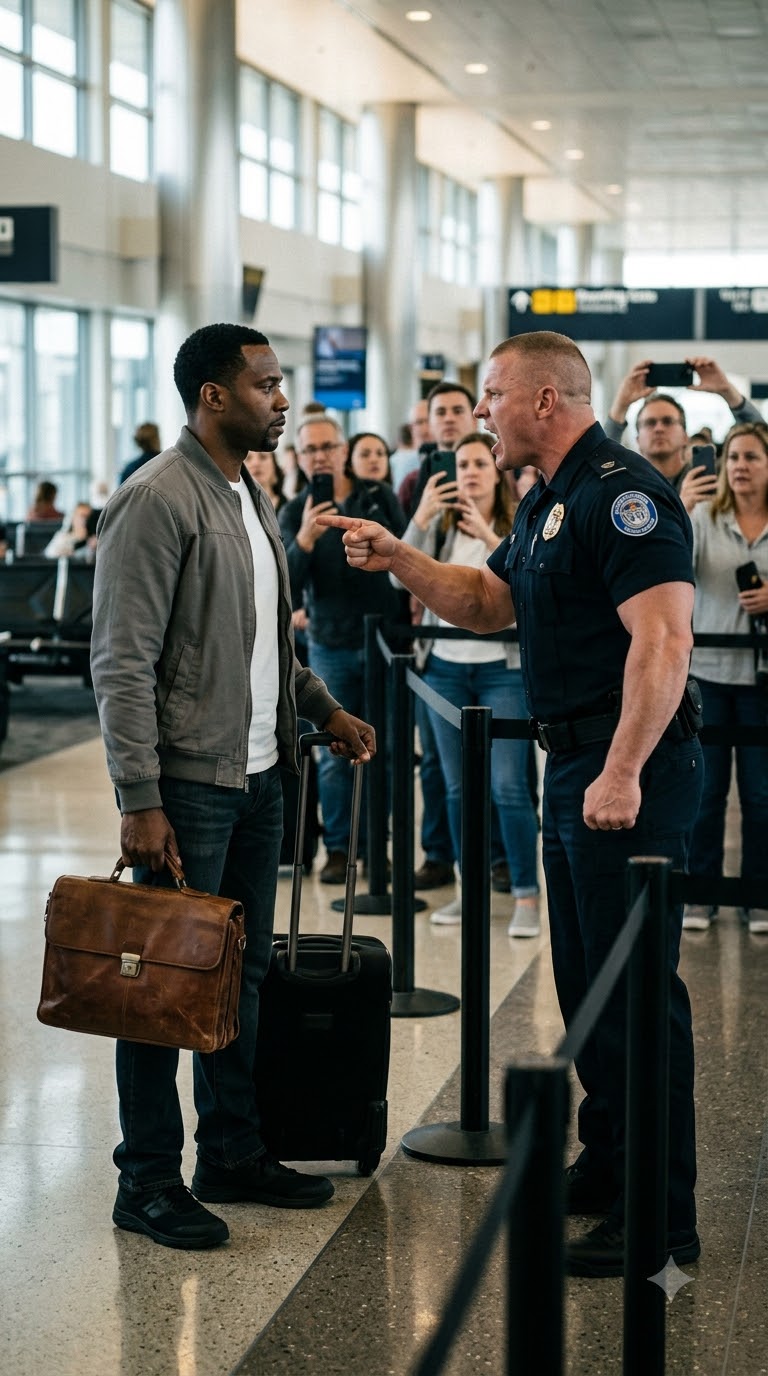
That was the point. Professionalism had made drama unnecessary. One officer had checked a fact before becoming loyal to suspicion.
Adrian rolled his suitcase toward the exit. A woman accidentally bumped his shoulder. “Sorry.”
“No problem.” They continued moving.
Outside, horns sounded in the pickup lanes. Parents hugged college students. Drivers held handwritten names against windshields.
A taxi dispatcher shouted numbers. Ordinary airport noise surrounded him. Adrian stopped for a moment beneath the terminal overhang.
He thought about Connor Vale. Luis Ortega.
Grace. Rebecca. Harold.
Jason. Monica. Terrence.
Valerie. His father. Evelyn.
So many people had carried different pieces of what eventually became the truth. Nobody carried all of it alone.
That was why the truth survived. Adrian’s daughter waved from a dark blue SUV near the curb.
He rolled the suitcase toward her. No badge visible.
No security detail. No special lane.
Just a retired man leaving an airport with his own luggage. Nobody stopped him.
Nobody asked why his suitcase looked expensive. Nobody needed to discover who he had once been.
And after everything Meridian Capital had been forced to learn, Adrian Mercer thought that ordinary ending was finally enough.
