

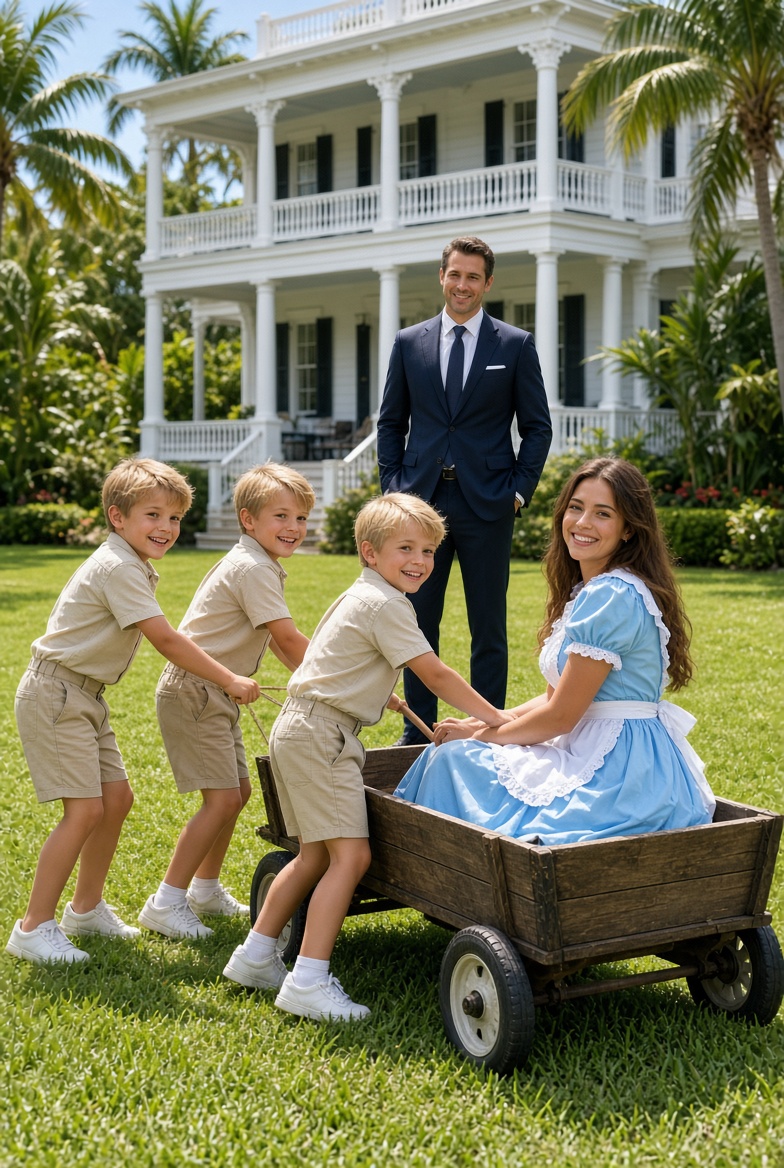
Daniel Whitaker believed he had already paid for every possible solution.
The best pediatric neurologists in Miami. Child psychologists whose waiting lists stretched into the following year. Therapy programs flown in from Boston, Chicago, and a clinic outside London that sent its director first-class and billed by the hour as if insight could be itemized like freight. Each specialist arrived with detailed reports, color-coded charts, and promises written in the confident language of people who had never had to live inside the silence they were paid to explain.
His six-year-old triplet sons—Ethan, Caleb, and Liam—had access to resources most families would never see in a lifetime. They had a sensory room with padded floors and programmable lights. They had occupational therapists who arrived with bins of textured toys. They had speech goals, social goals, attachment goals, and a wall in the west wing of the oceanfront estate in Naples, Florida, where those goals were printed, dated, and reviewed every Sunday evening as if the boys were a quarterly report that had not yet turned around.
None of it changed the look in their eyes.
They were quiet. Distant. Perfectly polite. They said please and thank you with a precision that made guests uneasy. They followed instructions as if deviation were a kind of danger. They almost never laughed, and when they did, the sound was thin and practiced, like a line they had been asked to rehearse until it resembled joy.
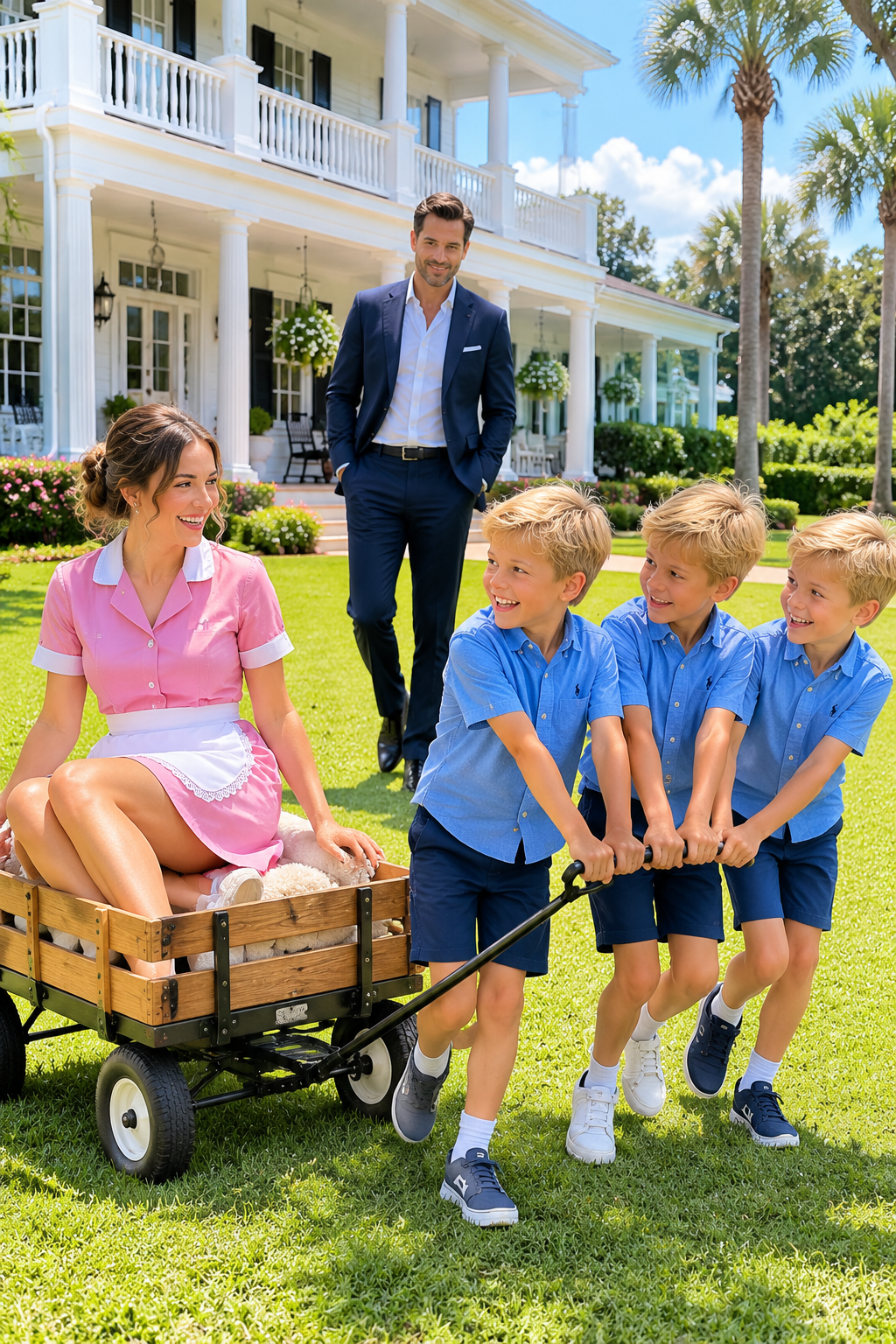
Doctors called it social-emotional delay.
Therapists mentioned attachment difficulties and used phrases Daniel wrote down because writing things down had always made problems feel governable.
He treated the boys the way he treated a struggling division of his company. He built spreadsheets. He tracked minutes of eye contact, instances of spontaneous speech, nights without a bedtime protest. He hired a night nurse he did not need and a weekend enrichment specialist whose smile never reached her eyes. He scheduled connection the way he scheduled capital calls.
Without meaning to, he had outsourced love.
The house remained painfully quiet. The Gulf moved beyond the windows. The staff moved through the halls on soft shoes. The triplets moved from breakfast to therapy to supervised play as if the day were a corridor with no doors.
One afternoon Daniel returned home after a long board meeting. His head throbbed from projections and the particular exhaustion of men who had spent hours sounding certain. All he wanted was a shower and a few minutes in which nobody required a decision.
He walked up the stone path toward the house and stopped.
A sound he had not heard in years was coming from the lawn.
Laughter.
Not the polite giggle the boys produced when a therapist held up a puppet. Not the careful smile they offered photographers at charity dinners. This was loud, wild, unfiltered—the kind of laughter that had edges and breath and no interest in being appropriate.
Daniel slowed.
Beneath a wide oak tree he had once considered removing for landscaping symmetry, a strange scene was unfolding.
Rosa, the housekeeper who usually moved through the estate like weather—present, necessary, nearly invisible—sat inside an old wooden cart the previous homeowner had left behind the garden shed. The cart was scarred and unlovely. One wheel complained. Rosa held a plain manila folder against her chest as if it contained a kingdom’s treasure.
In front of her, Ethan, Caleb, and Liam pushed.
They were talking over each other. Arguing. Alive in a way that made Daniel’s throat close.
“Slow down! The king’s papers will fall!”
“No, I’m protecting them!”
“I should steer. I’m the strongest!”
Daniel froze at the edge of the grass.
He could not remember the last time his sons had spoken without being invited to speak. He could not remember the last time their voices had tumbled into one another like that, messy and overlapping, as if language were a game instead of a test.
How had the quiet woman who folded his shirts and wiped down the guest bathrooms done in an afternoon what months of professional intervention had failed to do?
The doctors’ sentences returned to him with a new and ugly clarity.
Difficulty forming emotional bonds.
Since hearing that sentence, Daniel had replaced affection with structure. He had measured progress instead of inhabiting it. He had become a project manager in his own family, and the project had learned to perform for him.
He had once flown in a neurodevelopment specialist who promised breakthrough results and left behind a binder the thickness of a novel. He had stood in the sensory room after the man departed and stared at the lights as if they might confess what they were missing.
Every invoice had brought hope.
Every evening had ended in the same careful hush.
The sound of Daniel’s dress shoes on the stone walkway broke the spell.
The laughter stopped as if a switch had been thrown.
The boys froze. Their smiles vanished. They stepped back from the cart with the small, practiced alertness of employees caught idle when the owner entered the room.
Rosa climbed out quickly, smoothing her apron.
“I’m sorry, Mr. Whitaker,” she said. “I didn’t mean to disturb anything. We were only—”
Something tightened in Daniel’s chest, sharp and late.
“Can I help?” he asked, and the question sounded strange in his own mouth. “Maybe… push the cart?”
The boys did not answer him.
They looked at Rosa.
That look told Daniel more than any report on the west-wing wall. Authority in this game did not belong to the man who paid for the lawn. It belonged to the woman who had been willing to sit in a broken cart and become, for twenty minutes, someone worth protecting.
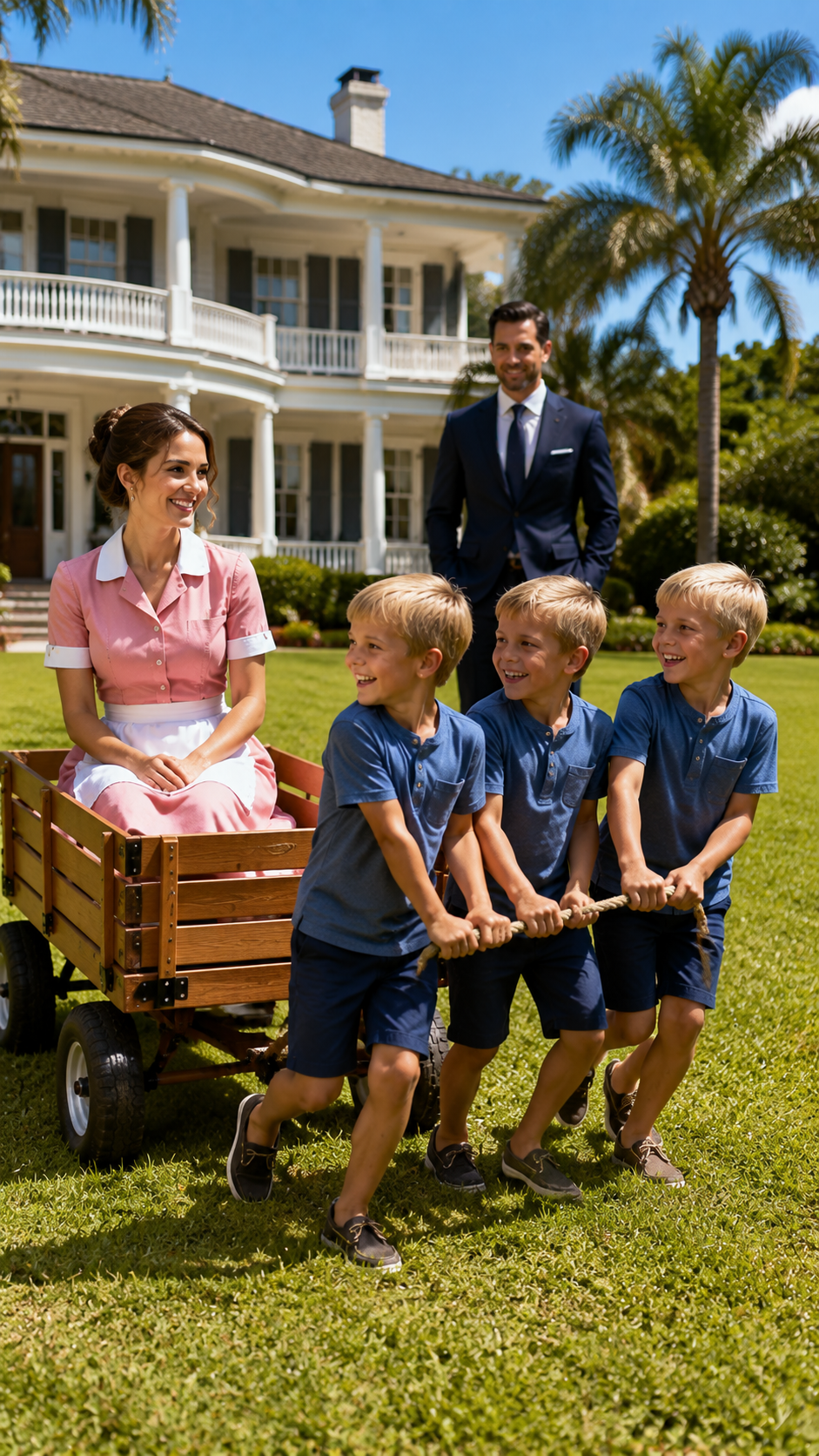
Rosa smiled, gentle and unsurprised, and nodded.
Daniel placed his hands on the weathered wood beside their smaller ones. The wheels creaked. The cart lurched, then found a rhythm as they moved together across the grass. His suit jacket pulled at the shoulders. A smear of dirt marked his cuff. He did not brush it away.
“Careful,” Rosa said, dropping her voice into the story as easily as she folded towels. “There’s a sleeping dragon behind the oak tree. If the papers rustle too loudly, he’ll wake up hungry.”
Ethan let out a hesitant laugh, then a realer one when the cart bumped a root and Rosa clutched the folder with theatrical terror.
Caleb announced that they would need an invisible bridge to cross the river that ran, apparently, from the birdbath to the hedge.
Liam, the quietest of the three, the one who often saved his words as if they were rationed, whispered, “Can we deliver good things to people who need them?”
Rosa knelt so her face was level with his and brushed his hair back from his forehead.
“You already did,” she said. “You made my day brighter. That’s a delivery. The best kind.”
Liam looked at his father then, just for a second, as if checking whether this new version of the afternoon would be allowed to continue.
Daniel nodded, because he did not trust his voice.
They pushed the cart until the sun dropped a degree and the Gulf wind came in cooler. When Rosa finally declared the king’s papers safely archived in the royal library—which was the garden bench—the boys did not immediately flatten back into politeness. They lingered. Ethan’s hand stayed on the cart handle. Caleb described the dragon’s snoring in unnecessary detail. Liam asked if they could play again tomorrow.
“If your father says yes,” Rosa answered, and she looked at Daniel without challenge, only invitation.
“Yes,” he said.
That night he sat alone in his office overlooking the water. For the first time in years he closed his laptop before the unread messages could recruit him. The cursor on the dark screen had always felt like a pulse. Without it, the room was only a room, and he was only a man who had watched his children become strangers under his own roof.
He thought of the way they had turned to Rosa.
He thought of the way they had stepped back from him.
He thought of every Sunday review on the west-wing wall and understood, with a clarity that felt like grief, that he had been grading them for failing a test he had designed so they could never pass. The test had been: become easy. Become fluent. Become the sons a successful man could display without discomfort.
They had become quiet instead.
The next morning he canceled two meetings. He postponed a flight to Atlanta that his chief of staff had already confirmed twice. He waited in the kitchen with coffee he did not drink until Rosa arrived, set down her bag, and understood from his face that this would not be an ordinary day of linens and floors.
She did not hesitate when he asked her to explain what she had seen.
“Children can feel when adults are rushing,” she said. She spoke as if she were telling him how to get a stain out of white cotton—practical, unsentimental, kind. “They feel stress even when you smile. They feel pretending. Your boys are very good at reading the weather in a room. If the weather is always a schedule, they become a schedule too. If you want them to open, you have to meet them without a plan. No goals. No ‘good job’ that sounds like a score. Just the game. Just you.”
“I don’t know how to do that,” Daniel said.
Rosa dried her hands on a towel.
“Then start by looking foolish,” she said. “They already know how. You’ve been the only one who forgot.”
That afternoon in the backyard she guided him into the boys’ imaginary world and then, gradually, stepped to the edge of it.
They crossed invisible rivers. Daniel took his shoes off because Caleb insisted the water would ruin them, and the grass was cool against his feet. They built a fort from cardboard boxes the groundskeeper had been about to crush for recycling. They battled a monster that lived behind a patio chair and required, for reasons Liam would not fully explain, an offering of three pinecones and a solemn apology.
At first Daniel felt ridiculous. His voice sounded too large. His ideas arrived like agendas. He caught himself correcting the physics of an invisible bridge and stopped mid-sentence when Ethan’s face began to close.
He followed instead.
He let Caleb decide that the fort needed a west gate even though the box had only one opening. He let Liam name the monster something soft and unexpectedly sad. He laughed—really laughed—when the cart wheel seized and they all piled into one another and Rosa declared that the dragon had sneezed.
The laugh startled him. It startled the boys too. Then Ethan grinned, crooked and unguarded, and the afternoon opened another inch.
Slowly, over days that were not dramatic and therefore easy to miss, something changed.
The boys talked more at dinner. They sat closer on the sofa, as if proximity were an experiment they were running with increasing confidence. Sometimes a hand found Daniel’s sleeve and stayed there. Sometimes a head leaned against his shoulder during a movie he had actually watched instead of previewing over email. They were testing whether he would remain if they stopped performing.
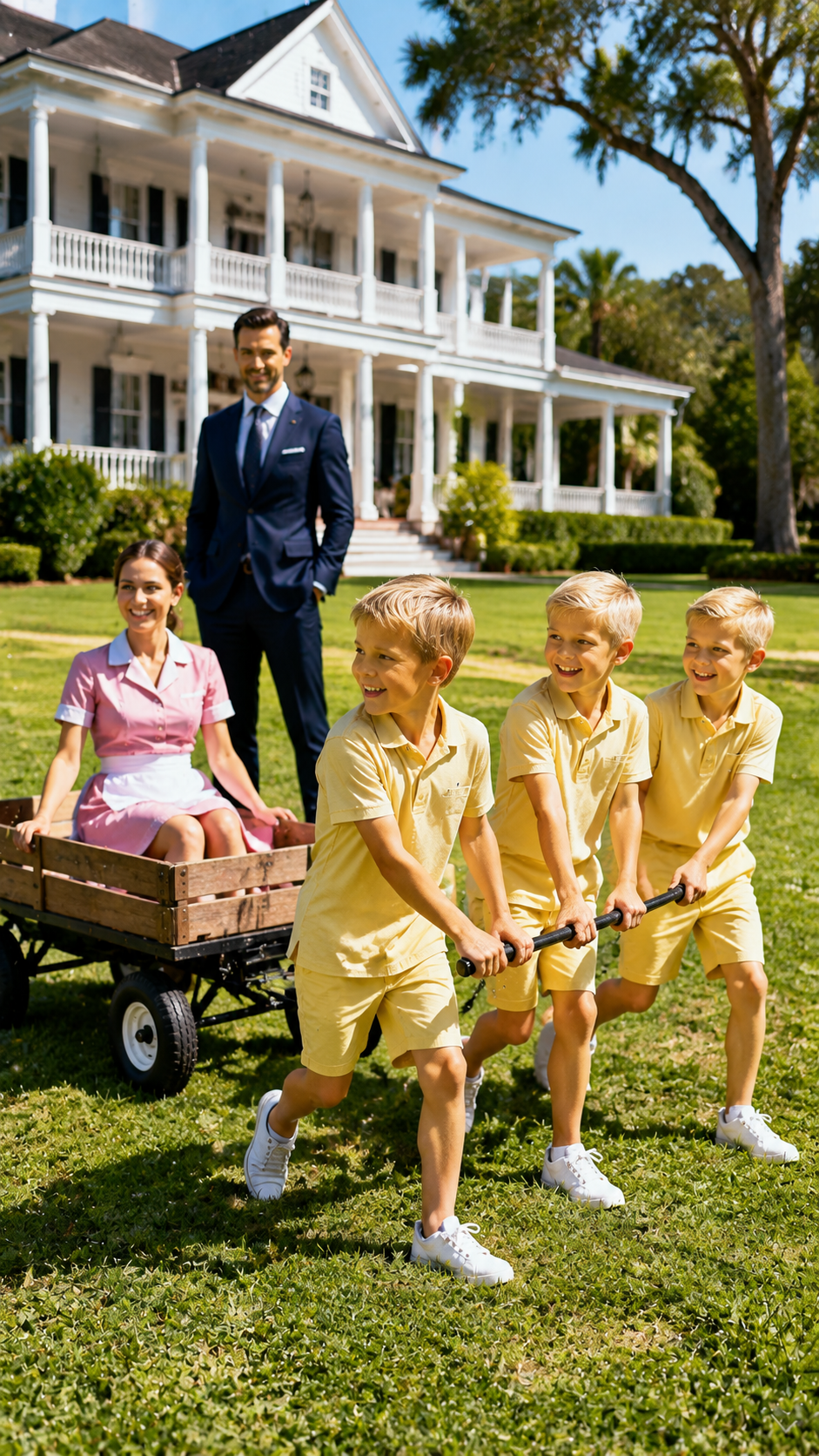
He remained.
Three weeks later their therapist recommended reducing the number of sessions.
“I want to be careful how I say this,” she told Daniel in the doorway of the office that still smelled faintly of dry-erase markers and anxiety. “They don’t need less support because they’ve been cured. They need less of the room where they were asked to prove they were improving. They’re bringing more of themselves into ordinary life. That’s the work.”
Even their pediatrician, a man who chose words as if each one might be entered into a chart, admitted something rarely written in medical reports.
“Environment matters more than people think,” he said. “Including the emotional one. Including the father in it.”
Guilt arrived with the relief, inseparable from it. Daniel sat in his car in the clinic parking lot and understood that he had spent a fortune trying to purchase a closeness he could have offered for free, and that the boys had paid for the delay in a currency no invoice captured.
Rosa began to step back.
She still made their lunches. She still knew which of Liam’s shirts he would tolerate and which seams bothered him. But she no longer sat in the cart unless invited, and when she was invited she made sure there was space on the handle for Daniel’s hands. She had built the bridge. Keeping it standing was no longer her job, and she was wise enough not to linger in a role that would let him remain a spectator.
One Saturday afternoon the boys played soccer on the lawn with a ball that kept escaping toward the oak. Daniel watched from the grass instead of from the terrace. He had changed into a shirt that could survive dirt. The house behind him looked, for the first time, merely large rather than important.
Ethan walked over during a pause in the game and rested his head on his father’s shoulder. He did it the way he did most new things now: as if checking the temperature of the air.
“You’re different now, Dad,” he said quietly.
Daniel put an arm around him and did not turn the sentence into a lesson or a joke. He looked back at the estate—the glass, the stone, the room full of lights that had never once made a child laugh like a wooden cart had—and finally understood what money had never been able to teach him.
Money can buy treatments.
It can buy experts, equipment, silence, and the appearance of a family that is being diligently repaired.
It cannot buy the unplanned hour under an oak tree.
It cannot buy the moment a child looks at someone else for permission to be happy in front of you.
It cannot buy the decision to be foolish on purpose.
Only presence can heal what presence first broke.
In Naples, Florida, a wealthy businessman discovered the one form of therapy he had never thought to try.
He showed up.
He stayed.
He pushed an old wooden cart across the grass and let his sons tell him where the dragon slept.
And the house, which had been so good at quiet, learned a louder and more necessary sound.
