

Have you ever walked into your own home and felt like a stranger?
That was how Ethan Caldwell felt on a gray Friday afternoon in late October, when he pushed open the heavy front door of his Chicago house two hours earlier than usual and stopped dead in the foyer. The marble floor still gleamed. The orchids on the console table were still perfectly arranged. The silence was still expensive. And yet the house no longer felt like his.
From the living room came a sound he had not heard in months: the quiet clink of a spoon against a bowl.
Ethan set his briefcase down without meaning to. He moved toward the doorway as if any sudden motion might shatter whatever was happening on the other side.
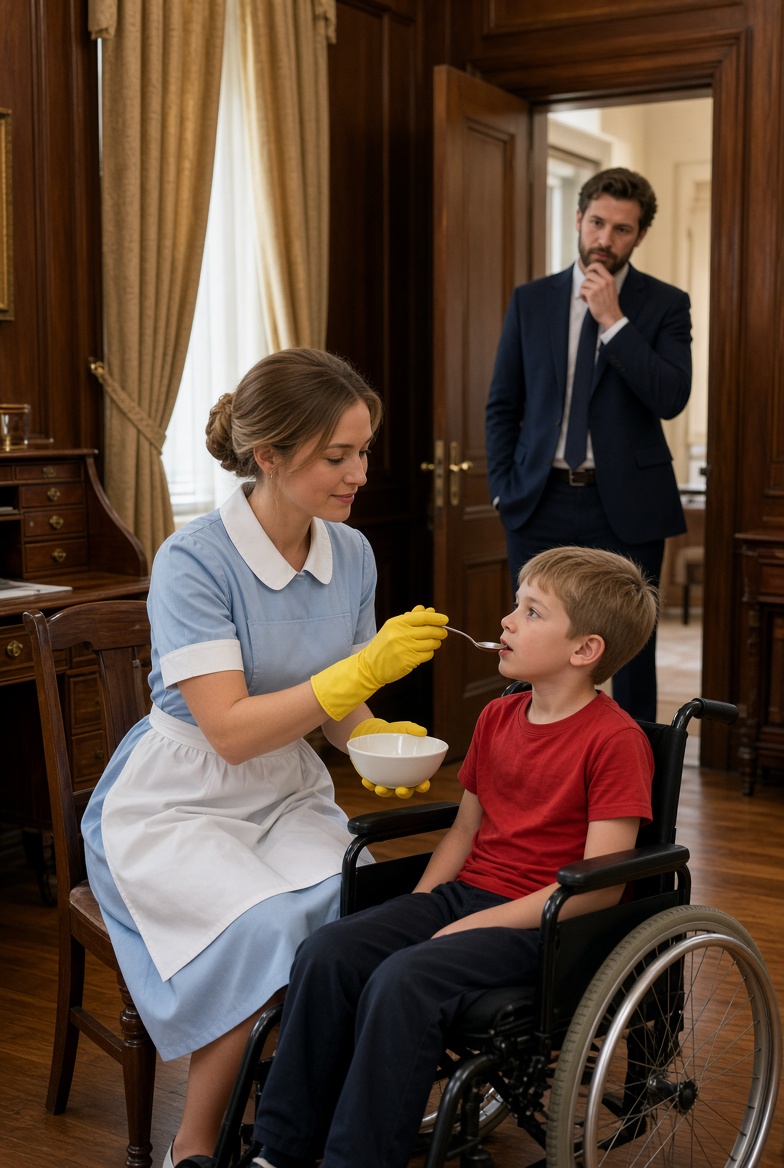
There, in a pool of afternoon light, sat Livia Brooks.
She was wearing the same simple blue uniform she always wore, the one that made her look smaller than she was. Beside her, strapped into his adaptive chair, was Daniel. Ethan’s son. Eight years old. Thin. Watchful. The boy who had turned every meal into a battlefield.
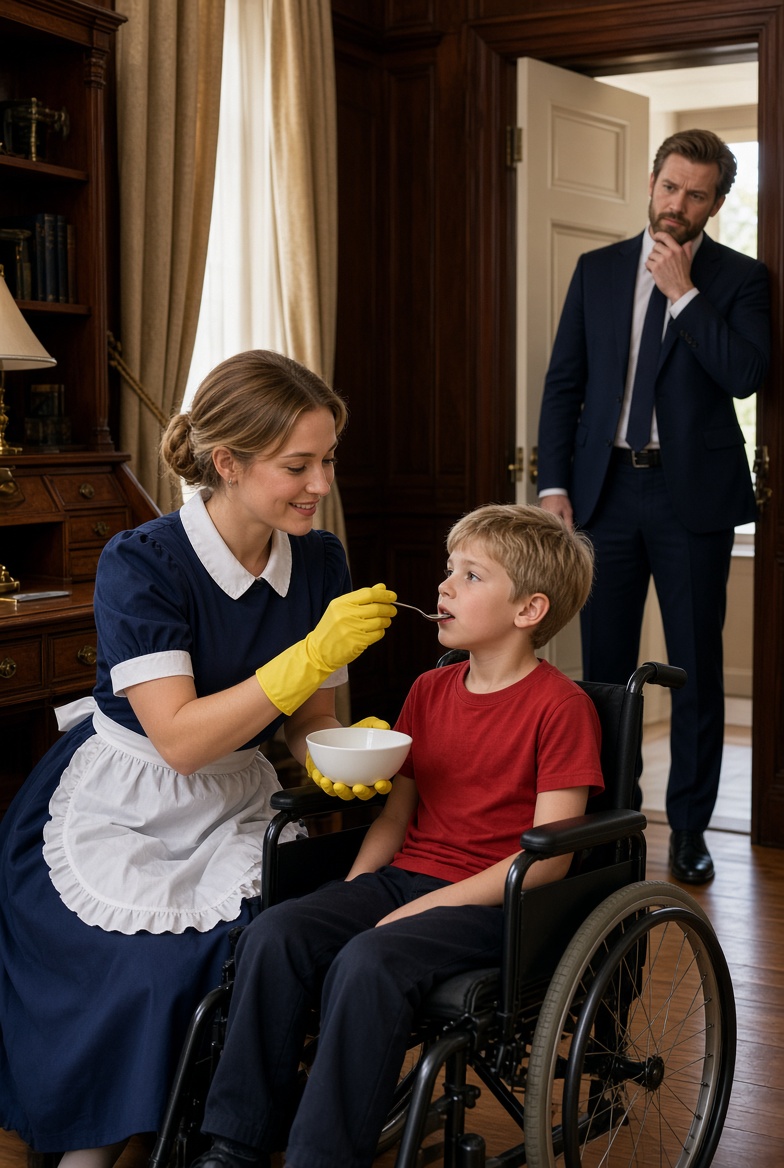
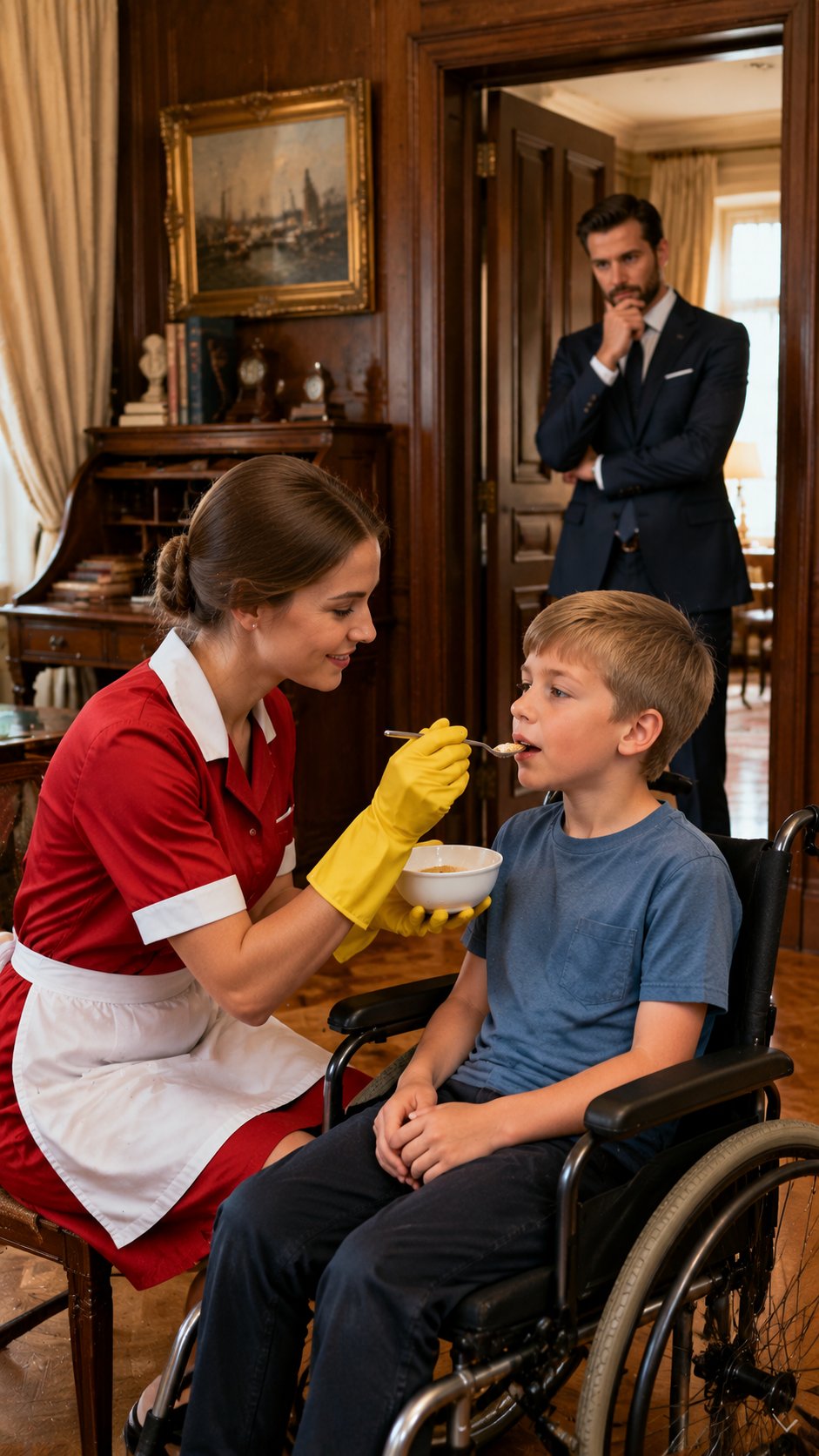
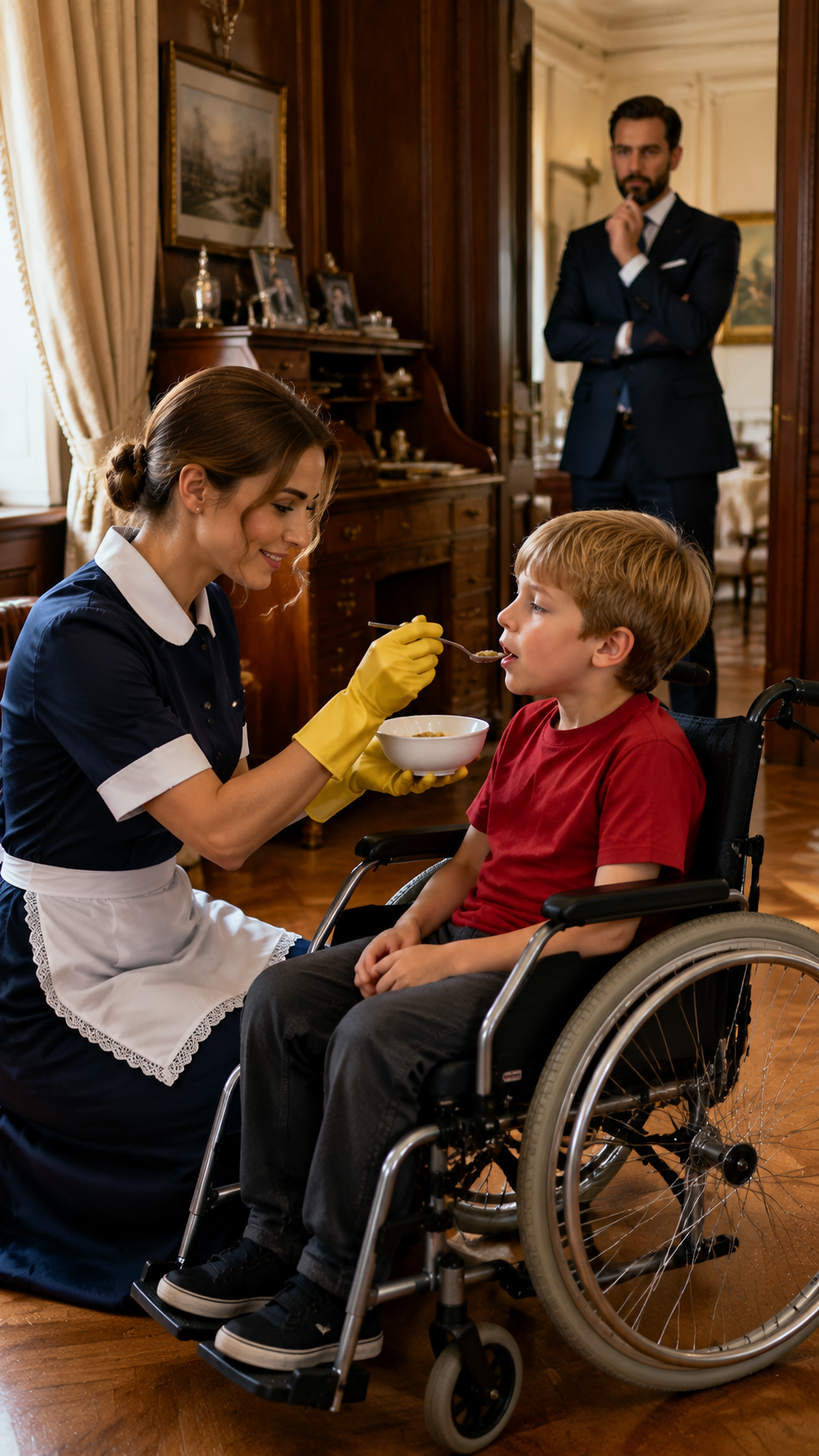
Livia held a spoon in her right hand. She did not push it toward Daniel’s mouth. She did not hover. She simply waited, the spoon a few inches away, letting him see it, smell it, decide.
And Daniel… was eating.
Not perfectly. Not quickly. But he was eating. A small swallow. A pause. Another swallow. No screaming. No arched back. No wild swing of an arm that sent food across the room. No caregiver backing away with shaking hands.
Ethan tightened his grip on the doorframe. For a moment he thought he might be seeing a hallucination brought on by too many late nights and too much coffee. Then Daniel accepted another spoonful, and the reality of it settled into Ethan’s chest like a weight he had been carrying for years finally shifting.
He had hired five caregivers in eight months.
The first lasted two days. She left a note on the kitchen counter that said only, I can’t do this. The second lasted four. She cried in the driveway and told Ethan that Daniel hated her, that children could sense fear, that she was not strong enough. The third tried force. The fourth tried bribery. The fifth, a woman with twenty years of pediatric experience, walked out after a particularly violent lunch and said she would not come back even if he doubled her salary.
There had been nights when Ethan sat on the floor outside Daniel’s room after the last of them left, listening to his son cry himself into exhaustion. He would press his forehead against the closed door and ask the same question until the words lost their shape.
Where did I go wrong?
He had built a logistics company worth more than most people would see in a lifetime. He could read a contract in minutes, salvage a failing deal over dinner, and talk a board of directors into a risk they did not want to take. He could not get his own child to eat a bowl of oatmeal without turning the house into a war zone.
“I’m sorry, sir,” Livia said softly, without turning around. “I didn’t know you’d be home early.”
She did not break her rhythm. She lowered the spoon, waited, lifted it again. Daniel tracked it with his eyes.
“Slowly,” she whispered to the boy. “If you want to stop, we stop. You’re in charge of your mouth. I’m just here.”
Ethan swallowed. No one had ever spoken to Daniel like that. Everyone else had spoken about him, over him, at him. They treated feeding like a task to complete before the next appointment. They treated Daniel like a problem to solve.
Livia was meeting him where he was.
Ethan stepped into the room. His voice, when it came, was barely steady.
“Did he… eat everything?”
Livia nodded once. “All of it. Mashed sweet potato and a little chicken. He ate yesterday too. And the day before that.”
Ethan blinked. “How?”
She hesitated. Not because she was hiding something, he realized, but because she was choosing her words the way she chose the pace of a meal: carefully.
“I took care of my younger sister for seventeen years,” she said. “Her name was Mara. She had cerebral palsy and a lot of sensory issues around food. People thought she was being difficult. She wasn’t. She was overwhelmed. I learned that patience and respect go further than force ever will. You can’t rush a nervous system into trust. You can only offer it, again and again, until it decides you’re safe.”
Something inside Ethan cracked.
He had spent years treating Daniel’s resistance as a failure of management. More staff. Better schedules. Different textures. Different chairs. Different experts. He had thrown money at the problem the way he threw money at every other problem in his life. And the problem had only grown quieter and more desperate, until the house itself seemed to hold its breath.
He stepped closer. For a long second he did not know if he was allowed to touch his own son. Then he placed a hand, very gently, on Daniel’s shoulder.
The boy did not flinch.
Daniel looked up. His eyes, which so often slid away from faces, held Ethan’s for a full breath. It was not a smile. It was not a word. It was something smaller and more devastating: permission.
You can stay.
Ethan’s breath caught.
“How much do you want,” he asked, the words coming out automatic, almost defensive, “to keep doing this?”
Livia looked at him. Her expression was firm, but there was no hardness in it.
“I’m not doing this for money, Mr. Caldwell. I’m doing it because I care. Daniel is not a job to me. But if you want… I can teach you. Not how to feed him. How to be with him while he eats. There’s a difference.”
That afternoon, Ethan did something he had not done in years.
He called his assistant and canceled every meeting until Monday. He silenced his phone and left it facedown on the kitchen island. He pulled a chair up beside Daniel’s—not as a businessman managing a difficult situation, but as a father who had finally run out of strategies and was willing, at last, to learn.
The house, which had felt cold and performative for so long, seemed to exhale.
Livia did not give him a lecture. She simply let him watch.
She showed him how she announced the food before it arrived, so Daniel was never startled. How she let him smell each bite. How she never scraped the spoon against his teeth. How she counted silently to five when he turned his face away, then offered again without irritation. How she praised nothing too loudly, because loud praise could feel like pressure. How she ended the meal before Daniel was exhausted, even if there was food left, because ending well mattered more than finishing the bowl.
“Tomorrow,” she said before she left that evening, “you try breakfast. I’ll be here, but I’ll stand back. If it doesn’t work, we wait. Then we try again. There is no failing. There is only information.”
It sounded simple.
Too simple.
And maybe that was why it scared him.
That night, after Livia had gone home to the small apartment she shared with a cousin on the South Side, Ethan sat on the edge of Daniel’s bed and adjusted the blanket over his son’s legs. He copied the same careful movements he had watched all afternoon: no sudden tugs, no brisk efficiency. Just presence.
Daniel’s breathing slowed.
Ethan stayed until the boy’s eyes closed.
“I’m going to do better,” he whispered into the dim room.
For the first time in a long time, it did not sound like a promise made in a boardroom. It sounded like a man speaking to the only person who had ever needed him to mean it.
The next morning the kitchen was quiet in a different way. Ethan set a tray on the low table Livia preferred—not the grand dining table, which made Daniel look even smaller. He had warmed the oatmeal too much and then cooled it again, anxious about temperature the way he used to be anxious about quarterly reports.
Daniel turned his face away.
The old panic rose in Ethan’s throat. The urge to hurry. To correct. To make it happen before the window closed.
He did not.
He held the cup where Daniel could see it. He waited. He spoke softly, the way Livia had spoken.
“Hey, buddy. We’ll go slow, okay? You don’t have to. I’m right here.”
A pause.
Daniel blinked.
Ethan offered the cup again.
One sip.
Then another.
It was not graceful. A little oatmeal dribbled down Daniel’s chin. Ethan wiped it with a napkin instead of a hurried swipe. Daniel accepted a third sip, then pushed the cup away with the back of his hand.
Ethan stopped.
He sat there, heart pounding, and realized he had not failed. He had listened.
From the doorway, Livia gave a small nod.
“See?” she said quietly. “When you slow down, he learns to trust you. Trust is the meal. The food is just what happens inside it.”
In that moment something in the house shifted.
The high ceilings no longer felt empty. The silence no longer sounded like abandonment. It sounded like two people learning a language that did not require words.
The days that followed were not miraculous. They were repetitive, ordinary, and occasionally messy. Ethan burned a pot of rice. Daniel refused lunch twice in one week and accepted it the third time as if nothing had happened. There were mornings when Ethan’s phone buzzed with a crisis from the office and he felt the old reflex to stand up and leave. Each time he looked at Daniel, and each time he stayed a little longer.
Livia taught him Daniel’s signals the way another person might teach a child to read.
A tight jaw meant too fast. A glance toward the window meant I need a break. A small hum, almost inaudible, meant this is okay. Fingers opening and closing against the tray meant more, but not yet.
Ethan began to see that his son had been speaking the entire time. The house had simply been too loud with other people’s urgency to hear him.
He learned other things as well, things that had nothing to do with spoons.
He learned that Daniel liked the sound of rain against the sunroom glass. That he would tolerate a hand on his shoulder but not a kiss on the forehead. That he flapped his hands when he was happy, not only when he was distressed, and that Ethan had spent years misreading joy as agitation. That the adaptive chair was not a cage if the person sitting in it was given choices. That “I love you” could be said by sitting still.
Weeks became a month. Then two.
Ethan delegated more at work. His partners complained, then adapted. The company did not collapse. Some deals closed more slowly. One fell through. Ethan discovered that a lost contract hurt less than another night of listening to his son cry behind a closed door.
He started coming home at four.
Sometimes Livia had already begun the afternoon snack. Sometimes she left the tray for him and went to fold laundry in the next room, close enough to help, far enough to let him try. He stopped thinking of her as staff in the way he had once thought of everyone who entered the house. She was the first person who had treated Daniel as a person instead of a project, and in doing so she had treated Ethan as a father instead of a client.
One Thursday in December, snow collected on the backyard hedge. Daniel ate half a banana and a few bites of yogurt. When he finished, he reached—not for Livia, but for Ethan’s sleeve. He held the fabric between two fingers for several seconds, then let go.
Ethan did not speak. He was afraid that if he did, the moment would dissolve.
Livia, drying a cup at the sink, did not look over. She only said, as if commenting on the weather, “That’s him telling you he knows you’re here.”
Months later, the house was still large. The business was still demanding. Daniel still had hard days, days when the world arrived too sharply and food became impossible again. Nothing had been cured, because there had never been anything to cure. What had changed was the atmosphere in which difficulty occurred.
Ethan no longer treated those days as emergencies. He sat. He waited. He offered and withdrew and offered again. Sometimes Daniel ate. Sometimes he did not. Either way, his father remained in the chair.
Daniel learned the most important fact of his young life: his father was not going anywhere.
Ethan learned the fact that undid him and remade him at the same time. The greatest lesson of his adult life did not come from a negotiation, a mentor, or a balance sheet. It came from a quiet woman in a blue uniform who refused to wrestle a child into compliance.
Love, she had shown him without ever using the word as a slogan, is not the project of fixing someone until they become easier to live with.
It is the practice of staying near them—patiently, imperfectly, again and again—until they feel safe enough to meet you halfway.
And on an ordinary morning in a house that had finally remembered how to be a home, that was enough.
