

The Whitmore estate sat on the wooded outskirts of Greenwich, Connecticut, as if it had been placed there to keep the world at a polite distance. From the road it looked like what it was: old stone, tall windows, a sweep of lawn that ended in a stand of oak. Inside, the house was built of something heavier than masonry. It was built of silence — the kind so complete it pressed against the lungs and taught even the clocks to tick more softly.
For seven years Jonathan Whitmore had lived inside that silence.
Ever since his wife, Caroline, died in a car accident only weeks after their daughter was born, he had become a man made of routine and restraint. He ran one of the largest private equity firms in New York City with a precision that left little room for sentiment. Markets moved when he moved. Competitors studied him the way sailors study weather. The city knew the version of him that sat at the head of a long table and closed a deal before the coffee cooled.
Inside his own house he was simply a grieving father.
His daughter, Amelia Whitmore, was seven years old. And she was blind.
Congenital blindness, the best specialists in Manhattan had told him when she was still an infant. Severe. Irreversible. Jonathan had repeated those words so many times they had acquired the weight of scripture. He said them to nannies who lasted a season and left. He said them to relatives who asked too gently over holiday dinners. He said them to himself in the dark of the study when the portrait of Caroline looked back as if she were still waiting for an answer he did not have.
Amelia was delicate and quiet. Most afternoons she sat in the same corner of the sunroom with a worn lavender teddy bear pressed to her chest. Her large hazel eyes never seemed to settle on anything in the room. She rarely smiled. She rarely spoke. Her gaze drifted toward a place Jonathan could not follow, and he had learned, with a kind of exhausted tenderness, not to tug her back.
Every morning he dressed her himself. He chose soft fabrics because tags and seams had once made her twist away, and he had decided that discomfort was another kind of danger. He brushed her brown hair until it lay smooth against her shoulders. He carried her into the garden because the path from the terrace to the rose beds was uneven, and he would not risk a fall. He named colors she could not see because naming them felt like keeping a promise to Caroline, who had planted those roses the spring before the accident.
“This one is yellow,” he would whisper, guiding her small fingers toward a bloom. “Bright like the sun.”
She touched the petals the way a careful child touches something she has been told is precious. Her face remained distant. Resigned. Jonathan had buried hope in the same earth that held his wife. His mission now was simple: protect Amelia from a world she could never see. Keep her safe. Keep her contained. Keep the house from becoming a place where hope might enter and then have to leave again.
The staff learned the grammar of that mission. Curtains stayed drawn against glare. Voices dropped at the sunroom door. Visitors were warned, kindly and firmly, not to startle her. Dr. Howard Klein, a longtime family consultant and one of the most respected ophthalmologists in the city, came on a regular schedule. He spoke in the low, certain tone of a man who had already been believed. He checked Amelia’s eyes, adjusted the prescription, and left another small carton of drops in the bathroom cabinet.
“Internal pressure,” he told Jonathan, not unkindly. “We manage it. We keep her comfortable. That is the work now.”
Jonathan nodded. He had nodded for seven years.
Then one day the silence cracked.
Her name was Elena Morales.
Elena was not merely looking for work when she applied to be a live-in housekeeper. She was looking for something to hold onto. Six months earlier she had lost her own son to leukemia. The grief had hollowed her in a way that made ordinary rooms feel too large. Caring for someone else was the only motion that still made sense. If her hands were busy, the quiet in her chest had somewhere to go.
She arrived for the interview in a dark coat that had seen better winters, her hair pulled back without vanity. Jonathan received her in the study — the room with the dark wood and the portrait he could not yet take down. He asked the usual questions. References. Hours. Whether she understood that the household was built around a child who could not see.
Elena answered simply. She had cared for her son through treatments that stole more than they gave. She knew how to move through a sickroom without turning it into a performance. She knew how to keep a promise to a child who could not always speak for herself.
Jonathan saw something in her eyes he recognized without wanting to name it. Survival through loss. Not brightness. Not optimism. The particular steadiness of a person who has already survived the worst sentence a parent can hear and has decided, without fanfare, to keep breathing.
He hired her that afternoon.
From the first day Elena felt drawn to Amelia — not with pity, which she had learned to distrust, but with instinct. While she polished the silver and dusted the high shelves, she watched the little girl the way a person watches weather: for small changes that the official forecast has already dismissed.
The other staff were kind in the way of people who have made peace with a story. Mrs. Hanley, who cooked, set Amelia’s plate in the same place every noon and spoke to her in a bright, careful voice. The gardener nodded when he passed the sunroom windows and did not wave, because waving, they had all been told, was wasted on a child who could not return it. Elena did the work she had been hired to do. She also paid attention.
One afternoon, pulling open the heavy velvet curtains so she could wipe the glass, she let a sharp beam of sunlight flood the room. The light landed directly across Amelia’s face.
The girl flinched.
Just slightly. A small tightening around the eyes. A faint turn of the head away from the brightness, as if the sun had spoken a language her body still understood.
Elena froze with the curtain cord in her hand.
Blind children, she knew from the long months in hospital corridors, did not always react to light. Some did, if they had residual perception. But Amelia’s file, the one Jonathan had shown her with the weary authority of a man reciting a diagnosis, said total congenital blindness. Severe. Irreversible. A child who lived in unbroken dark should not wince at a sudden bar of sun.
Elena closed the curtain halfway and finished the glass. She did not speak of it that day. Grief had taught her the cost of being wrong in a house that could not bear another upheaval. It had also taught her the cost of ignoring what her own eyes had seen.
Over the next week she began to watch more carefully, and more quietly.
She dropped a shiny spoon near Amelia while setting the tea tray. The girl’s pupils shifted — not toward sound alone, but toward the brief flare of metal in the light from the hall.
She turned the hallway sconces on and off while Amelia was being led past them toward the stairs. A blink. A subtle squint. The kind of protest a face makes when brightness arrives too fast.
She moved a vase of white roses from the far table to the low bench nearer the sunroom corner. Amelia’s head tipped, not toward the scent first, but toward the pale shape that had not been there the day before.
These were not the reactions of total darkness. They were the reactions of someone who could see light — perhaps shapes, perhaps the ghost of color at the edge of a world that had been chemically dimmed.
Elena’s heart pounded with a mixture of hope and dread. If she was right, everything Jonathan believed was wrong. If she was right, a child had been living inside a sentence that did not belong to her. If she was wrong, she would be the woman who had experimented on a billionaire’s daughter and been sent away for it.
She waited. She told herself she was gathering enough to speak. What she was really gathering was courage.
Dr. Klein came that Thursday, as he always did. Elena stayed in the hall with a stack of folded linens and listened. He spoke to Jonathan about pressure and comfort and the importance of consistency. He praised Amelia’s calm. He left another carton. Jonathan walked him to the door with the gratitude of a man who has outsourced the part of fatherhood he does not know how to perform.
Elena looked at the closed door and felt something harden in her chest that was not quite anger. It was the memory of sitting beside a hospital bed and being told, with the same gentle certainty, that there was nothing left to try.
One stormy night, thunder rattled the tall windows of the estate. Rain came sideways against the glass. Jonathan had gone upstairs early with a migraine, the kind that turned the study lamps into an insult. He left Elena to put Amelia to bed.
The house felt electric. The usual hush had a different quality, as if the storm had given every room permission to admit what it had been holding.
Elena knelt in front of the child. Amelia sat on the edge of the bed in a white nightgown, the lavender bear in the crook of her arm. Her hair was still slightly damp from the bath. Her eyes, as always, seemed to rest on a point beyond the wallpaper.
“Amelia, sweetheart,” Elena whispered. “I am going to try something. I just need you to be brave.”
Amelia clutched the bear but did not pull away. That, too, was a kind of answer.
Elena took out her phone. Her hands trembled. If Jonathan walked in, he might fire her on the spot for experimenting with his daughter’s condition. He might be right to, by the rules of the house as they had been written. She could not ignore what she had seen.
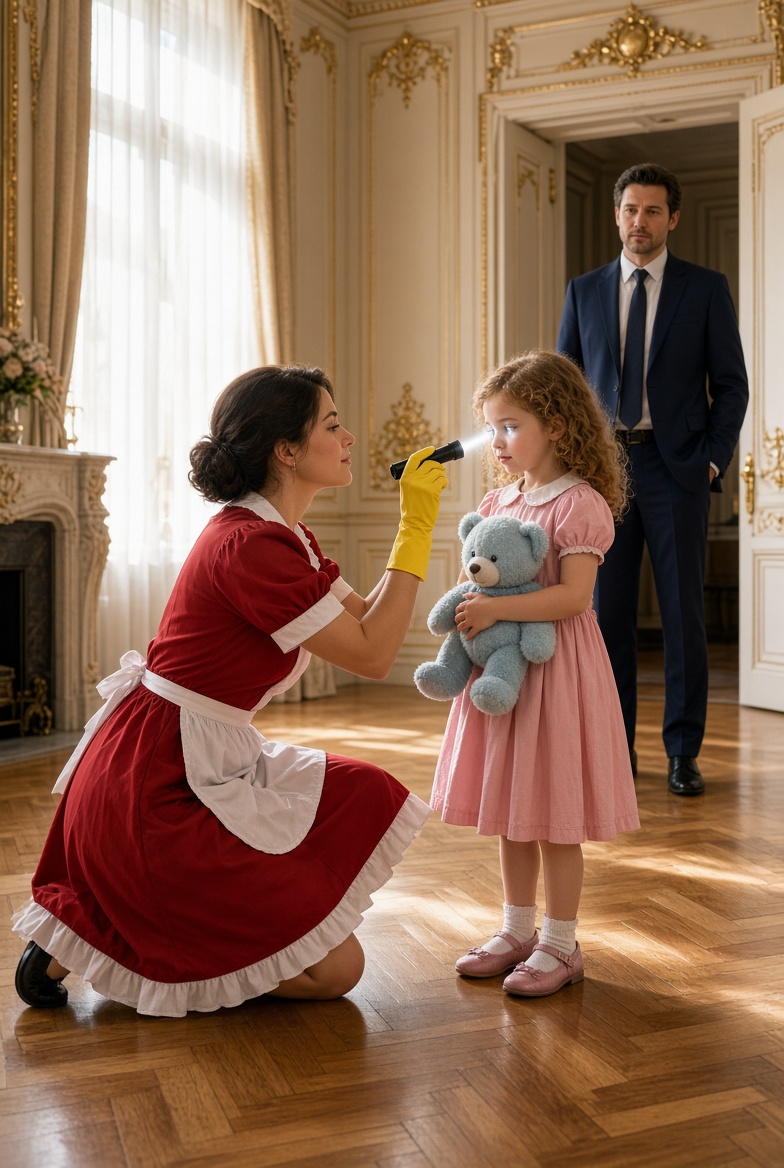
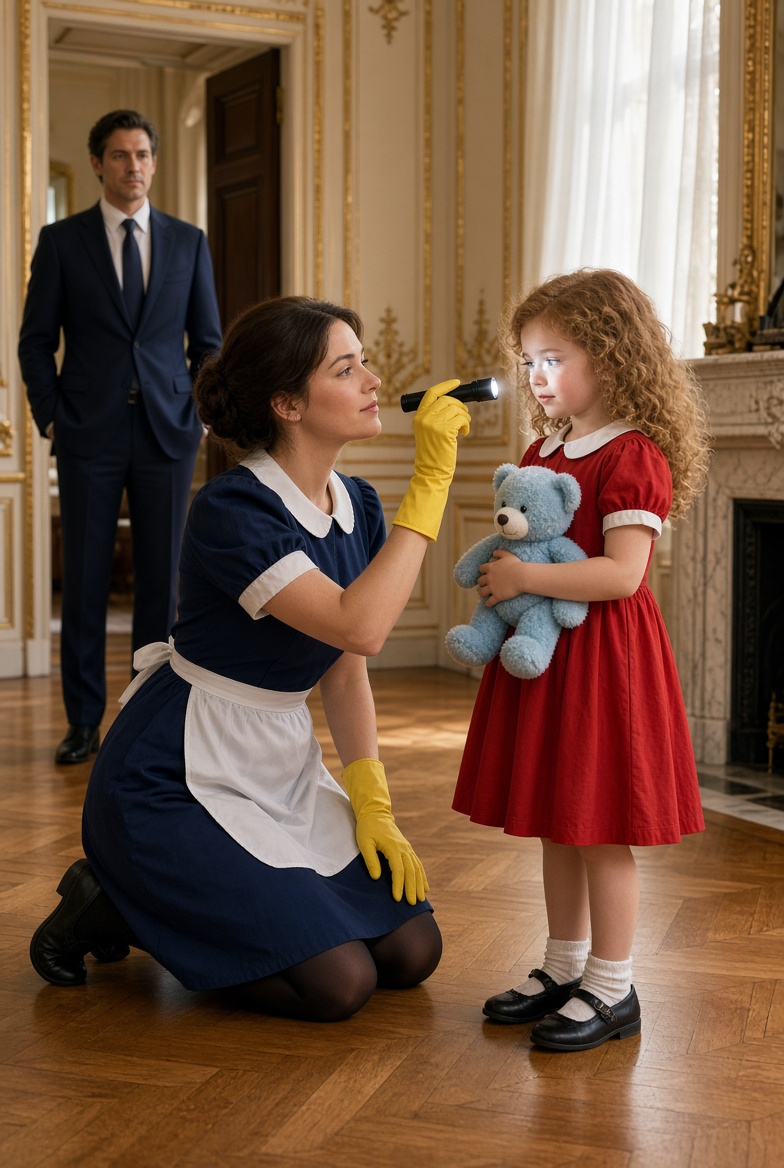
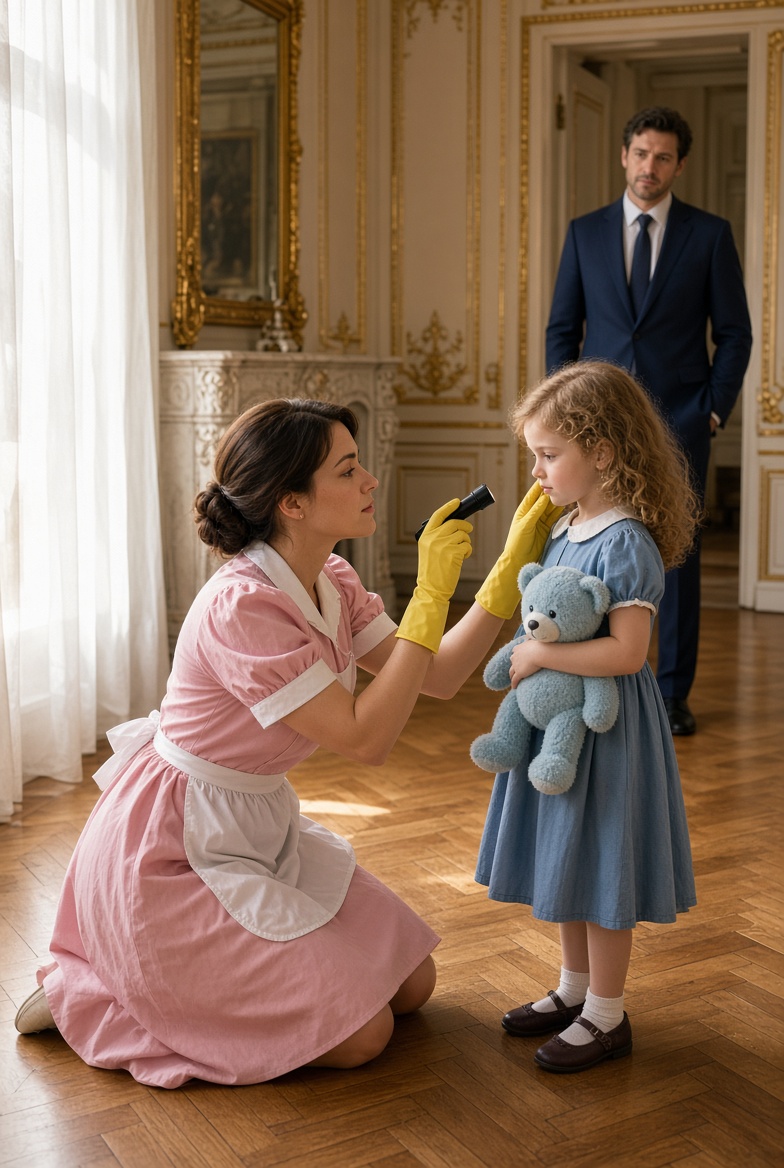
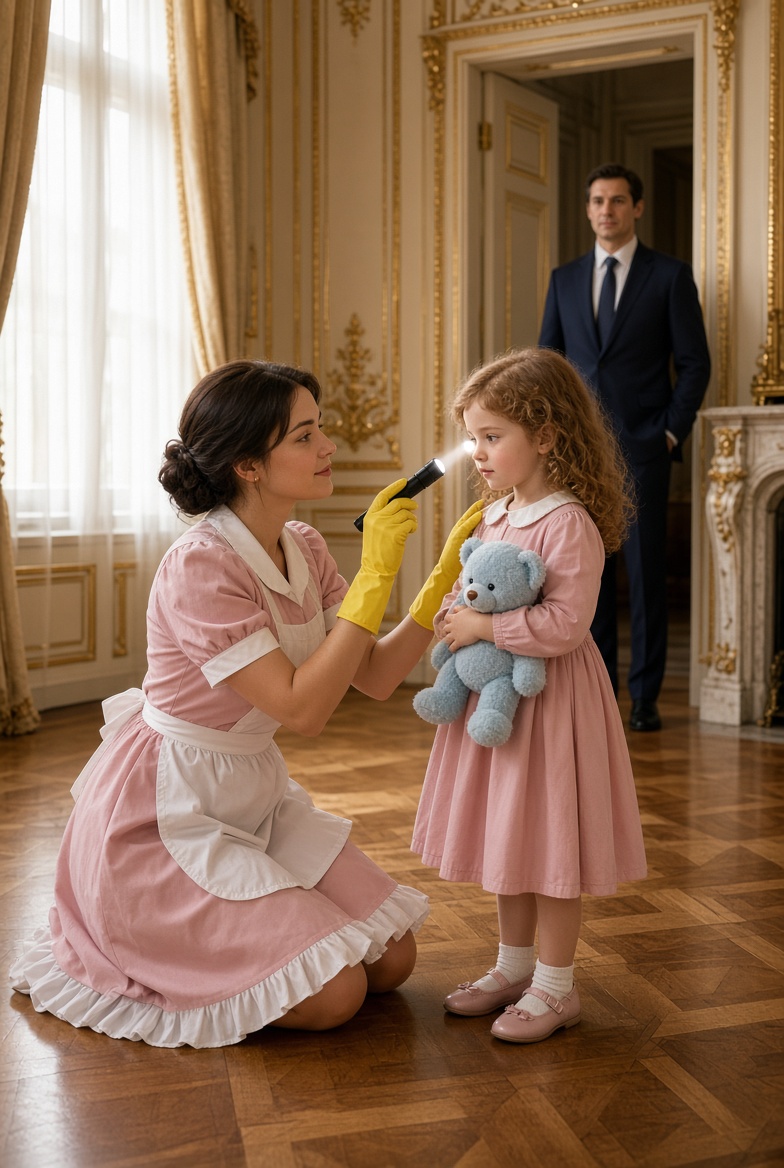
She turned on the flashlight.
The sharp white beam cut through the dim bedroom and landed directly in Amelia’s eyes.
For one endless second — nothing. The storm filled the pause. Elena could hear her own pulse.
Then Amelia’s pupils shrank.
She blinked rapidly. Once. Twice. Three times. Her face twisted in discomfort, the small, honest grimace of a person meeting a sensation she has not been allowed to name.
And then, in a small, cracking voice, she whispered:
“It’s bright… it hurts.”
Elena gasped. Tears spilled before she could stop them.
“She can see,” she breathed. “Oh my God. She can see.”
The bedroom door burst open.
Jonathan stood there in the clothes he had not changed from the office, one hand still at his temple. The migraine had not kept him as far away as he had intended. The light from the phone caught him like an accusation.
“What are you doing?” he shouted, storming forward. “I told you not to disturb her. Are you shining lights in her eyes?”
He grabbed Elena’s arm. The rage in him was not cruelty. It was seven years of protective grief given a target at last. Someone had broken the rule that kept the house from coming apart.
“You’re fired. Get out of my house.”
Before he could pull her toward the door, Amelia did something she had never done before.
She stood up.
Not the careful rising she allowed when a hand was offered. She stood on her own, the bear falling against the quilt, and with uncertain but directed steps she walked toward Elena’s voice.
“Daddy, stop!” she cried.
Jonathan froze. Amelia never raised her voice. Never moved independently across a room. The specialists had spoken of spatial caution, of a child who lived by sound and touch and the map other people made for her.
She turned her face toward him — not perfectly focused, but aligned, as if the idea of him had at last found a place in the visible world.
“Daddy. I saw the light. Miss Elena showed me the light.”
Jonathan dropped to his knees so hard the floor answered.
“What did you say?” he whispered.
“Light,” Amelia repeated, softer now, pointing toward the phone still burning in Elena’s hand. “I saw it.”
The world tilted. For a moment Jonathan was back in a hospital corridor seven years earlier, listening to a sentence that had rearranged his life, and understanding — too late and all at once — that sentences can be wrong.
That night no one slept.
Jonathan went straight to the bathroom cabinet where Amelia’s prescribed eye drops had been stored in neat rows, labeled in Dr. Klein’s even hand. For seven years the doctor had insisted they were necessary to manage internal eye pressure. Jonathan had administered them himself more mornings than he could count. He had been proud, in a grim way, of never missing a dose.
Elena sat at the kitchen table with her phone and the small printed insert from the carton. She searched the ingredients. Her face changed as the words assembled themselves into a meaning she did not want and could not refuse.
Atropine. Cyclopentolate.
In high, prolonged doses they dilate the pupils and paralyze the eye’s ability to focus. They cause extreme light sensitivity. They blur vision until the world becomes a smear a child learns not to trust. Given year after year to an infant, then a toddler, then a little girl who had been told she was blind, they could steal the very development the eye needed in order to learn seeing.
Jonathan read the same words over her shoulder. He felt physically ill. The migraine was gone. In its place was a clarity that hurt more.
It was not fate.
It was not congenital darkness.
It was chemical suppression. A slow theft of sight, administered in a house that believed it was offering care.
By morning he had canceled every standing arrangement with Dr. Klein. Within twenty-four hours, independent specialists — physicians with no history in the Whitmore file and no reason to protect a colleague’s reputation — examined Amelia at a hospital Jonathan had chosen because he did not know anyone on its board.
The truth came out like a bomb, and then like a ledger.
Amelia had been born with limited but functional vision. Not perfect sight. Not the easy, greedy seeing of an ordinary infant. Enough. Enough to track a face. Enough to learn light and shadow and, with time and therapy, the names of colors. The continuous medication had severely impaired that development. What the family had called blindness was, in large part, a condition that had been made.
Why?
The investigations that followed — first private, then legal — revealed a pattern Jonathan could barely stand to hear described. Malpractice. Financial manipulation. A disturbing architecture of control. Dr. Klein had kept a wealthy, newly widowed father dependent and unquestioning. Consultations billed at the highest tier. Pharmacy arrangements that routed through a practice Jonathan had never thought to audit. A diagnosis delivered in the raw weeks after Caroline’s death, when grief made a man grateful for any sentence that sounded like expertise.
Klein had not invented Amelia’s vulnerability. He had enlarged it, then charged for the management of the dark he had helped create.
In that first night and the day that followed, Jonathan did not care about revenge. He cared about his daughter.
He stood at the bathroom sink and threw every bottle into the trash. The plastic struck plastic with a sound too small for what it meant.
“We’re done living in the dark,” he said, and pulled Amelia into his arms. Without thinking — without the caution that had governed every other gesture in that house — he pulled Elena into the embrace too.
Elena stood rigid for a second, then let her forehead rest against the child’s hair. She had come into the house looking for something to hold. She had not expected to be held in return.
The following weeks felt like witnessing a miracle that refused to hurry.
Withdrawal from the drops was not gentle. Amelia’s eyes burned. Light, even the softened light of a lamp behind a shade, made her turn her face into Jonathan’s shoulder. She cried in a way she had not cried when she was believed to be beyond such protests. Elena sat with her through the worst hours, a cool cloth in her hand, speaking in the low voice she had once used in another child’s room.
“It will be less,” she told her. “Not gone. Less. You can tell us when it is too much.”
Being allowed to say that something hurt was, for Amelia, a kind of vision of its own.
First she saw blurred shapes — the moving dark of a person entering a doorway, the pale rectangle of a window. Then, slowly, colors began to detach themselves from the smear.
One morning Jonathan walked into the sunroom and found her standing by the window without being carried there. The heavy curtains had not yet come down, but they had been tied back, and a band of ordinary daylight lay across the floor.
She pointed toward the yard.
“Green,” she said softly.
Then toward a rose that had opened in the night.
“Red.”
Jonathan broke down. He sobbed in a way he had not even at Caroline’s funeral, when dignity had seemed like the last gift he could give the woman who was gone. These were not tears of loss. They were tears of return — of a world walking back into a house that had boarded its windows and called the boarding love.
The heavy curtains came down that week. Sunlight flooded rooms that had learned to live without it. Silence gave way to music from the old piano no one had touched, to the small raw laughter of a child discovering that a spoon thrown on purpose made a sound and a flash at the same time. Amelia still moved carefully. Her vision remained limited, hard-won, imperfect. She would never have the effortless sight of a child who had learned the world with open eyes from the beginning. She had something else: the knowledge that the dark had not been the whole truth.
Jonathan pursued legal action against Dr. Klein. The case moved as such cases do — through filings and depositions and the particular shame of a professional community forced to look at one of its own. Justice followed, not as a single triumphant hour, but as a series of consequences that made it harder for the same harm to be dressed again as care. Jonathan sat through the proceedings with the same stillness he brought to a boardroom, except that now the stillness was not a tactic. It was the posture of a father who had learned what his inattention had cost.
The real victory was not in court.
It was watching Amelia chase butterflies in the garden — badly, joyfully, with the lavender bear abandoned on the terrace steps. She missed more than she caught. She did not seem to mind. She ran as if running itself were a color she had just been given a name for.
Elena never left.
The live-in post became something the contract had no language for. She had walked into that house broken by the death of a son, and she had helped restore vision not only to a child but to a father who had mistaken containment for love. In the months that followed, the three of them learned a quieter domestic grammar: breakfast at the unshuttered window, the naming of colors that were no longer a ritual of consolation, the particular peace of a house that had decided to keep its lights on.
Jonathan still left for the city before the traffic thickened. He still signed what needed signing. When he came home he did not go first to the study. He went to the garden if the weather allowed, or to the sunroom if it did not, and he let Amelia tell him what she had seen that day, even when what she had seen was only the way dust moved in a shaft of afternoon.
Elena kept the house, and then, without anyone announcing the change, she kept more than the house. She was the person Amelia looked for when a doorway was too bright. She was the person Jonathan found in the kitchen at night when sleep would not come and the old habit of silence tried to reassert itself. They did not make speeches. They made tea. They made room.
Months later Amelia handed Jonathan a drawing. The paper was slightly crumpled from the journey between her room and his study. Three stick figures stood under a huge yellow sun. The sun took up most of the page, as if she were making up for every year it had been denied her.
“Who’s that?” Jonathan asked, though he already knew.
“You, me… and Mama Elena,” she said simply.
Jonathan looked up at Elena. In that quiet exchange something unspoken settled between them — not a declaration for the staff, not a plan written into any will, but the recognition that the house had acquired a third person who belonged to its future as much as to its repair.
The real blindness had never been only in Amelia’s eyes. It had been in a father’s surrendered heart. It had been in the ease with which grief accepts the first official sentence and calls it fate. It had been in the drawn curtains, the obedient bottles, the specialists who were never second-guessed because questioning them felt like questioning the dead.
Sometimes all it takes to change a life — to challenge years of fear and resignation — is one brave person willing to turn on a light in the dark.
Amelia still pauses at bright thresholds. She still reaches for a hand when the world arrives too fast. Jonathan Whitmore still runs a firm that moves astonishing sums. He has learned the difference between protecting a child and enclosing her. He has learned that love without scrutiny can become another kind of blindness, and that the most expensive specialists in Manhattan are not always the people standing closest to the truth.
And Elena, who came looking for something to hold onto, found that the work of holding on is not finished when the flashlight goes dark. It continues in ordinary mornings, in the garden, in the small courage of a child pointing at a rose and giving it its rightful name.
So the question the house no longer asks in silence is a simple one.
Are you someone who accepts the darkness?
Or someone who dares to look for the switch?
