

PART 1 — THE SURPRISE I NEVER EXPECTED
“If that little girl doesn’t finish those dishes, neither she nor her mother gets dinner tonight.”
I heard my mother say those words before she realized I was home.
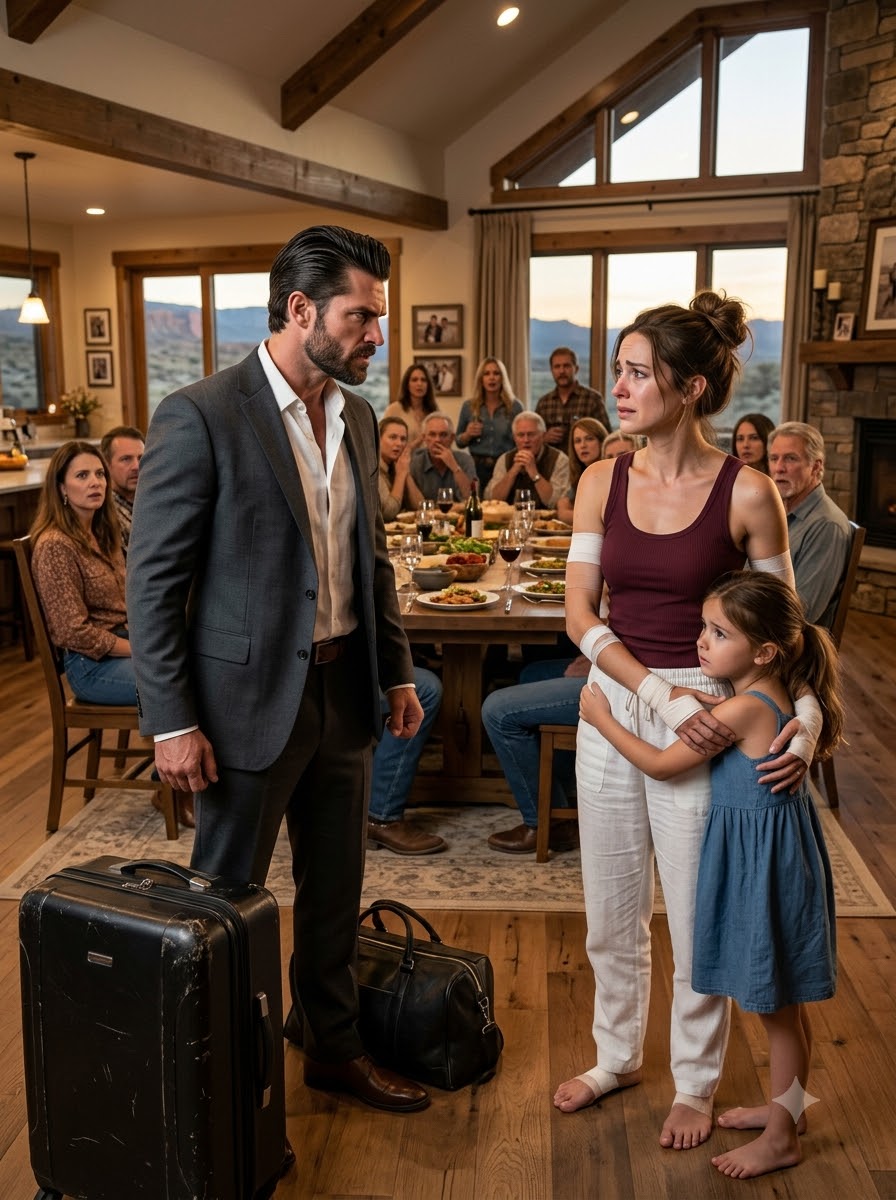
I stood in the hallway of my own house, suitcase still in my hand, hearing twenty people laughing in the next room while my five-year-old daughter stood at the kitchen sink with painfully red hands.
I had returned home two days ahead of schedule because I wanted to surprise my family.
Instead, I uncovered a truth that would permanently change all of our lives.
My name is Ethan Hayes. I was thirty-four years old at the time, married to my wife, Laura, and the proud father of our daughter, Mia.
For most of my adult life, I had convinced myself I was doing everything a responsible husband and father was supposed to do.
I worked hard.
I covered the bills.
I made certain we lived comfortably.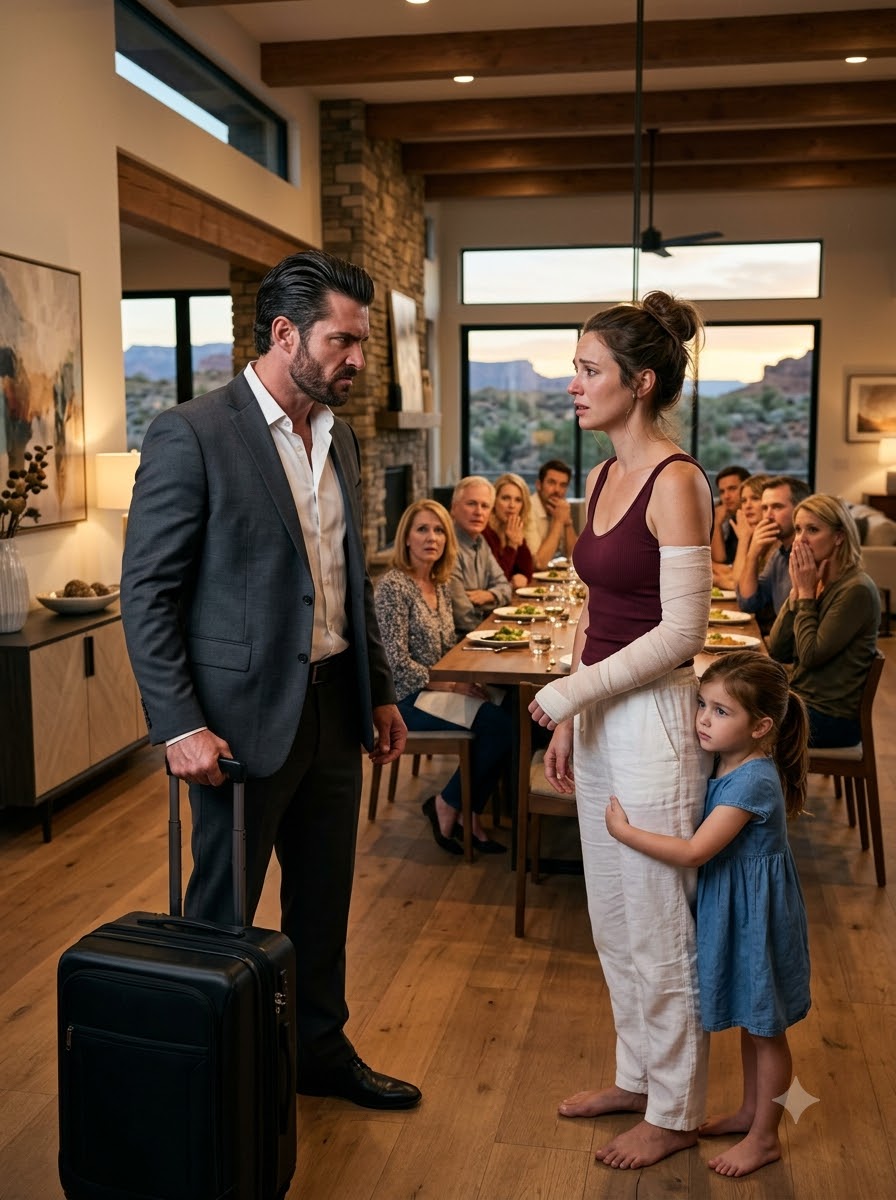
And because I was successful at providing those things, I told myself my family must be happy.
I was wrong.
The conference I had been attending in Seattle ended earlier than expected. Instead of calling Laura, I changed my flight and traveled straight home to Phoenix.
I pictured Mia yelling, “Daddy!” the moment I walked through the door.
I imagined Laura smiling in surprise.
Maybe we would order pizza, put on a movie, and spend the evening together.
Those simple thoughts remained in my mind throughout the trip from the airport.
Then I unlocked the front door.
The first thing that reached me was the smell.
Roasted meat.
Fried appetizers.
Sweet perfume.
Wine.
The second thing I noticed was the sound.
Laughter carried through the living room. Glasses clinked. Women spoke loudly over one another.
I glanced down.
Shoes nearly covered the entire entryway.
High heels, sandals, expensive leather flats.
At least twenty pairs.
I frowned.
Nobody had told me about a gathering.
Then I heard my mother speaking.
“My son insisted I buy this dress,” she announced proudly. “He said a woman like me shouldn’t have to dress modestly now that he’s doing so well.”
More laughter followed.
My mother, Diane Hayes, had been staying with us for almost a year.
She was sixty-two and owned a house in Maryland, but after complaining about her knees, loneliness, and the difficulty of maintaining a home alone, she asked to stay with us “for a little while.”
Laura had agreed before I could even respond.
“She’s your mother,” she had said. “Of course she can stay.”
In the beginning, everything appeared normal.
Then, gradually, things started to change.
Laura became quieter.
She lost weight.
Despite the Arizona heat, she started wearing long sleeves.
Mia, who normally filled every room with talking and laughter, suddenly went silent whenever my mother walked in.
I noticed.
But I never genuinely questioned it.
Whenever I asked Laura if something was wrong, Diane somehow responded before she could.
“Laura is tired because she isn’t used to managing a proper household.”
Or:
“Mia is going through a shy phase.”
Or:
“Your wife takes things too personally, Ethan.”
And I accepted those explanations.
Not because they actually made sense.
But because believing them was easier than facing the possibility that something could be seriously wrong.
That afternoon, I finally witnessed what my refusal to look carefully had cost my family.
I walked farther down the hallway.
The living room had been completely rearranged.
Two folding tables filled the room, covered with dishes, serving bowls, flowers, wine bottles, and half-eaten plates.
Around twenty women sat around them, laughing and eating.
My mother sat at the head of the table in a bright burgundy dress, holding a wineglass as though she were hosting a banquet in a home that belonged to her.
One guest leaned toward her.
“Where’s your daughter-in-law? I haven’t seen her sit down once.”
My mother smiled.
“She’s in the kitchen where she’s useful.”
Several women laughed.
Then Diane added, “And I have the child helping her. You have to teach girls responsibility while they’re young. Otherwise they grow up expecting everyone else to take care of them.”
My stomach tightened.
I looked toward the kitchen.
And everything inside me went cold.
Laura was standing at the sink.
Her hair was damp with sweat.
Dirty dishes covered the entire counter.
Pots were piled beside plates. Glasses overflowed from one side of the sink. Serving trays were leaning dangerously against the backsplash.
And next to Laura stood Mia.
My five-year-old daughter.
She was standing on a plastic step stool.
Her tiny hands were submerged in steaming dishwater.
She struggled to lift a heavy glass platter almost as wide as her torso.
Her fingers were bright red.
Her skin looked wrinkled and irritated from the hot water and detergent.
But she wasn’t crying.
That frightened me more than tears would have.
A woman entered the kitchen carrying an empty glass.
Without even glancing at Laura, she placed it on the counter.
“Could you bring me another iced tea? And cut some fresh fruit while you’re at it?”
Laura lowered her eyes.
“Of course.”
She turned toward the refrigerator.
That was when I noticed the bandage wrapped around one of her fingers.
Then I spotted another mark near her wrist.
A reddish burn disappearing beneath her sleeve.
My suitcase fell from my hand.
It hit the floor with a loud crack.
Every voice went silent. My mother turned.
The color immediately vanished from her face.
“Ethan?”
Laura went completely still.
Mia looked directly at me.
For one brief second, I expected her to jump down and race into my arms.
She didn’t.
She kept holding the platter.
“Daddy,” she whispered, “I have to finish first.”
I stared at her in disbelief.
“What?”
Her voice became even quieter.
“Grandma said if I don’t finish all the dishes, Mommy and I can’t eat dinner.”
And in that moment, the life I believed I understood completely shattered around me.
PART 2 — “PLEASE DON’T MAKE GRANDMA ANGRY”
I walked across the kitchen without saying anything.
Carefully, I took the glass platter from Mia’s hands.
Then I lifted her down from the stool.
The instant her feet touched the floor, she wrapped both arms around my neck.
Her hands were cold despite the steaming water.
Her fingertips were wrinkled and irritated.
She buried her face against my shoulder.
“My hands hurt, Daddy.”
I swallowed painfully.
Then she whispered something that still hurts every time I think about it.
“Please don’t tell Grandma I said that. She’ll get mad at Mommy.”
I closed my eyes.
My five-year-old daughter was terrified that admitting she was hurting would result in her mother being punished.
How had I failed to notice this?
How had I lived in the same house and never recognized what was happening?
I kissed Mia’s hair.
“You haven’t done anything wrong.”
She looked unsure.
I carried her toward the hallway.
“Go to your room for me, sweetheart. Take your favorite stuffed rabbit and stay there until I come get you.”
“Am I in trouble?”
That question nearly broke me.
“No.”
I crouched down in front of her.
“You are absolutely not in trouble.”
She nodded and quickly walked away.
She didn’t protest.
She didn’t ask questions.
She followed my instructions immediately.
Another warning sign I had failed to see.
When her bedroom door closed, I went back to the kitchen.
Laura remained beside the sink.
“Show me your hands,” I said.
“Ethan…”
“Please.”
She instantly pulled them behind her back.
That reaction told me everything I needed to know.
“I’m fine,” she whispered.
“You’re not.”
Her eyes filled with tears.
“Please don’t turn this into something huge.”
I looked at the woman I loved.
Laura wasn’t afraid for herself.
She was afraid of what might happen if I confronted my mother.
I gently reached toward her wrists.
She flinched.
That single movement cut through me like a knife.
Slowly, I pulled off the thick rubber gloves she had been wearing.
Her hands were swollen.
The skin around her knuckles was cracked.
Several fingertips had small cuts.
Her nails were damaged.
Then I carefully rolled her sleeves upward.
Marks covered her forearms.
Some appeared older.
Others looked recent.
“What happened?”
Laura shook her head.
“Not now.”
Then I heard my mother behind me.
“Ethan, this looks much worse than it is.”
I turned around.
She was standing in the doorway with several guests behind her.
“What exactly am I looking at, then?”
Diane raised her chin.
“Your wife has always been careless. She burns herself. She cuts herself while cooking. She makes everything dramatic.”
Laura lowered her eyes.
That reaction alone told me my mother was lying.
I walked into the living room.
Every person there was watching me.
“This gathering is over.”
Nobody moved.
“You all need to leave.”
A woman sitting near the end of the table gave an awkward laugh.
“Oh, Ethan, come on. Your mother is just old-fashioned. She believes children should help around the house. There’s nothing wrong with a little discipline.”
I looked directly at her.
“My daughter is five.”
The woman’s smile disappeared.
“And my wife is not here to serve you.”
My mother slammed her hand down on the table.
“This is ridiculous!”
“No. What’s ridiculous is that twenty people are sitting in my house eating while my wife and child are working in the kitchen with injured hands.”
“This is my home too!”
“No, Mom.”
My voice sounded calmer than I felt.
“It isn’t.”
She stared at me.
“You invited me to live here.”
“I invited you to be part of our family. I never gave you permission to control it.”
Her expression shifted.
The friendly hostess vanished.
What stood before me was someone furious because she had lost control.
“So this is what she’s done?” Diane shouted, pointing at Laura. “She finally turned you against your own mother?”
Laura stepped backward.
Fear flashed across her face.
“No one turned me against anyone.”
I pointed toward the door.
“Everyone out.”
Several guests began gathering their purses.
Others stayed seated, uncomfortable but clearly curious.
Then Diane turned toward Laura.
“You useless little—”
“Don’t.”
I stepped between them.
But my mother wasn’t listening anymore.
She grabbed a heavy cooking pot from the nearby serving table.
Everything happened within a second.
She swung it toward Laura.
I moved.
Hot broth splashed across my shoulder and the side of my chest.
Pain tore through me.
Laura screamed.
The pot slammed onto the floor. Twenty people went completely silent.
My mother stared at me.
And for the first time in my life, I looked at Diane Hayes without seeing “Mom.”
I saw a woman who had just attempted to hurt my wife.
A woman my daughter was frightened of.
A woman I had allowed inside our home.
“Leave.”
My voice was quiet now.
Perhaps that scared her more than shouting ever could.
“Ethan—”
“Get out.”
The guests finally began moving.
One by one, they collected their belongings and hurried toward the door.
Within minutes, the room that had been full of laughter was almost empty.
My mother started crying.
Not quiet tears.
Huge, dramatic sobs.
“How can my own son treat me like this?”
I said nothing.
I pulled out my phone.
And called emergency services.
For illustrative purposes only
PART 3 — THE TRUTH LAURA HAD BEEN HIDING
The paramedics arrived first.
Two police officers followed shortly afterward.
By then, the pain spreading across my shoulder and chest had grown worse, but I barely registered it.
My attention stayed on Laura.
Somehow, she seemed smaller.
As though she had spent months trying to disappear within herself.
One of the paramedics asked her to sit down.
“Ma’am, I need to examine your arms.”
Laura hesitated.
Her eyes immediately went toward my mother.
Diane sat rigidly in an armchair, her arms folded across her chest.
Even with police officers nearby, Laura still looked afraid of her.
I knelt beside my wife.
“You don’t have to hide anything anymore.”
Her eyes met mine.
There was disbelief in them.
Not relief.
Not yet.
Slowly, Laura pulled her sleeves up.
The paramedic’s expression changed.
There were more injuries than I had noticed in the kitchen.
Some were healing.
Others were recent.
A deep red mark stretched across her wrist.
The paramedic pointed at it.
“How did this happen?”
Laura said nothing.
“Laura,” I whispered.
She swallowed.
“This morning.”
My entire body became still.
“What happened this morning?”
She kept her eyes on the floor.
“Diane said the pot on the stove wasn’t heating fast enough. I reached for a spoon to check it.”
My mother interrupted.
“Oh, for heaven’s sake—”
One of the officers raised a hand.
“Let her finish.”
Laura continued.
“She grabbed my wrist and pressed it against the metal rim.”
I felt the room tilt.
“She did what?”
Laura’s voice cracked.
“She said maybe pain would teach me to pay more attention.”
I looked toward my mother.
Diane’s expression showed irritation.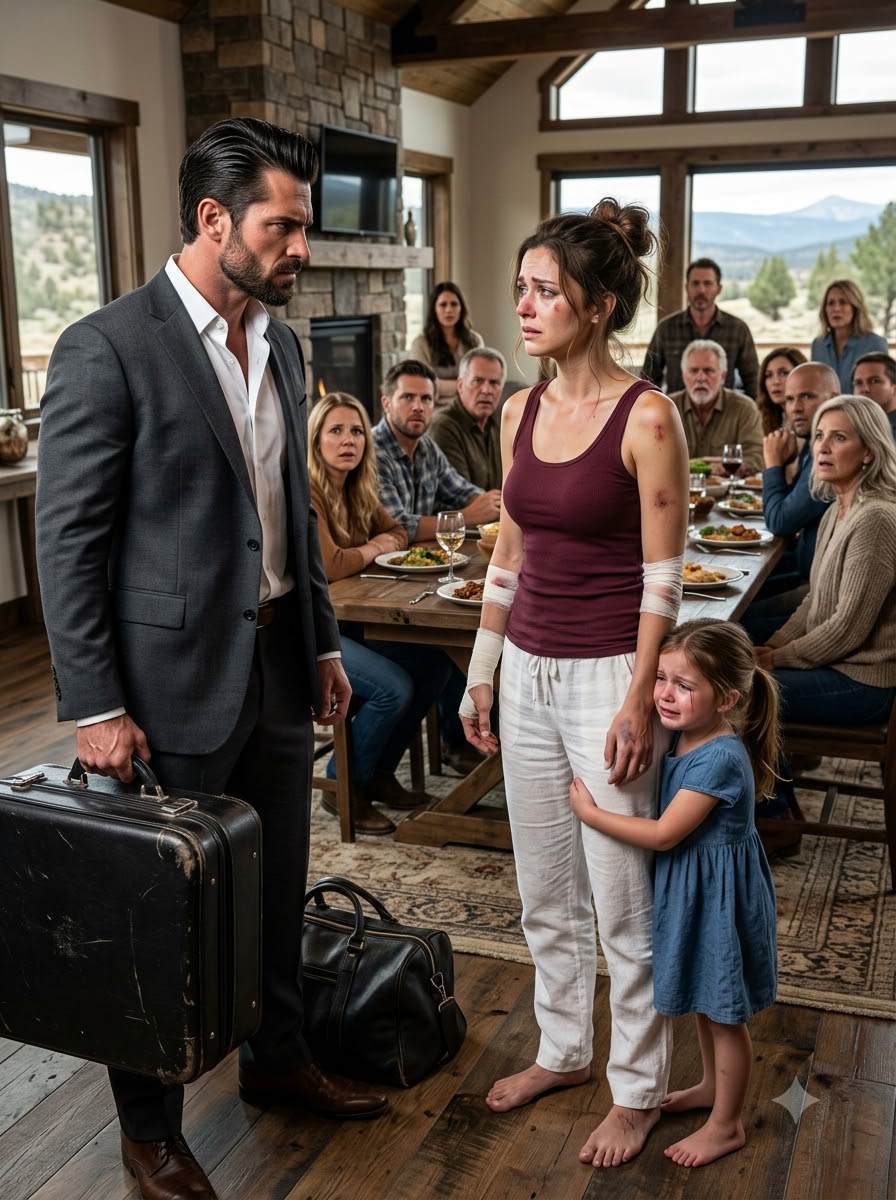
Not horror.
Not regret.
I knew then that Laura was telling the truth.
Before I could say anything, a small voice came from the hallway.
“Daddy?”
Mia stood outside her bedroom.
Barefoot.
Holding her stuffed rabbit.
I immediately went toward her.
“You were supposed to stay in your room, sweetheart.”
“I know.”
She looked toward the police officer.
“But he needs to see Grandma’s drawer.”
My mother’s head snapped around.
“What drawer?”
Mia shrank against me.
I wrapped one arm around her.
“It’s okay. Tell me.”
“The locked one.”
“What’s inside it?”
Mia lowered her voice.
“The bad videos.”
My mother stood.
“She doesn’t know what she’s talking about.”
The officer stepped between Diane and Mia.
“Please sit down, ma’am.”
Mia looked at me.
“Grandma keeps videos of Mommy crying.”
I stopped breathing.
“She said if you ever saw them, you would think Mommy was bad and make us leave.”
Laura covered her face.
My heart sank.
“Mia,” the officer said gently, “did you see one of those videos?”
She nodded.
“Grandma showed me.”
“What happened in it?”
“Mommy was cleaning the floor.”
Mia looked confused.
“Grandma was laughing because Mommy was crying.”
The room fell completely silent.
I turned toward Laura.
“What videos?”
She wiped her eyes.
“Your mother started recording me a few months after she moved in.”
“Why?”
“She said she was collecting evidence.”
“Evidence of what?”
“That I was disrespectful. Lazy. Unstable.”
Laura gave a broken laugh.
“She would provoke me for hours. Sometimes she’d insult me or keep Mia from resting. If I finally begged her to stop, she would pull out her phone.”
I stared at her.
“She threatened to show me?”
Laura nodded.
“She said she could edit the recordings to make it seem like I was screaming at an elderly woman.”
I could barely get the words out.
“And you believed I would side with her?”
Laura looked directly at me.
The sadness in her eyes hurt more than anger.
“Ethan, you already had.”
I froze.
She continued quietly.
“Every time I tried to tell you something was wrong, your mother explained it away before I could finish.”
I remembered every conversation. Mom is just adjusting.
Mom grew up differently.
Mom means well.
Mom’s lonely.
Mom’s old-fashioned. Laura looked directly at me.
“And every time, you accepted her version because it was easier.”
I had no argument.
She was right.
I had been so proud of being a peaceful man that I failed to realize my “peace” depended on Laura remaining silent.
I had confused the absence of confrontation with having a healthy home.
The truth was much uglier.
There had been a war taking place beneath my own roof.
And Laura and Mia had been fighting it alone.
PART 4 — THE LOCKED DRAWER
The officers instructed Diane not to touch anything.
Naturally, she immediately declared that she wanted to pack.
“I will not stay in a house where I’m treated like a criminal.”
One officer looked straight at her.
“You just threw hot liquid at your daughter-in-law and injured your son when he stepped in front of her. You’re going to remain where we can see you until we finish.”
Diane’s expression hardened.
“This family has become completely insane.”
While one paramedic treated my burns, I gave the officer permission to search my mother’s bedroom.
A small cabinet stood beside her dresser.
One drawer was locked.
I used the spare master key.
Inside, underneath scarves and folded documents, we discovered an old smartphone.
I recognized it immediately.
It had once belonged to me.
Months earlier, I had given it to Diane after she complained that her own phone wasn’t working properly.
What she apparently didn’t realize was that the device was still connected to my cloud account.
Later that night, after speaking with a lawyer and following instructions concerning the evidence, I accessed the synchronized backup.
There were more than thirty videos.
I watched the first one.
Laura was kneeling on the kitchen floor.
She was scrubbing between the tiles with a tiny brush.
My mother’s voice came from behind the camera.
“Look how dramatic she is. A grown woman complaining about cleaning when her husband works all day to support her.”
Laura said nothing.
She continued scrubbing.
The next recording showed Mia struggling with a soaked towel.
She could barely twist it.
My mother said, “If you’re old enough to scatter toys everywhere, you’re old enough to clean.”
I paused the video.
My hands were trembling.
I opened another.
Laura stood near the dining table.
“Could I please eat something?”
My mother laughed.
“The guests haven’t finished yet.”
“I haven’t eaten since breakfast.”
“You’ll eat when the people I invited are satisfied.”
I closed my eyes.
There were more.
Far too many.
Then I found one that lasted less than half a minute.
Mia was sitting on the kitchen floor.
She was crying.
Her hands were red from detergent.
The camera moved closer.
My mother’s voice said, “Stop crying before your father gets home. If he sees you acting like this, he’ll realize your mother doesn’t know how to raise you.”
Mia sniffled.
“My hands hurt.”
“Then you should have worked faster.”
I shut the laptop.
I barely reached the bathroom before becoming physically sick.
For a long time, I sat on the floor.
I wanted to aim every bit of my anger at my mother.
But another truth kept forcing itself into my mind.
I had helped create the conditions that allowed all of this to continue.
Not because I knew.
I didn’t.
But because I had refused to listen.
I had noticed Laura changing.
I had noticed Mia becoming frightened.
I had noticed my mother answering questions that weren’t meant for her.
And instead of asking why, I had chosen convenience.
I wanted to believe everyone could simply “get along.”
My wife and daughter had paid the price for that comfort.
The following morning, I took Laura to a doctor for a complete examination.
Her medical report documented injuries at different stages of healing, skin irritation caused by repeated exposure to cleaning chemicals, burns, cuts, and inflammation in both wrists.
We also arranged for Mia to meet with a child psychologist.
After speaking with her, the psychologist sat down with Laura and me.
“Mia is showing significant anxiety,” she explained. “She appears to associate her grandmother with punishment and deprivation.”
Laura squeezed my hand.
The psychologist continued.
“What matters now is consistency. She needs to know that when she says something hurts or frightens her, the adults responsible for her will listen and protect her.”
Those words settled heavily inside me.
Listen.
Protect.
Two things a father should never need to be reminded to do.
Yet I did.
For illustrative purposes only
PART 5 — THE DAY MY MOTHER LEFT
The legal process wasn’t dramatic.
There was no magical courtroom moment where everything was resolved overnight.
There were statements.
Medical reports.
Interviews.
Documents.
Meetings with attorneys.
Copies of recordings.
After reviewing the evidence, we were able to obtain an emergency protective order preventing Diane from contacting Laura or Mia.
The immediate change was much simpler.
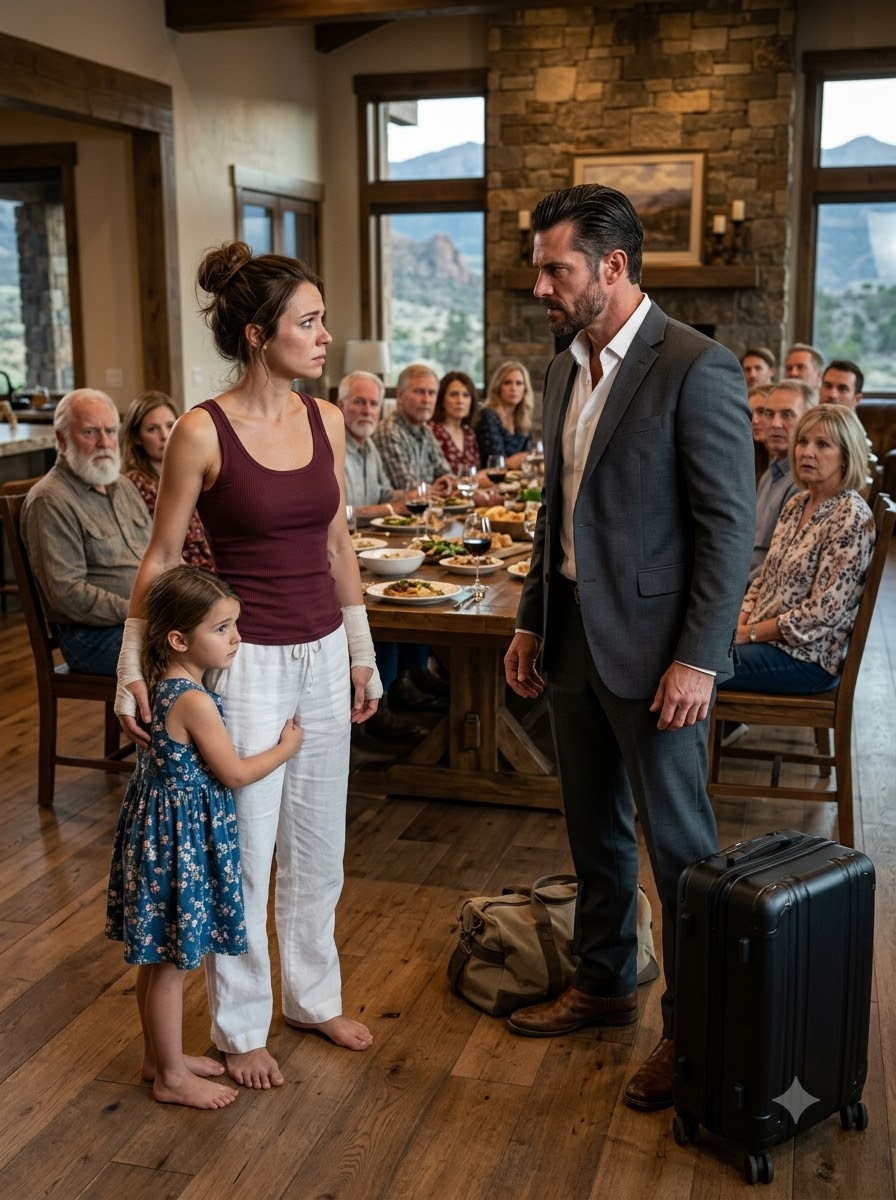
My mother had to leave our home.
Police officers were present while she packed.
I carried two suitcases into the hallway.
Diane followed me, crying.
“Ethan, please. I lost control.”
I turned toward her.
“For a year?”
She stared at me.
“What?”
“You lost control for a year?”
She wiped her cheeks.
“I was trying to teach Laura how to run a household.”
“By hurting her?”
“I never meant to seriously hurt anyone.”
“What about Mia?”
My mother rolled her eyes.
“I gave that child structure.”
“She is five.”
“You spoil her.”
“She was afraid she wouldn’t be allowed to eat.”
Diane looked irritated.
“You’re twisting everything.”
“No.”
I shook my head.
“For the first time, I’m seeing everything clearly.”
Her expression hardened.
“I raised you.”
“And I will always acknowledge that.” I moved a little closer.
“But raising me does not mean you own me. And it certainly does not give you ownership over my wife or daughter.”
She stared at me as though I had broken some sacred agreement.
“A good wife respects her husband’s mother.”
“A good wife is not a servant.”
I gestured toward the apartment.
“And a five-year-old child is not unpaid help.”
Diane folded her arms.
“So where am I supposed to go?”
“Home.”
“I don’t have a home here.”
“You have a paid-off house in Maryland.”
She looked offended.
“You expect me to live there by myself?”
“You also have two other grown children.”
That stopped her tears.
Her expression shifted.
“Your brother doesn’t have enough space.”
“Then stay with your sister.”
“She can’t afford to help me the way you do.”
There it was.
The truth, finally spoken aloud.
I had been sending my mother money every month.
Not because she lacked food or somewhere to live.
Her retirement income covered her basic expenses, and she owned her home outright.
My money covered restaurants, clothes, vacations, gifts, parties.
A lifestyle.
And apparently, that lifestyle had become more important to her than the people paying for it.
“Then,” I said, “you should have treated my family better.”
I set the final suitcase outside.
Then I changed the code on the electronic lock.
Diane watched.
The keypad beeped.
“You’re locking your own mother out?”
“I’m protecting my wife and daughter.”
“We’re blood.”
I looked at her.
“Blood is not permission to hurt people.”
Then I shut the door.
She continued shouting from the hallway for several minutes.
I didn’t open it.
Within hours, my phone started ringing.
My brother Mark called first.
“Have you lost your mind?”
“No.”
“Mom says you threw her into the street.”
“She owns a house.”
“That’s not the point!”
I listened as he defended her for almost a minute.
Then I sent him a photograph of Laura’s arm.
Silence.
Finally, he said, “You know Mom can be… intense.”
I nearly laughed.
“If you think that’s all this is, invite her to live with you.”
“What?”
“Give her your bedroom. Send her monthly spending money. Let her invite twenty friends over whenever she wants. Then have your wife serve them.”
“That’s different.”
“No.”
I ended the call.
Predictably, Mark never offered to take her in.
Neither did anyone else.
An aunt messaged me saying, “A good son forgives his mother.”
A cousin wrote that Laura was probably exaggerating because she wanted Diane gone.
Another relative accused me of choosing my wife over my family.
That one almost made me laugh.
My wife and daughter were my family.
So I stopped explaining myself.
Instead, I posted one video in our family group.
No explanation.
No angry paragraph.
No defense.
Just the recording of Laura scrubbing the floor while my mother mocked her.
The chat went silent.
Then someone left the group.
Then another.
My cousin deleted her accusations.
Mark stopped messaging me.
Sometimes a single piece of evidence says more than a thousand arguments ever could.
PART 6 — LEARNING HOW TO FEEL SAFE AGAIN
Eventually, my mother returned to Maryland.
At first, she told everyone Laura had manipulated me.
Then she claimed I had always been an ungrateful son.
Then she blamed stress.
Then loneliness.
Then “generational differences.”
Anything except herself.
Several of the women who had attended that final gathering stopped talking to her.
One of them—the same woman who had entered the kitchen demanding iced tea while Laura was overwhelmed—called my wife several weeks later.
Laura almost refused to answer.
But eventually, she did.
The woman spoke for several minutes.
When Laura ended the call, she sat quietly.
“What did she want?” I asked.
“She apologized.”
“For what?”
“For seeing things she knew weren’t right and pretending they were normal.”
Laura stared down at her hands.
“She said she was ashamed.”
Then she told me something I’ve carried with me ever since.
“Cruelty doesn’t always survive because cruel people are powerful. Sometimes it survives because everyone around them decides silence is safer.”
She was right.
And I had been one of those silent people without even realizing it.
For the next several weeks, my employer allowed me to work from home.
I changed my priorities.
I took Mia to kindergarten.
I learned how to do her hair.
My first attempts were terrible.
One ponytail would sit higher than the other.
Braids came undone before we even reached school.
Mia thought it was hilarious.
“Daddy, my hair looks confused.”
She was right.
And I loved hearing her laugh about it.
We bought a dishwasher.
The first evening we turned it on, Mia sat cross-legged in front of the machine.
She stared through the small window.
“That thing washes all of them?”
“Every plate.”
“And the cups?”
“Yes.”
“And forks?”
“Those too.”
Her expression became serious.
“So I don’t have to stand on the stool anymore?” My smile faded.
I knelt down beside her.
“No, sweetheart.”
“Ever?”
“Not like that.”
I held her little hands.
“You’re five years old. Your job is to learn, play, laugh, make drawings, ask a million questions, and sometimes help Mommy and Daddy with safe little things.”
She immediately wrapped her arms around me.
Laura’s recovery took longer.
Her burns gradually faded.
The cuts healed.
But fear had embedded itself into small, everyday habits.
One evening, she stood beside the couch and asked, “Would you mind if I sat down for a while?”
I looked at her.
“Laura, why are you asking?”
She quickly looked embarrassed.
“I don’t know.”
Another night:
“Is it okay if we order food? I’m tired.”
Another:
“Would you mind if I take a shower before cleaning the kitchen?”
Every question exposed another layer of what she had been through.
One evening, I held both of her hands.
“Laura, please listen to me.”
She looked at me.
“This is your home.”
Her eyes filled with tears.
“You do not need permission to sit down. You do not need permission to rest. You do not need permission to eat. You don’t need permission to exist comfortably in your own house.”
She nodded.
“I know.”
“But?”
She turned her eyes away.
“My mind knows.”
Then she placed a hand against her chest.
“This part still expects someone to get angry.”
I moved closer to her.
“Then I’ll keep reminding you until this part believes it too.”
I began therapy myself.
At first, I questioned whether I even deserved to discuss my feelings when Laura and Mia had suffered so much more.
But my therapist told me something important.
“Accountability isn’t the same as self-destruction. If you spend the rest of your life hating yourself for missing the warning signs, your family still loses. Learn from it. Change your behavior. Become reliable.”
So I did my best.
I stopped trying to defend myself.
When Laura was angry, I listened.
When she cried, I didn’t immediately tell her everything would be okay.
When Mia became frightened by a loud knock, I didn’t tell her she was being silly.
I learned that making someone feel safe wasn’t about simply saying, “You’re safe.”
It meant proving it over and over again.
image
For illustrative purposes only
PART 7 — THE SOUND OF A HOME HEALING
Six months later, our house looked almost identical.
But it sounded completely different.
There was music.
Laughter.
Cartoons.
Mia singing silly songs while she colored.
Laura chatting with friends on the phone.
Cabinet doors opening.
Toys rolling across the floor.
Sometimes I came home to shoes scattered in the hallway, crayons underneath the couch, a half-finished mug of coffee on the table, and stuffed animals taking over every chair.
Before everything happened, clutter had bothered me.
Afterward, it became beautiful.
It meant no one was afraid of making a mistake.
No one was rushing to hide evidence that they had rested.
No one was waiting nervously for footsteps in the hallway.
Our home was imperfect again.
And that imperfection had never felt so peaceful.
That November, Mia’s kindergarten held an autumn sports festival.
She entered the sack race.
Laura and I stood near the finish line, cheering so loudly that the other parents started laughing at us.
“Go, Mia!”
She bounced forward, nearly fell, recovered, and somehow crossed the finish line first.
“I WON!”
She raced toward us.
I lifted her into the air.
“You were incredible!”
“I’m the fastest sack jumper in the whole world!”
“Obviously.”
Laura laughed.
Then I noticed someone standing on the other side of the fence.
My mother.
Diane stood on the public sidewalk, far enough away to remain outside the restricted area.
She was wearing an old brown coat.
In one hand, she held a small bag.
Even from that distance, I recognized the packaging.
Strawberry candies.
Mia’s favorite.
For several seconds, my mother and I simply looked at each other.
She seemed older.
Smaller.
There were no friends around her.
No expensive dress.
No audience.
No table overflowing with food.
Just one woman standing alone outside a fence.
And yes, part of me felt sad.
She was still my mother.
The childhood memories were still there.
Birthdays.
School mornings.
Holiday dinners.
Times she had comforted me when I was young.
People are complicated.
Someone can have loved you once and still become unsafe.
Someone can have done good things and still need to face consequences for terrible ones.
I had finally learned that compassion and access were not the same thing.
I could feel sadness for her without opening that door again.
For months, Diane had been sending messages.
The first ones were angry.
Then they became defensive.
Then came apologies that weren’t really apologies.
“I’m sorry Laura misunderstood my intentions.”
“I’m sorry everyone became upset.”
“I only wanted the household to function properly.”
Every message shifted the responsibility onto someone else.
Then, one week before the school festival, something changed.
I received another text.
This one read:
“Ethan, I watched the videos. All of them. Hearing myself speak that way made me ashamed. I kept telling myself I was teaching discipline, but there is no excuse for what I did. I hurt Laura. I frightened Mia. I betrayed your trust. If they ever decide they want an apology from me, I will give one without defending myself.”
I read it twice.
Then I put my phone away.
I didn’t respond.
Not because I wanted revenge.
Because remorse does not automatically rebuild trust.
And forgiveness, if it ever came, did not mean Diane was entitled to a relationship with Mia.
That decision partly belonged to Mia when she was old enough and emotionally ready.
Not to my mother’s guilt.
Not to my relatives.
Not even entirely to me. “Daddy?”
Mia touched my cheek.
I realized I was still staring toward the fence.
“What are you staring at?”
I turned back toward her.
“You.”
She laughed.
“You weren’t!”
“I was thinking about how lucky I am.”
“That’s better.”
I looked toward the sidewalk one last time.
My mother was still standing there.
Then I took Laura’s hand.
And we walked away.
PART 8 — THE QUESTION THAT BROKE MY HEART
We made our way toward the food stalls.
Mia picked grilled corn, sweet tea, and a huge slice of chocolate cake.
“Can we share it?” Laura asked.
Mia looked horrified.
“I thought you said it was mine.”
We all laughed.
“All right,” I said. “You get first choice.”
Mia carefully studied the slice.
Then something shifted in her expression.
She pulled her hand away.
“Daddy?”
“Yes?”
“Am I allowed to eat it now?”
Laura’s smile disappeared.
So did mine.
There it was.
One small, quiet question.
Six months had gone by.
We had changed the locks.
My mother was gone.
The injuries had healed.
Therapy was helping.
Our home was filled with laughter again.
And yet, somewhere inside my daughter, there was still the memory that food could be taken away if she didn’t work hard enough.
I crouched beside her.
“Mia, look at me.”
She looked directly at me.
“You never have to earn food.”
She listened carefully.
“Not in our family. Not ever.”
“What if I don’t clean something?”
“You still eat.”
“What if my room is messy?”
“You still eat.”
“What if I’m naughty?”
Laura knelt beside us.
“You still eat.”
Mia looked from one of us to the other.
“Even if I spill something?”
“Even then,” I said.
She considered that for a moment.
Then her entire face lit up.
“Okay.”
She pointed dramatically toward the cake.
“Then I want the corner with the most frosting.”
Laura laughed through her tears.
“That is definitely my daughter.”
We sat together on a bench.
Mia ate her chocolate cake.
Laura rested against my shoulder.
And for the first time in months, I let myself simply watch them.
My family.
Not the family I was born into.
The family I had chosen.
The family that needed me not simply to provide money or a home, but to listen.
To notice.
To protect.
For most of my life, I had believed being a good son meant avoiding conflict with my mother.
I believed gratitude demanded endless patience.
I believed family loyalty meant forgiving everything.
Now I knew better.
Family is not a debt you repay by sacrificing the people you love.
Becoming someone’s mother, father, brother, sister, or grandparent does not give them permanent permission to cross boundaries.
Respect does not mean accepting cruelty.
Forgiveness does not require giving someone access again.
And establishing a boundary does not destroy a healthy family.
Sometimes boundaries are exactly what finally allow a family to heal.
That evening, we came home tired and happy.
Mia fell asleep in the car.
I carried her upstairs.
Laura opened the door.
I tucked Mia into bed, placed her stuffed rabbit beside her, and kissed her forehead.
When I came back downstairs, Laura was standing by the window.
“You okay?” I asked.
She nodded.
“Better.”
I wrapped my arms around her.
After a moment, she whispered, “You know something?”
“What?”
“The house feels like ours again.”
I looked around.
There were crayons scattered across the table.
One of Mia’s shoes was upside down beside the couch.
A cereal bowl had been forgotten near the sink.

Nothing was perfectly organized.
And I had never loved our home more.
Before going upstairs, I walked over to the front door.
I checked the lock.
Once.
Not three times.
Not nervously.
Just once.
Then I switched off the light.
For years, I believed the worst thing that could happen to me was losing my relationship with my mother.
Eventually, I realized something much worse had almost happened.
I had nearly lost my wife’s trust.
I had nearly taught my daughter that adults could hurt her while her father stood by and looked away.
I cannot change the months when I failed to recognize what was happening.
But I can choose what kind of husband and father I will be from this point forward.
And when I closed our bedroom door that night, I finally understood what home was supposed to feel like.
Not perfect.
Not silent.
Not controlled.
Safe.
And for the first time in a very long time, all three of us knew that no one on the other side of that front door had the power to take that feeling away from us again.
