


Part 1
My grandfather died with my hand clasped around his, while the rest of our family was nowhere to be found. His final breath carried seven words that would soon tear them apart: “Look behind the family portrait after I’m gone.”
For six months, I had fed him, changed his sheets, driven him to appointments, and slept in a chair beside his bed whenever the pain became unbearable. My father came once, for eleven minutes, to ask if he had updated his will. My mother sent flowers with the price tag still attached. My younger sister, Chloe, never came at all.
“He doesn’t even recognize anyone,” Chloe had said over the phone. “Why waste my time?”
Grandfather recognized everything.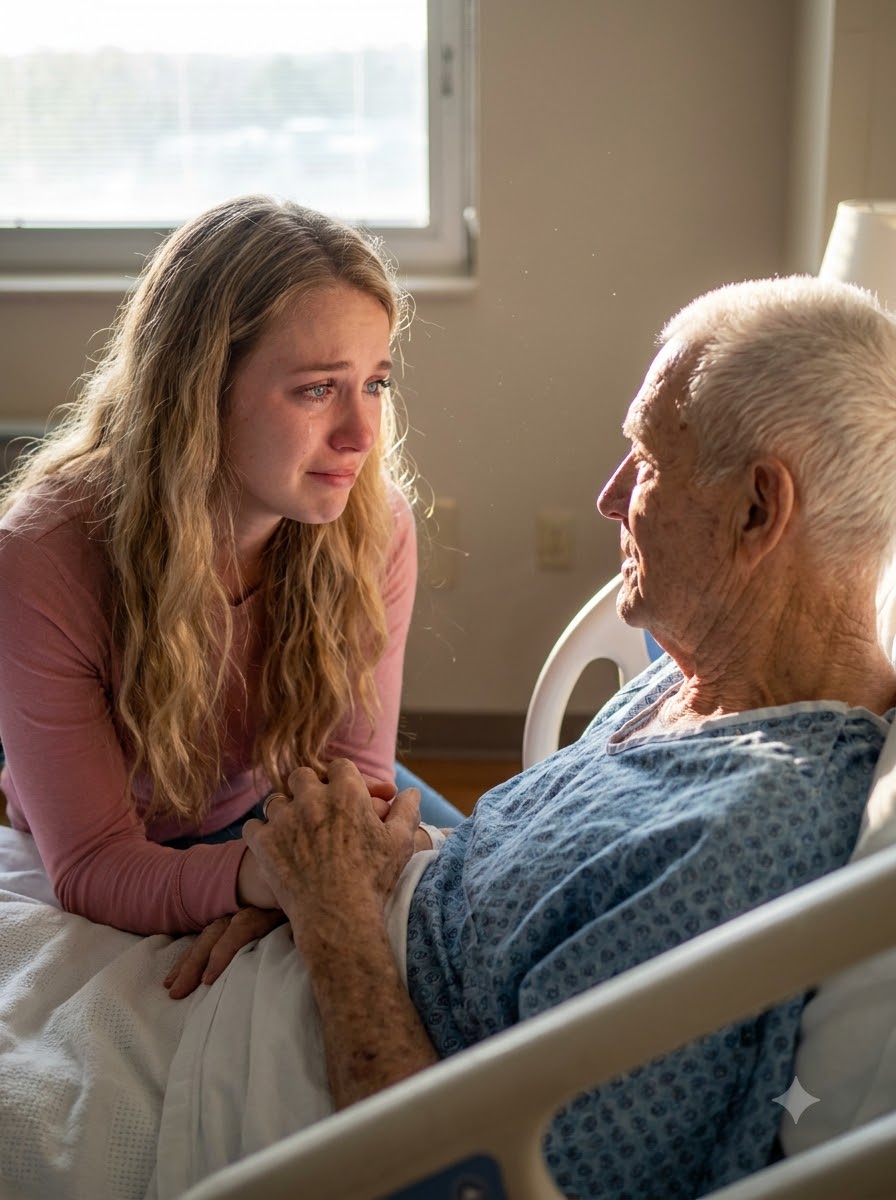
At the funeral, my parents dressed in black designer clothes and acted out their grief like actors competing for awards. Chloe only cried when people were watching. After the burial, we returned to Grandfather’s old house as attorney Raymond Vance read the will.
The house went to my father. His investment accounts went to my mother. His jewelry went to Chloe.
“And to Genevieve?” my sister asked, smiling across the table at me.
Mr. Vance adjusted his glasses. “A cedar music box and its contents.”
Chloe laughed. “You wiped his mouth for six months and got a toy?”
My mother placed her hand on my wrist with fake sympathy. “Your grandfather knew who was capable of managing real assets.”
My father leaned back in his chair. “You can clear your things out tonight. We’re listing the house this week.”
I looked at the three of them and said nothing.
They mistook my silence for defeat.
What none of them knew was that I worked as a forensic accountant for a federal contractor. I spent my days tracing hidden transfers, shell companies, forged authorizations, and money disguised as family gifts. During Grandfather’s illness, he had asked careful questions about trusts, property records, and financial crimes. I had assumed he was protecting himself.
Now I realized he had been preparing me.
That night, after my family left for a celebratory dinner, I returned to the dark house. The family portrait hung in the middle of the living room: my grandparents, my parents, Chloe, and me at twelve, standing at the edge of the frame.
I lifted it from the wall.
Behind it was a steel safe.
Inside were property deeds, bank statements, copies of canceled checks, three flash drives, and a sealed letter with my name written in Grandfather’s trembling hand.
The first line read:
Genevieve, everything they believe they inherited was stolen.
Part 2
I read the letter twice before I opened the files.
Grandfather explained that after my grandmother died, my father had taken control of his finances “to help.” Instead, he forged his signature on loan documents, transferred two rental properties into a company he secretly owned, and used his investment account to cover his failing construction business. My mother had helped by pretending to be Grandfather during phone calls with the bank. Chloe had received nearly two hundred thousand dollars for a boutique that never opened.
Grandfather had uncovered the theft eighteen months earlier. Instead of confronting them, he hired a private investigator, reconstructed the paper trail, and quietly moved the remaining legitimate assets into the Harrison Vance Irrevocable Trust.
I was the sole trustee.
The cedar music box contained the original trust seal and a small brass key.
I called Mr. Vance at six the next morning.
He arrived within forty minutes. By sunrise, his face had turned pale.
“This is enough for civil recovery,” he said, staring at the forged deeds. “Possibly criminal charges.”
“Possibly?”
He inserted one of the flash drives. A video appeared. My father stood beside Grandfather’s hospital bed, pressing a document beneath his hand while he was heavily sedated.
Mr. Vance swallowed. “Definitely criminal.”
We proceeded carefully. I hired a digital examiner, notified the banks, froze disputed transfers, and documented every call my family made.
They made plenty.
My father ordered me out of the house.
My mother demanded the music box.
Chloe sent a voice message laughing: “Don’t get sentimental, Genevieve. Grandpa chose the winners.”
I saved it. Then they became even more reckless.
Chloe attempted to auction Grandfather’s jewelry before probate was finalized. My father signed an agreement to sell the house to one of his business partners for half its actual value. My mother withdrew funds from an account that was already under legal review.
Every move became another brick in the wall closing around them.
Three days later, they summoned me to a “family meeting” at the house. I arrived in a plain gray suit, carrying nothing but a leather folder.
Chloe lounged in Grandfather’s chair, showing off the diamond necklace she had inherited. “You have ten minutes,” my father said. “Then security removes you.”
I set a single document on the table.
It was a temporary restraining order preventing the sale of the house.
My mother’s smile disappeared. “What did you do?”
“What Grandfather asked me to do.”
Chloe rolled her eyes. “With what money? Your little salary?”
I glanced at her necklace. “That diamond was purchased with funds taken from Grandfather’s medical account.”
Her fingers stopped around it.
My father ripped the order in half. “Paper doesn’t scare me.”
The front door opened behind him.
Mr. Vance walked in with two court-appointed officers and a forensic imaging team.
I watched my father’s expression change.
For the first time, he realized I had not come there to beg.
I had come to inventory everything.
Part 3
The final showdown took place two weeks later in probate court.
My family entered dressed like victims. My father carried a cane he had no need for. My mother held tissues. Chloe wore no jewelry.
Their attorney claimed Grandfather had been confused, manipulated, and emotionally dependent on me.
Then Mr. Vance played the recordings.
Grandfather appeared on the courtroom screen, thin but alert, sitting beside his doctor and two independent witnesses.
“My son believes illness made me stupid,” he said. “It only made me quiet.”
My father stopped breathing.
He explained the forged deeds, the stolen investments, and the pressure put on him while he was sedated. Then he stared directly into the camera.
“Genevieve received nothing under the old will because I gave her something stronger than an inheritance. I gave her lawful control of the trust and the evidence necessary to protect it.”
Chloe whispered, “No.”
The judge examined the trust documents, medical evaluations, bank records, digital files, and hospital footage. The forged transfers were canceled. The house, rental properties, and remaining investments were returned to the trust.
Then the detective waiting near the courtroom doors stepped forward.
My father was arrested for financial exploitation of an elderly person, forgery, and fraud. My mother was charged with conspiracy and identity theft. Chloe faced civil claims for knowingly accepting stolen funds and criminal charges after investigators discovered she had submitted fake invoices to justify the transfers.
My father turned toward me as the officer handcuffed him. “You’re destroying your own family.”
I stood. “No. I’m ending what you did to the only person who acted like family.”
My mother started sobbing. “Genevieve, please. We can fix this privately.”
“That was Grandfather’s mistake,” I said. “He kept your cruelty private too long.”
Chloe lunged at me, but an officer stopped her. “You think you’ve won?” she hissed.
I held her gaze. “I think he finally has.”
My father accepted a plea deal that included prison time, restitution, and a permanent ban from managing another person’s finances. My mother received house arrest, probation, and restitution that forced her to sell her vacation property. Chloe lost her boutique, declared bankruptcy, and spent six months in county jail after lying to investigators.
One year later, I opened the Harrison Vance Center, providing free financial counseling and legal referrals for elderly people facing exploitation by relatives.
I kept the family portrait in the lobby. Not because I longed for them, but because truth deserves to be framed.
On the anniversary of Grandfather’s death, I sat beneath that portrait and opened the cedar music box. Inside was one final note:
You were never the weak one, Genevieve. You were simply the only one strong enough to remain kind.
Outside, the center buzzed with voices, sunlight, and life.
For the first time since his funeral, I smiled without anger.
My revenge had never been about taking everything from them.
It was about transforming everything they had stolen into protection for people like him.
EPILOGUE: THE LIGHT BEHIND THE FRAME
The third anniversary of Grandfather’s passing arrived on a crisp, golden Tuesday in early October.
Inside the sunlit atrium of the Harrison Vance Center, the morning rush was beginning to settle. The building—a beautifully restored two-story brick landmark that had once stood as an abandoned branch bank—carried a quiet, purposeful energy. In the main concourse, two staff attorneys sat at consultation tables examining financial disclosures with an elderly couple who had driven three hours from the coast. Near the intake desk, a junior forensic auditor patiently explained how to freeze compromised credit lines to a woman whose own son had quietly opened three credit cards in her name.
I stood on the second-floor mezzanine, resting against the polished oak railing, looking down at the scene with a mug of black coffee warming my hands.
My assistant, Sarah, approached and handed me the morning’s stack of mail.
“The quarterly audit for the trust just came through from Mr. Vance’s office,” Sarah said softly. “Every dollar is accounted for, Genevieve. The center’s endowment is fully funded for the next six years, even after opening the new legal aid branch in Chicago.”
“Thank you, Sarah,” I smiled, taking the folder. “How is the intake list looking for this afternoon?”
“Full,” she replied, her expression becoming gentle. “A seventy-four-year-old retired schoolteacher is coming in at two. Her nephew convinced her to sign a quitclaim deed on her cottage while she was recovering from knee surgery. She thought she was signing a Medicare form.”
A familiar, icy shadow crossed my chest—not from fear, but from righteous, sharp resolve. “Assign her to my personal calendar. We’ll draft the emergency stay before four o’clock.”
Sarah nodded and headed back down the hall toward the research library.
I turned and walked toward my office at the end of the corridor. Hanging directly beside my desk was the grand gold-framed family portrait I had removed from Grandfather’s living room three years earlier.
It remained in the same frame. My parents stood near the center, polished, pristine, and arrogant in their designer clothes. Chloe stood beside them in a floral dress, her posture radiating the spoiled entitlement that had eventually landed her in a county jail cell. And at the far edge stood twelve-year-old Genevieve—quiet, observant, wearing a simple sweater, looking like an afterthought in her own family.
Visitors often asked why I kept a portrait of the people who had tried to destroy my life hanging inside the executive suite of a nonprofit devoted to protecting the elderly.
I kept it there for one simple reason: it was a monument to how illusions collapse beneath the weight of truth.
My father had served sixteen months of his four-year sentence before being released to a halfway house under strict supervision. He lived in a modest one-bedroom apartment in a neighboring county, working as an entry-level clerk at a logistics warehouse. By court order, seventy percent of his wages were automatically garnished every Friday to repay the restitution owed to Grandfather’s estate. I had not spoken to him since the day he was led from probate court in handcuffs.
My mother was still under house arrest in her small townhouse, living on a tiny pension and the goodwill of distant cousins she had not managed to alienate. She spent her days filing frivolous, self-pitying motions in civil court attempting to reduce her restitution payments—motions Attorney Raymond Vance defeated in court in under ten minutes every single time.
Chloe had completed her six-month sentence in county jail a year earlier. Stripped of her boutique, social circle, and stolen jewelry, she now worked retail at an outlet mall two towns away. Once, six months ago, I spotted her across the concourse at a regional train station. She looked at me—wearing my sharp gray suit and holding a briefcase filled with federal audit files—and immediately turned around, disappearing into the crowd. She no longer laughed about cedar music boxes.
I placed my coffee mug on the desk and walked over to the mahogany cabinet in the corner.
I unlocked the glass door, reached toward the back, and lifted out the small cedar music box. The polished wood still carried a faint scent of sweet pine and old parchment.
I settled into my leather armchair, placed the box on my lap, and turned the small brass key on its side.
Soft, delicate notes from a classic lullaby began chiming from the internal metal comb, echoing gently against the high ceilings of my office. It was the same melody Grandfather used to play on the old record player in his living room while I sat beside his armchair reading my accounting textbooks during those long, quiet weekend visits.
I raised the velvet lid and removed the small folded slip of paper resting inside—the final note Grandfather had left beneath the original trust seal:
You were never the weak one, Genevieve. You were simply the only one strong enough to remain kind.
I traced the fading ink of his handwriting with my thumb.
For a long time after his funeral, I wondered whether kindness was a flaw—a vulnerability that selfish, greedy people would always exploit. I had spent six months watching my family treat Grandfather’s declining health as a business opportunity, his gentle nature as stupidity, and my devotion as weakness.
But as I looked around my office now—at the stacks of legal filings that had saved dozens of grandmothers and grandfathers from losing their homes, the framed newspaper articles documenting the national impact of the Harrison Vance Center, and the bright autumn sunlight spilling across my desk—I finally understood.
Kindness wasn’t weakness. Kindness without boundaries was vulnerability, but kindness supported by truth, law, and unyielding courage was the most formidable force on earth.
Grandfather hadn’t given me a toy in his will. He had given me a weapon wrapped in cedar and trusted me to use it properly.
My phone chimed on the desk. A notification appeared from the front intake desk:
Mrs. Gable has arrived early for her two o’clock appointment regarding the quitclaim deed.
I closed the velvet lid of the music box, allowing the final chime of the lullaby to fade quietly into the room. I placed Grandfather’s note safely back inside, turned the brass lock, and returned the cedar box to its place in the cabinet.
I picked up my leather portfolio, straightened my blazer, and took a deep, steady breath.
I passed the family portrait on my way out without giving the three faces in the center a single second glance. My eyes rested only on the quiet twelve-year-old girl standing at the edge of the frame.
I smiled at her, pulled the door shut behind me, and walked down the stairs to save another family’s legacy.
