

THE MAN BESIDE ROOM NINE
A STRANGER IN THE NURSERY
The first time Gabriel Mercer walked into the neonatal intensive care unit at Lakeview Children’s Hospital in Grand Rapids, Michigan, I assumed someone had mistakenly sent him to the wrong floor.
I had been working there as a neonatal respiratory therapist for nearly thirteen years, long enough to recognize the familiar way most visitors approached our doors. New parents generally arrived with worried expressions and hurried footsteps, while grandparents carried coffee, folded blankets, and more hope than they knew how to put into words. Even our trained volunteers usually entered carefully, as though the air itself were too fragile to disturb.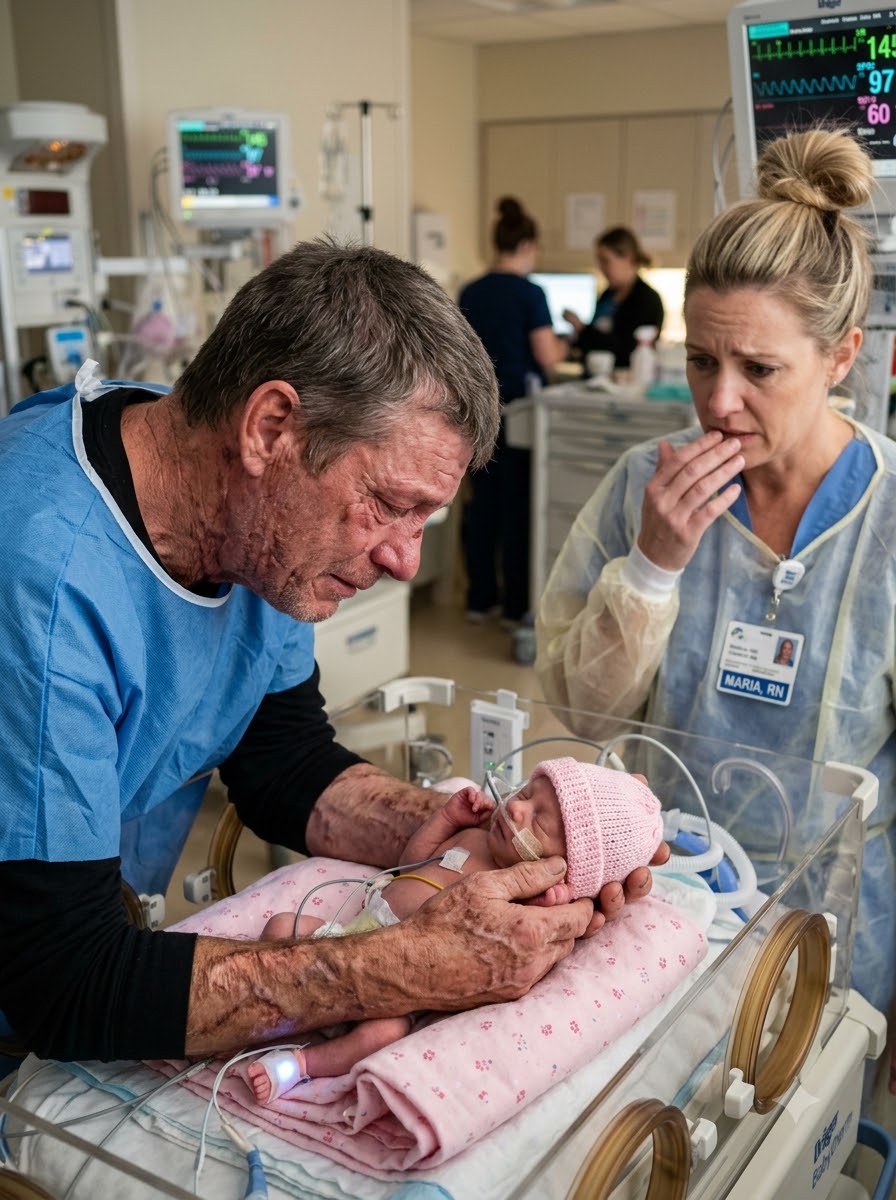
Gabriel was unlike them.
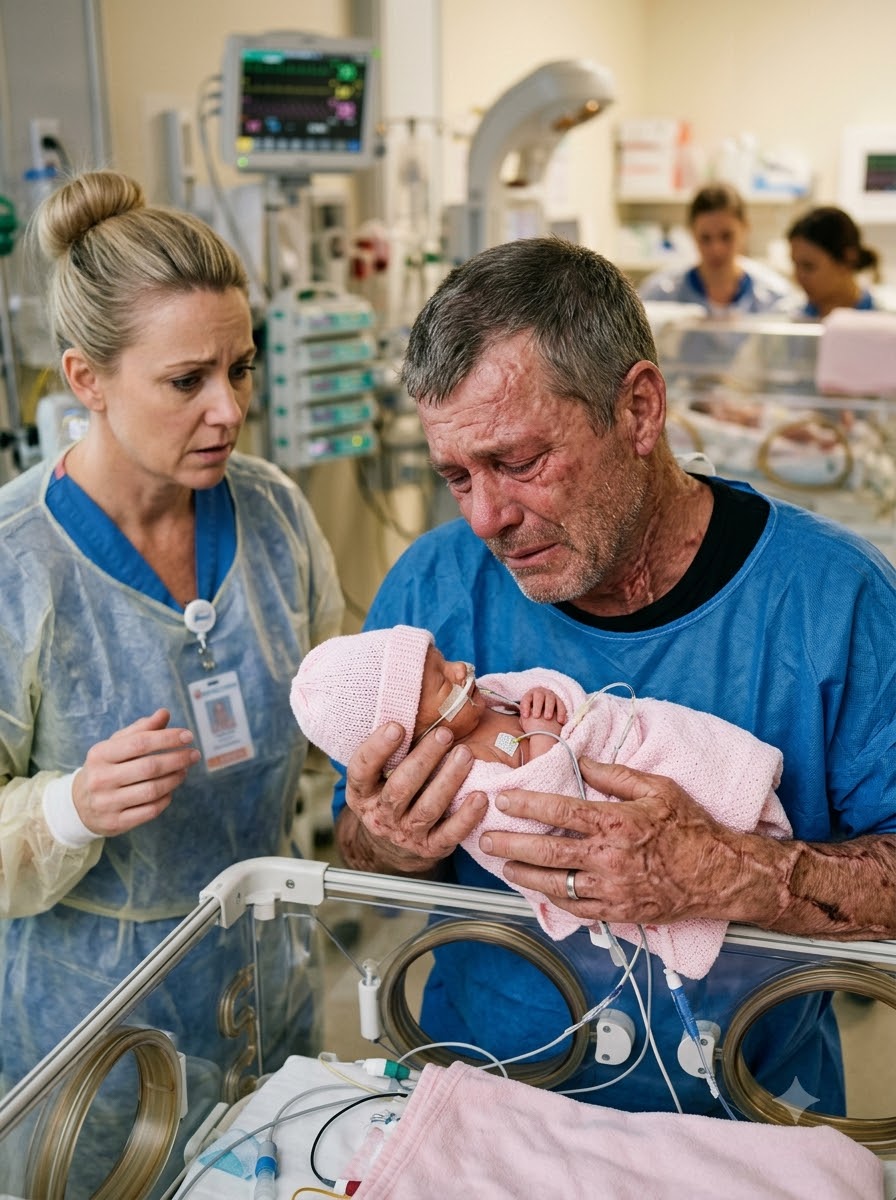
He stood nearly six feet five, with the broad shoulders and rigid posture of someone who had spent much of his adult life obeying military commands. He was fifty-three, although the deep lines around his eyes made him seem older. Pale scars extended from his neck beneath his shirt collar and continued along both forearms, where his skin had healed unevenly following an overseas vehicle fire many years before.
His hands caught my attention more than anything else. They were large enough to cover the back of a dinner plate, and they trembled constantly because of lasting nerve damage.
Nothing about him looked as though he belonged beside infants small enough to fit inside a winter hat.
Yet his volunteer identification was legitimate. He had completed the hospital’s screening process, undergone six weeks of training, passed every medical and psychological evaluation, and been approved to participate in our infant comfort program. The program was designed for babies whose parents could not stay at the hospital, particularly those who needed consistent human contact during lengthy and difficult recoveries.
Gabriel stood silently beside the handwashing station as I went through his paperwork for a second time.
Then the baby in room nine started crying.
We knew her only as Baby Girl Pierce.
She had been born seven weeks early, weighing just over two pounds, after a complicated emergency delivery. Her mother had battled substance dependency for years and left the hospital before social services could finish the required interviews. The space beside the incubator stayed empty. No father had called, and no relatives had brought photographs, blankets, or a name chosen with love.
Other babies in our unit had handmade signs taped to their walls and stuffed animals waiting for the day they could finally go home. Baby Girl Pierce had a printed identification card and a gray hospital blanket.
Her earliest days had been filled with painful withdrawal symptoms. Ordinary noises startled her. Bright lights overwhelmed her. Even gentle contact could make her tiny arms tremble as her heart rate climbed.
That morning, we had lowered the lights, adjusted her position, checked every line, and followed every part of her care plan. Even so, she cried with a thin, desperate sound that seemed impossibly strong for such a tiny body.
Gabriel turned toward room nine.
His expression shifted so quickly I almost missed it. The guarded appearance vanished, replaced by something gentler and unmistakably personal.
“Is that the baby who needs a holding volunteer?” he asked.
“She needs someone calm,” I replied. “She has trouble adjusting to touch, so we have to move slowly.”
He nodded, but I noticed his gaze fall toward his trembling fingers.
So did I.
I am not proud of what crossed my mind then. I wondered whether those scarred hands could safely support an infant whose entire head could fit inside one of his palms. I wondered whether the alarms, sharp noises, and urgency of the unit might awaken memories he was not prepared to confront.
Gabriel seemed to notice my uncertainty.
“If you don’t think I’m ready, tell me,” he said. “I won’t take it personally.”
There was no defensiveness in his voice, just honesty.
I looked from him to the incubator, where the baby’s legs were pulling tightly toward her stomach.
“Let’s try,” I said. “But I’ll stay right beside you.”
He washed his hands carefully, although water scattered from his unsteady knuckles. After putting on a clean gown, he approached the incubator and waited while I opened the side panel.
The moment his fingertips touched the edge of the mattress, Baby Girl Pierce cried even louder.
Her monitor sounded. Her heart rate climbed. Gabriel’s shoulders tightened as though an invisible weight had suddenly settled across them.
For several moments, he could not move.
The alarms meant something different to him than they did to us. I could see it in the distant look in his eyes and the sudden tension around his mouth. He was no longer standing inside a warm hospital room in Michigan. Some part of him had returned to another place filled with smoke, metal, and urgent voices.
“Mr. Mercer, step away for a moment,” I said, reaching toward him.
He closed his eyes and took one long breath through his nose.
“Please,” he whispered. “Give me ten seconds.”
I kept my hand close to his arm but gave him those seconds.
His breathing gradually slowed. The tension left his shoulders, and although his fingers still trembled, he leaned toward the incubator again.
“All right, sweetheart,” he murmured. “Neither one of us likes alarms. We already have something in common.”
THE NAME ON THE TAG
Gabriel did not try to lift her right away. Instead, he placed one open hand beneath her head while gently resting the other across her back, creating a secure boundary around her without applying pressure.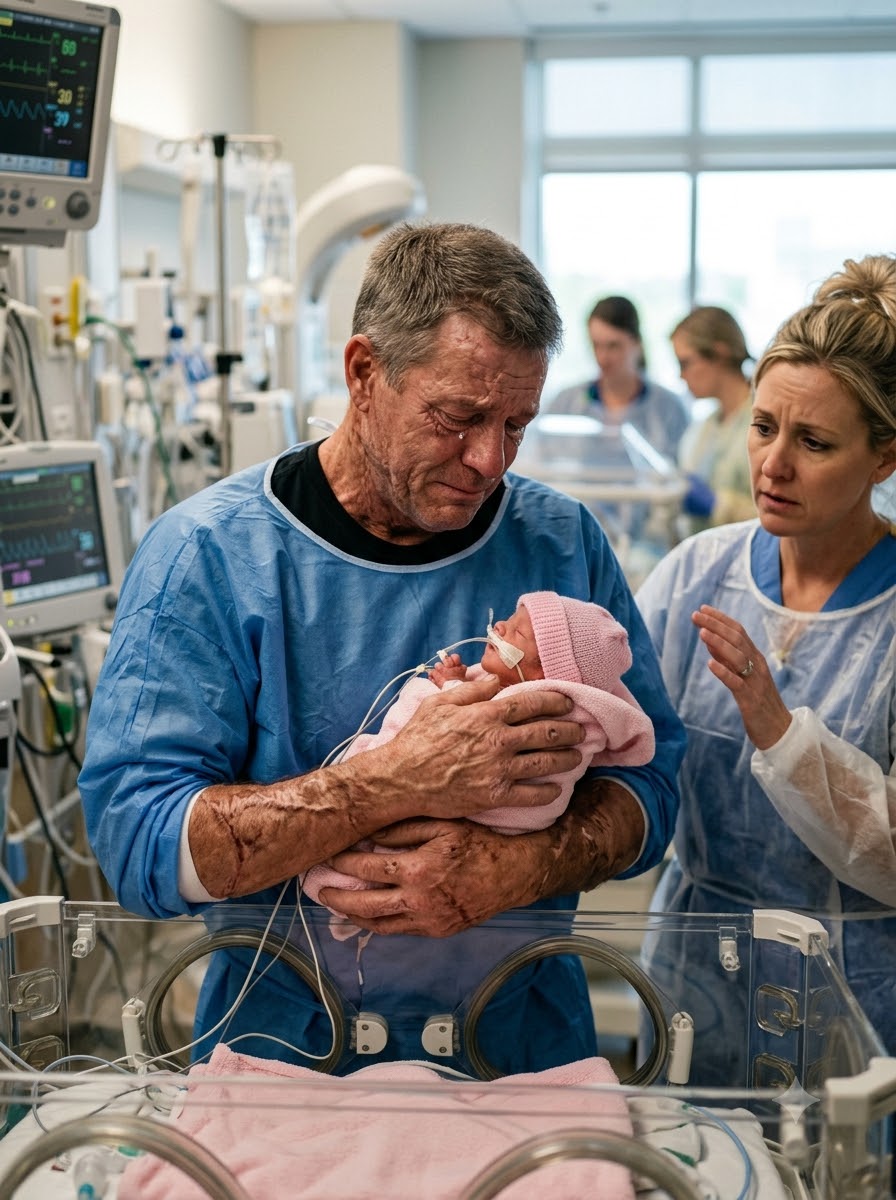
The technique was precisely what we had taught him.
He stayed motionless, giving the baby time to adjust to his warmth. His hands trembled against the mattress, but his touch never became unsure. He seemed to understand that comforting her did not mean he had to fix everything. For that moment, his only responsibility was to stay present. As he leaned closer, a small silver tag slipped from beneath his shirt. At first, I assumed it was his own military identification. Then the metal shifted beneath the fluorescent light, exposing an engraved inscription.
MAJ. GABRIEL MERCER
FOR DANIEL PIERCE
I CARRIED YOU HOME
I fixed my eyes on the final name.
Pierce.
The same surname printed on the card beside the incubator.
“Who was Daniel?” I asked quietly.
Gabriel lowered his gaze to the tag before responding.
“My flight medic,” he said. “And my closest friend.”
Twelve years before, Gabriel had served as an Army helicopter crew chief during an overseas deployment. When their aircraft went down during a rescue mission, flames spread through part of the cabin. Daniel Pierce, a twenty-eight-year-old medic from western Michigan, released Gabriel from his harness and dragged him far enough away for another crew to reach them.
Gabriel made it home with severe injuries. Daniel never got the opportunity to return to his family.
For years, Gabriel carried a weight that no ceremony or medal could ever remove. He reached out to Daniel’s parents and visited whenever they permitted him, but grief had driven the family apart. Daniel’s father died after a prolonged decline in health, while his mother moved west to stay with a cousin. His younger sister, Mallory, pulled away from almost everyone who had once known her.
Gabriel kept looking for her, not because he believed he could take Daniel’s place, but because he had made a promise during their final deployment.
“He worried about his little sister,” Gabriel explained. “He made me swear I’d look out for her if she ever needed help.”
Three days before, a former military family liaison had reached out after noticing Mallory Pierce’s name in a county notice searching for relatives of a premature infant. By the time Gabriel arrived at the hospital, Mallory had already left.
He had not signed up for the volunteer program expecting to find this particular baby. He had joined months earlier, hoping that spending time with infants could help him learn how to feel useful again. But when he heard about Mallory’s daughter, he realized why he needed to be there.
Inside the incubator, the crying slowly began to fade.
Gabriel began humming. The tune carried the steady rhythm of a military cadence, but he slowed it until it sounded almost like a lullaby. His voice was deep and uneven, more gravelly than musical, yet the baby seemed to respond to its steadiness.
Her heart rate began dropping.
One hundred seventy-eight.
One hundred sixty-two.
One hundred forty-eight.
The monitor settled into a reassuring rhythm as her body relaxed between Gabriel’s hands. Then one tiny finger opened and curled around the side of his thumb.
Gabriel stopped humming.
Tears gathered in his eyes and silently traced the scars along his cheeks.
“Hello, little bird,” he whispered. “Your uncle once stayed when I needed him. I can stay, too.”
Around us, the unit became strangely quiet. One nurse stopped while preparing medication. Another turned away and wiped her eyes with the back of her wrist.
I stood beside the incubator, ashamed of the judgment I had formed only minutes earlier. I had looked at Gabriel’s scars and trembling hands and imagined only what they might not be capable of doing.
The baby had noticed something different.
She had noticed safety.
THE HOUR HE NEVER MISSED
Gabriel came back the next evening at six o’clock.
Then he returned the evening after that.
For the next five weeks, he never missed a scheduled visit. He arrived wearing work boots and plain flannel shirts, carrying a thermos of coffee and a paperback book. We eventually learned that he repaired furniture in a small workshop behind his home, a quiet job he had chosen after leaving the Army because wood did not care whether his hands shook.
Every evening, he scrubbed in, settled into the rocking chair beside room nine, and waited while a nurse placed the baby against his chest.
The first time he held her outside the incubator, his expression became completely serious.
“She weighs less than one of my old boots,” he whispered.
“Then don’t drop the boot,” I replied.
He looked at me, startled, then laughed—a rough sound, as though he had not heard himself make it in years.
We began calling the baby Lila after Gabriel discovered the name written on the back of an old photograph Daniel’s mother had sent him years earlier. Mallory had once told her brother that if she ever had a daughter, she wanted to name her Lila Jane.
Social services approved the name for hospital use while the court continued reviewing the child’s case.
Lila gradually began improving. She gained weight, handled her feedings more consistently, and stopped startling at every movement around her. Her early symptoms faded, and the tense expression that had seemed permanently set across her tiny face slowly softened.
Gabriel changed too.
