

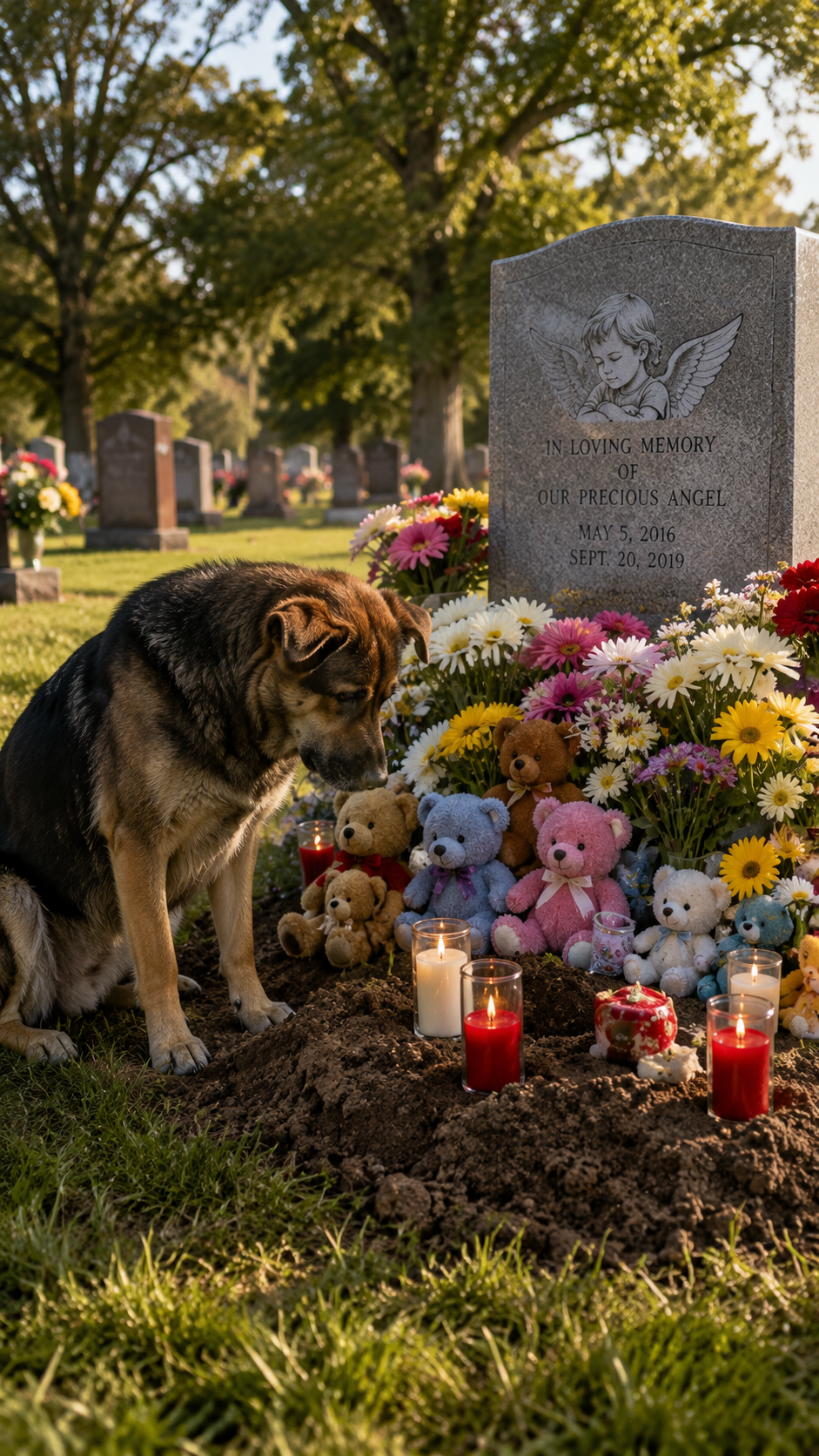
Part One: The Dog Beside the Grave
The cemetery was always peaceful on Sunday mornings.
Dew covered the grass, and the trees whispered whenever the breeze moved through their branches. I had become accustomed to that quiet. For two years, I had followed the same gravel path, carrying a small bunch of yellow daisies—Ethan’s favorite flowers.
My son had passed away just three weeks before his eighth birthday.
Every Sunday, I visited his grave and told him about the life that continued without him. I told him what I had prepared for dinner, which neighbors had stopped by, and what television shows he probably would have enjoyed.
That morning, I set the daisies beside his headstone and brushed away a few leaves.
“Mrs. Callahan finally painted her shutters,” I murmured. “She got rid of that terrible mustard color you used to tease her about. They’re blue now.”
The wind moved through the branches overhead.
For a moment, I imagined it was Ethan responding.
Then I glanced up.
The dog was there again.
He was a scruffy golden retriever mix with muddy fur, weary eyes, and no collar. He lay beside Ethan’s grave, his chin resting on his paws. He watched me peacefully, never barking or coming any closer.
“Hello, boy,” I whispered. “You came again.”
His tail tapped the ground once.
For a full year, he had shown up at Ethan’s grave before I did. Rain, snow, freezing mornings, and even the unbearable August heat never stopped him from coming.
I started bringing him some water and a little food.
“I asked about you again,” I told him. “The groundskeeper says no one knows where you came from.”
The dog blinked.
I had posted notices around the neighborhood and shared his picture online. I had asked everyone within three blocks whether he belonged to them.
Nobody claimed him.
My sister, Marlene, thought I was becoming fixated.
“Diane, you have to stop feeding that stray,” she had told me one evening.
“He isn’t a stray. He belongs to someone. He just keeps choosing Ethan.”
“Sweetheart, you’re grieving. You’re turning a dog into a sign because you don’t want to let go.”
Marlene had supported me after Ethan died. She took care of the hospital paperwork, funeral arrangements, and endless forms I could not make myself read.
She reminded me of that frequently.
“You have to move forward,” she always said. “Ethan wouldn’t want you trapped in sadness.”
But whenever I saw the dog lying faithfully beside my son’s grave, I wondered whether moving forward meant forgetting the person who had made my life worth living.
“You keep coming back,” I whispered to him. “Why, boy? Why Ethan?”
The dog lifted his head.
His eyes met mine with such quiet understanding that I caught my breath. It felt like he understood that the question mattered, even if he was not ready to answer it.
Then he lowered his chin again.
Three days later, he came to my house.
And this time, he had something in his mouth.
Part Two: The Rabbit
I was behind the house, trying to finish hanging laundry, when I heard scratching at the back gate.
It was soft and intentional—like someone tapping gently because they did not want to scare me.
I wiped my hands on my sweater and went over.
When I opened the gate, the dog was sitting on the other side.
His tail moved in small, cautious sweeps.
Something was hanging from his mouth.
At first, I thought it was a dirty cloth. Then I noticed its shape.
“Oh,” I whispered. “Oh, sweetheart.”
The dog waited until I crouched down. Only then did he lower his head and set the object at my feet.
It was a stuffed rabbit.
The toy had originally been gray, but dirt and age had faded it to a dull brown. One ear had been chewed almost halfway off.
I knew that ear.
My hands started trembling.
“Where did you find this?”
The dog only stared at me.
I picked up the rabbit. The fabric was stiff from dirt, but underneath it, I could still recognize its familiar shape.
Ethan had slept with this rabbit almost every night as a child.
He had carried it from room to room, taken it along on car rides, and refused to sleep without it. The toy had vanished when he was six, during the months when Marlene cared for him several days each week.
I had searched everywhere.
I had emptied boxes, checked closets, and searched through the garage until my knees ached. I had cried over that rabbit because, back then, I could not cry over anything else.
Now it was back in my hands.
“That’s impossible,” I murmured.
The dog stayed motionless.
As I turned the rabbit over, something hard moved inside its body.
I froze.
There was something concealed beneath the stuffing.
I rushed into the kitchen and set the toy on the counter. The dog remained outside the screen door, watching me.
“Don’t leave,” I told him. “Please.”
My phone started ringing.
Marlene’s name appeared on the screen.
I nearly ignored it, but guilt made me answer.
“Diane, darling,” she said warmly. “I just wanted to see how you were doing.”
“I’m fine.”
“You sound breathless.”
“I was hanging laundry.”
There was a pause.
“I’ve been thinking about you,” she said. “You still go to the cemetery every Sunday, don’t you?”
I looked at the rabbit.
“Yes.”
“Diane, it has been two years. You can’t keep living there.”
Her words had once made me feel cared for. That day, they sounded strangely controlling.
“Ethan wouldn’t want you to stay buried in grief,” she continued.
“I can’t talk right now.”
“Please listen to me. I’m only saying this because I love you.”
“I have to go.”
I ended the call before she could continue.
My hands trembled as I picked up a pair of scissors.
Carefully, I cut open the old seam along the rabbit’s back.
Yellowed stuffing spilled across the counter.
Then a folded piece of lined paper and a small metal key dropped from inside.
The key was tarnished and tiny—the type used for a padlock.
I unfolded the paper.
The handwriting was uneven and childish.
But I recognized it immediately.
It was Ethan’s.
The message contained only six words:
For Mama. Aunt M said don’t tell.
I sank onto the kitchen stool.
Outside, the dog was still watching through the screen door.
As if he had been waiting for me to discover that note.
For illustrative purposes only
Part Three: The Key
I spent the entire night at the kitchen table with Ethan’s photographs spread around me.
The note rested beneath the lamp.
I compared the handwriting with a birthday card he had made when he was six. The letters were round and crooked. The “E” in Ethan’s name leaned slightly left, and he always drew a tiny heart above the letter “i.”
There was no doubt.
The note was his.
I held the key in my palm and tested every lock in the house.
It did not fit the front door, the shed, the attic, or the old cabinet in the hallway.
But it had to belong somewhere.
Ethan had hidden it for a reason.
At dawn, I drove to the cemetery.
The dog was waiting beside the headstone.
“You knew, didn’t you?” I asked.
He slowly stood.
For the first time, he did not keep his distance.
I started walking, and he came alongside me. His fur brushed my knee as we left the cemetery and followed the sidewalk through town.
He guided me past the closed bakery, beyond the laundromat, and toward a low building with a faded sign.
A storage facility. I had driven past the place countless times without ever really noticing it.
Inside the office, a thin man wearing a green cap looked up from his coffee.
“Can I help you?”
“I’m looking for a storage unit,” I said. “It may be under my sister’s name. Marlene Callahan.”
He typed for a moment.
“Unit 34,” he said. “Paid on time for six years.”
My heart started pounding.
“Can I see it?”
He hesitated. “Your sister is the only person listed on the account.”
“I’m her sister.”
He studied my face.
“Funny thing,” he said. “A woman came here years ago asking about that unit. She said she was from the hospice on Third Street. Her name was Ruth. She wanted to know whether a little boy’s belongings had been stored there.”
Ruth.
I remembered her immediately.
Ruth had volunteered at the hospice during Ethan’s final weeks. When I was too exhausted to read to him, Ruth sat beside his bed and turned the pages of his favorite books.
She had been gentle with him.
She had also been there on the day Ethan’s rabbit disappeared.
The dog leaned against my leg.
I did not open Unit 34.
Not yet.
Instead, I drove directly to Marlene’s house.
She answered the door in a robe. The instant she saw my face, the color drained from hers.
“Diane? What happened?”
“Unit 34.”
Her fingers tightened around the doorframe.
“Come inside.”
“What is in that unit?”
“Please sit down.”
“What is in the unit, Marlene?”
She lowered herself onto the couch.
“Ethan’s things,” she finally said. “That’s all.”
“Why are they there?”
“Because you couldn’t bear to see them.”
“You never asked me.”
“You were falling apart,” she said. “You couldn’t even walk past his bedroom. I thought I was protecting you.”
I placed the key on her coffee table.
She stared at it.
“Ethan gave this to Ruth,” I said. “He hid it inside the rabbit. He wrote that you told him not to say anything.”
“That isn’t true.”
“Then why did he hide his message?”
Her eyes filled with tears.
I watched her closely.
“The trust fund,” I said. “You told me it was completely gone. You said the medical bills had taken everything.”
“Diane…”
“Was that true?”
Marlene covered her face.
For several seconds, the only sound in the room was her uneven breathing.
“I helped with everything,” she whispered. “I took time off work. I drove him to appointments. I paid for things.”
“That still doesn’t answer me.”
“I only borrowed a little at first.”
My stomach turned.
“And then?”
Her silence answered for her.
PART FIVE: WHAT MY SISTER HAD HIDDEN
Marlene lowered her hands.
“I meant to put it back,” she said. “I swear I did.”
“How much?”
She cried even harder.
“I was exhausted. I had bills. I thought no one would notice because you weren’t looking at anything. Then more expenses came, and I kept telling myself I would replace it later.”
“You stole from a dying child.”
“I loved him too!”
The words echoed through the room.
I looked at the woman I had trusted for forty years. She had brought food to my house after Ethan died. She had selected his funeral clothes. She had held me while I sobbed.
All that time, she had been hiding his belongings—and the truth.
“Love doesn’t give you permission to take what isn’t yours,” I said.
“I was trying to help.”
“No. You were deciding what I could handle. You were deciding what I was allowed to know.”
She looked toward the door.
The dog stood outside the screen, silent and watchful.
“Who is that dog?” she whispered.
“I don’t know.”
“But he led you here?”
“He brought me Ethan’s rabbit.”
Marlene’s expression shifted.
For the first time, fear showed beneath her tears.
I picked up the key.
“Ruth kept her promise,” I said. “A woman who barely knew Ethan protected his message for years. You were his aunt. You were the person I trusted most.”
“I was there for him.”
“So was Ruth. The difference is that she didn’t use his trust for herself.”
Marlene reached toward me.
I stepped away.
“I’m going to open the unit.”
“Diane, please don’t.”
“I should have known the truth years ago.”
“I’m sorry.”
“I know.”
But I did not forgive her.
Not then.
I walked outside. The dog immediately rose and followed me to the car.
He climbed into the back seat without hesitation.
As I started the engine, I looked at him in the mirror.
“I’m calling you Watcher,” I said. “Because that’s what you’ve been doing all this time.”
He rested his head on the seat and watched the road ahead.
Together, we drove back to the storage facility.
PART SIX: UNIT 34
The key turned easily.
The metal door rolled upward with a long, groaning sound.
A stale odor drifted from inside—dust, cardboard, and years of trapped air.
Watcher walked in first.
He didn’t hesitate.
The unit was filled with boxes.
On the shelves were Ethan’s baby blankets, his first pair of shoes, and drawings I had never seen. There were photographs, school papers, and a small wooden train he used to carry everywhere.
I touched the side of a box.
“Why didn’t I know about any of this?”
Watcher moved toward the back wall.
There, beneath a pile of blankets, I found an envelope containing cash. Beside it was a folder tied with faded string.
My fingers trembled as I untied it.
Inside were letters.
Dozens of them.
Some were written in Ethan’s childish handwriting. Others had been dictated from his hospital bed. Ruth had clearly saved every one.
I opened the first letter.
“Dear Mama,” I read aloud. “I’m okay. Don’t be scared. Aunt M is keeping my things safe until you’re ready. I love you bigger than the sky.”
My voice broke.
Watcher rested his chin on my shoe.
I pressed the letter against my chest.
Ethan had known I was hurting. Even while he was sick, he had been thinking about how to comfort me.
And somehow, he had also known that Marlene could not be trusted with everything.
I read another letter.
Then another.
One described a rainy afternoon when Ethan watched birds from his hospital window. Another told me he wanted yellow flowers at his grave because they looked like “little pieces of sunshine.”
I had never received any of them.
Marlene had kept them hidden.
She arrived less than an hour later.
She stood at the entrance of the unit, mascara streaking down her face.
“Diane, please.”
I didn’t look away from the letter in my hands.
“I only did it because I loved him.”
“You loved him,” I said quietly. “But you didn’t trust me to survive losing him.”
“I was protecting you.”
“No. You were controlling what I knew.”
She took a step forward.
I stepped back.
“The money will be accounted for,” I said. “Every dollar that can be recovered will go to Ethan’s memorial fund. The letters and his belongings stay with me.”
“Diane, you’re making this worse.”
“You made it worse years ago.”
“I was grieving too.”
“So was I.”
“I didn’t know what else to do.”
“You could have told me the truth.”
She began to sob.
For a moment, I almost felt sorry for her. Then I looked at the folder in my hands and remembered how many years I had spent believing Ethan had left me with nothing but silence.
“Love isn’t measured by how much pain you claim to have endured,” I said. “It’s measured by what you refuse to do to someone else while you’re hurting.”
Marlene stood there without an answer.
Eventually, she turned and walked away.
Watcher watched her leave.
Then he leaned against my leg.
PART SEVEN: THE LONG WAY HOME
I stayed in Unit 34 until the afternoon light faded.
I read every letter.
Some were only a few lines long. Others filled entire pages. Ethan wrote about his favorite cereal, the nurse with the purple glasses, and the dream he had about flying over the ocean.
He also wrote about me.
One letter said:
“Mom is tired, but she smiles when I tell jokes. I want her to smile more.”
Another read:
“If I can’t tell her myself, someone has to tell her that I’m not mad. I know she loves me.”
I pressed that letter to my lips.
“I’m sorry,” I whispered. “I’m sorry I wasn’t strong enough to hear you.”
Watcher sat beside me.
I had no idea where he came from or why he had chosen Ethan’s grave. I didn’t know whether he had belonged to Ruth, followed her, or simply carried some invisible memory from the past.
But I knew what he had done.
He had waited.
He had guarded my son’s grave through every season.
He had carried the rabbit to my home when I was finally ready to understand what it meant.
And he had led me to the truth.
I brought the letters and Ethan’s belongings home. For days, I arranged them carefully in his old bedroom.
I placed the rabbit on the shelf beside his photographs.
The toy was still dirty and worn, but I no longer wanted to repair it. Every tear and chewed thread was part of the journey that had brought it back to me.
I also contacted the bank and began the process of recovering what Marlene had taken. It wouldn’t be simple, and it wouldn’t erase the years she had stolen from me.
But Ethan deserved honesty.
So did I.
Marlene called several times.
I didn’t answer.
Not because I wanted revenge.
Because I finally understood that peace sometimes begins with refusing to keep explaining your pain to the person who caused it.
PART EIGHT: ETHAN’S ANSWER
The following Sunday, I returned to the cemetery with Watcher walking beside me.
He no longer stayed several feet away.
He walked close to my side, his shoulder brushing my leg as if we had been walking together for years.
Ethan’s grave looked different in the morning light.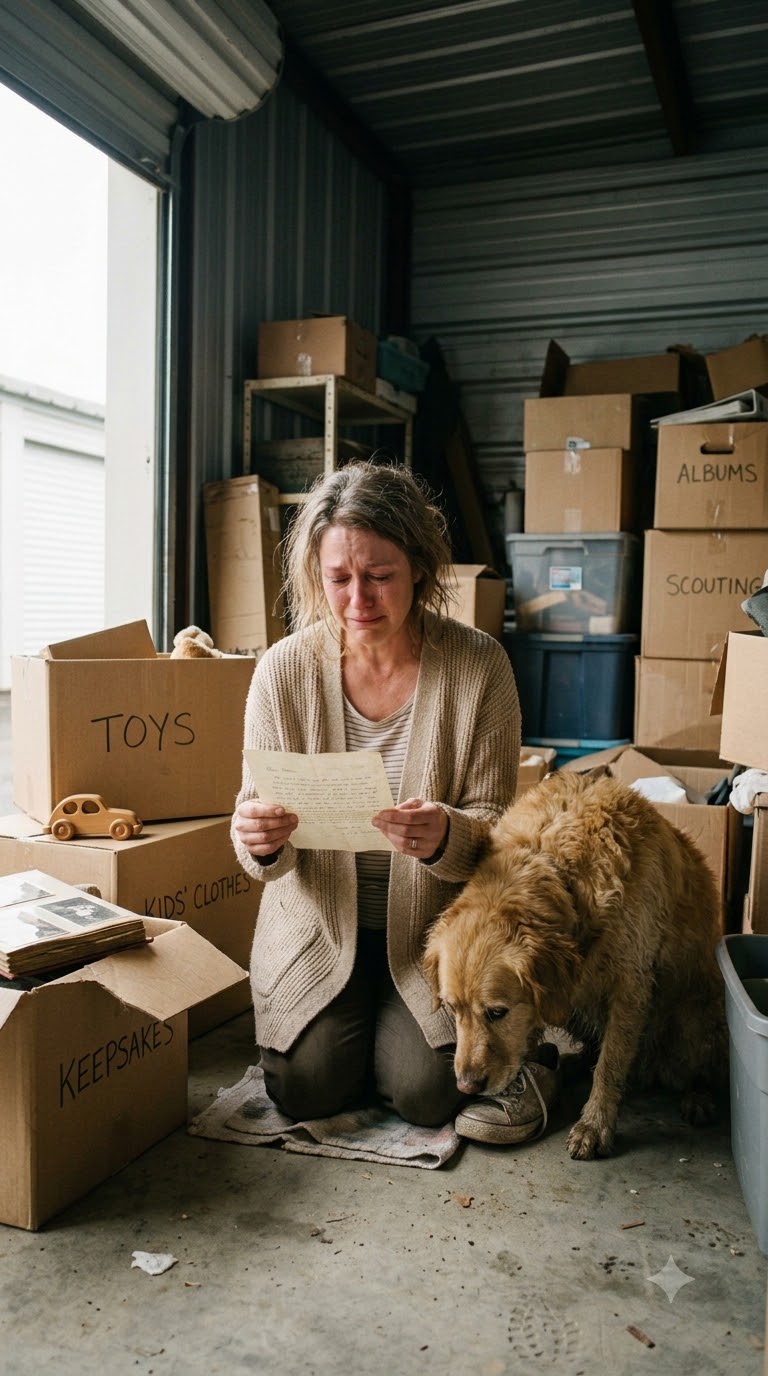
The yellow daisies I had planted had begun to bloom.
I knelt and placed a fresh bouquet beside the stone.
“I have something to read to you,” I whispered.
I unfolded one of Ethan’s letters.
The paper shook slightly in my hands.
“Dear Mama,” I read. “Please don’t be afraid of being sad. Sad means you love someone. When you miss me, look for sunshine. I’ll be there.”
I stopped reading because I could no longer see the words.
Watcher pressed against my knee.
I rested one hand on his head.
For two years, I had believed grief was the only thing connecting me to my son. I had been afraid that if I laughed again or slept peacefully or stopped visiting every week, I would somehow be leaving Ethan behind.
But the letters showed me something else.
Ethan had never wanted me to remain broken.
He had wanted me to live.
Not forget him.
Not pretend I was fine.
Live.
I folded the letter and placed it against the headstone.
“I found it, baby,” I whispered. “It just took a long way home.”
The wind moved gently through the trees.
Watcher laid his head against my knee.
And for the first time since Ethan died, the silence around his grave did not feel empty.
It felt like an answer.
