

PART 1 — THE GIRL IN THE BARN
At 3:07 in the morning, I kicked open the north barn door with a shotgun trembling in my hands.
The door struck the inside wall hard enough to shake dust from the rafters.
Cold air rushed past me.
A horse screamed in one of the stalls.
Behind me, boots pounded through the snow as Victor Hale and two security guards followed beneath the yellow emergency light.
I expected blood.
I expected a kidnapper.
I expected to find my daughters screaming in the arms of someone demanding money, revenge, or something worse.
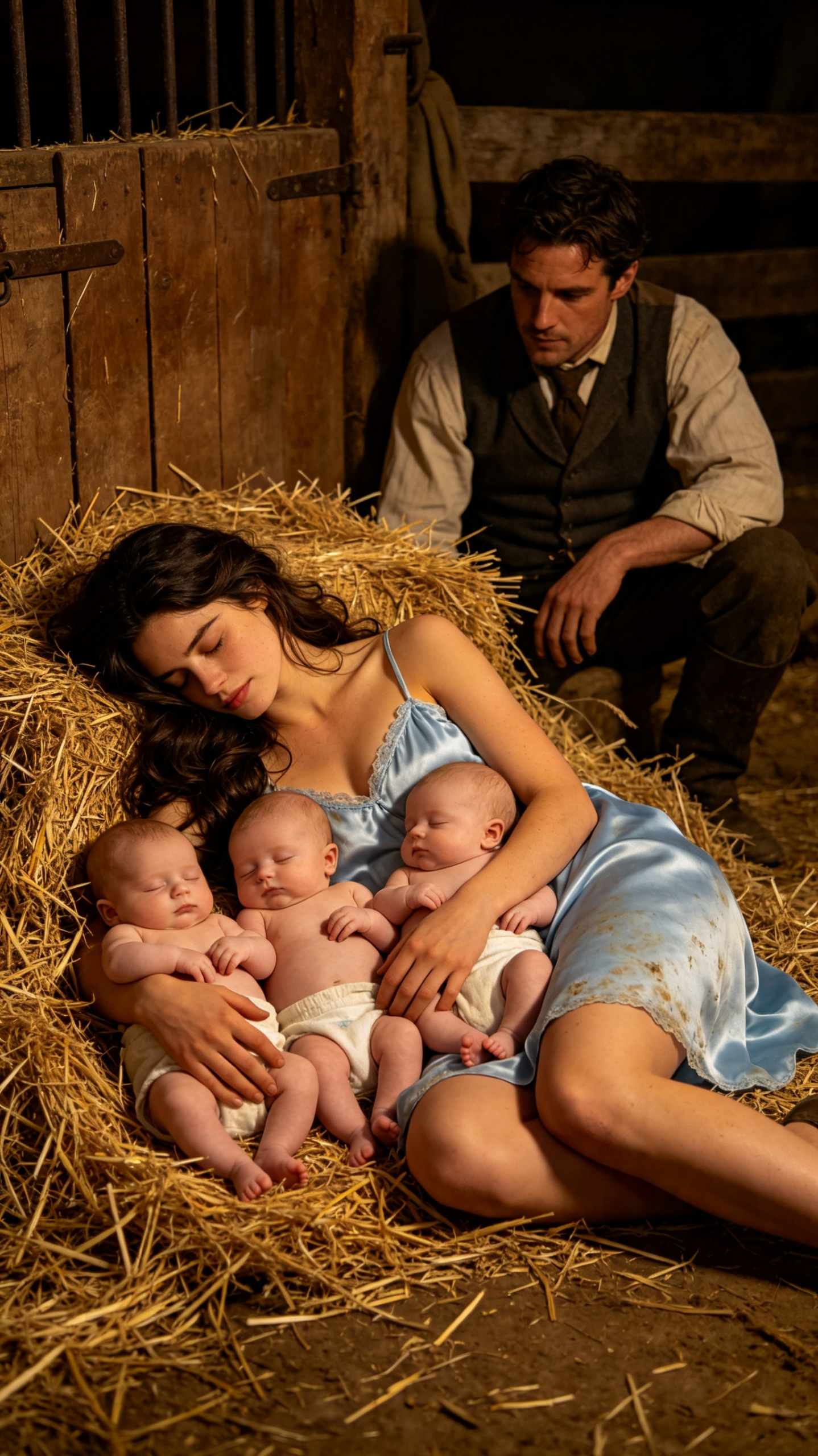
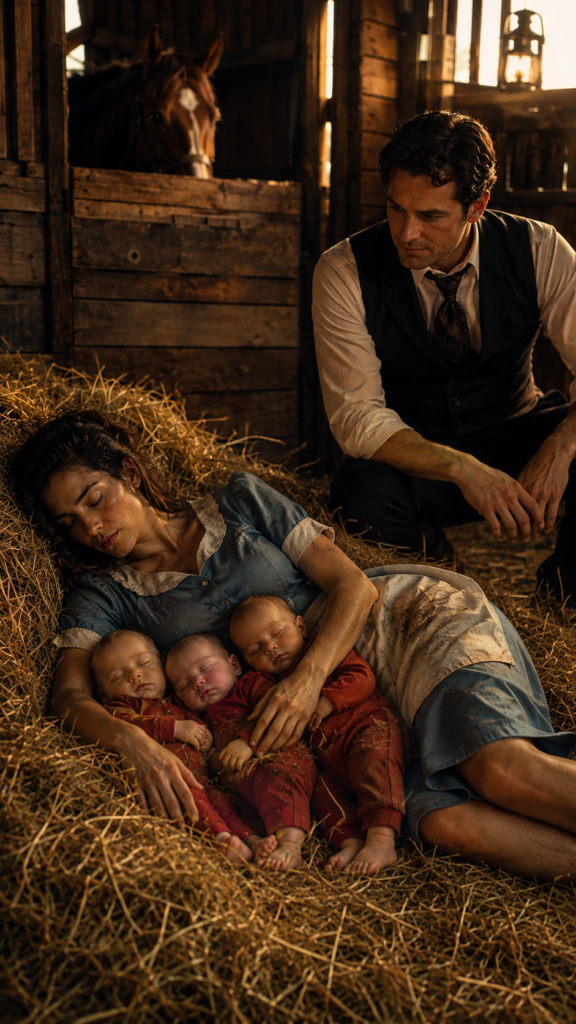
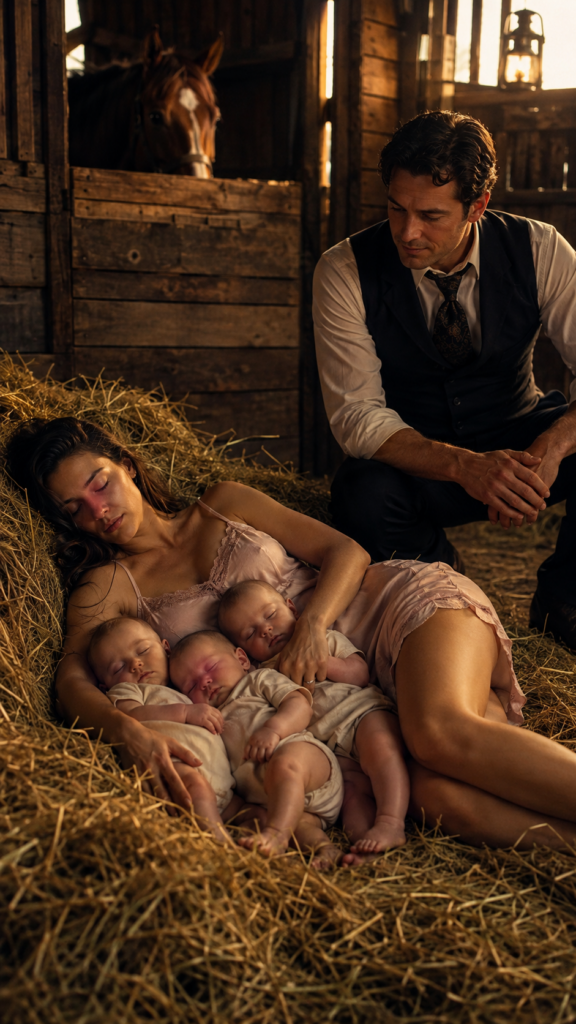
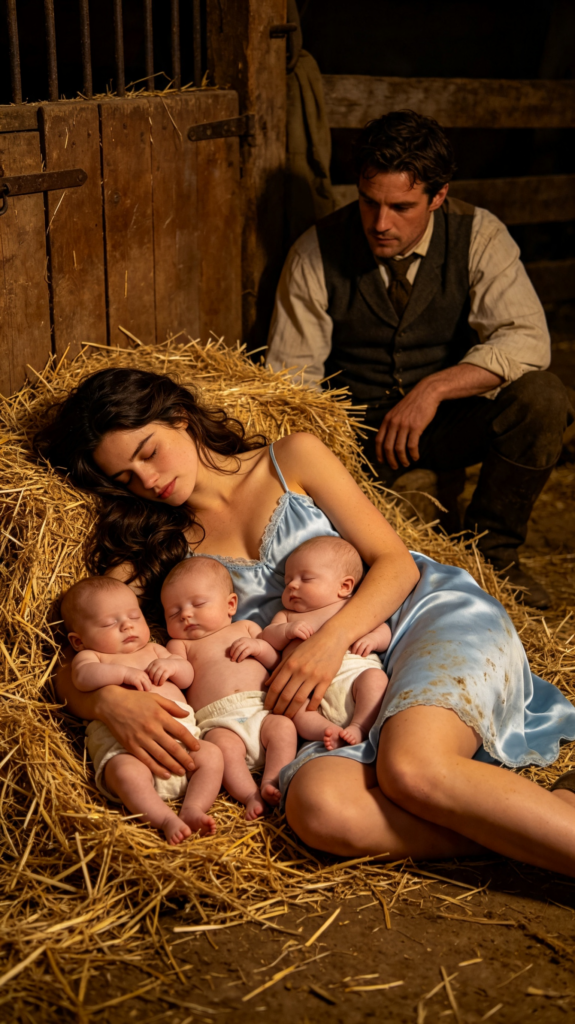
Instead, I found a young woman asleep in the hay.
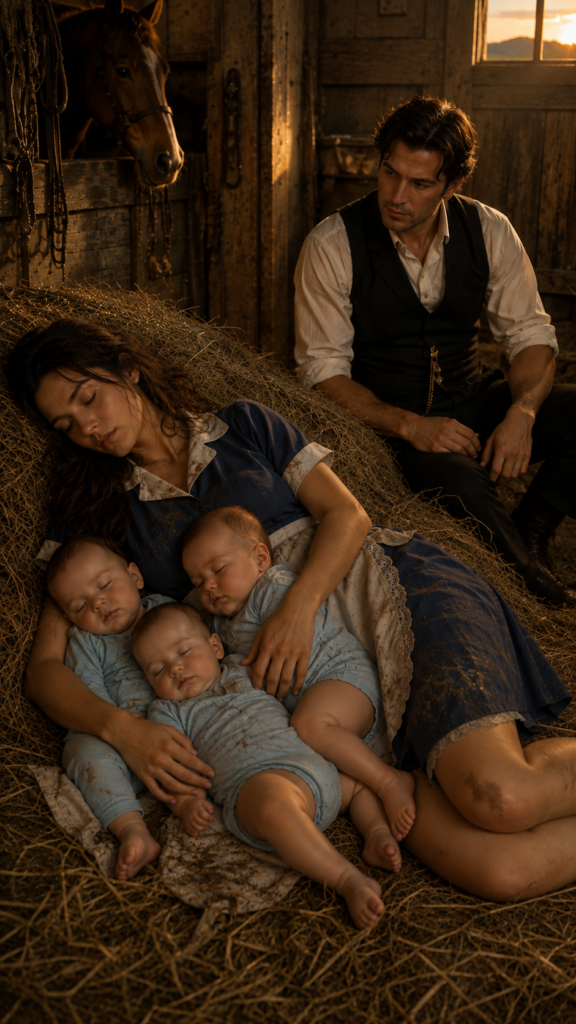
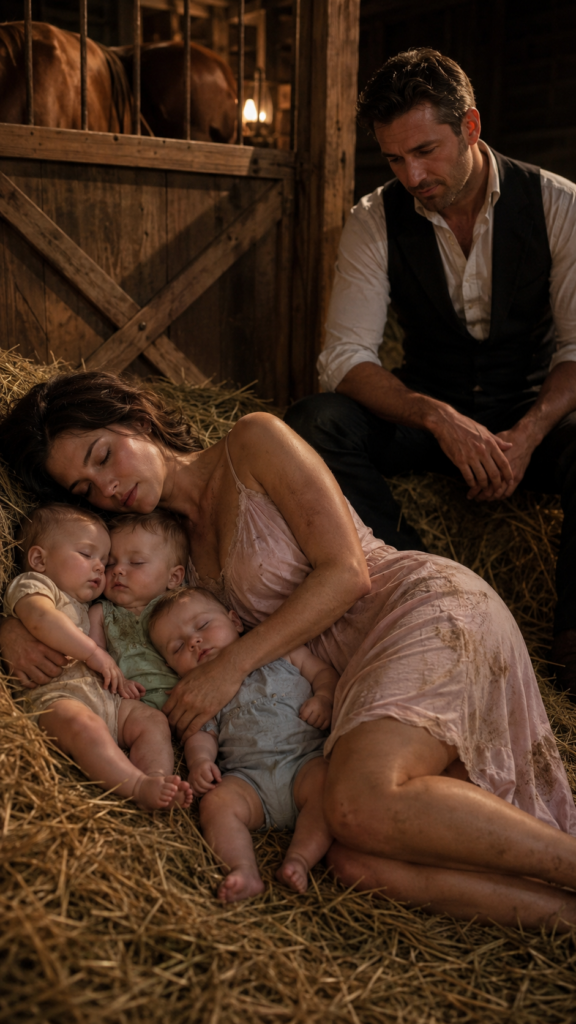
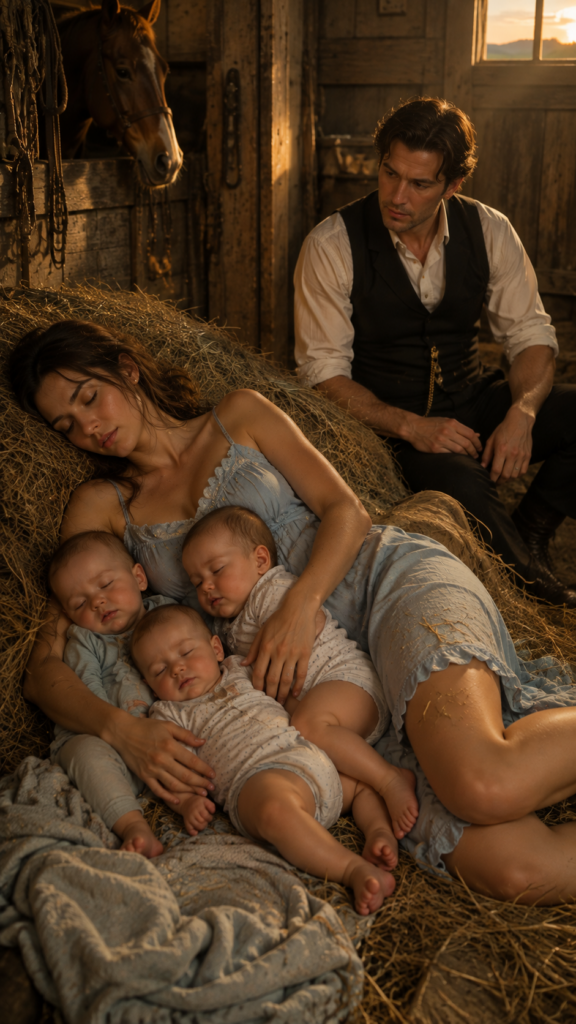
She was curled on her side near the old generator, her body wrapped around three tiny bundles as though she had tried to become a wall between them and the winter.
Emma Carter.
The waitress from the Maple Street Diner.
Her blue uniform was torn beneath one arm. One shoe was missing. Her dark hair was wet from melted snow and tangled with straw. Her lips had gone pale from the cold.
But even in sleep, she held my daughters tightly.
Sophie lay against her chest.
Lily was tucked beneath Emma’s bent arm.
Grace rested against her stomach, one tiny hand closed around the fabric of Emma’s uniform.
For one impossible second, no one moved.
The generator coughed behind them. A weak current of warm air drifted through the barn, carrying the smells of diesel, hay, damp wool, and horses.
Then Victor pushed past me.
“There she is,” he shouted. “That’s the kidnapper. Arrest her.”
Emma’s eyes flew open.
She did not look at the guards.
She did not look at the shotgun in my hands.
She immediately looked down at the babies.
“Please,” she whispered, raising one shaking finger to her lips. “Don’t wake them. Sophie’s fever finally started coming down.”
Relief hit me first.
Violent, breathless relief.
My knees nearly failed.
Then anger followed so quickly that it felt like shame wearing a different face.
“What did you do?” I demanded.
Emma blinked at me.
Her eyes were red from exhaustion.
“I kept them alive.”
“Why are they here?”
“The nursery heater stopped.”
“You expect me to believe you carried three six-month-old babies across my property in a blizzard?”
“They were turning blue.”
Her voice cracked, but her grip did not loosen.
“I tried the service hall first. The heat was off there too. The cameras were dark. The emergency lights weren’t working. I could hear the barn generator from the east corridor, so I wrapped them in blankets and ran.”
“You don’t live here.”
“No.”
“You don’t work here.”
“No.”
“Then how did you get inside my house?”
“The kitchen door was unlocked.”
Victor laughed once.
It was a quiet, contemptuous sound.
“Of course it was.”
One of the guards stepped forward and reached for his handcuffs.
Emma pulled Lily closer.
“Don’t touch them.”
“Step away from the children,” the guard ordered.
“No.”
His hand moved toward his belt.
I raised the shotgun.
Not at Emma.
At him.
“Wait.”
Everyone froze.
A small sound came from the hay.
Grace stirred.
Her eyelids fluttered, and her tiny fist slowly opened against Emma’s uniform.
Something red caught the barn light.
A ruby.
A gold chain.
A pendant shaped like a teardrop.
The world around me seemed to tilt.
I lowered the shotgun.
“No.”
Emma looked down.
Grace had wrapped the chain around two of her fingers.
I stepped closer, unable to feel my feet.
The ruby pendant had belonged to my wife.
Claire wore it on our first date.
She wore it on our wedding day, hidden beneath her dress because her mother had said red stones were bad luck for brides.
She wore it when the doctor told us we were expecting triplets.
And she wore it on the day she died.
After the funeral, I locked it inside the safe in my bedroom.
No one knew the combination except me.
Yet there it was, glittering in my daughter’s hand in the middle of a frozen barn.
“Where did you get that?” I asked.
Emma stared at the pendant as if she had never truly seen it before.
“I found it.”
“Where?”
“Beside the upstairs electrical panel.”
Victor crouched near me.
His expression changed with expert precision—concern first, then suspicion, then sorrow on my behalf.
“She’s been studying the house for weeks,” he said softly. “First the routines. Then the security. Now your valuables.”
Emma shook her head.
“I’ve never been inside his bedroom.”
“The pendant was in a locked safe.”
“I don’t even know where his bedroom is.”
Victor turned to the guards.
“You heard him. Take her.”
“Daniel,” Emma said.
It was the first time she had used my name.
Not Mr. Whitmore.
Not sir.
Daniel.
Something about it made me look at her.
She was frightened.
But beneath the fear was something else.
Urgency.
“Call a doctor for Sophie,” she said. “Not the private clinic. Call County General.”
Victor’s head turned sharply.
It was a small movement.
Almost nothing.
But I saw it.
“Why?” I asked.
Emma looked at him.
“Because I don’t trust the medicine in the nursery.”
Victor stood.
“That’s enough.”
“What does that mean?” I demanded.
“It means she’s panicking because her story is falling apart.”
Emma’s eyes did not leave mine.
“The bottles changed.”
“What bottles?”
“Sophie’s fever medicine. The labels were the same, but the seals were different. One nurse opened a new bottle Monday. By Tuesday, it had been replaced.”
Victor stepped between us.
“This woman delivers sandwiches. She is not a pharmacist.”
“No,” Emma said. “I’m someone who knows when a bottle has been opened because I spent four years measuring medicine for my little brother.”
The guards pulled her to her feet.
Her knees gave way.
Only then did I understand how exhausted she was.
She had carried three babies through deep snow.
One at a time or all together, I could not imagine.
Her bare foot was blue with cold.
Blood had dried along her heel.
Before they led her away, she removed her coat and wrapped it around Sophie.
Then she leaned down and kissed the air above Grace’s forehead without touching her.
“Please,” she whispered again. “Don’t let him take them back upstairs.”
Victor’s jaw tightened.
I heard the words.
I understood them.
But grief had turned my mind into a locked room, and Victor had been holding the key for almost a year.
So I did what frightened men often do.
I trusted the familiar lie instead of the unfamiliar truth.
“Take her to the service office,” I said.
Emma did not fight.
She looked at me once as the guards led her through the snow.
Not with hatred.
That would have been easier.
She looked at me with pity.
Dr. Patel arrived twenty-six minutes later.
He came through the front door carrying a black medical bag and wearing pajama pants beneath his winter coat.
Victor met him in the foyer.
“You didn’t call the private clinic?” he asked me.
“No.”
“Why not?”
“Because Sophie is my daughter.”
The answer came out sharper than I intended.
Victor lifted both hands.
“Of course.”
Dr. Patel examined the babies in the downstairs library because I refused to return them to the nursery.
Sophie’s fever was 104.2 degrees.
Lily’s temperature was dangerously low.
Grace was dehydrated.
All three had shallow breathing.
“They need to go to the hospital,” Dr. Patel said.
Victor frowned.
“The roads are nearly impassable.”
“Then we take the ranch vehicle with chains.”
“We have medical equipment here.”
Dr. Patel looked at him.
“Do you have a pediatric intensive-care unit hidden behind the wine cellar?”
Victor said nothing.
We wrapped the girls in heated blankets and carried them outside.
Before I climbed into the vehicle, I looked toward the service building.
One light burned in the office window.
Emma was in there.
Alone.
A guard stood outside the door.
For a moment, I considered going to her.
Then Sophie made a weak, broken sound in my arms.
I got into the car.
At County General, the doctors found traces of a sedative in Lily’s bloodstream.
Not enough to kill her.
Enough to make her sleep through distress.
Enough to stop her from crying when the room became cold.
Sophie had been given the wrong antibiotic.
Grace had a bruise beneath her heel consistent with repeated blood draws.
No blood tests had been authorized.
I stood behind a glass wall while nurses moved around my daughters.
Machines beeped.
Clear tubes ran into tiny hands.
Sophie wore an oxygen mask that covered half her face.
A doctor spoke to me, but his words came as if through deep water.
Exposure.
Medication irregularities.
Possible deliberate interference.
Mandatory investigation.
Then he asked me who supervised the nursery staff.
I turned toward Victor.
He stood beside the vending machines, speaking quietly into his phone.
As though sensing my eyes, he looked up and ended the call.
“What is it?” he asked.
“Who hired the night nurses?”
“I did. You asked me to.”
“Who purchased the medicine?”
“The clinic handled most of it.”
“Which clinic?”
“Daniel, you’re exhausted.”
“Which clinic?”
His expression softened.
It was the expression he had used at Claire’s funeral when he placed one hand on my shoulder and said he would handle everything.
“St. Matthew’s Private Care.”
The name made Dr. Patel glance up from Sophie’s chart.
“That clinic closed its pediatric service eight months ago.”
Victor did not react.
Not visibly.
But the silence between us changed.
A crack appeared.
Small.
Sharp.
Irreversible.
He smiled.
“They subcontract.”
“With whom?”
“I’d have to check the invoices.”
“Check them.”
“Now?”
“Now.”
His smile faded.
“You’re letting that waitress get inside your head.”
“No,” I said. “I’m letting my daughter’s blood test get inside my head.”
Victor stared at me for a long moment.
Then he walked away.
He did not check the invoices.
At 4:51 a.m., he left the hospital through a side exit.
By 5:03, he had stopped answering his phone.
PART 2 — THE HOUSE BUILT ON A LIE
I returned to Willow Creek Ranch just before sunrise.
The storm had weakened, leaving the world unnaturally still.
Snow covered the fences, the fields, the trucks, and the roof of the main house. Every surface looked clean.
That was the cruelty of snow.
It could bury footprints without erasing what had happened.
I found Emma in the service office.
She sat in a wooden chair with her hands cuffed in front of her.
Someone had given her a gray blanket.
Her wet hair clung to her cheeks.
The guard stood when I entered.
“Leave us.”
“Mr. Hale instructed—”
“Victor Hale no longer gives instructions on this property.”
The guard hesitated.
Then he unlocked Emma’s cuffs and left.
Red marks circled her wrists.
She rubbed them slowly.
“How are they?” she asked.
Not, Am I being charged?
Not, Do you believe me?
The babies.
Always the babies.
“They’re alive.”
Her shoulders collapsed in relief.
“Sophie?”
“In intensive care.”
Emma closed her eyes.
A tear slipped down her cheek.
She wiped it away before it reached her jaw.
“Tell me everything,” I said.
“I already did.”
“No. You told me what happened tonight. Tell me what happened before tonight.”
She looked toward the window.
Morning light had begun to thin the darkness.
“I started delivering food here three weeks ago,” she said. “The first time, one of the babies was crying so hard I could hear her from the kitchen.”
“Grace.”
“You know their cries apart?”
“I used to.”
The words left a bitter taste.
Emma continued.
“The nurse on duty was overwhelmed. She asked me to hold Lily while she changed Sophie. Then Grace started crying. I sang because I didn’t know what else to do.”
“What did you sing?”
“‘Red River Valley.’”
Claire’s favorite song.
My wife used to sing it badly while cooking.
She never remembered the second verse.
A memory rose inside me: Claire barefoot in our kitchen, one hand resting on her pregnant stomach, laughing because I had tried to correct the lyrics.
I had not allowed music in the house since she died.
“Why that song?”
“My mother sang it to me.”
Emma’s fingers tightened around the blanket.
“The babies stopped crying. After that, the nurses sometimes asked me to help when I delivered meals.”
“Which nurses?”
“Two named Tessa and June. But they disappeared.”
“Disappeared?”
“Victor said they resigned.”
“When?”
“Tessa left eleven days ago. June left four days later.”
Neither woman had submitted resignation letters.
I knew because I found their personnel files in Victor’s office.
Both files contained typed notices with identical wording.
Different signatures.
The same slant in every letter.
Forged.
“What strange things did you notice?” I asked.
Emma took a breath.
“The nursery was always warm during the day. At night, especially when Victor changed the schedule, it got colder. Not freezing. Just cold enough that the babies couldn’t settle.”
“Why didn’t anyone tell me?”
“They tried.”
The answer struck harder than accusation.
“What do you mean?”
“Tessa said she left you three messages. June said she asked to speak with you in person, but Victor told her you were unstable and couldn’t be disturbed.”
I stood abruptly.
The chair scraped across the floor.
“I was grieving.”
“I know.”
“You don’t know anything about it.”
“No,” she said quietly. “But I know grief doesn’t make a man deaf. Other people do that for him.”
I wanted to be angry.
Instead, I remembered the stack of unopened mail Victor brought to me each week.
The calls he screened.
The visitors he turned away.
The documents he placed beneath my hand and marked with yellow tabs where I should sign.
For months, he had told me he was protecting me from the weight of the world.
What if he had only been making sure the world could not reach me?
Emma looked down at her bruised wrists.
“Two nights ago, I heard him near the electrical panel.”
“What did he say?”
“He was on the phone. He said, ‘She won’t survive another fever. Once the babies are gone, Whitmore signs everything.’”
“Who was he talking about?”
“I assumed Sophie.”
“Why didn’t you come to me?”
“I tried.”
“When?”
“Yesterday afternoon. I asked the housekeeper if I could speak to you. Victor came instead.”
“What did he do?”
“He told me poor girls often confuse kindness with invitation.”
My stomach turned.
“He offered me five thousand dollars to leave Kentucky.”
“And when you refused?”
“He smiled.”
Emma’s voice became almost inaudible.
“He said there were worse places to sleep than a bus station.”
I stared at her.
“You came here with seventy-three dollars.”
She looked surprised.
“How do you know that?”
“The diner owner told Victor when he ran a background check on you.”
“He ran a background check?”
“Apparently.”
Emma gave a tired, humorless laugh.
“Then he knows.”
“Knows what?”
She looked at me.
“That Emma Carter isn’t my real name.”
The room seemed to narrow.
“What is your real name?”
She reached beneath her uniform collar and pulled out a thin chain.
A cheap brass locket hung from it.
Inside was a photograph of two children standing beside a river.
A dark-haired girl of about ten.
A younger boy holding her hand.
On the back, someone had written:
Emily and Noah Hale — Summer 2011.
“Hale?” I whispered.
Emma’s eyes filled.
“Victor is my father.”
She told me the story without drama.
That made it worse.
Victor had abandoned her mother when Emma—Emily—was eleven.
He took their savings and disappeared.
Her mother worked two jobs until her heart failed.
Her younger brother Noah developed a chronic kidney disorder. Emma dropped out of college to care for him, learning dosages, symptoms, fevers, and the particular silence that enters a room when someone you love is too sick to cry.
Noah died at sixteen.
Three months later, Emma found an old newspaper article about Victor Hale’s appointment as manager of Willow Creek Ranch.
He was standing beside me in the photograph.
Smiling.
Successful.
Respected.
“I didn’t come here for revenge,” she said. “At first I wanted to see him. I wanted him to look at me and understand what he had left behind.”
“Did he recognize you?”
“Immediately.”
“What did he say?”
“He said Emily died with her mother.”
Her face did not change.
Her voice did.
“He told me if I wanted to survive, I should keep using the name Emma Carter.”
I sat opposite her.
My anger had become something colder than rage.
“Why stay?”
“Because I saw your daughters.”
She looked toward the wall, but I knew she was seeing the nursery.
“The first time I held Lily, she grabbed my finger exactly the way Noah used to. I thought I could watch Victor from a distance. Then the medicine changed. The staff disappeared. And I realized he wasn’t just stealing from you.”
“What was he trying to make me sign?”
“I don’t know.”
I did.
Or part of me did.
Three days earlier, Victor had placed a document on my desk transferring operational control of the ranch and its investment holdings into a private trust.
He called it grief protection.
He said it would ensure the property continued if I became medically incapable of managing it.
The trust’s successor administrator was Victor Hale.
I had not signed.
Not yet.
But Victor had scheduled a meeting with my attorney for Friday.
Once the babies were dead, he would have told everyone I had collapsed.
Perhaps I would have.
Perhaps that was the point.
I left Emma in the office and went to the security room.
The main system showed nothing unusual.
The nursery cameras had gone offline at 1:38 a.m.
The upstairs corridor cameras followed three minutes later.
The logs labeled it an electrical failure.
But the electrical panel showed no recorded outage.
I called the company that installed the system.
A sleepy technician talked me through the backup archive.
Victor had insisted on a secondary hidden recorder after a cattle theft the previous summer.
He must have forgotten it existed.
Or believed I did not know how to find it.
At 6:22 a.m., I opened the backup file.
The image appeared in grainy black and white.
Timestamp: 12:44 a.m.
Victor entered my bedroom.
He walked directly to the wall safe behind Claire’s portrait.
He did not guess the code.
He entered it.
Correctly.
My hands began to shake.
The safe opened.
He removed Claire’s ruby pendant.
Then he took something else.
A document envelope.
He slipped both into his coat.
At 1:03, another camera showed him entering the nursery carrying a syringe.
He stood beside Sophie’s crib.
He looked down at her for almost a full minute.
Then he inserted the needle into the rubber port of her medicine bottle.
At 1:17, he placed Claire’s pendant beside the electrical panel.
At 1:32, he turned off the nursery heater.
At 1:36, he disabled the cameras.
At 1:40, he left the house.
I watched the footage three times.
Each viewing stripped away another layer of the man I thought I knew.
Victor had stood beside me when Claire died.
He arranged the funeral.
He chose the flowers.
He carried Sophie out of the hospital when I could not stop shaking.
He told me Claire’s last words had been that she forgave me.
I had believed him.
I had built my survival around those words.
But Victor had not been in the operating room when she died.
A nurse had told me that once.
I thought she was confused.
I opened the safe again.
Behind the place where the pendant had rested was a narrow folder I had never seen.
Inside were copies of insurance documents.
Claire’s life-insurance policy had been changed six weeks before her death.
The beneficiary was still me.
But the executor controlling the funds in the event of my incapacity was Victor.
There was also a medical authorization form bearing Claire’s signature.
It permitted Victor to communicate with hospital staff during her delivery.
At the bottom of the folder lay a small digital recorder.
Claire had used it to dictate notes when pregnancy made typing uncomfortable.
I pressed play.
Static filled the room.
Then my wife’s voice returned from the dead.
“Daniel, if you’re hearing this, something has happened.”
I stopped breathing.
Her voice was weak.
Afraid.
“I found discrepancies in the ranch accounts. Victor has been moving money through maintenance companies that don’t exist. I confronted him tonight. He said I was tired and confused.”
A pause.
Her breathing sounded uneven.
“He knows about the trust documents. He knows you sign things without reading them when you’re overwhelmed.”
Another pause.
Then came the words that broke something inside me forever.
“If I don’t make it through the delivery, don’t believe anything Victor tells you about my last words.”
The recorder slipped from my hand.
It struck the carpet without breaking.
Claire continued speaking from the floor.
“I’m not afraid of dying, Daniel. I’m afraid of leaving you alone with someone who knows how to turn love into a weapon.”
I sank beside the safe.
For ten months, I had lived on a lie.
Claire had not told Victor she forgave me.
She had tried to warn me.
And I had allowed the man she feared to raise our daughters in the house where she died.
PART 3 — THE LAST DAUGHTER
The state police arrived at 7:15 a.m.
Victor’s truck was found abandoned near the south field.
Fresh tire tracks led toward an old maintenance road bordering the river.
Officers searched the property.
They found forged invoices, sedatives, burner phones, and records of payments to two private nurses.
Tessa and June had not resigned.
They had been threatened.
Tessa was found at her sister’s home in Ohio.
June had been admitted to a hospital after a hit-and-run accident that occurred the night she tried to contact me.
Victor’s fingerprints were on the altered medicine bottles.
His accounts contained nearly four million dollars stolen from the ranch over six years.
But Victor himself had disappeared.
At 8:02, County General called.
Sophie had stopped breathing.
The world went white.
I remember dropping the phone.
I remember Emma catching it.
I remember the two of us racing through the snow in a police vehicle while the siren tore open the morning.
At the hospital, a nurse met us at the emergency entrance.
“They revived her,” she said. “She’s breathing.”
My legs failed.
Emma held me upright.
For several seconds, I leaned against the woman I had ordered arrested only hours earlier.
Neither of us spoke.
Inside the intensive-care unit, Sophie looked impossibly small beneath the tubes and wires.
Lily slept in the next crib.
Grace was awake.
When Emma entered, Grace began kicking beneath her blanket.
The nurse smiled.
“She knows you.”
Emma pressed one hand against the glass wall.
“No,” she whispered. “She remembers the song.”
I stood beside her.
“Sing.”
Her voice trembled through the first line of “Red River Valley.”
Grace quieted.
Lily opened her eyes.
Even Sophie’s pulse seemed to settle on the monitor.
I thought of Claire singing in the kitchen.
For the first time since her death, the memory did not feel like a knife.
It felt like a door.
Then a police officer entered the unit.
“Mr. Whitmore, we found Victor.”
“Where?”
“He was attempting to cross the river near the old mill.”
“Is he alive?”
“Yes.”
The officer glanced at Emma.
“He’s asking to speak with his daughter.”
Emma’s face hardened.
“He doesn’t have one.”
Victor sat handcuffed in an interview room at the hospital’s security office.
Mud streaked his trousers.
A cut ran across his forehead.
His expensive coat was gone.
Without the ranch, the polished office, and the authority in his voice, he looked smaller than I remembered.
Older.
Human.
That almost made him more frightening.
Emma stood beside me.
Victor smiled when he saw her.
“Emily.”
She did not answer.
“You always were stubborn,” he said. “Just like your mother.”
“You don’t get to say her name.”
“I suppose you think you saved them.”
“I did.”
“You delayed the inevitable.”
I stepped forward.
“Why my daughters?”
Victor looked at me with something close to amusement.
“They were never the plan.”
“What does that mean?”
“Claire was the plan.”
The room went silent.
Emma’s hand found the edge of the table.
Victor leaned back.
“Your wife was clever. Too clever. She discovered the accounts and threatened to expose me.”
“You killed her.”
“No.”
The word came quickly.
Too quickly.
“You arranged her death.”
“I altered the timing.”
My vision narrowed.
“What did you do?”
He looked down at his cuffed hands.
“Claire was scheduled for a planned cesarean on Monday. I convinced the physician that waiting until Wednesday would reduce complications.”
“She went into distress Tuesday night.”
“Yes.”
“You knew she would.”
“I suspected.”
A sound came from my throat that I did not recognize.
Emma stepped between us before I could reach him.
Victor watched me carefully.
“I didn’t force her body to fail, Daniel. Pregnancy did that.”
“You delayed her care.”
“I made a calculation.”
“You murdered her.”
“I protected what I had built.”
I lunged.
Two officers seized my arms.
Victor did not flinch.
That was when Emma slapped him.
The sound cracked through the room.
He turned his head slowly.
A red mark appeared across his cheek.
“My mother died waiting for money you stole,” she said. “Noah died because we couldn’t afford the treatment you promised to pay for. Claire died because she learned what you were. And you tried to kill three babies because you were afraid a grieving man might finally open his eyes.”
Victor’s expression changed.
Not guilt.
Pride.
“You think this is about money?”
“What else could it be?” I asked.
He looked at me.
“Legacy.”
He leaned forward as far as the handcuffs allowed.
“Your father promised me half of Willow Creek.”
My anger stalled.
“My father hated you.”
“Your father needed me.”
Victor’s voice grew steadier.
“For thirty years, I kept this ranch alive. I negotiated the land purchases. I broke strikes. I paid officials. I buried scandals. Your father called me family when he needed something done and staff when guests arrived.”
“That doesn’t make the ranch yours.”
“He promised me partnership. Then he died and left everything to you.”
“I didn’t know.”
“You never asked.”
The words landed because they were true.
I had inherited the ranch at twenty-seven and accepted Victor’s loyalty as if loyalty were another asset included with the land.
He had resented me long before Claire discovered his theft.
But resentment alone did not explain the babies.
“Why take the pendant?” I asked.
Victor’s gaze shifted toward Emma.
“To frame her.”
“You knew she would try to save them.”
“I knew she couldn’t resist sick children.”
Emma went still.
“You switched the medicine before she arrived in town,” I said. “You didn’t know she was coming.”
“No.”
Victor smiled faintly.
“But once she came, I understood the opportunity.”
“Why put the pendant near the panel?”
“So she would find it. She had been watching me. I wanted her curious.”
“You left the kitchen door open.”
“Yes.”
“You wanted her to enter the house.”
“Yes.”
“You wanted her to carry the babies away.”
“Or die with them in the nursery. Either outcome served me.”
Emma covered her mouth.
The horror was not that Victor had improvised.
The horror was that he had understood her goodness well enough to weaponize it.
He knew she would hear a baby cry.
He knew she would run toward danger.
He knew she would sacrifice herself.
He had constructed a trap whose final mechanism was his own daughter’s compassion.
Victor’s eyes moved between us.
“Daniel would lose the children and collapse. Emily would be arrested or dead. I would control the trust.”
“You forgot the backup recorder,” I said.
“No.”
He smiled.
“I didn’t.”
My skin went cold.
“What?”
“I knew you would find the footage.”
“Why would you leave evidence?”
“Because evidence tells people where to look.”
The interview-room door opened.
A nurse stood there, breathless.
“Mr. Whitmore, you need to come upstairs.”
Something in her face emptied my lungs.
“Sophie?”
“The babies are stable. But there’s a problem with Grace’s blood work.”
We ran.
A pediatric geneticist waited beside Grace’s crib.
He asked us to sit.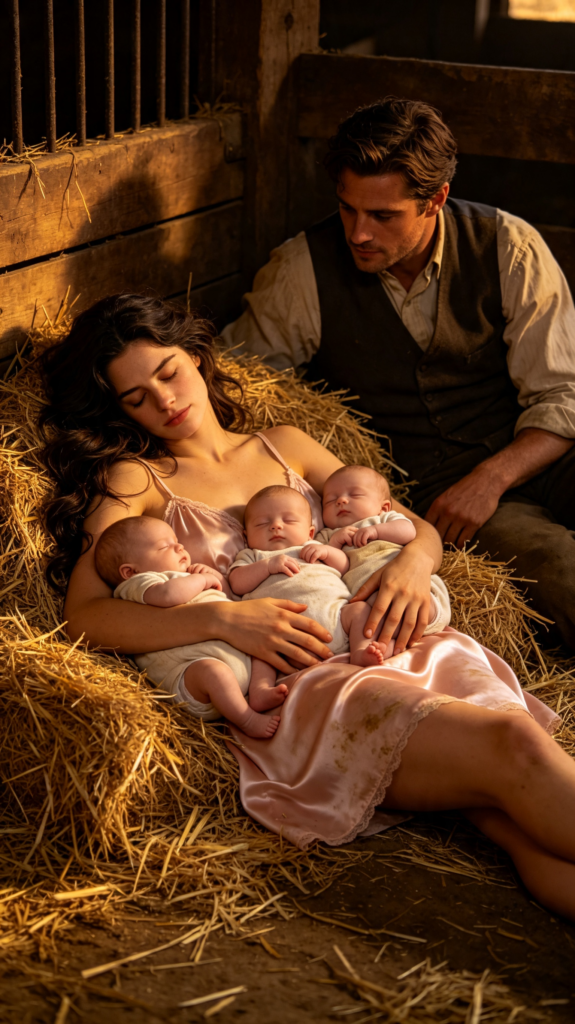
I refused.
“Tell me.”
He held a chart against his chest.
“We performed expanded testing because of the sedative exposure and the unexplained heel bruising. Grace’s blood type is inconsistent with the records we have for you and your late wife.”
“What are you saying?”
“There may have been an error in the original hospital records.”
“An error?”
“We need DNA confirmation.”
The room began to spin.
“All three are my daughters.”
“I’m not questioning your relationship to them.”
“You just did.”
Emma stood near Lily’s crib, pale and silent.
The doctor continued carefully.
“We ran an urgent comparison using archived maternal samples from Mrs. Whitmore’s delivery.”
“And?”
“Grace is not genetically related to Claire Whitmore.”
The words did not enter my mind.
They struck the outside of it and fell.
“That’s impossible.”
“We repeated the test.”
“She was delivered with her sisters.”
“Yes.”
“I watched them bring out three babies.”
The doctor looked down.
“According to the operative report, three infants were delivered. However, one baby—identified as Baby C—went into cardiac arrest and was transferred immediately.”
“Grace was Baby C.”
“That is what the current chart says.”
“Current?”
“There are inconsistencies in the original records. Pages were replaced. Identification numbers were altered.”
Emma gripped the crib rail.
“No.”
I turned toward her.
She was staring at Grace.
Not in confusion.
In recognition.
“No,” she repeated.
A memory moved behind her eyes.
“What is it?” I asked.
She stepped closer to the baby.
Grace reached up.
Her tiny hand closed around Emma’s finger.
Emma began to cry.
Not softly.
Not with relief.
She cried like someone watching a grave open.
“Noah wasn’t my only brother,” she said.
Victor’s words returned to me.
Evidence tells people where to look.
Emma swallowed.
“My mother had another child after Victor left. A little girl. She died during delivery.”
“How long ago?”
“Six months.”
The exact age of my daughters.
Emma’s breathing became shallow.
“My mother was forty-three. The pregnancy was dangerous. She called me from the hospital and said the baby was alive. Then a doctor told me they had both died.”
“What hospital?”
Her eyes found mine.
“St. Matthew’s.”
The private clinic Victor claimed had supplied the nursery medicine.
The closed clinic.
The clinic that had no pediatric service.
The clinic where Victor had hidden money.
The geneticist quietly asked, “Do you have a biological sample from your mother or any close relative?”
Emma looked at Grace.
“You can test me.”
They did.
We waited three hours.
Sophie improved.
Lily drank two ounces of formula.
Grace slept with her hand around Emma’s finger.
At noon, the geneticist returned.
He closed the door behind him.
“Grace is Emma’s half-sister.”
I sat down because the floor had disappeared.
Emma did not move.
The doctor continued.
“Based on the available records, we believe Mrs. Whitmore’s third baby died shortly after delivery.”
Claire had lost a daughter.
I had lost a daughter.
And neither of us had ever been allowed to mourn her because Victor had replaced her with another child.
“Why?” I whispered.
The answer came from the doorway.
“Insurance.”
Victor stood between two officers.
He had insisted on being brought upstairs after hearing that DNA testing had begun.
His face looked gray.
The officer beside him said, “He claims he can explain.”
Victor looked at Emma.
“Your mother called me when she went into labor.”
Emma’s eyes became empty.
“She still had your number?”
“She wanted help. Money. A doctor. Something.”
“So you helped her?”
“I saw an opportunity.”
Claire had delivered three babies on the same night Emma’s mother delivered one.
Claire’s third daughter died.
Emma’s mother suffered catastrophic bleeding.
Her newborn survived.
Victor was already paying a hospital administrator to alter Claire’s records.
A dead Whitmore infant threatened the structure of the family trust. My father’s will required three surviving direct heirs for certain land protections to remain intact. If fewer heirs survived the first year, a controlling portion of Willow Creek could be transferred into an administrative trust.
Victor needed three living daughters temporarily.
So he switched the babies.
He erased the death of Claire’s third child.
He placed Emma’s newborn sister in my arms.
He expected Grace to remain healthy until the trust deadline passed.
But then Emma arrived in town.
Victor recognized her.
If she learned Grace existed, if she requested records, if anyone connected the dates, the entire fraud would unravel.
So he decided all three babies had to die before their first birthday.
Their deaths would trigger my collapse and activate the incapacity clause.
Grace was never collateral damage.
She was evidence.
Emma crossed the room and stood before him.
“My mother died thinking her baby was dead.”
Victor said nothing.
“You took her child.”
“I gave the child a wealthy home.”
“You took her child.”
“I gave Grace nurses, security, land—”
“You took her child!”
Grace woke and began to cry.
The sound cut through every voice in the room.
Emma turned immediately.
So did I.
We reached the crib at the same moment.
For a second, our hands hovered over the baby.
Mine on one side.
Hers on the other.
Grace looked up at us with Claire’s ruby pendant resting on the blanket near her shoulder, sealed inside an evidence bag.
I thought I would feel something change.
That knowing the truth would loosen the bond between us.
It did not.
I had held Grace through colic.
I had counted every breath during her first fever.
I had slept on the nursery floor with one hand through the crib bars.
Her blood had never made her my daughter.
Love had.
Emma seemed to understand the same thing.
“She’s yours,” she whispered.
I looked at her.
“She’s ours.”
Her face crumpled.
Behind us, Victor began to speak.
No one listened.
The officers led him away.
He was convicted eighteen months later of attempted murder, kidnapping, fraud, embezzlement, evidence tampering, and conspiracy connected to Claire’s death.
He received three life sentences.
Tessa recovered.
June learned to walk again.
The hospital administrator accepted a plea agreement and revealed where Claire’s third daughter had been buried under a false name.
We gave her a proper grave beside her mother.
We named her Hope.
Emma did not leave Willow Creek.
At first, she stayed because Grace could not sleep without her song.
Then Sophie began reaching for her.
Then Lily refused her bottle unless Emma held it.
Months passed.
The babies learned to sit, crawl, and speak.
Grace’s first word was not Mama.
It was Em.
Mine was still the face she searched for when thunder shook the windows.
Emma’s was the hand she wanted when fever came.
There were no clean names for what we became.
Father.
Sister.
Guardian.
Family.
All were true.
None were enough.
On the first anniversary of the night in the barn, snow began falling over Willow Creek.
At 3:07 a.m., I woke and found the nursery empty.
Panic struck before reason.
Then I heard music downstairs.
I followed it to the kitchen.
Emma sat at the table in one of Claire’s old sweaters, singing “Red River Valley.”
Sophie, Lily, and Grace were asleep against her.
Three small heads rested over her heart.
On the table lay Claire’s ruby pendant.
Beside it was the brass locket containing the picture of Emily and Noah.
I stood in the doorway.
Emma looked up.
Neither of us spoke.
Outside, snow covered the path to the barn where she had nearly died saving children she did not yet know belonged to both of us.
Grace opened her eyes.
She reached one hand toward me and kept the other wrapped around Emma’s finger.
And beneath the quiet light of the kitchen, the daughter stolen from one dying mother and placed in the arms of another finally held her whole family at once.
