


A JOKE WORTH FIVE DOLLARS
The laughter of nearly three hundred guests echoed throughout the Denver Museum of Nature and Science’s glass atrium before Meredith Hale realized that her husband had deliberately made her the night’s spectacle.
She stood beneath a ring of white stage lights as Cameron Bellamy gripped her wrist and spoke to a ballroom packed with investors, executives, elected officials, and affluent donors. They had gathered to celebrate Cameron’s new position as senior vice president of Bellamy Urban Ventures, a national development firm recently purchased by Halstead Global Industries.
Cameron raised the microphone with a grin.
“We should raise additional money for tonight’s workforce scholarship fund, so let us begin with five dollars for my most dependable household appliance.”
A handful of guests laughed uneasily.
Cameron rested a hand on Meredith’s shoulder and steered her toward the middle of the stage.
“She cooks, cleans, remembers my appointments, and never stops asking questions about subjects she does not understand. Surely someone needs a full-time dishwasher.”
A man standing near the bar waved a five-dollar bill.
“Does she come with instructions?”
The ballroom exploded with louder laughter.
Heat rushed into Meredith’s face, but she kept her head up. She wore the modest burgundy dress Cameron had chosen because he claimed nothing should pull attention away from his promotion.
Earlier that day, she had fixed a loose button on his tuxedo, reorganized his presentation notes, and reminded him how to explain the risk-adjusted financing structure he planned to discuss.
She understood that structure because she had designed it.
For almost six years, Meredith had worked long after midnight while Cameron slept. She created acquisition models, assessed urban development opportunities, corrected his financial projections, and developed the operational strategy that had earned him three promotions.
Before marrying Cameron, Meredith had earned a master’s degree in applied economics and worked as a corporate analyst. She left that position after Cameron convinced her that helping his career accelerate would ultimately benefit them both.
“You understand technical details better than I do,” he had told her. “I understand how to persuade people. That makes us partners.”
Eventually, Cameron stopped calling her his partner.
At corporate dinners, he portrayed Meredith as a quiet homemaker who wanted nothing to do with business. Whenever executives complimented one of his strategies, he accepted their praise without acknowledging that his wife had prepared every significant page.
Earlier that evening, Serena Vale had approached Meredith before the speeches started. Serena served as Cameron’s communications director and had spent the previous year traveling with him to conferences, private dinners, and overnight meetings.
She wore a fitted red gown and carried herself like the ballroom already belonged to her.
“Corporate events must feel unfamiliar after so many years at home,” Serena said. “Most people here have actually contributed to the projects being celebrated.”
Meredith responded evenly.
“I understand the projects better than you realize.”
Serena smiled.
“Confidence is comforting when knowledge is unavailable.”
She walked back to Cameron’s table, leaned toward his ear, and laughed while looking in Meredith’s direction.
Now, standing beneath the bright stage lights, Meredith realized Cameron’s public humiliation had been planned. He was putting on a show for Serena.
Cameron lifted the microphone once more.
“Five dollars appears generous, but perhaps someone will offer ten. She rarely complains anymore, and I have trained her to stay out of serious conversations.”
Meredith scanned the ballroom, searching for anyone willing to intervene.
Several women looked visibly uncomfortable. A few executives stared down at their tables. Nobody confronted him.
Then a voice sounded from the back of the room.
“I will commit four million dollars.”
The laughter vanished instantly.
A tall man wearing a charcoal tuxedo stood from a table near the entrance. He was forty-three-year-old Harrison Cole, chief executive officer of Halstead Global Industries and the billionaire investor whose company had purchased Bellamy Urban Ventures six weeks earlier. Cameron’s confident smile faltered.
Harrison made his way toward the stage, a narrow leather folder in his hand.
“Mr. Cole, this is only a joke,” Cameron said.
“A joke generally requires something amusing.”
Harrison stepped onto the platform and took a signed document from inside the folder.
“You publicly stated that your wife contributed nothing meaningful to your professional success. Therefore, I am approving the four-million-dollar implementation reserve you requested for the Front Range Renewal Program.”
For a moment, Cameron’s confidence returned.
“That is excellent news.”
“You should read the remaining terms before celebrating.”
Harrison placed the document in his hands.
The reserve obligated Cameron to justify every financial assumption, submit a complete implementation plan, and establish ownership of all strategic materials within thirty days. Failure would result in termination, repayment obligations, and a formal fraud investigation.
The color drained from Cameron’s face.
Harrison turned to Meredith, slipped off his jacket, and carefully draped it over her shoulders.
“I am not purchasing you,” he said quietly. “Human dignity cannot be auctioned, and no amount of money determines your value.”
Meredith studied him.
“Then why did you name a price?”
“Because your husband just accepted the most expensive responsibility of his career, and he will now have to complete it without the person whose intelligence he stole.”
Harrison extended his hand.
For years, Meredith had permitted Cameron to decide where she stood, what she wore, and when she was allowed to speak. She knew accepting Harrison’s hand would not magically repair her life, but it would mark the first choice she had made completely for herself.
She took his hand.
The guests moved aside as Harrison guided her away from the ballroom. No one was laughing anymore. Serena lowered her eyes, while several senior executives observed Cameron with increasing doubt.
Inside Harrison’s waiting car, Meredith noticed a thick file lying on the seat.
She opened it and immediately recognized her handwritten notes, original spreadsheets, acquisition maps, and early versions of the Front Range Renewal Program.
“How did you obtain these?” she asked.
“Through the acquisition audit,” Harrison replied. “I know who built Cameron Bellamy’s career, and tomorrow the board will know as well.”
THE EVIDENCE HIDDEN IN METADATA
As the vehicle moved through downtown Denver, Harrison explained what his investigators had uncovered.
The Front Range Renewal Program was designed to transform abandoned industrial corridors across Colorado and neighboring states into advanced manufacturing facilities, affordable housing, and distribution centers. The proposal was intricate, thorough, and financially disciplined.
Cameron possessed none of those qualities.
“During his executive interview, I asked him to explain the sensitivity model on page forty-two,” Harrison said. “He described it as the section that prevents the numbers from becoming dangerous.”
Meredith laughed despite herself.
“That sounds exactly like him.”
The audit team had retrieved earlier versions of Cameron’s proposals. Most of the documents had been created between midnight and four o’clock using the residential internet connection registered to Meredith.
Several of the earliest drafts carried the initials M.H.
Cameron eventually erased those initials and replaced the document ownership information with his own name.
“I stopped signing the drafts after he told me married people should not keep score,” Meredith said.
“He was not afraid of keeping score. He was afraid the result would expose him.”
Harrison had also uncovered suspicious transfers involving confidential development information sent to Canyon Ridge Capital, a competing investment company in Phoenix. Cameron and Serena appeared to have been selling pricing information, client records, and bidding strategies, although the evidence was still incomplete.
Harrison offered Meredith independent legal counsel, a secure place to stay, and a temporary position as executive strategy adviser while the investigation moved forward.
She stared at him.
“You are offering me an executive role after speaking with me for less than an hour.”
“I am offering it after reviewing six years of your work.”
That distinction mattered.
At a private residence overlooking Cherry Creek Reservoir, attorney Olivia Grant waited with clean clothing, divorce documents, and a guest room. No one pressured Meredith into signing anything immediately.
Having the freedom to postpone a decision felt strangely unfamiliar.
She spent most of the night examining the recovered files. Cameron had erased her name, changed timestamps, and forwarded her work to Serena, who praised his intelligence in messages that gradually turned romantic.
At 4:47 in the morning, Meredith discovered photographs of Cameron and Serena kissing inside a hotel elevator during a conference in Dallas.
The photographs had been concealed inside a folder labeled Municipal Tax Records.
Meredith shut the computer. She did not shed a tear. The grief had been building inside her for years, and the photograph had simply given that pain a recognizable form.
Across town, Cameron went to a private bank, convinced that Harrison’s four-million-dollar commitment would be available to him as a personal reward.
The account manager quickly corrected that assumption.
“These funds are restricted to the Front Range Renewal Program. Your acceptance activated the oversight provisions in your original proposal.”
Cameron leaned forward across the desk.
“Mr. Cole announced the amount publicly and handed me the agreement.”
“He handed you a responsibility, Mr. Bellamy, not a gift.”
The agreement required a technical review the following Monday.
Cameron went back to his office and opened Meredith’s models. Equations he had confidently explained to investors suddenly looked meaningless. Transportation maps, financing assumptions, and vendor calculations provided no help to a man who had memorized conclusions without understanding how they had been developed.
He called Meredith again and again.
She ignored every call.
By midday, he hired a former security contractor to locate Harrison’s residence. Cameron drove there expecting his wife to be frightened, embarrassed, and prepared to apologize for humiliating him.
Instead, Meredith came to the entrance dressed in a cream business suit, a folder in her hand.
“Come home,” Cameron ordered. “We have a project to finish.”
“You have a project to finish.”
“Last night was an unfortunate joke, and everyone understood that.”
“You called me useless before three hundred people.”
“I was entertaining investors.”
“You were entertaining Serena.”
Meredith raised the hotel photographs.
Cameron’s expression hardened.
“Those images lack context.”
“The context is that you believed I would continue building your career while you mocked me beside the woman helping you betray me.”
Olivia stepped forward and handed Meredith an envelope. Meredith passed it through the gate.
Cameron opened the divorce petition, then immediately ripped it in two.
“That was only a copy,” Meredith said.
“You cannot survive without me.”
She held his gaze.
“You have reversed our positions.”
Cameron tightened his grip around the metal gate.
“If this project fails, everything we built disappears.”
Meredith turned toward the house.
“We did not build it together. I built it while you were sleeping.”
THE BOARDROOM EXAMINATION
On Monday morning, Cameron stepped onto the forty-sixth floor of Halstead Tower wearing the navy suit he considered lucky.
Serena was waiting outside the boardroom.
“You look terrible,” she whispered.
“I need you to discredit Meredith before Cole gives her access to the board.” “How?”
“Tell people she was involved with Harrison before the acquisition. Suggest that she traded confidential information for a position.”
Serena paused.
“That could expose us to additional scrutiny.”
“Do it before she destroys everything.”
Inside the boardroom, Harrison faced the gathered executives.
“This company has rewarded confidence without verifying competence. Beginning today, that practice ends.”
He presented Meredith as interim chief strategy and operations officer, giving her authority over the Front Range Renewal Program and the investigation into authorship.
Meredith walked in wearing a gray suit, a white silk blouse, and no wedding ring.
She switched on the presentation screen.
“Mr. Bellamy, your program assumes an eighteen-percent increase in rail freight costs during the first two years. Please explain how the distribution model absorbs that increase without reducing projected margins.”
Cameron forced a stiff smile.
“The model creates flexibility through integrated transportation assets.”
“That statement does not explain the calculation.”
“My analysts completed the technical modeling.”
“Please identify them.”
Cameron glanced around the table.
“I would need to review the staffing records.”
Meredith brought up the document metadata.
“You certified yourself as the sole author.”
Several directors exchanged uneasy looks.
She advanced to the following slide.
“The program promises a thirty-percent reduction in marketing expenditure while increasing qualified commercial leads. Which channels produce that growth?”
“Our digital ecosystem.”
“Which platforms?”
“The primary platforms used by industrial investors.”
“What customer acquisition cost did you assume?”
Cameron had no answer.
Meredith let the silence stretch until his discomfort became impossible to hide.
“These questions are designed to humiliate me,” he said.
“They are questions written by the person who designed the program.”
She displayed early drafts bearing her initials, residential timestamps, and messages in which Cameron instructed her to remove identifying information before submission.
Serena suddenly stood.
“Meredith was his wife. She may have typed documents he dictated.”
Meredith turned toward her.

“I expected you to make that claim.”
She played an audio recording recovered from a conference room system after an automated security alert.
Cameron’s recorded voice filled the boardroom.
“Has Canyon Ridge confirmed the payment?”
Serena responded.
“They will pay twice our annual bonuses once they receive the municipal pricing database and the vendor bid schedules.”
The recording continued, capturing their discussion about transferring confidential files and leaving the company once the acquisition was completed.
Serena stepped backward from the table.
“That recording was obtained illegally.”
Halstead’s general counsel answered from across the room.
“It was recorded through company equipment under a monitoring policy acknowledged by every employee.”
Cameron pointed toward Harrison.
“This is entrapment.”
“Entrapment requires someone to persuade you to commit a crime,” Harrison replied. “Nobody persuaded you to sell company information.”
Serena immediately began blaming Cameron, while Cameron accused her of creating the entire arrangement. Within minutes, their alliance fell apart.
Meredith raised one hand, bringing the room back under control.
“Security has preserved the evidence, and federal authorities have been notified. Both employees are suspended immediately.”
Cameron pushed himself up from his chair.
“You cannot do this to me.”
“You did this to yourself,” Meredith answered. “I am only refusing to hide the evidence.”
Security officers escorted Cameron and Serena from the boardroom. Before disappearing through the doorway, Cameron turned back toward Meredith.
“Harrison will discard you when he finishes using you.”
Meredith remained in her chair.
“Nobody gave me authority, Cameron. You merely spent six years pretending it belonged to you.”
THE RETURN AFTER DARK
That night, Meredith remained at the office late, organizing evidence for the investigators. Just before ten o’clock, the lights throughout the office suddenly went out.
Her computer screen went black.
A door opened somewhere in the hallway.
Slow footsteps approached her office.
Cameron emerged into the faint glow of Meredith’s phone flashlight. His lip was bleeding, his shirt was torn, and desperation filled his expression in a way she had never seen before.
“You should have helped me while you still had the opportunity,” he said.
Meredith stepped behind her desk.
“How did you enter the building?” “My administrative access card still worked at the service entrance.”
“Police officers are downstairs.”
“They are focused on Serena.”
Cameron’s eyes shifted toward Meredith’s jacket pocket.
“I need the encrypted drive.”
The device held copies of the stolen client information and financial transfers. Although multiple backups were already secured elsewhere, Cameron believed eliminating that drive might still protect him.
“The evidence has been duplicated,” Meredith said.
“You have always been a poor liar.”
“You have always been too arrogant to recognize the truth.”
He circled one side of the desk as Meredith moved toward the opposite side.
“You destroyed my career.”
“You mocked me publicly, stole my work, betrayed our marriage, and sold confidential information.”
“I gave you a home.”
“I paid for that home with the career you took from me.”
Cameron slammed both hands against the desk.
“You were nothing before my name opened doors for you.”
Meredith stared at him without flinching.
“Then why are you here begging for my work?”
He suddenly lunged across the desk and grabbed her wrist.
“Give me the drive.”
“No.”
His grip became tighter, sending pain through her forearm.
“Open your hand.”
Meredith kept her hand closed.
Cameron twisted her arm and forced her against the glass wall overlooking downtown Denver.
“You ruined everything.”
“You created every consequence waiting for you.”
He lifted his hand.
The emergency lights suddenly came on.
“Release her.”
Harrison stood in the doorway beside two Denver police officers and the head of corporate security.
Cameron stopped instantly.
Harrison crossed the office and pulled him away from Meredith. The officers restrained Cameron against the desk before placing him in handcuffs.
“She stole my company and my money,” Cameron shouted.
One officer began reading the charges, including assault, unlawful entry, attempted evidence destruction, corporate theft, and conspiracy to sell protected business information.
Cameron turned toward Meredith.
“Tell them this was a misunderstanding.”
She held her injured wrist close to her chest.
“You said I contributed nothing.”
“I was angry.”
“You offered me to strangers for five dollars.”
“It was a joke.”
Harrison moved between them.
“It was a joke only because you believed she could not make you face consequences.”
The officers led Cameron away from the building.
At the hospital, doctors confirmed that Meredith’s wrist had suffered a severe sprain but no fracture. After midnight, Harrison drove her back to the secure residence.
At the entrance, Meredith asked why he had personally returned to the office rather than sending the security team.
“The power failure triggered an alarm while I was still in the parking garage,” Harrison said. “Security found an injured building employee near the service stairwell.”
Meredith studied him carefully.
“You could have remained downstairs.”
“I could have.”
He did not turn the moment into a declaration or exploit her fear to create emotional dependence.
Instead, he simply opened the door and said, “Rest tonight. The company and the investigation will still exist tomorrow.”
Meredith nodded. “Will you?”
“Yes.”
THE TRIAL AND THE NAME RETURNED
Investigators eventually pieced together the entire operation. Cameron and Serena had transferred municipal pricing information, vendor negotiations, and confidential client records to Canyon Ridge Capital in exchange for payments routed through consulting firms and offshore accounts.
Cameron had also manipulated authorship records so he could receive promotions and performance bonuses based on Meredith’s work.
Serena entered a plea agreement and agreed to testify against him.
Cameron refused to cooperate. Instead, he claimed Meredith had fabricated the investigation because she resented his success, insisting that Harrison had influenced her into destroying their marriage.
Several tabloid outlets repeated his accusations, branding Meredith “The Four-Million-Dollar Wife.”
For several days, Meredith debated whether remaining silent would be easier.
Harrison refused to make the decision for her.
“You may speak publicly, or you may protect your privacy,” he said. “Neither decision makes you courageous or weak. The choice belongs to you.”
Meredith chose to speak.
During a press conference, she explained how her work had been taken from her and how she had allowed it to continue because she had mistaken loyalty for erasing herself.
“Marriage does not require one person to disappear so the other can appear brilliant,” she said. “Support becomes exploitation when only one person receives credit, authority, and freedom.”
The statement reached millions of people. Messages poured in from women who had managed businesses, written proposals, completed degrees, and handled finances while their husbands publicly claimed the achievements as their own.
Seven months later, Cameron’s federal trial began.
Forensic experts established that Meredith had created the original project files. Financial investigators followed the illegal payments, while Serena described Cameron’s intention to leave Halstead Global after collecting enough money.
“He told me Meredith would complete every technical requirement because she always rescued him,” Serena testified. “He said she was too loyal to expose him.”
When Meredith entered the witness box, the prosecutor asked why she had remained silent for so long.
“I believed his success belonged to our marriage,” she answered. “I did not understand that he viewed my love as free labor and my loyalty as protection from accountability.”
Cameron’s attorney suggested that Meredith was motivated by revenge.
Meredith stayed composed.
“I requested a divorce. The evidence requested justice.”
The jury found Cameron guilty of wire fraud, conspiracy, trade secret theft, obstruction, financial misconduct, and assault. He received an eleven-year federal prison sentence and was ordered to pay substantial restitution.
Serena received a reduced sentence because of her cooperation, although her professional career ended permanently.
One week later, Cameron appeared in family court for the final divorce proceeding.
He asked to speak directly to Meredith.
“We had good years,” he said. “You remember our first apartment and the meals we ate on the floor before we could afford furniture.”
Meredith remembered those moments.
That shared history made the betrayal more painful, but it did not change what the present had become.
“My mother is ill,” Cameron continued. “She will collapse if this divorce becomes final. I have lost everything, and you are the only person I have left.”
“You lost me long before the gala.”
Cameron moved toward her until a guard intervened.
“I can change.”
“You had six years to change while I was still standing beside you.”
“I was under extraordinary pressure.”
“Pressure did not create your character. It revealed what you were willing to do when you believed nobody could stop you.”
Cameron sank to his knees.
“Please do not abandon me.”
Meredith looked at the man who had once placed her beneath stage lights and invited strangers to determine her value.
She leaned closer so he could hear every word.
“You offered me for five dollars. Today, I would not pay one cent to return to the life you created.”
Twenty minutes later, the divorce became final.
BUILDING UNDER HER OWN NAME
Over the following year, Meredith rebuilt the Front Range Renewal Program. She eliminated inflated profit projections, established transparent vendor agreements, and partnered with community colleges to develop technical training programs throughout Colorado, New Mexico, and Wyoming.
The project launched below budget and generated more than five thousand jobs.
Meredith introduced profit-sharing opportunities, stronger protections for whistleblowers, and executive bonuses tied to ethical compliance rather than financial growth alone.
Business publications began referring to the system as the Hale Standard.
For the first time, her name appeared directly on the work she had created.
Her relationship with Harrison progressed slowly. They disagreed often, challenged each other’s ideas openly, and sometimes worked so late that they forgot to eat dinner. Harrison never expected Meredith to soften her arguments merely to protect his pride.
He invited her to dinner twice, and she declined both invitations.
On the third occasion, he described the evening as “two stubborn executives eating pasta without discussing industrial transportation.”
They discussed industrial transportation for twenty-five minutes before eventually moving on to books, family, grief, and the loneliness of being praised by people who never truly understood them.
Harrison’s wife had died nine years earlier following a long illness. Afterward, he had treated emotional attachment as though it were an avoidable business liability.
“You are not the only person who learned to hide inside work,” he told Meredith.
Neither of them rushed what developed between them.
Eventually, friendship became love, but it never felt like rescue. Instead, it felt like recognition between two people who understood that genuine respect left room for disagreement.
Eighteen months after the humiliating gala, Meredith returned to the same museum ballroom for Halstead Global’s annual leadership conference.
This time, she wore an emerald dress chosen entirely by herself.
More than five hundred employees, investors, students, and community representatives filled the room. Meredith stood on the same stage where Cameron had once ridiculed her.
“Humility does not require us to deny our abilities,” she told the audience. “Loyalty does not require protecting someone from the consequences of harming us, and love that demands your disappearance is not love. It is control disguised by commitment.”
The audience rose together in a standing ovation.
After the event ended, Harrison asked Meredith to remain while the staff cleared the ballroom.
He guided her onto the empty stage.
“The first time I stood here, I named a financial amount because I needed to stop what Cameron was doing,” he said. “I have regretted the wording ever since.”
“You made everyone listen.”
“However, I did not purchase your freedom. You claimed it. I did not give you a career, because you had already earned one. I merely recognized the person whose work was being hidden.”
He took both of her hands.
“I love your intelligence, your stubbornness, and the way you challenge me when everyone else agrees too quickly. I love that you treat an assistant with the same respect you give an investor.”
Meredith smiled as tears gathered in her eyes.
“I love that you have never asked me to become smaller so you could feel important.”
Harrison lowered himself onto one knee, but there was no audience left to influence her decision.
“Meredith Hale, will you build a life with me beside you, never behind you?”
She looked around the ballroom where her deepest humiliation had once taken place.
It no longer belonged to Cameron.
“Yes,” she whispered. “I will.”
They married several months later beside a mountain lake near Aspen. Harrison’s adult daughter stood beside Meredith during the ceremony, while Cameron’s mother also attended.
Meredith had arranged medical care and stable housing for the older woman without shielding Cameron from the consequences of his crimes.
Before the ceremony, Cameron’s mother embraced her.
“I am sorry for what my son became.”
“You did not make his decisions.”
“I should have recognized what he was doing.”
Meredith shook her head.
“Loving someone is not evidence that you approved of everything they became.”
Later, Meredith and Harrison established the Hale-Cole Foundation, offering legal assistance, emergency housing, and professional training to people whose careers or finances had been controlled by spouses.
Three years after Cameron’s conviction, Meredith received a letter from federal prison.
Cameron wrote that he worked on a sanitation crew, cleaning floors, kitchens, and industrial sinks. Other prisoners had learned about the gala and called him “The Dishwasher.”
At first, the nickname enraged him. Eventually, it forced him to confront the cruelty of treating honest work as something shameful.
He admitted that Meredith had devoted herself to their marriage because she loved him, while he had interpreted that devotion as proof that she mattered less.
Cameron did not ask her to return or forgive him.
He wrote that he did not know who he would become after prison, but he no longer wanted to remain the man who believed another person’s devotion existed for his own benefit.
Meredith folded the letter.
Harrison entered her office carrying coffee.
“Do you believe he changed?”
“I believe change is possible,” she replied. “I also believe I am not required to reward it with renewed access to my life.”
She placed the letter inside a locked drawer and never responded.
Forgiveness, she had learned, did not require opening a closed door again.
Later that afternoon, Meredith traveled to Albuquerque to open the foundation’s newest career center. A reporter asked whether she wished the humiliation at the gala had never happened.
Meredith considered the question carefully.
“I wish Cameron had chosen kindness,” she said. “Pain does not become valuable simply because someone survives it. However, I would not erase the woman who walked out of that ballroom, because she was terrified and still accepted the first opportunity to reclaim the truth.”
The reporter glanced toward Harrison.
“Did he lead you out?”
“At first,” Meredith answered. “Afterward, I learned to lead myself.”
That evening, Meredith returned to Denver and stood with Harrison on the balcony overlooking the city.
“What are you thinking about?” he asked.
“The price people place on things they do not understand.”
Harrison smiled.
“That sounds dangerous coming from an economist.”
Meredith rested her head against his shoulder.
“Cameron believed five dollars measured my worth. You named four million and frightened the entire room.”
“In retrospect, it was excessively theatrical.”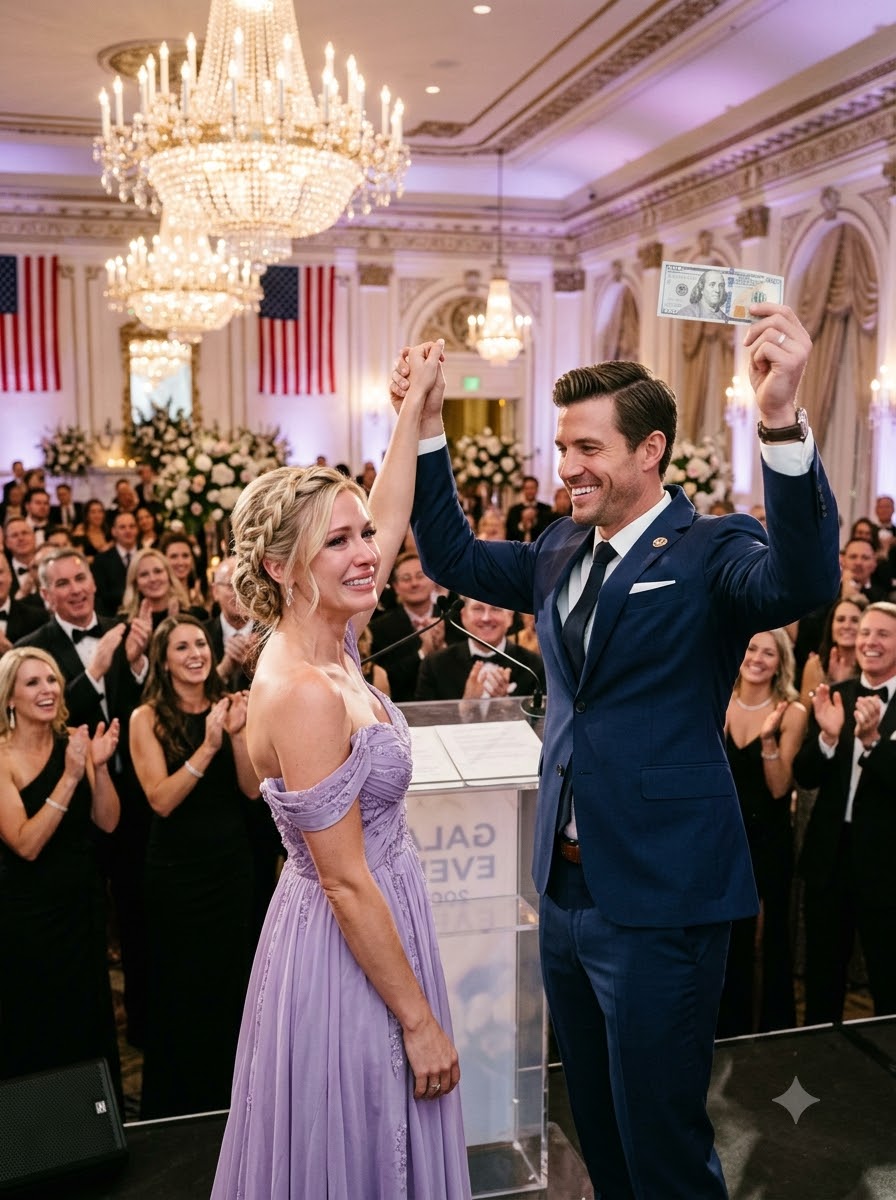
“Completely theatrical.”
“It worked.”
“It did.”
Harrison wrapped a blanket around her shoulders.
Meredith finally understood that her value had never been five dollars, four million dollars, or any other figure announced beneath a ballroom spotlight.
Her worth existed in the intelligence she had once hidden, the truth she eventually defended, the boundaries she learned to enforce, and the life she built under her own name.
No price could purchase those things.
Nobody would ever own them again.
THE END
