


The Invitation Designed to Humiliate Her
“Invite the woman who cleans the guest bathrooms,” Priscilla Harrington said, gently moving the ice around in her glass. “Just make sure you tell her it is a formal event. I would love to see what she considers elegant.”
Laughter floated through the sunroom of the Harrington estate in Franklin, Tennessee.
Priscilla sat beneath a glittering crystal chandelier alongside three women she had known for many years: Monica Vale, Denise Carrow, and Bridget Lennox. Every Wednesday afternoon, they gathered to talk about vacations, costly renovations, and the personal lives of people they considered beneath them.
Beyond the tall windows, a young woman named Kelsey Rowan was cleaning the stone terrace.
Kelsey had been working at the estate for nearly three years. She arrived before sunrise, completed every task without complaining, and rarely participated in the conversations taking place around her. At twenty-nine, she had warm hazel eyes, dark brown hair, and a calm expression that Priscilla found oddly irritating.
Kelsey never seemed impressed by the mansion.
She never stared at the designer handbags casually left on chairs.
She never appeared intimidated when wealthy guests spoke harshly to her.
There was something about her quiet confidence that made Priscilla feel as though the young woman knew something she did not.
“That might actually be entertaining,” Priscilla said, smiling as she picked up a cream-colored invitation from a nearby table. “My fifty-second birthday needs one memorable surprise.”
She called Kelsey into the sunroom.
Kelsey set her cleaning cloth on the terrace table before stepping inside.
“Did you need something, Mrs. Harrington?”
Priscilla extended the invitation between two fingers.
“My birthday gala is Saturday evening. Three hundred guests will be attending, and I have decided that you may come as well.”
Kelsey carefully accepted the card.
“Thank you for including me.”
Priscilla settled back into her chair.
“It is a formal evening, Kelsey. Very formal. I would hate for you to arrive without understanding what that means.”
Monica covered her smile with one hand.
Denise lowered her gaze toward her drink.
Bridget appeared uncomfortable but remained silent.
Kelsey studied Priscilla’s face briefly before placing the invitation inside her pocket.
“I understand perfectly.”
As soon as she returned to the terrace, the women started laughing again.
“She is really going to come?” Monica asked.
“Of course she is,” Priscilla replied. “People like her are always eager to enter rooms where they do not belong.”
None of the women noticed Kelsey pause just outside the window.
She had heard every word.
But rather than becoming angry, she drew a slow breath and went back to cleaning.

The Call She Had Refused to Make for Years
That evening, Kelsey returned to her modest apartment near East Nashville.
The space was small but comfortable. Beside the window stood a secondhand bookshelf filled with business journals, history books, and several framed photographs turned facedown.
Kelsey pulled the invitation from her coat pocket and set it on the kitchen table.
Under the overhead light, the gold lettering almost seemed to mock her.
For nearly four years, Kelsey had quietly lived under the surname Rowan. She had taken ordinary jobs, paid her own expenses, relied on public transportation, and refused every advantage that had once been available to her.
She wanted to understand who she was when there was no powerful family name standing behind her.
More importantly, she wanted to know whether people would respect her when they believed she had nothing valuable to give them.
Her years at the Harrington estate had finally provided the answer.
Kelsey picked up her phone and called a number she had avoided dialing for six months.
A deep voice answered after the second ring.
“Kelsey?”
Her grandfather could still recognize the silence before she said a word.
“Grandpa, I received an invitation tonight.”
“From Priscilla Harrington?”
Kelsey glanced toward one of the photographs lying facedown nearby.
“Yes.”
“And why does that sound like bad news?”
“Because she invited me as a joke. She wants to embarrass me in front of her guests.”
A long silence followed.
Her grandfather, Wallace Sterling, had created a respected agricultural and renewable-energy company operating throughout Wyoming, Colorado, and several neighboring states. He was known for making firm decisions, speaking plainly, and remaining loyal to the people who worked for him.
He had never supported Kelsey’s decision to disappear into an ordinary life, but he had respected her choice.
“Do you want me to handle this?” Wallace asked.
“No. I want to handle it myself.”
“Then why are you calling me?”
Kelsey picked up the invitation and studied the small gold crest printed across the top.
“Because I am ready to come home.”
Wallace fell silent once again.
When he finally answered, his voice was softer.
“Are you certain?”
“I have spent four years proving that I can survive without the Sterling name. I no longer need to hide from it.”
“Then I will be in Tennessee by Saturday afternoon.”
Kelsey closed her eyes.
“Thank you, Grandpa.”
“You never needed to thank me for standing beside you.”
The Son Who Recognized the Truth
The next morning, Priscilla had breakfast with her oldest son, Grant Harrington.
After his father passed away, Grant had assumed responsibility for much of the family’s commercial property business. Unlike his mother, he stayed away from social gossip and preferred using his time to examine contracts, visit construction sites, and speak directly with employees.
Priscilla spread jam over a piece of toast.
“I invited Kelsey to my birthday gala.”
Grant slowly lowered his tablet.
“Kelsey Rowan?”
“Yes, the housekeeper.”
“Why?”
Priscilla smiled.
“Because Monica thought it would be amusing.”
Grant stared directly at her.
“You invited an employee to a formal event so your friends could judge her clothes?”
“Do not make it sound so dramatic.”
“That is exactly what you are doing.”
Priscilla rolled her eyes.
“She accepted the invitation. Clearly, she does not mind.”
Grant pushed his chair away from the table.
“People often remain polite when they know their jobs depend on it.”
“I did not ask for a lecture.”
“No, but someone needs to tell you the truth before Saturday.”
Grant walked away from the terrace without finishing his coffee.
What Priscilla did not realize was that her son had already started becoming curious about Kelsey.
Several weeks before the gala, Grant had seen Kelsey studying a complicated land-development report during her lunch break. When he asked how she was able to understand it, she responded with an answer more insightful than anything he had heard from several highly paid consultants.
Later, he searched for her name.
“Kelsey Rowan” produced nothing.
But an older photograph from a regional business article showed a young woman with those same hazel eyes standing next to Wallace Sterling. The caption named her as Kelsey Sterling, the only granddaughter of the founder of the Sterling Group.
Grant kept searching and learned that she had quietly walked away from the company four years earlier.
He did not tell anyone.
He understood that Kelsey must have concealed her identity for a reason, and he believed she had the right to reveal the truth when she was ready.
On Saturday morning, Grant received a private call.
“Is this Grant Harrington?” Wallace Sterling asked.
“Yes, sir.”
“My granddaughter has cleaned your family’s home for almost three years.”
“I recently learned who she is.”
“And you kept that information private?”
“It was not mine to share.”
Wallace paused.
“That was the correct decision.”
Grant glanced toward the ballroom, where workers were arranging flowers for the evening.
“What will happen tonight?”
“That depends on the choices people make when the truth enters the room.”

The Woman Dressed in Emerald Green
By Saturday evening, the Harrington estate looked completely transformed.
White roses lined the staircases. Candlelight shimmered across the polished marble floors. Near the garden doors, a jazz quartet performed while three hundred guests arrived wearing evening gowns and tailored suits.
Priscilla stood beneath an enormous arrangement of orchids in a silver dress, greeting each person as they entered.
At eight-thirty, a black sedan pulled up near the front entrance.
The driver climbed out and opened the rear door.
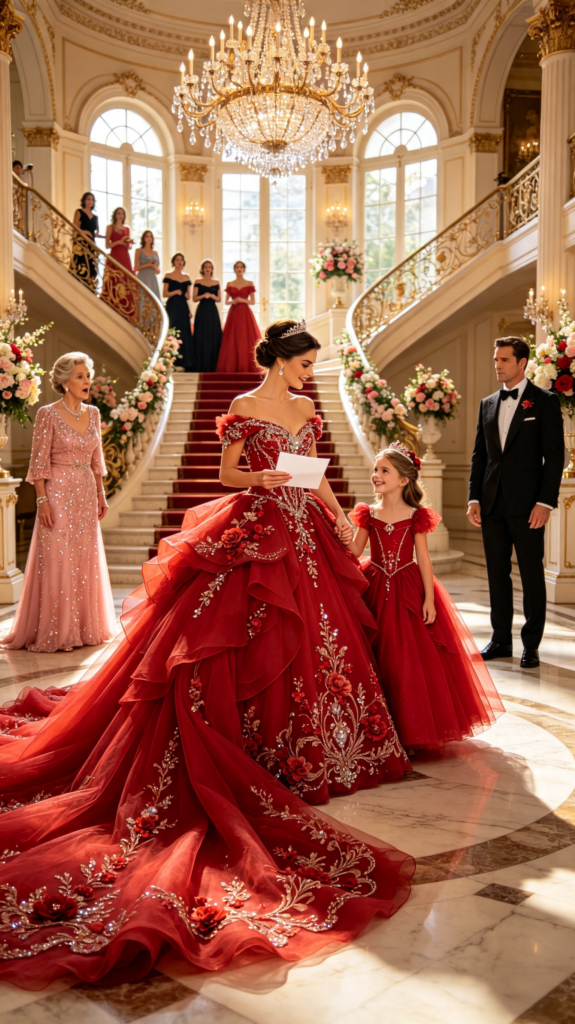
A woman stepped from the car wearing a floor-length emerald-green gown of soft silk. It was elegant without being extravagant, while the antique necklace around her throat reflected the light with every movement.
For several moments, Priscilla failed to recognize her.
Then Kelsey lifted her eyes.
Priscilla’s smile disappeared.
Monica grabbed Denise by the arm.
Bridget whispered, “That cannot be her.”
Kelsey entered with the effortless grace of someone who had spent her entire life attending gatherings exactly like this one.
She stopped directly in front of Priscilla.
“Happy birthday, Mrs. Harrington. Thank you for inviting me.”
Priscilla’s eyes settled on the necklace.
“Where did you get that dress?”
Kelsey gave her a slight smile.
“You asked me to come in formal attire.”
“Yes, but this is…”
Priscilla could not complete the sentence.
Nearby guests started whispering among themselves. Several recognized the antique necklace from photographs of the Sterling family taken years earlier.
Grant approached from inside the ballroom.
He looked toward Kelsey and gave her a respectful nod.
“You look wonderful.”
“Thank you, Grant.”
Priscilla turned abruptly toward her son.
“Why are you acting as though you know something?”
Before Grant could respond, the head of the household staff stepped onto the first marble stair and asked for everyone’s attention.
The music came to a stop.
“Ladies and gentlemen, at the personal invitation of Mrs. Priscilla Harrington, we are honored to welcome Miss Kelsey Sterling.”
Silence swept through the room.
The color disappeared from Priscilla’s face.
Kelsey slowly descended the grand staircase. She knew every one of those steps because she had polished them countless times while guests walked past without even acknowledging her presence.
But tonight, every eye followed her.
Then the front doors opened once more.
Wallace Sterling entered in a dark suit, accompanied by two senior members of his company.
The guests immediately moved aside.
He walked over to Kelsey and gently kissed her forehead.
“You kept me waiting long enough, sweetheart.”
Kelsey smiled.
“I needed time.”
Wallace turned his attention toward Priscilla.
“Thank you for inviting my granddaughter. Your invitation helped her make an important decision.”
Priscilla tried to regain her composure.
“Mr. Sterling, I had no idea Kelsey was related to you.”
“I know,” Wallace replied. “That is what makes tonight so revealing.”

The Truth Behind Her Ordinary Life
The guests moved closer as Kelsey took the microphone.
She did not speak loudly.
There was no need.
“Four years ago, I walked away from my family name after discovering that a man I trusted cared more about my inheritance than he cared about me.”
The ballroom remained completely still.
“I changed my surname and chose to live without family connections. I wanted to know whether I could build a life through my own work, and I wanted to learn how people behave when they believe someone has no influence.”
Kelsey glanced toward the members of staff gathered near the doors.
“I learned more than I expected.”
Priscilla crossed her arms.
“This is my birthday celebration, Kelsey. Perhaps personal speeches should be saved for another evening.”
“You invited me here because you wanted me to become part of the entertainment,” Kelsey replied. “I am only explaining why the joke did not go as planned.”
Several guests turned their eyes away from Priscilla.
Wallace moved forward.
“My granddaughter has completed the period of independence she chose for herself. Beginning Monday, she will assume leadership of the Sterling Community Development Division.”
Murmurs traveled throughout the ballroom.
The division oversaw major agricultural, housing, and energy investments spanning several states.
Priscilla looked at Kelsey as though she were seeing the young woman for the very first time.
But revealing her true identity was not the only reason Kelsey had come.
Grant carried a black folder over to the center table.
Priscilla’s expression shifted immediately.
“What is that?”
Grant looked at his mother with visible disappointment.
“Information that should have been reviewed years ago.”
The Folder Nobody Saw Coming
Kelsey placed one hand gently over the folder.
“During my time working here, I often heard conversations that people assumed I could not understand.”
Monica shifted uneasily.
Denise glanced toward the closest exit.
Priscilla responded quickly.
“Anything you heard inside my home was private.”
“Privacy does not turn false records into honest ones,” Grant said.
He opened the folder.
Inside were copies of supplier contracts, foundation expense statements, and records of payments made to small companies linked to Priscilla’s friends.
Grant had first noticed suspicious numbers months earlier, but whenever he questioned them, his mother insisted they were ordinary social and charitable expenses.
Kelsey had recognized those same company names while listening to conversations around the estate. After comparing them with publicly available records, she shared her concerns with Grant.
Together, they requested that independent auditors examine the information.
“The review found inflated service agreements, misleading charity expenses, and foundation funds directed toward businesses connected to Monica and Denise,” Grant explained.
Monica gave a forced laugh.
“This is absurd.”
Grant passed her a copy.
“The figures have been checked by independent professionals.”
Denise turned toward Priscilla.
“You said the payments were approved.”
“Do not discuss this here,” Priscilla snapped.
Bridget moved away from the others.
“I never agreed to any of this. I attended the charity meetings, but I did not sign financial documents.”
Priscilla turned to face her son.
“Grant, stop this immediately. I am your mother.”
His expression softened, although his voice remained firm.
“That is why I asked you repeatedly to correct the records privately. You refused.”
“I was protecting our family’s position.”
“You were protecting appearances.”
Tears gathered in Priscilla’s eyes.
“Everything I built was for you and your sister.”
“We never asked you to treat people as though their value depended on their bank accounts.”
Wallace turned toward the gathered guests.
“The Sterling Group has ended all business discussions involving the Harrington Foundation until the independent review is complete. The documents have also been delivered to the appropriate professional offices.”
Phones began appearing throughout the room.
Conversations spread quickly across the ballroom.
Guests who had spent years trying to earn Priscilla’s approval suddenly made certain they were nowhere near her.
“You are all judging me?” Priscilla demanded. “Many of you have made mistakes.”
Nobody responded.
Standing beside her now could bring unwanted attention to their own names.

The Apology That Arrived Too Late
Priscilla turned toward Kelsey.
Her earlier confidence was gone.
“What do you want? Do you want me to apologize in front of everyone?”
Kelsey regarded her calmly.
“An apology given only because the room has turned against you would mean very little.”
“Then what do you want from me?”
“I want you to remember every person who worked inside this house while you spoke as though they were invisible.”
Kelsey looked toward the servers, gardeners, drivers, and cleaning staff.
“A person does not become unimportant simply because they are serving your dinner, cleaning your floors, or opening your door.”
Priscilla lowered her gaze.
Kelsey continued.
“You invited me tonight because you believed my clothes would prove that I did not belong here. Instead, your behavior proved that kindness had never depended on wealth.”
Monica departed without saying goodbye.
Denise followed only moments afterward.
Bridget stayed just long enough to quietly apologize to Kelsey for laughing during earlier conversations.
The gala ended sooner than expected.
Guests left in small groups, talking quietly as they made their way across the driveway.
For the first time in three years, Kelsey did not exit through the service entrance.
She walked out through the front doors alongside her grandfather.
Grant followed them toward the car.
“I will send the remaining documents to the auditors on Monday,” he said.
Wallace nodded.
“Do what is right, even when it costs you something.”
Grant looked toward Kelsey.
“I am sorry I did not speak sooner.”
“You spoke when it mattered most,” she replied.
The Life She Chose From There
Three weeks later, Kelsey Sterling signed her first major agreement in her new role as an executive.
The program provided fair contracts, emergency assistance, and long-term purchasing guarantees for small farms across Tennessee, Kentucky, and Wyoming.
She selected the project because she had encountered many workers whose contributions were essential yet rarely acknowledged.
Grant restructured the Harrington Foundation and replaced several members of its leadership. He also introduced stronger protections for employees who raised concerns about financial wrongdoing.
The following year, Priscilla sold the estate after the independent review placed her under significant financial pressure. Yet losing the mansion hurt less than losing the social influence she had spent decades creating.
People who had once crowded around her dining table stopped answering her calls.
Kelsey took no pleasure in Priscilla’s downfall.
She believed consequences were necessary, but humiliating another person had never been what she wanted.
Inside her new office in Wyoming, she kept two objects in a wooden box: the faded denim uniform she had worn while working at the Harrington estate and the gold invitation that had been intended to embarrass her.
The uniform reminded her that honest work could never diminish a person’s value.

The invitation reminded her that cruelty often exposes far more about the person giving it than the person forced to receive it.
Kelsey had first entered the Harrington home through a side entrance because others assumed she belonged nowhere else.
She walked away through the front doors knowing she never again needed to conceal who she truly was.
Never judge another person’s worth by the job they perform, because the individual cleaning a room may carry more wisdom, courage, and dignity than all the people being honored within it.
True character becomes clearest in the way someone treats those who cannot provide them with status, wealth, influence, or an immediate personal benefit.
A simple uniform cannot erase intelligence, history, or possibility, just as expensive clothes cannot conceal selfishness once the truth is exposed.
Those who remain quiet are not necessarily powerless, because silence may be a deliberate choice made by someone who is watching, learning, and waiting until the right moment to speak.
An apology given only when consequences arrive may heal very little, while genuine respect offered from the beginning can prevent wounds that might otherwise remain for years.
Honest work deserves dignity in every form, whether it takes place in a boardroom, across a farm, inside a kitchen, or silently through hallways before anyone else arrives.
Wealth can open impressive doors, but only humility, kindness, and integrity allow someone to pass through them without sacrificing the respect of others.
The people society ignores often notice far more than anyone realizes, and treating them as invisible does not prevent them from understanding the truth unfolding around them.
Family loyalty should never demand silence when dishonesty is involved, because shielding someone from accountability can ultimately damage everyone connected to them.
The greatest victory is not making someone else feel small, but standing with dignity, speaking the truth calmly, and walking away without carrying the cruelty that was once directed toward you.
