

The Evening He Returned Too Soon
Graham Calloway had built his entire life around precision, the kind that allowed no space for hesitation or emotional distraction, because in his world, where he oversaw complicated infrastructure contracts across several states, one small error could trigger consequences far greater than anyone could afford. Every hour was carefully scheduled, every decision measured against efficiency, and every personal emotion quietly pushed aside in favor of control, which was why his home had gradually started to feel more like another branch of his professional life than a place where a family actually lived.
What very few people realized, however, was that behind his polished reputation and controlled confidence existed a silence that followed him home each evening, settling into the corners of his large Westchester County house and remaining there long after the final email had been answered and the lights in his office had gone dark.
That silence had started three years earlier, after his wife, Lillian, was no longer there to fill the rooms with her warmth, her music, and the quiet ability she had possessed to make everything around her feel human again.
Ever since, the house had stayed immaculate, organized, and painfully empty.
On a Thursday afternoon, a business deal in Philadelphia wrapped up earlier than expected, and although his assistant recommended staying overnight to prepare for the following day, Graham surprised even himself by refusing immediately.
“No, I’m heading home tonight.”
He offered no explanation because he could not fully explain the decision even to himself. He only knew that the idea of returning home suddenly carried an urgency he had not expected.
A Sound He Had Almost Forgotten
By the time his car passed through the wrought-iron gates and traveled up the long driveway, the late-afternoon sunlight had begun stretching across the stone exterior of the house, covering it in a gentle glow that stood in sharp contrast to the emotional distance Graham had become accustomed to.
He walked inside, loosening his tie with one hand as he automatically prepared his mind for whatever came next—the next responsibility, the next obligation, the next carefully planned hour.
Then he heard something.
Laughter.
It was not the polite laughter that filled the house during formal gatherings, nor the controlled amusement of colleagues exchanging rehearsed comments. This was something completely different—bright, spontaneous, and alive in a way that seemed almost foreign inside the house he knew.
Graham stopped in the middle of a step, his body responding before his mind had fully understood what he was hearing.
Those were his children.
And they were not simply laughing.
They were laughing freely.
Following the sound, he quietly made his way down the hallway, instinctively careful not to disturb whatever delicate moment was taking place, until he reached the open living-room doors and stopped just outside the entrance.
The Woman Standing at the Center
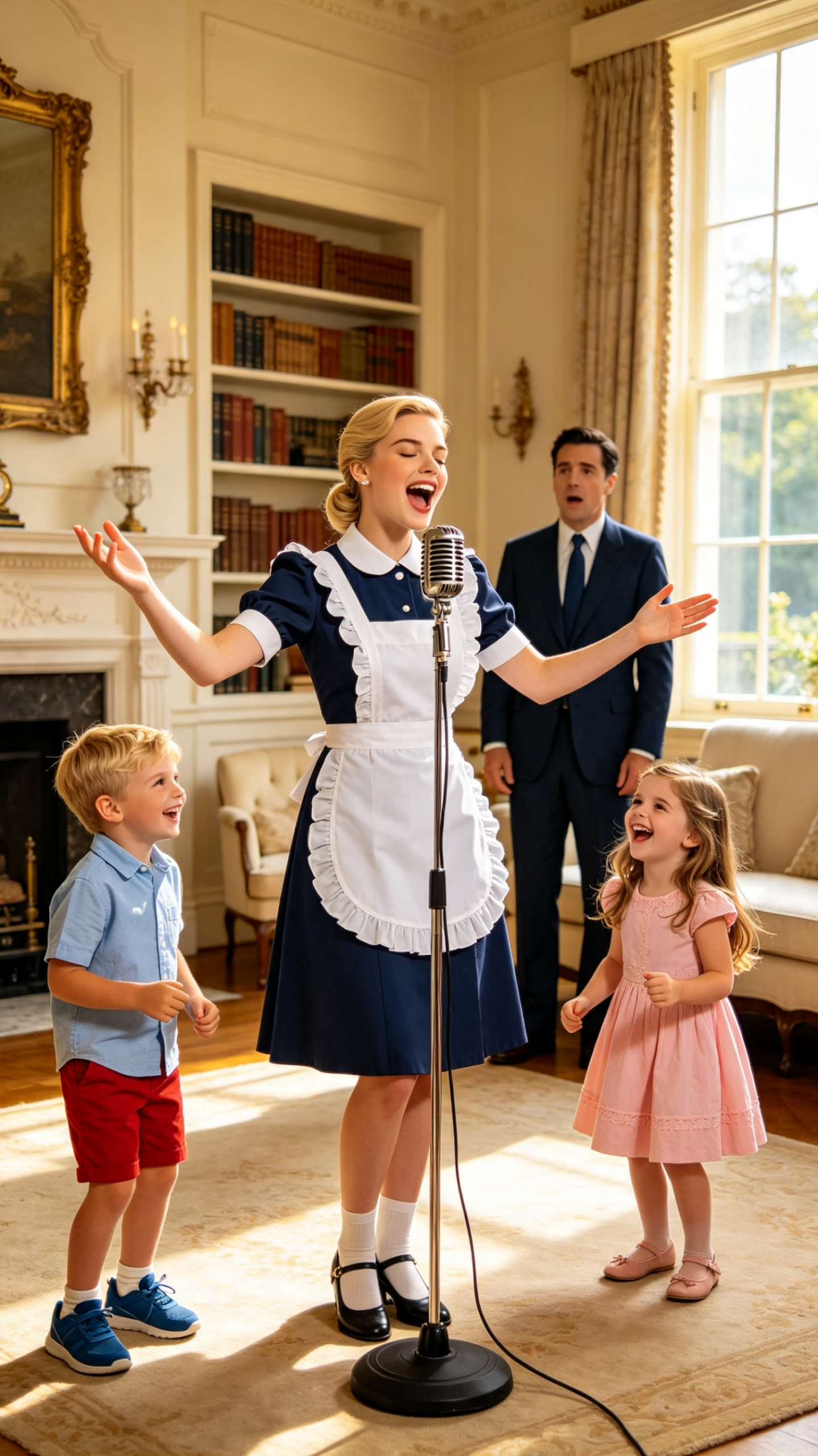
At the center of the living room stood Marissa Hale, the nanny Graham had hired six months earlier after an exhaustive search for someone capable of offering structure, consistency, and professionalism to his five-year-old twins, Lucas and Emma.
He had selected her because she appeared calm, responsible, and appropriately reserved.
But the woman before him now seemed entirely different.
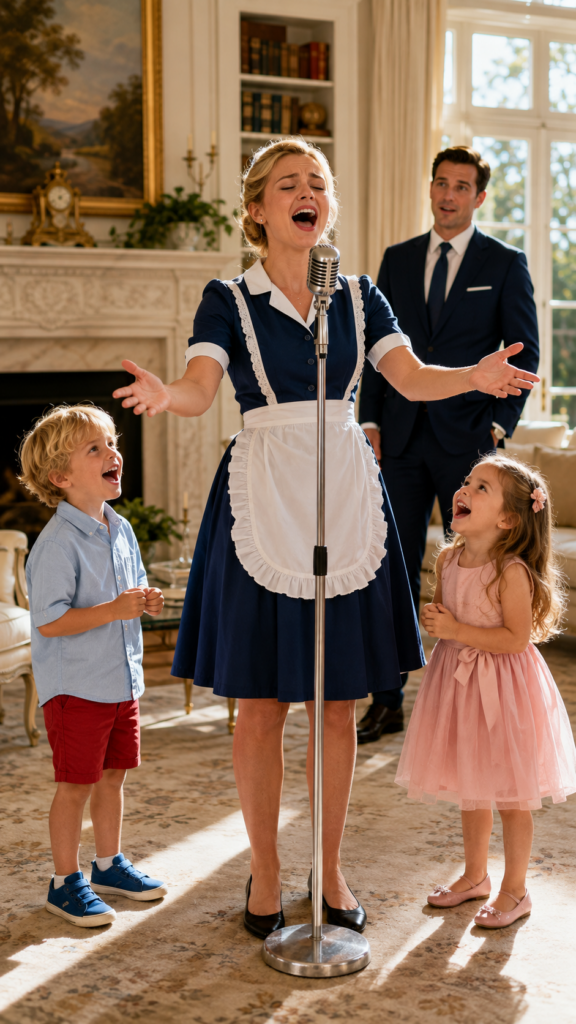
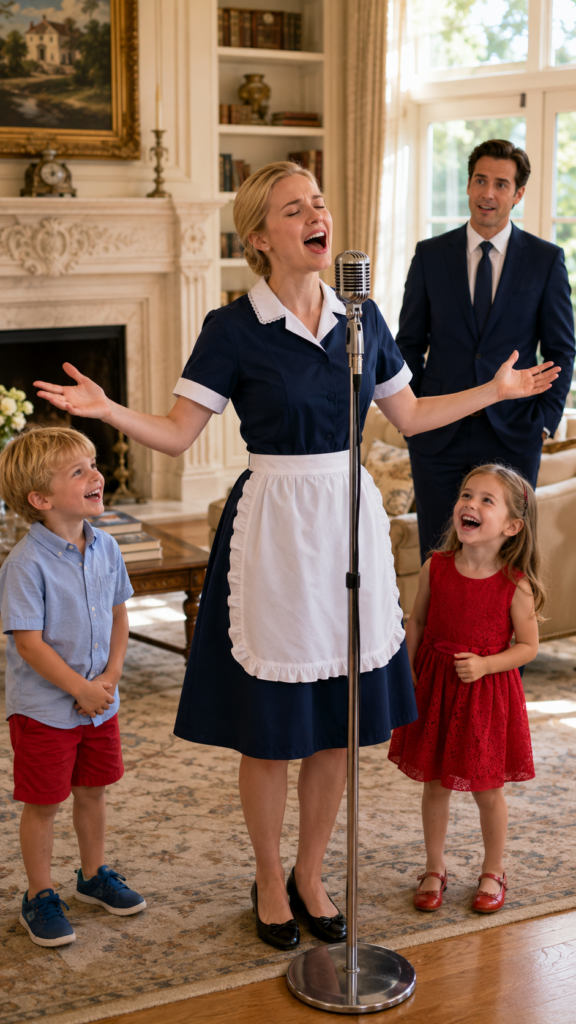
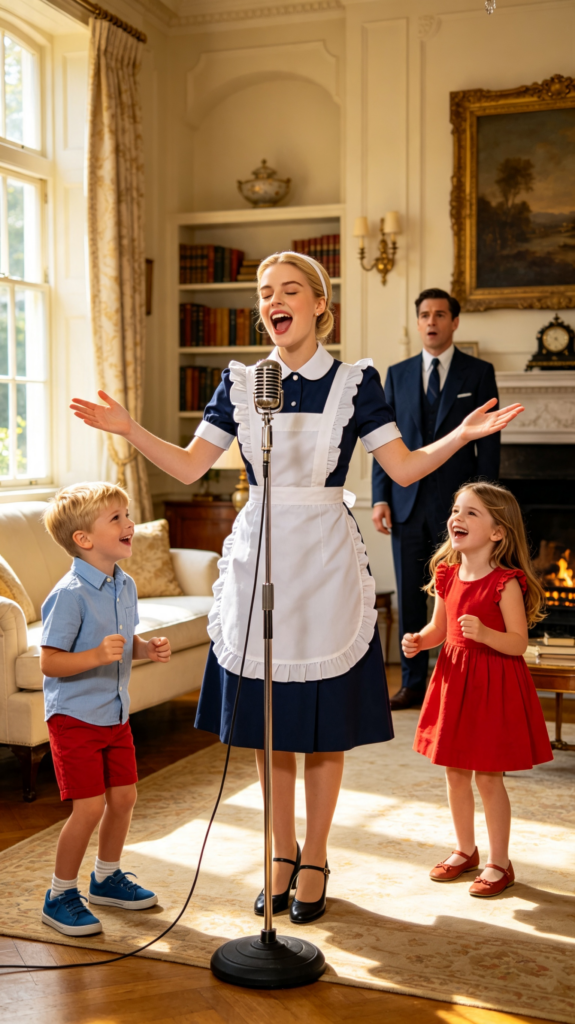
She stood barefoot on the rug with a small handheld microphone connected to a portable speaker, her posture comfortable yet expressive as she sang with a warmth and confidence that filled the entire room. There was a sincerity in her voice that made the space feel less like a meticulously maintained residence and more like a home where people genuinely lived.
Lucas clapped along in an uneven rhythm, his face glowing with excitement while he bounced eagerly on his heels. Emma twirled in small circles, her dress lifting slightly around her as she laughed without holding anything back.
They were not looking at Marissa the way children normally watched someone responsible for taking care of them.
They looked at her as though she had opened a door they had never realized was shut.
And for a moment that lasted much longer than Graham expected, he remained completely still and unnoticed beyond the doorway, feeling something inside him begin to shift in a way he had refused to allow for years.
Memories Returning Without Warning
Her voice, the rhythm of his children’s laughter, and the simple, unplanned happiness filling the room reached into a part of Graham that he had carefully kept closed away.
Suddenly, he remembered Lillian standing in the kitchen and singing softly while stirring something on the stove, dancing with the children in the living room whenever the music became impossible to ignore, or laughing with such complete freedom that everything else seemed temporarily unimportant.
After she was gone, Graham had convinced himself that maintaining order was the only way to move forward, that silence and control could protect everything they still had.
Instead, he had unknowingly removed something essential.
When the song ended, the children immediately burst into applause.
“Again!” Lucas called out, his voice filled with urgency.
“Please, one more!” Emma added, reaching for Marissa’s hand.
Marissa laughed softly, catching her breath before nodding.
“Alright, one more—but then we need to get ready for dinner, okay?”
Graham turned slightly away and briefly pressed his hand against his mouth as he exhaled, startled by the unmistakable emotion building inside his chest.
He had never expected to see this.
He had not prepared himself for it.
Still, he did not walk away.
A Different Kind of Conversation
Several minutes later, after collecting himself as much as possible, Graham stepped into the living room and finally revealed that he was there.
Marissa noticed him immediately, and the ease on her face shifted into uncertainty.
“Mr. Calloway, I didn’t hear you come in,” she said, lowering the microphone slightly. “I hope I didn’t overstep. They were a little restless, and I thought—”
Graham gently raised one hand, not to silence her, but to reassure her.
“No,” he said quietly. “Please don’t stop.”
Both children immediately rushed toward him.
“Dad, you heard her, right?” Emma asked, her eyes wide with excitement.
“She sings like someone on stage!” Lucas added, practically bouncing with pride.
Graham looked first at his children and then toward Marissa, speaking more softly than he had in a very long time.
“Is that true?”
Marissa hesitated briefly before responding.
“It used to be,” she said, her tone modest. “A while ago.”
Graham nodded, taking in her answer without asking anything further.
He could tell there was more behind those words, but for once, he felt no immediate need to examine or understand everything.
Dinner That Felt Different
That evening, rather than disappearing into his office or checking his messages between conversations, Graham stayed at the dining table with his children and began noticing details he had somehow overlooked before, from the animated way Emma described her day to Lucas’s habit of transforming almost everything into a game.
Marissa gently guided the meal, adding small moments of playfulness that turned what normally would have been a quiet, organized dinner into something warmer and lighter.
“Dinner can feel like music,” Emma said at one point, obviously repeating something she had heard earlier.
Graham glanced toward Marissa before answering, almost surprising himself with his response.
“Then maybe we should try it that way.”
Marissa smiled and began softly humming a tune. Before long, the children joined her with uneven yet enthusiastic voices, filling the dining room with something the house had been missing for far too many years.
What She Saw That He Had Overlooked
Later that evening, after the children had gone to bed and the house had settled into a quieter rhythm, Graham found Marissa in the kitchen, tidying everything with her usual quiet efficiency.
He leaned lightly against the counter, considering his words with more care than he normally did.
“You did more than entertain them tonight,” he said. “You reached them in a way I haven’t been able to.”
Marissa paused briefly before placing the dish towel aside.
“It’s not really about doing something special,” she replied. “It’s about seeing them as kids first, not as expectations or responsibilities.”
Graham considered her words, feeling their meaning settle heavily inside him.
“They miss their mother,” she added gently. “Even if they don’t always say it directly.”
Graham nodded, lowering his gaze slightly.
“I know,” he said. “I just… thought giving them stability would be enough.”
Marissa’s expression softened.
“Stability matters,” she said. “But so does warmth.”
A brief silence passed between them before she continued, her voice quieter.
“I stepped away from music for a long time,” she admitted. “After my husband passed, it felt easier to keep everything controlled, predictable. Singing made things feel too close.”
Graham released a slow breath.
“I understand that more than I expected to,” he said. “I thought silence would protect me too.”
He hesitated for a moment before adding, almost reluctantly,
“But it didn’t. It just made everything feel… distant.”
Marissa held his gaze, not with sympathy, but with a sense of recognition.
The Small Changes That Came After
The following morning, Graham canceled two meetings, something his team almost never saw him do, and sat through breakfast with his children without checking his phone a single time.
During the weeks that followed, subtle changes slowly began appearing, not as sweeping transformations, but as intentional adjustments in the way he decided to use his time.
Schedules grew more flexible.
Evenings became less structured.
Laughter, which had once seemed almost foreign inside the house, gradually returned in small yet meaningful moments.
And Marissa, without ever attempting to place herself at the center of attention, continued bringing something into their home that could neither be scheduled nor measured.
A Night That Felt Like Starting Over
Roughly a month later, Graham organized a small gathering at the house, inviting colleagues, friends, and several community partners under the guise of a casual evening together.
The guests arrived expecting the familiar atmosphere—polished, restrained, and quietly formal.
Instead, they heard music.
Real music.
At the front of the room stood a simple setup, and there was Marissa, carrying a calm confidence that belonged entirely to her.
She began singing without hesitation, her voice traveling through the room and drawing everyone’s attention, not because she demanded to be noticed, but because what they heard deserved their attention.
Graham remained near the back with Lucas and Emma, watching her while also noticing how the entire atmosphere of the room seemed to soften around the music.
“Dad, why are you smiling?” Emma whispered, gently tugging at his sleeve.
He glanced down at her before turning his attention back toward the front of the room.
“Because I think I finally understand something,” he said quietly.
“What?” Lucas asked.
Graham answered steadily, but there was a warmth in his voice that had been absent for years.
“The things that matter most aren’t the ones you can plan or control.”
A Home That No Longer Felt Empty
As the final note disappeared and applause filled the room, Marissa briefly looked toward Graham.
He responded with a small, almost unnoticeable nod, not out of politeness, but as a quiet acknowledgment.
Later that night, once the last guest had gone and the house became quiet again, the silence felt completely different.
It was no longer heavy.
It no longer felt hollow.
It felt… full.
For the first time in years, Graham no longer felt like a man standing by himself inside a life he had carefully constructed.
He felt like a father who had finally found his way back to something he had never realized was missing.
And as he remained there, listening to a quiet that now carried warmth instead of emptiness, Graham understood that the house itself had never changed.
He had.
And somehow, because he had changed, everything within those walls had slowly begun to feel alive again.
