

Part One: The Boy I Thought I Knew
I had always been certain I knew exactly who my son was.
Aaron was seventeen—tall, gentle, and much more thoughtful than most boys his age. He was the type of teenager who noticed when someone was sitting alone, held the door open without being asked, and quietly helped classmates without expecting recognition.
I couldn’t have been prouder of him.
Then one afternoon, a phone call from my closest friend made me question whether there was a part of my son I had never truly seen.
That morning had started like any other.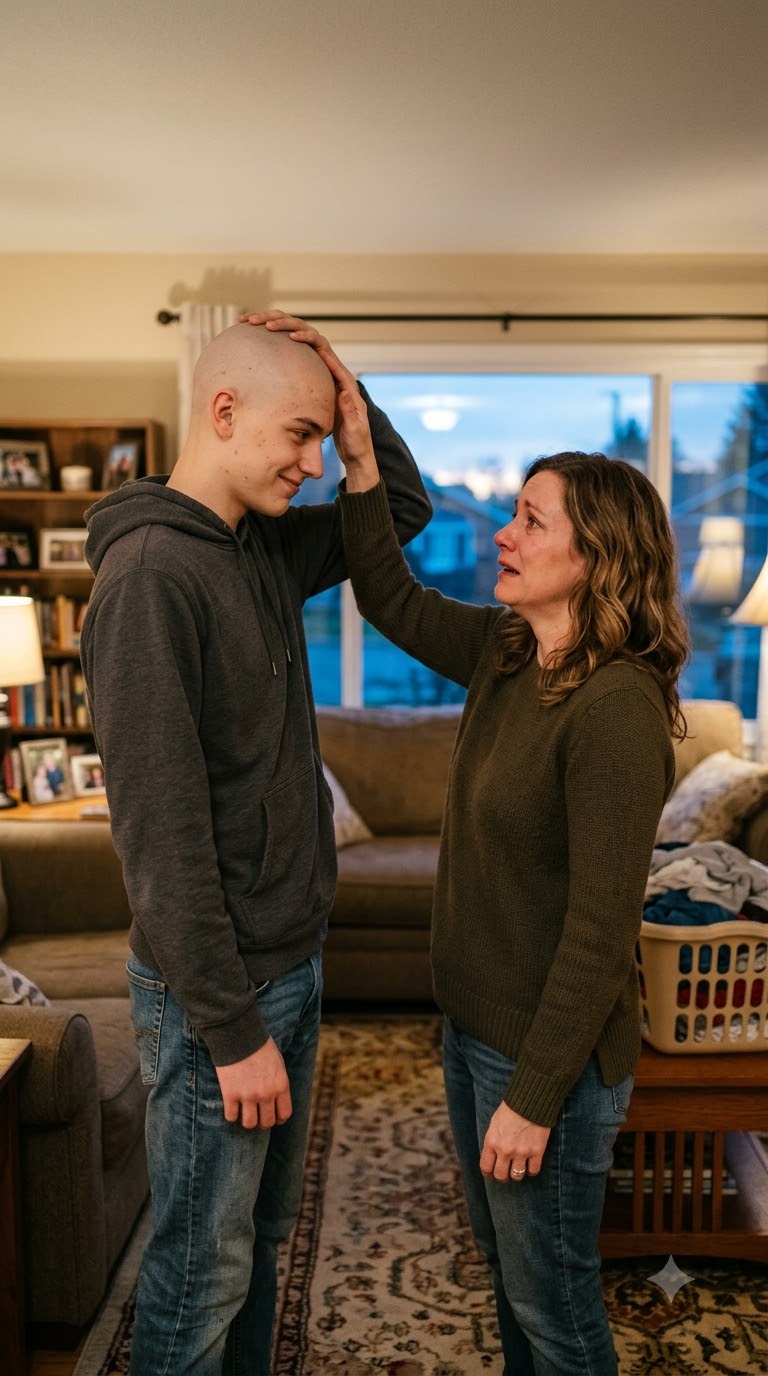
Gentle September sunlight spread across the kitchen counter as I stood at the sink washing out my coffee cup. Behind me, cabinet doors opened and shut while Aaron searched through the pantry.
“Mom, where did you put the chocolate granola bars?”
“They’re on the second shelf,” I answered. “The same place they were yesterday.”
A few moments later, he walked over carrying an open grocery bag. Inside, he had already packed fruit, crackers, two bottles of juice, and several snack bars.
My eyes drifted to the bag.
“Are you planning to feed an entire hospital floor?”
“Lily likes the chocolate ones,” he said. “And the food there isn’t exactly great.”
He sounded casual, but I knew every item had been chosen with care.
Aaron had always noticed the little things. When he was younger, he could spend hours organizing his building blocks by size and shape. Now that same patience helped him remember which snacks Lily could handle after treatment and which movies still made her smile when she was completely worn out.
Lily had been part of our family’s life for years.
Her mother, Diane, had been one of my closest friends for nearly twenty years. Our children had grown up side by side, sharing birthday celebrations, school functions, summer cookouts, and endless afternoons at each other’s houses.
When Aaron and Lily started dating, Diane and I couldn’t have been happier.
The first time we realized their friendship had become something more was during a backyard barbecue. Aaron reached across the picnic table and gently took Lily’s hand. Diane and I noticed at the exact same moment.
We acted as though we hadn’t.
Instead, we hurried into the kitchen and whispered excitedly like a pair of teenage girls.
They truly seemed made for one another. Their relationship had grown from years of friendship, trust, and shared memories. Aaron always knew how to make Lily laugh when she was frustrated, and Lily never failed to encourage him whenever he doubted himself.
For a while, life felt wonderfully uncomplicated.
Then, four months earlier, Lily was diagnosed with cancer.
One week she and Aaron were talking about college applications, school dances, and weekend plans.
The next, her days revolved around medical tests, treatments, hospital rooms, and endless uncertainty.
The diagnosis changed every one of us.
It changed Diane, who struggled to stay composed even while fear consumed her.
It changed me, because I no longer knew the right words to comfort my friend.
And it changed Aaron more than anyone.
He was watching the girl he loved endure something he couldn’t understand and had no power to fix.
Even so, he never pulled away.
Whenever he could, he visited the hospital after school. He brought Lily snacks, helped with homework, watched awful movies beside her bed, and simply sat with her whenever she was too exhausted to talk.
That morning, as he zipped up the bag, I asked, “You’re heading there after school again?”
“She had a difficult treatment yesterday,” he replied. “I promised I’d come by.”
I nodded.
“Please tell Diane I’m thinking of her. I sent her a message last night, but she didn’t say much.”
Aaron hesitated.
“She’s exhausted, Mom.”
“I know.”
Still, something had been bothering me.
Over the past several weeks, Diane’s messages had become noticeably shorter. Long conversations had been replaced with brief replies. Sometimes all she sent back was a heart, a thumbs-up, or a quick “okay.”
I tried not to let it bother me.
She was sleeping in hospital chairs, talking with doctors, keeping track of medications, and doing everything she could to stay strong for her daughter. She didn’t owe anyone cheerful conversations.
Aaron leaned over, kissed the top of my head, and picked up his keys.
“See you tonight.”
“Drive safely.”
“I will.”
I stood watching his old car disappear down the street.
After he was gone, the house felt strangely quiet.
I remember standing by the window with an uneasy feeling settling in my chest, as though something had been building around us for weeks.
I just didn’t know what it was yet.
Part Two: The Night He Came Downstairs
As time passed, Lily’s illness became impossible for any of us to ignore.
The treatments stole her strength. Her complexion turned pale, her appetite disappeared, and before long, her hair began falling out.
At first, she tried to laugh about it.
She wore bright hats and joked with Aaron about buying matching wigs. Yet even from a distance, I could tell how deeply the change hurt her.
Her hair had always been part of who she was. Since childhood, she had worn it long—sometimes curled, sometimes braided, and sometimes with colorful ends for school events.
Watching it disappear made the illness feel painfully real.
One evening, I was folding laundry in the living room when I heard Aaron walking downstairs.
His footsteps were slower than usual.
I lifted my head.
The towel slipped from my hands straight into the basket.
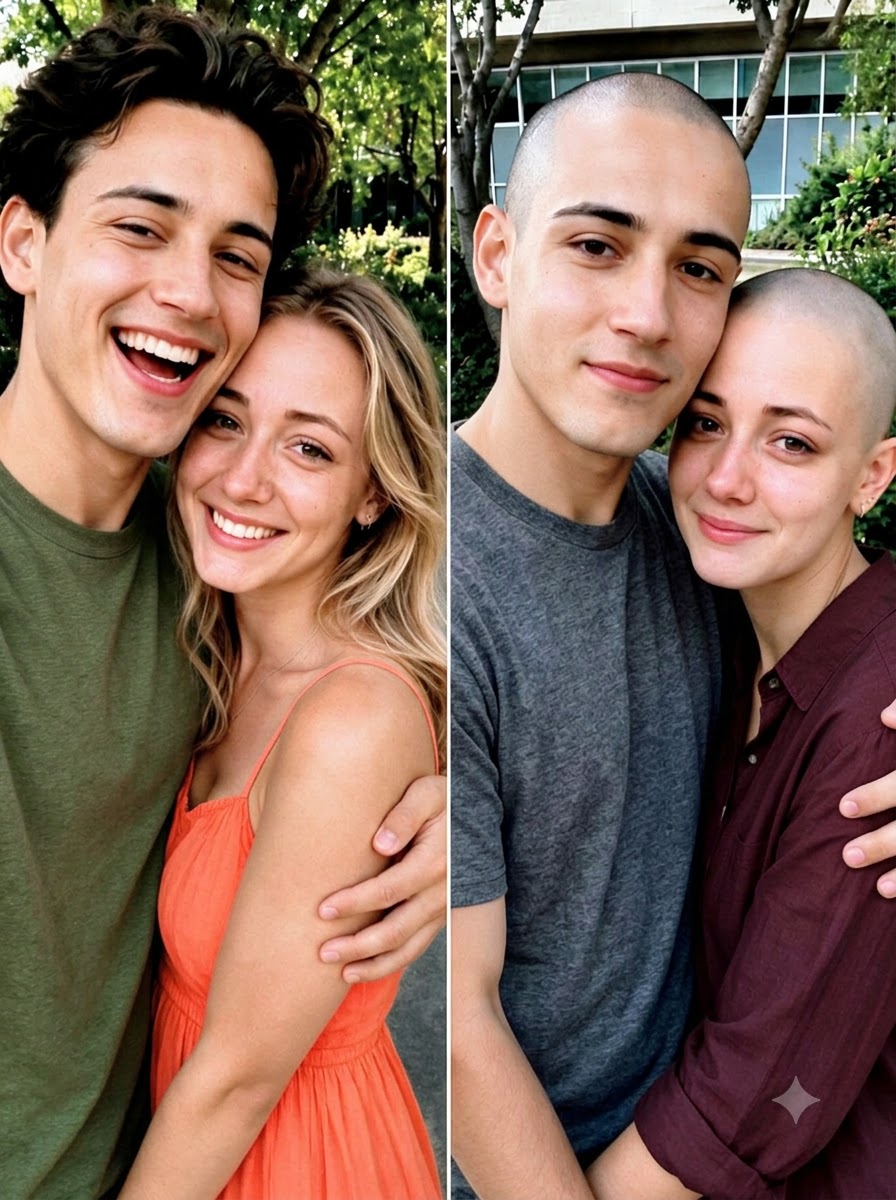
His curls had vanished.
Aaron had shaved his head completely.
For a long moment, I could only stare.
“Aaron,” I finally whispered. “What happened to your hair?”
He ran his hand across his smooth scalp and offered a nervous smile.
“I knew you’d be surprised.”
“Surprised?” I stood and walked toward him. “You had a full head of hair this morning.”
Without thinking, I reached up and gently rested my hand against his scalp. The skin felt cool beneath my fingers, so different from the thick dark curls I was used to brushing away from his eyes.
“Why did you do this?”
His smile slowly faded.
“Lily’s hair is falling out in handfuls now.”
My hand slipped back to my side.
Aaron lowered his eyes toward the floor. “She keeps acting like it doesn’t bother her. Last week, she even made jokes about it. But later, I found her crying in the bathroom. She thought I had gone downstairs to get coffee.”
My chest tightened.
“She didn’t want anyone to see her that way,” he continued. “She said she was scared people would look at her and only see someone who was sick.”
He raised his eyes and looked at me.
“I wanted her to understand that she’s still Lily. Hair or no hair. And I didn’t want her to feel like she had to face that part alone.”
His voice stayed calm, as if shaving his head had been the simplest choice he could make.
“So I told her that if she had to lose hers, she wouldn’t be the only one.”
For a moment, I was unable to say anything.
For seventeen years, I had tried to teach Aaron about compassion, bravery, and understanding. Yet the young man standing in front of me grasped those lessons far better than I had ever known.
I held back my tears.
“You are a remarkable person.”
He shrugged, obviously uncomfortable receiving praise.
“It’s only hair, Mom. It’ll grow back.”
“But the reason you did it matters.”
A small smile appeared on his face.
“I have a long day tomorrow. I should get some sleep.”
“You’re visiting Lily after school?”
“Coach said I could miss practice.”
I watched him walk upstairs.
For several minutes, I stayed in the living room surrounded by clothes that were only half folded.
My heart felt fuller than I could explain.
I thought shaving his head was the most thoughtful thing Aaron could have done.
I didn’t realize it was only the start.
For illustrative purposes only
Part Three: The Call
The next afternoon, I sat at the kitchen counter attempting to finish an email when my phone started vibrating.
Diane’s name appeared on the screen.
I smiled as I answered, assuming she was calling about Aaron’s shaved head.
“Hi, Di. Has Aaron arrived yet? I probably should have warned you. I nearly dropped the laundry when he came downstairs. How is Lily feeling?”
“Rachel.”
The way she spoke my name made me stop.
Her voice sounded strained, almost detached.
“What’s wrong?”
“You need to come to the hospital.”
I sat up straight.
“Is Lily all right?”
“She’s stable.”
“Then what happened?”
A long silence followed.
Finally, Diane said, “You need to see what your son has done.”
My stomach sank.
“What do you mean?”
“I don’t know how to explain it over the phone.”
Her breathing sounded unsteady.
“Diane, you’re frightening me.”
“Just come, Rachel. Please.”
Then she hung up.
For several seconds, I stood completely still with the phone still against my ear.
My mind instantly imagined every possible disaster.
Had Aaron gotten into an argument with a doctor?
Had he upset Lily?
Had he shared something private online?
Had he interfered with her treatment?
Diane’s words kept repeating in my mind.
You need to see what your son has done.
I grabbed my keys and ran outside without even taking a coat.
On the drive there, my hands shook as they gripped the steering wheel.
Every red light seemed endless. Every slow-moving car felt like it was intentionally blocking my way.
When I finally arrived at the hospital, my heart was racing.
The automatic doors opened, and I hurried inside.
Diane stood waiting in the hallway with her arms tightly folded around herself. She didn’t greet me or even try to smile.
“Come with me,” she said.
I followed her past the reception area and along a bright hallway that carried the smell of disinfectant.
“Please tell me what happened,” I said. “Did Aaron hurt someone? Did he say something to Lily?”
Diane kept walking.
“He crossed a boundary.”
I stopped.
“A boundary?”
She turned back toward me.
“It didn’t end with him shaving his head.”
“What does that mean?”
“Lily is a private person. Now everyone on this floor is talking about her. People have opinions. People are telling stories. They’re looking into her room.”
My fear began to turn into anger.
“You called me as though there had been an emergency. I drove here believing your daughter might have—”
I couldn’t finish the sentence.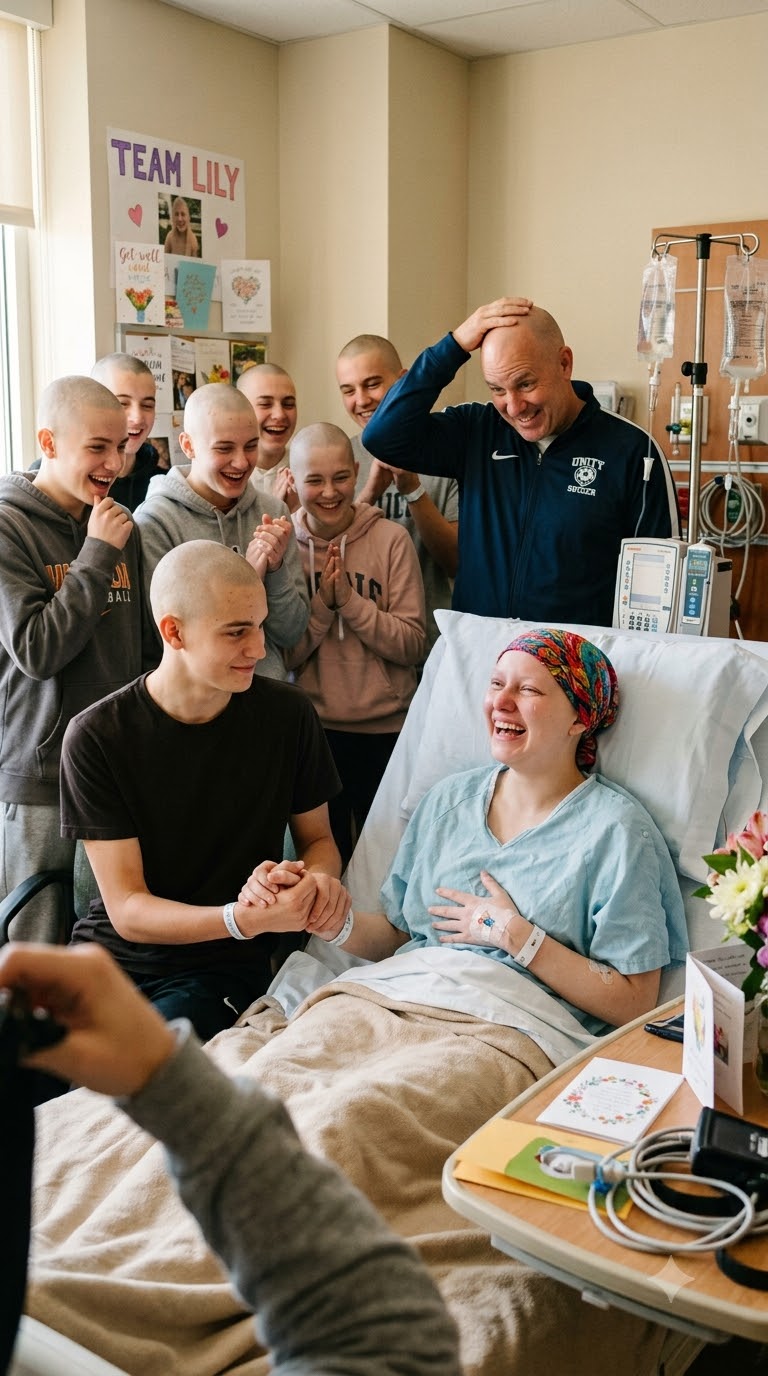
Diane’s face became harder.
“Maybe Aaron should have thought more carefully before making decisions involving someone else.”
I stared at her.
“Do not blame my son for trying to support your daughter.”
“I’m not blaming him for supporting her.”
“That’s exactly what it sounds like.” My voice was getting louder, and I made myself calm it down.
“He has been here almost every day for months. He brings her food. He helps with schoolwork. He sits beside her when she is too tired to speak. He has missed practices and barely sleeps.”
“I know what he does,” Diane snapped.
“Then why are you talking about him like he has done something wrong?”
Her eyes filled with tears, but she turned away before they could fall.
“You don’t understand.”
“Then help me understand.”
The hallway between us became completely quiet.
A nurse rolled a supply cart past us. Somewhere nearby, a machine continued to beep steadily.
Finally, Diane spoke.
“For weeks, I’ve watched Aaron walk into Lily’s room and bring her back to life.”
I stayed silent.
“He comes in with one of those ridiculous movies, or a bag of snacks, or some story from school. Suddenly, she sits up. She laughs. Sometimes she even eats.”
Her lips trembled.
“I bring her the blanket she has loved since she was six, and she turns toward the wall.”
“Diane…”
“I remind her to drink water, and she gets irritated. Aaron asks, and she takes the cup.”
“That isn’t his fault.”
“I know.”
The words came out softly.
“I know it isn’t his fault. But knowing that doesn’t make it hurt any less.”
She wiped beneath her eyes with the back of her hand.
“I am her mother. I am supposed to know how to comfort her. I’m supposed to be the person she needs most.”
“You are the person she needs most.”
“It doesn’t feel that way.”
For the first time, I realized Diane’s anger was not truly directed at Aaron.
It came from feeling powerless.
She had spent day after day beside her daughter’s hospital bed, watching treatments cause suffering she could not take away. Aaron’s ability to make Lily smile had become another reminder of everything Diane felt unable to provide.
“I’ve been jealous of a seventeen-year-old boy,” she confessed. “I’ve resented him for being able to reach my daughter when I can’t.”
Her admission stayed between us.
“That doesn’t make you a terrible mother,” I said.
“It makes me feel like one.”
“No. It makes you a terrified mother.”
She covered her face briefly.
“And then today he did something bigger. Everyone became involved, and I convinced myself he had turned Lily into some kind of display.”
“Did Lily feel that way?”
Diane lowered her hands.
“I don’t know. I was too angry to ask.”
She started walking again.
I followed her toward Room 412.
Part Four: Outside Room 412
Before we reached the door, I heard laughter.
Not forced laughter.
Not the quiet chuckle Lily sometimes gave when she was trying to comfort everyone else.
This was loud, breathless, uncontrollable laughter.
It sounded like a girl forgetting, even for a short moment, that she was inside a hospital.
Diane stopped outside the room.
Her hand remained on the door handle.
For a few seconds, neither of us said anything.
“That’s Lily,” I whispered.
Diane nodded.
Tears filled her eyes.
“I haven’t heard her laugh like that since before the diagnosis.”
I looked through the small window but couldn’t see much past the group gathered near the bed.
“What did Aaron do?”
Diane swallowed.
“I thought he was making her illness public. I thought he had invited people here just to stare at her.”
“And now?”
She listened as another wave of laughter came from inside.
“Now I’m not sure.”
I gently placed my hand on her shoulder.
“He may not be turning her into a spectacle, Diane.”
She looked at me.
“He may be reminding her that she still belongs to the world outside this room.”
Her expression broke.
“I think I understand that now.”
She opened the door.
Part Five: What My Son Had Done
I walked into the room and stopped.
Aaron was sitting beside Lily’s bed.
The two of them were laughing so hard that Lily had one hand pressed against her stomach. A colorful scarf covered part of her head, while loose strands of hair rested against her pillow.
Aaron’s head remained completely shaved.
But he was no longer the only one.
Standing behind him was almost the entire soccer team.
Every single boy had shaved his head.
Some had clean, smooth scalps. Others had uneven spots where they had obviously tried cutting it themselves. One boy still had a thin strip of hair above his ear that everyone kept teasing him about while laughing.
Coach Daniels stood with them, also bald, dramatically rubbing the top of his head.
Two teachers had joined them too.
Even the young hospital chaplain was there. He stood near the window with a smile, running his hand across his freshly shaved scalp.
For a moment, I could do nothing but stare.
Nurse Maria lifted her phone.
“You should see the recording,” she said.
She showed me a video filmed only minutes earlier.
One after another, the boys had walked into Lily’s room wearing hats.
Aaron had stood beside her bed and said, “You told me I looked strange without hair, so I brought some people who could make me look normal.”
The first teammate took off his hat.
Then another.
Then another.
Lily’s eyes grew wider with every person who revealed their shaved head.
By the time Coach Daniels walked in and made a dramatic bow, she was laughing so hard that tears were running down her face.
In the video, Aaron never asked anyone to applaud.
He never gave a speech. He simply stood beside Lily, smiling while person after person reminded her that she was not alone.
I turned to face him.
“You arranged all of this?”
His cheeks turned red.
“I started asking people a couple of weeks ago.”
“A couple of weeks?”
He nodded.
“I knew Lily’s hair was going to fall out, and I didn’t want her to feel like everyone was staring at her because she was different.”
He motioned toward his teammates.
“They all agreed. They said I had to go first, though.”
One of the boys laughed.
“We needed proof he was serious.”
Aaron smiled.
“So I went first.”
Lily reached out and took his hand.
“He wouldn’t tell me anything,” she said. “He only said he had a surprise.”
Her voice remained soft, but her eyes were glowing.
For the first time in months, the hospital room no longer felt like a place surrounded by sickness.
It felt full of life.
I looked at Diane.
Her arms hung loosely at her sides.
Tears silently ran down her cheeks.
“I couldn’t explain it to you on the phone,” she said. “I kept trying to say, ‘You need to see what your son did,’ but every time I said it, I didn’t know whether I was angry or grateful.”
I stepped closer.
“Now you know.”
She nodded while watching Lily laugh with the team.
“I’ve been so jealous of him,” she whispered. “I sit beside her and feel useless. Then Aaron walks through the door, and she becomes herself again.”
I wrapped my arms around my friend.
For several moments, she stayed still.
Then her body relaxed, and she started crying against my shoulder.
“We aren’t competing for her love,” I whispered. “You’re her mother. Nothing can replace that.”
“It feels as though I’m failing her.”
“You aren’t failing. You’re carrying what no parent should have to carry.”
She held me tighter.
“I don’t know how to do this.”
“Neither do I,” I admitted. “But you don’t have to do it alone.”
Behind us, Lily called, “Mom?”
Diane quickly wiped away her tears and turned around.
Lily reached her hand out.
“Come here. You need to see Coach Daniels without his hat.”
Diane laughed while still crying.
She walked across the room and sat beside her daughter.
Aaron stepped away to give them privacy.
As he came toward me, I placed my hand on his arm.
“You did all of this without telling me.”
“I thought you might worry.”
“I did worry.”
He winced.
“Sorry.”
“But I also don’t think I’ve ever been more proud of you.”
He looked around the crowded room.
“I didn’t do it by myself.”
“No,” I said. “But you gave everyone the courage to begin.”
For illustrative purposes only
Part Six: What Diane Could Not Say
Over the next hour, the room became filled with laughter and stories.
The soccer players gave Lily a team jersey signed by every player. One teacher brought a collection of handwritten notes from students. Coach Daniels announced that the team would dedicate its next game to her.
Aaron had also organized a donation drive for a patient-support program at the hospital.
He had done everything quietly.
No social media post.
No request for recognition.
No effort to place himself in the spotlight.
He only wanted Lily to understand that she had not vanished from the lives of the people who loved and supported her.
As everyone started to leave, Diane walked over to Aaron.
For a moment, she appeared uncertain about what to say.
Then she held both of his hands.
“I owe you an apology.”
Aaron looked surprised.
“For what?”
“For assuming the worst.”
“You didn’t.”
“I did,” she said. “I thought you were turning something private into a public event.” Aaron looked over at Lily.
“I asked her before the others came in. I told her I had invited some friends, but I didn’t tell her what they had done. I said they would leave immediately if she wasn’t comfortable.”
Diane briefly closed her eyes.
“Of course you asked.”
“I didn’t want her to feel trapped.”
Diane tightened her grip around his hands.
“You have been very good to her.”
Aaron shook his head.
“I love her.”
The quiet certainty in his voice broke something inside Diane.
She pulled him into a hug.
Aaron paused for a moment before returning the embrace.
I looked toward Lily.
She watched them with tears in her eyes and a smile on her face.
In that moment, I understood Aaron had done more than arrange an act of support.
He had brought all of us together again.
Fear had caused Diane to pull away.
Helplessness had made her question things.
Grief had convinced each of us that we had to carry our emotions alone.
Aaron reminded us that love was not something limited. Lily did not need to choose between her mother and her boyfriend. Diane did not have to be the only person who could comfort her daughter. And none of us had to face the uncertainty by ourselves.
Part Seven: Six Weeks Later
Six weeks later, Diane called me once again.
This time, I knew something had changed before she even spoke.
“The scans look better,” she said.
I held the phone tightly.
“How much better?”
“The doctors say the treatment is working.”
For a moment, neither of us spoke.
Then we both started crying.
The news did not erase everything Lily had been through. It did not mean the journey ahead would suddenly become easy. More appointments, treatments, and difficult moments were still waiting for her.
But it gave us hope.
That evening, Diane came over to my house.
We sat on the porch holding cups of tea while the sun slowly disappeared behind the trees.
For the first time in months, we talked without constantly reaching for our phones.
Aaron’s hair had started growing back in soft, dark patches.
Lily’s had begun returning as well.
“She says Aaron’s hair looks like a fuzzy tennis ball,” Diane told me.
I laughed.
“He complains about it every morning.”
For a while, we sat quietly and watched the sky change into shades of gold and pale pink.
Then Diane said, “I’m sorry about the way I spoke to you that day.”
“You were frightened.”
“That doesn’t excuse everything.”
“No,” I agreed. “But it helps me understand.”
She looked down at her cup.
“I honestly believed I was losing Lily in every possible way. To the illness, to the treatments, even to the people who could make her happier than I could.”
“You were never losing her to Aaron.”
“I know that now.”
She smiled slightly.
“He wasn’t taking my place. He was helping her find her way back to us.”
I thought about my son sitting beside Lily’s hospital bed, surrounded by teammates, teachers, and a bald chaplain.
“I used to think raising a good child meant teaching him to behave, work hard, and treat people with respect,” I said.
Diane looked at me.
“What do you think now?”
“I think it means raising someone who notices another person’s pain and chooses not to turn away.”
Through the window, I saw Aaron standing in the kitchen, searching through the pantry again.
A moment later, he opened the back door.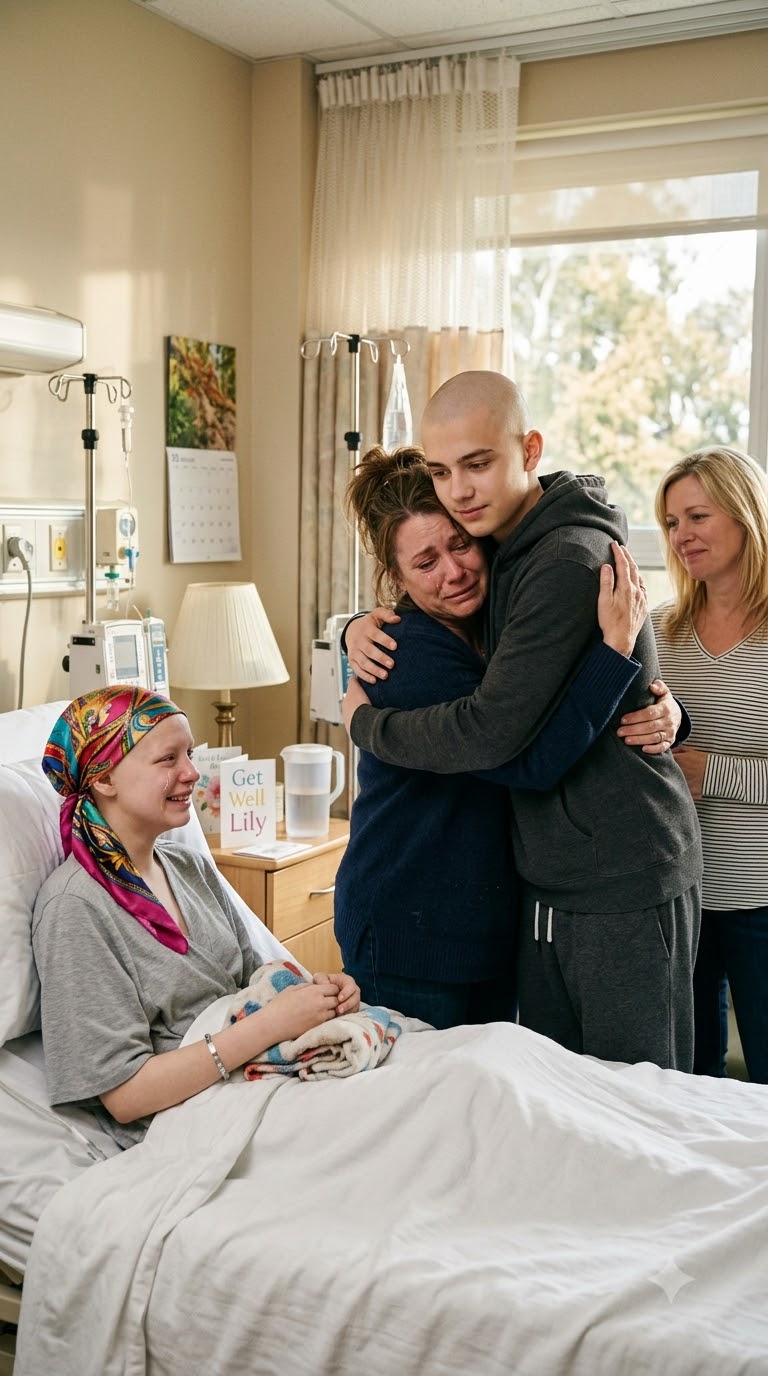
“Mom, are there any chocolate granola bars left?”
Diane and I exchanged a look and laughed.
“Second shelf,” I called.
He disappeared back inside.
I had always believed I was raising a kind boy.
But that day at the hospital, I realized that somewhere along the way, without me even noticing, my son had grown into a compassionate young man.
He had shaved his head so one frightened girl would feel less alone.
Then he had encouraged an entire community to stand beside her.
And by doing so, he reminded every adult in that hospital room of something we should never have lost sight of:
Love is not shown by always having the perfect words or by being able to remove someone’s pain.
Sometimes love is simply choosing to stay.
Sometimes it means listening.
Sometimes it means allowing others to help carry a burden that has become too heavy.
And sometimes, it looks like a hallway full of people who willingly give up something small so one person no longer feels different.
