

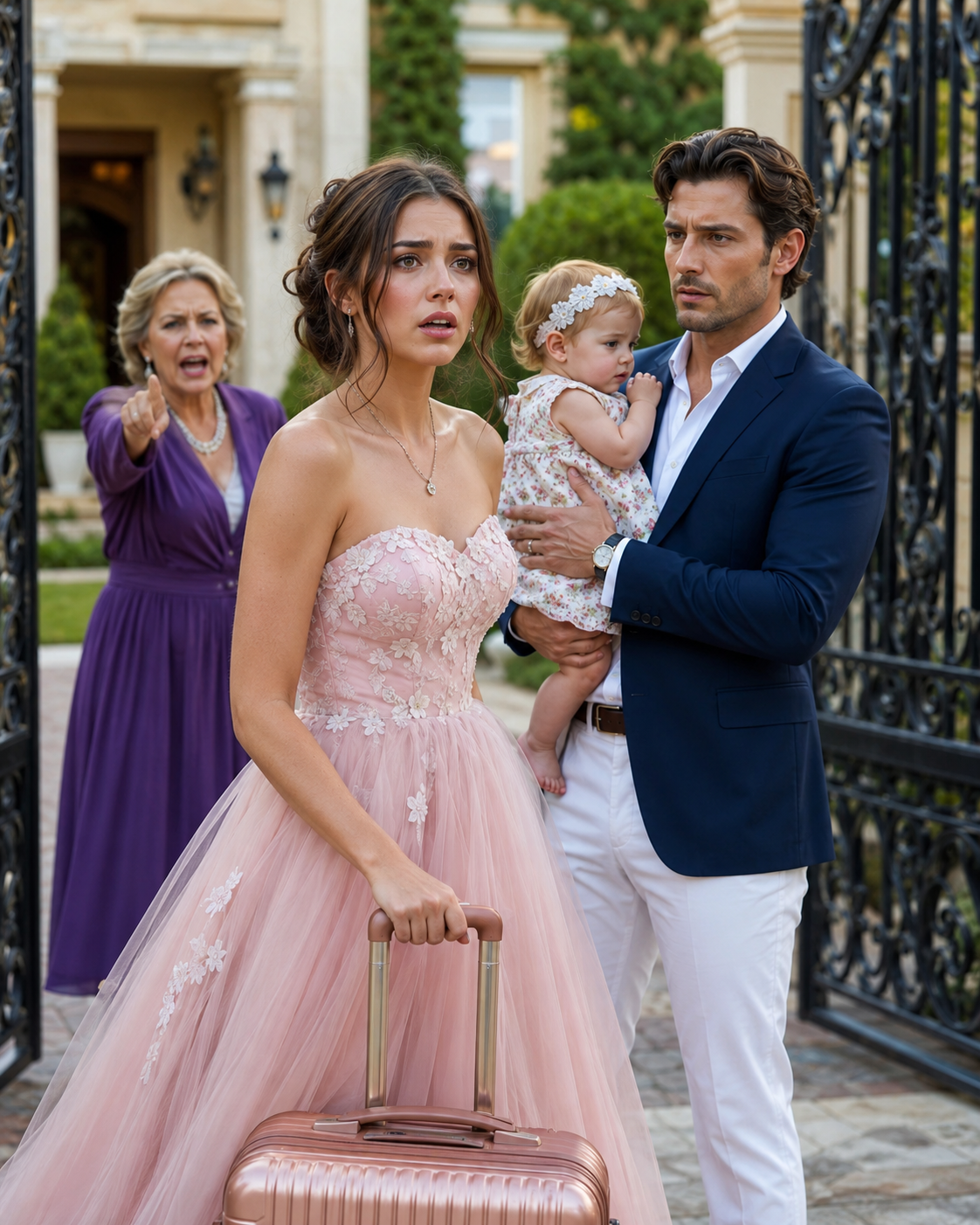
PART 1: THE NIGHT WE WERE FORCED OUT
My daughter was only thirteen days old when my mother-in-law ordered us to leave her house during the most violent thunderstorm Nashville had experienced that summer.
Isla had been unsettled since the afternoon, but by evening her skin appeared unusually golden, her lips were dry, and her tiny cries had weakened into soft, breathless sounds. I was still healing from an emergency cesarean delivery, and every rushed movement pulled painfully against the incision beneath my clothes. Still, I wrapped her in a cotton blanket and carried her downstairs, hoping Evelyn Mercer would take us to the pediatric emergency room.
She sat in front of the television, calmly sipping iced tea while rain hammered against the windows behind her.
“Evelyn, something is wrong with Isla, and I cannot safely drive while taking medication. Please take us to Vanderbilt Children’s Hospital.”
She looked at the baby without getting up, then turned toward me with clear disgust.
“You have been a mother for less than two weeks, Claire, and you already behave as though every little sound requires an ambulance.”
I explained that Isla had barely eaten, felt dangerously warm, and had only one wet diaper since morning. Evelyn dismissed every concern before accusing me of creating a crisis because I wanted attention.
Our temporary stay at her Brentwood home was only supposed to last three weeks. Matthew and I had already bought a small house closer to downtown Nashville, but plumbing issues delayed our move. Matthew believed living with his parents would allow me time to recover while he finished a demanding construction-management project.
Instead, Evelyn treated my presence like an inconvenience and my daughter’s arrival like a disappointment.
Throughout my pregnancy, she had constantly talked about continuing the Mercer family name through a grandson. When the ultrasound showed we were having a girl, she stopped asking about the nursery and began calling the pregnancy “an unfortunate first attempt.”
That night, when Isla started crying again, Evelyn finally stood up.
“Take that noise upstairs, or leave with your mother and let her support both of you. If you cannot manage one baby without creating chaos, you were never prepared to become a parent.”
Before I could respond, the front door opened behind us.
Matthew stood in the entryway wearing rain-soaked work clothes, his expression frighteningly calm. He had come home early after seeing the message I sent forty minutes earlier.
“Say that again while I am standing here, Mom.”
Evelyn’s expression changed immediately as she tried to make her voice gentler.
“Matthew, your wife is emotional, and I was only trying to make her understand—”
“You understood that my newborn daughter needed medical care, yet you refused to help because frightening Claire gave you satisfaction.”
He crossed the room, touched Isla’s forehead, and immediately grabbed his car keys. Then he went upstairs, packed our documents, clothing, formula, diapers, and medication into two travel bags before helping me put on a waterproof coat.
Evelyn followed him down the hallway, insisting that no son of hers would abandon his parents because of an overreacting wife.
Matthew stopped at the front door and looked at her without raising his voice.
“A mother does not have to earn compassion while recovering from surgery, and a baby should never have to prove she deserves protection. You have made both of them feel unsafe, so this stopped being our home tonight.”
His father, William Mercer, stepped out of his study and quietly asked everyone to wait until morning. Matthew’s expression softened toward him, but his choice remained firm.
“Dad, you have spent my entire life asking me to keep the peace whenever she crossed another boundary. Peace purchased with somebody else’s silence is only permission for cruelty.”
We drove through flooded streets toward Monroe Carell Jr. Children’s Hospital, where doctors diagnosed Isla with severe neonatal jaundice and dehydration. She was admitted for intensive phototherapy, and a pediatrician explained that any further delay could have caused permanent neurological complications.
Matthew sat beside the bassinet beneath the blue treatment lights, covering his face as tears slipped through his fingers.
At three fourteen the following morning, William called him.
“I need to speak with you before Evelyn creates another version of what happened. There is something about your birth that I should have told you thirty-two years ago.” Matthew squeezed my hand tighter.
“What could possibly be worse than tonight?”
William’s response came as a shaking whisper.
“The woman you have called your mother did not give birth to you.”
PART 2: A LIFE CREATED THROUGH SILENCE
William arrived at the hospital just before sunrise, carrying an old leather case and looking as though the night had taken years from him. He stood outside Isla’s room for several moments, watching his granddaughter beneath the phototherapy lights before turning back toward us.
“I failed Matthew when he was helpless, and last night I nearly allowed the same thing to happen to Isla.”
We entered a quiet consultation room, where William placed a faded blue blanket on the table. The name MATTHEW was carefully stitched into one corner with white thread.
He explained that thirty-two years earlier, while driving home after an overnight shift, he stopped near a small Methodist church outside Franklin after hearing the sound of a crying baby beneath the covered entrance. The infant had been wrapped in that blanket and left inside a wicker laundry basket with no note, identification, or medical records.
William took the baby to a hospital and contacted authorities. After no relatives could be located, he began the adoption process with Evelyn, whom he had recently married. According to him, she privately resisted but eventually signed the required papers to protect their image within the community.
Two years later, Evelyn gave birth to another son, Grant. From that point forward, Matthew became the child who had to earn everything, while Grant received love without expectations.
Matthew worked through college, helped cover household costs, and later paid for major repairs when William’s company experienced financial difficulties. Grant built up gambling debts, destroyed two vehicles, and eventually served prison time for wire fraud involving vulnerable retirees.
William’s confession explained years of favoritism, but one question remained.
“Why did she throw Claire and Isla out now?” Matthew asked. “She has resented me for years, but last night felt planned.”
William opened the case and pulled out a copy of his revocable living trust. Because Matthew had contributed nearly two hundred thousand dollars toward the Brentwood property, William had named him as the beneficiary. Grant would receive a smaller investment account that creditors could not immediately reach.
Evelyn discovered the amendment three weeks earlier, shortly before learning Grant might receive supervised release. She demanded William transfer the house to Grant, but he refused because Grant had already used the property as collateral for illegal debts.
“Evelyn told me she would make Claire miserable until you moved away voluntarily,” William admitted. “I did nothing because I feared another war inside that house.”
Matthew stared through the glass wall toward Isla’s room.
“You did not avoid a war, Dad. You simply chose who would be left undefended.”
Before William could answer, Evelyn called, shouting so loudly that I could hear her from across the table. Grant had been released that morning and wanted an immediate family meeting about the property.
Thirty minutes later, he appeared in the hospital hallway with two large men wearing dark jackets. Grant looked like Evelyn, from his narrow eyes to the satisfied smile on his face.
“So the church orphan finally learned why he never belonged,” he said. “That should make signing away the house much easier.”
Matthew stepped between Grant and Isla’s doorway.
“This is a neonatal unit, and your argument ends before it reaches my family.”
Grant pushed a folded quitclaim deed against Matthew’s chest.
“Sign this today, or Claire will discover how expensive refusing my associates can become.”
Hospital security stepped in before things could escalate, escorting all three men away while recording the threat. Grant continued smiling as the elevator doors closed.
“You cannot protect everyone forever, brother.”
Matthew looked toward our daughter and answered quietly.
“I only need enough time to expose you.”
PART 3: THE MASK BEHIND THE PERFECT IMAGE
After Isla’s condition improved, we stayed with my parents in Hendersonville instead of returning to Brentwood. Matthew installed extra cameras, informed local police about Grant’s hospital threat, and hired estate attorney Rebecca Sloan to examine William’s trust.
That night, someone slashed all four tires on my father’s truck and painted the word THIEF across his garage. Nothing was stolen, which made it clear the goal was intimidation rather than theft.
The next afternoon, Evelyn uploaded a tearful video claiming her adopted son was trying to leave his elderly parents without a home. Sitting beneath a family portrait, she portrayed herself as a devoted mother and accused me of influencing Matthew after failing to give him the grandson he deserved.
Thousands of strangers shared her accusations before we even understood what was happening. Some contacted Matthew’s employer, while others flooded the social-media page for my small interior-design business with hateful messages.
I wanted to defend ourselves immediately, but Matthew showed me footage recovered from William’s doorbell camera. In the video, Evelyn repeatedly practiced her tears while Grant adjusted the phone and told her exactly when to mention Isla. “They are manufacturing sympathy because they cannot manufacture ownership,” Matthew said. “Let them continue, because every lie establishes their intention.” Rebecca instructed us to save every piece of evidence and avoid reacting emotionally. She also uncovered questionable documents connected to William’s property, including a recently prepared power of attorney with a signature that did not match his.
Before she could request an emergency injunction, William collapsed in his study. Grant had allegedly placed a transfer paper in front of him and threatened to reveal a false tax crime unless he signed.
Paramedics rushed William to Saint Thomas West Hospital with a severe cardiac emergency. As the medical team prepared him for surgery, he held onto Matthew’s wrist and fought to stay awake.
“Under the floor beside my desk,” he whispered. “Your birth records and Grant’s debts are together.”
The surgery began before William could provide any more answers.
That evening, Rebecca secured archived records from the small rural clinic that had examined Matthew after he was discovered. Several sections showed changed dates, conflicting signatures, and mentions of an unidentified newborn delivered at a private maternity facility on that same night.
The official adoption records stated that Matthew’s biological parents were unknown. However, a damaged laboratory document named William Mercer as the possible father of a male infant whose hospital file was later marked as stillborn.
Matthew read the sentence repeatedly before setting the document down.
“My father was told his biological son was gone, and then he found me outside a church hours later.”
Rebecca gave a careful nod.
“The documents do not prove exactly what happened, but they are enough to justify immediate genetic testing. If the result confirms paternity, then someone did more than abandon an unidentified child.”
A nurse collected Matthew’s sample, while the hospital laboratory used blood already taken from William. The accelerated results would take about forty-eight hours.
During the wait, Evelyn called again and again, switching between apologies and accusations. In her final message, she failed to disconnect before speaking with Grant.
Her voice came through clearly on the recording.
“Find the folder before Matthew understands why his blanket had his real name embroidered on it.”
PART 4: BENEATH THE STUDY FLOOR
Rebecca reached out to the Williamson County Sheriff’s Office and arranged a supervised trip to collect William’s documents. Since the property legally remained under his ownership, investigators could accompany Matthew with his written permission.
I wanted to stay with Isla, but the folder could contain information that affected my daughter’s safety. My parents cared for her while I went with Matthew, Rebecca, and two deputies to the Brentwood home.
The study had already been heavily searched before we arrived. Desk drawers were scattered across the carpet, books had been pulled apart from shelves, and William’s locked cabinet was left open. Yet beside the desk, one section of flooring beneath the rug appeared slightly raised compared with the surrounding boards.
A deputy removed the panel and uncovered a waterproof metal container. Inside were William’s original trust documents, years of payments from Matthew, fraudulent loan papers carrying William’s name, and photographs linking Grant to several people being investigated for financial extortion.
Underneath those files was a sealed envelope containing the hospital bracelet from William’s newborn son. The handwritten name matched Matthew’s birth date and the medical details kept in his adoption records.
Rebecca placed the evidence into numbered bags.
“Whatever Evelyn hid began at that hospital, but Grant’s current fraud may be enough to stop every attempted property transfer.”
Before we could leave, heavy footsteps echoed through the hallway. Grant walked in with three men, and one of them shut the study door behind them.
He looked surprised to find the deputies there, but that surprise quickly turned into anger.
“Those records belong to my mother, and nobody is removing them.”
One deputy warned that interfering with the collection of authorized evidence could result in arrest. Even so, Grant moved toward me after noticing the envelope I was holding.
“Give me the hospital file, Claire, because this family existed long before you arrived.”
Matthew stepped directly in front of him.
“This family existed around a lie, and you are terrified the truth will leave you with nothing.”
Grant grabbed Matthew’s shirt, but the deputies stopped him before he could strike. One of his men tried to flee through the kitchen and was intercepted by additional officers waiting outside.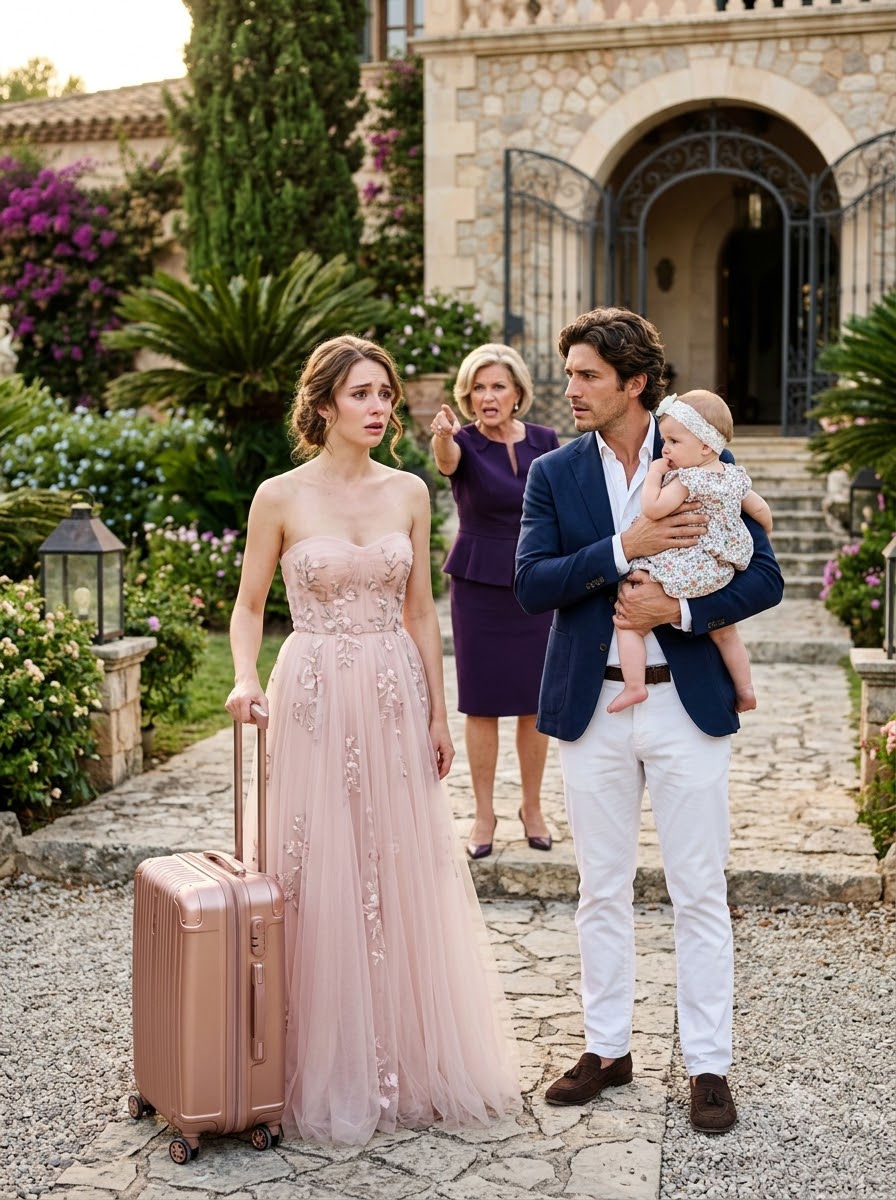
The confrontation uncovered forged identification, blank property paperwork, and an unlawfully carried handgun belonging to one associate. Investigators arrested Grant for intimidation, suspected forgery, and violating the terms of his supervised release.
As officers escorted him toward a patrol vehicle, he looked past Matthew toward Evelyn, who had appeared from an upstairs bedroom.
“Tell them he was never supposed to come back,” Grant shouted. “Tell them what you did before they make me pay for everything.” For the first time since I had known her, Evelyn looked truly frightened. She gripped the staircase railing with one hand while staring at the embroidered blanket.
“William should never have found that basket,” she murmured.
Matthew moved closer, though two deputies continued standing between them.
“You recognized me when he brought me home, didn’t you?”
Evelyn remained silent, but her silence no longer shielded her. It confirmed that the abandoned infant had never been a stranger.
PART 5: THE SON WHO RETURNED HOME
The laboratory results arrived the following morning while William was recovering in intensive care. Rebecca reviewed them beside his hospital bed with Matthew, Evelyn, and two investigators present.
“The probability that William Mercer is Matthew’s biological father exceeds 99.99 percent.”
William began crying before Rebecca could finish speaking. He reached toward Matthew with trembling hands, struggling to understand the unbelievable truth of what had happened.
“I searched for my son while believing I had buried him, then found that same child without knowing whom I was saving.”
Matthew carefully embraced him around the medical equipment.
“You still stopped in the rain, Dad. Whatever else you failed to do later, you stopped when I needed someone.”
Evelyn first denied any involvement, claiming she had only recognized the blanket from a nearby charity. Investigators quickly destroyed that claim with archived employment records and testimony from a former maternity nurse named Denise Harper.
Years earlier, Evelyn had been involved in an affair with a financial broker named Russell Kane. As her marriage to William began falling apart, Russell convinced her that William’s rightful heir would permanently prevent them from accessing Mercer family wealth.
After Matthew’s birth, Evelyn paid a records employee and pressured Denise to create a false medical emergency. William was informed that his newborn son had died, while Evelyn secretly carried the healthy baby away through a service entrance.
She planned for Russell to organize an anonymous adoption somewhere far from Tennessee. However, afraid they would be discovered, he abandoned Matthew at the church during a storm. William happened to pass by while heading home from work and heard his own son crying beneath the covered entrance.
Evelyn immediately recognized the blanket when William brought the baby home. By that point, revealing the truth would have exposed her affair, the falsified death record, and the abandonment. She allowed the adoption to continue, then spent thirty years resenting Matthew for representing the secret she could never escape.
Grant’s DNA test confirmed that Russell, not William, was his biological father. Evelyn’s extreme protection of Grant had been fueled by guilt, favoritism, and her unresolved attachment to Russell, who later died while under investigation for federal fraud.
Matthew listened quietly until the investigators finished explaining everything.
“When you left me outside that church, did you ever turn around?”
Evelyn’s lips shook as she looked down.
“I believed Russell would place you somewhere safe. When William brought you home, I became terrified that telling him would destroy everything.”
“You were not protecting a family,” Matthew answered. “You were protecting the life you stole, even when keeping it alive meant treating me like an outsider in my own home.”
Evelyn began begging for forgiveness, insisting that she had still fed him, clothed him, and raised him. Matthew remained calm, although his voice carried the weight of thirty-two years of buried pain.
“Providing what the law required did not make your cruelty maternal. Love is measured most clearly when somebody powerless becomes inconvenient.”
William asked everyone except Matthew and me to leave. Once the room was quiet, he apologized for overlooking Evelyn’s behavior and confusing financial support with being a father.
“I spent decades preserving the appearance of a family while allowing you to feel unwanted inside it.”
Matthew held his father’s hand.
“I cannot recover those years, but you can protect Isla now by telling the complete truth.”
William agreed to give a sworn statement, remove every authority previously given to Evelyn, and cooperate fully with the criminal investigation. PART 6: THE LAST CHOICE WILLIAM MADE
Evelyn was temporarily released while prosecutors examined the decades-old evidence, but a protective order prevented her from contacting us or entering William’s hospital room. Grant remained detained as investigators connected his forged paperwork to a larger operation targeting elderly property owners.
William recovered from surgery and began rehabilitation, although his condition remained delicate. During those weeks, Matthew visited him every afternoon, occasionally bringing Isla along after her pediatric appointments.
The baby made a full recovery. Her skin regained a healthy tone, she returned to normal feeding, and her determined cries soon filled every quiet corner around her. William said each cry proved that silence no longer controlled their family.
He revised his trust with independent legal oversight. The Brentwood property would be sold, confirmed debts would be settled, and the remaining estate would go to Matthew. William also signed official documents correcting the false birth records and confirming Matthew’s legal identity.
One week later, Evelyn broke the protective order. Security footage captured her entering the house through a back window and carrying boxes of documents toward the fireplace. William, who had briefly returned with a home-health aide, found her inside the study.
When the aide contacted the police, Evelyn tried to take the signed statement from William’s hands. During the struggle, he lost his balance, fell, and suffered another cardiac episode.
Officers arrived before any evidence could be destroyed, but William never completely recovered. He spent his final six days in a private hospital room surrounded by Matthew, Isla, and me.
On his last evening, he asked to hold his granddaughter. Matthew carefully placed her against his chest while I supported her head.
William looked at her face with exhausted warmth.
“This child did not divide our family, Matthew. She revealed where love ended and fear had been pretending to replace it.”
Then he turned toward his son.
“Sell the house, because ownership never made it a home. Build somewhere Isla will never confuse obedience with affection or silence with peace.”
Matthew’s eyes filled with tears.
“I wanted you to defend me long before I knew why she hated me.”
“I know, and my greatest regret is that you had to become a father before I learned how to be one.”
William passed away the next morning with Matthew holding his hand.
At the memorial service, Matthew placed the embroidered blanket beside his father’s photograph instead of inside the casket. He explained that the blanket represented both betrayal and rescue, and he wanted Isla to inherit the truth without carrying the hatred connected to it.
Evelyn attended under supervision but remained apart from the family. She cried when the minister described William stopping beside the church during the storm, but Matthew did not go to her.
Forgiveness, he later told me, could never mean giving access again to those who had put people in danger.
PART 7: JUSTICE WITHOUT VENGEANCE
The criminal cases continued for nearly three years because prosecutors had to rebuild medical records created before digital systems became common. Denise Harper testified that Evelyn had arranged the false report, while financial records confirmed payments made to the hospital clerk and Russell Kane.
Evelyn eventually accepted responsibility for custodial interference, falsification of medical documents, conspiracy, and obstruction of evidence. Grant was convicted separately for forgery, extortion, financial fraud, and threats made against our family.
The original video Evelyn posted disappeared after investigators released verified evidence and public corrections followed. Matthew declined interview requests from national programs, believing Isla’s childhood should not be turned into public entertainment.
We sold the Brentwood house as William requested. Matthew used part of the proceeds to create the William Mercer Family Advocacy Fund, a nonprofit supporting foster children, adoptees seeking lawful access to records, and parents facing pressure from controlling relatives during postpartum recovery.
“My father was deceived about who I was,” he said at the opening ceremony. “However, the choice he made beneath that church awning was real, and this organization exists because every vulnerable child deserves someone willing to stop.”
With the remaining inheritance, we opened Harbor House, a maternal wellness center near Nashville. The facility provided lactation support, postpartum counseling, legal-resource guidance, and temporary rest spaces for mothers traveling between medical visits.
I designed every room with wide windows, gentle neutral tones, and comfortable chairs placed so no exhausted parent would ever feel hidden or unwanted. Above the entrance, a small plaque displayed William’s final meaning of home: A Place Where No Child Must Be Afraid To Need Help.
When Isla was three years old, we attended Evelyn’s final sentencing hearing. She looked much older, with silver hair and shoulders bent beneath the consequences she had delayed facing for decades.
As deputies prepared to take her away, she noticed Isla sitting beside Matthew and asked for permission to speak.
“Please let me hold my granddaughter once. Whatever I did to you, she is still part of me.”
Matthew pulled Isla closer without anger or hesitation.
“When she was feverish and helpless, you treated her suffering as a weapon against her mother. Being her grandmother was an opportunity you rejected, not a title you can reclaim after accountability arrives.”
Evelyn cried, but Matthew did not change his decision. Protecting Isla did not require cruelty toward Evelyn; it simply required a boundary that tears could no longer cross.
Outside the courthouse, Isla held her father’s hand as sunlight reflected across the stone steps.
“Daddy, why was that lady crying when she saw me?”
Matthew knelt until they were face to face.
“She made choices that hurt many people, and now she feels sad about what those choices cost.”
Isla thought about his answer before touching his cheek. “Are you sad too?”
“Sometimes I am, sweetheart, but loving you reminds me that sadness does not get to decide what kind of father I become.”
She wrapped both arms around his neck, and he raised her while laughing through his tears.
PART 8: WHERE LOVE FINALLY LIVED
Our restored home in East Nashville was completed soon after the trial ended. It was smaller than the Brentwood house, but sunlight poured into the kitchen each morning, Isla’s artwork decorated the refrigerator, and no one inside measured love by inheritance or gender.
On stormy evenings, Matthew sometimes stood beside Isla’s bedroom window and watched the rain collect against the glass. He never shared every detail of his early life with her, but he promised that when she was old enough to ask, she would receive the truth exactly as it was.
We stored the embroidered blanket inside a cedar box instead of displaying it as a symbol of suffering. To Matthew, it no longer represented only the night he was abandoned. It also represented the moment William heard the cries of a child everyone else expected the storm to erase.
Years later, during a family gathering at Harbor House, Isla asked why the foundation supported people we had never even met.
Matthew looked across the room at young parents receiving free supplies, legal assistance, and compassionate medical care.
“Because someone can be frightened, exhausted, or completely alone without being undeserving. Your grandfather taught me that stopping to help one vulnerable person can change generations.”
I realized then that Matthew had not overcome his past by pretending it never happened. He had turned it into a promise that ended with our daughter and continued through every family we supported.
Blood eventually revealed Matthew’s origins, but biology had never guaranteed devotion, bravery, or kindness. Evelyn shared his blood yet abandoned him, while William saved an unknown infant before learning that the child was his own.
That difference shaped the home Matthew created afterward.
In our family, no child would ever be treated as a disappointment because she was born a girl. No mother recovering from childbirth would be humiliated for asking for help, and no frightened person would be forced into silence simply to protect someone else’s image.
One evening, as another summer storm crossed Nashville, Isla climbed between us on the couch and asked if thunder could make a house scared.
Matthew kissed the top of her head before answering.
“A house cannot be brave or frightened, but the people inside it can choose what happens when the storm arrives.”
“What would we choose?” she asked.
He looked at me, then pulled the blanket more tightly around our daughter.
“We would open the door, turn on the light, and make certain nobody was left outside.”
Outside the windows, rain continued falling over the city, but our daughter rested safely between us, surrounded by the unconditional love Matthew had once been forced to search for.
That was the inheritance William truly left behind, and it was worth more than every home, account, or carefully protected family name. A real home was never built only through ownership papers or shared blood. It was created whenever love became brave enough to protect the person who could not yet protect themselves.
THE END
