

PART 1
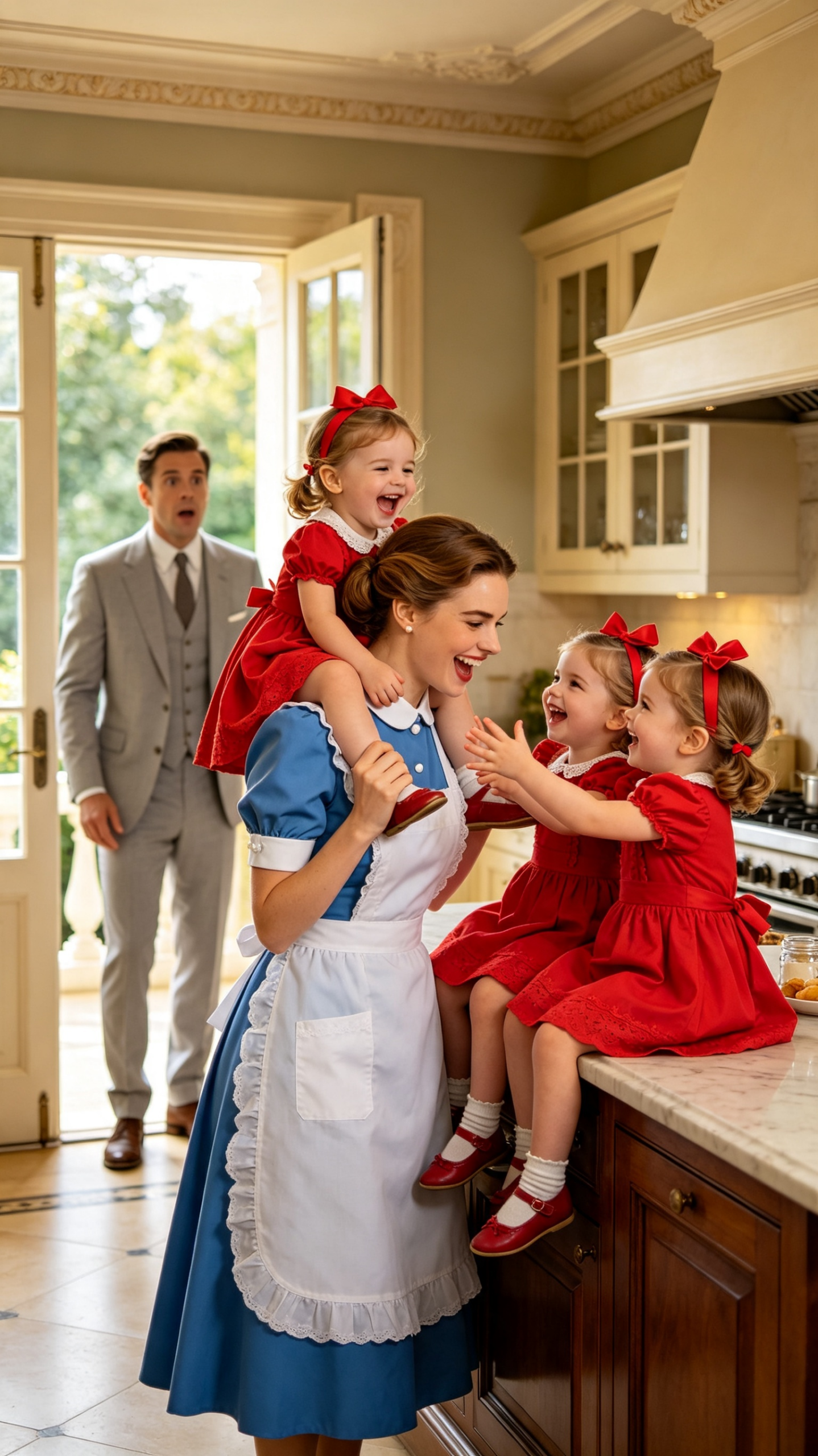
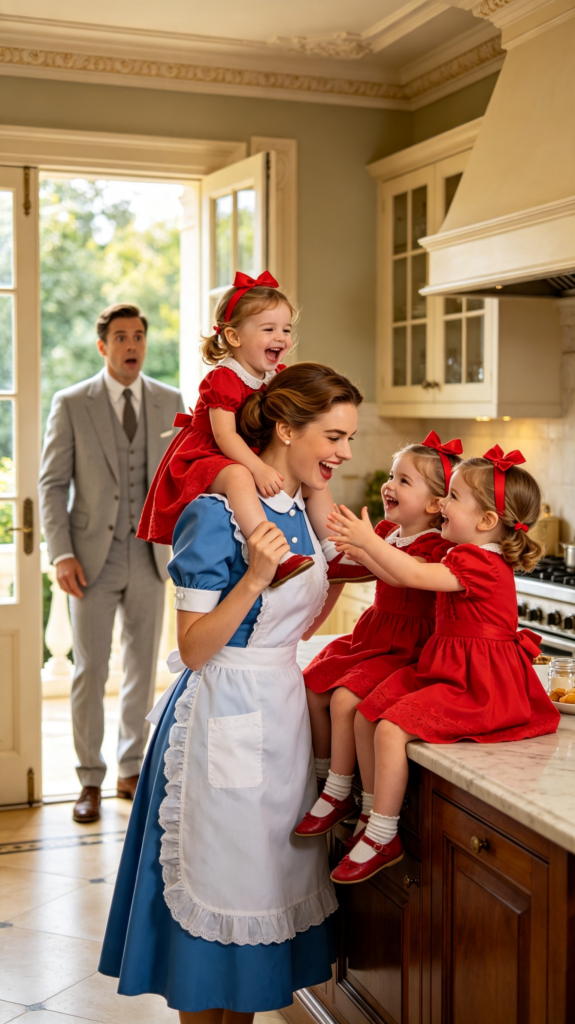
“Take off that uniform and get out of my house. Starting today, you don’t go anywhere near my daughters ever again.”
Julian Sterling’s command echoed across the bright kitchen like a door being forcefully closed.
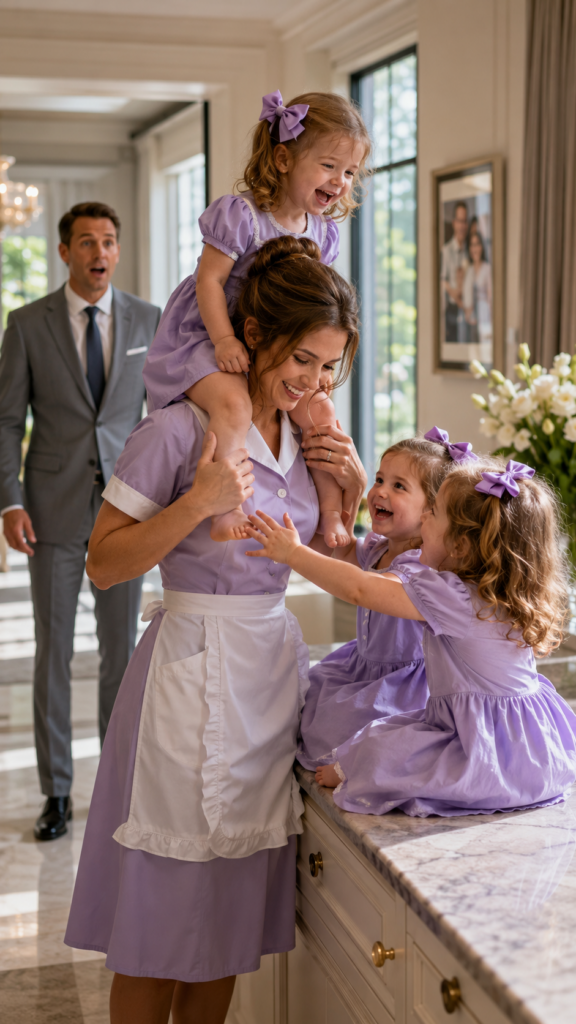
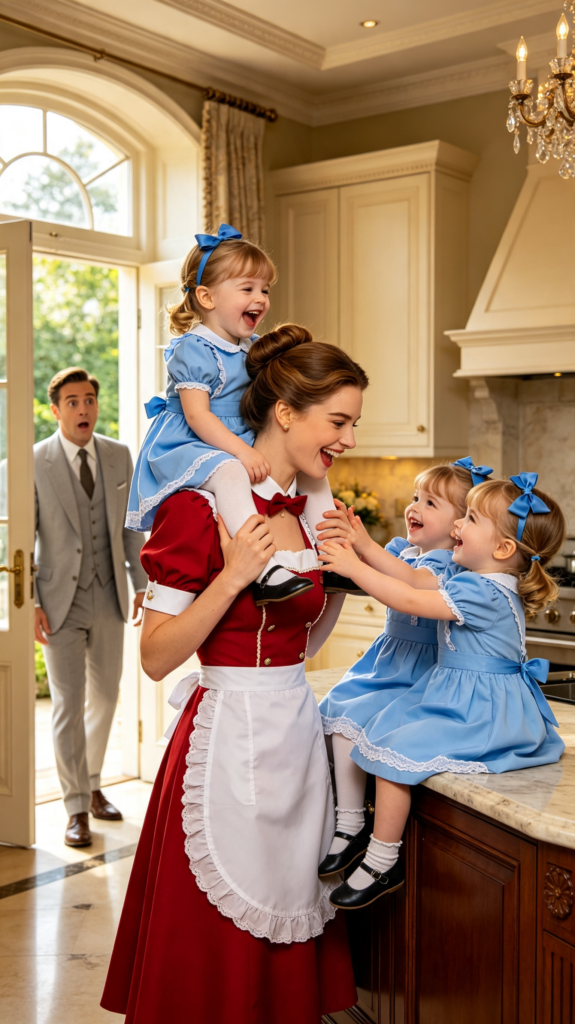
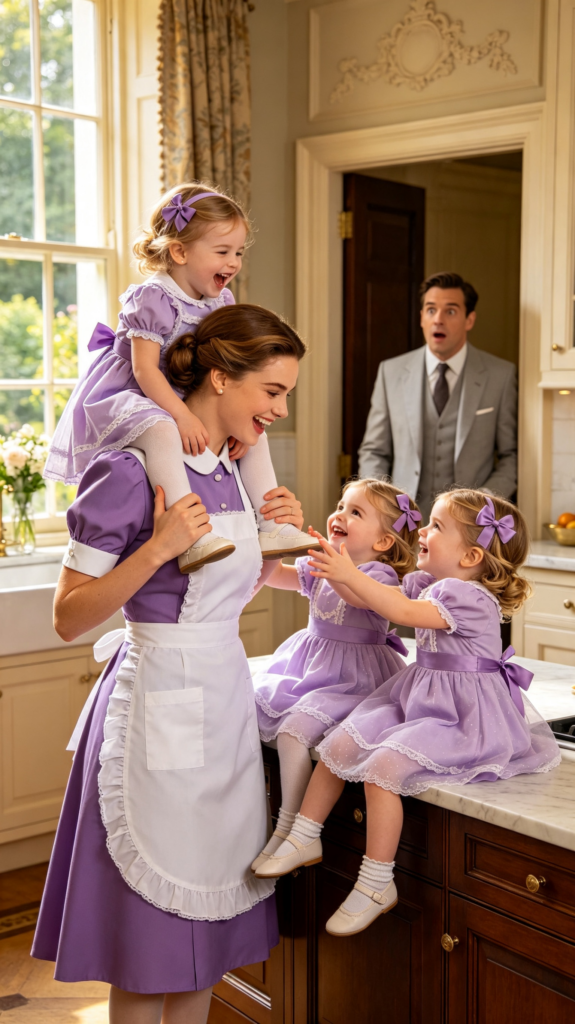
Rachel gently lowered six-year-old Lily from her shoulders, while Maya and Chloe stood frozen, their wooden spoons suspended above the stainless-steel mixing bowl. In the space of a moment, the triplets’ happiness disappeared, replaced by a frightened silence.
Julian had returned unexpectedly from a business trip to Chicago. As the owner of a successful luxury boutique hotel chain headquartered in Austin, Texas, he was a man used to making decisions quickly and without challenge. Yet inside his enormous Westlake Hills home, there was a problem that his fortune, elite specialists, and powerful social connections had failed to solve.
His six-year-old triplets had not spoken a single word since their mother, Victoria, died sixteen months earlier because of sudden post-surgical complications.
Before Victoria’s death, Maya filled the house with endless creative stories; Chloe could ask questions for hours until sleep finally took her; and Lily created little songs about everything around her. But after the funeral, the three girls completely withdrew into silence. They expressed themselves only through drawings, small gestures, and quiet looks. Julian hired some of the best child psychologists in the world, transformed their bedrooms, brought home a golden retriever, and even created a massive indoor playroom designed like a fairy-tale castle.
Nothing changed.
Eventually, Julian fell back on the only way he knew to survive his own pain: burying himself in work until he no longer had to feel anything.
Rachel Vance had been strongly recommended by Mrs. Miller, the Sterling family’s longtime housekeeper. At twenty-nine years old, Rachel lived nearby in East Austin and spent her weekends studying toward a special education degree. After caring for her younger brother when their father became ill, she understood the quiet difference between genuinely supporting a child and simply trying to force them to recover.
She never pushed the girls to speak.
She cleaned their school uniforms, arranged their toys, and softly hummed gentle acoustic songs while completing her daily tasks. When the girls chose to sit beside her, Rachel welcomed their presence. When they needed distance, she respected it.
One afternoon, Lily left a crayon drawing on the kitchen island. It showed four women holding hands. Rachel didn’t ask questions or make a big reaction. She simply placed it on the refrigerator with tape.
A week later, Chloe stood beside her and whispered, “The one in the blue dress is Mommy.”
Rachel didn’t gasp, celebrate, or rush to tell the housekeeper. She only looked at the drawing and quietly answered, “I can tell she loved you girls so very much.”
After that moment, the girls slowly began finding their voices again. First came tiny whispers, then brief sentences, and eventually the cheerful laughter that had disappeared from the house for so long.
Julian knew nothing about their progress because he rarely shared breakfast with them and usually returned home after they were already asleep.
That afternoon, he entered the house and saw his daughters singing and baking, their cheeks covered with flour, while Rachel wore a bedsheet around her shoulders like a superhero cape. For one brief moment, Julian felt a powerful sense of relief.
But then he saw Lily wrap her arms tightly around Rachel’s waist, and a painful, bitter feeling twisted inside him.
It wasn’t anger.
It was shame.
A woman he had barely noticed had achieved what he, their own father, had been unable to do.
“You were hired to work here, not to play mother,” he snapped coldly.
Rachel’s face turned pale. “Mr. Sterling, I would never try to take her place—”
“I don’t want explanations. You’re fired.”
Mrs. Miller, the chauffeur, and the child therapist who had just arrived for an appointment witnessed everything. Rachel quietly removed her apron, placed it on the table, picked up her bag, and left without saying another word in her defense.
The girls looked at their father.
Julian waited for them to scream, object, or finally say something.
They remained silent.
That night, all three girls returned to the same painful silence that had surrounded them since their mother’s death sixteen months earlier.
The following morning, Julian discovered a folded piece of paper pushed underneath his bedroom door. The message was written in dark purple crayon.
As soon as he read the first line, it felt as if the ground beneath him disappeared.
Rachel gave a quiet, bitter laugh. “You don’t need me, Mr. Sterling. You need to stop running.”
Julian began to bring up his twelve hotel properties, his eight hundred employees, and the massive expansion project worth millions that was waiting ahead. But for the first time, he heard how empty those accomplishments sounded.
“I don’t know how to be the father they need,” he confessed in a low voice.
“Then learn,” Rachel answered firmly. “But don’t use me as a temporary bandage while you continue living your life through airport terminals.”
She softly closed the door.
Julian returned home by himself. He canceled his afternoon appointments and sat on the floor inside the play castle, legs crossed. The triplets were gathered beneath a small table, surrounded by scattered pillows.
“I read your letter,” Julian said, his voice trembling. “I made you believe your voices bothered me. That wasn’t true, but I understand that’s what I made you feel.”
The girls stayed quiet.
“I also hurt Rachel because I was jealous. She was there for you when I chose not to be. That wasn’t your fault, and it wasn’t hers either.”
That night, Julian sat in the hallway outside their bedroom and read a bedtime story through the small opening in the door because they still wouldn’t allow him to come inside.
The next morning, he attempted to make scrambled eggs and ended up burning the entire pan.
Lily took one tiny bite and wrote on a paper napkin: Tastes gross.
“Yeah,” Julian admitted with a sad smile. “Honestly, it’s terrible.”
Maya almost smiled.
For five days, Julian concentrated on keeping the smallest promises. He drove his daughters to school himself, arrived home exactly when he promised, and turned off his phone during dinner.
On the sixth day, his business partner Marcus called.
“The lead investor for the new resort can only meet tomorrow in New York, man. We’re talking tens of millions here.”
Julian looked across the room at his daughters, quietly working on a puzzle together on the floor.
“I already lost the most important thing in my life because I believed work couldn’t wait,” Julian replied calmly. “Count me out.”
He ended the call.
During their next family therapy appointment, the psychologist asked the girls how they felt whenever their father raised his voice. Maya drew a closed door, Chloe drew an airplane, and Lily drew a face with a red ‘X’ across the mouth.
“Does the door mean you want to run away?” Julian asked gently.
Maya shook her head. She looked up at him and whispered, “It means you’re leaving.”
It was the first sentence she had spoken directly to him since the day he fired Rachel. Julian desperately wanted to reach for her and hold her, but he made himself wait, allowing her to come closer only when she was ready.
That afternoon, they discovered a cardboard box sitting on the front porch. Inside were Rachel’s folded apron, a few storybooks, and a note the girls had secretly written to her weeks earlier:
Rachel: With you, we remembered what Mommy sounded like when she laughed.
At last, Julian understood.
Rachel had never tried to take Victoria’s place. She had only helped his daughters reconnect with the memory of their mother without feeling guilty, as if loving someone new meant betraying her.
He returned to East Austin.
This time, he didn’t bring flowers or offer a generous contract. He carried the purple crayon letter instead.
“I wanted you to come back before because I wanted everything to become easy again,” Julian said quietly while standing on her porch. “Now I understand it won’t be easy, and it shouldn’t be.”
Rachel studied his face. “What changed?”
“I canceled my travel schedule, started seeing a therapist, and transferred daily operations to my management team. If my company falls apart because I choose to stay home with my kids, then I built a terrible company.”
“That sounds nice, Mr. Sterling.”
“I’m not asking you to believe me just because I say it,” Julian said softly. “I’m asking you to watch and see.”
Rachel agreed to visit the girls—not to immediately return to her old position, but simply to spend time with them.
When she walked up the driveway two days later, the triplets were already waiting by the window.
Lily spotted her first.
“Rachel!”
All three girls ran through the front door and wrapped their arms around her.
“We thought you didn’t love us anymore,” Chloe cried.
“I love you girls so much,” Rachel whispered as she hugged them tightly.
“Daddy said he hurt you,” Maya added, glancing toward her father.
Julian didn’t try to defend himself. “I did. And I’m trying to repair what I damaged, without making her forgive me before she’s ready.”
Lily reached for Rachel’s hand, then took her father’s hand too, but she kept a small space between them.
“Not yet,” Lily whispered.
“That’s okay, sweetie,” Julian replied. “Whenever you’re ready.”
That moment showed Rachel more than any promise or speech could have. She agreed to return for a three-month transition period with set hours, professional pay, clear boundaries, and required participation in family therapy.
“I can guide them,” Rachel told him clearly. “But you have to be the one who stays.”
PART 3
The first major challenge came when Julian’s wealthy, image-focused mother, Evelyn, arrived for a visit. The moment she saw Rachel sitting at the dining room table eating lunch with the family, Evelyn openly scoffed.
“Since when does the domestic staff sit at the table with the family?”
The girls immediately went still, their spoons stopping above their plates.
“Since I understood that respect isn’t measured by the person who signs the paycheck,” Julian replied calmly.
Evelyn’s expression turned cold. “She’s using your guilt against you, Julian. Victoria would never have accepted this.”
Julian slowly rose from his chair. “Do not use my late wife’s name as a weapon against the woman who cared for your granddaughters when I didn’t have the strength to be there for them.”
Evelyn grabbed her handbag and stormed out.
But two days later, she came back.
This time, there were no cutting remarks and no expensive presents meant to replace genuine connection.
“I was cruel,” Evelyn admitted privately to Rachel. “I hid behind my pride because I didn’t know how to handle my own grief over Victoria.”
Rachel accepted her apology with grace, though she didn’t act as if the hurtful words had never been spoken. For the triplets, watching an adult acknowledge a mistake, apologize, and work to change without expecting immediate forgiveness became an important lesson.
The months that followed were still filled with challenging moments.
Some nights, the girls woke up crying because they missed their mother. Other times, they became angry with Julian because they remembered all the times his work had taken him away.
He no longer tried to win their love with gifts.
Instead, he sat beside them and listened.
One evening, during a powerful thunderstorm, a sudden burst of thunder made Chloe scream in fear. Julian rushed into the room, but Lily instantly pulled away and hid behind Rachel.
“Please don’t get mad because we made noise,” Lily cried.
Julian lowered himself onto the hardwood floor several feet away from them.
“You can make all the noise you need to,” Julian said gently. “I’m right here, and I’m not going anywhere.”
He remained there on the floor for more than an hour, never forcing them to come closer. Slowly, Maya walked over and sat beside him. Then Chloe asked him to close the window blind. Finally, Lily moved toward him and rested her sleepy head on his shoulder.
It wasn’t a sudden recovery.
It was trust rebuilding through small, quiet moments.
Six months later, Rachel finished her degree and opened a community counseling center dedicated to children who had experienced the loss of a parent. Julian contributed funding to help launch it, but only under one condition Rachel insisted on: his family name would not appear anywhere on the building or its sign.
The triplets were singing again.
There were still moments when sadness returned, but their silence was never again caused by the fear that their voices were too much for someone else to handle.
During their final family therapy session of the year, the counselor asked the girls what they needed from their father to continue feeling safe.
“For Daddy to tell us before he leaves the house,” Maya answered carefully.
“For him to come home when he says he will,” Chloe added.
Lily looked directly at Julian. “For him not to fire people when he gets jealous.”
Julian nodded seriously. “I’ll carry that lesson with me for the rest of my life.”
A few weeks later, the family planted sunflowers in the backyard—Victoria’s favorite flowers.
Rachel explained to the girls that seeds needed care and patience, even during the time when nothing could be seen growing beneath the soil.
“Even when it rains?” Chloe asked.
“Especially when it rains,” Rachel replied with a smile.
A bright yellow butterfly floated down and landed softly on Lily’s small plastic shovel.
“It’s Mommy,” the little girl whispered.
Julian felt the instinct to gently explain reality, but he stopped himself.
“Maybe she came to see that we’re not lonely anymore,” Julian said softly.
Maya reached over and held his hand. “Are you going to stay right here, Daddy?”
Julian glanced at his phone, sitting completely turned off on a patio chair, then looked toward Rachel, who had dirt covering her knees from planting.
“Yes,” Julian answered firmly. “Not because I’ll never make another mistake, but because I’m never going to run away and hide when I do.”
Lily reached for Rachel’s hand, then reached for her father’s, and slowly brought them together until their fingers intertwined.
Months later, the sunflowers finally opened into fields of bright golden blooms.
Julian was in the middle of a video meeting with international partners when Chloe suddenly rushed into his home office.
“Daddy! They opened!”
A long time ago, he would have asked her to wait five more minutes while he finished the call.
This time, he simply closed his laptop immediately.
He walked barefoot across the warm afternoon grass and found his three daughters laughing and playing among the tall yellow flowers. Rachel sat nearby on the patio steps, watching them with a peaceful smile.
Julian had built towering hotels, purchased valuable properties, and appeared on the covers of business magazines.
But he understood now that his greatest treasure had never been connected to buildings carrying his family name.
It was found in keeping promises, respecting boundaries, apologizing without trying to purchase forgiveness, and staying present when pain became overwhelming.
Rachel had never replaced Victoria.
She had only opened a door that allowed three little girls to understand that loving the mother they lost did not mean they couldn’t love the people who chose to stay.
And Julian finally learned the truth that money could never purchase:
A family doesn’t begin speaking again because someone forces answers out of them.
They begin speaking when they finally feel safe enough to be heard.
