

PART 1 — THE BACKYARD WHERE SILENCE FINALLY BROKE
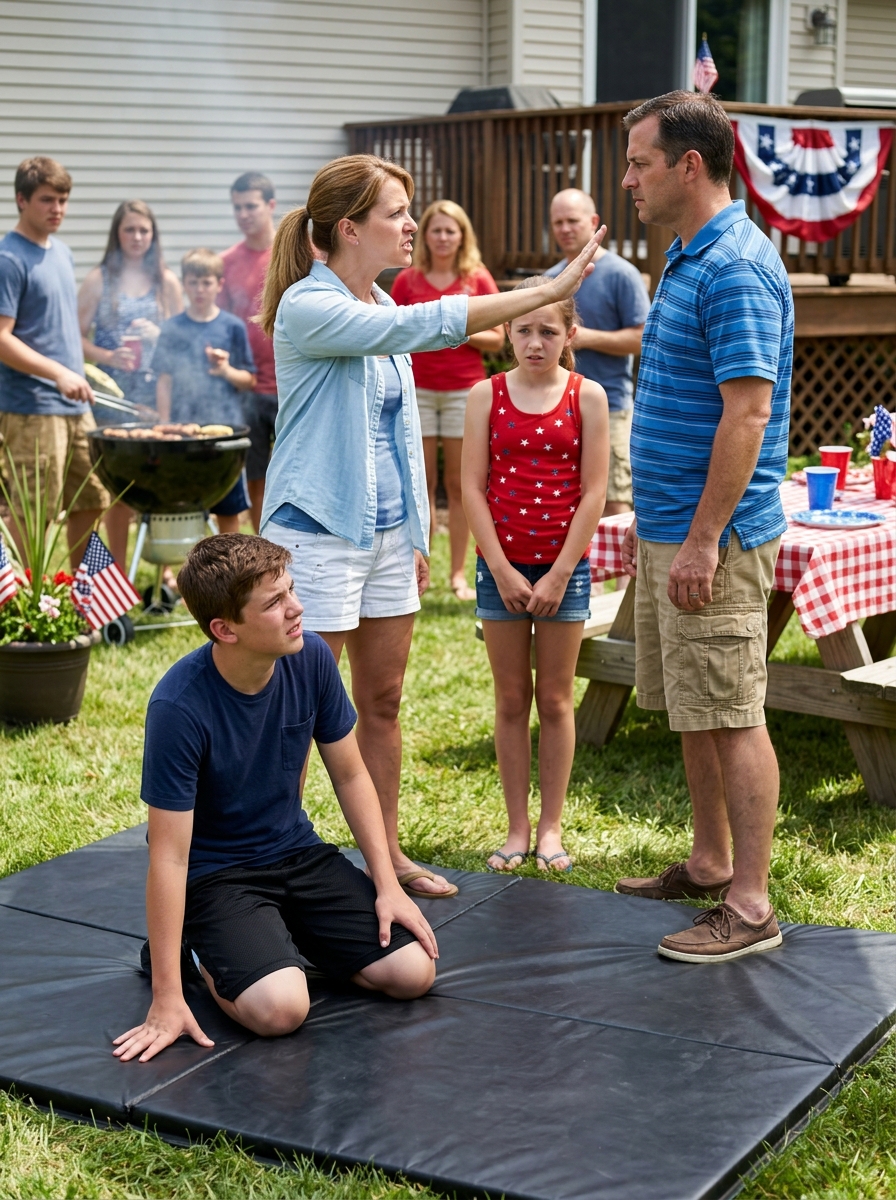
My brother-in-law pushed my thirteen-year-old son onto the backyard wrestling mat with enough force that Caleb’s hands struck the canvas before his knees followed. The entire yard fell silent except for the grill crackling near the patio, a distant firework bursting somewhere beyond the neighborhood, and the quiet gasp my daughter released behind me.
For a few seconds, nobody moved.
Derek Vaughn stood above my son with a smile that made my stomach tighten. He was the type of man who confused being loud with being powerful and cruelty with comedy, a former supply corporal who talked about discipline as though he had created it while allowing everyone else to fix the problems caused by his pride. He clapped once, dramatically, then looked around the yard expecting approval.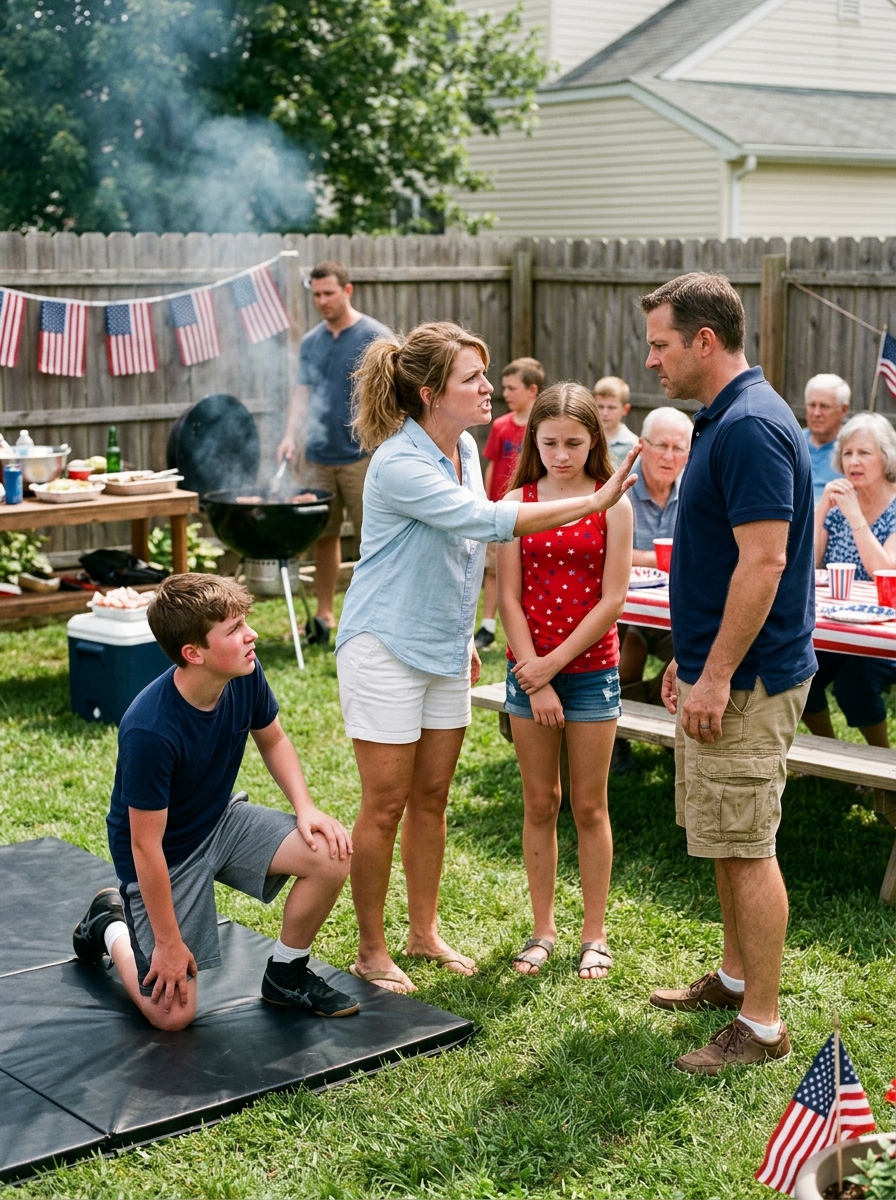
“Come on, Caleb,” he said. “If you want to grow up, you have to stop folding every time somebody touches you.”
Caleb lifted himself from the mat, his face burning with pain and embarrassment. He did not cry. Somehow, that hurt even more.
My nine-year-old daughter, Emma, moved closer to me and whispered, “Mom, why does Uncle Derek always do that?”
The question wounded deeper than anything Derek had ever said.
Because I had tolerated it. Because I had laughed it off. Because every Fourth of July barbecue, Thanksgiving gathering, birthday celebration, and family discussion had shown him that I would quietly accept disrespect if it kept my mother calm and prevented my sister from choosing between her husband and reality.
My name is Laurel Bennett. I am forty-four years old, a retired United States Marine Corps lieutenant colonel, and for twenty-two years I allowed my family to believe I had spent my service sitting behind safe desks, handling paperwork at quiet bases and receiving benefits I had not truly earned. I let them call me fortunate. I let them call me reliable. I let them call me the person who always had money when someone’s roof needed fixing, car broke down, tuition was due, or an unexpected bill appeared.
I never told them about the operations. I never showed them my scars. I never corrected the jokes when they slowly became disrespectful habits. I believed humility meant remaining quiet until that silence eventually became a prison.
That afternoon, we gathered in my mother’s backyard in Richmond, Virginia, beneath strings of patio lights and paper flags. My mother, Elaine, sat beside the glass table holding a plastic cup of iced tea with a worried look she never transformed into action. My younger sister, Mallory, stood near the grill pretending to organize hamburger buns while her husband entertained relatives who laughed because stopping him was harder.
Derek struck the mat with both hands.
“Come on, Laurel. Since you are so concerned, maybe you want to teach the boy how it is done.”
A few cousins laughed quietly. Derek widened his stance, making himself appear larger.
“Do not worry. I will go easy on the office Marine.”
Mallory stared down at the buns.
My mother said, “Derek, do not start.”
But she never said, Laurel, you do not deserve that. She had never said it. Not when Derek joked about my “printer-jam combat experience.” Not when he suggested my retirement was effortless money. Not when he bragged about covering family expenses I had secretly paid from my own account because Mallory begged me not to embarrass him.
I looked at Caleb. His eyes stayed on the mat, and shame rested across his shoulders like a burden someone else had placed there.
That was enough.
I stepped forward.
“You want a round?” I asked.
Derek’s smile widened.
“Finally. I thought the paperwork department might be too delicate.”
I removed my watch and handed it to Emma.
“Stand with your grandmother.”
Emma wrapped her fingers around the watch.
“Mom?”
“I am all right, sweetheart.”
Derek rolled his neck and stepped onto the mat like a man entering a story where he already knew the outcome. He expected fear. He expected doubt. He expected the quiet woman he had mocked for years to back away because everyone was watching.
I gave him none of that.
PART 2 — SIX SECONDS
Derek charged forward high, careless, and smiling. He reached out as if he were grabbing something helpless, not entering a controlled physical exchange with another adult. That was his first mistake, though it would not be his last. People who depend on intimidation often mistake patience for weakness.
I moved outside his path, caught his wrist, shifted my hips, and used his own momentum against him. My left foot planted firmly. My shoulder lowered. My grip adjusted without unnecessary movement. I brought him down hard enough to stop the attack, but not hard enough to cause injury. Training is not anger. Control is not cruelty. Strength does not need approval from an audience.
He struck the mat with a shocked grunt.
Before he could recover, I had his arm controlled behind him, one knee positioned over his hip, and my other hand holding the collar of his shirt so his shoulder remained protected and his pride did not. The entire exchange lasted less than six seconds.
The backyard went completely quiet.
Derek struggled once.
“Get off me.”
“Say you are finished.”
He tried using force to escape. I adjusted my weight slightly. The movement was minimal, but the meaning was obvious. He stopped pushing and turned red against the mat.
“Say you are finished,” I repeated.
His voice sounded strained.
“Finished.”
I released him immediately and stepped away.
Nobody applauded. Nobody laughed. Mallory stood frozen. My mother looked at me as if someone had uncovered a person she never knew existed. Caleb looked surprised first, then proud, then relieved in a way that nearly broke my heart.
Derek stood up quickly, rubbing his shoulder.
“Dirty move.”
“Controlled move.”
“You humiliated me in front of my family.”
I looked at Caleb.
“You did that to yourself in front of my son.”
Derek stepped toward me, and chairs scraped behind the patio table.
A voice from the fence interrupted.
“Step back, Corporal Vaughn.”
Silas Mercer, my mother’s quiet neighbor, stood beside the gate with one hand resting on his cane and the other touching the brim of an old Marine Corps cap. He was in his seventies, thinner now, but his voice still carried the authority of someone who had spent a lifetime giving orders.
Derek turned.
“This is not your business, old man.”
Silas straightened as much as his body allowed.
“Actually, it is exactly my business.”
My stomach tightened.
“Silas, please.”
He looked at me, and his eyes carried a respect I had spent years trying to keep away from my family.
“Lieutenant Colonel Bennett,” he said.
Mallory whispered, “Lieutenant Colonel?”
Silas turned toward everyone gathered around the table.
“Everyone here should choose their words carefully. This woman is not some harmless clerk you get to mock between hamburgers. In 2011, outside Sangin, her unit pulled six of us from a disabled convoy while rounds were tearing concrete from the wall behind us. She carried me when my leg would not move. I remember her voice because she kept telling me I was not allowed to die in such an inconvenient place.”
The grill continued hissing.
Nobody spoke.
Derek forced a laugh that sounded empty.
“Marine Raider? Her?”
Caleb pulled out his phone with trembling hands. He searched quickly, the way children search when the world they know suddenly changes and they need proof before believing it. Then he turned the screen toward me.
“Mom,” he said quietly, “is this you?” On the screen appeared an old association article I had never shared with them. The photograph was blurry but impossible to mistake: me wearing dress blues beside a Marine general, being awarded a Bronze Star with valor. Below the caption was a mention of a Purple Heart and a humanitarian evacuation command citation.
Emma leaned over her brother’s arm to see it.
“Mom, you were hurt?”
That was the voice that reached the part of me I had spent far too long trying to protect.
I could handle Derek’s jokes. I could handle my mother’s convenient helplessness. I could handle Mallory’s silence because she valued my financial help more than my self-respect. But I could not handle my children believing that their mother had shown them disrespect was something you simply endured by acting like it was not there.
Mallory moved closer to me.
“Laurel, why did you never tell us?”
I looked around the yard, at the grill, the paper plates, and the family I had supported while allowing them to believe I was only someone they could rely on.
“Because every time I tried to be more than useful, this family became uncomfortable.”
My mother’s eyes filled with tears.
“That is not fair.”
“No,” I said. “It is not.”
PART 3 — THE DRIVE BACK HOME
I did not remain for the fireworks. I helped Caleb and Emma into my truck while Derek stayed seated on the grass, rubbing his shoulder and suddenly looking much smaller than the image he had created for himself. Mallory followed me toward the driveway, but Derek called her name in a tone that sounded like a command. She stopped.
That told me everything I needed to understand.
The drive home was dark, broken only by porch lights, bursts of fireworks, and the quiet glow from the dashboard. Emma fell asleep with my folded jacket beneath her cheek. Caleb stayed awake, staring through the windshield as if the night itself had become something he needed to figure out.
After almost twenty minutes, he finally spoke.
“Mom, why did you let him talk to you like that?”
I tightened my hands around the steering wheel.
The old explanation was easy: because I was exhausted, because family was complicated, because my mother depended on me, because Mallory was trapped in a marriage she defended publicly while criticizing privately. None of those reasons were enough for my son.
“Because I thought enduring disrespect quietly made me strong.”
He turned to look at me.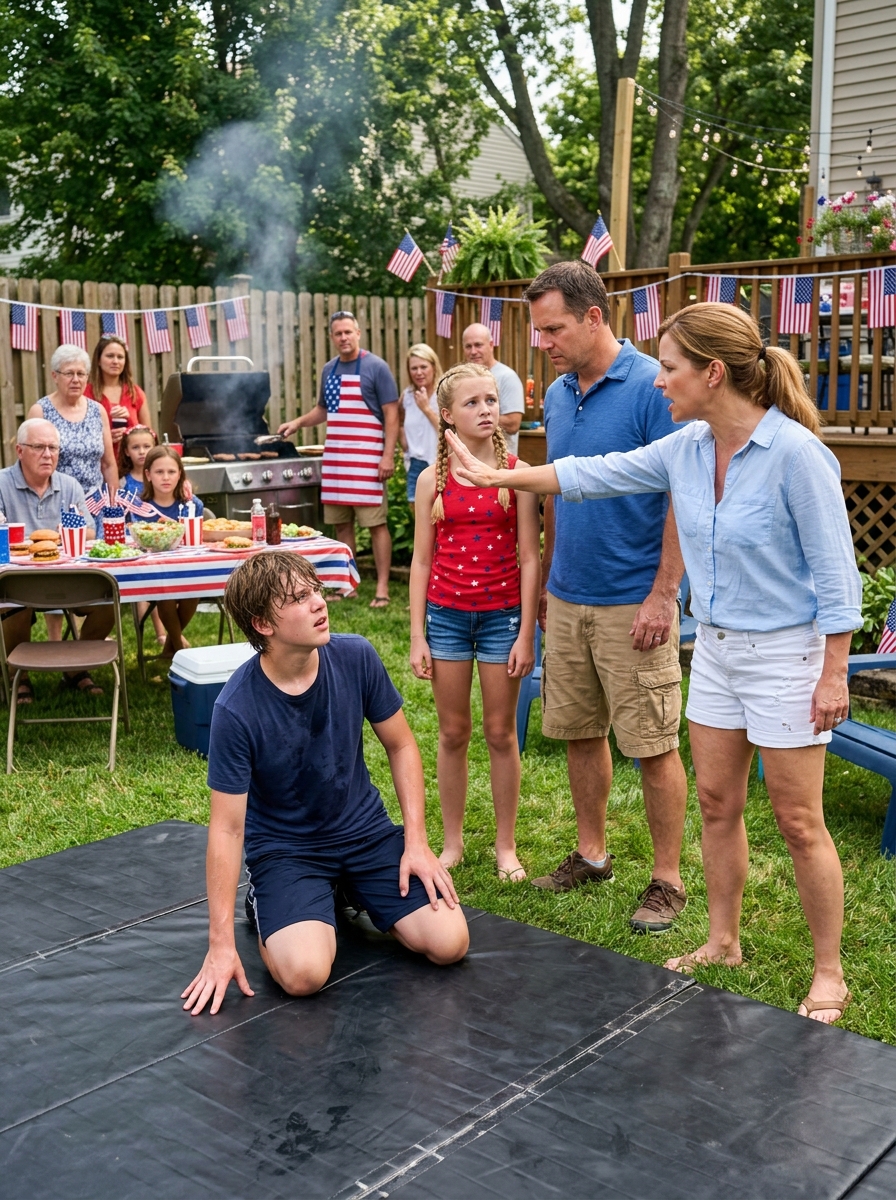
“Did it?”
Children can be painfully honest.
“No,” I said. “It made me forget I deserved better.”
He lowered his eyes to his hands.
“I do not want to learn that.”
The words struck harder than anything Derek had done.
“Then I will stop teaching it.”
The following morning, I called Tasha Reed, the person who had helped me through the most difficult year after retirement and never let me pretend self-erasure was noble. She answered without even saying hello.
“Silas called me.”
I closed my eyes.
“Of course he did.”
“How bad?”
“I put Derek on the mat in front of the family.”
“Good.”
“Tasha.”
“Do not Tasha me. That man has been using your patience as a public punching bag for years.”
I sat at my kitchen table, my coffee growing cold between my hands.
“My mother cried.”
“Let her,” Tasha said. “People cry when the appliance they have depended on suddenly reminds them it is human.”
It was a harsh statement. It was also true.
After we ended the call, I opened my banking app and stopped the automatic transfers: money toward my mother’s utilities, Mallory’s mortgage assistance, and the emergency savings account that was meant to be temporary three years earlier. Then I requested a public summary of my military record and wrote an email to my mother and sister.
I love you. I have spent most of my adult life helping this family, and I do not regret generosity freely given. What I will not continue is financial support in a family system where I am mocked, diminished, or treated as useful but not respected. If you want me present, that presence will now require honesty, boundaries, and basic dignity.
I attached the record.
I stared at the screen for a long moment before finally pressing send.
For twenty-two years, I had feared that showing who I truly was would come across as arrogance. But humility and disappearing are not the same thing. Humility does not require your children to watch you fade away.
Mallory called first.
She was crying so intensely that I could barely understand her.
“I knew Derek went too far sometimes, but I told myself you did not mind because you always smiled.”
“That was easier for you.”
She took a shaky breath.
“Yes. It was. I let him make you the joke because it kept the peace in my house.”
It was the first honest thing anyone in my family had said to me in years.
“I cannot fix your house for you anymore,” I said.
“I know.”
“Do you?”
There was a pause.
“I am trying to.”
It was not enough to repair everything, but it was enough to leave the door open.
Three days later, my mother called. She did not start with an apology. She started with a question.
“The year you sent money for my roof, were you recovering from the injury in that record?” I closed my eyes.
“Yes.”
“You told me you fell down concrete steps.”
“I did not want you to worry.”
Her voice trembled.
“I let you carry everything.”
“Yes,” I said. “You did.”
For the first time, I accepted her hurt instead of trying to take it away.
PART 4 — THE CEREMONY THAT REVEALED THE TRUTH
Two months later, my former unit organized a small recognition ceremony at Quantico for retired service members participating in a mentorship program. I had avoided events like that for years because they exposed parts of me that combat never could. This time, I invited my family because keeping secrets had already taken too much from all of us.
Mallory asked if Derek could attend.
“Only if he understands this is not about his pride.”
He arrived wearing a dark suit, quiet for once, with his hands folded in front of him instead of taking up space around everyone else. He did not exactly look humble. He looked like someone trying to practice humility before truly understanding it.
My mother sat between Caleb and Emma. She held the program so tightly that the paper bent beneath her fingers.
When Colonel Hayes read my record aloud, it felt as if the room was being pulled back through years of memories.
Bronze Star with valor. Purple Heart. Special operations deployments. Humanitarian evacuation command. Advisory work with wounded service members. Twenty-two years of experiences my family had reduced to harmless office jokes because I had allowed them to.
Emma leaned against my mother and whispered loudly enough for me to hear.
“Grandma, Mom is really brave.”
My mother covered her mouth.
“Yes, sweetheart. She is.”
After the ceremony ended, Derek came toward me near the hallway windows. He stopped at a respectful distance, which was already something new.
“I was wrong,” he said.
I waited.
He swallowed.
“I made you smaller because I needed to feel larger. I did it in front of your children, and I did it because nobody stopped me. That does not excuse it.”
For the first time since I had known him, he did not follow it with a joke.
“I am sorry, Lieutenant Colonel.”
I watched him carefully. Apologies often come easily after someone has been corrected in public. Real change is harder once everyone has gone home.
“I accept the apology,” I said. “That does not restore trust.”
He nodded.
“I understand.”
“Do you?”
His expression tightened, but he did not push back.
“I am beginning to.”
Mallory walked over a moment later. She looked at him, then at me, and I saw something shift in her face. Not a dramatic transformation. Not a final answer. Just the beginning of understanding that peace created from another woman’s silence was never truly peace.
“Derek is moving into the guest room for a while,” she said quietly. “We are starting counseling next week.”
Derek looked uncomfortable but did not object.
I nodded.
“That sounds like a beginning.”
On the drive home, Caleb held the ceremony program across his lap.
“Mom?”
“Yes?”
“Can I tell people about you?”
I smiled sadly.
“You can tell the truth. Just remember that the medals are not the whole story.”
“What is the whole story?”
I looked at him briefly before returning my eyes to the road.
“That strength is supposed to protect people, not make them feel small.”
He carefully folded the program.
“That sounds better than Uncle Derek’s version.”
“It is.”
PART 5 — THANKSGIVING IN MY HOME
By Thanksgiving, our family gathered at my house for the first time in years. I agreed to host because hosting no longer meant giving myself away. The difference was clear before anyone even arrived. I did not cover everyone’s travel costs. I did not send Mallory grocery money. I did not move money into my mother’s account when she mentioned the higher winter utility bills. I simply told them what I was preparing and what they could contribute.
They contributed.
It felt almost unbelievable.
My mother arrived carrying a sweet potato casserole and a nervous expression. Mallory brought pies. Derek unloaded folding chairs from his truck without explaining how much effort it took. Caleb and Emma watched him with the cautious curiosity children show toward adults who are trying to earn back trust.
Dinner felt uncomfortable at first, which was exactly why it felt honest. Nobody joked about my career. Nobody asked me to solve a financial problem. Nobody treated my quietness as approval. When Derek started telling a loud story about someone at work, he stopped halfway through, looked at Caleb, and lowered his voice.
Small actions matter when they are repeated.
After dinner, my mother stood beside me at the sink. For most of my life, she had let me handle the cleanup because I was “better at keeping things moving.” This time, she rolled up her sleeves and helped.
“I should have asked more questions,” she said.
I handed her a plate.
“Yes.”
She washed it slowly.
“I think I was afraid of the answers. If you were stronger than I realized, then I had fewer reasons to justify depending on you so much.”
It was not a flawless apology. It was something better than a flawless performance.
“I wanted to be depended on,” I said. “That was part of the problem.”
She looked at me.
“Why?”
I watched the steam rise from the sink.
“Because being needed felt safer than being truly known.” My mother started crying softly, but she continued washing the plate. I loved her for that more than I thought I would. For the first time, her tears did not make me pause the conversation and comfort her before the truth had a chance to fully reach the room.
Later, after everyone had gone home, I found Caleb and Emma in the living room studying the framed photograph from the ceremony. I had placed it on the shelf because hiding it again would have taught them the wrong lesson.
Emma asked, “Were you scared when you were a Marine?”
I sat down beside her.
“Many times.”
She looked confused.
“But brave people are not scared.”
Caleb answered before I could.
“No, brave people do the right thing while they are scared.”
I looked at him, and something inside me finally relaxed.
The following spring, I began mentoring young veterans who were transitioning out of active duty. Some carried medals they never talked about. Some carried injuries nobody else could see. Some had families who wanted heroic stories but struggled with the complicated aftermath. I shared what Tasha had taught me, though I softened her words for people who were not familiar with her unique kind of honesty.
“Humility is a virtue,” I said during the first session. “Disappearing is not.”
For years, I had mistaken one for the other.
Derek changed gradually. Not suddenly, not perfectly, and not without setbacks. He apologized to Caleb without anyone forcing him to. He stopped turning physical challenges into jokes with younger relatives. He still raised his voice more than necessary sometimes, but Mallory no longer laughed just to make things easier. When he crossed a line, she addressed it immediately. The first time she did, my mother looked surprised, then proud, then saddened that it had taken so long.
Some bridges are rebuilt piece by piece.
Others stay closed because protecting yourself matters more than holding onto memories.
Ours became something between the two: careful, tested, but still standing.
Every Fourth of July now, we gather at a public park instead of my mother’s backyard. There is no wrestling mat. Derek handles the grill because he truly is good at it. Mallory brings salads she insists she did not buy from a deli. My mother sits beneath a canopy and tells Emma stories about my father, an aircraft mechanic who taught me that quiet service mattered long before I turned that lesson into disappearing from myself.
This year, when fireworks began lighting up the sky beyond the trees, Caleb stood beside me with his hands in his pockets.
“Do you ever wish Silas had not said anything?”
I thought about it.
“Sometimes I wish I had said it first.”
He nodded.
“You say things now.”
“I am learning.”
Fireworks burst red and gold above the park. Families cheered. Children covered their ears and laughed. Derek called from the grill that the burgers were ready, then looked at me and added carefully, “When you are ready, Colonel.”
Not as a joke.
Not as a challenge.
As respect.
I walked toward the picnic table with my children beside me and realized that the six seconds everyone remembered were not the moment I defeated Derek. They were the moment my children watched me stop allowing myself to disappear.
That was the victory worth holding onto.
THE END
