

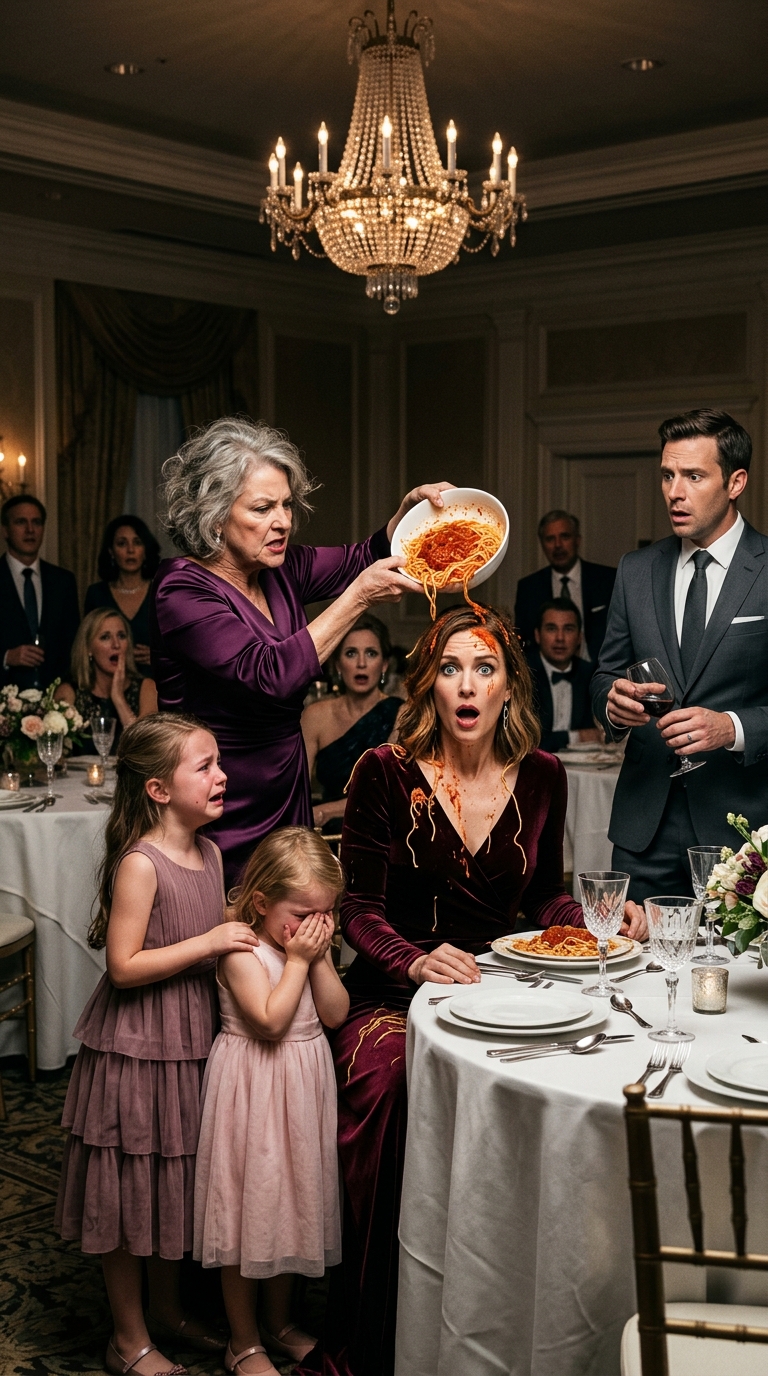
THE TABLE AT THE FAR END OF THE LAWN
The first thing my mother-in-law did was remove my daughters’ dinner plates.
She did it slowly, almost like a performance, in front of enough people to ensure everyone would remember it. The gathering was taking place at a massive stone estate in Great Falls, Virginia, a property with white columns, a circular driveway, and a wide lawn stretching toward the Potomac beneath rows of perfectly maintained maple trees. Nearly one hundred relatives and guests had traveled from Virginia, Pennsylvania, and Ohio because my husband, Warren Pike, had announced that he had purchased the estate after what he called “the biggest year of his career.”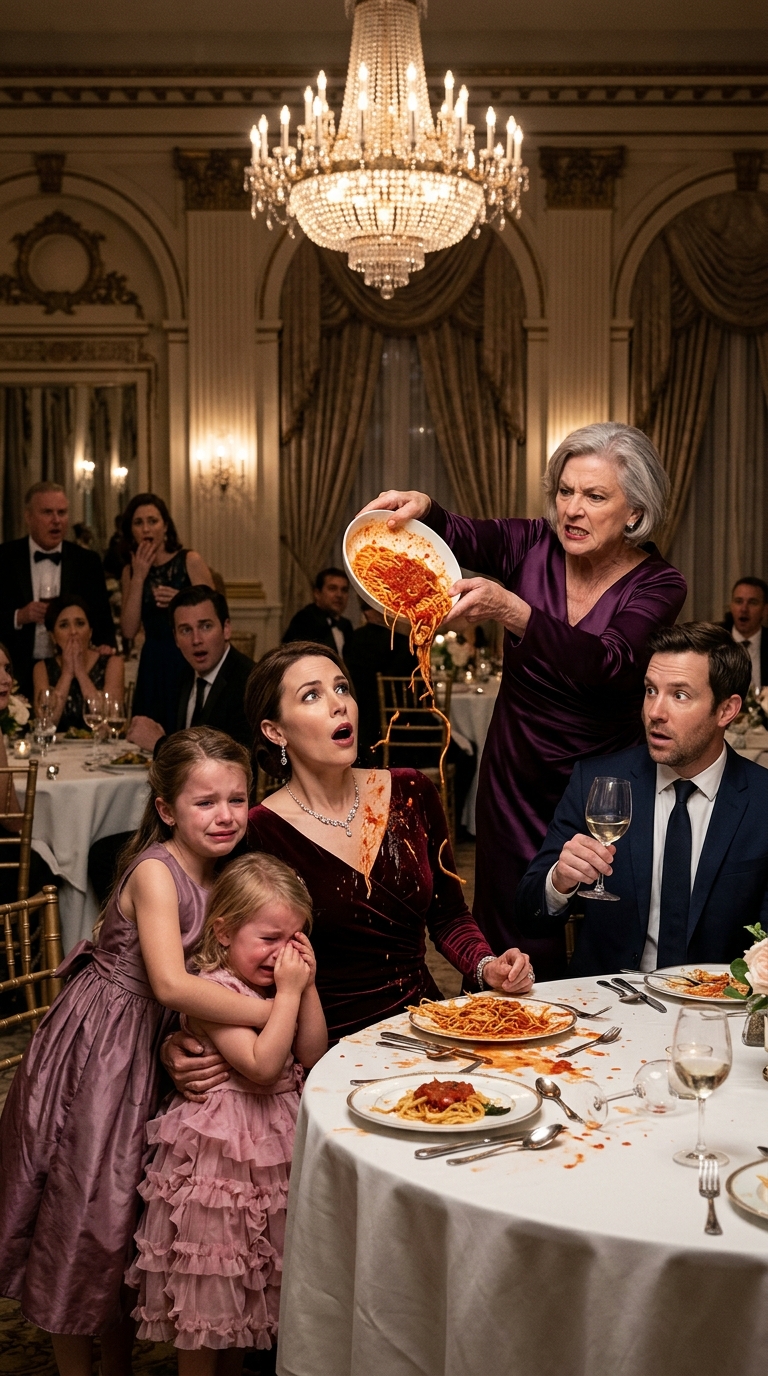
There were tables covered in linen beneath a rented pavilion, a live jazz trio playing near the terrace, chilled seafood towers, carved prime rib, crab cakes, roasted vegetables, and more flowers than most people ever see outside of weddings. Warren’s relatives spent the afternoon posing beside the fountain and congratulating each other as if his achievements belonged to the entire Pike family. My daughters and I had been placed at the far end of the lawn.
Sadie was eight. June had just turned five.
They were still eating when Beverly Pike approached.
My mother-in-law wore a cream-colored designer-style suit, large gold earrings, and the satisfied look of someone who had spent her life mistaking control for significance. Without asking, she picked up Sadie’s plate, then June’s, and passed both to a nearby server.
Sadie looked up at her.
“Grandma, I wasn’t finished.”
Beverly chuckled softly.
“Sweetheart, the best food is for the main family table. Maybe one day your mother will understand that families need sons to carry something forward.”
Several guests close by heard every word.
One cousin stared down at his napkin. An aunt suddenly became interested in her phone. No one stepped in.
Then Beverly placed a cracked plastic container in front of us. Inside were cold leftovers collected from serving trays: pieces of bread, overcooked vegetables, a little gravy, and food that had clearly been discarded after the buffet.
“There,” she said. “You three can manage with that.”
When she shoved the container closer, some gravy spilled onto June’s pale-blue dress and splattered onto Sadie’s cheek.
For a moment, neither girl moved.
Sadie looked beyond me toward the raised terrace, where Warren sat at the center table beneath the string lights with his brothers, cousins, and several coworkers. I knew what she was hoping for. She was waiting for her father to stand up. She was waiting for him to tell his mother that she had crossed a line.
Instead, Warren lifted his wineglass.
“Allison, don’t start anything,” he called across the lawn. “Mom knows how these family events work. Just let me have one good day.”
A strange silence spread across the nearby tables.
I took a cloth napkin and gently wiped Sadie’s face.
Then I cleaned June’s dress as carefully as I could.
I had been married to Warren for eleven years, and for most of that time his family believed I worked as a part-time leasing assistant for small apartment properties. Beverly often called me “dependent.” Warren’s older sister once told relatives that I was fortunate he accepted my lack of ambition. During Christmas, I received household cleaning supplies as a joke while the other women opened jewelry.
None of them knew I was the founder and majority owner of Reed Urban Partners, a private commercial real-estate advisory company that had quietly expanded throughout the Mid-Atlantic. We represented developers, negotiated land purchases, managed investment partnerships, and had recently completed projects in Northern Virginia, Maryland, North Carolina, and Tennessee.
I had concealed the true size of my work for years.
At first, I convinced myself I was protecting my marriage.
The reality was harder to admit.
I was protecting Warren’s pride.
He worked as a regional sales manager for an office technology company. His income was respectable, but almost every part of his lifestyle was financed. The imported SUV, the expensive suits, the club memberships, the dinners he called “executive networking,” even the watch he claimed came from Switzerland.
At home, he gave me a set amount for groceries and questioned every receipt.
Years earlier, when I mentioned receiving a large commission, Warren reacted with such anger that I finally understood something I should have seen much sooner: he did not want a successful wife. He wanted a wife who made him appear more successful.
So I stopped sharing details.
My mother helped me arrange my first investments. My company remained separate from our marriage. I kept my public image quiet, allowed Warren to believe I only handled basic leasing work, and made myself smaller inside our home because I thought maintaining peace was worth pretending.
It was not.
Silence never made Beverly more compassionate. It only gave her more confidence.
Three weeks before the party, she had taken my daughters to help hand out promotional flyers for one of Warren’s cousin’s businesses during an unusually hot Saturday. When I objected, she told me that girls who were unlikely to “carry on the family name” should learn to be useful.
That night, Sadie asked me something while I brushed her hair.
“Mom, does Grandma think we matter less because we’re girls?”
I remember looking at my daughter in the mirror and realizing my silence was no longer protecting anyone.
It was teaching my children to accept being mistreated.
By the time Warren announced that he had purchased the Great Falls estate for nearly five million dollars, I already knew the reality.
He had not bought it.
He had rented it for six months.
He was carrying much more debt than he admitted, yet he planned an extravagant party because he wanted his relatives to believe he had become the person he had spent years pretending to be.
That was when I stopped saving him.
A month earlier, Warren had asked me to arrange a temporary family loan through my parents. I told him they might agree if he signed a formal promissory note for $300,000.
He signed without reading beyond the first page.
He was smiling when he did it.
“Your parents should be grateful they can finally invest in someone who knows how to make real money,” he said.
No money was ever transferred into his account.
The note, however, recorded his obligation exactly as his own attorney-approved paperwork stated.
At about the same time, through a professional connection Warren had no idea I possessed, I arranged the extravagant catering package he insisted on for his celebration. The agreement was simple: the remaining balance had to be paid during the event, and Warren personally guaranteed the account.
He signed that as well.
So when Beverly slid leftovers toward my daughters and Warren told me not to cause a scene, I said nothing.
I rose, picked June up into my arms, and reached for Sadie’s hand.
“Enjoy the estate,” I said quietly. “Enjoy the dinner. Enjoy everything you’ve worked so hard to make people believe.”
Warren looked over from across the lawn with a frown. Beverly crossed her arms.
I lowered my gaze to my daughters.
“We’re leaving. From now on, you will not eat what someone else decides you deserve.”
Then we walked through the iron gates.
None of them realized that the biggest bill of the day had yet to arrive.
A DINNER NO ONE COULD TAKE AWAY
Inside the car, June gently rubbed at the stain on her dress. Sadie sat beside her, unusually quiet.
We had driven less than a mile before she asked the question that erased every excuse I had spent the last eleven years making.
“Mom, are we embarrassing to Dad?”
I pulled into a peaceful parking area beside a small park and switched off the engine.
Then I climbed into the back seat.
“No,” I said. “Listen to me carefully. There is nothing about either of you that should ever make a parent ashamed.”
Sadie looked up at me, her eyes filled with tears.
“Then why didn’t he say anything?”
There are times when a mother wants to cushion the truth because she believes kindness means hiding it.
I had already done far too much of that.
“Because your father made a bad choice,” I said. “He chose approval over courage. And I made bad choices too. I stayed quiet when I should have protected you sooner.”
June rested her head against me.
“Do we have to go back?”
I kissed the top of her head.
“No, baby. We don’t.”
I took them to a restaurant in Georgetown where I had hosted business dinners for years, even though neither of my daughters had ever been there before.
We sat beside the windows overlooking the river, and when the server handed us our menus, Sadie’s eyes immediately went to the prices.
That tiny habit nearly broke my heart.
My eight-year-old had learned to fear spending money in a home where money had never actually been the problem.
“Order what sounds good,” I told her.
“Anything?”
“Anything.”
We ordered shrimp, grilled salmon, warm bread, roasted potatoes, and three desserts because June could not decide between chocolate cake and vanilla custard, and for once I did not ask her to choose.
At first, both girls ate carefully.
When the server placed a fresh plate in front of June, she actually looked over her shoulder.
I reached across the table and gently held her little hand.
“Nobody is taking your dinner away.”
As my daughters slowly began to relax, Warren’s celebration carried on without us.
I only learned what happened afterward from several people, although videos had already spread throughout the extended family by then.
Shortly after two that afternoon, the catering director walked over to Warren carrying a burgundy folder containing the final invoice.
The total came to just under $300,000.
According to those who witnessed it, Warren laughed.
He pulled out the black credit card he loved displaying on restaurant tables.
“Go ahead,” he said. “That’s what it’s there for.”
The card was declined.
He tried again. He handed over another card.
That one was declined as well.
A third card came next. By then, the conversations at the nearby tables had completely stopped.
Beverly reportedly stepped forward and accused the catering staff of humiliating her son. The director stayed composed.
“Mrs. Pike, the contract requires full payment today. Both you and Mr. Pike signed the event guarantee.”
Warren started calling me.
Once.
Then again.
Then over and over.
My phone remained turned off.
Someone suggested that he use money from the sale of his former home, and that was when everything started falling apart. Another relative questioned why an owner would need approval from a property manager to bring additional guests into his own house.
The catering director did not reveal the truth.
Warren revealed it himself.
Under pressure, surrounded by relatives who had spent the entire afternoon celebrating his supposed achievements, he admitted that the estate was leased.
Not bought.
The mood of the celebration shifted instantly.
An uncle from Pittsburgh demanded to know why he had traveled all that way for a “housewarming” at a property Warren did not own. A cousin asked if Warren had lied about his other investments. Beverly blamed me first, then the catering company, then the bank.
For years, the Pike family had mistaken appearances for evidence of character.
That afternoon, appearances finally came with a price.
THE HOME MY DAUGHTERS HAD NEVER KNOWN ABOUT
After dinner, I drove Sadie and June to a house in McLean.
It sat behind a simple stone wall on a quiet street surrounded by trees, with large windows, a library, a sunroom, and a backyard big enough for two children to play without anyone making them feel like they were in the way.
The house was owned by a family trust my mother had created years earlier.
I had stayed there during some of the hardest times in my marriage, but I had never brought the girls because I kept convincing myself that I would eventually fix our home with Warren.
Sadie stepped inside the foyer and looked up at the curved staircase.
“Whose house is this?”
I placed our bags down.
“It belongs to our family.”
She frowned.
“Like Aunt Melissa’s family?”
“No. Our family. Your grandmother, me, you, and June.”
June’s mouth fell open.
“We can sleep here?”
“Yes.”
“Tonight?”
“Tonight and tomorrow night, and for as long as we need.”
She paused.
Then came the question I knew she had been holding onto since we left the party.
“Grandma Beverly can’t take our food here, right?”
I knelt down in front of her.
“No one is going to treat you that way here.”
That night, my daughters slept together in the biggest upstairs bedroom, surrounded by books and stuffed animals my house manager had quickly gathered after I called ahead. I sat beside them long after they fell asleep and thought about everything I had taken from them, not because we did not have money, but because I had been trying to protect a man’s illusion.
Cheaper shoes.
Smaller programs.
No vacations unless Warren approved them.
Endless explanations about why we could not afford things I knew we absolutely could.
I believed that making myself smaller would keep our family intact.
Instead, it had taught my daughters that love meant making themselves smaller too.
By the next morning, Warren had called more than sixty times.
I ignored every call.
At nine thirty, the security desk called from the front entrance.
“Ms. Reed, there’s a man and an older woman here asking to see you. They say they’re family.”
I checked the camera.
Warren looked like he had spent the night in his suit. Beverly stood beside him wearing sunglasses, even though the morning sky was cloudy.
“Let them in,” I said. “Have two security staff remain nearby.”
When Warren entered the house, he stopped before reaching the living room.
His eyes traveled from the artwork on the walls to the windows, the furniture, and the garden visible beyond the glass.
Then he looked back at me.
“What is this?”
I wore white trousers and a navy silk blouse. Nothing flashy. Nothing dramatic. Yet the way he looked at me told me he was realizing, maybe for the first time, how little he truly understood about his wife.
“A house,” I said.
“With whose money?”
Beverly lowered her sunglasses.
“Did you take the money your parents were supposed to give Warren?”
I almost smiled.
Even then, standing inside a home she could not explain, Beverly’s first response was still an accusation.
I walked over to the coffee table and picked up a leather portfolio.
“Sit down.”
Warren stayed standing.
So I opened the portfolio myself.
Inside were company records, property ownership documents, partnership agreements, audited statements, trust papers, and several recent transactions from Reed Urban Partners.
He stared at the first page.
Then the next.
By the fourth, his expression had completely changed.
“What is Reed Urban Partners?”
“My company.”
He looked up.
“You work for them?”
“I founded it.”
The room went silent.
Beverly grabbed one of the documents.
“This can’t be right. You show apartments.”
“That was one small part of my work years ago.”
Warren lowered himself into a chair.
“How much is all this worth?”
I closed the folder.
“That is no longer information you need.”
THE MESSAGE HE NEVER BOTHERED TO READ
For several moments, Warren only stared at me.
Then his expression softened so quickly that I almost respected the instinct behind it.
“Allison,” he said, “why didn’t you tell me?”
I looked at the man I had married, the man who had sat beneath glowing lights the day before while his mother embarrassed our daughters.
“Because the first time I earned more than you expected, you made it clear that my success offended you.”
He covered his face with both hands.
“I was younger. I was insecure.”
“You were still insecure yesterday.”
“I didn’t know this was your life.”
“You knew Sadie was crying.”
He looked away. “You knew June’s dinner was taken away from her. You knew your mother had spent years making them feel less valued because they were girls. You knew all of that.”
Beverly suddenly lowered herself into the chair beside him.
“We may have made mistakes.”
“No,” I said. “You made choices.”
I pulled two more documents from the portfolio. The first was a petition to dissolve the marriage.
The second was the $300,000 promissory note.
Warren immediately recognized his signature.
“What are you doing?”
“Exactly what the document says. Holding you responsible for what you signed.”
He quickly stood up.
“That money was supposed to come from your parents.”
“You signed a legal agreement without reading it because you were too focused on celebrating yourself.”
“You set me up.”
I shook my head.
“I stopped shielding you from your own choices.”
Beverly leaned closer.
“Allison, sweetheart, think about the girls. Warren is their father. We can fix this. We can all start over.”
It was the first time in years she had called me sweetheart.
Money achieved in thirty seconds what my patience had failed to achieve over eleven years.
“Yesterday you took food away from those girls in front of a hundred people.”
Her eyes began to fill with tears.
“I was angry.”
“You were comfortable. There’s a difference.”
Warren walked around the table and knelt in front of me.
For years, I had pictured him apologizing. In those private moments, I believed I would finally feel relief.
Instead, I only felt exhausted.
“Please,” he said. “I know I messed up. Give me one more chance. I’ll talk to Mom. I’ll go to counseling. I’ll be different.”
I looked closely at his face.
“You are not afraid because you lost me.”
He stayed silent.
“You are afraid because you just realized I was the person with the money.”
His shoulders lowered.
Behind him, Beverly started talking quickly.
“The girls are my granddaughters. I love them. Let me see them. Let us stay here for a while until Warren gets everything sorted out. You have plenty of space.”
That was when every remaining doubt disappeared.
Not because she asked for help.
Because even her apology came with a condition.
I stood.
“My daughters are not decorations you can reclaim now that you know their mother has assets.”
Beverly began crying.
“I said I was sorry.”
“You’re sorry the balance of power changed.”
Then I turned toward Warren.
“You will handle the catering contract. You will handle the promissory note. You will handle every relative you deceived. My attorneys will speak with you about everything else.”
His voice shook.
“Is that it? After eleven years?”
I thought about Sadie asking if her father was ashamed of her.
I thought about June looking behind her in a restaurant, afraid someone might take away her plate.
“No,” I said softly. “Yesterday was it. This is only the paperwork.”
WHAT FREEDOM LOOKED LIKE ONE YEAR LATER
The months that came after were less dramatic than people might expect, although in some ways they were more difficult.
Ending a marriage is not a single victorious moment. It is school paperwork, legal appointments, sleepless nights, conversations with children, changing emergency contacts, creating new routines, and learning not to mistake guilt for responsibility.
Warren fought almost everything at first.
Then the records began telling the truth.
My business interests had been kept separate and legally protected long before the separation. The McLean house belonged to a family trust. The company had its own ownership structures. My attorneys had prepared everything years before I found the strength to leave.
The family videos from the party became important too, though not in the way Warren expected. Several relatives had recorded Beverly taking the girls’ food away. Messages revealed a long history of hurtful comments. Former household employees shared what they had seen over the years.
The final custody arrangement placed the girls mainly with me, while Warren had to meet certain requirements before requesting expanded visitation.
He said he would change.
For a while, he didn’t.
His career also began falling apart after his employer examined several financial and administrative issues connected to his personal borrowing. The company eventually dismissed him. His leased SUV was gone. The expensive dinners stopped. Some relatives who had praised him at the Great Falls celebration stepped away once they realized how much of his image had been built on debt and exaggeration.
I did not celebrate that.
Despite what some people assume, freedom does not depend on enjoying someone else’s downfall.
I simply stopped protecting him from the consequences of his actions.
One year later, Sadie and June were living lives I almost couldn’t recognize.
Sadie joined a swim team and discovered a fierce competitive side. June started piano lessons, mostly because she loved pressing the lowest keys and making the entire room shake. Both girls attended a school where their teachers knew them personally, and slowly, almost without notice, some of their old fears disappeared.
They stopped asking whether normal groceries were “too expensive.”
They stopped hiding snacks in their bedrooms.
They stopped looking at me before ordering from a menu.
One Sunday afternoon, we made garlic shrimp on the back terrace while summer rain moved through the trees. June sat inside, happily repeating the same four piano notes for what felt like the thousandth time.
Sadie walked behind me and wrapped her arms around my waist.
“Mom?”
“Hmm?”
“When I grow up, I want to be like you.”
I turned around and looked at her.
A year earlier, this child had sat at the edge of a party table with gravy on her cheek, waiting for someone older to decide she mattered.
Now she stood with confidence.
I moved a loose strand of hair away from her face.
“I hope you become much braver than I was.”
She frowned.
“You’re brave.”
“Eventually,” I said. “But I want you to understand something sooner than I did.”
“What?”
I looked through the glass doors at June, still happily attacking the piano.
Then I faced my oldest daughter again.
“Never make yourself smaller just to make someone else feel bigger.”
Sadie thought about that.
“Even if you love them?”
I nodded.
“Especially then. Real love doesn’t ask you to disappear.”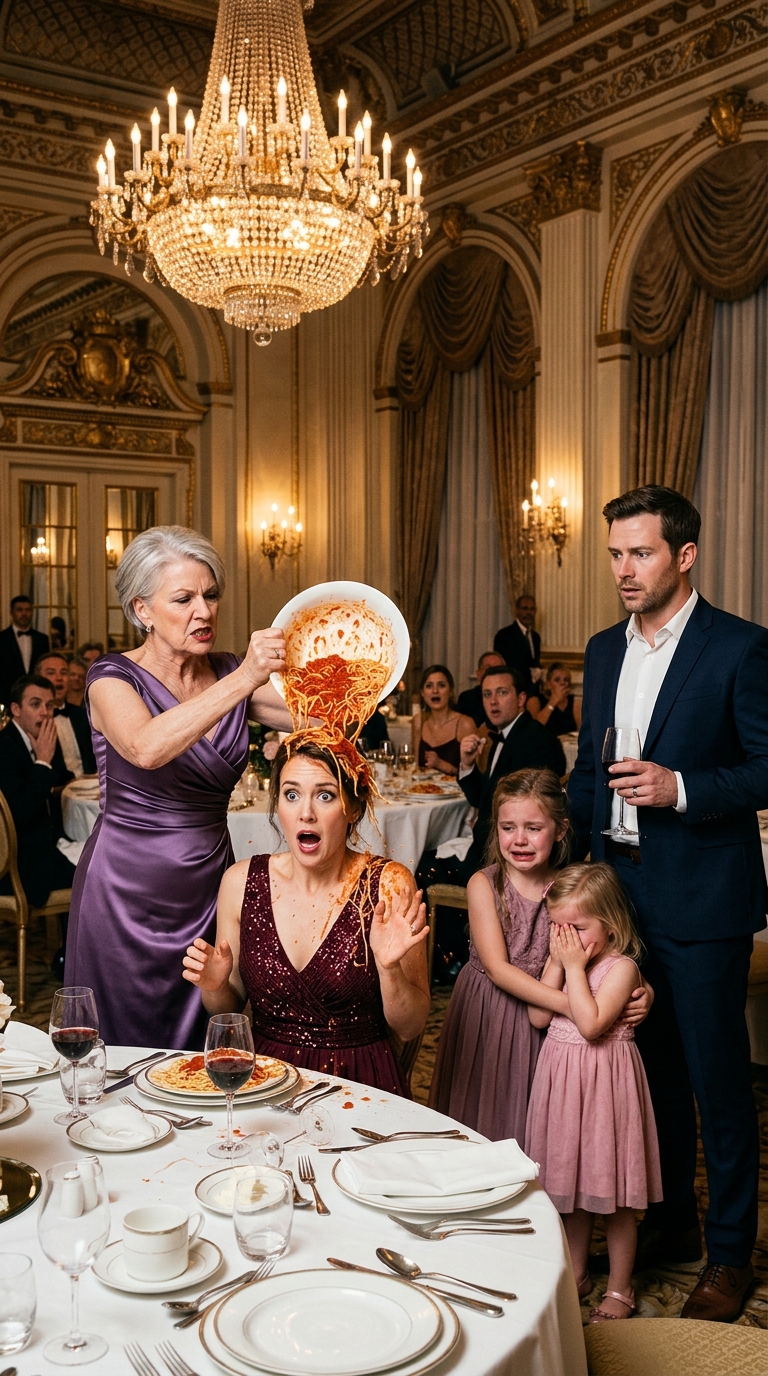
That evening, the three of us shared dinner at a wooden table overlooking the rain-covered garden. There was nothing luxurious about it. No live music. No rented pavilion. No relatives raising glasses to a man pretending he owned a home.
Just my daughters debating over the final piece of bread.
June reached for it first, then paused and split it in half.
“Here,” she said to her sister.
Sadie smiled.
And watching them, I finally understood what had taken me eleven years to realize.
A woman does not destroy a family by refusing humiliation.
A family begins to break when maintaining peace requires one person to give up her dignity, and when children are taught that love must be earned by accepting less.
I once believed silence was a sign of loyalty.
I understand now.
Sometimes the most loving thing a mother can do is rise from the wrong table, take her children’s hands, and guide them toward a life where no one gets to decide they only deserve the leftovers.
