

The Gift Inside the Velvet Box
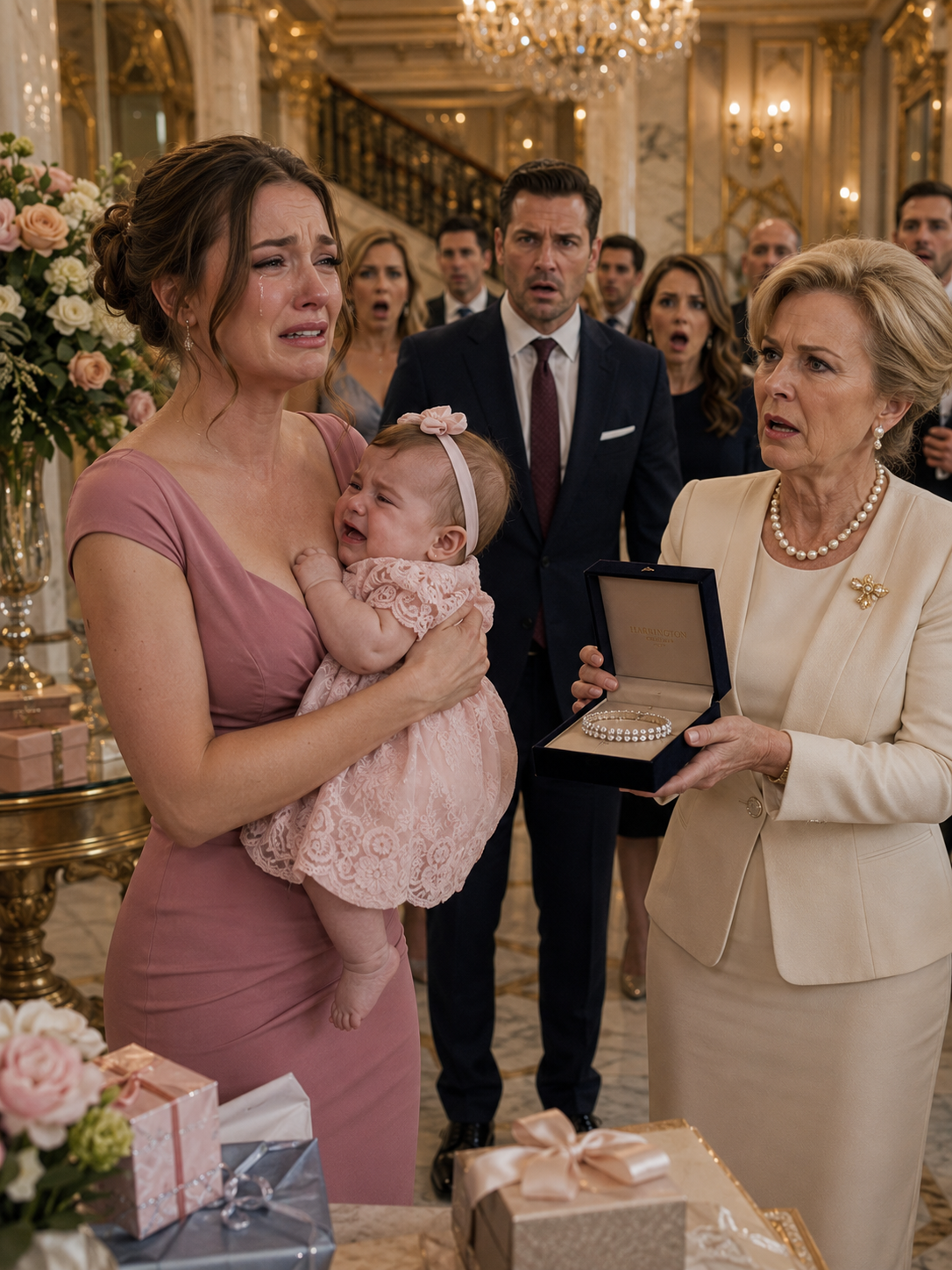
I still remember the tiny jingle of the gold bell when my mother-in-law pulled the collar from its velvet box.
It was such a bright, delicate little sound, and maybe that was exactly why it remained in my memory. Some moments change your life with shouting and broken doors, while others shift everything because of something so small you almost miss it: a look exchanged across a crowded room, fingers gripping a baby blanket tighter, a tiny bell ringing beneath a crystal chandelier.
My daughter, June, was only five weeks old.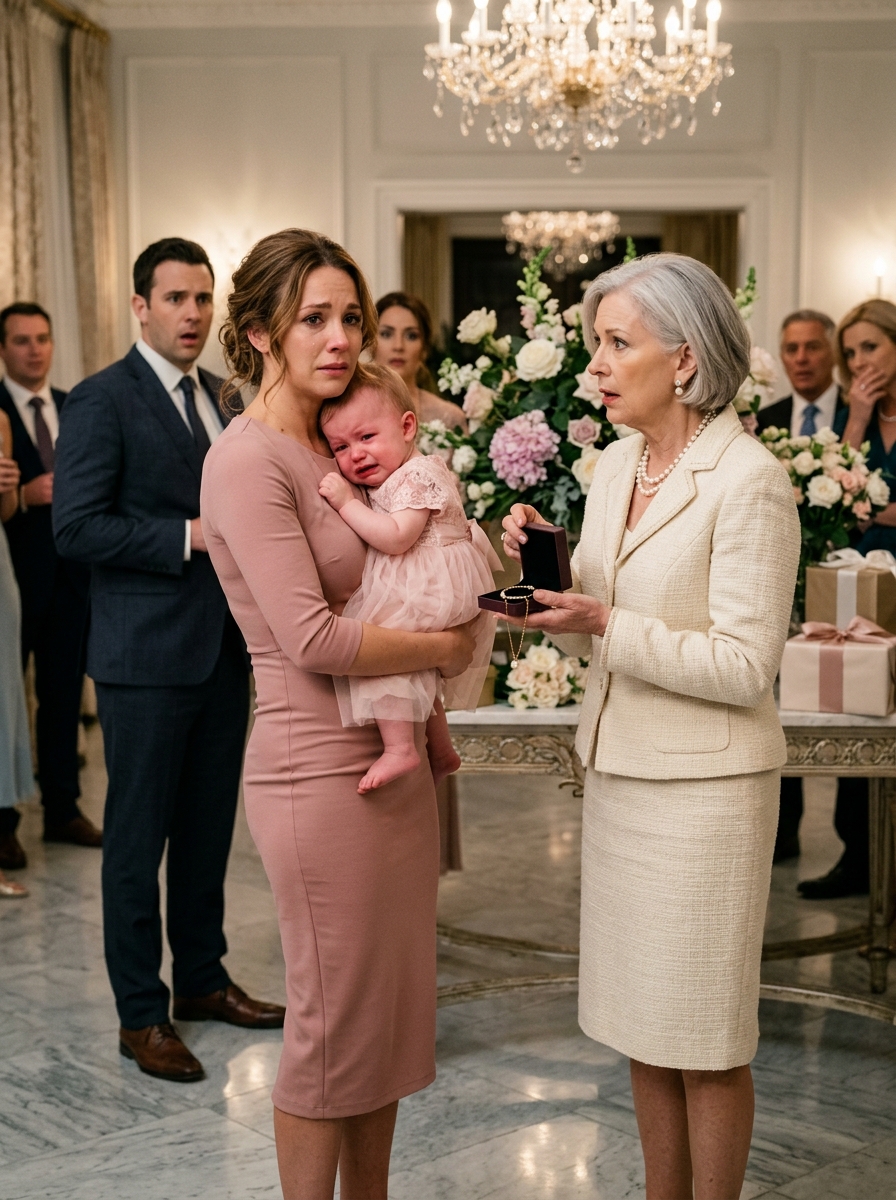
I stood beside the gift table in the sunroom of the Pembroke family estate in Myers Park, one of those historic Charlotte neighborhoods where the oak trees appear older than time and the houses sit far back from the street, making ordinary people wonder what takes place behind those grand windows.
White roses decorated silver vases. Servers quietly walked through the rooms carrying trays of sparkling water and small pastries. Nearly sixty guests had gathered to celebrate the newest addition to the Pembroke family.
And every single person heard Margaret Pembroke say what came next.
She raised the slim black pet collar, allowing the gold bell to sway gently from side to side, and smiled directly at me.
“Since my son was generous enough to bring you into this family, I thought the baby should have something to remind her where she came from.”
For a few seconds, the entire room became still.
Then the laughter started.
That was the part I would remember most clearly in the months afterward. Not Margaret’s ivory outfit or her flawless pearls, not even the collar itself, but the laughter.
It was not uncomfortable laughter from people unsure how to react. It was real amusement, the kind that happens when everyone has already decided whose emotions deserve protection and whose do not.
June slept against me inside a pale pink cotton wrap, her warm cheek resting beneath my chin. She smelled lightly of milk and baby lotion, and I looked down at her peaceful face, wondering how someone so new to the world could already be caught in the middle of an old family conflict she could not possibly understand.
My name is Nora Ellis Pembroke.
I was raised outside Dayton, Ohio, in a white working-class family that never had much wealth but always found room at the table for anyone who showed up hungry. My father repaired heating systems for almost thirty years. My mother worked in the front office of a small public elementary school and spent her weekends preparing casseroles for neighbors facing difficult times.
I became a pediatric physical therapist and later accepted a position at a children’s rehabilitation center in Charlotte. That was where I met Wesley Pembroke during a charity planning meeting.
He came from a world so far removed from mine that, during those first few months, I truly believed our relationship would eventually collapse under the differences between us.
It did not.
Wesley was kind, humorous, and much less impressed by his family’s wealth than most people expected. We married two years later.
Margaret never truly accepted either of us.
She almost never said anything openly cruel. She was far too refined for that. Instead, she hid her insults behind polished words.
“Nora has such a practical background.”
Or:
“It’s wonderful how some people adapt when they suddenly find themselves in more sophisticated surroundings.”
Whenever I told Wesley that his mother made me uncomfortable, he would sigh and ask me to be patient.
“She’s complicated,” he would say. “Don’t let her get under your skin.”
For three years, I tried not to.
Then June arrived, and something within me changed.
Maybe motherhood does that. Maybe you start realizing that every silence teaches your child something, even before she has the ability to speak.
Margaret walked closer with the collar hanging between two fingers.
“Oh, Nora, don’t look so serious. It’s a joke.”
A woman standing near the fireplace laughed again.
Someone else said, “Margaret, you are impossible.”
I held June closer.
“Please put it away.”
Margaret’s smile became thinner.
“Honestly, you should learn to take a joke. It’s not as if I bought something cheap.”
Then she reached toward my baby.
I stepped back.
June woke up and began fussing, startled by the movement and the voices surrounding her.
Something inside me suddenly became completely calm. I pulled out my phone. I acted as though I was checking a message, then quietly turned on the recording. I captured Margaret’s expression, the collar, the bell, and the guests who were still smiling around her. I recorded her reaching toward June again even after I had already told her to stop.
Then I stopped the recording, slipped my phone back into my purse, picked up the diaper bag from beneath the table, and headed toward the front entrance.
Behind me, Margaret raised her voice so the entire room could hear.
“There she goes. Some people can change their clothes, but they never outgrow being dramatic.”
I never looked back.
That surprised even me.
For years, I had imagined defending myself would involve a powerful speech or some unforgettable confrontation. Instead, it looked like an exhausted mother walking through an elegant hallway with a fussy baby in her arms and a phone hidden inside her purse.
By the time I reached my car, one thing was completely clear.
I would never again ask June to quietly accept disrespect simply because I had been too afraid to challenge it.
The Folder I Never Thought I Would Need
When I returned to our townhouse, I placed June in her bassinet and stayed beside her until her breathing became peaceful and steady. Only after that did I open my laptop.
I transferred the video to cloud storage.
Then I sent a copy to my own email.
After that, I saved it onto an external drive.
Finally, I placed it inside a private folder I had been collecting for almost a year.
Until that day, I had never been completely sure why I kept saving those things. Maybe I needed proof that I was not imagining the repeated behavior. Maybe some quiet part of me understood that eventually someone would ask why I had finally reached my breaking point.
The folder held screenshots of Margaret asking Wesley if he was “absolutely certain” June was his child. It contained a voice message where she questioned whether someone from my background could teach a Pembroke child “proper standards.” There were pictures from a holiday dinner where I had been seated at a small table because, according to Margaret, the main dining room had become too crowded.
There were family group conversations where they called me “the therapist girl.”
There was more.
Much more than I wanted to accept.
Wesley returned home shortly after nine that night from a business trip to Richmond. He found me sitting at the kitchen island, my laptop open in front of me, with a cup of tea beside me that had gone untouched.
“How was the party?” he asked.
I turned the screen toward him.
“Watch.”
At first, he looked uncertain.
Then the video reached the moment his mother opened the box.
He became completely still.
He watched her lift the collar.
He heard the laughter.
He saw June wake up.
When the recording finished, he stared at the black screen.
Then he watched it again.
The second time, something changed in his expression.
“She tried to put that near June?”
“Yes.”
He looked at me.
“Why didn’t you call me?”
I wish I could say I responded calmly.
I did not.
“Because every time I called you about your mother, you told me to be patient.”
The words remained between us.
Wesley looked down.
I opened the private folder.
For the next hour, I showed him everything.
Some documents he read more than once. Others he could not bring himself to finish. At one point, he stood and walked toward the window, then returned without saying a word.
When the final message disappeared from the screen, he looked years older than he had that morning.
“We’re seeing my father tomorrow.”
Charles Pembroke had created the family company more than thirty years earlier, starting with two struggling roadside inns before growing it into a regional hospitality and commercial property empire with offices throughout the Southeast.
He was serious, controlled, and not someone people would describe as affectionate.
But he had always treated me as an equal.
The next morning, Wesley and I sat across from him in his uptown Charlotte office.
Charles watched the entire video.
He listened to several recordings.
He read through the messages carefully.
When he finished, he closed the laptop and placed both hands on the desk.
“This is not a misunderstanding.”
Wesley stayed silent.
Charles looked at me.
“How long?” “Almost from the beginning.”
His jaw tightened.
He lifted the office phone from his desk.
“Helen, call the immediate family. Five o’clock. Main conference room. I don’t care what is on anyone’s calendar.”
Then he turned back toward us.
“No more pretending.”
WHEN THE ROOM FELL SILENT
By five that evening, the Pembroke conference room was filled.
Margaret arrived last.
She walked in wearing a navy designer dress, placed her handbag beside a chair, and glanced around with clear annoyance.
“Charles, what exactly is so urgent?”
He gave no response.
Instead, he connected the laptop to the large screen mounted on the wall.
The video started playing.
No one laughed this time.
When it finished, the final frame remained displayed on the screen: Margaret leaning toward my baby with the black collar in her hand while several relatives stood nearby watching.
Margaret adjusted one of her pearl earrings.
“Surely we are not turning a silly family joke into a public hearing.”
Charles looked directly at her.
“You reached toward a five-week-old baby with a pet collar after her mother told you to stop.”
“I never actually put it on her.”
“Because Nora left.”
Margaret’s expression became colder.
“Nora has always been overly sensitive.”
Wesley stood up.
His chair slid slightly backward.
“How was she supposed to feel around you?”
Margaret blinked.
“Excuse me?”
“Welcome? Safe? Respected?”
“Wesley, sit down.”
“No.”
I had never heard him speak to her like that before.
His voice was not raised.
That was exactly what made it more powerful.
“I should have said this years ago.”
Margaret looked at her son as though she no longer recognized him.
Charles lifted one hand.
“We are not finished.”
His assistant entered carrying several thick folders and placed copies in front of everyone at the table.
Pages were turned.
Eyes moved from one document to another.
Inside were Margaret’s messages suggesting I had chosen Wesley because of his wealth. There were transcripts of recorded conversations. There were screenshots from private family chats questioning whether my parents would know how to act at formal gatherings. There was also a message suggesting I should not sit near business partners during dinner because I might not understand their discussions.
I watched the room change as everyone read.
One cousin who had laughed at the party no longer looked in my direction.
An aunt pressed her lips tightly together.
A woman who had once told me to “try harder with Margaret” slowly shut her folder.
Charles spoke in a quiet voice.
“This did not begin at a baby party. It is a pattern. And too many people in this room helped it continue by treating it as entertainment.”
Margaret pushed the folder away.
“Because she does not belong here.”
The words seemed to shock even her after they left her mouth.
Nobody moved.
For years, Margaret had hidden behind polite phrases, subtle remarks, and carefully chosen words.
Now the truth was standing in the room without anything covering it.
Wesley stared at his mother for a long moment.
Then he said, “Thank you.”
She frowned.
“For what?”
“For finally saying it plainly.”
His voice faltered for only a moment before becoming steady again.
“You don’t dislike something Nora did. You dislike what she represents. Her father worked with his hands. Her mother worked in a public school. Her family never had your money, and you decided that made them smaller.”
Margaret shook her head.
“I was trying to protect you.”
“You were trying to control me.”
Charles reached for a cream-colored envelope and set it down in front of his wife.
She looked at the envelope, then back at him.
“What is that?”
He answered in the same calm voice he had maintained throughout the entire meeting.
“The beginning of a formal separation.”
The room suddenly felt smaller.
Margaret stared at him.
“You cannot be serious.”
“I have never been more serious.”
“You are ending thirty-one years because of her?”
Charles shook his head.
“No. I am stepping away because I finally understand what I have spent years excusing.”
He paused.
“You treated kindness as weakness, money as permission, and family loyalty as a reason no one should challenge you.”
Margaret stood from her chair.
“I built this family with you.”
“And I should have stopped this behavior long ago.”
Then Charles explained everything that would follow.
She would immediately step down from the family advisory board. All financial matters would be handled through attorneys. She would stay at a separate property while the situation was being resolved.
And until Wesley and I decided otherwise, she would have no contact with June.
Margaret turned her attention toward me.
For the first time, there was no amused expression on her face.
“You have no idea what you are setting in motion.”
My hands trembled beneath the table, but I answered.
“I do. I’m making sure my daughter grows up knowing that ‘family’ is not a free pass to treat people this way.”
Wesley reached across and took my hand.
I allowed him to hold it.
WHAT AN APOLOGY COULD NOT REPAIR
The meeting ended without coffee, embraces, or simple solutions.
Several relatives attempted to speak with me afterward. One aunt admitted she had never realized how serious things had become. A cousin claimed he had not truly been laughing, even though his voice was clearly captured in the recording.
I listened without defending myself.
By that point, I had learned something important: some apologies come from genuine understanding, while others appear only after someone is forced to face the embarrassment of having witnesses.
That evening, Wesley and I drove home in silence while June slept peacefully in the back seat.
After parking the car, he turned off the engine but remained still for a moment without opening his door.
“I’m sorry.”
I stared straight ahead through the windshield. I had pictured hearing those words so many times before. I imagined them after family gatherings, holidays, quiet insults, and every moment when he asked me to be the one who showed more patience.
Now that they had finally been spoken, they did not feel like a solution.
They felt like the first truthful step toward repairing something that had been damaged for years.
“Sorry isn’t enough.”
He nodded.
“I know.”
“I need to know you will never again ask me to stay quiet just because someone feels uncomfortable when I set a boundary.”
“I won’t.”
“And not only for me.”
He turned his attention toward the back seat.
“For June too.”
EIGHT MONTHS LATER
Charles and Margaret officially ended their marriage after more than thirty years together. People in their social circles had plenty of opinions. Some believed Charles had gone too far. Others claimed I had torn apart a respected family.
But the video remained.
Facts are difficult to rewrite when everyone has seen the truth.
Margaret stepped away from several community organizations and moved into a smaller home outside Asheville. In the beginning, she sent Wesley angry messages accusing me of turning him against her.
He never responded.
Then the messages became less hostile.
Eventually, they stopped completely.
Months later, a letter arrived addressed to me.
I left it unopened.
Another one came a few weeks later.
I left that one unread as well.
The third arrived on a Saturday morning while June, now crawling around, chased a yellow ball across our living room rug. Wesley handed me the envelope.
“It’s addressed to you.”
I placed it on the table.
Several hours passed before I finally opened it.
Margaret wrote that she had started meeting regularly with a counselor. She wrote about control, pride, and the expectations she had carried from her own childhood. She admitted that she had mistaken status for character and spent years judging people by things that never truly mattered.
One paragraph made me stop reading.
She wrote:
“Nora, that day I did not treat June badly because of who she was. I treated her badly because she was yours. Until I can fully face what that says about me, I have no right to ask for a place in her life.”
She did not ask me to forgive her.
She did not request time with June.
At the end, she wrote only:
“I treated your family background as though it were something embarrassing. I understand now that the embarrassment belonged to me.”
I carefully folded the letter.
From the kitchen, Wesley looked over at me.
“Are you okay?”
I looked at our daughter.
June had managed to sit upright in the center of the rug and was clapping proudly for herself after accomplishing such a small milestone.
“I don’t know yet,” I said. “But I’m peaceful.”
And that was the truth.
Peace did not mean the past had vanished. Some wounds do not disappear simply because someone writes a meaningful letter or begins trying to change. Trust comes back slowly, if it comes back at all.
But I was no longer waiting for Margaret to become someone else before allowing myself to live fully.
THE SOUND OF THE BELL
A few weeks ago, I was organizing the back of a closet when I discovered a small shopping bag I had completely forgotten about.
Inside was the collar.
I must have placed it inside the diaper bag while leaving the party, although I had no memory of doing it.
The gold bell rang as the collar landed on the kitchen counter.
For one brief moment, I was transported back to that sunroom beneath the chandeliers, surrounded by people laughing while my newborn daughter moved against my chest.
Wesley walked in and saw what I was holding.
“Throw it away.”
I almost did.
Then I closed my fingers around the small bell.
“No.”
He looked confused.
“Why keep it?”
I glanced toward the nursery, where June slept with one tiny hand resting beside her cheek.
“Because one day, someone tried to use this to remind my daughter of her place.”
I placed the collar inside a small wooden box.
“And instead, it reminded me of mine.”
My place was never beneath Margaret.
It was never outside the polished world of the Pembroke family.
It was never at a side table, waiting for approval from people who believed money made them superior.
My place was beside my child.
Beside the husband who was finally understanding that love without boundaries can become another form of silence.
Beside my parents, who never owned a grand estate but taught me more about dignity than any marble hallway ever could.
Charles visits June almost every Sunday now. He brings cinnamon bread from a bakery near his apartment and sits on the living room floor even when his knees ache. He never speaks negatively about Margaret in front of her. He simply continues showing up, week after week, as though consistency can repair a small piece of what he once allowed.
Wesley and I are rebuilding too.
Slowly.
Honestly.
We no longer dismiss disrespect as “just a comment.” We no longer mistake avoiding conflict for keeping peace. In our home, no one’s background becomes entertainment. Money never gives someone permission to make another person feel insignificant. And when I say no regarding my daughter, that decision is respected.
I still do not know what place Margaret will have in June’s life someday.
Maybe there will be one.
Maybe there will not.
Real transformation requires more than regret, and forgiveness does not mean automatic access.
But I know this.
Dignity does not always arrive through a dramatic speech.
Sometimes it is a woman with trembling hands carrying her baby through a doorway while everyone behind her is still laughing.
Sometimes bravery looks completely ordinary.
Sometimes justice begins with pressing “record.”
And sometimes the object meant to remind you where you belong becomes the thing that teaches you how to stand.
One day, when June is old enough to ask about the small black collar inside the wooden box, I will tell her the truth in a way she can understand.
I will tell her that some people spend their entire lives believing wealth makes them more valuable, and sometimes they must lose the safety of that belief before they learn to truly see others.
I will tell her that her mother did not grow up in a mansion. Her grandfather repaired furnaces through cold winters. Her grandmother worked in an elementary school office and knew countless children by name. There were no inherited fortunes waiting for us, no family corporation, no antique silver prepared for Sunday meals.
But there was love.
There was effort.
There was kindness.
And on the afternoon when a room full of people expected her mother to lower her head and accept humiliation as the cost of belonging, she chose something much simpler.
She picked up her baby.
She walked away.
And she never confused silence with grace again.
