

PART 1
Mariana Escobedo decided to run away from her husband the night she heard Diego say that her son needed to learn how to obey “the hard way.”
It was not a heroic decision.
There were no screams, no large suitcases, no slamming doors.
Only a candle trembling on the shelf, the wind hitting the wooden windows, and an 8-year-old boy pretending to sleep with his eyes squeezed shut too tightly.
Mariana was folding Santiago’s wool sweater over a wooden chest when she heard Diego’s footsteps in the hallway.
Heavy. Slow. Deliberate.
That was how he walked when he returned from the cantina with anger trapped in his chest and needed to find someone to pour it onto.
He stopped in front of the boy’s room.
“That kid needs to understand who’s in charge in this house,” he said from the other side of the door. “If his mother doesn’t learn, he’ll learn for her.”
Mariana stopped breathing.
Then she heard the bedroom door close.
And silence.
That kind of silence that was not peace.
It was surveillance.
During 10 years of marriage, Mariana had learned to measure fear through small sounds: a key turning too forcefully, a chair dragging across the kitchen floor, a slow breath behind her.
She looked at Santiago.
The boy remained completely still, but she knew he was not asleep. No 8-year-old closes his eyelids that tightly if he feels safe.
She knelt beside his bed and touched his forehead.
Santiago opened his eyes.
He did not ask anything.
That hurt Mariana the most.
A child should ask questions, complain, ask for water, make noise, take up space.
For months, Santiago had been learning how to disappear so his father would not notice him too much.
Mariana felt something inside her break.
“Get dressed quietly,” she whispered. “We’re leaving.”
Santiago did not ask where.
He simply reached under the bed for his shoes.
Mariana opened the chest where Diego believed she only kept fabrics, threads, and old clothes.
Underneath an embroidered blanket were the coins she had saved for 2 years by sewing dresses, mending shirts, and making napkins for the women in town while everyone else slept.
It had never been enough to escape.
That night, she understood it never would be if she waited until she had enough.
She tucked the money inside her bra, packed 2 changes of clothes for Santiago, his inhaler, his school papers, a bread roll wrapped in a napkin, and an old photograph hidden inside her prayer book.
The photograph showed a strong woman with a long braid and a stern expression, standing in front of an adobe and stone house high on a hill.
Behind her were agave plants, oak trees, and a vast open sky.
On the back it said:
Catalina Escobedo. La Loma de los Encinos. 1989.
Catalina was Mariana’s great-aunt.
She had died without children.
Her house in the mountains of Puebla had been closed for more than 20 years.
Mariana did not know if the walls, roof, or door were still standing, but it was the only place that did not belong to Diego or to anyone she owed favors.
She remembered visiting once when she was a child.
She remembered the smell of mint, beans cooking in a clay pot, a long wooden table, and Catalina’s large hands arranging colorful threads.
“If one day you have nowhere else to go,” the old woman had told her, “the house on the hill will still be standing. Old houses endure longer than men who think they own everything.”
It took Mariana years to understand those words.
She understood them that night.
They left through the back door without turning on any lights.
The cold November wind struck their faces.
Santiago held his mother’s hand and did not complain.
They walked until they reached the highway.
A truck driver carrying crates of tomatoes toward Zacatlán picked them up without asking questions, because some men understand fear without needing explanations.
He dropped them off at dawn at a crossroads where a rusty sign read:
La Loma de los Encinos, 4 km.
They continued on foot.
The path was made of dirt, stones, and wet leaves.
Santiago walked with soaked shoes, but he did not complain.
Halfway up the hill, Mariana broke the bread roll and gave him the larger half.
The boy looked at her before taking it, as if he still needed permission to be hungry.
Mariana had to bite her lips to keep from crying.
“Eat, my love.”
The house appeared through the fog just as the sun began to rise.
It was low and ancient, with dark stone walls, a thick wooden door, and windows covered in dust.
A huge agave plant had grown beside the corral, its leaves reaching toward the entrance as if trying to protect it.
Santiago looked at it.
“Are we going to live here?”
Mariana swallowed hard.
She did not know how to answer.
Then the boy pointed at the doorway.
Between two stones was a bundle wrapped in dried leather.
Mariana pulled it out with trembling hands.
Inside was an iron key and a yellowed piece of paper.
“For whoever arrives in need: the door opens inward. Turn the key 2 times to the right.”
There was no signature.
But Mariana knew it was from Catalina.
She placed the key into the lock.
Turned it 2 times.
The door opened with a long creak, as if the house had been waiting for years.
Inside, it smelled of old wood, damp earth, and ancient ashes.
There were cracks.
There was dust.
There was abandonment.
But there were also walls.
There was a roof.
There was a fireplace.
And on the shelf sat an oil lamp with its reservoir half full, as if someone had left it prepared for a woman who did not yet know she would need it.
Santiago stepped inside behind his mother and took a deep breath.
“It smells like history.”
Mariana laughed and cried at the same time.
For the first time in years, she closed a door without fear.
PART 2
The morning light revealed everything the night had spared.
The roof had 2 holes, the back window was broken, the pantry smelled of rotten wood, and there were mouse tracks in the kitchen.
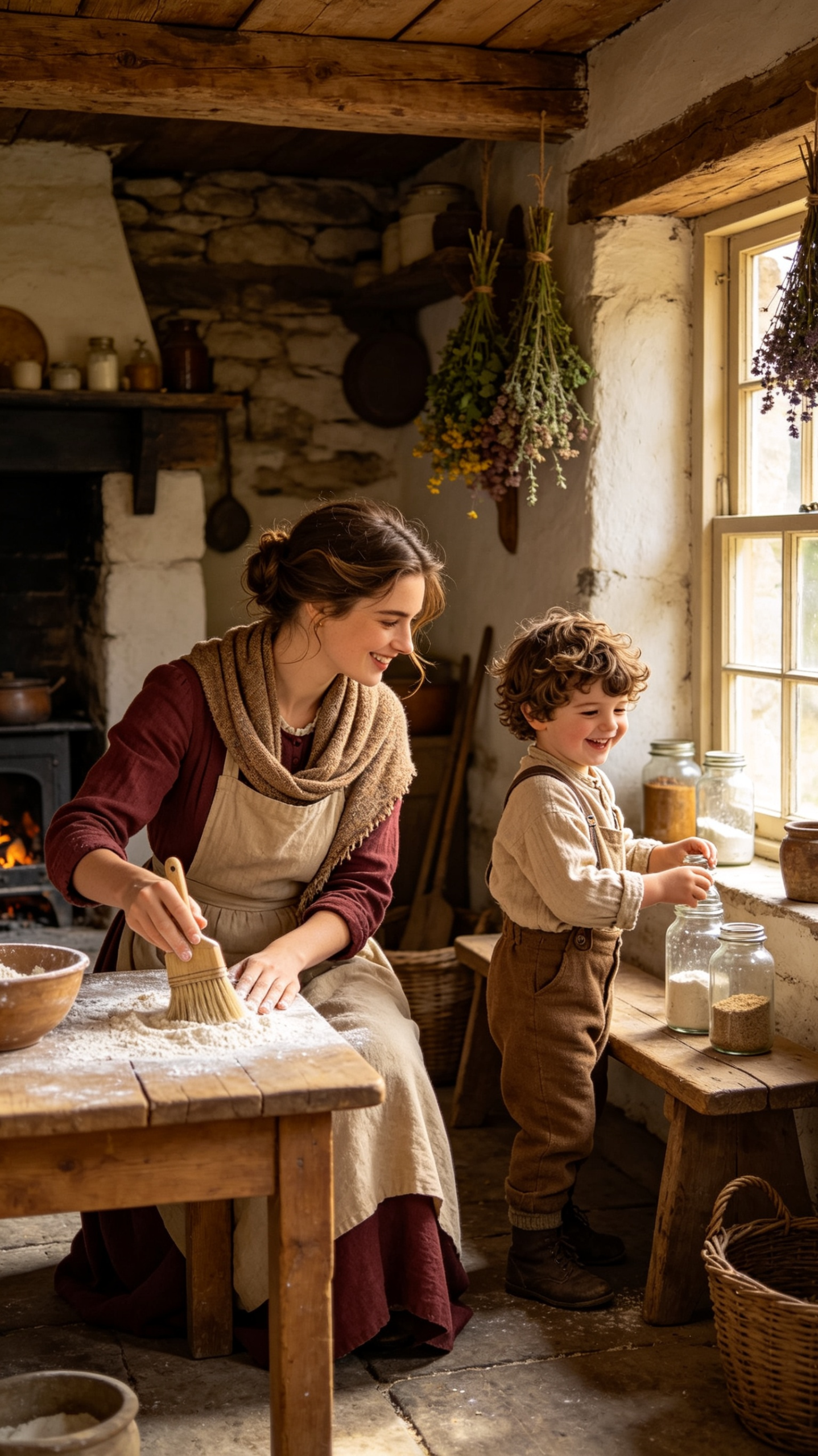
But the table was still sturdy, the fireplace worked well, and the yard had rosemary, rue, lavender, thyme, and a crooked lemon tree that still produced small fruits.
Mariana started by sweeping.
Then she opened the windows.
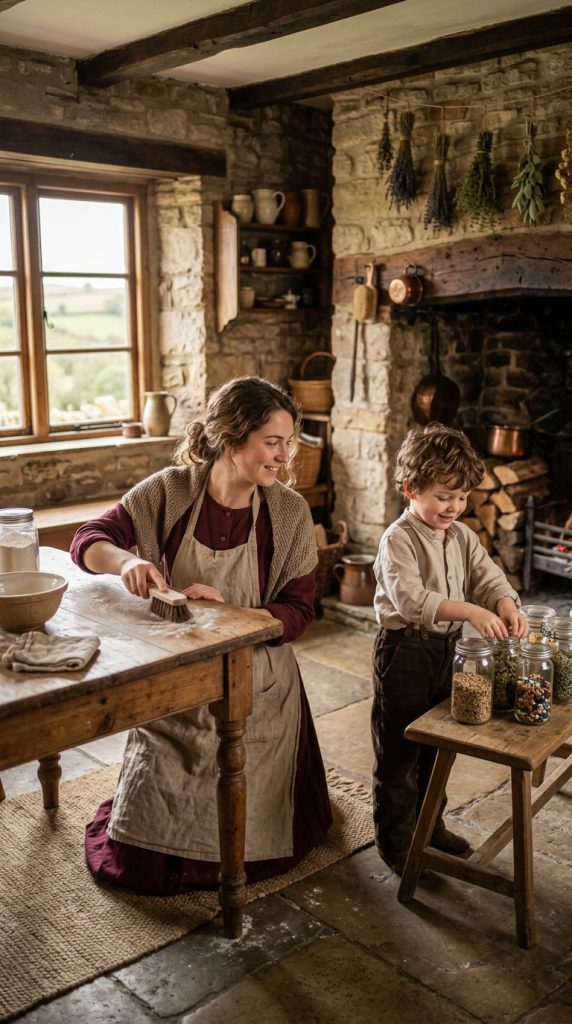
After that, she heated water with dry branches and cleaned the table until the wood regained a lively color beneath the grime.
Santiago helped her without being asked.
He collected old jars, lined them up on the windowsill, and gave them imaginary names.
“This one is the king,” he said, holding one up. “This one is the general. And this one is the prince, but he’s crooked.”
“Crooked princes are the ones who rule the most,” Mariana replied without thinking.
Santiago looked at her and smiled.
It was a small smile, almost afraid of itself, as if he did not know whether he had permission to exist.
At noon, someone knocked on the door.
Mariana grabbed a kitchen knife before opening it.
Outside stood an old man, tall, wearing a palm hat, carrying a wooden cane, and holding a loaf of bread under his arm.
“I’m Eustaquio Reyes,” he said. “I have a cornfield on the other side of the hill. I saw smoke coming from Catalina’s house and came to see if there were living people here or ghosts.”
Mariana did not know whether to laugh.
“I’m her great-niece.”
The old man looked at Santiago, then at the house.
“Then you’d better learn how to live here before the house eats you alive.”
He left the bread on the doorstep.
“I patched the roof 3 winters ago so it wouldn’t collapse. Not because I cared, but because ruins attract drunkards.”
“Thank you.”
“Don’t thank me yet. First check if there are scorpions.”
There were scorpions.
But there was something else too.
Santiago found it 3 days later, behind a cabinet.
A loose wooden board hid a wooden box wrapped in waxed cloth.
Mariana opened it on the table.
Inside were letters, seeds, recipes, embroidery patterns, and an unfinished piece of work: a red rose stitched onto white fabric, with the needle still stuck in the stem.
On top of everything was a letter.
“Mariana, if you are reading this, you found the path. It doesn’t matter how long it took you. Houses do not count time the way people do.”
Mariana sat down on the floor.
Catalina wrote without decoration or unnecessary words.
She spoke about the land, the plants, the women from the village she had secretly helped, the ones who arrived one night carrying sleeping children in their arms and fear in their feet.
“There are women who stay because they believe love means enduring everything. There are women who leave too late. And there are women who never leave because no one ever told them they had the right. If you are one of them, remember this: being afraid does not mean you are wrong. It means you are still alive.”
Mariana cried silently.
The next day, Eustaquio arrived with wooden boards and tools.
He climbed onto the roof without asking permission and spent hours hammering, grumbling, and teaching Santiago how to hold the hammer.
The boy managed to drive 3 nails without bending them and went to bed that night with blisters on his fingers and pride on his face.
Life began to breathe again.
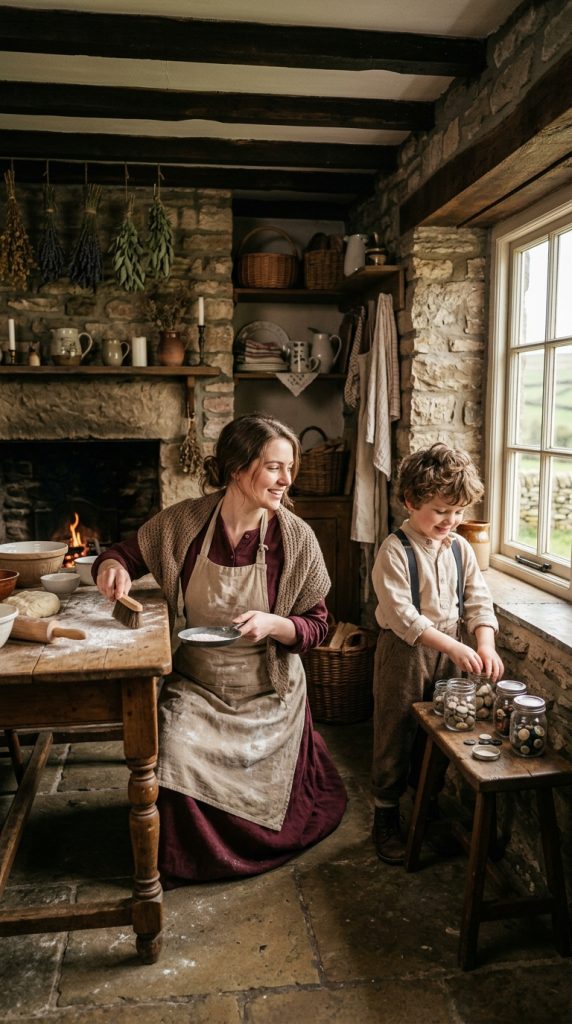
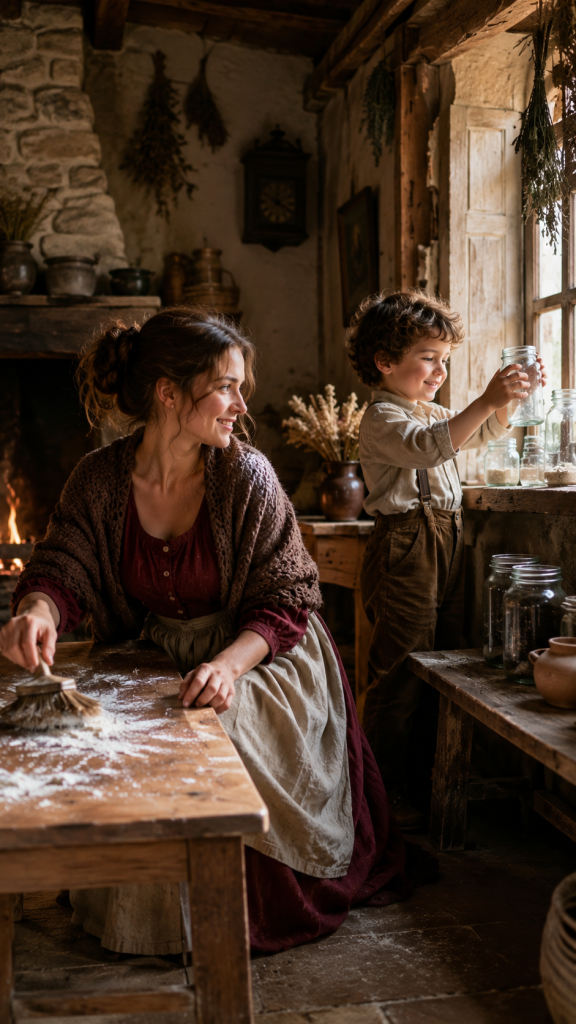
Mariana dried herbs, embroidered napkins, repaired clothes, and followed Catalina’s notes like someone following a recipe to rebuild herself.
A woman from the village, Concepción Molina, came up to buy lavender.
Then she returned for rosemary.
Then she brought other women with her.
And that was how “Catalina’s Craft” was born: a small stand selling herbs, embroidery, and homemade ointments.
But 3 weeks later, Diego appeared on horseback, wearing a clean shirt and a new hat, as he always did when he wanted to appear respectable in front of others.
Santiago was in the corral with Eustaquio.
When he saw his father, he stepped backward until his back hit the wall.
Mariana saw it.
And that was enough.
“I came to take you both home,” Diego said calmly.
“Santiago is with me.”
“You brought him to a ruin, without telling me, without permission. What kind of mother does that?”
Concepción was nearby.
Eustaquio set down his hoe.
Two women walking up the path stopped.
Diego did not raise his voice because he knew there were witnesses.
That was his skill: saying cruel things in a calm voice.
“I didn’t leave without a reason,” Mariana said.
“What reason? You had a roof, food, and a husband. What more did you want?”
Mariana looked at Santiago, still hiding beside the wall.
“I wanted my son to stop making himself invisible just to survive.”
Diego smiled.
“You’re exaggerating as always. Come. We’ll talk alone.”
The old habit appeared inside Mariana:
Obey.
Step aside.
Lower her eyes.
Apologize.
But Eustaquio dropped the hoe against the stones.
The sound was sharp and dry.
“If it’s a family matter,” the old man said, “then act like family, not like you own livestock.”
Diego looked at him with hatred.
Mariana breathed in.
“I’m not going with you.”
Diego clenched his jaw.
“This isn’t over.”
Before leaving, he looked at the house, the jars, the bundles of herbs, and Santiago.
“You think you can live from this. We’ll see.”
When the horse disappeared, Santiago walked over to his mother.
“He’s coming back, isn’t he?”
“Yes.”
The boy swallowed.
“I don’t want to go back. I used to pretend to sleep whenever he argued so he wouldn’t know I was listening. But I heard everything. And I’m afraid I’ll learn to do that forever.”
Mariana knelt in front of him and hugged him.
“You won’t have to learn that.”
PART 3
Diego returned 15 days later, but this time he did not come alone.
He arrived with the village assistant judge, 2 town officials, and that expression of an offended husband that so many people had believed for years.
He came prepared to portray Mariana as a confused woman, an irresponsible mother, and an ungrateful wife.
But he did not expect to find 12 people standing in front of the house.
Concepción had informed the women of the village.
Eustaquio had called the miller, 2 farmers, and Don Ernesto Ibarra, a retired notary who knew agricultural laws and had reviewed Catalina’s documents.
Mariana came out holding a folder in her hands.
Diego got off his horse and smiled as if the entire situation was an embarrassing performance.
“Mariana, stop making a scene. Take the boy and let’s settle this at home.”
“This is my home.”
He let out a low laugh.
“Your home? Don’t say ridiculous things.”
Don Ernesto opened the folder.
“The property is registered under Catalina Escobedo’s name and was passed through direct inheritance to Mariana Escobedo. The hill, the orchard, and the house belong to her.”
The assistant judge looked at the documents.
Diego looked at the judge.
For the first time, no one rushed to agree with him.
Then he changed tactics.
He approached Mariana and lowered his voice.
“The boy needs his father. If you fill his head with fear, you’re the one hurting him.”
That was when Santiago stepped out of the house.
No one called him.
The boy walked until he stood beside his mother.
His face was pale, but his feet were steady.
“I am afraid of him,” he said.
No one moved.
Diego opened his mouth.
Santiago continued:
“I’m afraid when he comes home late. I’m afraid when he speaks quietly. I’m afraid when he says he’s going to teach me how to obey. I pretended to sleep so he wouldn’t know I was listening. But I heard everything. And I don’t want that to be the first thing I learn in life.”
A woman covered her mouth.
Mariana felt her heart break and grow stronger at the same time.
Diego took a step toward the boy.
Eustaquio stepped between them.
He said nothing.
He did not need to.
Diego looked around.
He saw the faces.
He saw the judge reading the papers.
He saw Concepción standing proudly.
He saw Mariana without lowering her eyes.
For the first time in 10 years, she did not look down.
“This isn’t over,” he said.
“For us, it starts ending today,” Mariana replied.
The process was slow.
Diego filed motions, invented stories, claimed Mariana was unstable, that Catalina had influenced her even after death, that the house was an obsession, and that Santiago needed masculine discipline.
But the boy’s words had been heard by too many witnesses.
Concepción testified.
Eustaquio testified.
Don Ernesto brought the documents.
Several women spoke about how Diego treated Mariana when he thought no one was watching.
The decision came at the end of winter.
Mariana read the document 3 times before believing it.
She was granted custody of Santiago.
Her rights over the house and land were recognized.
And, although written in cold legal language, her right not to return was officially acknowledged.
She did not feel happiness at first.
She felt exhaustion.
A clean, enormous exhaustion, as if she had finally released a stone she had carried for years without realizing it.
Santiago was in the garden when she came outside holding the paper.
He was planting onions with the seriousness of a tiny engineer.
“Is it done?” he asked without looking up.
“Almost.”
“Almost good or almost bad?”
Mariana tucked the document into her apron pocket.
“Almost completely good.”
The house was never perfect.
The roof creaked whenever the northern wind blew.
The pantry door swelled with the rain.
In December, the fireplace had to be lit before dawn.
But the house was alive.
People began calling it “Catalina’s Craft.”
At first, it was only herbs and embroidery.
Then came rosemary ointments, dried lavender, flower-patterned napkins, tejocote jam, and workshops for women who climbed the hill with small excuses and big problems.
Mariana did not solve their lives.
She simply gave them hot tea, a chair, silence if they wanted to be quiet, and words when they needed to hear one simple sentence:
“You’re not crazy. You’re not alone.”
Santiago changed too.
He stopped asking permission to be hungry.
He stopped lowering his voice when speaking to an adult man.
If something frightened him, he said so.
One day, he gave names to the rows in the garden.
“This is the kingdom of the onions, that one is the forest of mint, and over there lives the army of radishes.”
Eustaquio pretended to be offended.
“Onions don’t have kingdoms.”
“Mine do.”
Mariana heard her son’s laughter and felt that, finally, the world did not fall apart when he took up space.
One spring afternoon, Santiago found Catalina’s box open on the table.
“Can I write something to her?”
“To Catalina?”
“Yes.”
Mariana gave him a sheet of paper.
The boy wrote slowly, with the tip of his tongue peeking between his teeth as he concentrated.
Then he folded the paper and placed it among the old letters.
“What did you write?”
Santiago looked out the window toward the dirt road.
“That my mom doesn’t pretend to sleep anymore.”
Mariana froze.
She had spent years pretending she did not hear, pretending it did not hurt, pretending nothing was wrong.
Catalina had known before ever meeting her.
Some truths travel between women like seeds waiting for the right soil.
That night, Mariana climbed to the highest room of the house and lit the oil lamp she had found on the first day.
The flame trembled for a moment.
Then it steadied.
Downstairs, Santiago slept with the peaceful breathing of a child who no longer had to listen for doors in his dreams.
Eustaquio had left firewood beside the wall, saying it was not because he cared, but because poorly fed fireplaces were a disgrace.
Concepción had written down 4 new orders for the market.
Mariana looked at the dark path winding up between the oak trees.
She thought of Catalina, leaving behind a hidden key for someone who did not yet know she would need it.
She thought of herself, on that night when she realized she did not have to be ready to leave.
She only had to refuse to stay.
“Thank you, Catalina,” she whispered.
The lamp continued burning.
And from then on, every night, a light remained glowing in the highest window of Catalina’s Craft, so that any woman who climbed the hill with fear in her feet, a small bag in her hand, and a child beside her would know that at the end of the road there was a door.
And that door opened inward.
