

Part 1:
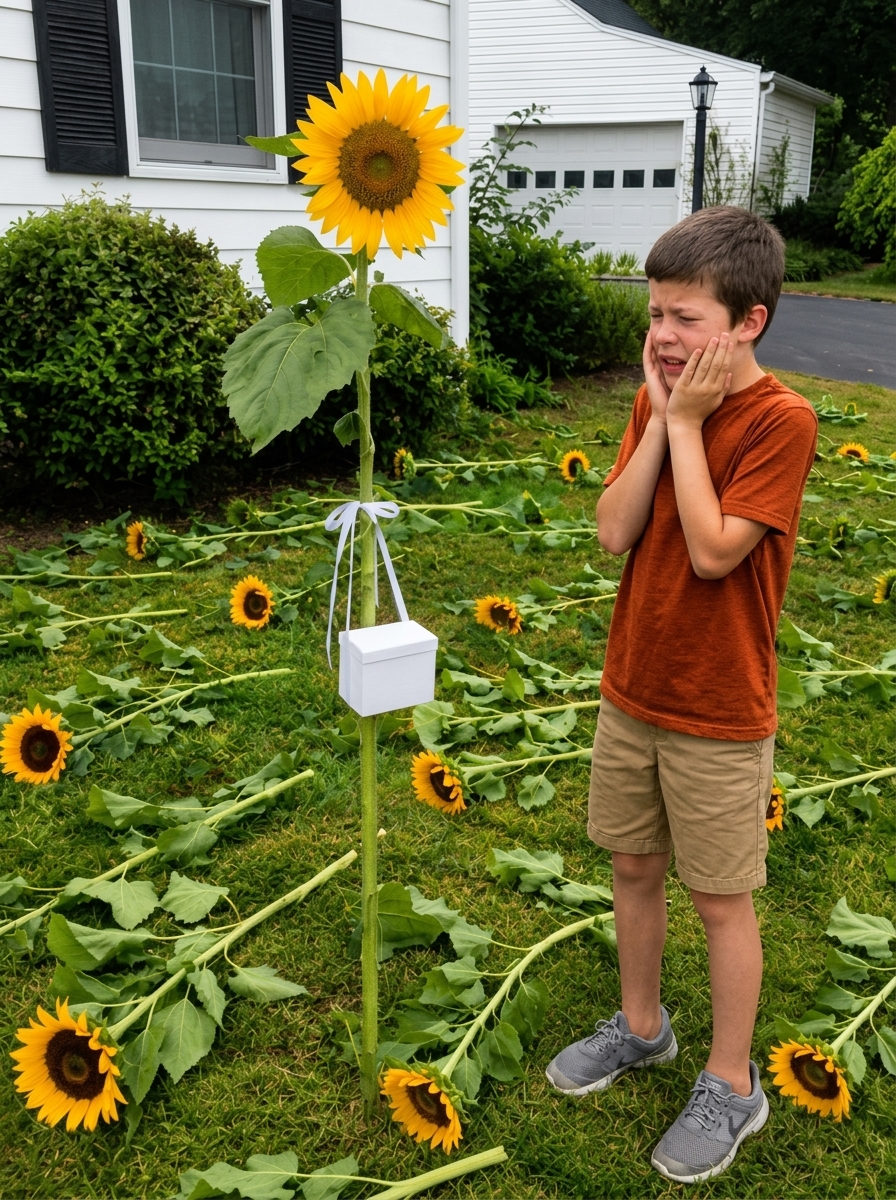
For six years, my son and I planted sunflowers in memory of the twin sister he lost when they were only six. But last Saturday, before dawn, we walked into the garden and discovered every flower had been cut down except one.
Hanging from that single remaining stem was a small white box.
My son Patrick lost his twin sister, Lily, when they were six years old.
From the moment they were born, they were inseparable.
When Patrick laughed, Lily laughed along with him.
When Lily cried, Patrick cried too.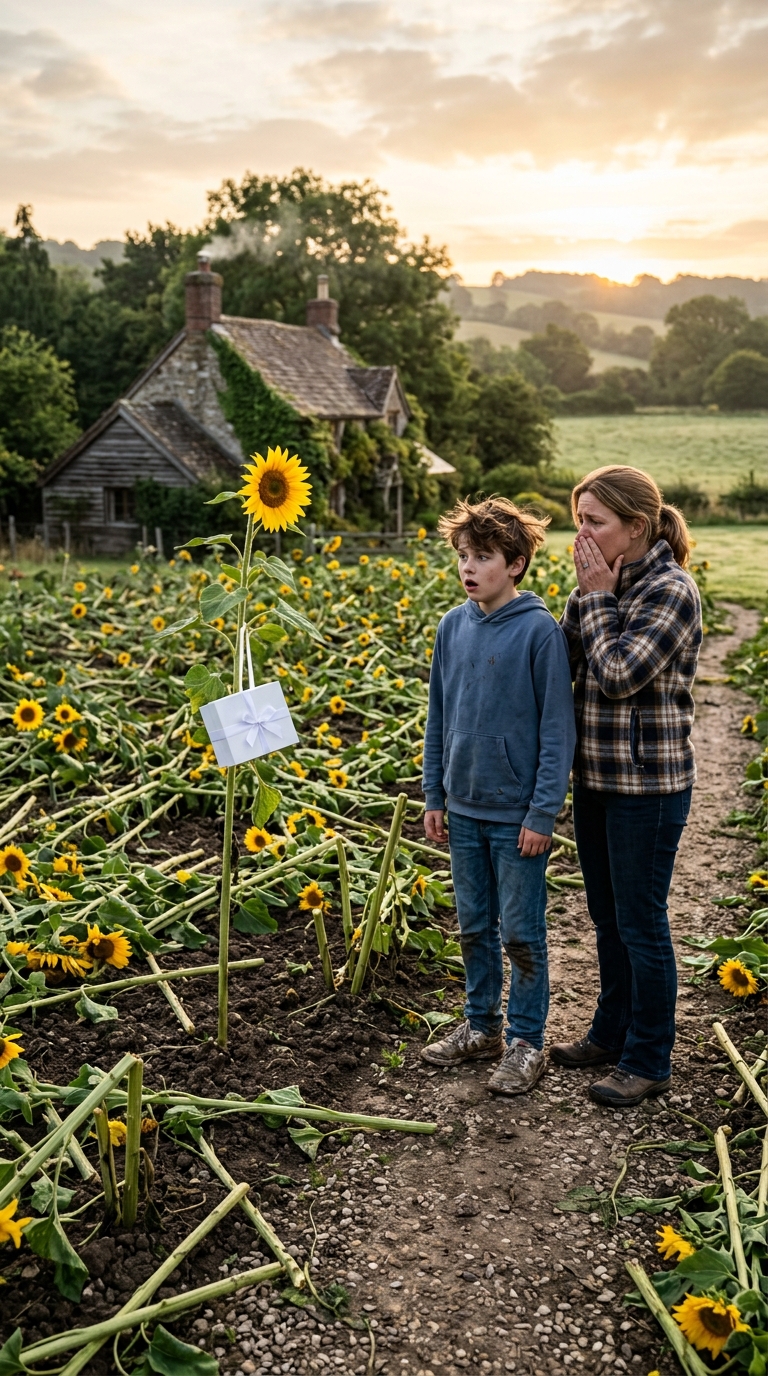
Lily was brave.
Patrick was cautious, always looking out for danger.
One summer afternoon, we were staying at my parents’ farmhouse. The twins asked if they could bring some stale bread down to the pond behind the pasture to feed the ducks.
I said yes.
Only Patrick came back.
He was soaked up to his knees, covered in mud, and screaming so loudly that I could barely understand what he was saying. By the time his words became clear, he was already dragging me toward the water.
We found flattened reeds, murky water, and half a bag of bread lying near the shore.
Deputies searched until nightfall. They examined the pond, the road beyond the fence, and the drainage path where water flowed away after heavy storms. A distant cousin named Vince, who lived nearby, stayed outside searching through the entire night.
The deputies believed Lily had fallen near the edge and been swept into the deeper current.
They called it a tragic accident.
Patrick called it his fault.
A duck had been trapped in the reeds. Lily wanted to help it. Patrick had been holding her hand. He let go for one second to grab the bread sack before it blew into the water. When he looked back, Lily had stepped too close. And then she disappeared.
From that day on, Patrick woke up screaming.
“I shouldn’t have let go of her hand.”
We tried therapy. We tried patience. We tried every kind explanation people could give us. But nothing could reach the part of Patrick that believed he had failed his sister in a single careless moment.
Then, on what would have been Lily’s seventh birthday, Patrick asked me for sunflower seeds.
“They were her favorite,” he whispered. “We should still celebrate her.”
So we planted them together behind the farmhouse.
The first patch was crooked and imperfect, but Patrick loved it. After that, it became something we did every year. Every spring, we worked the soil together and placed fresh seeds into the earth. Every summer, Patrick sat surrounded by the tall yellow flowers and told Lily about everything she had missed.
When he joined the baseball team, the sunflowers were the first ones he told.
Last Saturday marked six years since we lost her. Patrick woke up before sunrise and asked if we could take lemonade to the garden before the heat arrived.
The second we stepped outside, he froze.
Every sunflower had been cut down.
Every single one.
Except for one tall stalk standing in the middle of the garden.
A small white box hung from it with a ribbon.
Patrick looked at me.
“Mom…”
My hands trembled as I untied the ribbon. When I opened the box, my knees almost collapsed.
PART 2:
Inside was a photograph of a girl standing beside a sunflower field along the roadside. She wore a yellow sleeveless dress, with her collarbone exposed under the sunlight.
For one impossible moment, I thought I was looking at Lily.
Patrick snatched the photograph from my hand so quickly I barely reacted. He stared at it without even blinking.
“Mom,” he whispered. “That’s her.”
A folded note was tucked behind the photograph.
I should have taken more time. I should have looked closer. But grief changes the way the mind works. I looked at that girl, older and taller, and for a brief moment, the daughter I had buried in my heart felt alive again.
The note read:
“She is alive. Bring $40,000 if you want the truth.”
A phone number was written underneath.
“Call now.”
I didn’t stop Patrick from making the call. I needed to hear someone speak Lily’s name too.
He turned on speakerphone, his hands trembling.
A man answered on the second ring. His voice was quiet and steady, almost as if he had practiced his words. He said he knew what happened to Lily. If we wanted the truth, we had to bring forty thousand dollars in cash to the Pine Crest Motel the following afternoon.
Patrick could barely get the words out.
“Is she okay?”
The man paused just long enough to make the silence painful.
“She’s alive.”
That was all Patrick needed to hear.
He collapsed right there in the ruined garden, holding the photograph tightly. I wrapped my arms around him, but I was crying too. Neither of us was thinking clearly anymore.
After that, Patrick carried the picture everywhere, from one room to another, as if it would vanish if he ever put it down.
He said maybe someone had taken Lily that day.
Maybe someone had discovered her and raised her.
Maybe she had only recently found out who she really was. I listened because I wanted to believe him.
I did not tell my parents right away. I wanted to have one hour of hope with my son.
It lasted less than twenty minutes.
My mother came in from the yard, noticed the photograph in Patrick’s hands, and immediately froze.
“Oh my God,” she whispered.
My father stayed silent for almost a full minute.
By noon, the four of us were sitting around the kitchen table with the photograph lying in the middle. Patrick refused to let anyone question it.
“What if someone took her that day?” he demanded. “What if she couldn’t get back? What if she only found out later?”
My mother quietly cried while running her fingers along the edge of the photograph. My father studied it for a long time before finally saying:
“It looks like her.”
By that evening, we had created entire possibilities from a single picture and one note. We were not being foolish. We were grieving. There is a difference, but when hope enters the picture, that difference can become dangerously thin.
I barely slept that night.
Patrick did not sleep at all.
Around two in the morning, I found him sitting at the kitchen table, still holding the photograph.
“I keep trying to remember if her left eyebrow always sat a little higher when she was thinking,” he said.
“Patrick…”
“What if she’s been waiting for us?”
The next morning, the cold daylight forced us to look at everything again.
My mother was the first one to speak.
“Where is Lily’s birthmark?”
Everything inside me stopped.
I took the photograph from Patrick and looked more carefully.
Lily had a small crescent-shaped birthmark near her collarbone.
The girl in the picture didn’t have one.
Patrick noticed my expression change.
“What?”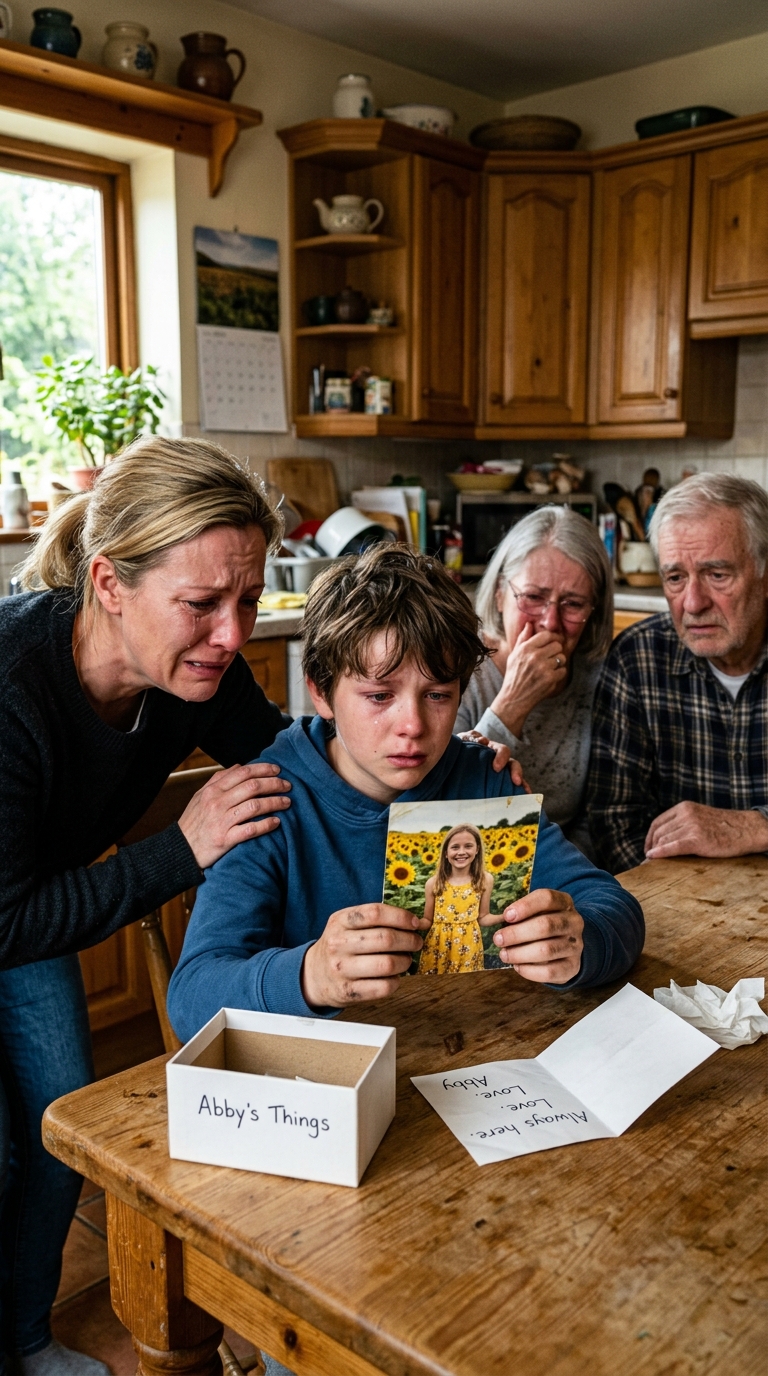
I didn’t answer quickly enough.
“What?” he repeated.
I turned the photograph toward him and pointed.
For a moment, he only stared.
Then he shook his head.
“No. Maybe it’s the angle.”
“It isn’t.”
“Maybe makeup covered it.”
“Patrick.”
“Maybe the picture was edited.”
His voice grew louder with every word. I think he felt the truth approaching and hated that I recognized it before he did.
Then he looked at each of us, and the realization finally reached him.
He collapsed inward and covered his mouth with both hands.
PART 3:
I had already watched him grieve Lily once.
He was not prepared to lose her a second time.
I called Detective Harris, the same deputy who had searched for Lily six years earlier and had since become a sergeant. He arrived at the farmhouse within an hour. I showed him the note, the photograph, the severed sunflower stalks, and the old back gate that was hanging open.
The flowers had been cut neatly with shears. Tire marks were visible in the damp soil near the gate. Only family members and a few longtime neighbors even knew that the gate opened directly into the sunflower patch.
Someone had not accidentally discovered our pain.
Someone had planned it.
Harris instructed me to call the number from his phone using a blocked line and keep the man talking. I did.
The same calm voice answered on the second ring.
He repeated the instructions about the forty thousand dollars and the Pine Crest Motel.
This time, I noticed something in the background.
A bell above a door.
Then a woman’s voice called out:
“Order for Ray.”
When the call ended, Harris looked at me.
“Ray’s Diner.”
There was only one diner near the motel.
PART 3:
Harris wasn’t comfortable with it, but he agreed that Patrick could come as far as the diner and remain in the car unless we needed him. Patrick sat in the back seat, the photograph turned face down on his knee. He could barely bring himself to look at it, but he refused to release it.
At the diner, we showed the waitress the picture and told her we were searching for a cousin.
She nodded.
“That’s Emily. She helps out at Miller’s produce stand sometimes. She lives with her grandmother over in Dalton Ridge.”
Patrick closed his eyes.
We drove to Dalton Ridge.
Emily’s grandmother opened the door, saw the photograph, and immediately tried to shut it again. Harris showed his badge, and she finally allowed us inside.
A man had taken the photo the previous week, she explained. He said he needed it for a flyer for the local sunflower festival.
“He said his name was Vince.”
Vince.
His name immediately came back to me.
Vince would have known about the accident. He was seventeen when Lily disappeared, old enough to hear what the adults were saying and old enough to remember the guilt Patrick carried. He had spent that night searching around the pond. He also would have known about our sunflower tradition and the piece of farmland we sold the year before.
With her grandmother standing beside her, Emily shared one more detail.
Vince had asked her to hold a sunflower and look sad.
She remembered mud on his shoes and a white ribbon sticking out of his pocket.
Harris arranged the motel meeting.
Before I stepped out of the cruiser, he made me repeat the instructions twice.
Do not improvise.
Do not follow Vince anywhere.
Do not give him the envelope unless he gave the signal.
I walked inside carrying an envelope filled with shredded paper and wearing a wire beneath my shirt.
Vince stood near the vending machines, a cap pulled low over his face.
He started speaking before I even had a chance to say anything.
Lily had survived, he claimed.
A woman had taken her in.
She remembered the farmhouse porch.
She still talked about Patrick, though she called him Pat.
I let him continue.
Then I told him our farmhouse did not have a porch until four years after Lily disappeared.
I told him Lily had never called her brother Pat.
She called him Patch.
Then I said:
“I found Emily.”
His expression changed instantly.
He tried to laugh.
But I had Emily’s grandmother.
I had the photograph.
I had the recording.
I had the ribbon, the tire tracks, and the story he created falling apart around him.
Harris stepped forward.
Vince ran toward the back stairwell, but he only made it three steps before another deputy stopped him.
By evening, he was in custody.
Later, Harris told us Vince had never known anything more about Lily than anyone else in town. He remembered Patrick’s guilt, heard about the land sale, and decided that our grief would make us easy targets.
The sunflowers, the ribbon, Emily’s picture, the note—it was all a performance.
When I returned home, Patrick was sitting beside the damaged garden.
“So she wasn’t Lily,” he said.
“No.”
He nodded slowly, staring at the broken flowers. Then he said:
“We need to fix what he messed up.”
The next morning, Emily and her grandmother came to help us remove the cut stems. Emily apologized over and over until Patrick finally looked at her.
“You didn’t hurt us,” he said. “He did.”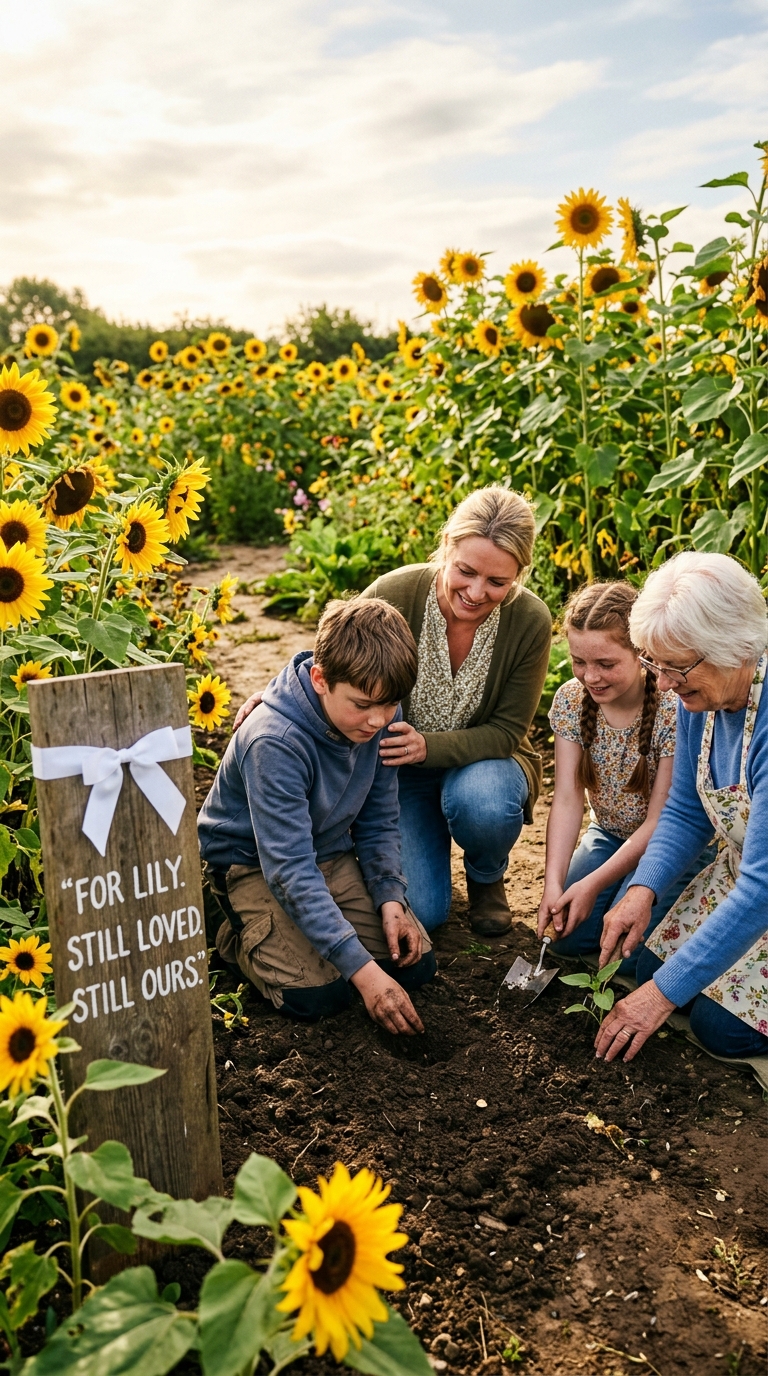
We planted new seeds in neat rows.
Before we finished, Emily pushed the final seed into the soil herself.
“For Lily,” she said softly.
Patrick nodded.
“For Lily.”
Then he tied a new white ribbon around a small wooden marker and wrote:
“For Lily. Still loved. Still ours.”
When he stood up, he did not reach for my hand.
He stood there by himself.
And I looked at my son with pride.
Because for the first time, he was no longer trying to hold Lily close through his own pain.
He walked back toward the house without turning around.
