

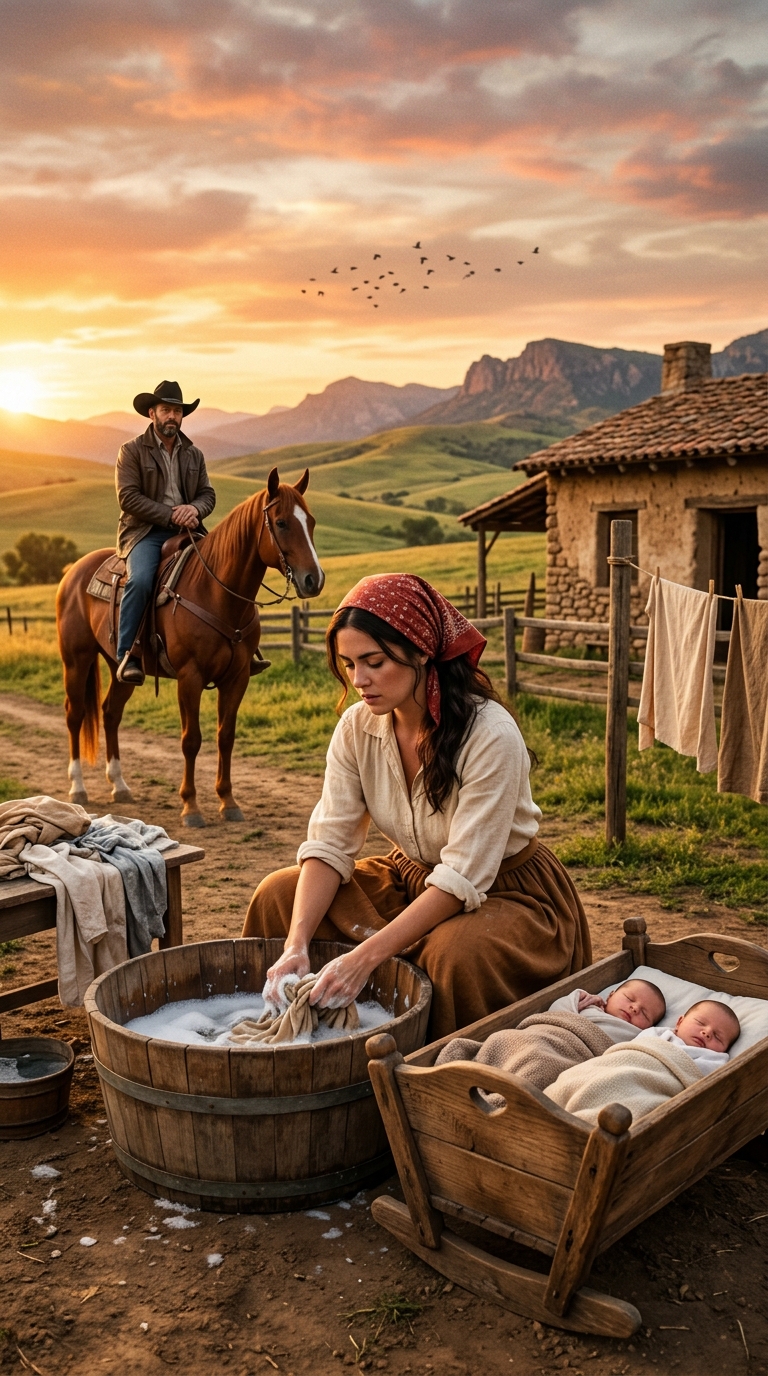
The twins were barely five months old. The boy was named Emiliano and the girl, Jacinta, after the grandmother Mariana barely remembered. They were small, fragile, and beautiful, and since their father died, they were the only reason Mariana got up before the roosters crowed.
Four months earlier, she had buried Jacinto Morales, a day laborer at the San Laureano hacienda. A tree fell on him while he was clearing brush for Don Anselmo Robledo, the owner of nearly all the land in the region. Jacinto left that morning with his machete at his belt, kissed the sleeping children, and promised Mariana he would return for lunch. He never came back.
Since then, Mariana had learned that grief was a luxury for those who had food stored away. She did not. She had two infants, an adobe house built on borrowed land, three scrawny chickens, a tired cornfield, and a dignity that many mistook for pride.
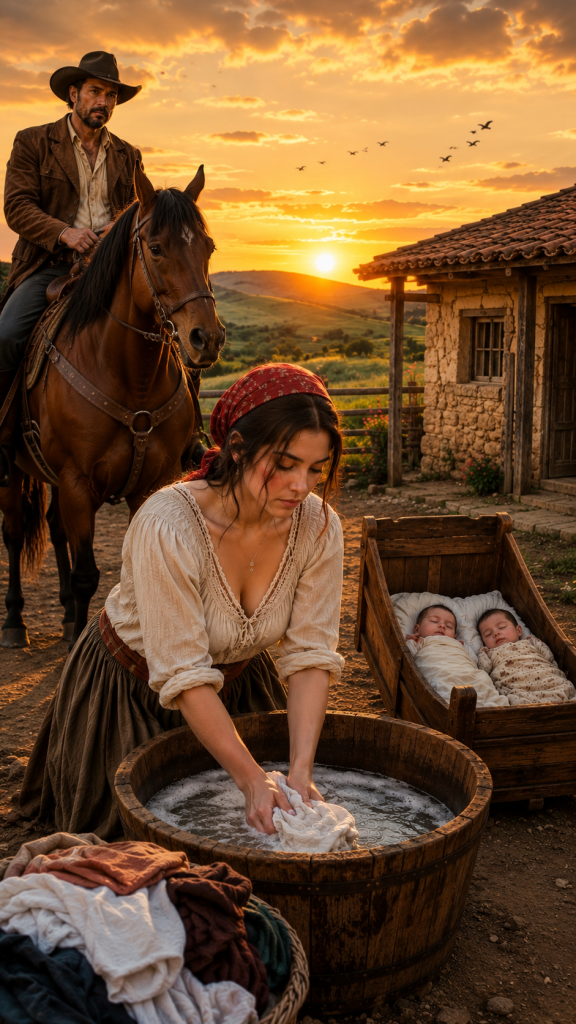
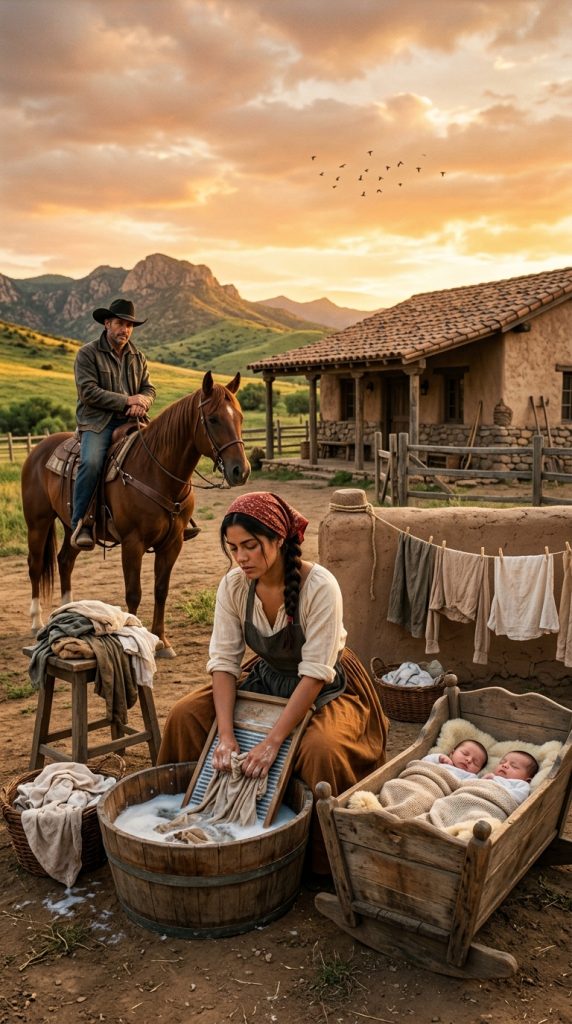
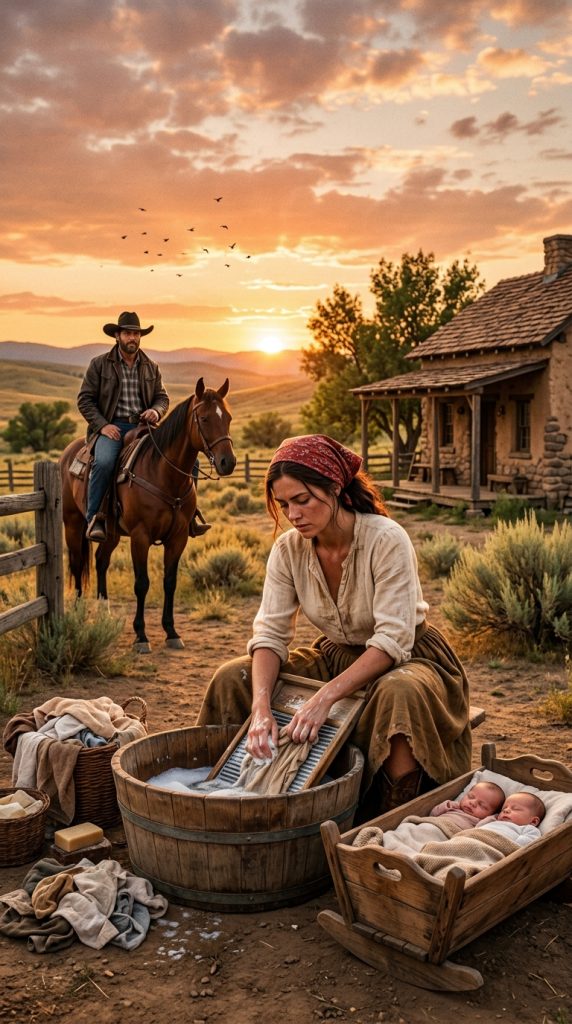
That Friday, the sun beat down heavily on the patio. Mariana had washed three piles of clothes for Doña Eulalia, the shopkeeper’s wife, and she still had to hang the sheets when she heard hooves on the road.
She looked up.
A man on horseback appeared around the bend. He rode a strong, well-cared-for chestnut horse. The rider was about 38 years old, with a short beard, skin marked by the sun, and broad shoulders that showed he was not afraid of work. He wore a light shirt, a palm-leaf hat, and boots covered in dust. He stopped well away from the fallen fence, as if he knew that a woman alone measures the steps of strangers.
“Good afternoon,” he said, removing his hat. “Sorry to bother you. I’m coming from the ravine road and my throat is dry. Could you spare me a jug of water?”
Mariana looked at him without lowering her eyes.
“I do have water.”
She went into the kitchen and returned with a clay jug. She handed it to him from a distance. The man took it with both hands, drank slowly, and closed his eyes for a second in gratitude.
“God bless you.”
His gaze drifted toward the cradle. Mariana noticed and hardened her expression.
“They’re mine,” she said before he could ask.
“I wasn’t going to bother you,” he replied calmly. “I just thought it had been a long time since I saw two little ones sleeping with such peace.”
That phrase disarmed her more than any compliment. No one spoke of her children with tenderness. In the town they were seen as a burden, as a problem, as proof that Mariana was trapped.
“Their names are Emiliano and Jacinta,” she said, without knowing why she was telling him.
“Beautiful names.”
“And you?”
“Rafael Arriaga.”
The name sounded familiar. She had heard of a rancher on the other side of the ravine, a single, hardworking man, owner of cattle and a large house that had never been filled with family.
Rafael returned the jug.
“Thank you for the water, ma’am.”
“Mariana.”
He nodded his head.
“Thank you, Doña Mariana.”
He mounted again, touched the brim of his hat, and rode away down the road.
Mariana returned to the laundry, but she could no longer scrub the same way. Something about that man unsettled her. It was not fear. It was not illusion either. It was the strange feeling of having been seen not as a widow, not as a poor woman, not as a woman alone, but as a person.
Three days later, Rafael returned. This time he said he was passing by and remembered that the water from her tinaja was the freshest in the sierra. Mariana did not believe him, but she filled the jug anyway.
He drank and then looked at the roof.
“Those tiles are not going to hold up through the next rain.”
“I know.”
“I have tools in my saddlebags. I can fix them.”
“I have no way to pay you.”
“I’m not charging you.”
Mariana pressed her lips together. She wanted to say no, that she did not need favors, that she already had enough with the town gossip. But she looked at her sleeping children, then at the sky full of dark clouds, and understood that pride sometimes weighs less than fear.
“Do what you want,” she finally said. “But don’t come into the house.”
Rafael did not smile. He simply nodded.
He worked for more than an hour under the sun. He fixed the tiles, reinforced a post, straightened the fallen fence, and before leaving, he left a small sack of beans and a piece of cheese by the stove.
“I bought too much,” he said.
“Liar.”
Then he smiled slightly.
“A little bit.”
Mariana wanted to get angry, but she couldn’t. That night, for the first time in months, the twins slept without water dripping onto the cradle.
But in small towns, a man helping a widow never takes long to turn into poison.
On Sunday, as she left mass, Mariana felt the murmurs behind her. Doña Petra, the blacksmith’s wife, looked her up and down and whispered something that made two other women laugh. Mariana pressed Jacinta to her chest and kept walking with Emiliano sleeping in her rebozo.
On Tuesday, Doña Mercedes the midwife arrived with a basket of eggs and a face like a storm.
“Daughter, I’ve come to warn you about something. Don Anselmo is saying at the store that this house is being wasted with you living here alone. He says he’s going to settle the matter soon.”
Mariana stood motionless.
“The house was part of Jacinto’s agreement.”
“Agreements are forgotten when the boss wants land.”
Two days later, Don Anselmo Robledo appeared in the patio with his foreman, Rufino Vega. Don Anselmo was a man with a thin mustache, an expensive vest, and a rotten soul. Rufino, on the other hand, seemed made of stone and threat.
“Mariana,” the landowner said with false sadness, “I have waited out of respect for Jacinto’s memory, but I can no longer keep postponing the accounts.”
He took out a yellowish paper.
“Your husband owed me money.”
Mariana felt cold in the full heat.
“Jacinto never mentioned any debt to me.”
“Men don’t always tell their wives everything.”
He showed her the paper without letting go. There was a signature similar to Jacinto’s, but the amount written was absurd.
“That’s a lie.”
Don Anselmo smiled.
“You have fifteen days. If you don’t pay, the house becomes mine.”
Rufino moved his horse slightly toward the children’s cradle. Mariana stepped in front of it.
“Don’t look at my children.”
“Then think carefully about what you do,” Don Anselmo said. “And tell that meddling rancher that in San Laureano lands, I give the orders.”
They left, leaving behind dust, fear, and rage.
When Rafael arrived at dusk with fresh milk, Mariana could no longer stay silent. She told him everything. The invented debt, the threat, the deadline, Don Anselmo’s name.
Rafael listened without interrupting. When she finished, his face had changed.
“That paper is fake.”
“I can’t prove it.”
“I can try.”
“I don’t want to owe you more.”
“Then don’t owe me anything. Let me find the truth.”
The next morning, Rafael rode to the municipal seat. He looked for Don Lucas Beltrán, an old notary who had known his father. He asked him to review Don Anselmo’s loan records.
The answer came in the late afternoon: there was no debt in Jacinto Morales’s name. Not for that amount, nor for any other.
But there was something worse.
Don Lucas found three similar cases. Widows of dead day laborers, questionable papers, debts that appeared after the burial, and houses seized out of desperation.
Rafael felt a calm rage, the kind that does not shout because it is too busy preparing justice.
While he was returning with the proof, Rufino arrived alone at Mariana’s house.
It was night.
The twins were sleeping. Mariana was closing the door when she heard the horse. She took Jacinto’s machete and stepped out onto the corridor.
“What do you want?”
Rufino dismounted with a crooked smile.
“To remind you that fifteen days pass quickly.”
“They already reminded me.”
The foreman looked inside.
“Small children are delicate. A slip, an illness, a bad night… A single mother should avoid problems.”
Mariana felt fear crawling up her back, but she raised the machete.
“Take one more step and I’ll scream so loud even the dead will wake up.”
Rufino laughed.
At that moment, another horse entered the path like a shadow. Rafael appeared with a pistol in his hand, pointed at the ground but ready.
“She asked you to leave.”
Rufino turned.
“This is not your business.”
“Threatening children is the business of any decent man.”
For a few seconds, no one breathed. Then another voice was heard from the road.
“It is also the business of the Church.”
Father Celestino arrived on a mule, accompanied by Don Lucas the notary. Behind them came two men from the town whom Rafael had met on the path. Rufino understood that he could no longer act in the dark that night. He mounted, spat on the ground, and left.
Mariana, still holding the machete, felt her legs weaken. Rafael holstered his weapon and did not approach until she lowered her arm.
“I have the proof,” he said. “Jacinto owed nothing.”
Mariana closed her eyes. A tear fell, but this time it was not from defeat.
The next day, Rafael entered Don Elías’s store at the busiest hour. Father Celestino was with him. Don Lucas carried the papers. Don Anselmo was sitting at the back table, surrounded by men who always laughed at his jokes because they feared him more than they respected him.
“I’ve come for Jacinto Morales’s debt,” Rafael said.
The store fell silent.
Don Anselmo pretended calm.
“That is a private matter.”
“Not when the paper is fake.”
Don Lucas placed the documents on the table. He showed the empty register, the compared signatures, the other cases of dispossessed widows. Father Celestino spoke afterward, with a clear voice.
“Whoever robs a widow robs in front of God.”
Then something unexpected happened. Doña Remedios, a thin woman who always sold tamales in the square, stood up crying.
“He took my house too. He said my husband owed him.”
Another woman spoke from the doorway.
“And my sister’s.”
The town, which for years had remained silent out of fear, began to murmur differently. It was no longer gossip. It was indignation.
Don Anselmo tried to stand, but Rufino was not there to protect him. Rafael stepped forward.
“You are going to withdraw that lie today. And you are going to sign before a notary that the house where Mariana Cárdenas lives is free of any debt.”
Don Anselmo clenched his teeth.
“And if I don’t?”
Rafael did not raise his voice.
“Then we will go to the judge with four widows, a priest, a notary, and half the town as witnesses.”
Don Anselmo signed that same afternoon.
But Rafael did something more. He legally bought the piece of land where Mariana’s house stood and, before Don Lucas, had the deed put in her name and that of her children.
When Mariana saw the document, she could not speak.
“It is not charity,” Rafael said. “It is protection. True protection does not depend on a man being nearby. It must be written on paper, with a seal and signature.”
Mariana held the deed with trembling hands.
“Why are you doing all this for me?”
Rafael looked at the cradle where Emiliano and Jacinta slept embracing each other.
“Because the first day I saw you, I understood that you did not need anyone to save you. You needed someone to stand beside you while you defended yourself.”
Mariana cried in silence.
Three months passed before she accepted marrying him. Rafael did not pressure her. He went to see her, helped with the cornfield, carried the children, fixed what was broken, and left before the town could dirty what was clean again.
The day Mariana said yes, they were under the guava tree where he had tied his horse the first time.
“I don’t want a house where I am treated as grateful,” she said.
“I want a house where you give the orders with me,” he replied.
They were married in the parish of Las Ánimas. This time there were no mocking murmurs. Doña Mercedes cried in the front pew. Father Celestino blessed the twins, who were already trying to grab the flowers from the altar. Don Elías brought sweet bread. Even Doña Petra, the gossip, lowered her head when Mariana passed by in a simple white dress.
Years later, Rafael’s large house was no longer empty. It filled with laughter, small footsteps, the smell of coffee, wooden toys, and clothes hung in the sun. Emiliano learned to ride before he could read. Jacinta learned to read before she could ride. Mariana never forgot Jacinto, because true love does not erase what came before; it only learns to live with the memory without letting it cause harm.
One rainy afternoon, Mariana found Rafael looking out at the patio from the corridor.
“What are you thinking about?” she asked.
He smiled.
“About that day when I asked for a jug of water and ended up finding my whole life.”
Mariana rested her head on his shoulder.
“I thought you were another man who had come to take something from me.”
“And what did I take?”
She looked at her children running under the rain, free on land that no one could take from them anymore.
“The fear,” she said.
And for the first time in a long time, the widow who had washed other people’s clothes with broken hands felt that life had not only given her back a roof. It had given her back the right to look toward the future without lowering her eyes.
