

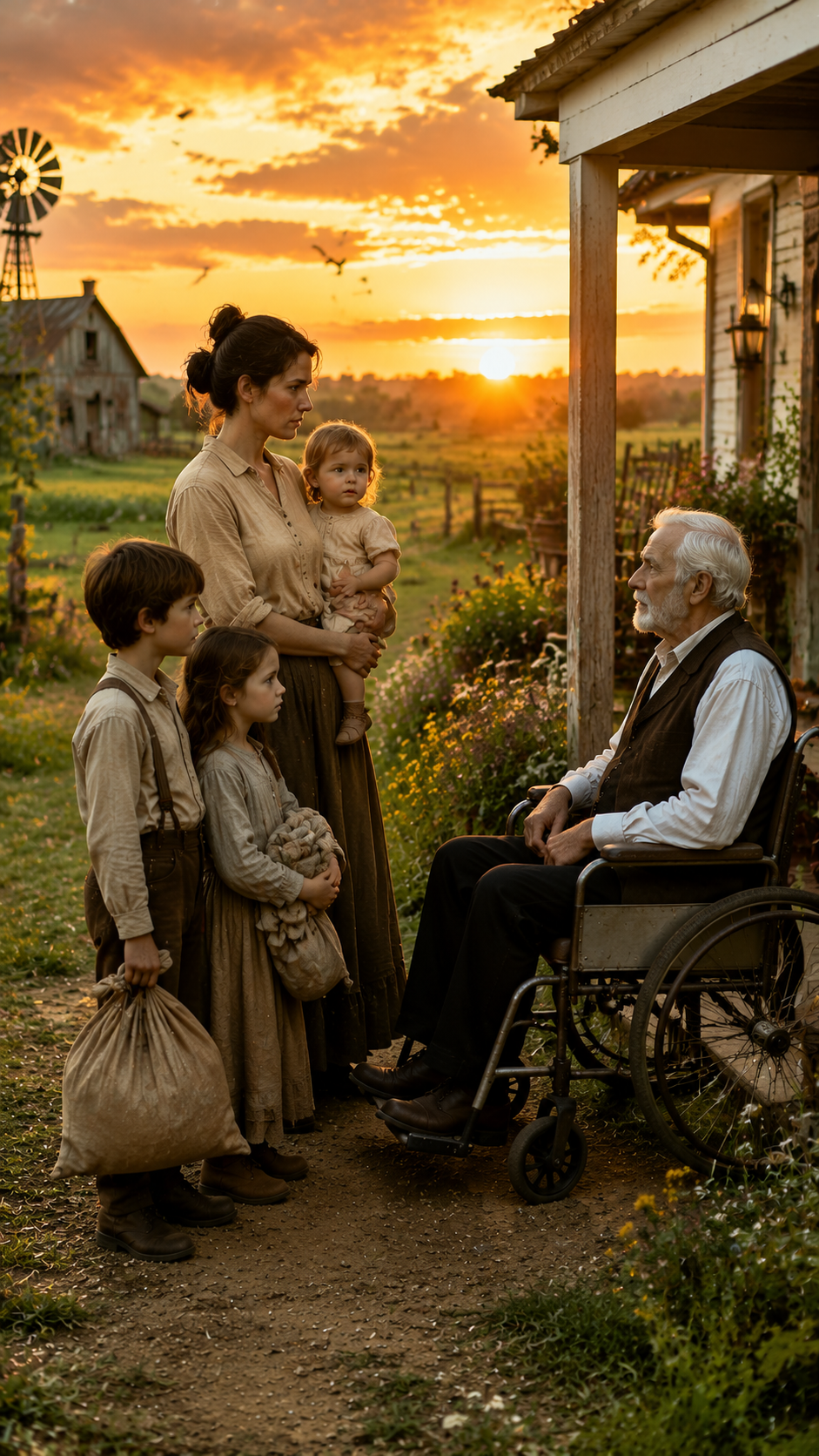
The sun was sinking behind the hills of Jalisco like a giant ember, painting the old walls of San Isidro Ranch in shades of copper. The chapel bells had just finished ringing the evening prayer, and the afternoon wind carried the scent of dry earth, worn leather, and freshly burning firewood.
Don Rodrigo de la Vega sat in his wooden wheelchair beneath the arched porch, staring at the dusty road that descended toward the valley. He was 74 years old, with a neatly trimmed white beard and dark eyes that no longer expected much from anyone.
He had once owned 400 hectares of fertile land, 30 cows, 12 horses, and a respected name throughout the entire region.
But ever since Doña Rosario, his wife, passed away, the ranch had become far too large for him.
For 50 years, they had lived together in that house. They had prayed for children, visited doctors, healers, and saints. They never came.
When Rosario died, Don Rodrigo realized that loneliness could make more noise than a celebration.
Since then, all he had left were the workers who came and went, a loyal foreman named Fortino, and that wooden wheelchair where he had been trapped after a fall near the stable.
That afternoon, while he looked toward the road without truly seeing it, he noticed a figure approaching.
At first, he thought it was just a mirage caused by the heat.
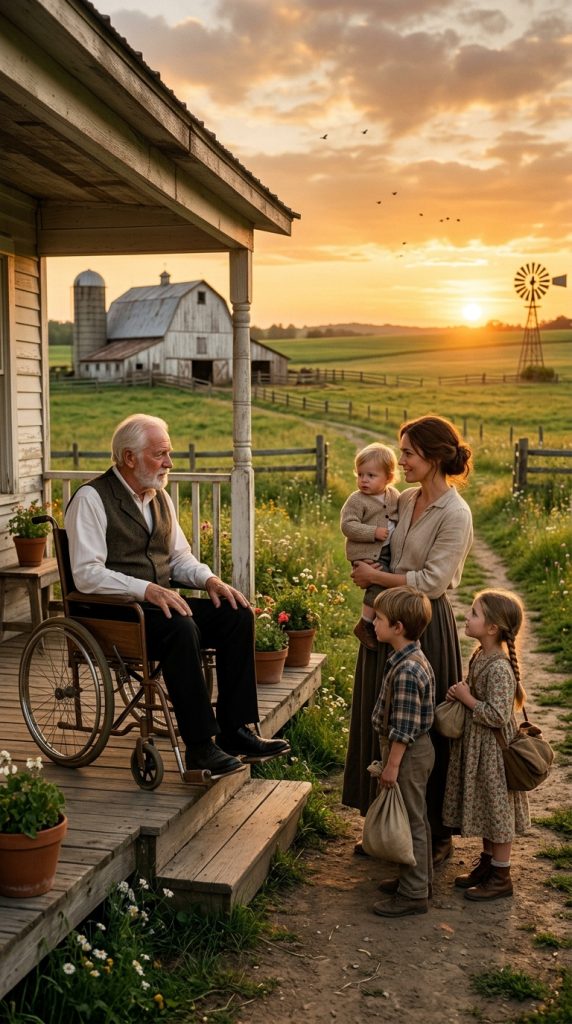
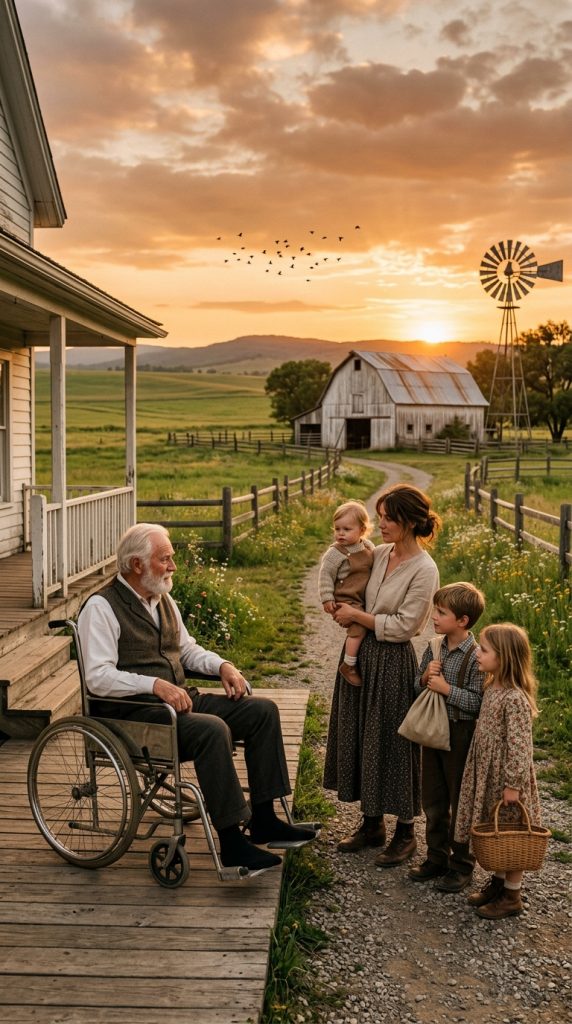
Then he recognized a young woman wearing a dark skirt, a worn rebozo, and a face exhausted from the long walk. She carried a baby in her arms.
Behind her came two children: a thin eight-year-old boy with a small bag over his shoulder, and a little girl hugging a rag doll.
They stopped at the foot of the porch.
The woman lifted her face.
She did not look like someone asking for charity.
She looked like someone asking permission to keep breathing.
“Good afternoon, sir,” she said. “Are you Don Rodrigo de la Vega?”
“I am,” he replied, without looking away. “Who is looking for me?”
“My name is Catalina Morales. I am a widow.”
The baby moved against her chest. The little girl hid behind her skirt. The older boy held the old man’s gaze with a seriousness that did not belong to someone his age.
Catalina swallowed.
“You have no one to take care of you… and my children have no grandfather. Please let us stay.”
The silence that followed was so deep that they could hear the old well’s wheel turning in the distance.
Don Rodrigo did not answer immediately.
He looked at the woman, then at the children, then at the orange sky where Rosario used to say that God painted the most beautiful pictures at sunset.
Something inside him, something buried for years, moved painfully.
“Come up,” he finally said. “Tell me your story.”
Catalina sat on the lowest step of the porch, like someone who still did not dare to take a chair.
She explained that she came from a small ranch near Tepatitlán.
Her husband, Julián Morales, had died seven months earlier after falling down a ravine while checking the cattle.
After burying him, Catalina discovered debts he had never told her about: loans signed with a merciless moneylender, interest that grew like weeds, and documents stamped by the village judge.
They were given three days to leave their home.
“I walked for two days with my children,” she said. “I didn’t come here asking for charity. I know how to cook, milk cows, sew, clean, keep accounts, and care for the sick. If you let me work, I won’t fail you.”
Don Rodrigo looked at her hands.
They were cracked, but steady.
The hands of a woman who had lost so much, but had not lost her dignity.
“What are the children’s names?”
The older boy straightened.
“Tomás, sir.”
“Do you know how to handle horses?”
“My father taught me.”
“And the girl?”
“Lupita,” Catalina answered. “And the baby is named Mateo.”
Little Lupita slightly lifted her rag doll, as if she wanted to introduce her too.
Don Rodrigo felt a knot form in his throat.
“There is a room next to the kitchen. It isn’t big, but it has a roof. You will work here. There will be food, a bed, and a modest salary. I am not doing you a favor, Doña Catalina. I am giving you a job.”
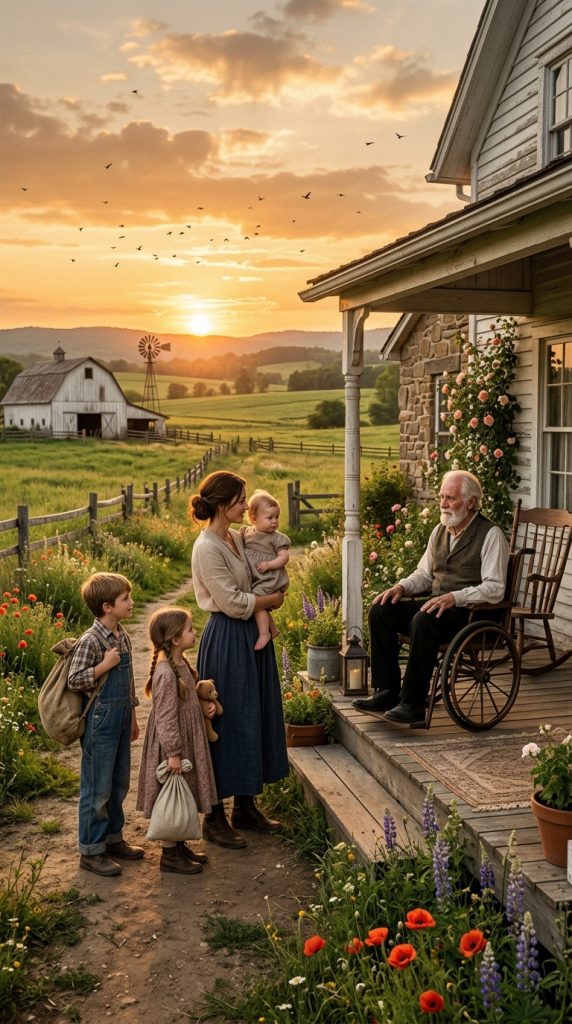
For the first time, Catalina’s eyes filled with tears.
“Then I accept.”
And that was how everything began.
The first days were awkward, filled with silence and habits that clashed with each other.
Don Rodrigo wanted his coffee at six in the morning, black and without piloncillo. Catalina learned without needing to be reminded.
He couldn’t stand anyone moving Rosario’s books. She cleaned them without changing their order.
He ate dinner before darkness fell. She had the table ready when the sun touched the mesquite trees.
Little by little, the ranch began to breathe differently.
Tomás earned his place in the stable.
Without anyone asking him, he cleaned stalls, carried small buckets of water, and listened to Fortino as if every word were a sacred lesson.
One afternoon, Don Rodrigo saw him stroking the oldest horse, a chestnut named Canelo.
“That animal is no longer useful for work,” the old man said.
Tomás didn’t remove his hand from the horse’s neck.
“But he can still listen, sir.”
Don Rodrigo said nothing.
But that night, he gave the boy the largest piece of meat on his plate.
Lupita discovered Doña Rosario’s sewing room.
It had been locked since the funeral, but the little girl found the door slightly open and went inside.
When Don Rodrigo found her sitting on the floor, surrounded by threads and fabric scraps, he felt a sudden wave of anger and sadness.
“Those things belonged to the lady of this house,” he said in a stern voice.
Lupita looked at him innocently.
“Did she die?”
Don Rodrigo closed his eyes.
“Yes. She went to be with God.”
The little girl thought for a moment.
“My daddy did too. Maybe they already know each other.”
The old man had to turn toward the window so she wouldn’t see his wet eyes.
“I’m sure they do.”
From that day on, every afternoon Lupita learned to sew with Catalina, using Rosario’s threads.
And Don Rodrigo, without saying a word, began leaving that door open.
With Mateo, it was both harder and better.
The baby knew nothing about respect or distance. The moment he saw the old man, he would stretch out his arms toward him.
The first time Catalina placed him on Don Rodrigo’s lap, the old man froze, as if someone had placed a priceless treasure in his arms—something fragile and dangerous at the same time.
Mateo grabbed his beard.
And the old man, who had not truly laughed in three years, burst into a laugh that echoed throughout the entire porch.
From the kitchen, Catalina smiled without turning around.
San Isidro Ranch began to smell like freshly made tortillas, soup simmering on the stove, lavender soap, and clothes drying under the sun.
Children’s voices returned.
The sound of plates on the dinner table returned.
Even Christmas returned.
That year, Catalina found Doña Rosario’s old clay nativity set stored away, and Lupita placed the golden star on top crookedly because Don Rodrigo told them Rosario used to say that no star in the sky was perfectly straight.
But peace, like all good things, awakened envy.
In January, a man arrived at the ranch wearing a fine suit, polished boots, and a hat that looked far too new.
He rode an expensive mule and was accompanied by a servant.
His name was Ernesto de la Vega, Don Rodrigo’s nephew.
He did not ask about the old man’s health.
He asked about the land.
“Uncle,” he said with a thin smile, “I heard you have strange people living here.”
Don Rodrigo was sitting on the porch, with Mateo asleep on his knees.
“They are not strange people. They are my people.”
Ernesto looked at Catalina the way someone looks at something that does not belong.
“A widow with three children does not appear at a ranch without a reason.”
Catalina pressed her lips together but said nothing.
Don Rodrigo did.
“Be careful with your words.”
Ernesto tilted his head, pretending to show respect, but his eyes calculated every wall, every corral, and every tree.
Days later, Licenciado Bernal, the town notary, arrived with documents.
Don Rodrigo had made a decision.
If Catalina stayed at the ranch, working and caring for him until his death, San Isidro would belong to her and her children.
Catalina was speechless.
“Don Rodrigo, that’s too much.”
“It’s not charity,” he said. “Rosario and I wanted children, but we couldn’t have them. Maybe God took His time sending them to me, but in the end, they arrived walking down that dusty road.”
Catalina lowered her eyes to hide her tears.
“I only came because it was the one honest thing I could offer you: the truth.”
“And it was the best thing anyone had offered me in years.”
The news reached Ernesto quickly.
The following night, while everyone slept, someone opened the corral gate.
The horses ran out in panic.
Canelo fell into a ditch.
Tomás, awakened by the noise, ran outside barefoot with a lantern and found an unknown worker trying to escape.
Fortino caught him before he could jump over the fence.
The man, trembling, confessed that Ernesto had paid him to cause an accident and prove that Catalina was incapable of managing the ranch.
But Ernesto did not give up.
Three days later, he arrived with the local judge and two guards.
He carried a document accusing Catalina of manipulating a sick elderly man in order to steal his inheritance.
“This woman must leave today,” Ernesto declared. “And those children must leave with her.”
Lupita clung to her mother’s dress.
Tomás stood in front of Mateo with his fists clenched.
Don Rodrigo asked them to take him to the center of the courtyard.
Fortino pushed his wheelchair forward.
The old man looked fragile beneath the sun, but his eyes carried the strength of the old landowners who had ruled those fields for generations.
“Licenciado Bernal,” he said, “read the second document.”
The notary opened a sealed folder.
Ernesto turned pale.
The document was not just a simple inheritance clause.
It was a legal adoption recognizing Tomás, Lupita, and Mateo as descendants of the De la Vega family, signed before witnesses two weeks earlier.
Don Rodrigo was not only leaving the ranch to Catalina.
He had given the children his family name.
“This is madness!” Ernesto shouted. “They are not your blood!”
Don Rodrigo looked at him with sadness.
“Blood means nothing when it comes without love. These children gave me more family in four months than you have given me in your entire life.”
Ernesto lost control.
He lunged toward the papers, but Tomás stepped in front of him.
He never reached them.
Fortino and the guards grabbed him.
Then the captured worker confessed the truth about the corral sabotage in front of the judge.
Ernesto’s face changed completely.
He was arrested right there, in the middle of the dusty courtyard, surrounded by the uneasy sounds of the cattle.
Before leaving, he looked at Catalina with hatred.
“This isn’t over.”
Don Rodrigo answered firmly:
“For you, it is.”
Years passed.
Don Rodrigo did not die quickly, as everyone had expected.
He lived another eight years, and they were the most peaceful years of his old age.
Tomás grew strong and educated. He learned to manage the ranch with a sense of justice that made the old man proud.
Lupita became a cheerful young woman who embroidered tablecloths so beautiful that wealthy families from Guadalajara ordered them.
Mateo, who remembered no other life, had called Don Rodrigo “grandfather” since the day he learned to speak.
Catalina never stopped working.
She never acted like the owner before the time came.
She cared for the old man through his illnesses, accompanied him during his quiet afternoons, and every Day of the Dead, she lit a candle for Rosario, secretly thanking her for leaving room in that house for a second family.
Don Rodrigo died one spring morning, sitting on the porch, sunlight on his face and Mateo—now a young man—reading an old history book aloud to him.
He did not suffer.
He simply closed his eyes as though he had finally heard someone he loved calling him from far away.
The ranch chapel was filled during his funeral.
Farmers, workers, neighbors, and entire families came to say goodbye.
Catalina cried silently, standing beside her children.
When the service ended, Tomás took his mother’s hand.
“What are we going to do now?”
Catalina looked at the ranch, the arches, the well, the stable, and the road where she had arrived years earlier with nothing but her children and her dignity.
“The same thing your grandfather taught us,” she said. “Take care of what you love.”
From that day forward, San Isidro Ranch was no longer known as the home of the lonely old man.
People began calling it the home of the grandparents who were found.
And every evening, when the sky lit up above the hills, Catalina sat on the porch, in the chair that had once belonged to Don Rodrigo, and felt that life does not always return what was lost…
But sometimes it sends something different, so the heart can find a home again.
