

Chapter 1: The Quiet Arrival
I came back from the United States carrying a heavy leather suitcase filled with costly tokens of regret for my long absence, a carry-on bag crammed with duty-free dark chocolate, and the unquestioning confidence a husband often takes for granted. My name is Daniel. For the past four years, my job in corporate logistics kept me moving through airports far more than through my own home. I focused on shifting goods across the globe, completely unaware of the harsh changes unfolding beneath my own roof.
My flight from Chicago benefited from a strong tailwind and landed two hours early. As the rideshare wound through the familiar streets of our Oak Creek suburb, I deliberately kept my phone tucked away in my jacket. I didn’t message my wife, Olivia. I wanted to surprise her. I envisioned her face brightening, perhaps even hearing one of those rare, authentic laughs that had grown uncommon between us. I pictured entering the guest bedroom to see my seventy-two-year-old mother, Evelyn, still up and reading by the window, so I could give her the soft powder-blue cardigan she had requested.
It was late afternoon, just after four o’clock. The neighborhood lay in that thick, golden-hour calm, a peaceful stretch when the tidy lawns seemed drowsy and everything felt secure.
I hauled my bags up the walkway, my dress shoes tapping lightly on the concrete. I reached for my keys, expecting the usual catch of the deadbolt, but the brass handle turned easily under my thumb. The front door was unlocked.
A faint sense of worry brushed the back of my neck. I entered the foyer, quietly closing the heavy door and setting my bags on the hardwood. The house carried a light scent of lemon cleaner and rich vanilla candles. It appeared spotless.
Then the afternoon quiet broke. My wife’s voice rang out sharply from the kitchen tiles down the hall. It wasn’t a tone I knew. It lacked the polite rhythm she used at neighborhood gatherings or the weary familiarity of daily life together. It was poisonous. It carried a frigid command that froze the blood in my veins.
“Faster. Stop dragging it out. Don’t act old in my house.”
The words lingered, sharp and heavy. I stood still, my hand on the suitcase handle. A second voice replied, faint, delicate, and trembling with weariness that dropped my stomach.
“Please… my hands hurt. The water is cold.”
It was my mother.
For a brief moment, my mind rejected what my ears reported. I hunted for some innocent explanation—a mix-up, a strange prank, a TV playing in another room. But the strong thud of my heartbeat warned me otherwise. I released the luggage and moved quietly down the hallway, stepping into the kitchen archway, wholly unprepared for the horror ahead.
Chapter 2: The Staged Reality
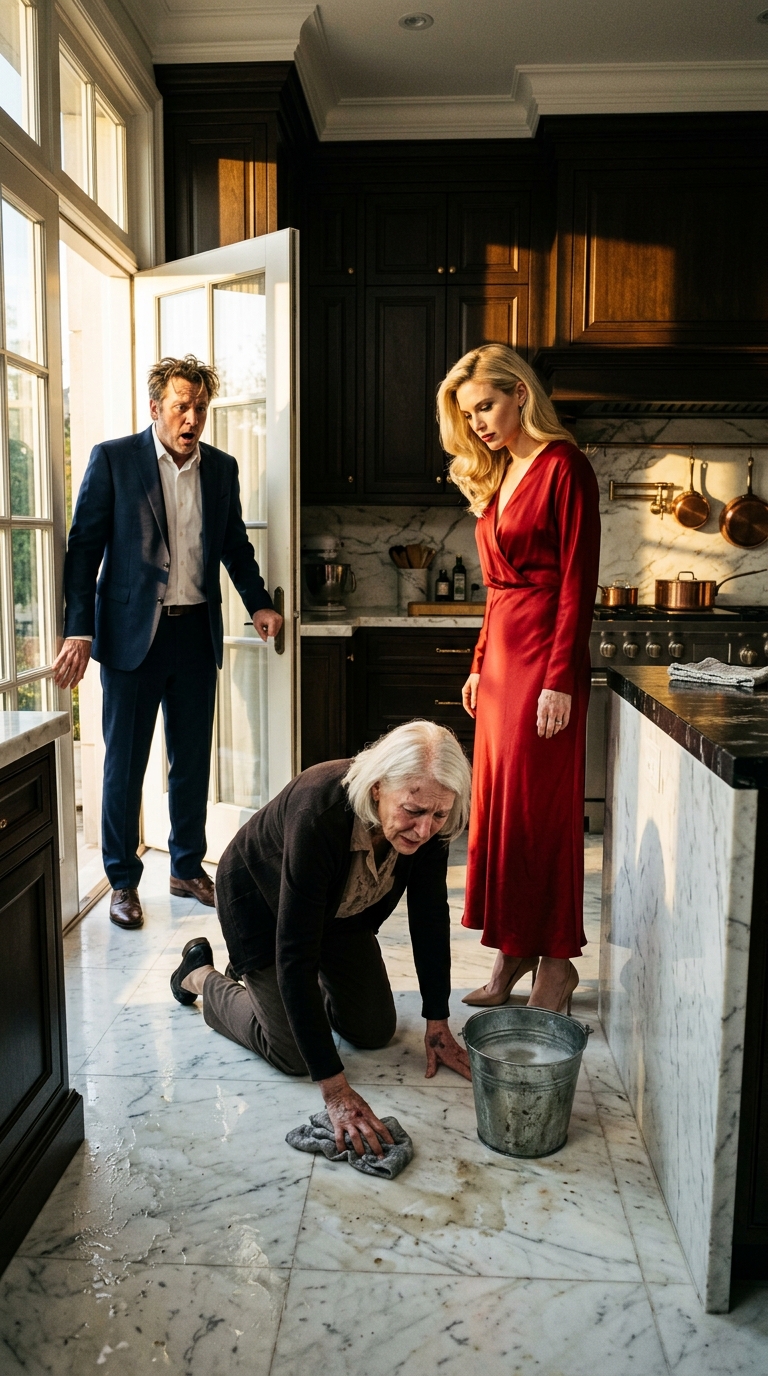
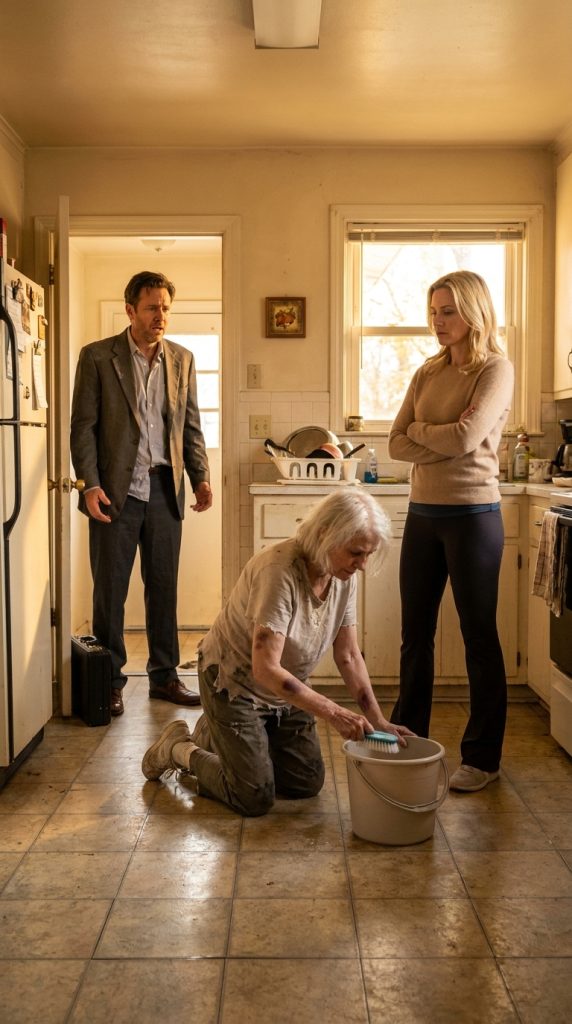
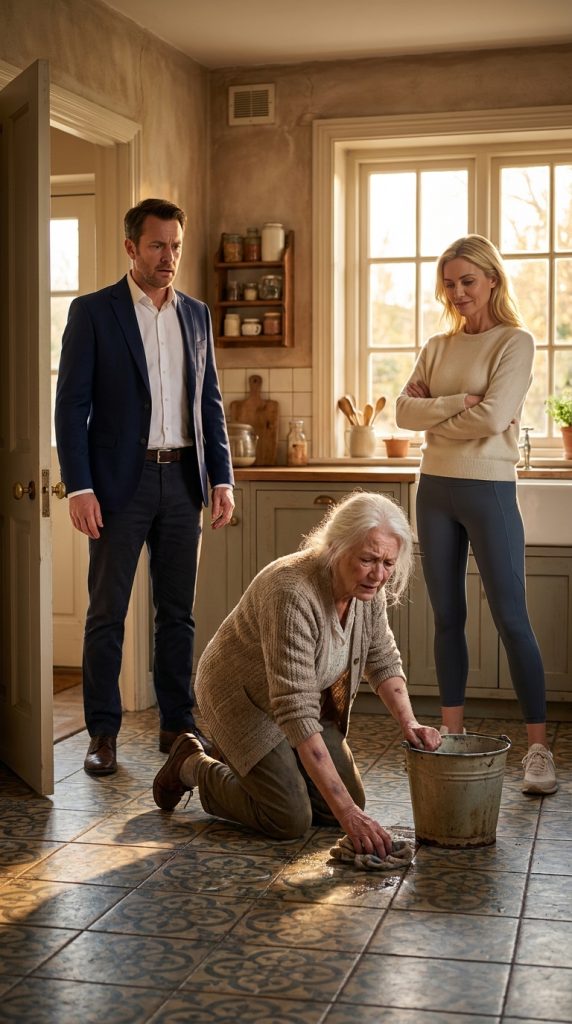
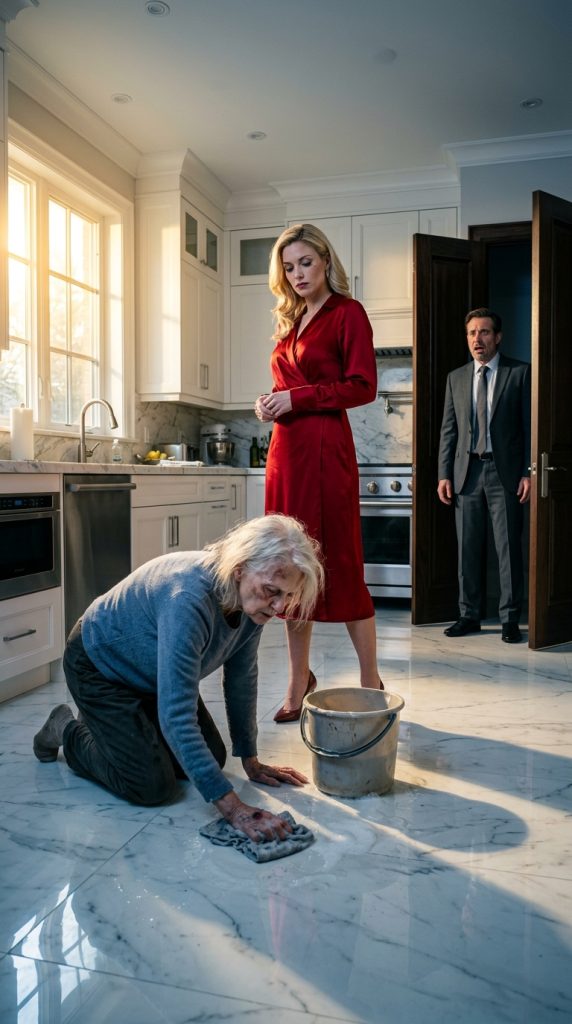
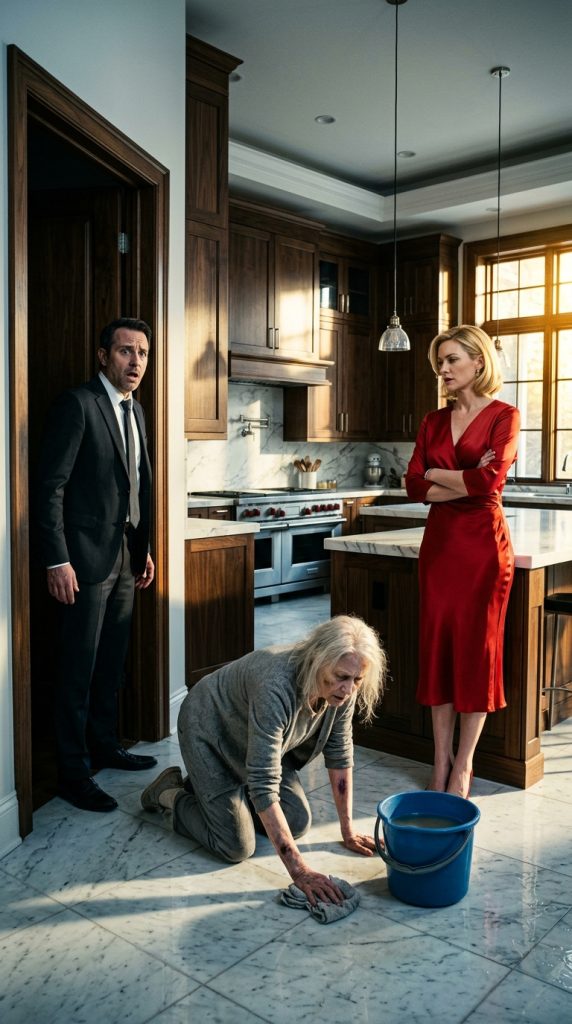
My mother was on the floor.
She knelt on the cold ceramic tiles. One frail, spotted hand pressed flat to steady herself, knuckles pale from effort. Her other hand awkwardly pulled a heavy, gray, dripping rag across the floor. A cheap plastic bucket of dirty water sat near her shaking elbow. Her shoulders, bent under a thin blouse, trembled with quiet, held-back tears.
Standing over her like a guard in the middle of the kitchen was Olivia.
My wife wore fitted yoga pants and a clean white cashmere sweater, arms folded tightly across her chest. She observed my mother scrubbing with cool annoyance, overseeing her as if directing unreliable hired help.
A surge of sickness struck me so hard I grabbed the doorframe to stay upright. The wood dug into my palm.
Olivia noticed the motion. She turned, her blonde hair catching the light. Her face changed in an instant. The mocking harshness disappeared. Her eyes widened in feigned shock, then her mouth formed a practiced, smooth smile—the same one she used when neighbors praised her yard.
“Oh,” she said lightly, her voice casual and unconcerned. “You’re early.”
On the floor, Evelyn went still. Slowly and painfully, my mother raised her head to look at me.
She wasn’t relieved. She didn’t release a breath of rescue. Her eyes were wide with pure terror. That instant shattered my world. She should have felt safe the moment her son entered. Instead, she drew back, chin quivering, as if I had interrupted something fragile and perilous.
I didn’t blink. I held my gaze on Olivia as I stepped fully into the kitchen. The lemon cleaner scent now felt choking and sharp in my throat.
“What is this?” I asked, my voice low and rough in a way I barely recognized.
Olivia gave an irritated sigh and shrugged. She even seemed put out by my serious tone. “She spilled her soup earlier. I simply told her she needed to clean up her own messes. It’s basic accountability, Daniel.”
My mother started to speak, but her jaw only shook, and she closed it. As she moved, her blouse sleeve slid up. Her knuckles were raw and red. Above her left wrist, a dark purple bruise stood out against her pale skin, shaped disturbingly like a thumbprint.
I closed the gap, stepping into Olivia’s space. She stepped back instinctively, the false smile cracking. “Why is my mother on the floor?”
Olivia’s face stiffened, shifting to defensive anger. “Don’t start acting dramatic, Daniel. She lives here under my roof. She eats my food. She should contribute to the household.”
Contribute.
The word rang in my head like a shot as Evelyn fought to stand. She pushed up from the tile, wincing as her sore joints protested. I knelt, wrapping my arms around her waist to help her. She felt weightless, like a bundle of dry sticks.
But when my hand touched her upper arm, she jerked away sharply.
It was an instinctive flinch, not only from arthritis pain but from deep fear. She braced for a hit, a push, or a grab.
As I held my mother, staring at the woman I had vowed to love and protect, a crushing wave of understanding hit me. This wasn’t one bad afternoon or a single outburst. The rehearsed harshness in Olivia’s voice, the learned terror in my mother’s eyes, the flinch—they revealed a long pattern of horror. This wasn’t the first time. It was only the first time a helpful tailwind brought me home early enough to see the darkness.
Chapter 3: Confessions in the Living Room
I led my mother from the kitchen, my hand gently on her thin shoulder blades. I took her to the living room and carefully settled her on the sofa. Her breathing came in shallow, quick gasps. She kept running her hands over her skirt, smoothing it nervously, as if fixing the wrinkles could undo the scene I had witnessed.
In the kitchen, Olivia stayed behind at first. She opened and closed cabinets, loudly loading the dishwasher with deliberate clatter. It was intentional. She was asserting control, sending noisy signals through the walls that she remained in charge and unaffected. The whole house now felt artificial, arranged, and threatening.
I knelt on the carpet before my mother, meeting her eyes. “Mom. Please. Look at me.”
She wouldn’t. She fixed her stare on a loose thread on her skirt.
“How long has this been happening, Evelyn?”
“Daniel, don’t do this,” she whispered, her voice breaking. A tear slid down her lined cheek. “You just walked through the door. You’re tired from your flight.”
That evasion—her deep habit of putting my comfort before her pain—revealed far more than any timeline would have.
The kitchen noise stopped. Footsteps approached. Olivia entered the living room with a tall glass of ice water, beads of condensation on the sides. She offered it like a truce, her face set in tired patience.
“Here,” Olivia sighed, holding it toward my mother. “Drink this. Let’s all just calm down and take a breath. There’s absolutely no need to make this into something ugly.”
I rose quickly, my knee hitting the oak coffee table and rattling the coasters. I moved between them and slapped the glass from Olivia’s hand. It smashed on the floor, ice and water spraying across the wood.
“Something ugly?” I roared, the shout scraping my throat. “I just found my seventy-two-year-old mother scrubbing your floor on her hands and knees while you barked orders at her like a dictator! You crossed ugly a long time ago, Olivia.”
Olivia pulled back, real surprise showing before anger took over. “She is exaggerating the situation! And so are you! You have no idea what it’s like managing her all day!”
Behind me, Evelyn tried to intervene. “It’s fine, Daniel. Really, I’m fine. I’m just slower these days. My hands shake. I make silly mistakes. Olivia just likes things clean…”
I turned, stunned at the woman who raised me. “Why are you protecting her? Mom, she is torturing you!”
My mother finally met my eyes, hers filled with deep sorrow. She clutched the sofa edge. “Because,” she choked out, the sound raw and broken, “I didn’t want to be the reason your marriage fell apart.”
The living room fell deathly quiet. Only the slow drip of water from the coffee table broke the silence.
Then the floodgates opened. The awful truth of my absence emerged in painful fragments—not a smooth speech, but scattered details, halting words, and humiliations a proud woman struggled to voice.
While I handled shipping deals abroad, Olivia had set “house rules.” My mother admitted she had to wash her bedsheets by hand in the basement sink because Olivia said they smelled “medicated and old.” Evelyn was forbidden from the den or living room after six in the evening for my wife’s “quiet time.” If she left a coffee mug in the sink, Olivia would pound on her door before dawn.
The cruelty worsened. Twice recently, Olivia hid my mother’s arthritis pills, letting her endure a full day of pain before returning them as a “lesson in personal responsibility.” Three weeks earlier, she made Evelyn carry a heavy basket of wet towels down the steep basement stairs until she slipped and nearly fell.
I turned slowly to Olivia. I searched her face, her stance, her clenched jaw for any sign of regret or shame. I saw none—only annoyance that her hidden rule was now exposed.
“Before we moved her in, you looked me in the eye and said you wanted her here so she wouldn’t be lonely,” I said, my voice eerily steady, the calm of someone with nothing left to lose.
“I did,” Olivia shot back, arms crossed. “But I didn’t sign up to be an unpaid, full-time caretaker for an ungrateful, clumsy woman who manipulates you every single chance she gets! I have a life too, Daniel!”
Evelyn collapsed then, hiding her face in her bruised hands, shoulders shaking with silent, painful sobs.
That was the breaking point. Any last shred of control I held snapped.
I faced Olivia and pointed firmly at the stairs. “Go upstairs. Pack a bag. You are leaving this house tonight.”
She laughed harshly in disbelief. “Excuse me? This is my house too.”
“If you are not out of that door in twenty minutes,” I warned, stepping closer so she had to tilt her head up, “I will physically drag you out onto the lawn by your cashmere sweater. Pack. Now.”
She read my eyes. She saw no bluff. Color left her face. She tried rage, yelling that I chose a senile old woman over my wife. When that failed, she turned to tears, claiming every marriage has rough patches. She blamed my travel, shouting that I didn’t understand running the house alone.
Maybe I didn’t know every detail of household management. But I recognized clear, heartless cruelty when I faced it.
When Olivia finally stomped upstairs, slamming doors hard enough to shake the wedding photos in the hall, I sat beside my mother. I took her cold, shaking hands in mine, gently stroking her bruised knuckles.
She rested her head on my shoulder, her breathing easing. Then she whispered the heartbreaking line that still echoes in my mind.
“Daniel… I kept thinking that if I just stayed quiet, if I just did what she asked without complaining, she might eventually get kinder.”
But monsters never grow kinder in the dark. They only grow bolder.
Chapter 4: The Digital Excavation
Olivia left the next morning with two large rolling suitcases and an expression of pure, angry indignation. No apology came. No remorse. She truly believed I would call by lunch. She expected me to calm down, accept the situation, and return to the distracted husband who had overlooked the signs for a year. She thought I would plead for her return.
I didn’t. Instead, I took my mother straight to the local urgent care clinic.
In the clean examination room, the truth solidified. The doctor, a serious woman with keen eyes, performed a full check. She noted severe inflammation in both wrists, a strained rotator cuff in the left shoulder, and several bruises matching repeated grabbing and heavy labor.
Hearing a medical expert list my mother’s injuries made the abuse real. It removed any remaining urge to downplay what had occurred in my home.
After getting Evelyn’s prescriptions and settling her comfortably with a heating pad, I went to my home office, locked the door, and finally did what I should have done earlier. I moved beyond wondering if it looked bad and began a thorough search to confirm the truth.
I opened my laptop and accessed the home security system logs.
I became a researcher of my own family’s tragedy. I carefully examined weeks of saved camera footage. I matched the video times to texts Olivia sent me during my travels across time zones. Bit by bit, the grim reality came into sharp focus.
Dozens of messages from Olivia griped about my mother’s “bad attitude” and ordered her not to enter the kitchen during guest visits. I found a printed checklist of harsh chores that would tire someone half her age.
But the worst proof, the one that turned my stomach, came from a Tuesday two weeks earlier.
I opened a text Olivia sent me from Berlin: Mom seems great today! Just sitting in the garden, stubborn as always, but we’re having a nice afternoon. Miss you. I matched the exact time to the hallway camera.
I hit play. The silent footage showed my mother in clear pain, straining to pull our heavy vacuum up the stairs. Midway, she slumped against the railing, holding her chest. Olivia entered, stepped right over my struggling mother, picked up a pillow from the landing, and went downstairs without pausing.
I watched it three times. My jaw hurt from clenching. The woman I married wasn’t merely mean. She preyed on weakness, disguising her malice behind ordinary suburban life.
I didn’t contact Olivia. I didn’t yell. I printed the texts, saved the videos, copied the medical notes, and compiled them into a thick folder.
I hired the toughest divorce lawyer in the area that week. The trap was ready, and the predator had no clue.
Chapter 5: The Architecture of Healing
Olivia contested the divorce fiercely at first. Through her lawyer, she started a calculated campaign of attacks. She called me an unforgiving, absent husband. She described my mother as a dramatic, confused elderly woman who exaggerated and caused accidents. She even phoned our Oak Creek friends, crying and claiming I had grown “emotionally unstable and paranoid” from too much work travel.
But facts don’t bend easily.
Medical records of defensive bruises don’t bend. Video evidence of a frightened older woman treated like a captive doesn’t bend. When habitual liars collide with solid, documented proof, their certainty usually collapses fast.
At our first mediation session, my lawyer slid an iPad across the table and showed the vacuum video to Olivia’s attorney. I saw the blood leave the lawyer’s face. Olivia stared down, hands shaking.
By the second month, the defiance faded. She sought a private settlement to keep the evidence out of court. I offered only the legal minimum, completed the divorce, and sold the Oak Creek house. The place felt tainted. I could no longer stand being inside.
I moved my mother and myself to a smaller, calmer apartment near the river—a modest ground-floor unit with wide hallways, gentle natural light, and no stairs.
I hoped removing the danger would bring quick recovery, but trauma lingers longer than expected. For the first three months, my mother would hesitate at the kitchen doorway, quietly asking permission before opening the fridge for water. She still tried hand-washing dishes even when her swollen knuckles made it painful.
Trauma isn’t always dramatic. It often appears as a seventy-two-year-old woman automatically whispering “I’m sorry” just for taking up space. Each time she apologized for “causing trouble,” I sat with her, held her hand, and gently reminded her that enduring harm is not the same as causing it.
Gradually, things eased.
Six months after that early return, Olivia’s shadow finally lifted. We sat at dinner in the small nook. I had burned a loaf of garlic bread under the broiler and served it with a straight face, calling it a specialty.
Evelyn looked at the blackened bread, then at my serious expression, and laughed.
It wasn’t the cautious, restrained sound from the past year. It was a full, genuine laugh that lit her eyes and shook her shoulders. Standing there with a spatula, hearing my mother’s real joy fill the room, I understood something deep. Peace isn’t merely the lack of fighting. Peace carries its own warm, beautiful sound.
I once thought major betrayal struck like a storm—loud, clear, and destructive. But I learned the hardest way that the worst betrayals creep in silently. They wear the mask of everyday habits. They hide in busy lives, convenient timing, and the trust we give those closest to us.
I arrived at the truth dangerously late. But, thank God, I wasn’t too late to choose a better path.
If this story feels painfully familiar, if a tight knot of recognition forms in your gut, don’t dismiss it. Speak for the quietest person in your family. Examine the hidden corners of your own home.
And if you’ve ever stood at that crossroads, forced to pick between a comfortable lie and a painful truth, tell me honestly—what would you have done the exact moment you opened that unlocked door?
