

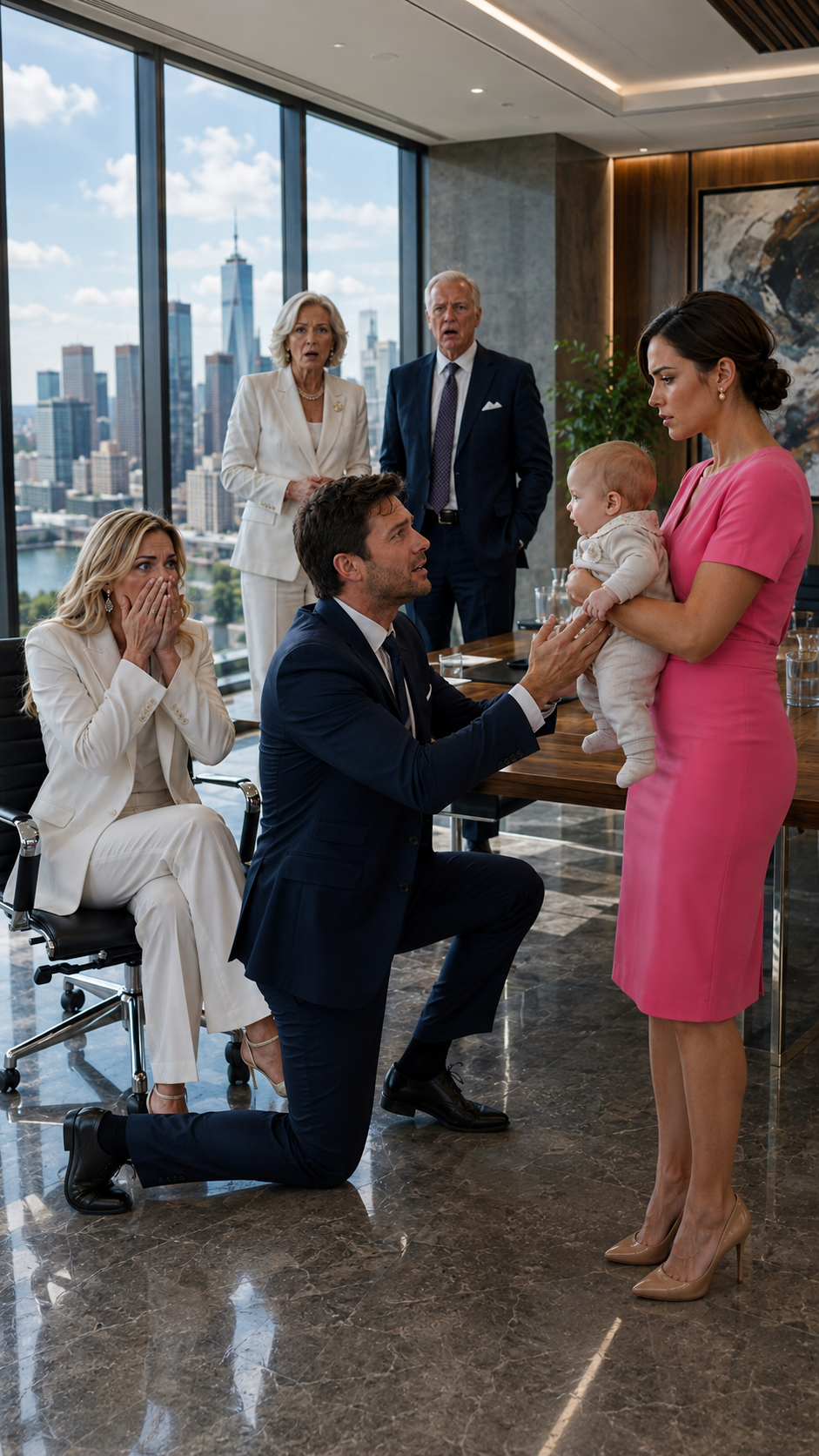
PART 1 — THE DAY I WALKED INTO HIS DIVORCE MEETING
The day I stepped into my billionaire husband’s private divorce session holding his daughter asleep in my arms, I saw the most influential man in the room lose something no amount of money could ever restore. He believed our marriage would conclude with a single signature.
He believed I would silently accept the papers, take whatever was offered, and vanish from his life like a regret he no longer wished to remember.
But the instant his eyes fell on the infant against my chest, everything shifted.
The elevator rose through the heart of Pierce Tower in downtown Seattle, smooth and soundless, as if it were taking me to a routine appointment rather than the collapse of my marriage. My name was Hannah Waverly then.
At least, on paper.
I was twenty-nine, dressed in a cream blouse beneath an aged navy coat, my dark hair neatly pinned at the back. My shoes were plain. My hands remained composed. Anyone passing by would have assumed I was simply another woman heading to a business meeting.
They would not have known I had spent the past year raising a child on my own.
They would not have known the little girl resting against my chest was the daughter my husband had never once seen.
I adjusted the soft carrier and looked down at Grace. Her small hand rested on my blouse, her cheek warm against my collarbone. She was only four months old, yet she had become the reason I was still able to stand.
“We’re going to be okay,” I whispered.
I did not know if I was speaking to her or myself.
When the elevator doors opened, the executive floor stretched out in glass, polished wood, and quiet affluence. Assistants moved swiftly behind immaculate desks. Phones rang softly. Everyone was trained to keep disruption far from men like him.
But disruption had already arrived.
And she was holding a baby.
THE ROOM WENT SILENT
A receptionist looked up and stiffened at once.
“Mrs. Waverly,” she said, rising too quickly. “Mr. Waverly is still in a private meeting.”
A year earlier, I would have apologized.
I would have sat down, folded my hands, and waited for Preston Waverly to decide whether his wife was worthy of five minutes.
But that version of me no longer existed.
She had disappeared somewhere between unpaid medical bills, sleepless nights, unanswered messages, and the slow realization that love offers no protection when the person holding your heart chooses silence.
I kept walking.
At the end of the corridor stood the double doors to Preston’s corner conference room. Behind them, I knew lawyers, advisors, and carefully managed decisions were turning pain into paperwork.
I placed my hand on the handle.
Then I pushed the doors open.
Every voice stopped.
A dozen heads turned toward me. Men in dark suits paused mid-document. A woman near the window lowered her pen. Preston’s attorney froze with a folder half-raised.
And then Preston looked up.
For a brief moment, he looked irritated.
Then his eyes dropped to Grace.
The irritation disappeared.
His expression changed so completely the room seemed to hold its breath.
He stared at the baby in my arms, then back at me, as though his mind refused to accept what his eyes already knew.
I stepped inside and let the doors close behind me.
“Hello, Preston,” I said quietly.
He did not respond.
His gaze stayed locked on Grace.
The attorney cleared his throat. “Mrs. Waverly, this is a private legal discussion.”
I looked at the thick folder on the table. My married name was printed across the front.
“I know exactly what this meeting is,” I said. “That is why I’m here.”
Preston finally rose.
He moved slowly, like a man afraid that any sudden motion might break reality.
“Hannah,” he said, voice low. “Whose baby is that?”
The question should have cut me.
Instead, it left me still.
I adjusted Grace gently against my chest.
“Her name is Grace,” I said. “And she is your daughter.”
FOUR MONTHS TOO LATE
No one spoke.
The silence in the room felt heavier than anger.
Preston’s face drained of color. His hand gripped the edge of the table as though it was the only thing keeping him upright.
“That is not possible,” he said.
I let out a small, exhausted laugh.
Not because it was amusing, but because I had replayed this moment so many times I had expected everything except stillness.
“It is possible,” I said. “You just weren’t there.”
His jaw tightened.
“Why didn’t you tell me?” That question was so small compared to the truth that I could barely draw breath.
“I tried,” I said.
He stared at me.
So I told him.
“I called your office. Your assistant said you were unavailable. I emailed you. The messages bounced back. I went to your building when I was six months pregnant, and security told me I was no longer allowed upstairs.”
Preston looked toward his attorney, then back at me.
“No,” he said. “I never ordered that.”
“Maybe you didn’t,” I replied. “But it happened.”
A ripple of unease moved through the room.
Preston’s attorney stepped forward. “Mrs. Waverly, perhaps we should continue this discussion privately.”
“No,” I said.
It came out steady, but it stopped everything in the room.
“You were all here to discuss my marriage without me. You can hear why I’m here.”
Preston never looked away from me.
“Everyone leave,” he said.
No one moved at first.
Then chairs scraped back. Files shut. Devices were collected. One by one, the executives and lawyers filed out, their expressions tight with the discomfort of people who had just witnessed something money could not smooth over.
When the last assistant slipped through the door, it clicked shut behind her.
For the first time in nearly a year, I was alone with my husband.
Except we weren’t truly alone.
Grace stirred softly against my chest.
Preston’s gaze dropped to her again.
“May I see her?” he asked.
There was no authority in it.
Only disbelief.
And something dangerously close to regret.
THE PROOF HE COULD NOT IGNORE
I stepped closer, but not too close.
Grace blinked awake, squinting at the bright room. Her eyes were gray-blue—like the faded photographs I once saw in Preston’s mother’s home.
Preston inhaled sharply.
“She looks like my mother,” he whispered.
“She does,” I said.
His hand lifted, then stalled midair, unsure.
That hesitation said more than any apology ever could.
Preston Waverly was a man who entered boardrooms as if the world had already agreed with him. He made decisions that shifted companies. He signed contracts worth fortunes most people could never imagine.
But in front of his daughter, he looked unmoored.
I reached into my coat pocket and placed an envelope on the table. Inside were hospital records, a birth certificate, and the results of a private DNA test I had paid for with money I barely had.
“I brought proof,” I said. “Not because I owe it to you, but because Grace deserves the truth.”
Preston looked at the envelope but didn’t touch it.
“I didn’t know,” he said.
It was quiet.
And I believed him.
Which somehow made it worse.
Because if he didn’t know, someone had made sure he never would.
“I know,” I said. “But I did. Every day. Every appointment. Every night she cried. Every bill I couldn’t pay on time. Every time someone asked where her father was.”
His expression tightened.
“Hannah…”
I shook my head.
“No. You don’t get to say my name like that now.”
He flinched, but nodded.
He looked like he wanted to find the right words, but there were none for missing the beginning of your child’s life.
Finally, he said, “Where have you been living?”
I almost smiled.
Not because it was funny.
Because it revealed how little he knew.
“In a studio apartment in Tacoma,” I said. “Before that, with a woman I barely knew who helped me when I had nowhere else to go.”
His expression shifted.
“You had nowhere to go?”
“You moved me out of our apartment within forty-eight hours of ending our marriage.”
“I arranged a townhouse,” he said quickly.
“Under your company’s name,” I replied. “With staff reporting every time I came and went. That wasn’t a home, Preston. That was a holding space for my disappearance.”
He closed his eyes.
For the first time, he looked less like a billionaire and more like a man realizing he had trusted the wrong people with everything that mattered.
THE FATHER WHO ARRIVED TOO LATE
A knock came at the door.
Preston turned sharply. “Not now.”
The door opened anyway.
His assistant stepped in, pale and tense.
“I’m sorry, Mr. Waverly,” she said. “Your father is here. He says it’s urgent.”
Preston’s jaw tightened.
“Tell him I’m unavailable.”
Before she could respond, Conrad Waverly entered.
He was seventy, tall, silver-haired, and dressed like a man who had never doubted that families like his owned the rules of the world. His gaze moved from Preston to me, then to Grace.
And he did not look surprised.
That was the first thing I noticed.
Not shock. Not confusion. Recognition. Preston saw it too.
“You knew,” he said.
Conrad adjusted his cuff as though the conversation were merely an inconvenience. “I suspected,” he replied.
My arms tightened instinctively around Grace.
Preston moved one step closer to his father.
“What does that mean?”
Conrad’s expression stayed composed.
“It means I did what was necessary to protect this family from a mistake made during an emotional period.”
The room felt like it shifted beneath us.
A mistake.
He meant my daughter.
He meant my marriage.
He meant the months I spent alone, afraid, carrying a child his son was never allowed to know.
Preston’s voice lowered.
“What did you do?”
Conrad exhaled, almost indifferent.
“I redirected certain correspondence. Your wife was becoming a distraction during a critical acquisition. You were finally returning to discipline. I was not going to let sentiment destroy decades of work.”
For several seconds, Preston did not move.
Then his expression shifted into something I had never seen before.
Not anger.
Not exactly.
Something colder.
“You blocked her messages?”
“I managed a situation,” Conrad said.
“You kept me from my daughter.”
Conrad’s gaze drifted briefly to Grace.
“You have no idea how complicated legacy becomes when handled carelessly.”
I stepped back, holding Grace closer.
“She is not a complication,” I said.
Conrad looked at me then, as though I had become a problem he could no longer dismiss.
“Hannah, you were overwhelmed and emotional. I did what was necessary.”
I lifted my chin.
“No. You did what powerful people do when they believe no one will ever make them answer for it.”
Preston turned toward me, his face pale with shock and shame.
“Hannah, I didn’t know.”
I believed him.
But belief did not erase the nights.
It did not erase the fear.
It did not erase the first time Grace smiled and there was no father there to see it.
I looked from Preston to his father, then down at my daughter.
“Maybe you didn’t know,” I said softly. “But I was still alone.”
Grace shifted in my arms and made a small sound.
Preston looked at her as though that sound had cracked something open inside him.
Then, for the first time since I entered the room, his voice broke.
“Please don’t leave yet.”
I held his gaze for a long moment.
Then I said, “I came here for the truth, Preston. Not for promises.”
And behind him, Conrad Waverly’s calm finally began to fracture.
PART 2 — THE TRUTH THAT CHANGED EVERYTHING
No one spoke after that.
The room, which had only minutes earlier been filled with contracts and legal language, now felt unbearably small.
Grace rested quietly against my shoulder, unaware that the adults around her were watching an entire life of hidden decisions collapse at once.
Preston slowly turned away from his father.
For years, he had believed Conrad Waverly was the smartest man he knew.
The man who built an international empire from almost nothing.
The father who insisted every difficult decision was made for the good of the family.
Now, for the first time, Preston understood how many of those decisions had never truly been his.
“How many?” he asked quietly.
Conrad frowned.
“How many what?”
“How many letters did you hide?”
Silence.
“How many phone calls?”
Still nothing.
“How many chances did you take away from me?”
Conrad clasped his hands behind his back.
“You are viewing this emotionally.”
Preston let out a short, bitter laugh.
“She is my wife.”
He looked at Grace.
Then corrected himself.
“She is still the mother of my daughter.”
Conrad’s tone remained steady.
“Your future was larger than one relationship.”
Preston looked directly at him.
“No.”
His voice stayed calm.
That calmness unsettled Conrad more than shouting ever could.
“My future was standing in front of your office carrying our child while you made sure I never knew.”
The older man said nothing.
For the first time in decades, he had no strategy left to contain what had been exposed.
A BOX HIDDEN FOR NEARLY A YEAR
I quietly reached into the diaper bag on my shoulder.
There was one more envelope.
Unlike the first, this one was worn at the edges.
I placed it on the conference table.
“These were returned to me.”
Preston opened it slowly.
Inside were six unopened letters.
Every envelope bore his office address.
Every one stamped in red.
RETURN TO SENDER.
NO LONGER ACCEPTING PERSONAL MAIL.
His hands began to tremble.
He opened the first letter.
An ultrasound photo from twelve weeks.
A small handwritten note beside it.
“Today I heard our baby’s heartbeat. I wish you had been there.”
The second letter held another photograph.
“She kicked for the first time today. I kept smiling all afternoon because I imagined you feeling it too.”
The third was marked by dried tear stains.
“The doctor says she’s healthy. I still believe you’ll answer one day.”
Preston could barely keep reading.
His eyes stayed locked on the pages.
Every milestone.
Every appointment.
Every hope.
Every disappointment.
He had missed all of it.
Not because I stayed silent.
Because someone ensured he would never hear me.
He set the letters down carefully, as though they might break.
“I should have been there.”
I nodded.
“Yes.”
Nothing else needed to be added.
A MEMORY THAT NEVER LEFT ME
The room fell quiet again.
After a long moment, Preston asked softly,
“Why didn’t you stop trying?”
I looked down at Grace before answering.
“Because she deserved a father, even if I wasn’t sure he wanted to be one.”
I remembered every visit to his office.
Every security guard who politely turned me away.
Every assistant who apologized without helping.
Every ride home where I told myself tomorrow might be different.
I had believed love could survive distance.
I had believed honesty would eventually reach him.
Instead, every door closed quietly.
There came a morning when I stopped waiting for anyone to answer.
That was the day I stopped being someone’s wife and became only Grace’s mother.
It was the hardest decision I ever made.
And the strongest.
SOMEONE HAD BEEN WATCHING
A gentle knock broke the silence.
This time, Preston nodded toward the door.
A woman in her early sixties stepped inside. She wore a simple gray dress and carried a small wooden box.
I recognized her immediately.
Months earlier, when Grace and I were struggling to afford rent, she had quietly paid our grocery bill at a neighborhood market before slipping away without giving her name.
I had looked for her afterward.
I never found her.
Until now.
She offered a gentle smile.
“I wasn’t sure you would remember me.”
I stared at her.
“You helped us.”
She nodded.
“I tried to help in the only way I could.”
Preston looked confused.
“Lillian… what are you doing here?”
So that was her name.
Lillian set the wooden box on the table.
“Conrad hired me many years ago.”
She glanced briefly toward the older man.
“I also became the only employee who still remembered that people matter more than profit.”
Conrad’s expression tightened.
“This isn’t your concern.”
Lillian ignored him.
She opened the box.
Inside were printed emails.
Phone logs.
Mail records.
Security reports.
All carefully arranged by date.
She turned to Preston.
“I kept copies.”
His eyes widened.
“Copies of what?”
“Every instruction ordering staff to block your wife’s messages.”
The room went silent again.
Preston slowly lifted the first document.
The signature at the bottom was Conrad’s.
There was no room for doubt.
No ambiguity.
No defense left to offer.
Everything had been deliberate.
THE BEGINNING OF A DIFFERENT FUTURE
Conrad quietly reached for his coat.
“This discussion is over.”
Preston looked up.
“No.”
His father stopped.
“It’s only beginning.”
For the first time, Preston’s voice carried none of the obedient son he had always been.
He sounded like a father.
He walked toward Grace carefully.
Not close enough to startle me.
Only close enough to see her face.
She opened her eyes.
And looked straight at him.
Then, without hesitation, she smiled.
A small smile.
The kind babies give without knowing why.
But it broke something open inside Preston.
Tears gathered in his eyes.
“Hello, Grace.”
She reached out a tiny hand.
He didn’t touch her immediately.
Instead, he looked at me.
“May I?”
I studied him for several long seconds.
The old Preston would have taken without asking.
This man waited.
That difference mattered.
I gave a slow nod.
He extended one finger.
Grace wrapped her tiny hand around it.
A man who had negotiated billion-dollar deals stood perfectly still because a baby was holding him.
No contracts.
No boardrooms.
No titles.
Nothing had ever made him look so human.
A PROMISE INSTEAD OF AN APOLOGY
After several quiet moments, Preston finally looked at me.
“I know I can’t fix everything I missed.”
I stayed silent.
He continued.
“I won’t ask for forgiveness today.”
That surprised me.
Most people asked before they had earned anything.
He did not.
“But if you’ll allow it, I want to spend the rest of my life showing Grace I never chose to leave her.”
I searched his face.
For the first time since I had known him, there was no pride.
No image.
Only regret.
Real regret.
I answered honestly.
“Grace deserves the truth.”
He nodded.
“She will have it.”
“She deserves consistency.”
“She’ll get it.”
“She deserves people who choose her every single day.”
Without hesitation, he said,
“Then that’s exactly what I’ll be.”
I looked toward the wide windows overlooking Seattle.
The city looked unchanged.
Traffic moved.
People hurried along sidewalks.
Business continued in nearby towers.
The world had not stopped.
Only ours had.
I gently kissed Grace’s forehead.
The divorce papers still sat untouched on the table.
No one reached for them.
Because everyone in the room understood something more important than ending a marriage.
Sometimes the greatest loss is not wealth.
It is time.
Time with the people who needed you most.
And once it is gone, no success can ever bring it back.
As I turned toward the door with Grace in my arms, Preston walked beside me.
Not ahead.
Not behind.
Beside me.
For now, that was enough.
Neither of us knew what came next.
Trust would not return quickly.
Neither would healing.
But for the first time in over a year, we were walking toward truth instead of away from it.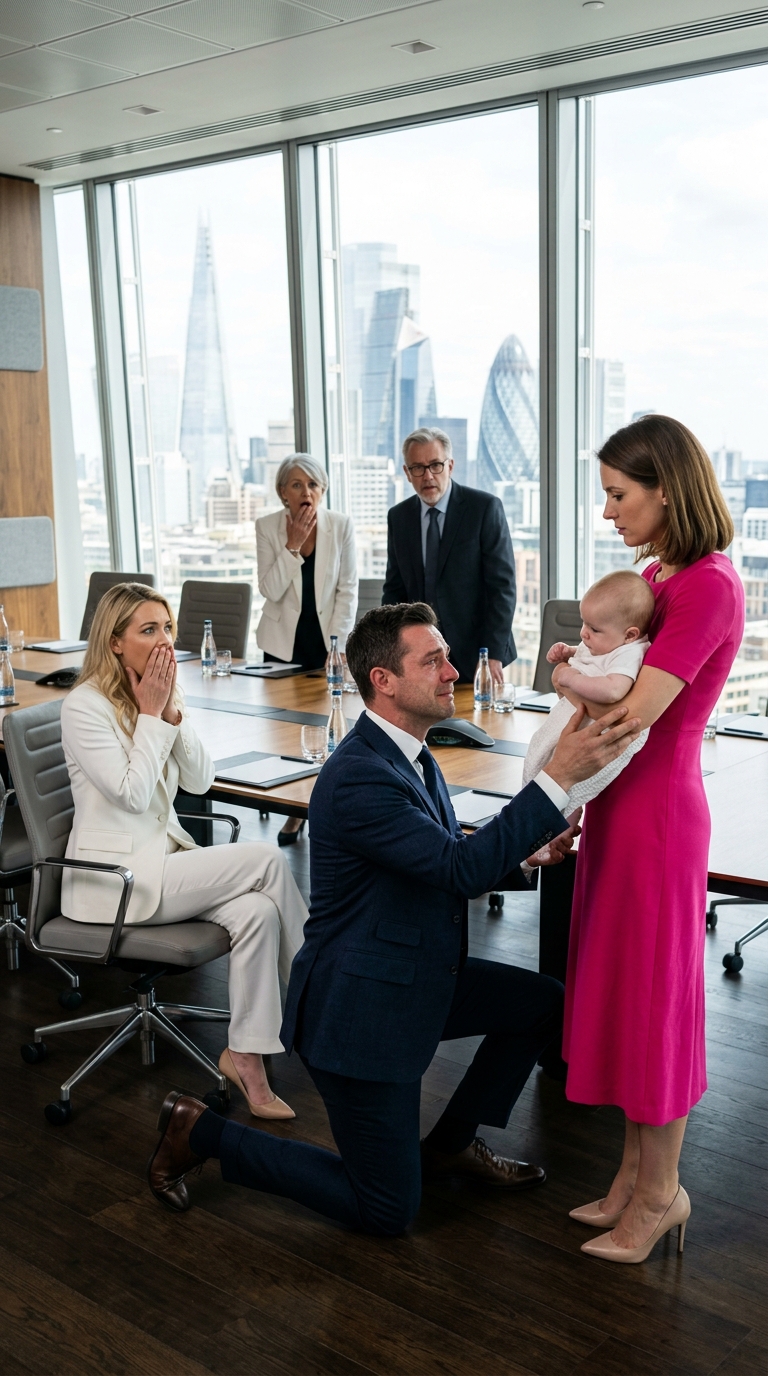
Grace let out a soft laugh between us.
It was the sweetest sound either of us had heard in a long time.
Sometimes the greatest act of courage is protecting your child when no one else will, even if it means carrying every burden alone.
Love is not measured by promises or wealth, but by the quiet choice to stay, to listen, and to show up again and again without being asked.
Success can build empires, but only kindness, honesty, and time can build a family that lasts.
Truth may be delayed by power, but it has a way of surfacing when it is finally ready to be seen.
Children do not remember money; they remember who made them feel safe.
Forgiveness should never be rushed, because trust is rebuilt through consistent action over time.
Even when doors close, hope can arrive through unexpected people and change everything.
A single honest conversation can reveal years of misunderstanding.
Every child deserves to be known, and every parent deserves the chance to try.
And no matter how painful the past is, choosing honesty and courage today can still create a better future.
