

PART 1
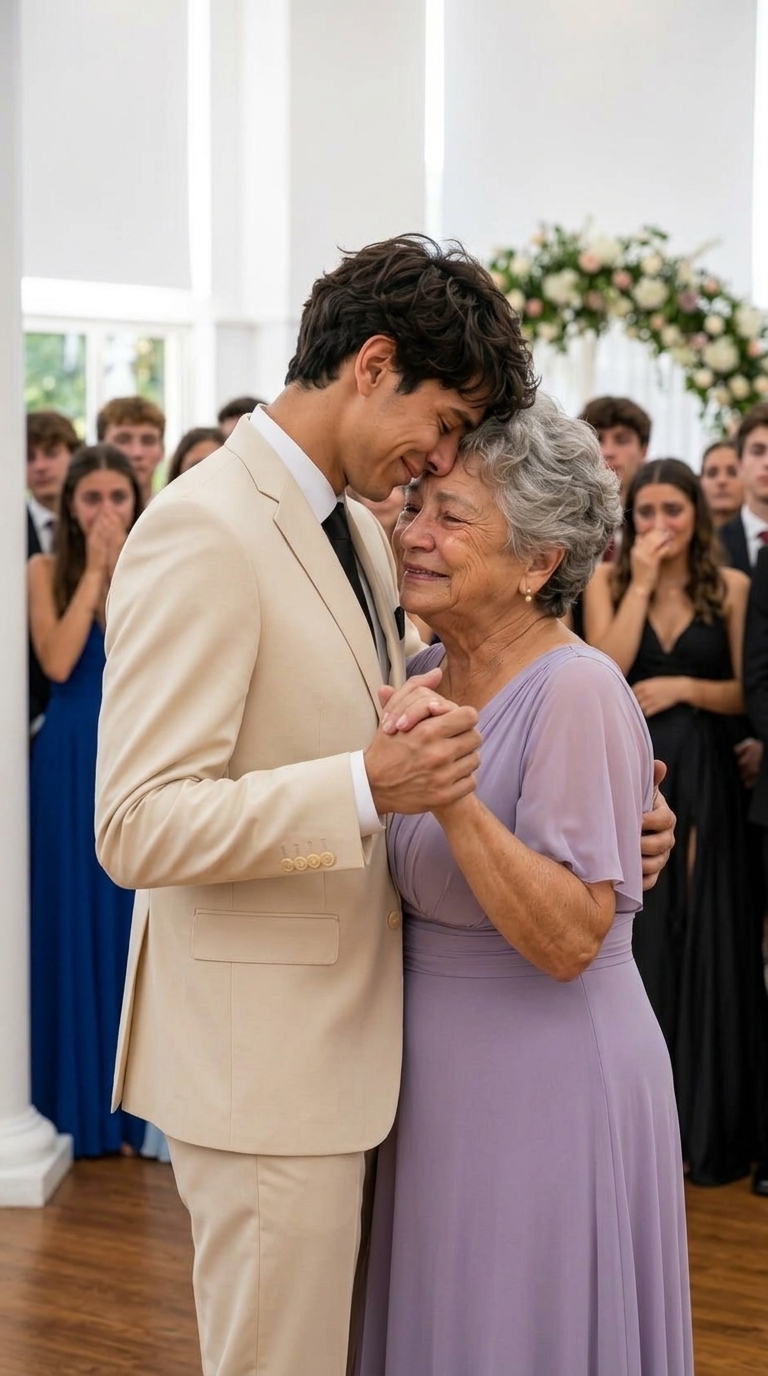
At eighteen years old, Mateo Ríos arrived at the graduation dance of Colegio Benito Juárez with the only woman who had never let go of his hand: his grandmother Carmen.
He did not arrive in a rented van. He did not arrive in a designer suit. He arrived in an old taxi, wearing shoes he had polished himself and carrying a white rose he had bought at a stand outside the Metro.
Walking beside him was Doña Carmen, a seventy-two-year-old woman, short and dark-skinned, her hair pulled back in a tight bun and wearing a navy-blue dress she had used, according to her, “only for important occasions.”
For Mateo, there was no one more elegant in the entire hall.
His mother had died when he was born. No one knew anything about his father except that one day he had promised to return and never did.
Doña Carmen raised him alone in a working-class neighborhood in Iztapalapa, between counted tortillas, overdue bills, and nights when she pretended not to be hungry so the boy could have dinner.
For years she cleaned classrooms, bathrooms, and hallways in the very same school where Mateo studied. She arrived before the teachers. She left when no one else remained. And yet, every time Mateo had a presentation, a contest, or a parent-teacher meeting, she would quickly change out of her apron, fix her hair, and sit all the way in the back to applaud him as if she were watching a world champion.
But Mateo’s classmates never saw her that way.
To them, Doña Carmen was “the lady with the mop.” The one who smelled like bleach. The one who picked up gum stuck under the benches. The one who cleaned the bathrooms after recess.
Some said to Mateo: “Here comes your grandma, dude. Did she already bring you the mop as your inheritance?”
Others covered their noses when she passed by.
Mateo clenched his fists but never answered back. Not because he was a coward, but because he knew that if Doña Carmen saw him fighting, she would think it was her fault. And that would have broken her soul.
When the graduation dance was announced, everyone began showing off dresses, dates, borrowed cars, and plans to go to a party in Polanco afterward.
Mateo only thought of one person.
“Grandma, I want you to come with me,” he told her one night while she mended a shirt under the yellow kitchen light.
Doña Carmen dropped the needle. “Don’t talk nonsense, mijo. That place is for young people.” “That place is to celebrate that I finished. And I finished because of you.”
She shook her head many times. She said she didn’t have a nice dress. That they would make fun of her. That he deserved to arrive with a girl his own age.
But Mateo insisted.
And that night, when they crossed the entrance to the hall, the laughter began before the first song even played.
Someone shouted from a table: “No way! Mateo brought the cleaning lady as his date!”
The laughter exploded like fireworks.
Doña Carmen lowered her gaze. Mateo felt her hand trembling.
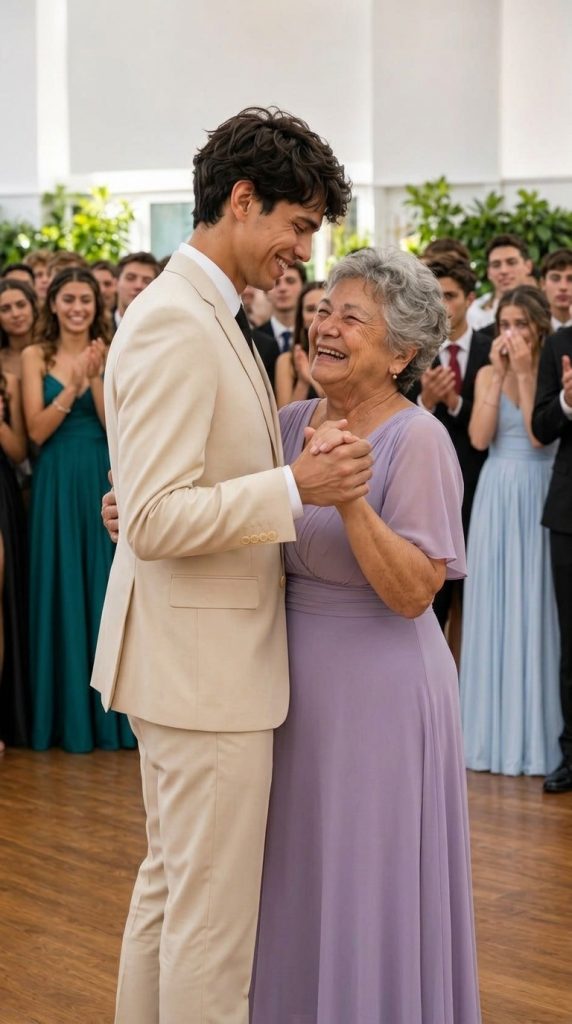
Then the music started. He bowed in front of her and said: “Grandma, may I have this dance?”
The entire hall erupted in mockery.
And when Doña Carmen tried to let go of him to leave, a cruel voice shouted from the back: “Dance with her slowly—don’t break the grandma!”
Mateo stopped smiling. He looked at everyone. And walked straight toward the microphone.
PART 2
The master of ceremonies tried to stop him. “Mateo, this isn’t the right moment…”
But Mateo did not let go of the microphone.
The hall was still laughing. Some were recording with their phones. Others pointed at Doña Carmen as if she were part of a private joke.
She stood beside the dance floor, very still, eyes full of shame, clutching her black purse against her chest.
Mateo took a deep breath. He did not shout. He did not insult anyone. He simply spoke with a calm so firm that the music turned off by itself.
“You’re laughing at a woman who has cleaned these floors for twenty years.”
The laughter began to fade.
“You’re laughing at the hands that cleaned your classrooms, your bathrooms, your vomit after the school fairs, and even the trash you left on the floor even though the bin was only two steps away.”
An uncomfortable silence fell over the tables.
Mateo looked toward the boys who had mocked him the most.
“For twenty years, my grandmother arrived before all of you. While some came in new cars, she came in a pesero, with pain in her knees, carrying her lunchbox and a bucket.”
Doña Carmen slowly shook her head, as if begging him to stop.
But Mateo continued.
“My mother died bringing me into the world. My father left. And this woman, at fifty-four years old—when she already deserved to rest—started over. She changed my diapers. She taught me to read. She cured my fevers. She made me hotcakes on Saturdays even when sometimes there was only flour and water.”
A teacher covered her mouth with her hand.
Mateo raised his voice a little more.
“When I didn’t have sneakers for physical education, she washed stairs in three more houses. When they asked me for books, she sold her wedding ring. When I got sick as a child, she spent two nights sitting in a hospital chair because there was no bed for her.”
No one moved. Not even those who were recording.
“And even so, she never told me she was tired. She never threw anything in my face. She never allowed me to miss school, even though she had to come clean the very same school where later others humiliated me for being her grandson.”
Mateo paused. His eyes were red, but he did not cry. Not yet.
“Today some of you are laughing because I came with my grandmother to the dance. But honestly, I didn’t come out of pity. I came with pride. Because if there’s anyone here who deserves the first dance tonight, it’s not a girl in an expensive dress or a guy in a rented suit. It’s her.”
Doña Carmen began to cry in silence.
Then something no one expected happened.
The principal, Mr. Luján, stood up from the main table. For years he had treated Doña Carmen with cold courtesy, like someone greeting an invisible person.
He walked over to Mateo, took another microphone, and said: “Mateo, wait.”
The hall grew even more tense. Some thought he was going to scold him.
But the principal lowered his gaze.
“There’s something this school should also know.”
Doña Carmen’s eyes widened. “Principal, no…”
He looked at her with old guilt. “Doña Carmen, it’s been too long.”
Mateo looked confused.
The principal took a deep breath.
“Twelve years ago, this school was about to expel Mateo.”
A murmur ran through the hall. Mateo frowned. He didn’t remember that.
“His tuition was six months behind. There was an administrative order. I was the assistant principal back then. The council decided the boy couldn’t continue.”
Doña Carmen lowered her head. Mateo looked at her, frozen.
“But the next day,” the principal continued, “Doña Carmen came to my office with an envelope full of small bills. Coins. Savings. Wrinkled money. She asked us not to tell the boy anything.”
Mateo felt the floor disappear beneath his feet.
“I told her it wasn’t enough,” the principal confessed. “And she asked for extra work. She said she could also clean the laboratories, wash windows, stay in the afternoons—whatever was needed. For twelve years she did more work than she was supposed to, without full pay, so Mateo could keep studying here.”
The silence became unbearable.
Doña Carmen covered her face. Mateo let a tear fall. He had never known that.
He had thought his scholarship had always come from good grades. He didn’t know that before every diploma there had been a woman hiding pain, debts, and humiliations.
But the principal wasn’t finished.
“And today, before this dance, we received a letter from the Universidad Nacional Autónoma de México. Mateo didn’t just get a scholarship. He got a full scholarship for academic excellence.”
A timid applause started in one corner.
But Mateo didn’t smile. He was still looking at his grandmother.
The principal swallowed.
“That letter arrived three days ago. Doña Carmen was the first to see it. And she asked that it not be announced yet, because she didn’t want to take away from her classmates’ moment.”
Several students lowered their gaze. The same ones who had been mocking no longer knew where to put their faces.
Then, from the back table, Brandon—the boy who had shouted about “the cleaning lady”—let out a nervous laugh.
“Come on, don’t make her a saint either. She’s just a janitor.”
It was like throwing gasoline on the fire.
Professor Laura, the first teacher who always defended the quiet students, stood up abruptly.
“No, Brandon. Not a janitor. A woman who worked harder than many adults in this hall. A woman who raised a boy better than all of you put together.”
Brandon’s mother tried to intervene. “Excuse me, don’t talk to my son like that.”
But the principal looked at her seriously.
“Ma’am, your son just publicly humiliated a worker of this institution. And it’s not the first time. We have reports.”
Brandon went pale.
Mateo didn’t need to say anything more. Because in that instant, many understood that the mockery hadn’t been a joke. It had been cruelty. It had been classism. It had been that ugly habit of looking down on those who clean what others dirty.
Doña Carmen tried to approach Mateo. “Mijo, let’s just go. I don’t want problems.”
But Mateo set the microphone down on the table and walked toward her.
He knelt in front of everyone. He took her wrinkled hands—those hands that smelled of soap, of bleach, of warm tortillas, of an entire life given without applause.
“Forgive me, Grandma,” he said, his voice breaking.
She looked frightened. “Why, my boy?”
“Because I let them humiliate you for many years so that you wouldn’t suffer. But you suffered anyway. And alone.”
Doña Carmen cried like someone who had been holding it in for decades. She caressed his face.
“I didn’t suffer from working, Mateo. I suffered when I saw you lower your head because of me.”
That sentence landed harder than any speech.
Mateo stood up slowly. He looked at the hall again.
“My grandmother never gave me shame. She gave me a home. She gave me a name. She gave me a future. And if anyone here thinks that cleaning floors makes a person less, I hope one day they have to look in the eyes of the person who cleaned their dirt.”
No one applauded at first. Not because they didn’t want to, but because the shame weighed too heavily.
Then Professor Laura started. Then another teacher. Then the event’s cooks. Then some parents. And finally, almost the entire hall stood up.
But Mateo didn’t look at the others. He simply extended his hand toward Doña Carmen.
“Now yes, Grandma. May I have the first dance?”
She let out a small laugh through her tears. “Oh, mijo… with these knees I can’t dance anymore.”
“I’ll lead you.”
The music started again. It wasn’t a modern song. It was an old bolero—the kind Doña Carmen played on Sundays while she swept the house.
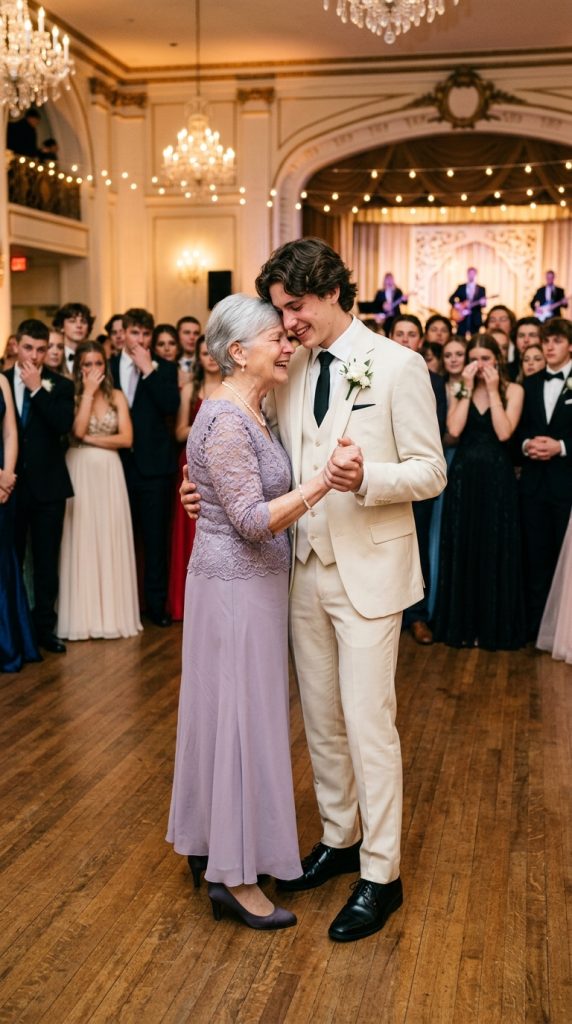
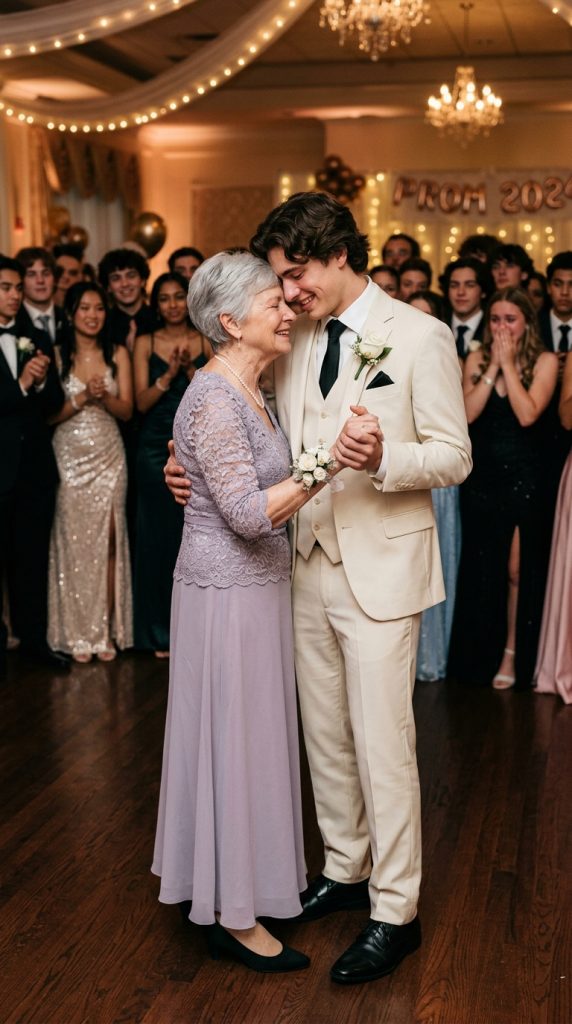
Mateo took her carefully. She placed one hand on his shoulder. And they took slow steps in the middle of the dance floor.
At first, everyone watched them in silence. Then something changed.
The lady from the kitchen put down a tray and wiped her tears. A janitor standing by the door took off his cap in respect. Several students started recording again, but not to mock. This time they were recording because they understood they were witnessing something that would not be repeated.
Brandon stood up to leave, red with anger. But his own father stopped him by the arm.
“You’re staying,” he said sharply. “And tomorrow you’re going to apologize to that lady.”
“Dad…”
“Tomorrow? No. Right now.”
The boy swallowed. He walked to the dance floor when the song ended.
Everyone looked at him. For the first time in years, Brandon didn’t have a cruel phrase ready.
He stood in front of Doña Carmen. “I’m sorry, ma’am,” he murmured. “I went too far.”
Doña Carmen looked at him. She didn’t smile. She didn’t humiliate him. She only said:
“I hope you never need someone to clean up the mess you make with your mouth, son.”
The hall froze.
And then a nervous, honest laugh erupted among several people. It wasn’t mockery. It was relief. It was poetic justice.
Mateo smiled for the first time all night.
Weeks later, the video of the dance went viral on Facebook. Thousands of people commented. Some said Mateo had given a lesson in love. Others argued that the students’ parents were also responsible for raising children who despised humble work. Many shared photos of their own grandmothers, mothers, aunts, and fathers who had cleaned houses, sold food, carried boxes, or worked under the sun so someone else could study.
But Doña Carmen didn’t understand this going viral. She only said: “See, mijo, from going around talking into microphones.”
Mateo started university months later. The day he left, Doña Carmen made him chilaquiles, folded two shirts for him, and hid two hundred pesos in his backpack, even though he swore it wasn’t necessary.
Before getting on the bus, Mateo hugged her tightly. “One day I’m going to buy you a house where you won’t have to clean anything that isn’t your own coffee cup.”
She gave him a gentle swat on the chest. “Don’t promise me houses. Promise me you’ll never look down on anyone.”
Mateo nodded.
Because that was the true inheritance his grandmother left him. Not money. Not a last name. Not connections.
She left him the dignity of knowing that no honest work stains a person. What does stain is mocking those who break their backs so others can walk on clean floors.
And maybe that’s why that night became impossible to forget.
Because everyone arrived at the dance looking for a nice photo. But they ended up seeing a seventy-two-year-old lady teach an entire school what many adults still haven’t learned:
that greatness doesn’t always enter through the main door. Sometimes it arrives with worn shoes, tired hands, and the smell of bleach.
