

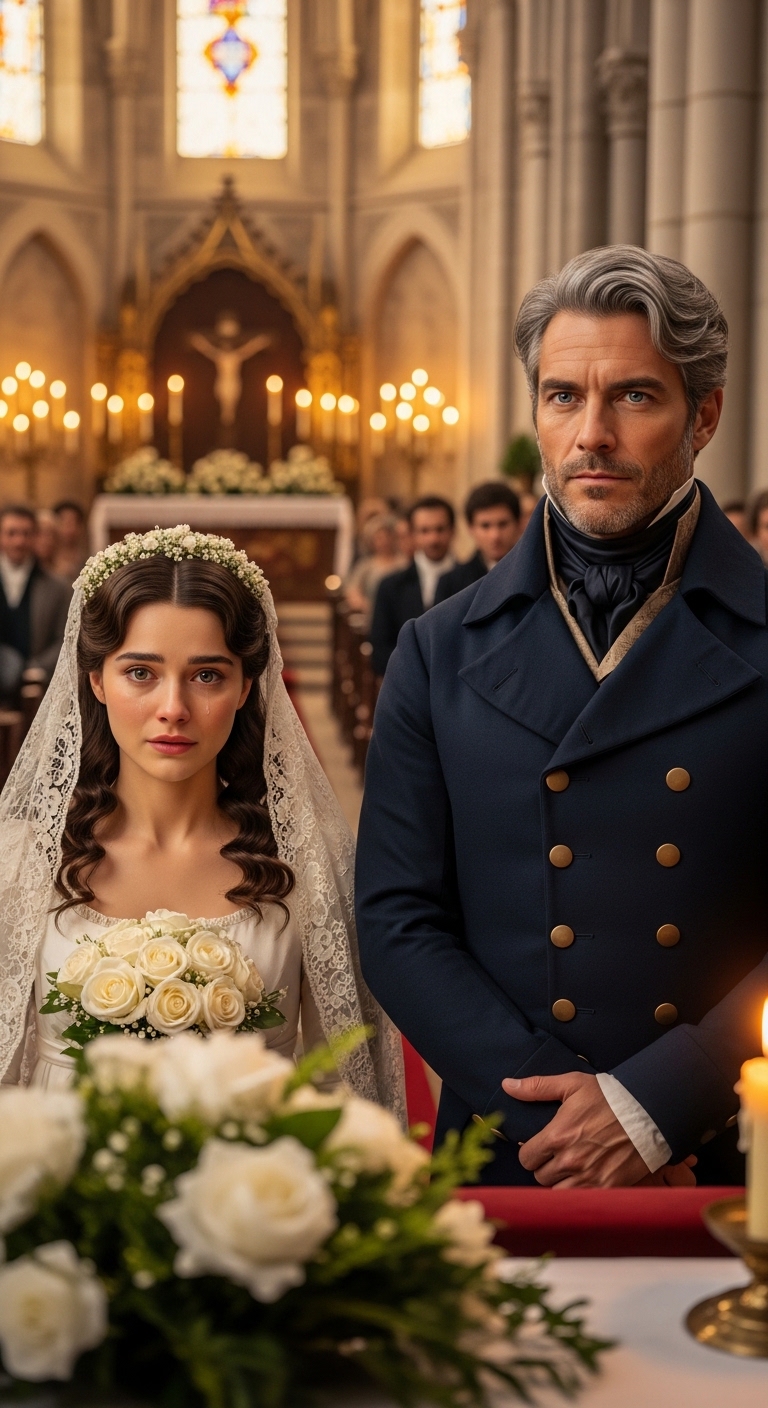
She was 19 years old and walked toward the altar of the San Miguel chapel with an empty stomach, a dry heart, and a debt of three million pesos hanging around her neck like a stone.
Her father, Don Ernesto Aranda, had died four months earlier, leaving behind promissory notes, fake mortgages, loans with impossible interest, and a line of men who came to the family home like vultures smelling fresh meat.
Her aunt Soledad squeezed her arm so tightly she nearly dug her nails in.
“Walk straight,” she whispered. “Don’t embarrass the family.”
Lucía wanted to laugh.
Family?
The house had already been sold. The horses auctioned off. Her mother’s jewels pawned one by one. The only thing left was her, dressed in a borrowed gown that was too big in the shoulders and too short in the sleeves.
At the end of the aisle there were no flowers or beautiful music. There were murmurs. Women in dark shawls pretending to pray while looking at her with pity. Men in fine hats calculating how much a girl was worth when she no longer had a clean name or money behind her.
And beside the altar, an old priest who looked more tired than compassionate.
“They say Don Santiago isn’t even coming,” someone murmured behind her.
“With that reputation, it’s better for her if he doesn’t show up.”
Lucía did not lower her gaze.
Everyone spoke of Santiago Robles as if he were a curse.
The Boss of the Sierra.
Owner of the El Encino Negro hacienda, north of Durango, where the mist descended from the hills and the roads disappeared in storms. He was 42 years old, with scars on his face, hands of a man who had fought more than he had signed papers, and a reputation so heavy that even small-time narcos avoided crossing his lands.
They said his first fiancée had died of sadness before the wedding.
They said the workers obeyed him out of fear.
They said a woman who entered his house left silent—if she left at all.
Lucía didn’t know what was true.
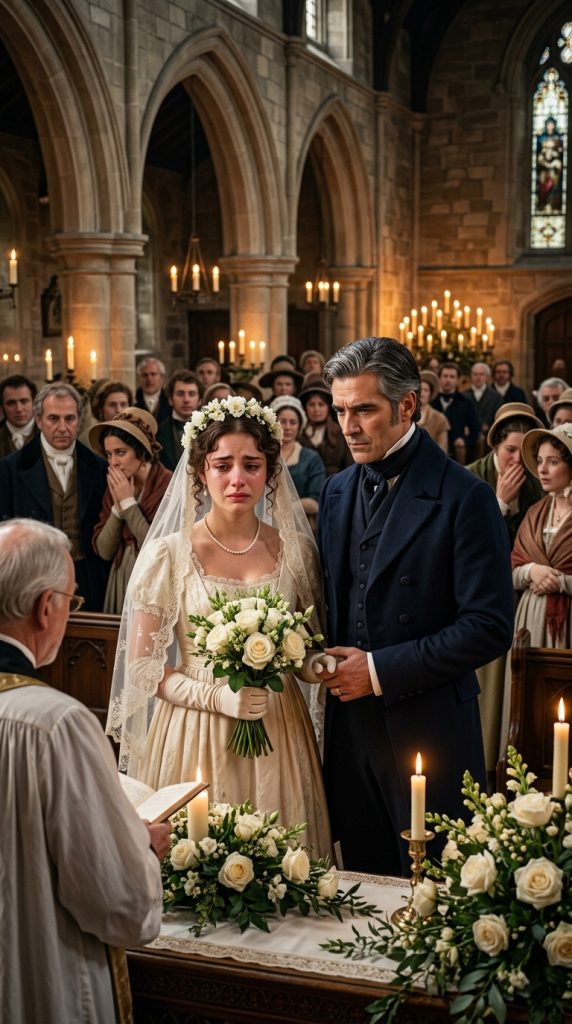
She only knew that he had sent a letter to her aunt: he would pay all of Ernesto Aranda’s debts if Lucía agreed to marry him.
“At least you’ll have a roof,” Soledad had told her. “At least you’ll have protection.”
“Protection from whom?”
Her aunt didn’t answer, because they both knew the answer: from worse men.
The chapel door burst open.
Silence fell like a bucket of ice water.
Santiago Robles entered without haste. Tall, dressed in black, hat in hand and gray eyes like the sky before hail. He didn’t come adorned or smiling. He came like a man closing a dangerous deal.
Two men accompanied him—one old and thin, the other young with an alert gaze.
Santiago scanned the chapel with his eyes, as if weighing the cowardice of every person seated there.
Then he looked at Lucía.
She felt the air catch in her throat.
He approached until he stood in front of her.
“Miss Aranda.”
“Don Santiago.”
The priest cleared his throat.
“We can begin, if the bride and groom…”
“Not yet,” Santiago said.
The entire chapel stirred with murmurs.
Soledad squeezed Lucía’s arm harder.
“What does this mean?” she whispered.
Santiago ignored her.
“I need to speak with her alone.”
“That’s not appropriate,” the priest said.
“Neither is selling a girl to cover a dead man’s debts, Father.”
No one breathed.
Lucía felt something inside her break, but not from pain. From surprise.
Santiago walked out to the atrium without looking back. Lucía hesitated for a second. Her aunt tried to stop her.
“Don’t make him angry.”
Lucía pulled free.
“Maybe I’m already tired of everyone deciding for me.”
Outside, the mist covered the town. Santiago waited by the steps, hands clasped behind his back.
“Do you want to marry me?” he asked.
Lucía looked at him as if she hadn’t understood.
“Does what I want matter?”
“Yes.”
“Why?”
“Because I’m asking you.”
Anger rose in her throat.
“You paid the debts. If I say no, everything comes back. The lenders, the promissory notes, the men who came to look at me like I was a mare for sale.”
“Nothing comes back.”
Lucía stood motionless.
Santiago took an envelope from his jacket.
“The debts were settled this morning. All of them. Your father owes nothing anymore. Neither do you.”
“Then… why are we here?”
Santiago looked toward the chapel, where dozens of shadows pressed against the windows.
“Because there were five men trying to buy you under different names: marriage, help, contract, protection. If you marry me, my name will cover you. No one touches what is under my responsibility.”
“Like property?”
He looked her straight in the eyes.
“Like a person I don’t intend to let be destroyed.”
Lucía felt her legs tremble.
“And if I say no?”
“You leave free. With the debts paid. I’ll get you a safe place far from here.”
“And what do you gain?”
For the first time, Santiago’s hard face changed. Something old and wounded appeared in his eyes.
“Maybe to sleep one night knowing I didn’t let another girl be handed over to wolves while everyone watched.”
Lucía didn’t know what to say.
She looked at the chapel. Inside were those waiting to see her humiliated. Outside was a dangerous man offering her a real choice, even wrapped in fear.
“One condition,” she said.
“Tell me.”
“If I marry you, I want to be able to leave. Not today. But if in six months I can’t live like this, if you turn out to be like all the others, I want a clean exit.”
Santiago nodded.
“You’ll have it. In writing.”
“Does your word mean anything?”
“You’ll have to find out.”
Lucía took a deep breath.
It wasn’t love. It wasn’t trust. It wasn’t salvation. It was an open door in the middle of a fire.
“Then let’s get married,” she said. “But don’t think you’re buying me.”
The corner of Santiago’s mouth barely moved.
“I didn’t come to buy you, Lucía. I came to give you a key.”
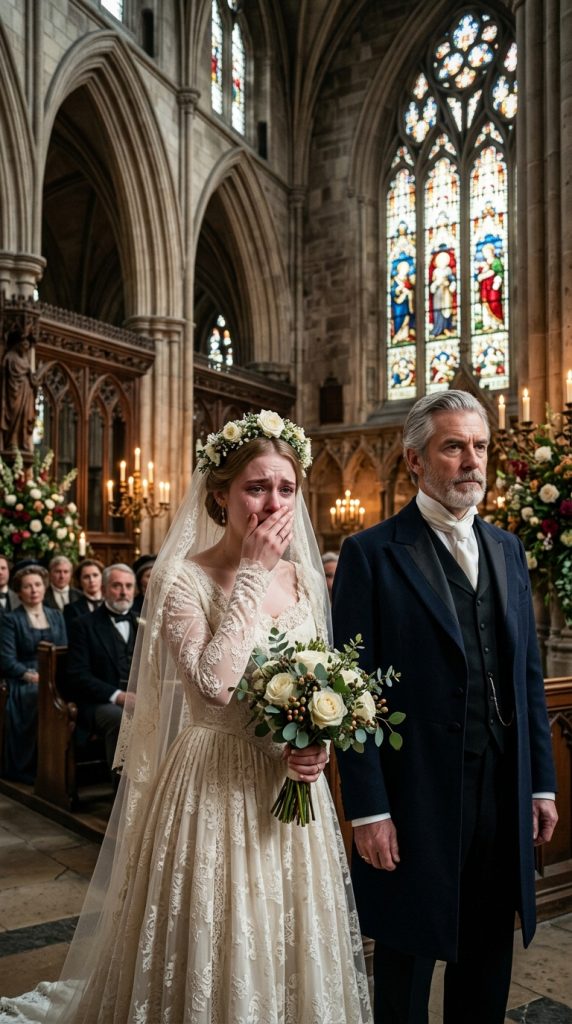
Part 2
The El Encino Negro hacienda looked like a prison built by men who distrusted even the sun: stone walls, reinforced gates, narrow windows, and hills around it like sleeping giants.
Lucía arrived there at dusk, after five hours in a black truck crossing muddy roads, nopales, ravines, and mist.
Santiago barely spoke during the trip, except to tell her she would have her own rooms, her own key, and freedom to walk around the house, the library, the patios, and the stables.
“I won’t enter your room without permission,” he said. “No one will.”
She didn’t fully believe him, but when Doña Remedios, the housekeeper, handed her two bronze keys and told her Santiago had no copies, Lucía felt a strange knot in her throat.
Her room was not luxurious, but it was warm: a clean bed, a desk with new paper, a bookshelf with novels, a lit fireplace, clothes in her size, and a balcony overlooking the hills.
A comfortable cage is still a cage, she thought.
But that night, when she locked the door from the inside, she understood that for the first time in months no one could enter to decide for her.
The following days were strange.
Santiago ate alone in his study, rode the hacienda before dawn, and avoided long conversations. The workers, however, did not seem terrified. They spoke of him with respect, even affection.
Martín, the foreman, told her that Santiago had paid for his son’s operation. Jacinta, a kitchen girl, said he had never allowed a boss to hit a worker on his lands.
Doña Remedios only said:
“Señor Robles is not soft, child, but he is not unjust either.”
Lucía began to explore.
She discovered cellars, granaries, corrals, workshops, an enormous library, and an abandoned chapel where there was a photo of a young woman with braids, lively eyes, and a smile that looked like a wound.
One stormy afternoon, she heard glass breaking on the second floor. She went up with a candle and found Santiago nailing boards over a window shattered by the wind.
The room was full of boxes, old dresses, letters, and toys. On the floor, soaked by the rain, lay a diary.
Lucía read just one line:
“Today Santiago promised me he would never let anyone hurt me.”
He froze.
“She was my sister,” he said at last. “Mariana. They married her at 17 to a landowner from Zacatecas to save my father’s business. I was young and stupid. I thought the law would protect her. When I tried to get her out of that house, it was too late. They said she fell down the stairs. Everyone accepted the lie.”
Lucía carefully set the diary down.
“That’s why you looked for me.”
“That’s why I couldn’t stay still. You’re not her, I know. But when I heard those men talking about you as if you were merchandise…” He swallowed. “I thought maybe this time I could arrive before it was too late.”
Something changed between them that night.
They didn’t fall in love suddenly, there were no sweet promises, but they began to have dinner together. He taught her the hacienda’s account books; she found errors, suggested changes, spoke with the workers, listened to complaints, and resolved small disputes with a clarity that surprised everyone.
Santiago began to look at her not as a saved debt, but as an equal.
Then the men came.
It was a moonless night.
Ten armed riders appeared at the gate. Among them was Julián Treviño, a rich merchant, widowed three times, one of the men who had wanted to “rescue” Lucía before the wedding.
“We’ve come for what Robles stole from us,” he shouted from outside. “That girl was promised before he put his money in.”
Santiago grabbed a rifle, but Lucía stepped in front.
“Don’t hide me.”
“I’m not going to let them see you.”
“They’ve seen me my whole life. Now they’re going to hear me.”
She approached the iron gate with a pistol in her hand, even though she barely knew how to hold it. Her voice trembled at first, then grew firm.
“I was not promised to anyone. No one bought me. No one has the right to claim me. I married because I chose to.”
“Chose?” Treviño mocked. “A hungry girl chooses what she’s told.”
“A hungry girl quickly learns to recognize vultures,” Lucía replied. “And you, Don Julián, smell like carrion from far away.”
The men laughed, but with less confidence.
Santiago stood beside her.
“You have one minute to leave. After that, this hacienda will defend itself. There are rifles in the windows, oil ready in the gate channels, and enough witnesses to hang you legally.”
Julián spat on the ground.
“This doesn’t end here.”
“No,” Lucía said. “It ends when you understand that a woman is not a debt, nor a prize, nor property.”
That phrase spread across Durango before dawn. Some called her insolent. Others, brave.
But when Julián Treviño filed a complaint before the territorial council accusing Santiago of abuse, kidnapping, and forced marriage, Lucía knew the real battle had only just begun.
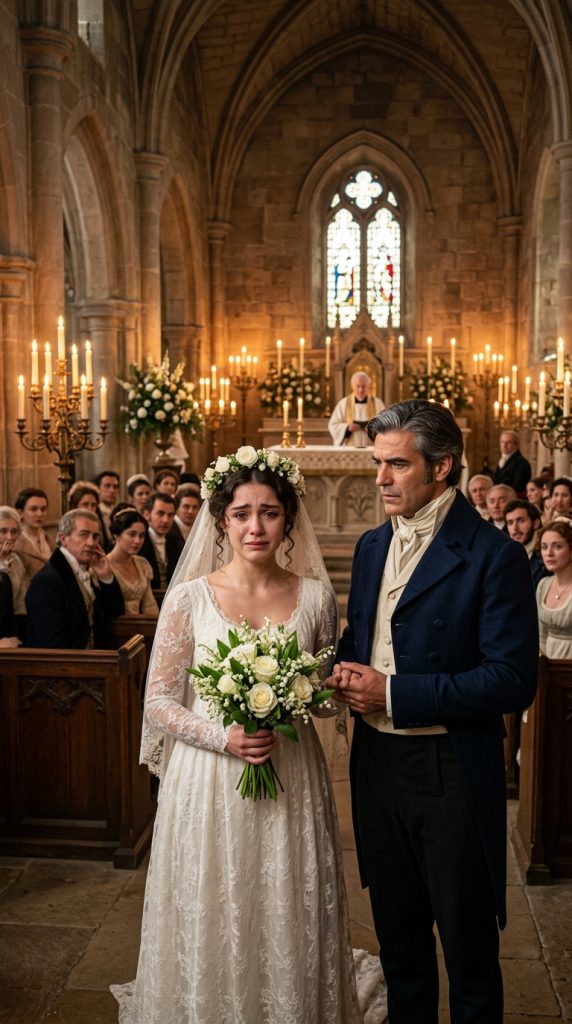
Part 3
The council hall was full when Lucía entered on Santiago’s arm.
Landowners, merchants, politicians, silent wives in the gallery, village journalists with open notebooks. Everyone wanted to see the girl who, according to some, had been sold; according to others, had bewitched the most feared man in the sierra.
The municipal president, Don Aurelio Montalvo, struck the table with a gavel.
“The validity of the marriage between Don Santiago Robles and Doña Lucía Aranda will be reviewed, given the economic circumstances, the age difference, and the accusations of coercion.”
Lucía stood up before Santiago could stop her.
“Do not speak of my will as if I were not here.”
The room fell silent.
Don Aurelio frowned.
“You will have the opportunity to testify.”
“I’ll take it now. Everyone says they want to protect me, but no one asked me anything when the lenders came to my house, when they offered to marry me in exchange for erasing debts that weren’t even mine, when my aunt accepted proposals because she saw no other way out. If you are going to judge someone, judge the men who turn necessity into a market.”
Julián Treviño shifted in his seat.
Lucía pointed at him without fear.
“That man came drunk to see me and said he was going to ‘tame me with patience.’ Others offered a roof, food, a name. None offered freedom. Santiago did. He paid the debts before the wedding. He asked me if I wanted to marry. He gave me keys, my own room, a six-month exit contract, and paid work in the administration of the hacienda. Tell me, Mr. President: is that a prison or more freedom than many respectable wives have ever had?”
A murmur rose like fire.
An older woman, Doña Inés Villaseñor, wife of a powerful landowner, stood up from the gallery.
“My husband is 26 years older than me and my father forced me to marry. No one checked my consent because there was money and a nice mass. If you are going to protect women, start by listening to the living ones, not by silencing the only one who dared to speak.”
Another woman stood. Then another.
A foreman from El Encino Negro testified that Lucía had reduced abuses in the workers’ contracts. A merchant admitted that the hacienda now paid on time with clear accounts. Even one of Santiago’s rivals acknowledged that she had prevented a shootout over land with a fair solution.
Don Aurelio reviewed the documents Lucía had brought: receipts, agreements, salaries, testimonies. His face lost its hardness.
“The accusation does not hold,” he said at last. “The marriage is valid. And this council will open a review of marriage contracts tied to family debts.”
Julián Treviño stood up furious.
“This is a disgrace!”
Lucía looked at him without blinking.
“No, Don Julián. The disgrace was believing you could put a price on a life.”
Outside, people were waiting. Some applauded when Lucía came out. Others stepped aside, uncomfortable.
Santiago said nothing until they reached the truck. Then he took her hand with a gentleness that would have surprised anyone who only knew his reputation.
“Today you didn’t just win your freedom,” he said. “You opened a door for many more.”
“I didn’t win it alone.”
“No. But the voice was yours.”
The months passed.
The exit contract reached its date and Santiago placed the papers on the desk without drama.
“You can leave whenever you want. With money, a house, and a clean name.”
Lucía looked at the keys she still carried in her pocket. She remembered the chapel, the mist, the fear. Then she looked at the library full of notes from both of them, the account books corrected by her hand, the patios where the workers now greeted her with respect, and the man who had learned to dine accompanied, to apologize, and not to hide behind his hardness.
“I want to stay,” she said.
Santiago closed his eyes for a moment, as if that phrase was too big for his chest.
“Out of obligation?”
“Out of choice. And if one day I leave, it will also be by choice.”
He smiled, truly, for the first time without sadness.
“Then stay, Lucía Robles. Not as a paid debt. As the owner of your own story.”
Years later, when a little girl with gray eyes ran through the corridors of El Encino Negro asking why her mother kept some old keys in a wooden box, Lucía sat her on her lap and told her the truth without embellishment.
“Because there was a time when everyone believed a woman could only survive by obeying.”
“And did you obey?” the girl asked.
Lucía looked at Santiago, who listened from the doorway with the same clumsy tenderness as always.
“At first I was afraid,” she answered. “But then I chose. And when a woman learns she can choose, my child, no one can lock her up the same way again.”
Outside, the sierra was covered in mist, the same mist from that day in the chapel. But for Lucía it no longer seemed like a threat. It seemed like a distant memory.
The hacienda everyone called a prison had filled with laughter, fair work, shared decisions, and open doors.
And the girl who had arrived dressed in lace and fear ended up becoming the woman who changed the rules of an entire territory.
Because in the end, it wasn’t the marriage that saved her.
It was the key.
It was the choice.
It was discovering that her life was not an inherited debt, but a story she could still write with her own hands.
