

In northern Mexico, where the wind lifts dust as if trying to erase the paths, lived Don Eusebio Mendoza, a sixty-eight-year-old rancher who spoke little and observed much. His ranch lay between the dry borders of Nuevo León and Tamaulipas, far from the town, far from noise, far from almost everything.
Since his wife, Doña Carmen, had passed away, the house had become too big for one man. Not because it had many rooms, but because silence filled every corner. Her chair still stood at the table. Her apron still hung in the kitchen. In the wardrobe, stored in a wooden box, was the blue shawl she used on cold afternoons.
Don Eusebio had a son, Julián, who lived in Monterrey. He called on Sundays, sent money, and promised to visit soon, but life in the city always brought new urgencies. Don Eusebio never complained. He himself had raised him to seek a better future, not to stay buried in hard land that barely provided enough to live on.
One August morning, before sunrise, Don Eusebio saddled his horse Canario and went out to check a fallen fence near the abandoned Ríos ranch. That place had been empty for years. The owner had died without children, and no one claimed the property. The adobe walls still stood, the corral endured out of stubbornness, and the rusty gate creaked in the wind as if still waiting for someone.
Don Eusebio fixed the fence and, on the way back, Canario stopped abruptly.
He didn’t neigh. He didn’t startle. He simply stood still, ears raised, staring toward the old corral.
“What did you see, old friend?” Don Eusebio murmured.
He dismounted, walked slowly, and pushed open the gate.
What he saw inside took his breath away.
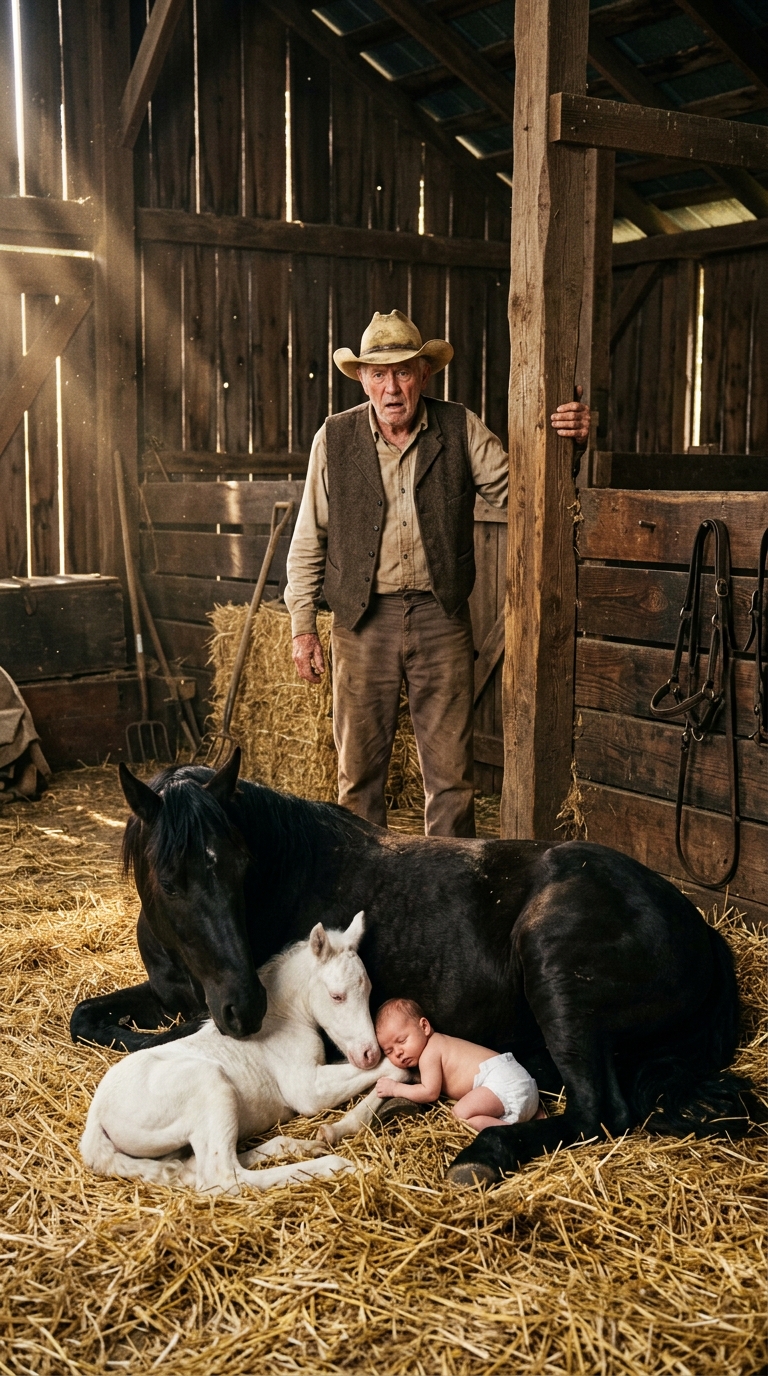
On the dirt floor lay a dapple-gray mare, large and still damp with the sweat of labor. Beside her, trembling on weak legs, a newborn filly tried to stand. But that was not what froze Don Eusebio’s blood.
Next to the filly was a human baby.
A newborn girl.
Tiny, wrapped in a man’s shirt, with clenched fists and a serene face. She was nestled against the mare’s body, nursing as if that enormous animal were the only safe thing in the world.
Don Eusebio stood motionless.
He looked around. There was no one. No fresh tracks, no voices, no signs of a woman. Only the mare, the filly, and that impossible little creature.
The mare lifted her head and looked at him. Not with fear. Not with threat. She looked at him as if she knew he had arrived late, but still in time.
Don Eusebio removed his hat.
“Holy Virgin…” he whispered.
He didn’t think too much. In the countryside, when life stands before you, you don’t ask where it came from before helping it. He approached slowly. The mare didn’t move. She only lowered her muzzle and gently brushed the baby’s head, as if to say: “This one is mine too.”
Don Eusebio lifted the little girl with care. She was warm. She was breathing well. She had no wounds. She made a small movement with her mouth but did not cry.
“Come with me, little one,” he said in a voice he hadn’t used in many years. “You’re not staying here.”
First he took the baby to his ranch, wrapped against his chest. Then he returned for the mare and the filly. The mare followed him without resistance, as if she had already decided to trust him. The filly walked clumsily behind her mother.
That day, Don Eusebio’s house changed forever.
He didn’t know how to care for babies. The last time he had held one was when Julián was born, and Doña Carmen had been alive to show him what to do. But now there was no one. So he did the only thing he knew: begin.
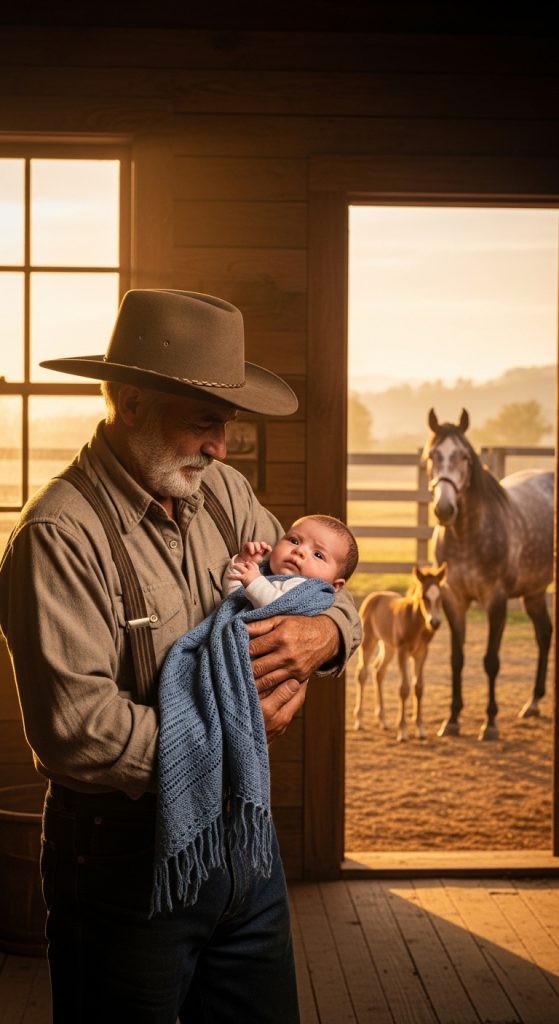
He boiled water. He looked for clean cloths. For the first time in years, he opened the drawers of his late wife. He found blankets, bandages, a small scented soap, and the blue shawl.
As he wrapped the baby in that shawl, he felt something break inside him.
“Oh, Carmen,” he said into the air. “You left me alone for this, didn’t you?”
The little girl opened her eyes. They were dark, enormous, and serious. Don Eusebio felt that gaze pierce through him.
On the third day, he gave her a name.
He called the mare Paloma, because she had arrived white with rain and dust. He called the filly Lucerita, for the light-colored spot on her forehead. And the baby, after looking at her for a long time, he named Milagros.
Because that’s what she was.
A miracle.
The town doctor arrived almost a month later, brought by a neighbor in a truck. He examined the girl, asked how she had survived, and when Don Eusebio pointed to the mare, the doctor was left speechless.
“The mare fed her?”
“Well, I wasn’t going to let her starve, doctor.”
The doctor didn’t know what to say. He only said the child was healthy, strong, and surprisingly well. Then came the paperwork, the questions, and the authorities’ suspicion. No one understood how a newborn had appeared like that. Don Eusebio didn’t either. But in the end, the girl was registered as Milagros Mendoza.
From then on, the ranch came back to life.
Milagros slept better when she heard Paloma moving in the corral. If she cried at night, the mare would approach the fence and snort softly until the girl calmed down. Lucerita grew up close to her, following the baby’s every movement with strange attention, as if both had been born with a shared secret.
Don Eusebio changed without realizing it. He fixed the gate. He painted the room. He planted a shade tree in front of the house. He lit the clay oven again. He sang softly again while making coffee.
When Julián came to visit and saw his father carrying a baby, he thought he had misunderstood life.
“Dad… whose child is that?”
Don Eusebio looked at Milagros, asleep against his chest.
“I don’t know whose she was,” he replied. “But now she’s not alone.”
Julián tried to argue. He spoke about his father’s age, the dangers, the paperwork, the responsibility. Don Eusebio listened in silence.
“Do you know what you’re doing?” Julián asked at the end.
Don Eusebio looked at the girl.
“No,” he said. “But I’m taking care of her.”
Julián said nothing more.
What no one knew was that Milagros’s story had not begun in that corral.
Her real mother was Marisol Ortega. Her father, Mateo Saldaña. They were day laborers from southern Tamaulipas, poor, hardworking people who had nothing but their hands and the hope that the next day would be less hard than the last.
Marisol was nine months pregnant when they decided to flee the ejido where they lived. A group of violent men had been roaming the area, stealing animals, threatening families, and taking what little the poor had saved through years of effort. Mateo had heard of a ranch to the north that offered steady work and a small house for families.
They left one night without saying goodbye to anyone.
They walked for three days.
On the third night, Marisol felt a sting in her ankle.
“Something bit me,” she said, clenching her teeth.
Mateo shone a flashlight. Two small marks. The skin was beginning to swell.
He thought it was a snake.
He carried her as far as he could, but Marisol was heavy with pregnancy and he was exhausted. Seeing the abandoned Ríos ranch, he took her to the corral for shelter. That night the storm began.
Marisol had a fever. Mateo wanted to stay, but she took his face in both hands.
“Go get help.”
“I’m not leaving you.”
“If you stay, all three of us will die.”
Mateo cried silently. Then he ran out into the rain, promising to return.
But he never made it in time.
In the first town where he asked for help, they mistook him for a thief who had been prowling the ranches. A stranger, thin, dirty, desperate, telling an impossible story about a wife bitten by a snake and a baby about to be born. No one believed him. They locked him up while they called the authorities.
Weeks passed.
Then months.
When they caught the real thief, Mateo had been imprisoned for nearly eight months by mistake.
He left with a grown beard, a thin body, and one idea fixed in his chest: to return to the corral where he had left Marisol.
He walked until his feet bled.
When he reached the abandoned ranch, he found no one. Not Marisol. Not the baby. Only old pieces of cloth, dry straw, and a mark on the ground where someone had once fought to live.
Mateo fell to his knees.
“Forgive me,” he said, looking at the earth. “Forgive me, Marisol.”
He spent hours there, until a peasant crossing the path told him that months earlier, Don Eusebio Mendoza had found a baby in that same corral.
Mateo felt the world stop.
“A girl?” he asked.
“Yes. A girl. She lives with him. And with a dapple-gray mare that won’t even let her breathe alone.”
Mateo ran.
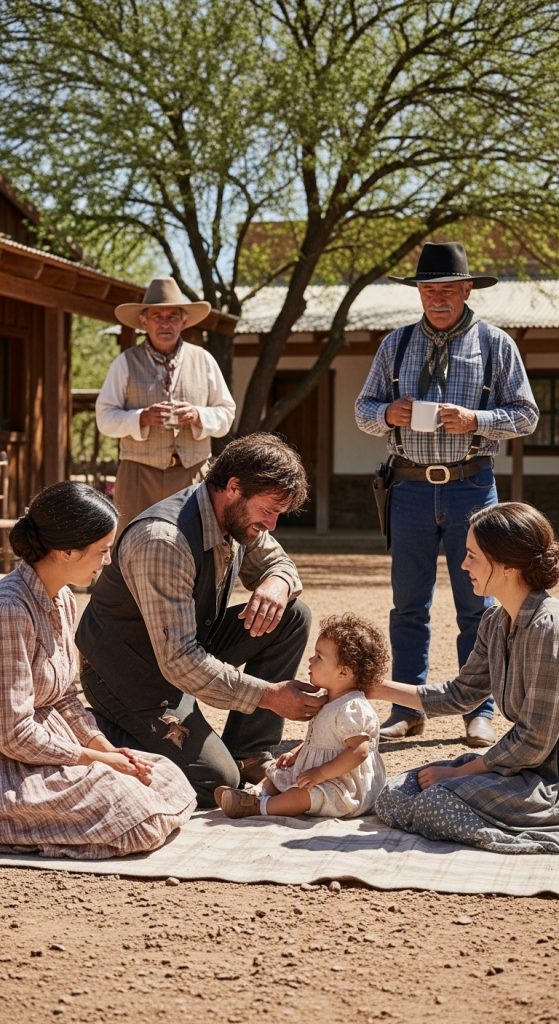
When he arrived at Don Eusebio’s ranch, he saw a little girl sitting on a blanket in the patio. She had big, serious, dark eyes. Beside her, a dapple-gray mare lowered her muzzle as if watching over her. Nearby, a young filly with a white star on her forehead was jumping around.
Mateo couldn’t move.
Don Eusebio came out of the house with a cup of coffee in his hand.
“Are you looking for someone?”
Mateo tried to speak, but his voice broke.
“I’m looking for my daughter.”
Don Eusebio felt a blow to his chest.
For months he had feared this moment without admitting it. He knew Milagros came from someone. He knew that one day someone might appear. But he never imagined it would hurt like this.
Mateo told him everything. The escape. The bite. The storm. The unjust imprisonment. The two hundred and forty-three marks he had made on the adobe wall while thinking of his wife and his baby.
Don Eusebio listened without interrupting.
When Mateo finished, Milagros crawled toward Paloma and let out a small laugh. The mare lowered her head. Mateo covered his mouth with one hand.
“She looks like Marisol,” he whispered.
Don Eusebio looked away.
“I didn’t know her name.”
“Her name was Marisol.”
There was a long silence.
Mateo looked at the old rancher.
“You saved my daughter.”
Don Eusebio swallowed.
“Paloma saved her first.”
Mateo approached Milagros slowly. The girl looked at him with curiosity. She didn’t cry. She only stretched out a hand and touched his beard. Mateo broke right there, on his knees in front of her.
“I’m your dad,” he said through tears. “I took a long time, my girl, but I came back.”
Don Eusebio felt his heart break and, at the same time, fill with peace.
That night, Mateo did not take Milagros away.
Not because he wasn’t her father, but because he understood something as he watched her sleep peacefully while Paloma kept watch by the corral and Don Eusebio adjusted the blanket with clumsy but loving hands.
“Don Eusebio,” Mateo said at dawn. “I have no home. I have no job. I don’t have Marisol. I only have my daughter. But she also has you.”
The old man didn’t respond.
Mateo took a deep breath.
“If you’ll let me, I’ll stay and work here. I’m not coming to take Milagros away. I’m coming to learn how to be her father… without tearing her away from what saved her.”
Don Eusebio pressed his lips together. He looked toward the corral. Paloma stood beside Lucerita, and Milagros slept in Doña Carmen’s blue shawl.
“There’s always a need for someone to fix fences around here,” he said at last.
Mateo lowered his head.
“Thank you.”
“And one more thing,” Don Eusebio added. “In this house, don’t call me boss.”
Mateo looked at him, confused.
Don Eusebio cleared his throat.
“Milagros calls me grandpa, even though she still doesn’t speak. So you figure out what to call me.”
For the first time in many months, Mateo smiled.
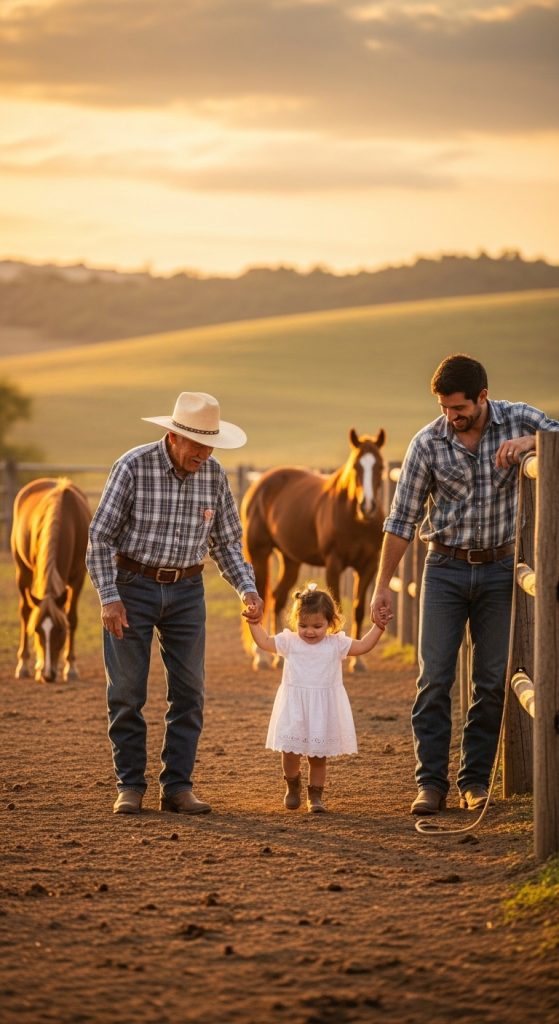
Over time, the ranch stopped being a place of silence. Julián visited more often from Monterrey. Mateo worked the land with gratitude. Don Eusebio taught Milagros to walk among the mesquite trees. Paloma continued to care for her as if the girl were also her foal. Lucerita grew strong, beautiful, and inseparable from the little one.
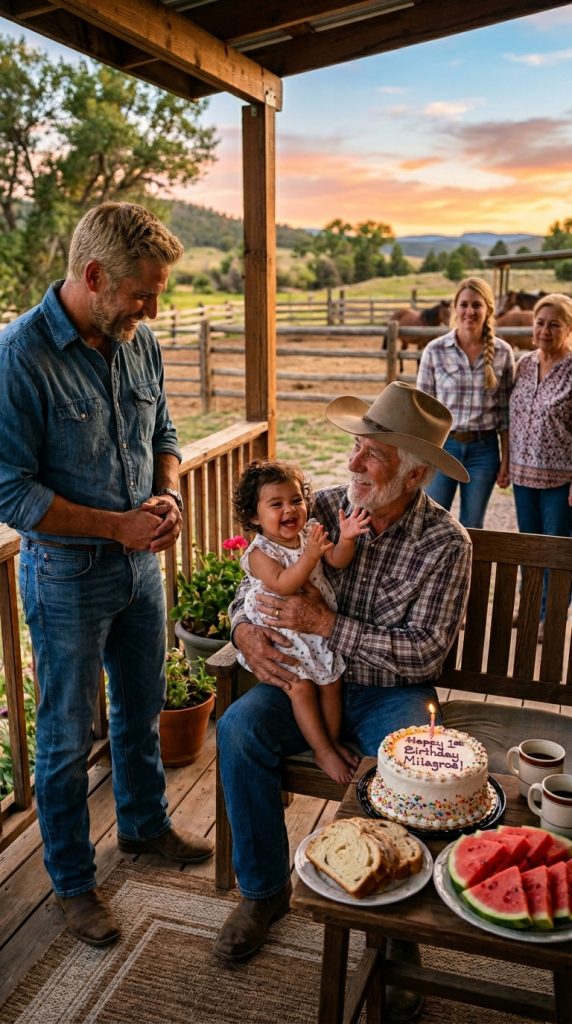
A year later, on Milagros’s birthday, they didn’t throw a big party. Just sweet bread, coffee, a watermelon sliced on the table, and a small candle stuck in a simple cake.
Mateo carried his daughter. Don Eusebio sat beside him. Paloma watched from the corral.
“Your mom left you alive,” Mateo whispered in the girl’s ear. “And God put in your path those who didn’t let you go.”
Milagros, still not understanding the words, stretched her arms toward Don Eusebio.
The old man received her with care.
And for the first time since Doña Carmen’s death, Don Eusebio no longer felt that the house was incomplete.
Because some families are not born together.
Some are found in the middle of a storm, in an abandoned corral, under the gaze of a mare who decided not to abandon a little girl.
And that, in that dry land of the north, was enough for everyone to start living again.
