

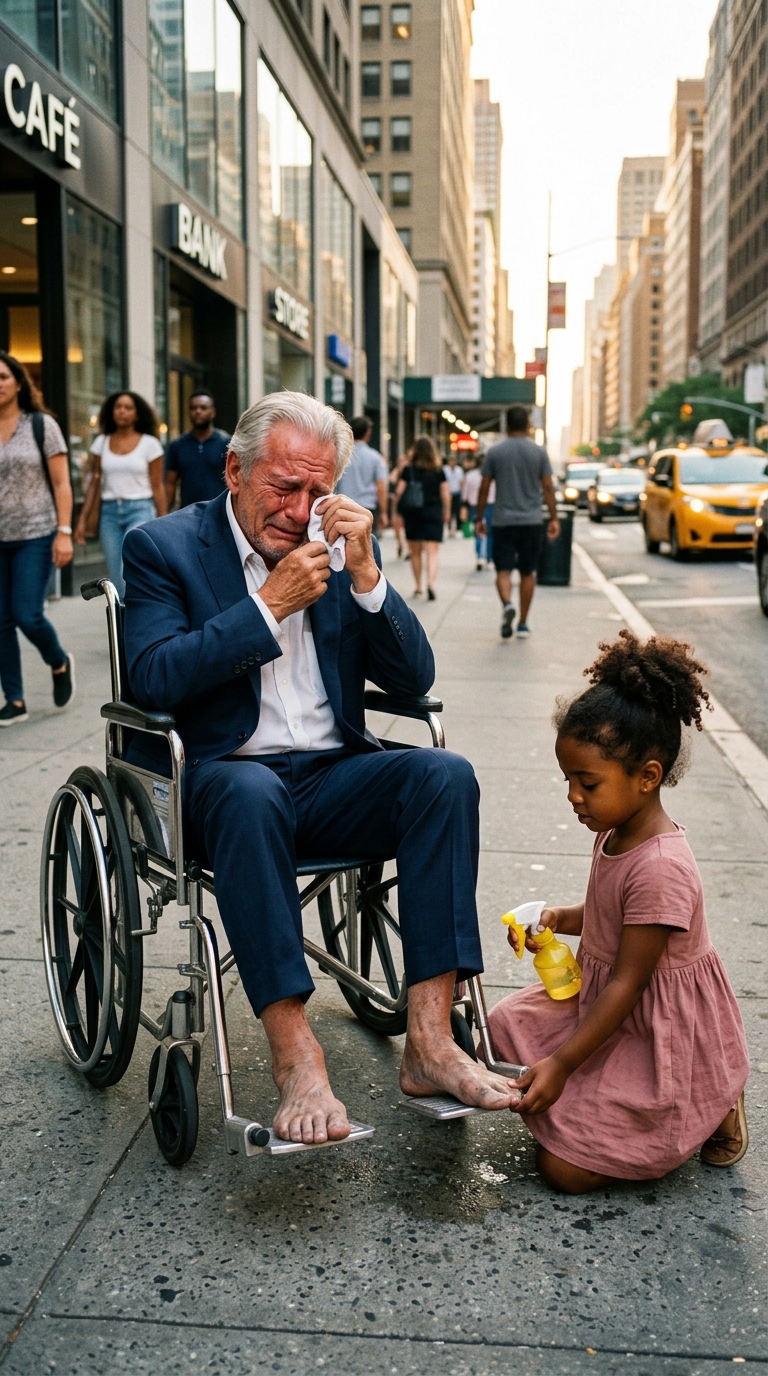
The Girl Who Spoke to the Part of Him He Had Buried
Ronan Vale was forty-three years old, wealthy enough to influence markets, buy buildings without visiting them, and make people lower their voices the moment he entered a room. From his glass-walled office in downtown Charlotte, North Carolina, he controlled investment firms, commercial properties, and a growing network of private ventures that had made his name familiar in business magazines and feared in negotiation rooms. He had the kind of success that looked untouchable from a distance.
But five years earlier, on a rain-slick highway outside Boone, one violent accident had split his life into before and after. The crash left him unable to walk, and though the injury changed his body, it was not the deepest wound he carried home with him. Something in his spirit had hardened after that night. He stopped trusting kindness. He stopped believing in anything he could not measure. Worst of all, he began treating everyone around him as if pain gave him permission to become cruel.
His estate in the Myers Park neighborhood was large, silent, and polished to perfection, yet it felt less like a home and more like a sealed vault. Employees moved carefully through its halls, speaking in quiet tones, always trying not to trigger his temper. Ronan could dismiss a driver, embarrass an assistant, or reduce a groundskeeper to silence over the smallest mistake. The pay was excellent, which meant most people stayed, but no one stayed because they felt valued.
Only one person still dared to speak to him with honesty.
Her name was Maris Holt, his executive assistant of nearly fourteen years, a fifty-seven-year-old woman with steady eyes, silvering hair, and the unusual ability to stand in front of wealth without becoming impressed by it. She remembered the version of Ronan that had existed before the accident: sharp, ambitious, demanding, yes, but still capable of warmth. She had watched grief and bitterness swallow that man piece by piece.
From time to time, she challenged him. She reminded him that suffering did not give anyone the right to wound others. She talked about grace, about second chances, about the possibility that a person could still change after becoming someone they did not recognize. Ronan usually answered with dry mockery. He said hope was for people who could not handle facts. He said faith was a story people told themselves because reality was too disappointing. He said many things. All of them protected the same hidden truth: he did not know how to live with what he had become.
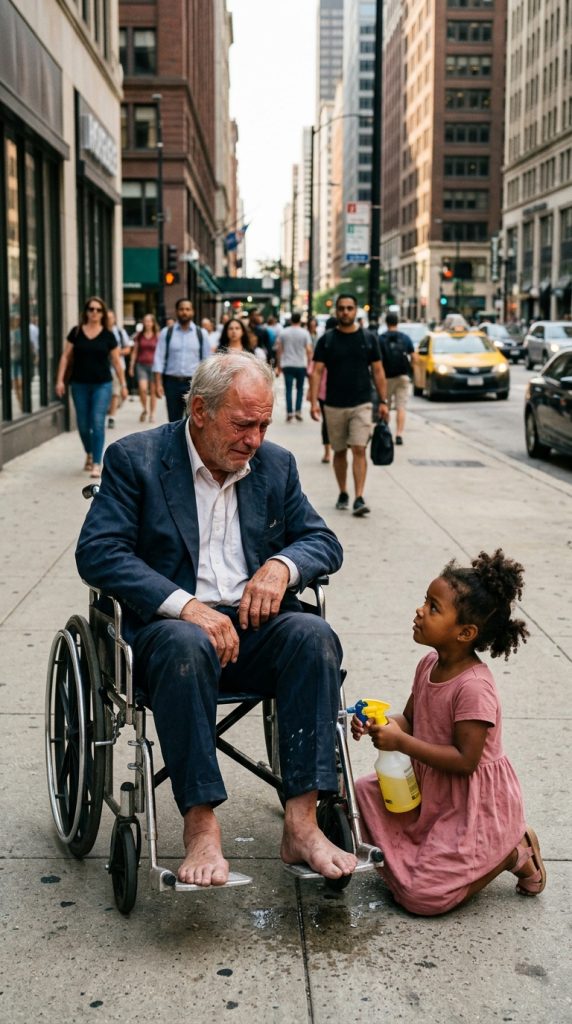
A Voice at the Car Window
One cold Tuesday morning in late February, Ronan instructed his driver to stop on Tryon Street so he could get coffee from the one café he still considered worth the inconvenience. He sat in the back seat checking messages on his tablet, irritated before the day had even properly begun, when a shadow moved across the tinted glass.
At first he assumed it was someone selling flowers or asking for money. But when he glanced up, he saw a little girl standing beside the car. She looked to be around eight years old. She was Black, barefoot despite the cold pavement, wearing a faded sweatshirt two sizes too big and leggings that had clearly seen too many nights outdoors. Her hair was loosely braided, and her face was smudged with city dust. Yet her eyes were bright and calm in a way that did not fit the traffic, the noise, or the hard edge of the street around her.
She was not tapping on the window.
She was not begging.
She was simply looking at him, as if she could see through the glass and all the layers he had built behind it.
Ronan slammed his palm against the door and snapped at the driver to move her away. The driver stepped out, trying to wave her back toward the sidewalk, but the girl did not flinch. Then, in a voice so clear it seemed to cut straight through the city noise, she spoke.
“Your legs are waking up. You’re going to walk again.”
Ronan stared at her, then hit the control and rolled the window down with a sharp, angry motion.
“What did you just say?” he demanded.
She repeated it, without trembling.
“You’re going to walk again.”
His face darkened. “Do you think this is funny? Who told you to say that?”
The girl only held his gaze.
The driver finally guided her away, though even then she did not look frightened. She stepped backward through the crowd as if she had delivered something that did not belong to her in the first place, something she had simply been entrusted to carry.
All the way back to the estate, Ronan tried to dismiss the encounter as nonsense. Yet that simple sentence stayed with him long after the sound of traffic had faded.
The First Impossible Sign
That night, Ronan was alone in his study, surrounded by dark wood shelves and the soft glow of lamplight, when he reached for a folder placed just beyond his balance point. The movement was small, careless, and badly timed. His chair tipped. He struck the floor hard.
The shock of the fall filled him with instant fury. He cursed under his breath and tried to pull himself back up, but then he froze.
Pain.
A sharp, electric stab shot through his right leg.
For five years, there had been nothing below his waist except absence. Not pressure. Not temperature. Not the smallest trace of sensation. Yet now his body was sending back something real, undeniable, and immediate.
He stayed there on the floor, breathing hard, afraid to trust what he had felt and unable to pretend he had imagined it. By the time Maris arrived fifteen minutes later, called by a broken sentence he barely managed over the phone, he was pale and shaking.
“I felt it,” he told her. “I actually felt something.”
Maris knelt beside him, her expression changing from concern to stunned focus. She helped him back into the chair and called his neurologist, Dr. Clayton Merrick, a specialist who had treated him since the accident. The doctor arrived that evening with portable equipment, clearly expecting another false alarm born from desperation.
Instead, he found the first measurable response Ronan had shown in years.
The next morning brought more tests at the hospital. Then consultations. Then scans. Then repeated confirmation from people who rarely allowed themselves surprise. There was nerve activity where none had been present before. Minimal, but unmistakable.
Ronan heard the words but barely processed them. His mind returned again and again to the child beside the car window.
“Your legs are waking up.”
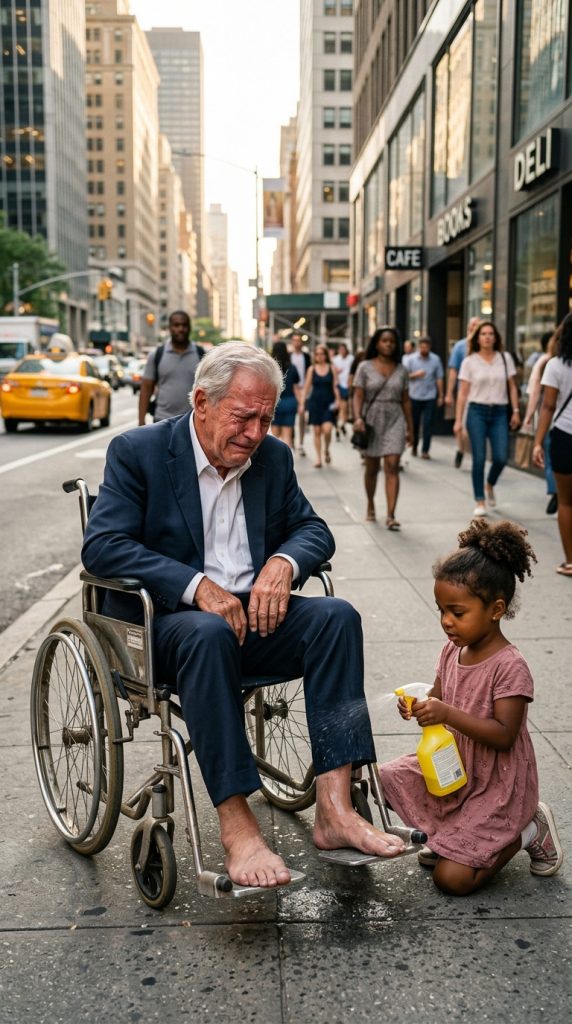
The Search for the Girl
Once he left the hospital, Ronan became fixated on finding her.
He sent his driver and two security men across Charlotte with the little information he had: a young Black girl, around eight, barefoot, oversized gray sweatshirt, calm voice, no name. They searched shelters, bus stops, underpasses, church steps, alley corners, community kitchens, and neighborhoods Ronan had likely passed for years without really seeing.
Three days went by without a trace.
His frustration grew sharp and ugly. He barked at employees over misplaced papers. He raised his voice at the gardener for trimming the hedges unevenly. He threw a crystal paperweight against the wall when a meeting link failed. It was as if panic had reopened old habits and sharpened them. He needed an answer, and anger was still the language he knew best.
Then on the fourth day, the call came.
One of the guards had found a girl matching the description sitting beneath a bus shelter near Wilkinson Boulevard, sharing half a sandwich with a stray dog curled against her side.
“Bring her here,” Ronan said instantly. “Right now.”
When the girl entered the estate that afternoon, escorted by men who suddenly seemed uncomfortable in their own jackets, she looked around with quiet curiosity, not fear. The marble floors, the high ceilings, the framed art, the polished staircase—none of it appeared to impress her.
Ronan studied her from his chair.
“What’s your name?”
“Talia,” she answered.
“Last name?”
She shrugged lightly. “I don’t have one that anybody uses.”
“Who sent you to me?” he asked. “Who told you what to say?”
Talia met his eyes with a steadiness that felt older than childhood.
“Nobody sent me. I just knew.”
Ronan leaned forward, irritated by the simplicity of her answer. “Children don’t just know things like that.”
She touched the center of her chest with one small hand. “Sometimes I feel something in here. Not like hearing with my ears. More like understanding before the words come.”
Ronan pulled several bills from his wallet and dropped them onto the table between them.
“Take this and tell the truth.”
Talia did not reach for the money.
“I don’t want your money,” she said. Then, after a pause, “But if you have food, I’d be glad for that. I’m really hungry.”
Maris, who had been standing silently near the doorway, closed her eyes for one second as if asking heaven for patience.
“For once in your life,” she told Ronan quietly, “see what’s right in front of you.”
Then she led Talia toward the kitchen.
A Child Who Changed the Atmosphere of a House
The estate’s cook, Diane Mercer, seated Talia at the long breakfast table in the kitchen and served her soup, fresh bread, and fruit. The girl ate with the deep concentration of someone who had learned not to waste either food or kindness. While she ate, she talked.
She spoke of people from the streets not as tragedies, but as neighbors. She mentioned a retired teacher named Mr. Leland who taught children to read using old newspapers. She spoke of a flower seller named Miss June who saved leftovers for kids sleeping near the train station. She described a twelve-year-old boy named Micah who watched over his younger twin sisters every night with the seriousness of a grown man. She talked about each person with respect, never pity.
Diane blinked back tears while placing a second bowl in front of her.
That evening Maris told Ronan the girl could not be sent back out into the cold.
“It’s late,” she said. “She stays tonight.”
Ronan muttered that he was not opening a shelter. Maris ignored him. There were more than twenty empty bedrooms in the house and not one good excuse that would survive speaking it aloud.
By the next morning, Talia had somehow done what no consultant, doctor, or expensive retreat had managed in years: she had softened the emotional climate of the estate without trying. Staff members smiled more. The butler, a rigid man named Edwin Shaw, found himself answering her questions with unexpected warmth. Owen, the groundskeeper who had barely spoken since losing his wife three years earlier, spent an hour showing Talia how to plant seeds in neat lines by the greenhouse.
Ronan found all of it unsettling.
At breakfast he finally asked, with more sharpness than he intended, “How long are you planning to stay?”
Talia looked at him, calm as ever.
“As long as I’m welcome.”
His pride reacted before his heart could.
“Then maybe you should go now.”
For the first time, something in the room seemed to stop. Talia set down her fork. She thanked Diane for breakfast, thanked Maris for the bed, and walked toward the front door without argument.
Ronan watched her leave and felt an ache in his chest that had nothing to do with his injury.
Two days later, the sensation in his legs increased again.
Learning to Stand in More Than One Way
Dr. Merrick recommended immediate physical therapy, and this time Ronan did not argue. The therapist, Colleen Hart, had spent years maintaining his muscle condition with little visible reward. The first time Ronan moved his toes on command, Colleen covered her mouth and cried openly. He looked away, unable to trust the hope on her face because hope had once made him feel foolish.
Still, progress came.
First pressure. Then pain. Then warmth. Then movement.
Within six weeks, he could stand with support. Within two months, he was taking careful steps with a walker across the therapy room floor. Each milestone felt almost too large to touch. The household cheered every sign of improvement, but Ronan often responded with silence. Part of him was grateful. Another part was afraid. His bitterness had become his armor. If his body healed, what excuse would he have left for the life he had been living?
In the middle of this fear, he called Maris.
“Find her,” he said. “Please.”
Maris found Talia near the same bus shelter, braiding another little girl’s hair while dividing an orange into careful pieces.
When Maris asked whether she wanted to return, Talia smiled as though the answer had never been in doubt.
Back at the estate, Ronan met her in the sunroom, standing between therapy bars, sweating with effort.
“You were right,” he said at last.
Talia tilted her head. “About your legs?”
He gave a short, unsteady laugh.
“About more than that, I think.”
She walked closer and took his hand as if it were the most natural thing in the world.
“You don’t have to understand everything right away,” she told him. “Just be thankful for the next step.”
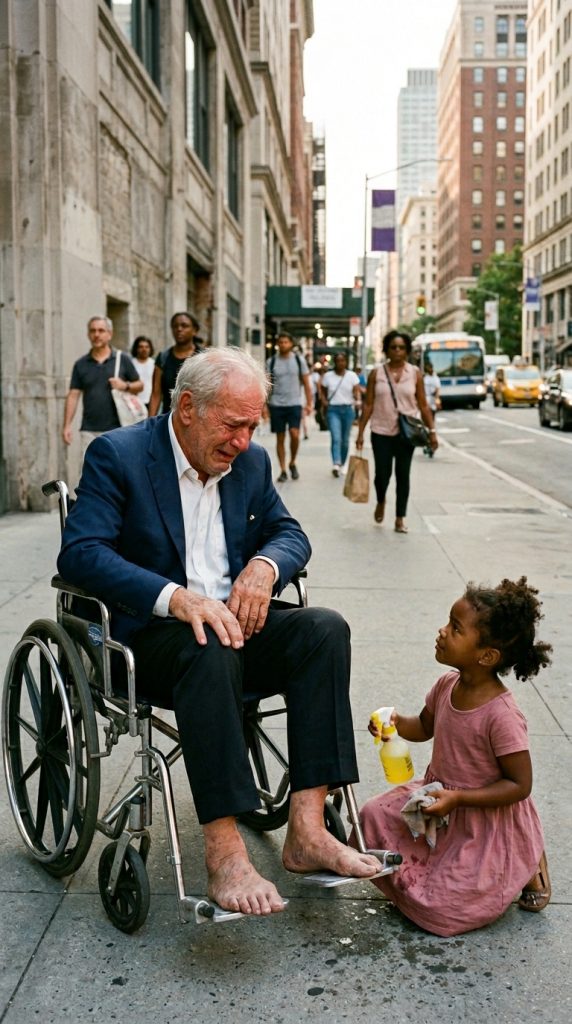
A Different Kind of Miracle
As Ronan’s recovery continued, the story began to leak beyond private walls. A few medical staff mentioned his progress. Someone in the household spoke to a cousin. A local paper ran a quiet piece. Then came more attention than Ronan wanted: reporters, curious investors, public speculation, and offers from people eager to attach themselves to a remarkable story.
One of them was Silas Brant, a polished businessman with perfect teeth, easy charm, and a proposal dressed up as generosity. He suggested branded recovery clinics, speaking tours, partnerships, sponsorships, and a foundation built around Ronan’s name.
For a dangerous moment, old instincts stirred. Ronan knew how to monetize attention. He knew how to turn sympathy into leverage.
Then Talia walked into the room.
She listened for less than a minute before looking directly at Silas.
“You don’t want to help people,” she said. “You want to use hurt people to make yourself bigger.”
The room went silent.
Silas laughed, but there was strain behind it. “That’s a serious accusation from a child.”
Talia did not look away.
“It’s still true.”
Silas left in visible irritation. Four days later, news surfaced that several of his companies were under investigation for fraud and misuse of charitable funds.
Ronan sat with the article in his hands for a long time, then looked out the window where Talia was teaching the stray dog she had named Sunny to chase a tennis ball across the lawn.
He no longer cared what label people placed on her insight. Miracle. Gift. Intuition. Grace. None of those words fully explained her. But explanations mattered less and less. What mattered was what she was awakening in him.
The House Becomes a Home
The real turning point did not come when Ronan walked ten steps alone.
It came when Maris asked him one evening, “You have more money than you can spend in three lifetimes. Why not use it to build something that outlives your name?”
Ronan almost gave his usual answer. He almost said that one man could not fix the whole world. He almost reached for cynicism like a familiar coat.
But Talia, seated on the floor with Sunny’s head in her lap, spoke before he could.
“Then help one person, and let that person help another.”
That night Ronan did not sleep. He sat by the window of his study and looked out over grounds that had once felt like proof of success and now looked strangely empty. By morning, his decision was made.
He called Maris at sunrise.
“Find a property,” he said. “Something large enough for housing, classrooms, job training, therapy rooms, and a garden. I want a place where people can heal without being made to feel small.”
What followed changed the direction of every life around him.
A former warehouse property on the west side of Charlotte was purchased and redesigned. Diane agreed to run the community kitchen. Owen planned a therapeutic garden program. Colleen created a mobility and rehabilitation center for people who could never have afforded private care. Mr. Leland was invited to teach reading and writing. Miss June would manage a flower corner at the entrance. Micah and his sisters would receive family housing and education support.
When Ronan suggested naming the place after himself, Maris gave him a look that ended the idea immediately.
So the center became Haven House.
The Man He Became
Construction took six months. During that time, Ronan did something even harder than learning to walk again: he started apologizing. He reached out to former employees he had dismissed unfairly. He offered compensation when he could, sincere words when money was not enough, and the humility to accept rejection when some people wanted nothing from him anymore.
That lesson mattered. Forgiveness, he discovered, was not a switch someone owed you. It was a road you had to walk without demanding a reward.
On the day Haven House opened, Ronan stood before a crowd with a cane at his side and gratitude in his voice. He looked stronger than he had in years, though not because of his posture. Strength had returned to his face in a different form. He looked like a man no longer hiding behind his injury.
He spoke honestly. He told the crowd that his greatest healing had not started in a hospital room, but in a moment when a barefoot child spoke hope into a life that had gone cold. He said that walking again mattered, but it was not the whole miracle. The deeper miracle was learning to care without fear, to give without control, and to understand that love often enters a life through the people the world overlooks.
When he finished, the applause was not formal. It felt full, relieved, almost tender.
Months later, the idea of adopting Talia no longer felt like a possibility. It felt like truth waiting for paperwork.
Ronan confessed his fear to Maris one evening.
“I don’t know how to be a father.”
Maris smiled softly.
“No one starts out knowing. They learn by staying.”
The process took time and scrutiny, as it should have. Social workers reviewed his past, his household, his transformation, and the structure of support around Talia. Maris agreed to serve as legal co-guardian if ever needed. When the adoption was finally approved, Ronan cried without trying to hide it.
Talia threw her arms around him and whispered, smiling against his shoulder, “So now I can call you Dad for real.”
He laughed through tears.
“You always could.”
Walking Forward
One quiet evening in early spring, Ronan and Talia walked through the gardens at Haven House while Sunny limped happily ahead of them, still old, still scarred, still deeply loved. Ronan no longer needed assistance on most days, though a cane remained useful when the weather turned cold. Talia brushed her fingertips over the flowers planted in memory of people who had suffered and survived.
After a while, Ronan asked, “Do you believe in miracles?”
Talia looked up at him with the same calm certainty she had carried the day she stood beside his car.
“I believe miracles don’t always look the way people expect,” she said. “Sometimes they look like a child being heard. Sometimes they look like a man learning how to say he was wrong. Sometimes they look like a place where people get to begin again.”
Ronan looked across the property, at the children running near the garden, the kitchen lights glowing, the classrooms filled, the therapy room windows bright against the evening sky. Then he looked down at the small hand resting trustingly in his.
At last, he understood the full truth.
He had not only learned how to walk again.
He had learned how to live.
Real change does not always begin with power, money, education, or status, because sometimes the turning point in a person’s life begins with one honest voice that reaches the part of them they have spent years trying not to feel.
A wounded heart can hide behind pride for a very long time, but healing often starts the moment someone chooses compassion over control and allows kindness to enter where bitterness once felt safer.
People who seem the strongest from the outside may be carrying the deepest emptiness within them, which is why gentleness can become a greater force than pressure, shame, or fear ever could.
The world is quick to overlook those who appear small, poor, tired, or forgotten, yet some of the most life-changing wisdom we will ever receive may come from the very people society has failed to notice.
Recovery is not only about the body doing what it could not do before, because true recovery also means learning how to speak more softly, love more honestly, and treat other people with the dignity we once denied them.
Saying sorry does not erase the past, but sincere repentance matters because it proves a person is no longer asking to be excused and is finally willing to become responsible for the harm they caused.
Hope is not weakness, and faith is not foolishness, because both can give a person the courage to take the next step even when they cannot yet see the full road in front of them.
A home becomes meaningful not when it is filled with luxury, but when it becomes a place where people are safe, welcomed, nourished, and reminded that their lives still carry worth.
No one is too broken to begin again, and no life is too damaged to hold purpose, because grace often arrives in quiet ways and rebuilds people one honest choice at a time.
The greatest miracle in any human life may not be the visible blessing that others celebrate, but the invisible transformation that teaches a wounded person how to become loving, humble, and fully alive again.
