

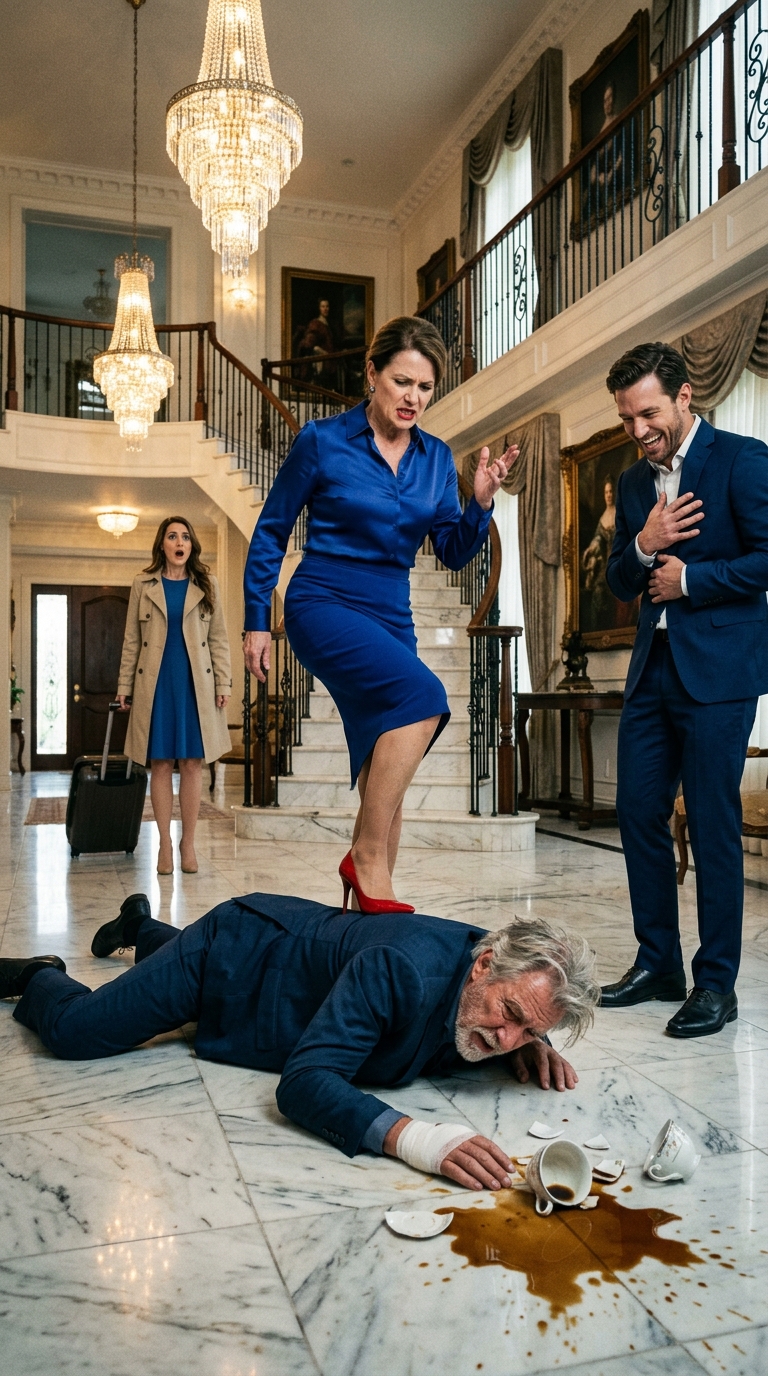
I arrived home just in time to witness my injured father dragging himself across the marble floor while my stepmother stood over him laughing.
“Crawl faster, Richard, or you get no medicine,” she said, pressing her heel near his trembling hand.
My stepbrother smirked nearby, proudly wearing my father’s watch like a prize he had stolen.
They believed I was still the powerless daughter who had run away years ago.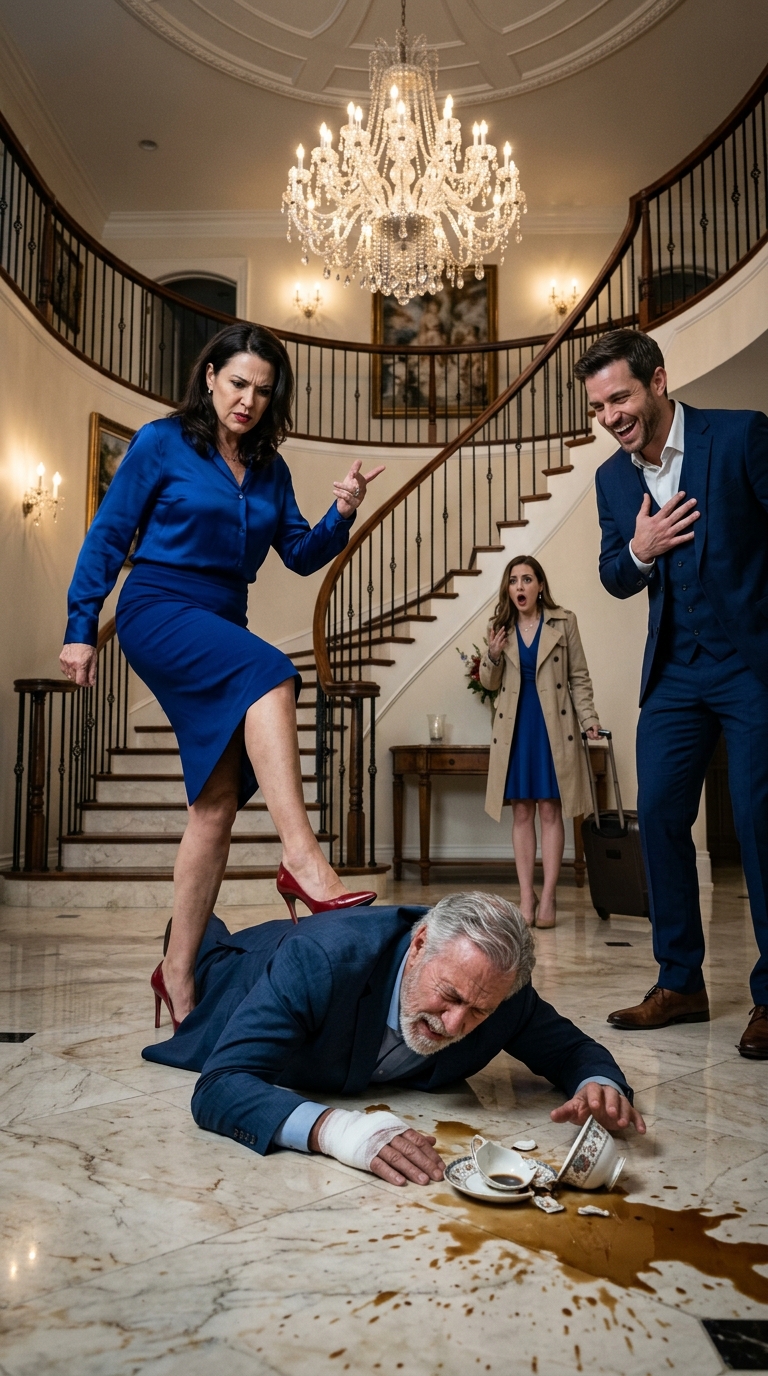
What they didn’t know was that I had returned with evidence, attorneys, and one final signature capable of destroying everything they had built on lies.
My stepmother forced my injured father to crawl across the floor just to serve her tea.
She laughed when the cup trembled in his hand and hot tea splashed onto his bandaged wrist.
“Useless old man,” Vivian said, lifting one red heel and pressing it against his shoulder. “You used to own half this city. Now look at you.”
My father, Richard Hale—the founder of Hale Construction—tightened his jaw but remained silent.
His right leg had never fully recovered from the accident.
Several ribs were still healing.
Yet his deepest wound wasn’t physical.
It was humiliation.
I stood frozen in the doorway, a suitcase hanging from my hand.
Vivian noticed me first.
Her smile was sharp enough to cut glass.
“Well, well. The orphan princess returns.”
Six years had passed since I left.
Six years of law school.
Six years of corporate investigations.
Six years spent learning how powerful people hid their crimes behind paperwork and polished smiles.
I returned because Dad’s longtime nurse had sent me a single message.
Come home. Something is wrong.
Now I understood exactly what she meant.
Behind Vivian stood Marcus, wearing my father’s watch.
My father’s watch.
“Isabella,” Dad rasped weakly. “You shouldn’t have come.”
Marcus laughed.
“Listen to him. Even broken, he knows you can’t help.”
Vivian crossed the room and air-kissed beside my cheek.
The expensive perfume she wore couldn’t disguise the rot underneath.
“Your father signed everything over. The house. The company shares. The accounts. He understood who actually takes care of him.”
Dad lowered his eyes.
Shame seemed to swallow him whole.
I carefully set down my suitcase.
“Did he?” I asked.
Vivian’s smile tightened.
“Careful, girl.”
“Or did you make him sign while he was drugged?”
The room went silent.
The kind of silence that arrives just before a storm breaks.
Marcus stepped forward immediately.
“You better watch your mouth.”
I glanced at his wrist.
Then at Vivian’s heel resting against my father.
“Take your foot off him.”
Vivian chuckled.
“And if I don’t?”
Without answering, I walked past her, helped my father sit upright, and gently wiped the tea from his shaking hand.
Vivian’s voice sharpened.
“This is my house now.”
I slowly looked around the mansion my mother had helped design before cancer took her away.
The memories remained.
The love remained.
Only the people inside had changed.
“No,” I said quietly. “It’s a crime scene.”
Marcus laughed again.
That was his first mistake.
Because I had not returned to beg.
I had come with court filings in my suitcase, recordings stored on my phone, and copies of my father’s original trust documents already secured by three separate law firms.
Vivian believed she had trapped a wounded man.
What she failed to realize was that his daughter had become the kind of woman who dismantled predators legally, publicly, and permanently.
The next morning, she learned exactly how dangerous that could be.
At nine o’clock sharp, six attorneys arrived.
Behind them came two forensic accountants.
Then three investigators.
Finally, a judge-signed emergency order.
Vivian nearly dropped her coffee.
“What is this?”
I handed her the paperwork.
“A temporary injunction.”
Marcus grabbed the documents.
“You can’t do this!”
“Actually,” one of my attorneys replied calmly, “she already has.”
Within an hour, every account connected to the disputed transfers was frozen.
Within two hours, investigators began examining years of financial records.
Within three hours, the truth started surfacing.
Large withdrawals.
Forged signatures.
Altered medical reports.
Hidden transfers.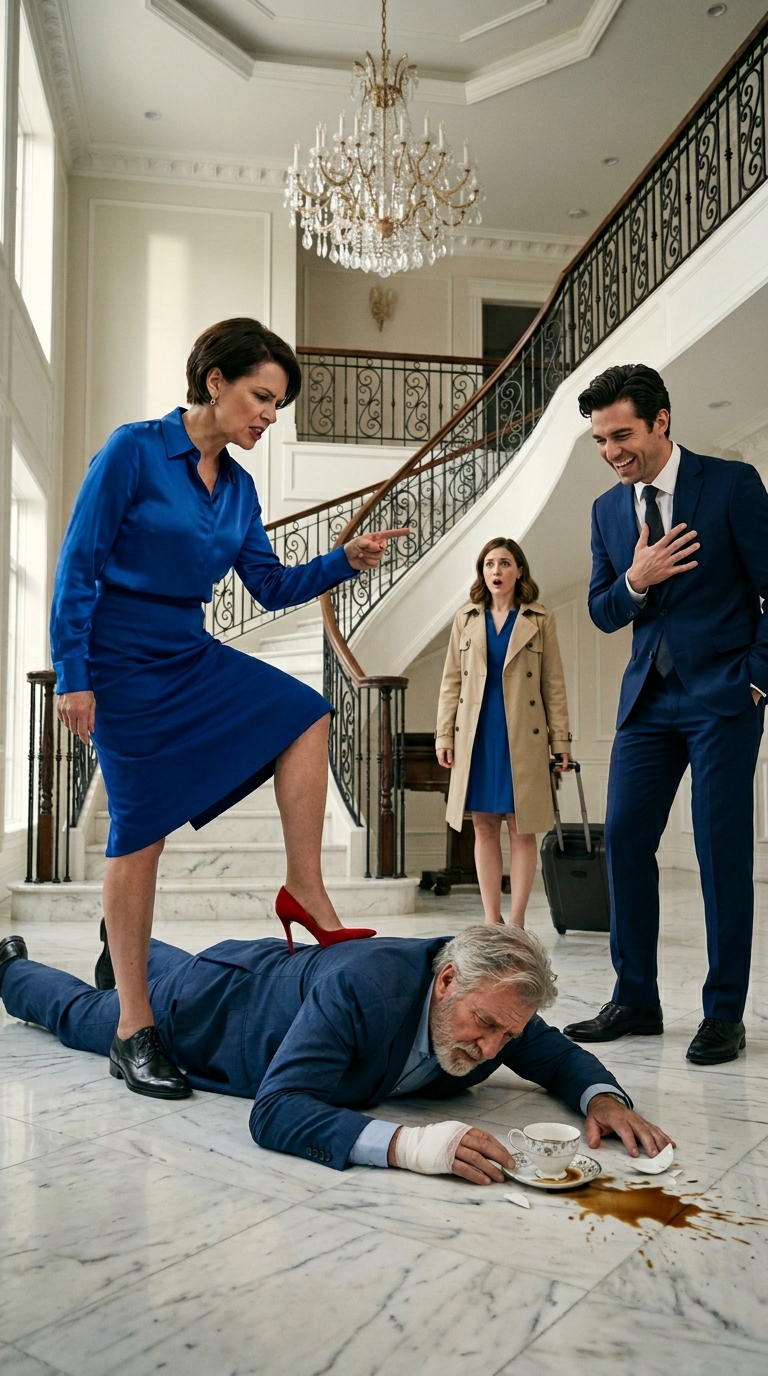
Drug purchases billed through company accounts.
The deeper investigators looked, the uglier it became.
By evening, Vivian was screaming.
By midnight, she was panicking.
Three days later, everything collapsed.
The nurse testified.
The doctors testified.
The financial records testified.
Even several former employees testified.
One by one, the lies unraveled.
The evidence proved that Vivian had manipulated my father’s medication while pressuring him into signing documents he barely understood.
Marcus had helped transfer money through shell companies.
Both of them had assumed no one would ever challenge them.
They were wrong.
The court reversed every fraudulent transfer.
The mansion returned to my father.
The company shares returned to my father.
The bank accounts returned to my father.
And when criminal charges followed shortly afterward, neither Vivian nor Marcus could escape the consequences.
The day they were escorted from the mansion, Vivian turned toward me.
“You ruined us.”
I looked at her calmly.
“No. You ruined yourselves.”
Marcus said nothing.
For the first time in his life, he had no clever remark.
No laughter.
No stolen trophy.
Not even my father’s watch.
I had already taken it back.
A month later, Dad sat in the garden watching the sunset.
His health was improving.
Slowly.
Painfully.
But improving.
I brought him a cup of tea.
This time, he didn’t have to crawl for it.
“I’m sorry,” he said quietly.
“For what?”
“For not protecting you after your mother died.”
I sat beside him.
“You were grieving too.”
“I should have seen what Vivian was becoming.”
I looked at the roses my mother had planted years earlier.
“You see it now.”
His eyes filled with tears.
“I nearly lost everything.”
I squeezed his hand.
“You didn’t lose me.”
For a moment, neither of us spoke.
Then he smiled.
The first genuine smile I had seen from him in years.
Months passed.
The company stabilized.
Dad stepped back from daily operations.
To everyone’s surprise, he asked me to become CEO.
“I built this company,” he said during a board meeting, “but Isabella saved it.”
The board voted unanimously.
For the first time, I sat in the chair that had once belonged to him.
Not because of inheritance.
Because I had earned it.
Under new leadership, Hale Construction flourished.
Employee programs expanded.
Scholarships were created.
Safety standards improved.
Profits rose.
More importantly, the company regained its integrity.
Then one spring afternoon, something unexpected happened.
I met Daniel.
He was an architect hired for one of our largest projects.
Unlike most people, he had no idea who I was when we first met.
He spilled coffee on my presentation.
Apologized profusely.
Then spent twenty minutes making me laugh.
It was the most normal conversation I’d had in years.
Friendship came first.
Then trust.
Then love.
He never cared about the mansion.
Never cared about the company.
Never cared about the wealth.
He cared about me.
One evening, Dad watched Daniel helping repair a broken garden bench.
After a long silence, he leaned toward me.
“He’s a good man.”
“He is.”
“He reminds me of someone.”
“Who?”
My father smiled.
“The man I wanted to be.”
Two years later, Daniel proposed beneath the oak tree where my parents had once shared their first anniversary picnic.
I said yes before he could even finish asking.
Dad cried.
Openly.
Shamelessly.
And nobody teased him for it.
On our wedding day, he walked me down the aisle himself.
His leg still carried a slight limp.
His hair had turned silver.
But his dignity had returned.
As he placed my hand in Daniel’s, he whispered:
“Your mother would be proud of you.”
For a moment, tears blurred my vision.
The ceremony took place in the garden.
The same garden where Vivian once mocked him.
The same garden where hope had nearly died.
Now it overflowed with flowers, laughter, and family.
Real family.
People who loved one another.
People who stayed.
As the sun began to set, I looked around at everything we had reclaimed.
Not the mansion.
Not the money.
Not the company.
Those were only things.
What we had truly recovered was far more valuable.
Our peace.
Our dignity.
Our future.
The woman who had returned home carrying a suitcase full of legal documents had come expecting a battle.
She never imagined she would also find healing.
Or forgiveness.
Or love.
But sometimes justice doesn’t simply punish the guilty.
Sometimes it gives the wounded a chance to begin again.
And as I stood beside my husband, with my father smiling proudly from the front row, I realized something beautiful.
The people who tried to break us had failed.
Because in the end, we weren’t defined by what they took.
We were defined by what we rebuilt.
Together.
And that became the happiest victory of all.
