

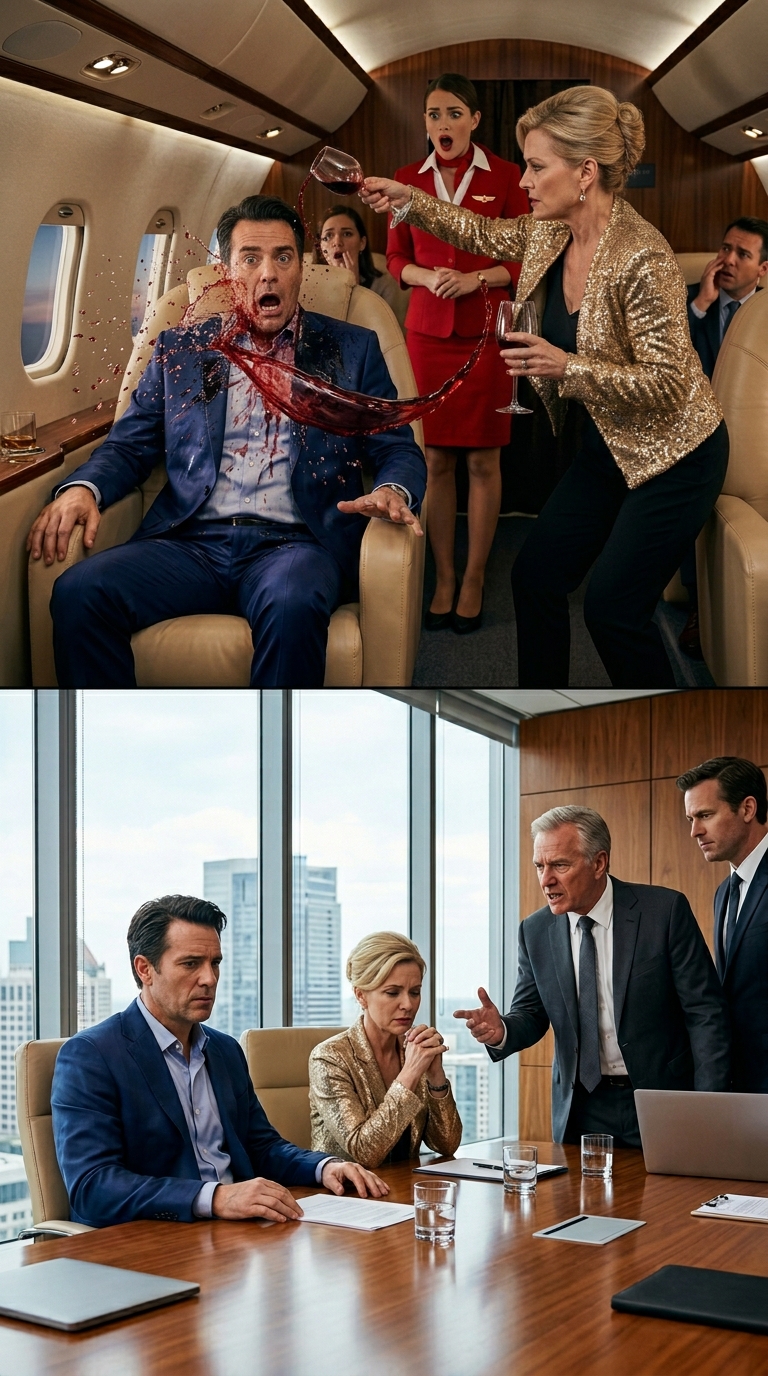
The freezing splash of carbonated soda struck my chest before my mind could even process what had happened.
I shot to my feet from seat 2A as dark liquid soaked through my tailored Tom Ford suit and spread across the confidential acquisition documents sitting on my tray table.
“Oops,” a sharp voice dripping with sarcasm sang out above me.
I wiped the soda from my face and looked up.
Standing in the aisle was a middle-aged woman wrapped in designer labels, clutching an empty glass.
Her lips twisted into a look of pure contempt.
“You’re in my space,” she hissed, leaning close enough for me to smell the alcohol on her breath. “And I don’t sit next to people who look like you. Especially not in first class.”
My name is Julian Vance.
I am the founder and CEO of Vanguard Holdings, a multi-billion-dollar consumer products company.
I’ve spent years navigating high-stakes negotiations, difficult boardrooms, and fierce competitors.
Yet I had never experienced someone openly humiliating me at thirty thousand feet simply because of the color of my skin.
I kept my voice calm.
Measured.
Controlled.
“Ma’am, you just ruined legally binding documents. Sit down and back off. Now.”
Instead of stepping away, she shoved her designer handbag into my shoulder.
“Don’t you dare give me orders!” she screamed.
Passengers turned immediately.
“Do you know who I am? My husband is Arthur Sterling! He practically owns this airline! I will have you thrown off this plane in handcuffs!”
A flight attendant hurried over.
“Mrs. Sterling, please—”
“Get this thug out of my sight!” she yelled, pointing directly at me. “He threatened me! He tried to touch my bag! Call air marshals right now!”
Before I could respond, she reached toward my laptop.
Her hand slammed down onto the screen.
She attempted to yank it from the tray table.
I grabbed her wrist to stop the device from crashing to the floor.
My phone tumbled into the aisle.
“Let go of me!” she shrieked.
She jerked her arm away and raised her hand as though preparing to strike me.
The cabin froze.
Then something interesting happened.
I smiled.
Not because I enjoyed the situation.
Not because I wasn’t angry.
But because I knew something she didn’t.
Mrs. Sterling believed her husband’s name could solve any problem.
What she didn’t know was that I had spent the last six months negotiating the largest acquisition of my career.
And Arthur Sterling was at the center of it.
The remainder of the flight was tense.
Flight attendants separated us.
Witness statements were collected.
Several passengers volunteered to provide accounts of what happened.
Mrs. Sterling spent the next two hours loudly complaining.
Threatening lawsuits.
Threatening jobs.
Threatening everyone.
I simply reviewed documents on a backup tablet and waited.
As the aircraft began its descent, my phone vibrated.
A message appeared.
DEAL FINALIZED.
BOARD VOTE UNANIMOUS.
CONGRATULATIONS.
I looked out the window and smiled.
Perfect timing.
The moment the plane landed, airport security was waiting at the gate.
Mrs. Sterling immediately pointed toward me.
“There he is!”
Security officers calmly ignored her.
Instead, they spoke with the flight crew.
Witnesses.
Passengers.
The flight attendant.
Within minutes it became obvious what had happened.
Mrs. Sterling’s confidence started fading.
Then a tall man in a dark suit approached me.
“Mr. Vance?”
“Yes.”
“Your car is waiting.”
Mrs. Sterling overheard.
Her eyes narrowed.
“Who exactly are you?”
For the first time, I answered.
“Julian Vance.”
The name meant nothing to her.
At first.
Then her face slowly changed.
Recognition.
Confusion.
Panic.
“Wait.”
I said nothing.
Her expression grew paler.
Because Arthur Sterling had spoken about Vanguard Holdings countless times.
And she finally remembered why.
Three hours later, I arrived at Sterling Aviation headquarters.
Not as a guest.
As the new majority owner.
Months earlier, Arthur Sterling had quietly sought investors after a series of poor business decisions placed his company under severe financial strain.
The deal finalized that afternoon transferred controlling interest to Vanguard Holdings.
Arthur remained employed.
But he no longer controlled the company.
And neither did his family.
At 4:00 p.m., Arthur entered the boardroom.
He looked exhausted.
Then he saw me.
His expression changed instantly.
“You were on that flight.”
“I was.”
Arthur closed his eyes.
Slowly.
Painfully.
Then he asked:
“What happened?”
I explained everything.
The soda.
The insults.
The threats.
The witnesses.
The attempted destruction of company documents.
The silence afterward felt enormous.
Finally Arthur spoke.
“I’m sorry.”
It sounded genuine.
“Julian… I’m truly sorry.”
I believed him.
Because unlike his wife, he understood consequences.
The next morning, Mrs. Sterling requested a meeting.
I almost declined.
Eventually I agreed.
She arrived without designer confidence.
Without arrogance.
Without an audience.
For the first time, she looked human.
“I came to apologize.”
I remained silent.
Tears filled her eyes.
“I don’t know why I behaved that way.”
The answer was obvious.
Entitlement.
Prejudice.
Arrogance.
But saying those words wouldn’t change anything.
Instead I asked:
“Do you understand why it was wrong?”
She nodded immediately.
“Yes.”
For several moments neither of us spoke.
Then she surprised me.
“I embarrassed my family.”
I shook my head.
“No.”
I looked directly at her.
“You embarrassed yourself.”
She lowered her eyes.
And for the first time since we’d met, she had nothing to say.
Months passed.
The incident spread online after passengers posted videos.
Millions watched.
Opinions flooded social media.
But I refused to make it a public spectacle.
I declined interviews.
Rejected television appearances.
Ignored attempts to turn the event into entertainment.
Instead, I focused on something more useful.
Change.
Working alongside several aviation organizations, Vanguard funded customer-service and anti-discrimination training programs across multiple travel companies.
Something positive emerged from an ugly experience.
Meanwhile, Sterling Aviation slowly recovered.
Arthur proved to be a capable executive once his focus returned to running the company rather than protecting family drama.
Surprisingly, he and I developed mutual respect.
Not friendship.
Respect.
Years later, I attended a scholarship ceremony funded jointly by Vanguard and Sterling Aviation.
Students from underrepresented communities received scholarships for business, engineering, and aviation careers.
As I walked through the event, someone approached.
Mrs. Sterling.
Older now.
Quieter.
Different.
She wasn’t carrying designer bags.
Wasn’t issuing threats.
Wasn’t demanding attention.
Instead she handed me a small envelope.
Inside was a handwritten note.
It simply said:
“Thank you for showing more grace than I deserved.”
I folded the letter carefully.
Then smiled.
Because life had taught me something important.
Victory isn’t always watching someone fall.
Sometimes victory is watching someone grow.
The young scholarship recipients filled the room with excitement and possibility.
Their futures stretched endlessly ahead.
As I stood on stage later that evening, I looked across the crowd and thought back to that first-class cabin.
The spilled soda.
The insults.
The humiliation.
At the time, it felt like a confrontation.
In reality, it became an opportunity.
Not for revenge.
For perspective.
The woman who tried to destroy my day didn’t destroy my future.
She couldn’t.
Because my future had never belonged to her.
It belonged to me.
And as the audience rose in applause while students celebrated the next chapter of their lives, I realized something.
The best endings aren’t built on revenge.
They’re built on moving forward.
With dignity.
With purpose.
And with the confidence that no one else’s prejudice can define your worth.
That flight landed years ago.
But the lesson stayed with me.
Never underestimate the power of staying calm while someone else reveals exactly who they are.
Because sometimes the person smiling quietly isn’t losing.
They’re simply waiting for the truth to arrive.
