

PART 1
Isabel de la Torre knew the dress was ruined the moment she saw her sisters smiling.
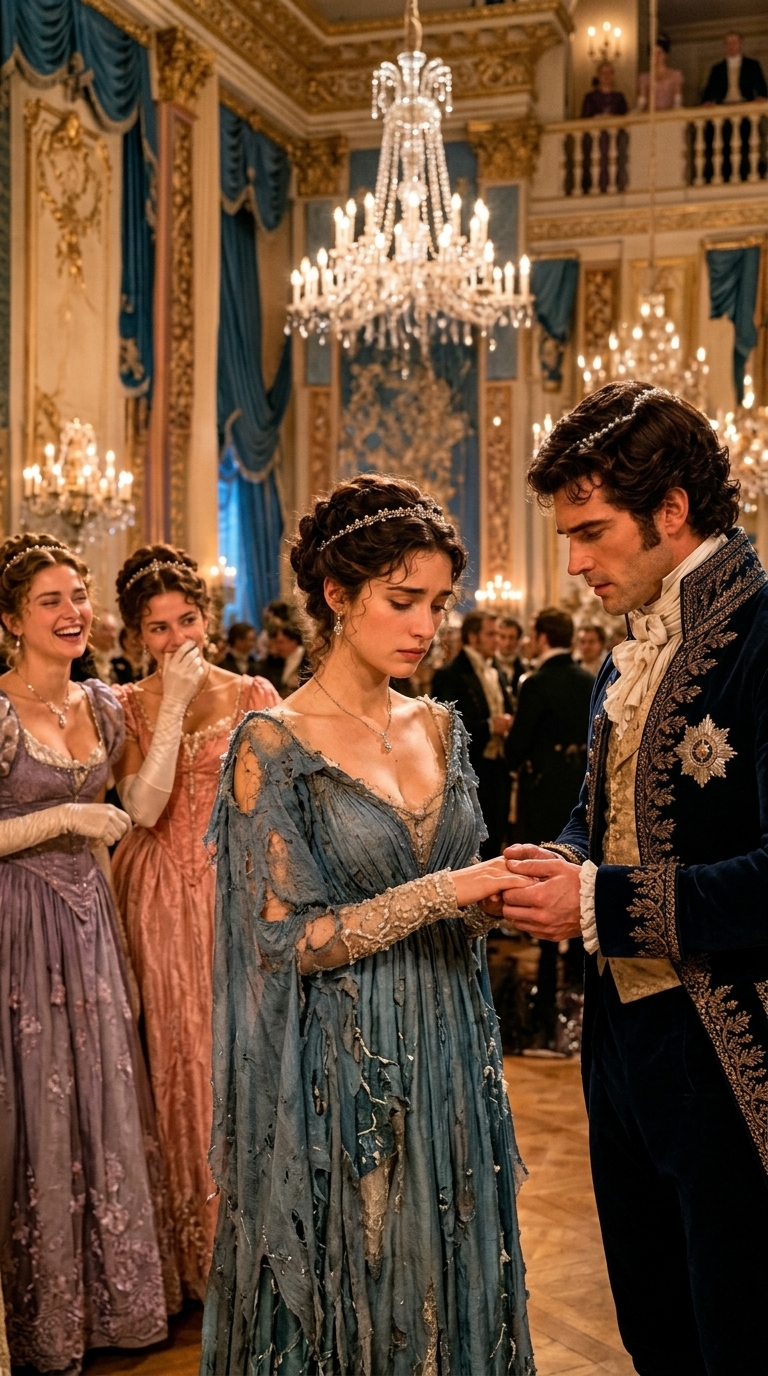
Catalina held it between her hands as if presenting a jewel to the court, while Mercedes pretended to adjust her fan to hide her laughter. The silk, which must once have been sky blue, now had the sad color of clouds before rain. The lace was yellowish, the hem hung crooked, and one sleeve was wider than the other.
“It’s for you,” Catalina said with poisonous sweetness. “For the ball hosted by the Marquis of Santa Lucía.”
For a moment, Isabel wanted to believe it. Don Alejandro de Almonte’s ball was the most anticipated event of the season in Puebla. All the old families had been talking about it for weeks. All the mothers dreamed of their daughters being seen beneath the crystal chandeliers. All the young women imagined a distinguished hand asking them to dance.
Isabel had not expected to attend.
Since her mother’s death, the de la Torre household had become a cold place, filled with extinguished prayers, covered furniture, and unpaid bills. Her father, Don Eusebio, lived shut away in his study, surrounded by letters from creditors and ever-longer silences. Catalina and Mercedes, beautiful, proud, and desperate to marry well, saw every ball not as a party but as an escape.
Isabel, the youngest, was barely a useful shadow.
She sewed on buttons. She mended tablecloths. She helped the maids when no one was looking. Under her mattress, she kept a notebook full of dress designs she would never be able to wear: sleeves like flowers, embroidery like vines, light skirts for women who entered a ballroom without fear.
But that afternoon, when she touched the dress, she discovered the trap.
The waist had been unpicked from the inside. It was not wear. It was not an accident. If she walked too quickly, if she breathed deeply, if someone touched her with force, the fabric would open in front of everyone.
“I can’t wear this,” she whispered.
Mercedes let out a little giggle.
“In a room with so many candles, no one will notice the flaws.”
Catalina approached, smoothed her shoulder with false tenderness, and pressed right where the seam was weakest.
“Then try not to move too much, little sister.”

Isabel looked her in the eyes and understood. They did not want to do her a favor. They wanted to take her to the ball to humiliate her. They wanted everyone to see the poor daughter, the forgotten sister, the girl who did not deserve to be chosen.
“Don’t cry,” Catalina murmured. “Tears stain the silk, though this one is already beyond repair.”
Downstairs, Don Eusebio’s voice ordered them to hurry. The carriage was waiting.
Isabel wanted to refuse. She wanted to throw the dress on the floor. But she knew her father would not ask what had happened. He would only say there was no money for whims, that an obedient daughter did not make scenes, that the family already had enough shame.
So she dressed.
Before going down, a young maid named Tomasa arrived with her apron torn, trembling because the housekeeper could fire her. Isabel, still wearing the dress with cold hands, took needle and thread and repaired the fabric with small, firm stitches.
“You sew better than any dressmaker on Mercaderes Street,” Tomasa said, admiring her.
Isabel smiled sadly.
“Perhaps one day I will dress important ladies.”
“Or marchionesses,” the girl replied.
Isabel almost laughed. Then she heard Catalina calling her from the hallway.
“Isabel! Do you also plan to arrive late to your own humiliation?”
The carriage moved along cobblestone streets, oil lamps, and decorated balconies. Upon arriving at the Santa Lucía residence, Isabel saw women covered in pearls descending, mothers with calculating looks, and gentlemen who smelled of tobacco, money, and ambition.
Don Alejandro de Almonte, Marquis of Santa Lucía, had returned to social life after years of absence. He was still young, rich, powerful, and single. That was enough to turn his ball into a battlefield.
From the top of the main staircase, Alejandro observed his guests with the serene expression of someone who had learned to distrust every smile. His aunt, Doña Amalia, told him in a low voice:
“You will have to dance tonight.”
“I know.”
“With some available lady.”
“I feared you were going to mention the footmen.”
Doña Amalia sighed.
“Not all of them come to hunt you.”
Alejandro looked at the ballroom. He saw mothers pushing daughters, young women practicing blushes, gentlemen calculating dowries. He had grown up among titles, other people’s debts, and outstretched hands. He knew how to distinguish courtesy from hunger.
Then the de la Torre family was announced.
Catalina entered first, dressed in pink. Mercedes followed in gold. Then Isabel appeared.
The murmur changed tone.
It was not admiration. It was judgment.
The blue dress looked even sadder beneath the chandeliers. The mended seams were noticeable. The cheap lace hid nothing. Isabel kept her chin high, but she felt every look like a needle.
“Stand up straight,” Mercedes whispered. “If you slouch, the dress looks even more miserable.”
Catalina smiled for the others and squeezed her arm.
“Stay here. From this corner you can watch how the real ladies dance.”
Isabel lowered her gaze. She was about to step back when a tray of glasses trembled near her. Tomasa, who was serving that night at the marquis’s house, had tripped. Before the crystal fell, Isabel held the tray with both hands.
“Nothing happened,” she told her quietly. “Breathe.”
Tomasa looked at her with gratitude and fled before anyone could accuse her.
A little later, an elderly countess lost her balance while trying to reach her cane. Everyone saw her, but no one moved quickly enough. Isabel did. She held her arm and helped her sit down.
“You saved me from a public fall, child,” the countess said.
“Then we’ll say you just wanted to rest,” Isabel replied.
From the other end of the ballroom, Alejandro saw everything.
He also saw how Catalina scolded her for dealing with maids. He saw Mercedes laughing behind her fan. He saw Isabel trying to disappear after helping two people no one else had wanted to notice.
And for the first time all night, the marquis stopped looking at the glittering dresses.
He looked at the girl who was doing everything possible not to be seen.
PART 2
The first dance began without Isabel, as she had already expected.
Catalina accepted the hand of a widowed colonel; Mercedes danced with the son of a landowner from Atlixco. Both twirled beneath the chandeliers with perfect smiles, pretending that the ruin of their house was not breathing behind them.
Isabel remained near the staircase, her hands crossed over the waist of her dress, praying that the seam would hold until the end of the night.
But Catalina returned before the music ended, flushed with satisfaction, and placed herself beside her.
“You’re still alone,” she said.
Mercedes arrived immediately.
“Perhaps someone will ask you out of Christian charity.”
Isabel did not respond. Then Catalina, with an apparently affectionate gesture, touched the waist of the dress and squeezed. A stitch gave way. Isabel felt the blood drain from her face.
“Don’t do that,” she whispered.
Catalina opened her eyes wide, pretending innocence.
“Did I hurt you?”
Another stitch broke. Isabel took a step back, but the hem caught on the wood of the staircase. The sound was small but cruel: a dry tear, enough to cut the music inside her chest.
Some guests turned. The fabric had opened at the side, showing the old lining and the broken seam. It was not indecent, but it was humiliating. Visible. Impossible to hide.
A lady laughed behind her fan. A gentleman murmured something about families that had come down in the world. Mercedes brought her hands to her chest with false compassion.
“Oh, Isabel, your dress.”
Catalina tilted her head.
“Poor thing. You should withdraw before the marquis sees it.”
That phrase hurt more than the tear.
Before the marquis sees it.
As if being looked at by him would be another punishment.
Isabel held the torn fabric with both hands and walked toward the corridor. She just wanted to find a shawl, an exit, any door that would take her out of that ballroom where her dignity was coming undone thread by thread.
But Mercedes grabbed her by the wrist.
“Don’t run. It will look like you did something wrong.”
Isabel looked at her with eyes full of tears.
“Wrong? What did I do?”
Catalina approached her ear.
“Forget your place.”
Then the ballroom fell silent.
Not gradually, but suddenly.
Isabel thought someone had seen more of the dress and lowered her head, ashamed. But the gazes were no longer fixed on her. They followed someone crossing the ballroom.
Don Alejandro de Almonte advanced among the guests. All the young women straightened. All the mothers held their breath. Catalina took a step forward, ready to receive him. Mercedes smiled as if she had already won.
But the marquis passed them without stopping.
He passed the new silks, the old pearls, and the rehearsed smiles.
He stopped in front of Isabel.
“Miss de la Torre,” he said.
Her name, in that voice, sounded impossible.
She raised her gaze. He did not look amused or compassionate. He looked indignant, but not against her.
“Would you grant me this dance?”
A shiver ran through the ballroom. Isabel clutched the torn fabric.
“Mr. Marquis, you don’t have to do this.”
Alejandro tilted his head slightly.
“Do what?”
“Be kind to me in front of everyone. I know what they say. You don’t have to link your name to my shame.”
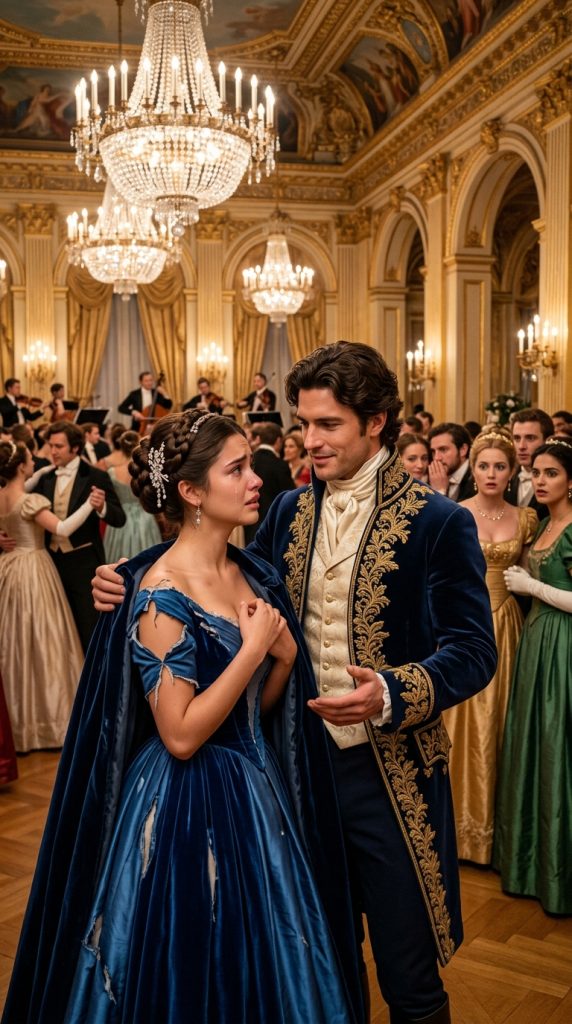
Something hard crossed his face. Without answering, he removed his black coat and placed it over Isabel’s shoulders, covering the tear. The murmur was immediate.
Catalina whispered an almost inaudible “no.” Alejandro heard it, but did not look at her. He extended his hand toward Isabel.
“Cruelty has already been quite abundant tonight,” he said clearly. “I see no reason to add mine.”
The words fell like a verdict. The fans stopped moving. The eyes that had mocked lowered in shame.
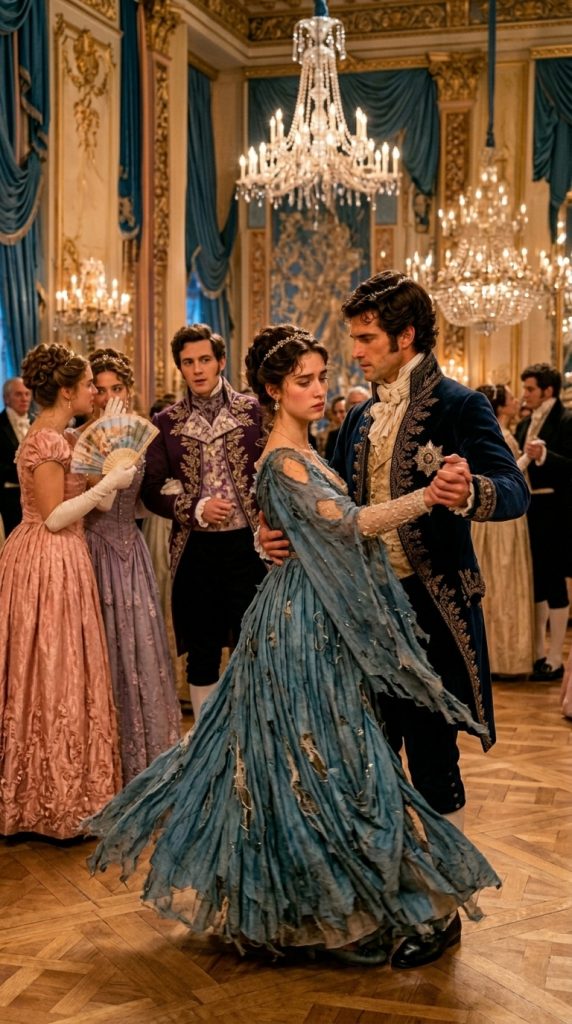
Isabel looked at the marquis’s hand. Everything in her wanted to flee, but on Alejandro’s face there was no pity. There was respect.
With trembling fingers, she placed her hand in his.
The music began again.
Isabel expected laughter, but no one dared. Not while the Marquis of Santa Lucía guided her through the center of the ballroom as if she were the most worthy woman of the night.
“You’re trembling,” he said in a low voice.
“I’m trying not to step on you. That would be a more original scandal.”
Alejandro smiled faintly.
“A victory.”
Isabel blinked.
“Which one?”
“That you still have your sense of humor. The small victories are usually the most honest.”
She looked at him surprised. No man in her world spoke like that. He should have asked her about the weather, the music, or her family. Instead, he spoke like someone who knew the world could be unfair.
“Why did you choose me?” she asked.
“Because before anyone else thought of helping, you helped.”
“Did you see what happened with Tomasa and the countess?”
“I saw many things tonight.”
Isabel felt the tears return, but this time not from shame.
“I didn’t come looking for this.”
“I know.”
“How can you know?”
“Because you were the only lady in the ballroom who was trying not to be seen.”
That truth struck her in the chest. For a moment she forgot the torn fabric, the laughter, and her sisters watching from the side with their destroyed pride. She only heard the music and the serene voice of a man who had seen her when everyone else had used her as a joke.
The next day, however, the entire city was talking about her.
The society pages did not name her, but everyone understood.
“A young woman from a family that had come down in the world obtained the marquis’s first dance in theatrical circumstances,” said one column.
Catalina left the paper next to her plate.
“Congratulations. You’re famous now.”
Mercedes added:
“I would have written ‘desperate.’”
Isabel folded the newspaper.
“I didn’t ask him for anything.”
“No,” Catalina said. “You just tore your dress at the perfect moment.”
Don Eusebio entered the dining room with a gray face. He carried a letter in his hand.
“Mr. Robles has withdrawn his interest in Mercedes. He says our surname has become unstable.”
Isabel waited for her father to defend her. He did not.
That afternoon she heard, behind the study door, that they were planning to send her to the family’s old hacienda so the scandal would cool down.
No one asked if she had suffered.
No one said she was innocent.
That same night she packed her notebook of designs, a ribbon from her mother, and the ruined blue dress. She did not know why she was taking it. Perhaps because leaving it behind would allow her sisters to decide what it meant.
Before dawn she left for the San Jacinto hacienda, a forgotten property among nopales, old jacarandas, and peeling walls.
She thought no one would look for her there.
She was wrong.
PART 3
Don Alejandro arrived at San Jacinto on the third day, under a fine rain that darkened the dirt roads.
Isabel saw him from the window and almost dropped the cup of chocolate she was holding. She thought the shame was making her imagine things, but the carriage stopped in front of the entrance and he got out without haste, hat in hand and his damp coat over his shoulders.
Isabel should have hidden.
Instead, she went down the stairs with her heart pounding like a church bell.
“Miss de la Torre,” he greeted.
“Mr. Marquis.”
The formality hurt more than she expected. Alejandro noticed.
“You left without letting me speak to you.”
“I thought my silence would be kinder.”
“To whom?”
Isabel looked toward the wet courtyard.
“To you.”
He remained silent for a moment. Then he pointed to the neglected garden.
“Walking with me will not ruin my reputation more than what they are already saying.”
She wanted to smile, but sadness won.
They walked among dry rosebushes and moss-covered fountains. The rain made the broken stones shine.
“You shouldn’t have come,” Isabel said.
“I disagree.”
“People are talking.”
“People always talk.”
“They say I trapped you with tears and theater.”
Alejandro stopped.
“Did you?”
She looked at him, hurt.
“No.”
“Then we have no reason to believe them.”
“You can ignore them. You are a marquis. I am the girl with the torn dress.”
He turned to her with a seriousness that left her motionless.
“No. You are the woman who helped a maid when everyone else preferred to look away. The woman who prevented an old lady from falling without asking for applause. The woman who was in a ballroom prepared to humiliate her and yet did not become cruel.”
Isabel closed her eyes.
“Please don’t make me sound better than I am.”
“I’m trying to make you hear what is true.”
Then Alejandro signaled toward the carriage. His coachman brought down a long box covered with dark cloth. Isabel frowned.
“What is that?”
“Something that should return to its owner.”
He opened the box.
Inside was the blue dress.

Isabel brought a hand to her mouth. It was the same and yet it was not. The silk had been cleaned and reinforced. The torn seams had been restored with silver thread embroidery. The marks of damage were not hidden; they had been turned into delicate branches that climbed the bodice like bougainvillea under the moon. The crooked hem had been corrected. The old lace had disappeared.
It was beautiful not because it looked new, but because someone had decided to save it.
“Why did you do this?” she whispered.
Alejandro lowered his voice.
“Because I hated what they tried to make it mean. They wanted that dress to prove that you were less. Undeserving. Disposable.”
The word pierced her chest.
Disposable.
That was how she had felt for years.
“But damaged things do not lose their value,” he continued. “Sometimes they just wait for someone to have enough patience to see what still remains.”
Isabel cried then, silently, without spectacle. Alejandro did not try to touch her without permission. He simply stayed close, near enough that she did not feel alone.
“I did not admire your dress that night,” he said. “I admired your heart.”
For the first time since her mother’s death, Isabel believed that being seen did not have to hurt.
Two weeks later, Doña Amalia organized a gathering at her house in Puebla. It was not as large as the Santa Lucía ball, but every important person who had ever repeated the gossip attended.
Catalina and Mercedes arrived expecting to find Isabel still hidden at the hacienda. When they saw her enter, both turned pale.
Isabel was wearing the restored blue dress.
The ballroom recognized it immediately. People remembered what had made them laugh, but now they could not mock. Each silver stitch seemed to say that the humiliation had not won.
The countess whom Isabel had helped approached and kissed her cheek.
“My child, now you truly look like who you are.”
Catalina gripped her fan tightly.
“How touching. You kept the disguise.”
Isabel looked at her calmly.
“No. I kept the lesson.”
“And what was it?” Mercedes asked, tense.
“That people show their true face when they believe someone cannot defend themselves.”
The words were soft, but everyone nearby heard them. Catalina lowered her gaze. Mercedes found no response. For the first time, Isabel did not need to accuse them. Their own fear betrayed them.
At the back of the ballroom, Don Eusebio watched his daughter as if he had just discovered someone who had always been in front of him.
Later he approached, awkward, aged, with moist eyes.
“Isabel… I should have protected you.”
She did not respond immediately. She had waited years for those words. When they came, they did not erase the damage, but they opened a door.
“Yes, Father,” she said in a firm voice. “You should have.”
Don Eusebio bowed his head.
“Allow me to begin late, even if I don’t deserve it.”
Isabel looked at him for a long time. Then she nodded.
“Begin by telling the truth.”
And that same night, in front of several relatives, Don Eusebio admitted that Isabel had not caused any scandal, that her sisters had acted with cruelty, and that the de la Torre house would not be saved by selling its daughters as merchandise.
Catalina and Mercedes were not ruined, but they were forced to face something worse for them: the indifference of a world that no longer saw them as elegant victims, but as small women.
The music began.
All eyes sought Alejandro. He crossed the ballroom without haste. Catalina held her breath. Mercedes pretended to look elsewhere.
But the marquis stopped in front of Isabel.
“Miss de la Torre,” he said, with a warmth only she understood. “Would you grant me this first dance?”
Isabel remembered the other night: the tear, the laughter, the coat over her shoulders, the hand that did not treat her with pity but as a person.
This time she did not tremble.
She placed her hand in his.
“Yes,” she answered. “This time, with pleasure.”
While they danced, Alejandro murmured:
“Your dress could damage my reputation again.”
Isabel smiled.
“It survived once.”
“For you,” he said, “I would risk more than my reputation. I would risk being understood.”
She laughed softly, and that laugh was the beginning of a different life.
Months later, Isabel opened a small sewing workshop in Puebla with the help of Doña Amalia and the discreet support of Alejandro. There worked girls without dowries, young widows, and maids whom no one had looked at twice.
On the door there were no coats of arms or titles, only a simple sign: “Casa Isabel. Dresses for women who deserve to enter without fear.”
On the day of the inauguration, Alejandro arrived with a bouquet of orange blossoms and a question that no longer needed witnesses.
Isabel did not answer immediately. She looked at her hands, once trembling, now steady. She looked at the blue dress preserved on a mannequin, not as a memory of shame, but as proof of rebirth. Then she looked at the man who had seen her before she herself knew how to do so.
“Yes,” she said at last. “But promise me something.”
“Whatever you ask.”
“Never rescue me to hide me. Walk with me so I can continue standing.”
Alejandro smiled, moved.
“All my life, Isabel.”
And this time, when the city spoke, it was not of scandal or pity. It spoke of the young woman who turned a torn dress into destiny, of a marquis who chose kindness over pride, and of a woman who discovered that dignity, when sewn with truth, never breaks again.
