

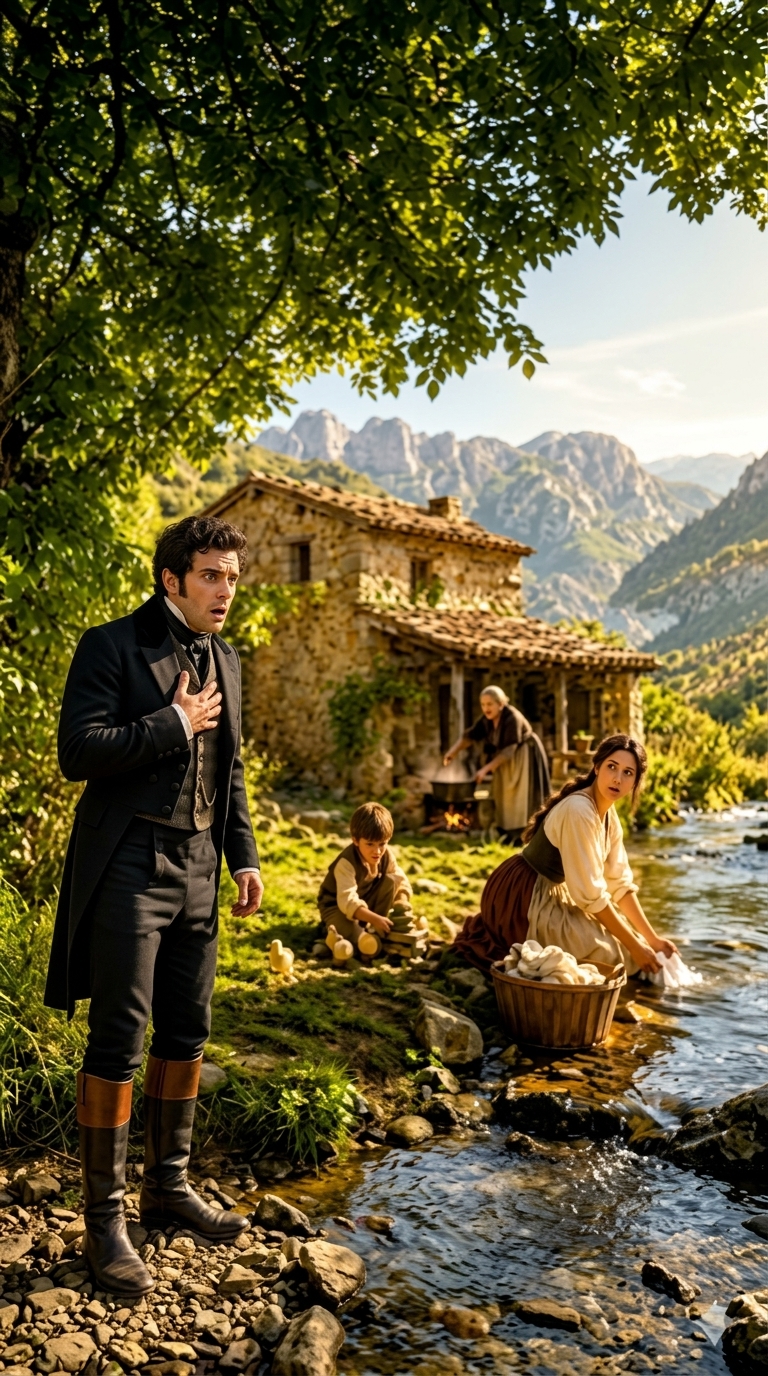
On the night Alejandro Del Valle announced his engagement, his supposedly dead wife appeared in the salon with a 6-year-old boy who had the same eyes as him.
Until that moment, Hacienda Santa Rosalía had been a perfect painting: antique lamps lit, crystal glasses on white tablecloths, fresh bougainvillea arrangements, and the elegant murmur of the richest families in Parras, Coahuila. The guests had come to celebrate the union between Alejandro, heir to the Del Valle vineyards, and Lucía Ibarra, daughter of a wine entrepreneur from Monterrey. It was a convenient marriage, an alliance to save old debts and sustain a surname that was already crumbling inside.
Alejandro stood next to the main table, in an impeccable suit and with a heart full of stones. Beside him, Lucía smiled politely, but without love. Both knew that the engagement was an agreement, not a dream. In front of them, Doña Marisela Del Valle, Alejandro’s mother, watched every detail with the same coldness with which she had run the hacienda for 30 years. She was dressed in black, as always, and her mere presence made the employees lower their gaze.
“This house needs firmness, not sentimentality,” she had told him that afternoon. “Your father is weak, the accounts are bad, and Lucía is the way out.”
Don Ernesto Del Valle, Alejandro’s father, was sitting in an armchair near the window. His hands trembled. He had a pale face and a subdued voice. For years, Doña Marisela had been administering a bitter medicine to him that, according to her, kept him calm.
“Your father can no longer handle anything,” she repeated. “That’s why you must obey.”
Alejandro had obeyed for too long.
He had also obeyed six years earlier, when his first wife, Inés Robledo, disappeared on a stormy night. Inés was the daughter of a humble healer from the sierra, a woman without fortune or surname, but with a light that Alejandro had never found in anyone else. He had loved her against his mother’s will. Marisela detested her because Inés spoke with the peons, took care of Don Ernesto, and did not allow herself to be humiliated by the old grandeur of the hacienda.
One morning, Alejandro returned from an urgent trip to Saltillo and found a letter on the table. Supposedly written by Inés. It said she was leaving with another man, that she had stolen jewelry, that she had never loved Alejandro, and that she did not want to set foot in Santa Rosalía again.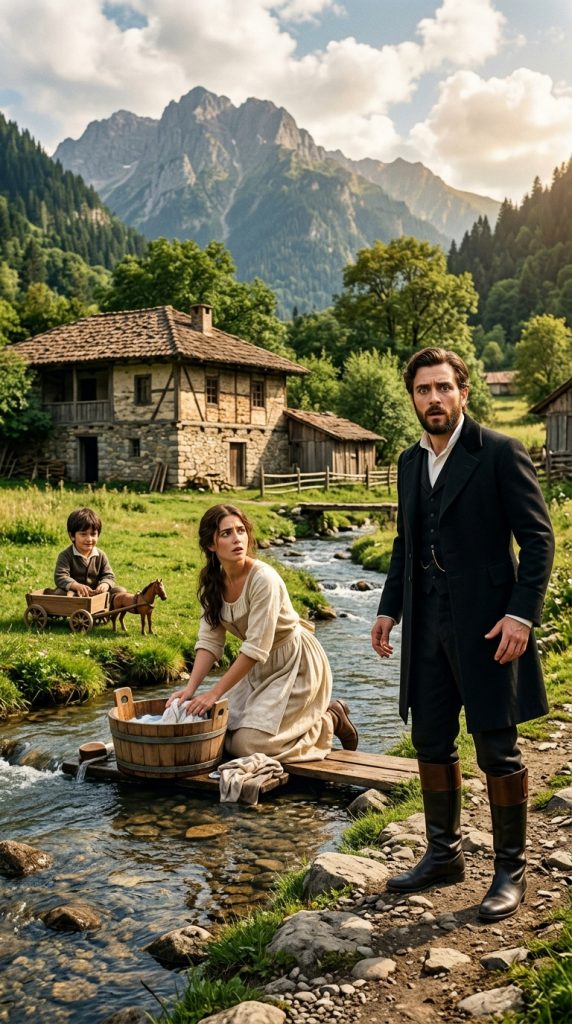
He did not want to believe it, but Marisela put proof before his eyes: a maid who swore she had seen her leave at night, a servant who said he had seen a stranger waiting for her, a torn handkerchief found by the stream. The body never appeared. The town spoke of flight, of shame, of death. And Alejandro, broken inside, ended up accepting the version everyone repeated.
Until two weeks before the engagement.
Destiny led him to a mountain market in Arteaga, where his carriage stopped due to a damaged wheel. There, among stalls of cheese, pulque bread, medicinal herbs, and baskets of eggs, he saw a woman with a dark shawl arranging jars on a blanket. Next to her, a small boy was playing with a wooden cart.
The cart rolled to Alejandro’s feet.
“It got away from you,” he said, bending down.
The boy lifted his face.
Alejandro felt the world split in two. He had his eyes. The same seriousness. The same way of looking before trusting.
“What’s your name?”
“Darío,” the boy replied.
Then the woman with the shawl ran toward them.
“Darío, come here.”
The shawl slipped. Alejandro stopped breathing.
“Inés.”
She paled as if she had seen a ghost.
“Don’t call me that.”
Alejandro took a step, but she put the boy behind her body.
“You’re alive.”
“No thanks to you.”
The phrase pierced his chest. Lucía, who was nearby, immediately understood that this woman was not a stranger.
“Who is she, Alejandro?”
He could barely speak.
“My wife.”
Lucía widened her eyes.
“Your wife is dead.”
Alejandro watched Inés walk away with the boy by the hand.
“That’s what I thought.”
From that day, everything changed. Alejandro returned to Arteaga in secret. He found the humble house of Doña Remedios, an elderly woman who had protected Inés for six years. The dwelling had a tin roof, chickens in the patio, and the smell of damp firewood. There were no stolen jewels. There was no lover. There was no wealth. Only dignified poverty, silence, and a boy raised without a father.
Doña Remedios was the first to speak.
“I found her by the stream after the storm. She was beaten, with fever, and pregnant. In her delirium she repeated your name, Mr. Alejandro. Yours.”
Inés did not cry. She looked at him with old, tired rage.
“Your mother forced me to write that letter. Ramiro, the foreman, beat me and chased me when I tried to escape. I was trying to reach you. I wanted to tell you that your father was not naturally ill.”
Alejandro felt cold.
“What are you saying?”
“The medicine for Don Ernesto is weakening him. I recognized it because my mother knew about plants. Your mother did not want to cure him. She wanted to extinguish him little by little to control the hacienda.”
“It can’t be.”
Inés clenched her jaw.
“That’s what I said when I heard Doña Marisela and Ramiro talking in the greenhouse. They also mentioned Esteban.”
Esteban was the young administrator of the hacienda, supposedly Marisela’s godson, always close to the accounts and contracts. Alejandro had never fully trusted him.
“What does Esteban have to do with it?”
Inés lowered her voice.
“Your mother said everything should go to ‘her true son’.”
Those words destroyed the last thing Alejandro thought he knew about his family.
In the following days, he accused no one. He observed. He changed his father’s medicine for a check-up by a doctor from Saltillo, without notifying Marisela. He reviewed old accounts. He discovered money transfers to phantom companies linked to Esteban. He found documents where several hectares of vineyard were ready to pass to intermediaries. And one night, hidden behind the old greenhouse, he heard Marisela, Ramiro, and Esteban arguing.
“Alonso is waking up too much,” said Esteban.
“Because someone is sticking their nose in,” replied Ramiro.
Marisela spoke in a low voice.
“At the party he will sign what is missing. Alejandro will be tied to Lucía and the debts. Then Esteban will take full administration.”
“I’m tired of waiting for crumbs,” spat Esteban. “This house is also mine.”
Marisela looked at him furiously.
“It belongs to you more than to him, but don’t ever speak to me like that again.”
Alejandro felt the blood roaring in his ears. His mother had not only destroyed his marriage. She had wanted to erase his pregnant wife, sicken his father, and hand over the hacienda to the son she had secretly had with Ramiro.
The day of the engagement arrived.
The salon was full. Lucía, smarter than everyone believed, already knew part of the truth. The night before, Alejandro had told her everything. She did not cry or make a scene. She simply removed the ring and said:
“I don’t want to enter a family built on a false grave either. Do what you have to do.”
When Marisela raised her glass to toast, Alejandro interrupted her.
“Before announcing an engagement, this house must hear a truth.”
Silence fell over the guests.
The main door opened. Inés entered, dressed simply, without jewels, without false pride. Beside her came Doña Remedios. Darío did not enter; Alejandro refused to exhibit his son as proof. The boy waited in the kitchen with a kind maid and a cup of hot chocolate.
Marisela stepped back.
“This is impossible.”
Inés raised her head.
“The impossible thing was living six years buried by a lie.”
Ramiro tried to leave through a side door, but two of Alejandro’s trusted men stopped him. Then the doctor from Saltillo entered with a report in hand. He confirmed that Don Ernesto’s medicine contained substances capable of weakening him slowly. Then an accountant showed the transfers to Esteban. Finally, Don Ernesto, more awake than in years, stood up with the help of a cane.
“Marisela,” he said with a broken voice, “I suspected you, but I was a coward. I stayed silent too long. Not today.”
The mask of Mrs. Del Valle broke.
“I did everything for this house.”
Alejandro looked at her with hard sadness.
“No, mother. You did it for control.”
“I made you strong.”
“You made me obedient. The woman who survived what you did to her made me strong.”
Marisela tried to approach.
“Son…”
Alejandro stepped back.
“Don’t use that word tonight.”
Ramiro ended up confessing when the police arrived. He said he had followed orders, that Inés fell into the stream during the chase, that Marisela promised to protect him if he kept the lie. Esteban shouted that the hacienda also belonged to him, but Don Ernesto publicly disinherited him from any irregular benefits and handed the documents to the authorities.
The party ended without music, without toasts, and without engagement.
Weeks later, Marisela and Ramiro faced judicial proceedings. Esteban fled but was arrested in Monterrey trying to sell false documents. Don Ernesto began to recover slowly under medical care. Lucía returned to her family with her head held high and, before leaving, hugged Inés.
“Forgive me for occupying a place that was never empty,” she said.
Inés did not know what to answer, but she took her hand.
Alejandro did not ask Inés to return immediately. He knew an apology did not rebuild six years. For months he traveled to Arteaga, not with grand promises, but with small acts. He repaired Doña Remedios’s roof, fixed Darío’s cart, brought doctors when the boy got sick, and accepted every silence from Inés without demanding forgiveness.
One afternoon, Darío looked at him while they fed the chickens.
“My mom says my dad died.”
Alejandro felt a knot in his throat.
“Your mom said that because she wanted to protect you.”
“And now?”
Inés was at the door, listening.
Alejandro knelt in front of the boy.
“Now, if she allows me and if you want, I can learn to be one.”
Darío thought for a moment.
“You can start tomorrow.”
Inés covered her mouth to keep from crying.
A year later, Hacienda Santa Rosalía no longer seemed like a mausoleum. The doors of the greenhouse were opened. Don Ernesto spent afternoons in the sun. Doña Remedios had a room next to the patio. The workers received better pay and Alejandro put the accounts in view of all the partners.
Inés returned, but not as the humble girl who asked permission to exist. She returned as the woman who had survived and who now walked through the house without lowering her gaze. Alejandro never called her his again. He learned to say “my companion” with respect.
One morning, Darío ran among the vineyards with his repaired wooden cart. Inés watched him from the corridor. Alejandro approached slowly.
“I don’t know if one day you can forgive me for everything.”
She looked at the rows of grapes under the sun.
“Not everything is forgiven at once. Some things are worked on, like the land.”
“Then I will work.”
Inés finally looked at him. There was no longer hatred in her eyes, although scars remained.
“That’s what I want to see.”
Alejandro smiled faintly.
In the distance, Darío shouted:
“Mom! Dad! Come see!”
The word dad floated in the air, soft and enormous. Inés closed her eyes for a second. Alejandro did not move until she walked first. Then the two of them went toward the boy, not as a perfect family, but as a family that had gone through lies and still chose to start over.
And that afternoon, for the first time in many years, Hacienda Santa Rosalía did not seem like a house full of ghosts.
It seemed like a home.
