

PART 1
Catalina de la Serna needed a husband before dawn broke, even if it was a stranger she found on the street.
The early morning fell over Mexico City like a veil of ice. In the large house of the De la Serna family, near San Francisco Street, the oil lamps flickered in front of the portrait of Don Ignacio, her deceased father. Catalina stood before that painted face, with a bag of gold coins in her hand and her heart turned to stone.
Don Ignacio had been a respected landowner in Puebla, a man with a serene voice who had taught her to read poetry, to ride horses, and not to bow her head before anyone. But upon his death, he left something no one expected: debts, promissory notes, mortgaged lands, and a desperate widow.
Doña Mercedes, her mother, entered the room dressed in black, her hair pulled back and her face hard.
“The notary will come at seven,” she said. “Don Evaristo Aranda will sign the agreement and you will be his wife before the week is over.”
Catalina tightened her grip on the bag.
“He is 53 years old.”
“He has money.”
“He looks at me as if he had already bought me.”
Doña Mercedes did not look away.
“Because perhaps that is the only thing we have left to sell.”
Those words did not shout. They did not need to. They broke something inside Catalina with cruel precision.
She went up to her room without kissing her mother. Under the mattress she kept five letters from Jacinto Salvatierra, a young merchant who had sworn eternal love to her. He had written that they should flee before dawn, that she should bring what she could, that in Veracruz they would take a ship and start a life far from everyone.
Catalina wanted to believe him. She needed to believe him.
She put on a dark blue travel dress, simple boots, and a thick cloak. She packed 38 coins, her grandmother’s garnet brooch, and her father’s silver watch. Then she slipped out through the kitchen, crossed the frozen patio, and walked to the Posada del Águila, where Jacinto was supposed to be waiting for her.
When she arrived, she saw him at a table in the back with another man. She was about to call out to him when she heard his laugh.
“The girl will bring jewelry and coins,” Jacinto was saying. “When she hands them over to me, I’ll leave on the Puebla road. By the time they discover I have no intention of marrying her, she will already be ruined.”
“And if she cries?” asked the other man.
Jacinto let out a loud laugh.
“Young ladies cry about everything. I never loved her. I only needed her desperation.”
Catalina did not feel pain at first. She felt silence. An enormous silence, as if the world had been emptied. She stepped back without making a sound, went out into the street, and let the cold air strike her face.
She did not cry. She could not allow herself to.
She had less than three hours left. If she returned home, Don Evaristo would have her signature, her body, her life. If she fled alone, society would destroy her. If Jacinto found her, he would steal the only thing she had left.
She walked aimlessly along the cobblestone street until she tripped on a loose stone and fell against the chest of a man.
He caught her by the arms before she hit the ground.
He was tall, wearing a black coat, a fine hat, and with a dark gaze. He did not seem drunk, nor a thief, nor lost. He seemed like a man accustomed to the world obeying when he spoke.
“Are you hurt?” he asked.
Catalina looked at him. At any other moment she would have felt fear. That night she only felt urgency.
“I need to ask you an absurd question,” she said, “but I swear I am serious.”
He did not smile.
“Speak.”
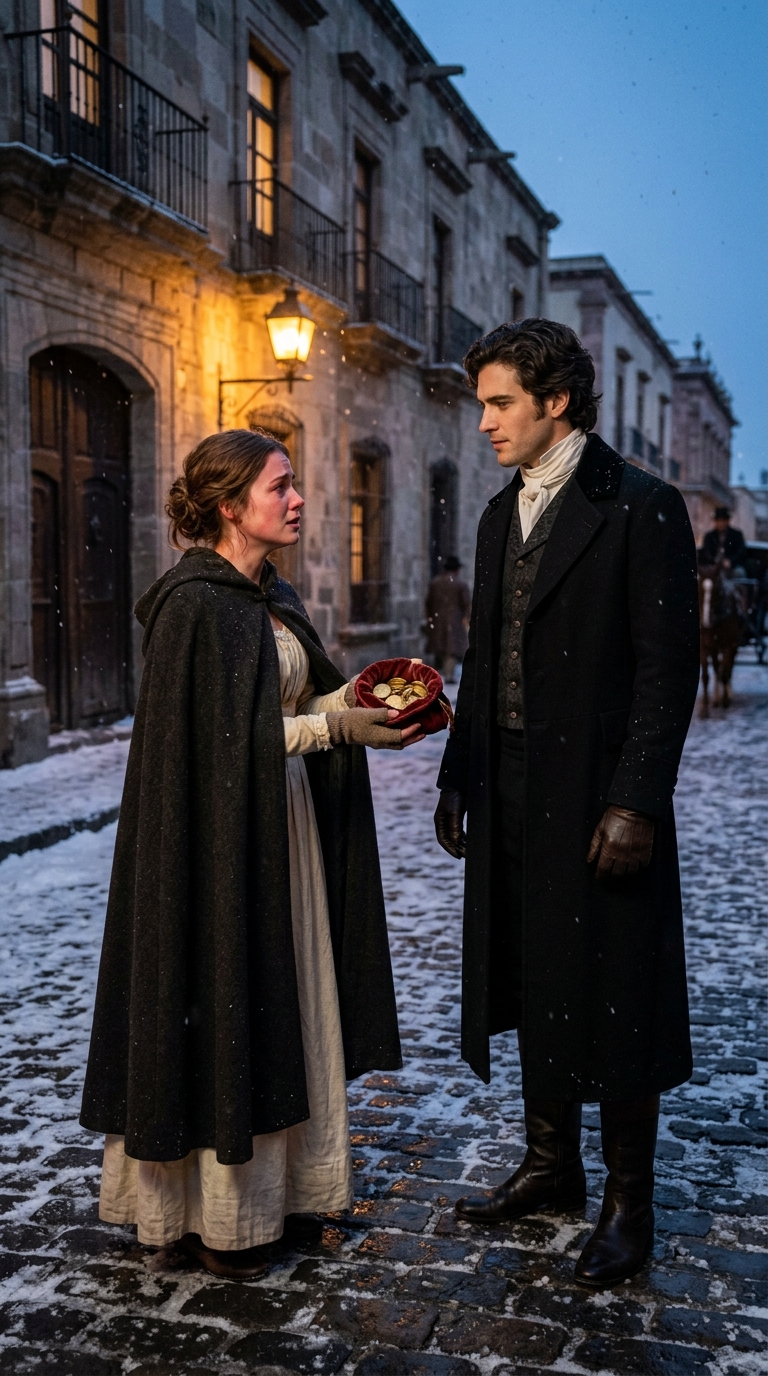
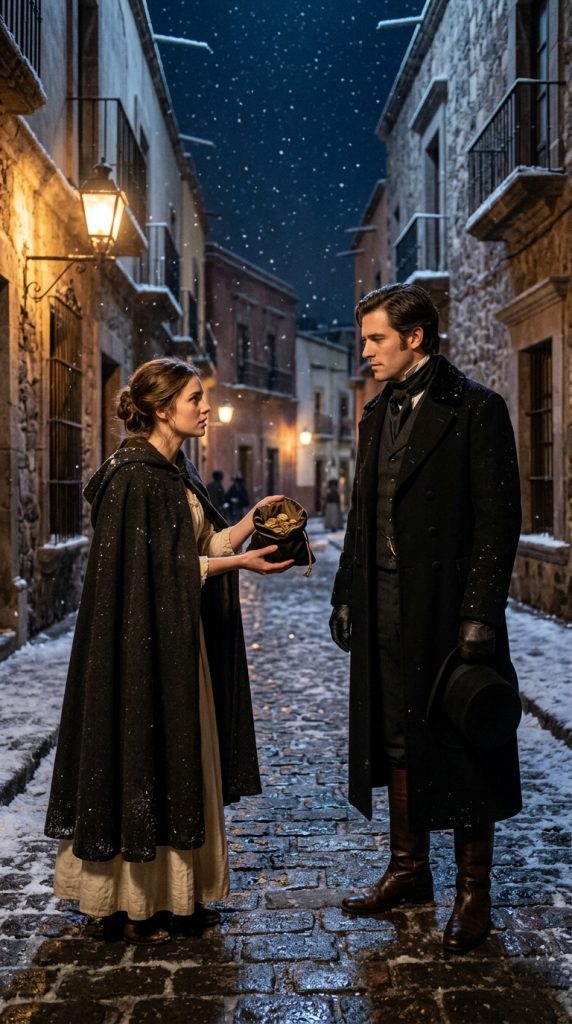
Catalina opened the bag. The coins gleamed under the gas lamp.
“My mother will sign a contract at dawn to hand me over to Don Evaristo Aranda. I cannot prevent it, but there is something I can do. If I am already married, no contract can sell me.”
The man observed her, not the coins.
“You don’t know who I am.”
“No. But I see that you are a gentleman, that you have influence, and that you are awake at four in the morning. That is enough for me.”
He remained silent.
Catalina lifted her chin.
“Marry me before dawn. All of this will be yours.”
The stranger looked at her face for a long moment. Then he removed his right glove and held out his hand.
“Keep your gold,” he said. “I accept the request, not the payment.”
PART 2
The man’s name was Alejandro. That was all Catalina knew during the first hour.
His carriage appeared as if the night itself had summoned it—black, discreet, pulled by two strong horses. He spoke with his coachman, mentioning a notary, an urgent ecclesiastical license, and a chapel on Regina Street. Catalina climbed into the carriage with icy hands and her mind spinning between fear and disbelief.
Alejandro sat across from her, took a blanket, and placed it over her shoulders without asking permission, with a sobriety so delicate that it disarmed her more than any pretty words from Jacinto.
“Why are you helping me?” she asked.
He looked out the window, where the old city slept among silent bells and closed balconies.
“Because you spoke to me with the truth. That is rare.”
Catalina did not respond. She had known men who made promises, men who bought, men who calculated. She had never known one who truly listened.
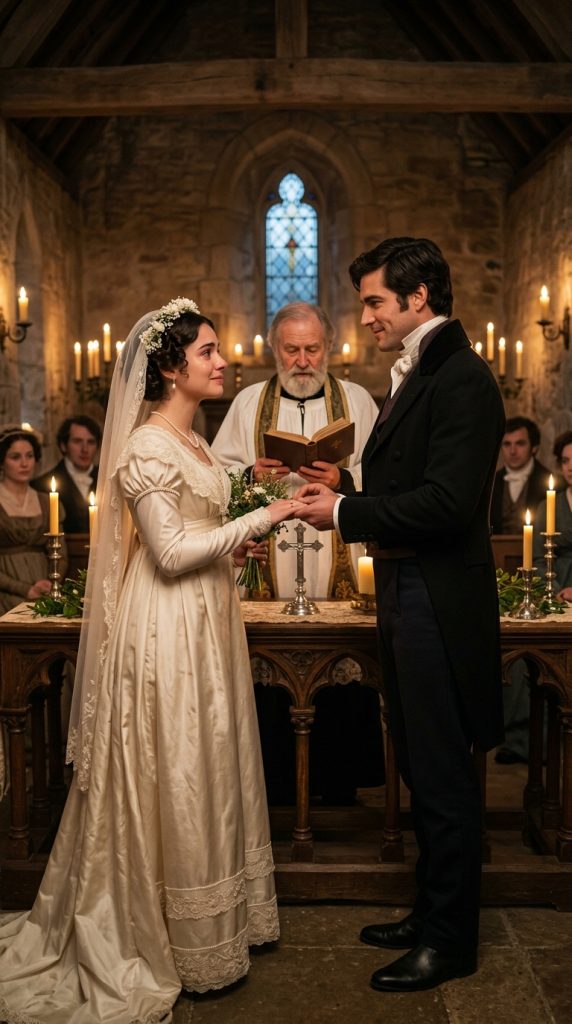
In the chapel of Santa Inés, a sleepy priest, two witnesses, and a notary with round glasses were waiting for them. The ceremony was brief. Catalina said her vows with a steady voice. So did Alejandro.
When the gold ring was placed on her finger, she felt that she had not won happiness, but a border: behind her lay the cage; ahead, an unknown territory.
When they left, the clock showed five. Two hours remained before Don Evaristo arrived at her mother’s house expecting to find an obedient young woman.
The carriage did not return immediately to the De la Serna house. It stopped in front of an ancient palace on an elegant street, with high gates, awake servants, and a carved coat of arms above the arch.
Catalina stepped down and froze when she saw it. She knew that emblem: the black eagle on a silver field.
“Montenegro,” she whispered.
Alejandro looked at her calmly.
“Alejandro Montenegro y Rivas, Count of Monteclaro.”
Catalina felt the air leave her chest. She had married the most feared man in Mexican nobility, the same one who was said to be able to destroy a fortune with a single letter and save a family with one signature.
“I offered you 38 coins,” she murmured, almost laughing out of pure terror.
“And I refused them.”
“Why didn’t you tell me who you were?”
“Because perhaps you would not have asked for my help.”
She could not deny it.
Before seven o’clock, Catalina returned to her house with him. Doña Mercedes was in the salon, pale and rigid, with the contract spread out on the table. Don Evaristo Aranda was drinking thick hot chocolate by the fireplace, dressed in a dark frock coat, satisfied like a landowner awaiting the delivery of a property.
His smile died when he saw Alejandro.
The Monteclaro notary placed the marriage certificate on the table.
“Doña Catalina de la Serna contracted marriage this morning with Don Alejandro Montenegro y Rivas, Count of Monteclaro. The sacrament is registered, signed, and sealed. Any subsequent contract is null and void.”
Doña Mercedes brought a hand to her chest. Don Evaristo stood up.
“This is a mockery.”
Catalina looked at him without lowering her eyes.
“No. It is my marriage. And you no longer have any claim.”
Don Evaristo tried to speak, but Alejandro placed another document on the table.
“You do have something to answer for. These documents prove that you inflated debts, falsified interest rates, and pressured several families to take their lands and women. The originals are already in the hands of the Royal Audiencia.”
The color drained from Don Evaristo’s face. Doña Mercedes looked at the papers as if she finally understood that the ruin that had pushed her to sell her daughter was not destiny, but a trap.
Don Evaristo took his hat and left without saying goodbye. For the first time in months, Catalina saw fear in the eyes of a man who had always wanted to provoke it in others.
PART 3
When the door closed, the salon was filled with an ancient silence. Doña Mercedes was not looking at Catalina, but at the ring on her hand. She no longer seemed like a cruel mother, but a woman who had bet the only thing she loved because she believed there was no other way out.
“I thought I was doing it to save you,” she said at last, her voice broken. “I thought that if we lost the house, the lands, your father’s name, I would lose you too.”
Catalina felt that the anger was still there, alive, but beneath it was something harder: compassion.
“You lost me when you decided not to ask me what I wanted.”
Doña Mercedes closed her eyes. A tear fell down her cheek, small, belated, real.
“Forgive me, daughter. Not today if you cannot. But someday.”
Catalina did not run to hug her. That would have been a lie. She simply sat down in front of her and placed her father’s silver watch between them.
“Papa hid these coins so I would have a way out. You tried to take mine away. If we are going to remain family, you will never again decide my life without me.”
Doña Mercedes nodded. It was not a complete reconciliation, but it was the first brick of a new house.
In the following weeks, Don Evaristo’s fall shook the salons of Mexico. The investigation revealed nine deceived families, haciendas stolen with false papers, and three young women forced into marriages over invented debts. His properties were seized and his name was so tarnished that not even his old friends opened their doors to him.
Jacinto Salvatierra was also exposed. He had used false letters and promises of love with other girls. He fled toward Veracruz before he could be arrested, but Catalina felt nothing when she learned of it. Jacinto had been a necessary lie that led her to an unexpected truth.
In the Monteclaro palace, Alejandro never treated her as a prisoner or as an acquired debt. He gave her her own rooms, access to the library, freedom to visit her mother, and time to decide what kind of marriage she wanted.
That moved her more than any declaration. A man who could command everyone chose not to command her.
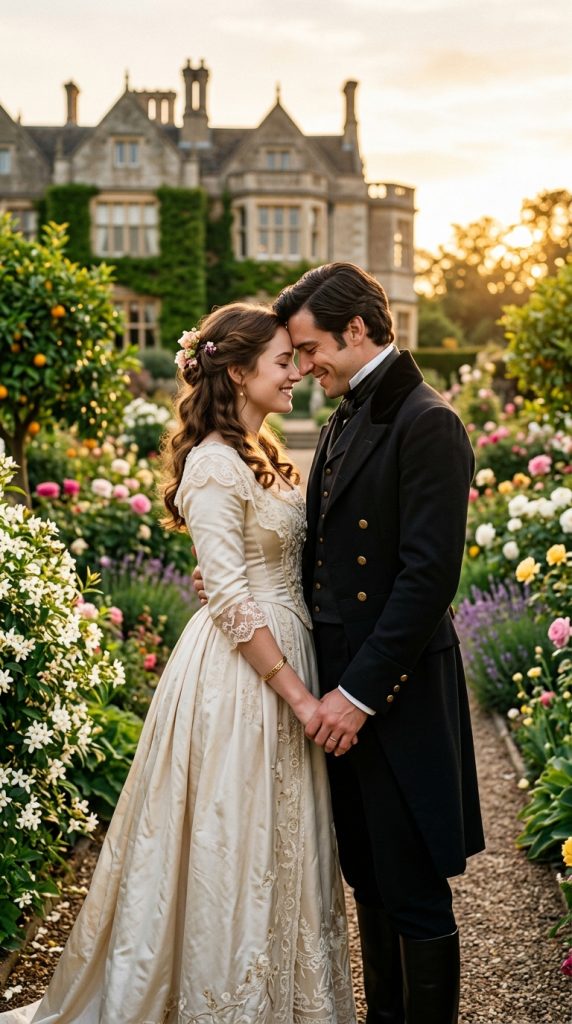
Three months passed. One April afternoon, Catalina was walking in the garden among orange trees and bougainvillea when she heard his footsteps. She already recognized them.
Alejandro always walked beside her, never ahead. She stopped under a tree.
“On the night we got married, you said you accepted for reasons that were not only the investigation. I want to know the other reason. I am tired of men who speak beautifully and say nothing.”
Alejandro removed his right glove, just as on that first early morning, and took her hand.
“When I saw you on the street, cold, betrayed, and yet still standing, I did not see a desperate woman. I saw a brave woman. Then I wanted to protect you. Later I wanted to know you. And now… now I don’t want a life where you are only my wife on paper.”
Catalina felt that the world, at last, stopped pushing her toward a cage.
“Then say it clearly.”
He brought his forehead to hers.
“I love you, Catalina. Not out of gratitude, nor duty, nor that hastily placed ring. I love you because by your side I don’t need to be feared to be seen.”
She smiled with tears in her eyes.
“I love you too, Alejandro. But not because you saved me. I love you because after saving me, you let me choose to stay.”
Months later, when the De la Serna hacienda was freed from the false debts, Catalina returned to Puebla with her mother and her husband. Doña Mercedes waited in the courtyard, humbler, less rigid, with trembling hands.
Catalina hugged her first. Not because she had forgotten, but because she no longer wanted pain to rule everything.
At sunset, Alejandro took her to the garden where Don Ignacio had planted jasmine years before. Catalina took out her father’s silver watch and placed it in her husband’s palm.
“He used to say that a woman should always have a reserve of value to save herself.”
Alejandro closed his fingers around the watch and then gave it back to her.
“Then keep it. But no longer as an emergency exit. Keep it as proof that one night you saved yourself.”
Catalina looked at the golden sky over the old hacienda, listened to her mother praying softly inside the house, and felt Alejandro’s hand entwined with hers.
She had left her home believing she was walking toward betrayal. Without knowing it, she had walked toward freedom, toward love, and toward a life that, for the first time, bore her own signature.
