

On the morning she was supposed to get married, Doña Catalina de Aranda discovered that her white dress was not a promise of love, but an elegant shroud with which they intended to bury her alive.
The 1825 sun fell over the courtyards of the San Jerónimo hacienda, on the outskirts of Puebla, illuminating the stone fountains, the orange trees in bloom, and the tables prepared for a banquet that was never meant to take place. In the dressing room, Catalina stood motionless, her cold hands resting on a crumpled note that Remedios, her former governess, had just handed her.
“Read it quickly, child,” the woman had whispered, her face pale. “Last night I overheard them in the study. Your uncle and Don Rodrigo don’t know I was behind the door.”
Catalina read it once. Then again. Each word seemed to open a new wound.
Convent of seclusion. Mental incapacity. Total control of the assets. Three doctors willing to sign. Immediate transfer after the wedding.
The world tilted beneath her feet.
Her mother, before dying, had left a fortune in trust to protect her until she turned 30 or married. But that protection had become the key to her prison. As soon as she became the wife of Don Rodrigo Moncada, he would request that she be declared insane, send her to a house of confinement in the mountains of Oaxaca, and take control of everything.
At 27 years old, Catalina had endured too many losses: the death of her mother, her father’s death a few months later, the indifference of her married sisters, and the greed of her uncle Esteban, her legal guardian. But she had never imagined they would hand her over to a man whose smile was as cold as a steel blade.
“You have to leave now,” said Remedios, pulling a simple blue wool dress from a trunk. “The guests are arriving. The house is full of servants, musicians, and cooks. No one will notice two women leaving through the service corridor.”
“Where will I go?” Catalina asked, even as she was already removing the wedding dress.
“Anywhere they can’t find you. To Veracruz, to the capital, to any road where your name doesn’t weigh like a chain.”
Remedios placed a small bag of coins in her hand.
“These are my savings.”
“I can’t accept them.”
“You can and you must. Your mother treated me like a person when no one else did. I will not allow her daughter to be sold like a fine mule.”
Catalina wanted to hug her, but outside they heard wheels on the gravel. The first carriages were entering the main courtyard.
They descended a narrow staircase. In the kitchen, women shouted orders, servants carried silver trays, and musicians tuned violins. Remedios pretended to faint by the back door, and when two maids ran to hold her, Catalina crossed the threshold and stepped out into the open air.
She did not run at first. She walked with her head down among the bushes, crossed the orchard, and escaped through an opening in the wall that she had known since childhood. When she reached the dirt road, she looked back one last time at the hacienda where she had been born. Then she heard shouts.
They had discovered her.
Then she did run.
Her boots were not made for fleeing. Her skirt tangled between her legs. Her heart pounded against her ribs. Behind her, the sound of horse hooves was getting closer.
As she rounded a curve surrounded by ahuehuete trees, she saw a carriage stopped on the road. It was black, sober, with an ancient coat of arms painted on the door. Next to the front wheel, a coachman was examining a horse’s shoe. The door was slightly ajar.
Catalina did not think. She climbed in, slipped under the seat, and pulled a blanket over her body.
The riders passed minutes later, raising dust. They did not stop. They never imagined that the fugitive bride was hidden under the seat of a stranger.
“Ready, Your Excellency,” said the coachman.
A deep voice replied from outside:
“Then let’s continue. I’m in no hurry.”
Catalina closed her eyes. She did not know who the owner of the carriage was. She only knew that, for the first time since dawn, she was not in her uncle’s hands.
The journey was a long torture of fear, dust, and silence. When the carriage stopped in front of an inn, Catalina thought of fleeing, but her legs were numb and the courtyard was full of men. She hid again.
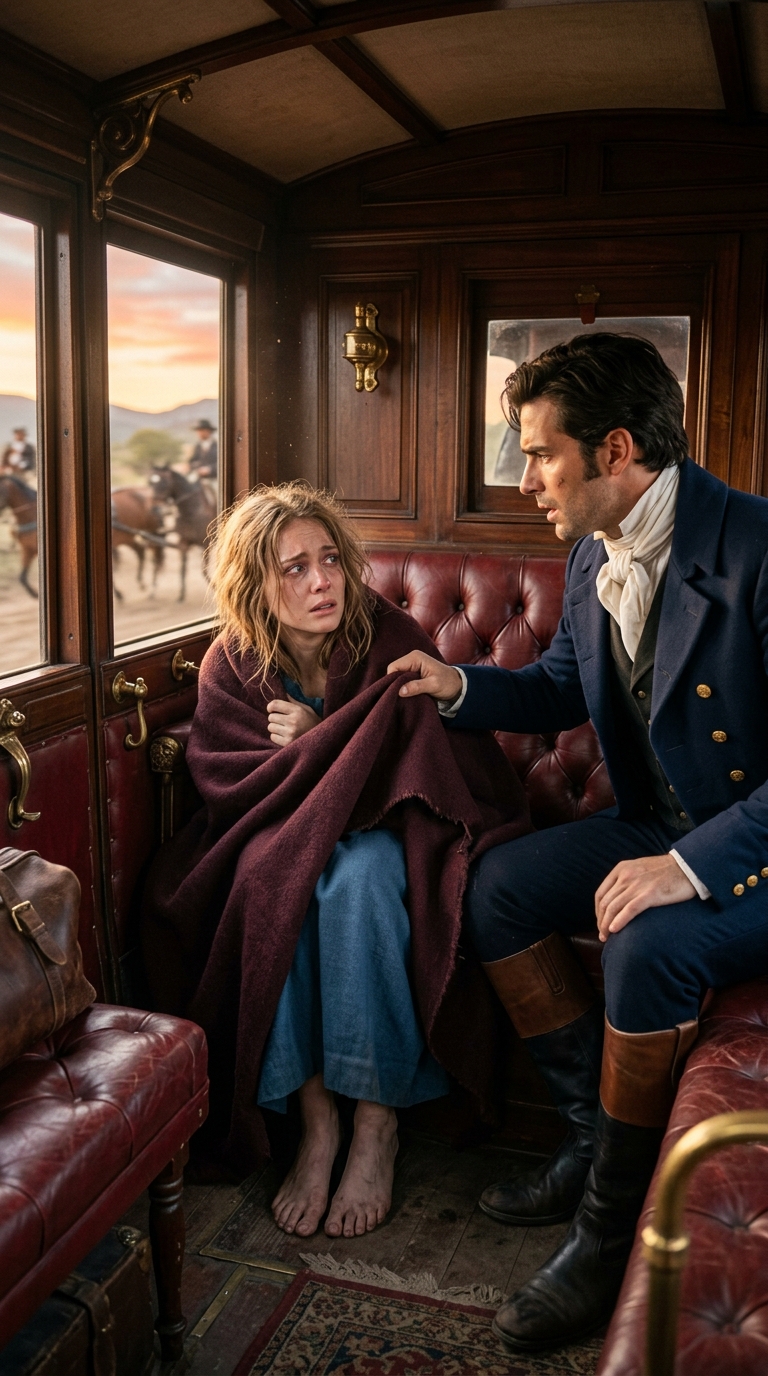
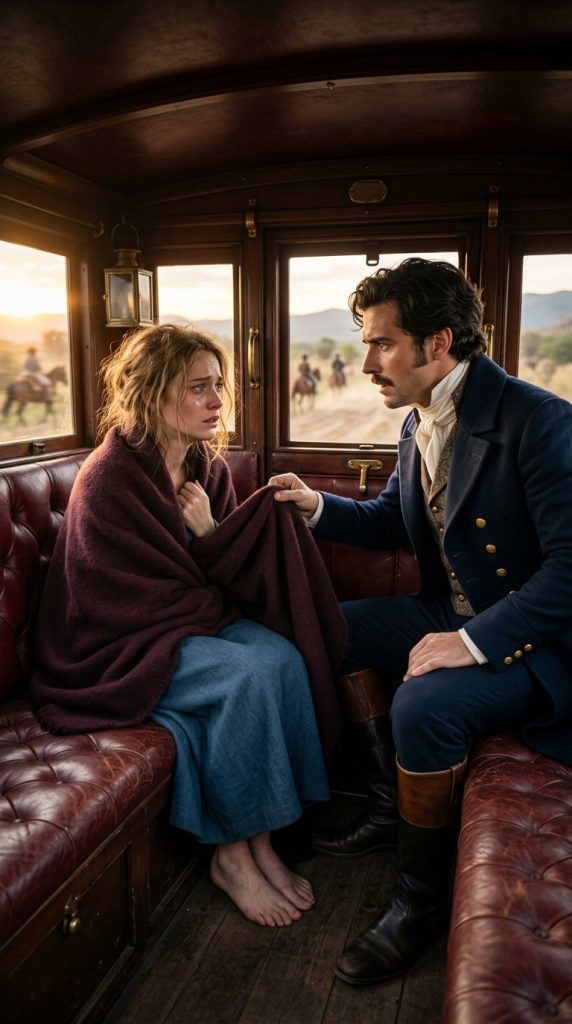
At dusk, the door opened.
A hand lifted the blanket.
Catalina found herself staring into the dark eyes of a man about 35 years old, tall, serious, dressed with aristocratic sobriety. He did not seem surprised; he seemed to be calculating every detail.
“Please,” she whispered. “Don’t turn me in.”
He did not call the coachman. He did not shout. He closed the door behind him.
“Explain to me how you ended up hidden in my carriage.”

Catalina swallowed.
“I was fleeing from a cruel man.”
“That I already guessed. What I don’t know is whether you are fleeing from a crime or from an injustice.”
“From an injustice,” she replied, with a firmness she did not even know she still possessed.
The man observed her—her hands, her accent, her posture. He did not believe the lie she improvised about having been a companion to an elderly lady. But he did not turn her in either.
“I am Don Cristóbal de Valdecañas,” he said at last. “Tonight you will come with me to my residence. Tomorrow you will decide what to do. While you are under my roof, no one will touch you.”
Catalina did not know whether to trust him. But she was too tired to keep running.
The Valdecañas house stood in the middle of dark fields, with iron balconies, thick walls, and lamps lit like warm stars. Doña Elvira, the housekeeper, received her without asking questions. They gave her water, food, and a clean room.
The next morning, Catalina found Don Cristóbal in the library. He offered her to stay for three days in exchange for organizing some ancient documents in French and Latin. It was a test, and both knew it.
During those days, she worked in silence. She translated letters, classified papers, and avoided talking about herself. But Cristóbal was too intelligent not to see the truth. In her education, her manners, and the pain she hid when speaking of her dead parents, he found the answer.
“You are not a lady’s companion,” he said on the third day. “You are Doña Catalina de Aranda.”
She set the pen down on the desk.
“Yes.”
“And today you were supposed to become the wife of Don Rodrigo Moncada.”
Catalina closed her eyes. Then she told him everything: the note, the convent of confinement, the bought doctors, her mother’s fortune, the complicity of her uncle Esteban.
When she finished, Cristóbal was standing by the window, his face hardened.
“Moncada has already had two wives,” he said. “Both died before completing two years of marriage. It is whispered in the city, but no one dares say it aloud.”
Catalina felt her blood run cold.
“Then he would have killed me.”
“First he would have locked you away. Then he would have waited for the right moment.”

That same afternoon, a letter from her uncle arrived. In it he offered a reward for Catalina and claimed that the young woman had escaped in a fit of madness.
“It has begun,” she said bitterly.
Cristóbal folded the letter with dangerous calm.
“No. Now we begin.”
He traveled to the capital and visited the Aranda family lawyer. There he confirmed that the trust existed, that Catalina would inherit an enormous fortune, and that if she were declared incapable, her guardian would control everything. He also found Remedios, who had been dismissed without a reference and was sheltering in a humble house.
When Catalina saw her arrive at Valdecañas days later, she ran to her and hugged her like a daughter.
“I thought I had lost you,” she cried.
“You saved me first, child,” Remedios replied. “I only opened a door for you.”
But the peace did not last long.
One morning, two carriages arrived at the residence. From them stepped Don Esteban and Don Rodrigo Moncada, accompanied by an official and two guards.
Catalina hid behind a bookcase, trembling.
“We have come for my niece,” Esteban demanded in the foyer. “She is ill and must return to her family.”
Doña Elvira blocked their way.
“No one enters this house without Don Cristóbal’s authorization.”
“That girl belongs to me by law,” said Esteban.
Then a voice sounded from the staircase.
“No one belongs to anyone in my house.”
Cristóbal had returned.
He descended with documents in hand, followed by his lawyer. Catalina came out of her hiding place, pale but upright.
Don Rodrigo smiled.
“Poor thing. Look at her. She is beside herself.”
“No,” said Catalina, and her voice did not tremble. “I am out of your reach.”
Cristóbal placed the papers on the table.
“I have testimony from Remedios, a copy of the trust, the names of the bought doctors, and letters proving Don Esteban’s debts. In addition, I have requested an investigation into the deaths of Don Rodrigo’s previous wives.”
The color drained from Moncada’s face.
“This is slander.”
“Then you will not fear appearing before the judge.”
Esteban tried to shout, but his voice broke. He knew he was lost.
Still, one danger remained: as long as Catalina remained under guardianship, her uncle could drag her into endless lawsuits. That night, Cristóbal spoke to her with a honesty that disarmed her.
“There is a legal way out. If you marry me, you will no longer be under your uncle’s authority. Your fortune will be protected and no one will be able to lock you away without facing my name.”
Catalina looked at him for a long time.
“Are you offering me another arranged marriage to save me from the first one?”
“I am offering you protection. Nothing more. If you accept, you will sleep in your own chambers, manage your assets, and be free to decide your life. I will not ask for love as payment.”
She lowered her gaze. She thought of her white dress turned into a threat. She thought of the dust under the carriage seat. She thought of Cristóbal’s hand giving her bread when she had nothing.
“And what if one day love appears without us asking for it?”
For the first time, he smiled with sadness.
“Then I will not treat it as a debt, but as a miracle.”
They were married at dawn in the hacienda chapel, without music, without a banquet, without greedy guests. Only Remedios, Doña Elvira, the lawyer, and an old priest who understood that sometimes God blesses a flight more than a celebration.
When Don Esteban returned furious and saw the ring on Catalina’s hand, he understood that he no longer had power over her.
“You have dishonored me,” he spat.
Catalina looked at him with a serenity that had cost her years of pain.
“No, uncle. I simply stopped obeying those who wanted to destroy me.”
The trial came weeks later. In the courtroom, Don Rodrigo tried to present her as a hysterical woman. But Catalina spoke with clarity. Remedios repeated what she had heard. The documents spoke for themselves. And when a maid from Moncada’s first wife appeared, telling how her mistress had been isolated before dying, the silence in the room became a verdict.
Don Rodrigo was arrested for fraud, conspiracy, and other charges that would soon grow. Don Esteban lost the guardianship, his debts came to light, and he was forced to return what he had taken from the family inheritance.
Catalina left the courthouse with weak legs. Outside, the sky was clear after the rain. Cristóbal walked beside her, not touching her, waiting for her to choose.
She was the one who took his hand.
“I no longer have to run,” she said.
“No.”
“But I want to go home with you.”
He looked at her as if those words were worth more than all the lands of Mexico.
Months later, the Valdecañas residence was no longer a silent house. Catalina opened a school for orphan girls in one of the old wings. Remedios was named director. Doña Elvira pretended that so much laughter bothered her, but she always left sweets on the tables.
Catalina learned to manage her fortune, to sign her own documents, and to look powerful men in the eye without lowering her head. Cristóbal learned to laugh in the library and to leave flowers on his wife’s desk without explaining why.
One afternoon, as the sun fell over the fields, Catalina found the old note that had saved her in a drawer. She held it between her fingers, remembering the terror of that day.
Cristóbal approached her from behind.
“Does it still hurt?”
Catalina folded the note carefully.
“Yes. But it no longer rules over me.”
He offered her his arm. She took it.
And so, the woman who had escaped hidden under the seat of a carriage ended up walking through the corridors of her own house, not as a prisoner of a name, but as the owner of her destiny, loved without chains, and finally free.
