

PART 1
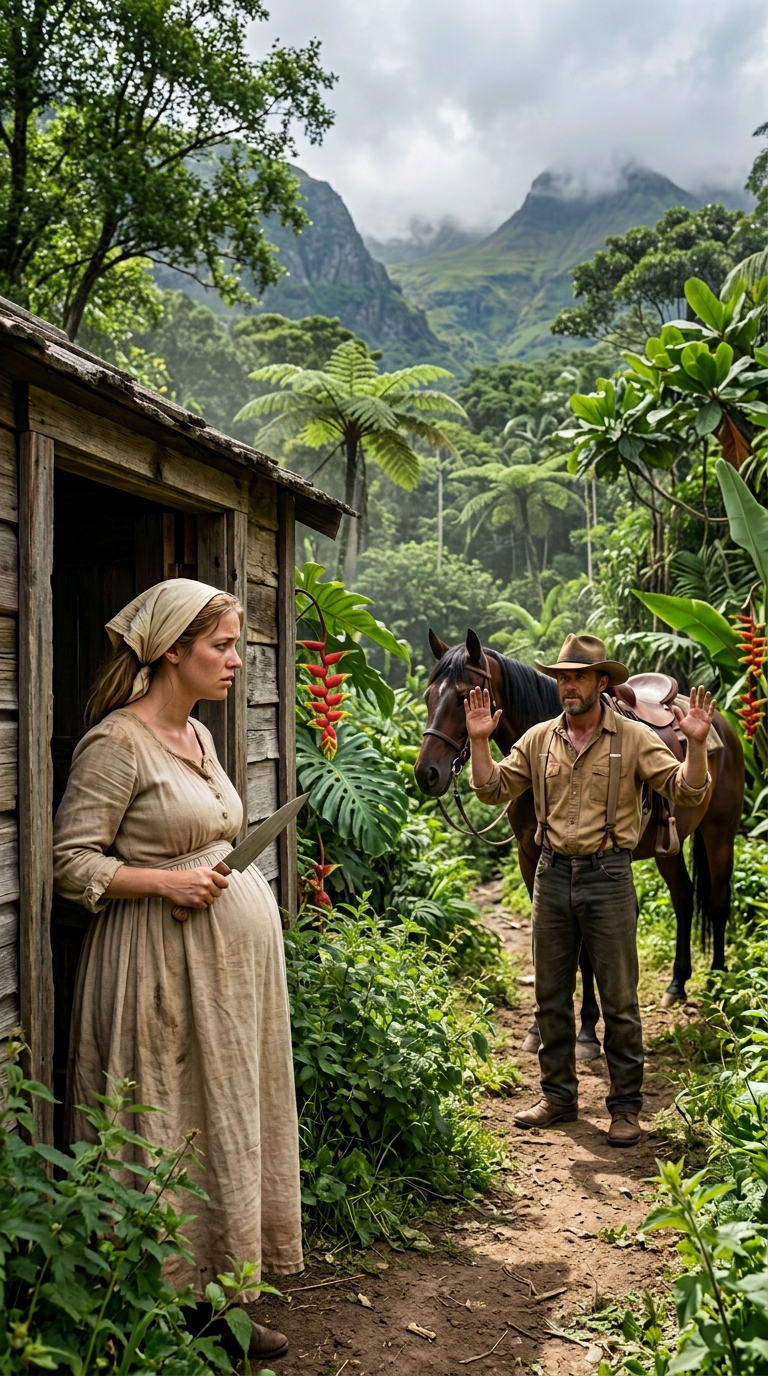
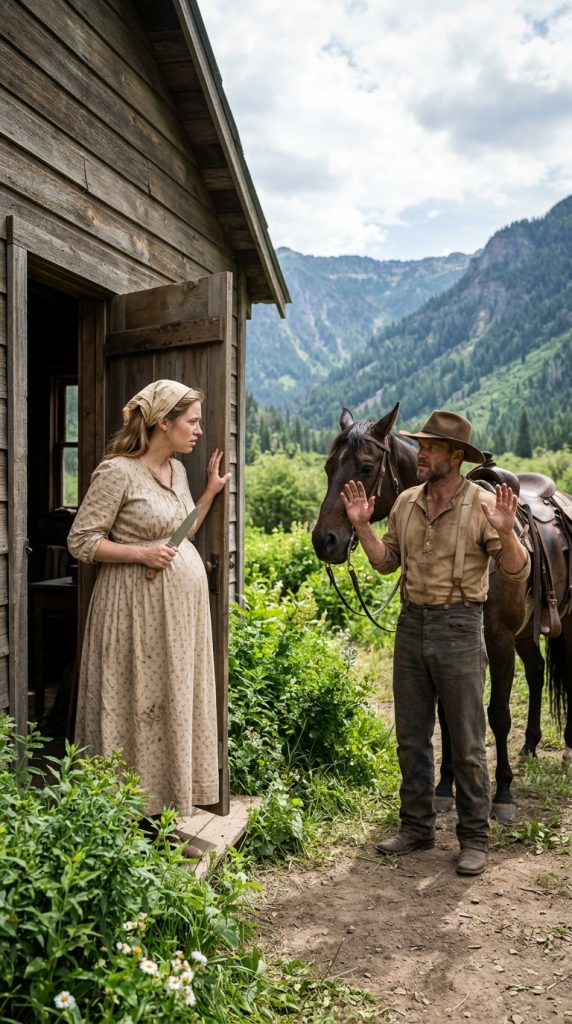
Mariana was holding a knife to her seven-month-pregnant belly when the stranger appeared among the mesquite trees and raised his hands to show her he meant no harm.
The young woman stood in the doorway of a shack almost hidden in the sierra, her coarse cotton dress stretched over her belly, her feet covered in dust, and her eyes wide like those of a cornered animal. Behind her, the little adobe house looked as if it were about to collapse. The roof had holes, the door barely closed, parts of the cornfield had dried up, and the smoke from the hearth rose in a thin, sad line, as if even the fire was afraid to stay there.
The man stopped his horse a few steps away.
“Don’t be afraid, ma’am. I’m not looking for trouble. My horse lost a shoe and I saw smoke from the path.”
Mariana did not lower the knife. For months she had not trusted any man’s voice.
She was 26 years old and her life had been marked by loss. Her parents had died when she was 14 during a fever that swept through the town of San Miguel de la Sierra. She was taken in by a godmother named Doña Petra, not out of love, but because the village priest had asked her to do so in front of everyone. From then on, Mariana learned that a roof could feel like a prison and that a plate of food could be paid for with humiliations.
At 20 she met Rogelio Castañeda at a fair in Jalisco. He arrived with a new hat, an easy smile, and words so beautiful they seemed true. He said he had land toward the sierra, that he needed a wife to build an honest life, and that with him she would never lack bread or respect. Mariana wanted to distrust him, but a woman who had never been chosen becomes vulnerable when someone looks at her as if she were worth something.
She married him in a simple ceremony. There was no party, no flowers, no promise other than the one that came from Rogelio’s mouth in front of the altar.
But when they arrived at the supposed property, Mariana found an abandoned shack, a piece of land without papers, and a man who worked little and drank a lot. Rogelio was not a farmer, nor an owner, nor a man of his word. He was a card player, one of those who lose what little they have and then bet what does not yet exist.
When Mariana became pregnant, she felt both joy and terror. Joy because she would finally have someone of her own. Terror because she knew Rogelio was not made to take care of anyone.
One morning, when she was five months pregnant, Rogelio saddled the horse and said he was going to town for supplies. He did not look at her when he said goodbye. He did not return that night. Nor the next day. By the third week, Mariana understood the truth: he had abandoned her in the middle of the wilderness, pregnant, without money, without a horse, and without anyone to ask for help.
She survived by eating less, carrying water from the stream, sleeping with the knife under her pillow, and talking to the baby as if it could already answer her. She told it about her mother, about the songs of the grinding stone, about a world that had not been kind to her, but that perhaps could be different for this child.
And then that man arrived.
His name was Tomás Arriaga. He was 40 years old, with broad shoulders, worker’s hands, and an old sadness hidden behind his beard. He had been a muleteer for years. He was on his way to a small ranch he wanted to register in his name, but destiny had diverted him down the wrong path.
Or perhaps the right one.
Tomás fixed the horseshoe without asking for anything. He worked in silence while Mariana watched him from the doorway. When he finished, he was ready to leave, but he saw the almost finished firewood, the broken roof, the fallen fence, and that pregnant woman pretending she could manage alone.
He put one foot in the stirrup. He remained still.
He remembered his younger brother, Julián, dragged away by a swollen river 15 years earlier while Tomás tried to hold his hand. He had never been able to save him. Since then, he had carried a guilt that had turned him into a man of the road, without a home, without family, and without roots.
But that afternoon, in front of Mariana, he felt that if he left, he would once again let go of a hand asking for help.
He got off the horse.
“I’ll stay one more day,” he said without looking at her. “That roof won’t hold up through another rain.”
Mariana did not answer. She went into the shack and closed the door.
But that night, for the first time in months, she did not push the wooden bar all the way in.
PART 2
One day became two, then five, then a full week. Tomás fixed the roof, repaired the fence, cleared the path to the stream, and cut enough firewood so that Mariana would not have to go alone into the brush.
She continued to distrust him, but she began leaving a jar of coffee by the hearth and a plate of beans on a wooden bench. She did not say thank you. He did not ask for explanations. Both understood gestures better than words.
One afternoon Doña Refugio appeared, an old healer who lived on the other side of the hill. She arrived with herbs, arnica oil, and a gaze capable of reading secrets. She examined Mariana and said the baby girl was well positioned, but the mother needed to eat more and rest.
Before leaving, she approached Tomás and said, without lowering her voice:
“You can stop pretending you’re here out of obligation. God doesn’t put a man at a door like this just so he can play the fool.”
From then on, the house began to change. Mariana no longer walked around with the knife at her waist. Tomás no longer slept so far from the door. In the evenings they sat outside, listening to the crickets and the water of the stream.
She told him about her parents, about Doña Petra, about Rogelio, about the shame of having believed in a man who only wanted a servant. Tomás spoke little, but he listened as if every word were sacred.
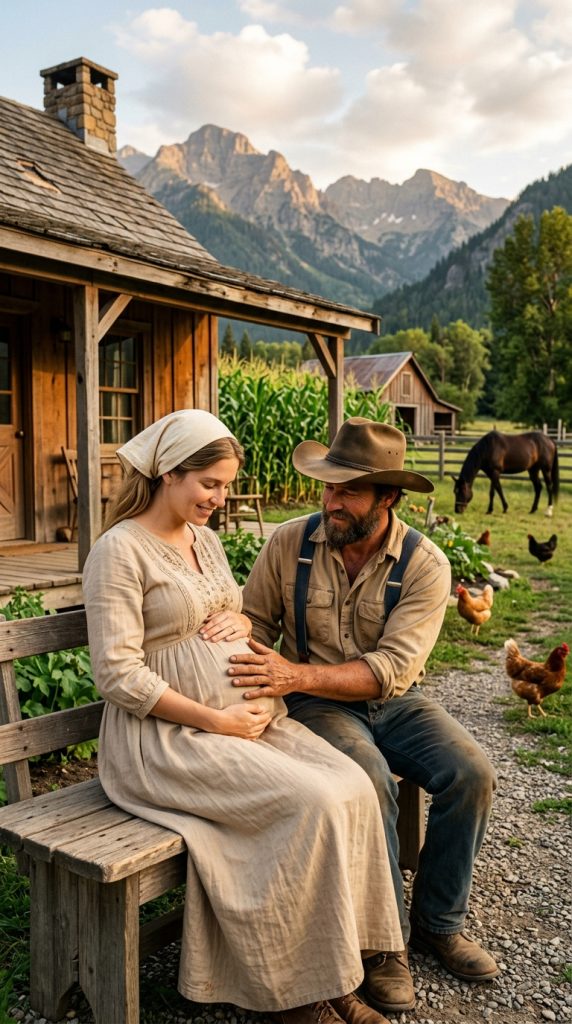
One full-moon night, the baby kicked hard and Mariana, without thinking, took Tomás’s hand and placed it on her belly. He remained motionless. When he felt the small kick under her skin, something in his face broke.
Mariana saw tenderness where before there had only been guilt. And for the first time she thought that perhaps this man was not there out of pity. Perhaps he was there because he wanted to stay.
Everything seemed to be beginning to heal until Rogelio returned.
He arrived on a stifling afternoon, riding a skinny horse, his clothes dirty and his face that of a man who owed money. He looked at the growing cornfield, the repaired roof, the chickens, the new corral, and then looked at Tomás with calculated rage.
“Who are you and what are you doing on my property?”
Tomás stood between him and the door.
“I’m taking care of what you abandoned.”
Mariana appeared behind him, pale, with one hand on her belly. Rogelio smiled when he saw her, but there was no love in his gaze, only interest.
He said he had come for what was his, that the land was going to be sold to a landowner from Querétaro, and that she needed to sign to transfer the rights. Mariana then understood that he had not returned out of remorse or for the baby. He had returned for money.
Tomás clenched his fists, but spoke calmly.
“She is not going to sign anything.”
Rogelio let out a bitter laugh.
“She’s my wife. The law is on my side.”
“The law can also hear that you left her four months pregnant in the middle of the wilderness, without food, without money, and without a single letter.”
Rogelio turned red. He threatened to return with authorities, papers, and witnesses. But when he looked at Mariana expecting to see her tremble, he found something different. She was crying, yes, but with her chin held high.
“I’m not going to give you my signature,” she said. “Not my fear. Not my life.”
Rogelio spat on the ground and left, promising to return.
When the sound of the horse disappeared, Mariana doubled over as if all her courage had left her body. Tomás caught her before she fell. She rested her forehead on his shoulder and cried for everything she had kept silent.
He said nothing.
He simply stayed.
And for Mariana, that was more powerful than any promise.
PART 3
Doña Refugio arrived the next day as if the wind had told her what had happened. She listened in silence, prepared a tea for Mariana, and then said that Rogelio would return because men like him always come back when they smell money.
Tomás went to the town of San Andrés de los Altos and spoke with Father Mateo, a serious and respected man who knew very well the difference between sin and gossip. He also spoke with Don Silverio, the blacksmith, and with two muleteers who had seen Rogelio losing money in cantinas in other towns.
By the time Rogelio returned ten days later with a rural judge and two men pretending to be witnesses, Mariana was no longer alone.
Father Mateo arrived on horseback behind them. Doña Refugio appeared along the stream path. Don Silverio stood by the fence with his arms crossed.
Rogelio tried to speak first, saying that Tomás had invaded his house and stolen his wife. But Father Mateo raised a hand.
“Before talking about theft, let’s talk about abandonment.”
The rural judge listened to the testimonies. He learned about the four months without news, the pregnancy, the shack in ruins, the land without clear registration, and Rogelio’s attempt to force a signature to sell something he had never cared for.
Rogelio changed his tone, shouted, insulted, and said a wife should obey. Then Mariana stepped forward. She had an enormous belly, wet eyes, and steady hands.
“I obeyed when I was a child. I obeyed when they gave me a corner to sleep in. I obeyed when he brought me here and lied to me. But I will not obey to lose the only thing I kept alive with my own hands. This land was not saved by him. This house was not built by him. And this daughter is not going to grow up watching her mother kneel before a coward.”
The silence was so great that even the chickens stopped moving.
The rural judge looked at Rogelio and ordered him to leave until the matter could be reviewed at the municipal seat. Rogelio wanted to protest, but when he saw all those firm faces he understood that he no longer had a woman alone in front of him. He had an entire community watching.
He left without shots, without blows, without glory.
And Mariana knew this time it was final, because Rogelio was not fleeing an obligation: he was fleeing from a woman who had recovered her dignity.
That same night, between exhaustion and tension, the labor pains began. Tomás ran for Doña Refugio under a light rain, his heart pounding in his chest.
The birth lasted until dawn. Mariana screamed, cried, and squeezed Tomás’s hand so hard she almost broke his fingers, but she never asked to give up.
When the first cry filled the shack, Tomás covered his mouth with his hand and cried in silence.
It was a girl, small, strong, with lungs full of life.
Mariana held her against her chest and whispered:
“She will be called Luz. Because she arrived when I thought there was nothing left.”
Tomás looked at the baby as if they had just handed him the whole world. She was not his blood, but from that moment she was his daughter by choice.
Months later, Father Mateo helped register the land in Mariana’s name. The house stopped being a refuge of fear and became a home. The cornfield grew, the chickens multiplied, and Luz learned to sleep in Tomás’s arms as he walked along the veranda murmuring songs he made up.
Mariana began to smile without realizing it.
One Sunday, when the girl was already several months old, Tomás took a simple silver ring made by Don Silverio out of his pocket. He did not kneel with grand words, because he did not know how to speak beautifully. He simply placed the ring on the table and said:
“I cannot promise you there will never be difficult days. But I can promise you I will not leave when they come.”
Mariana looked at the ring, then at the house, the cornfield, Luz sleeping in her basket, and at the man who had shown her with actions what others had sworn with lies.
“Then stay,” she replied. “But not out of pity. Stay for love.”
Tomás took her hand carefully.
“For love, Mariana. That’s why I stayed from the first day.”
They were married in the small church of San Andrés de los Altos, without luxuries, with Doña Refugio as godmother, Don Silverio as godfather, and Luz asleep during almost the entire ceremony.
When the priest declared them husband and wife, Mariana did not feel that someone was rescuing her. She felt something much more beautiful: that she was finally walking beside someone who did not want to possess her, but to accompany her.
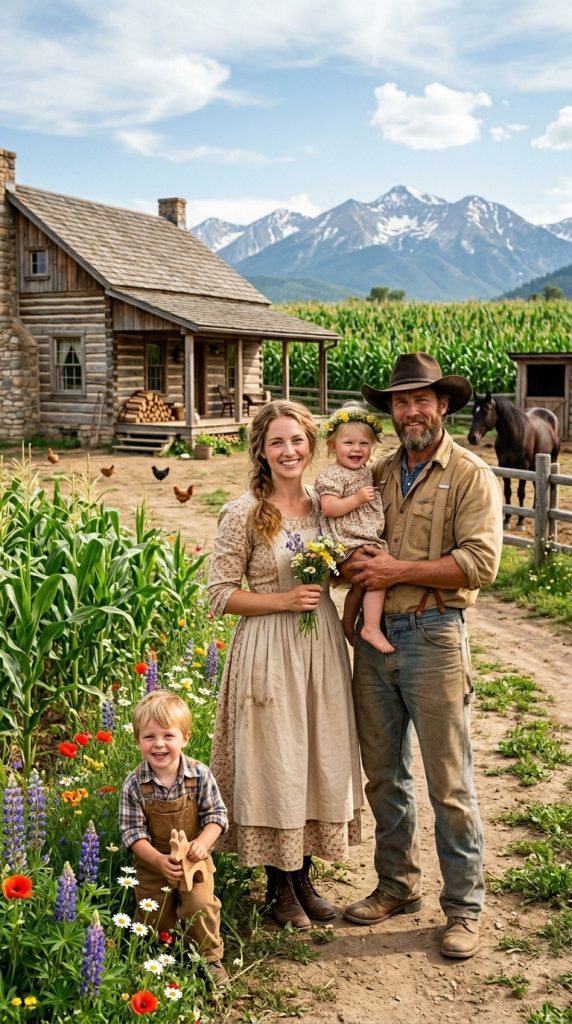
Years later, Luz ran through the patio calling Tomás “dad,” and every time he heard that word, the old guilt over his lost brother hurt a little less. Later a boy was born, and Tomás asked to name him Julián. Mariana accepted, squeezing his hand.
In that shack that had once been a ruin, laughter, corn, flowers, and a family chosen with the heart grew.
And Mariana understood, as she looked at the sunset over the sierra, that sometimes life does not return what it took, but it can send someone who stays, repairs the roof, lights the fire, and turns fear into a home.
