

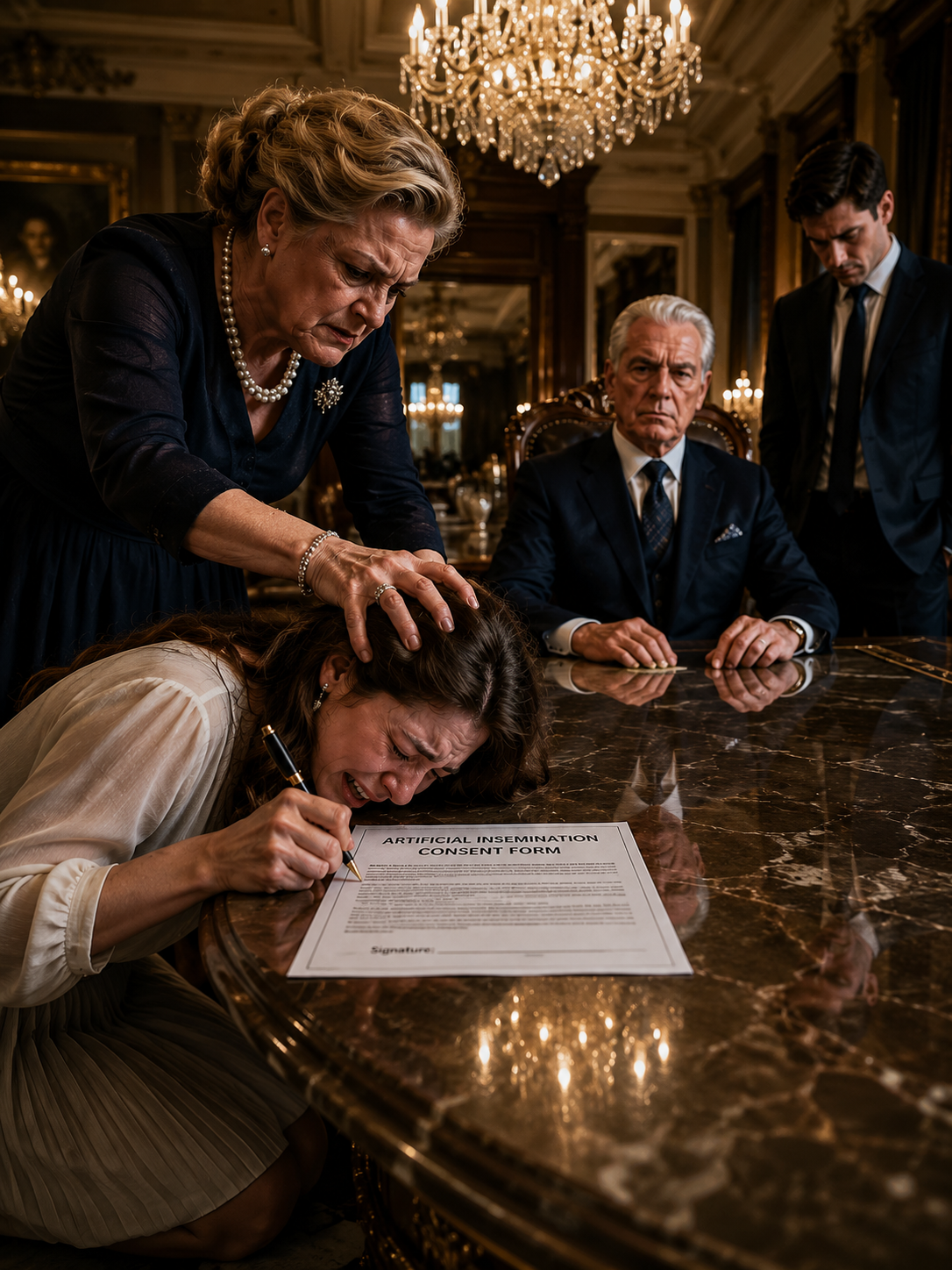
“Sign it.”
My mother-in-law slid the paper across the dining table as if she were passing me a grocery list.
I looked down.
At first, I thought I had misunderstood.
Then my eyes caught the title.
Consent for Artificial Insemination.
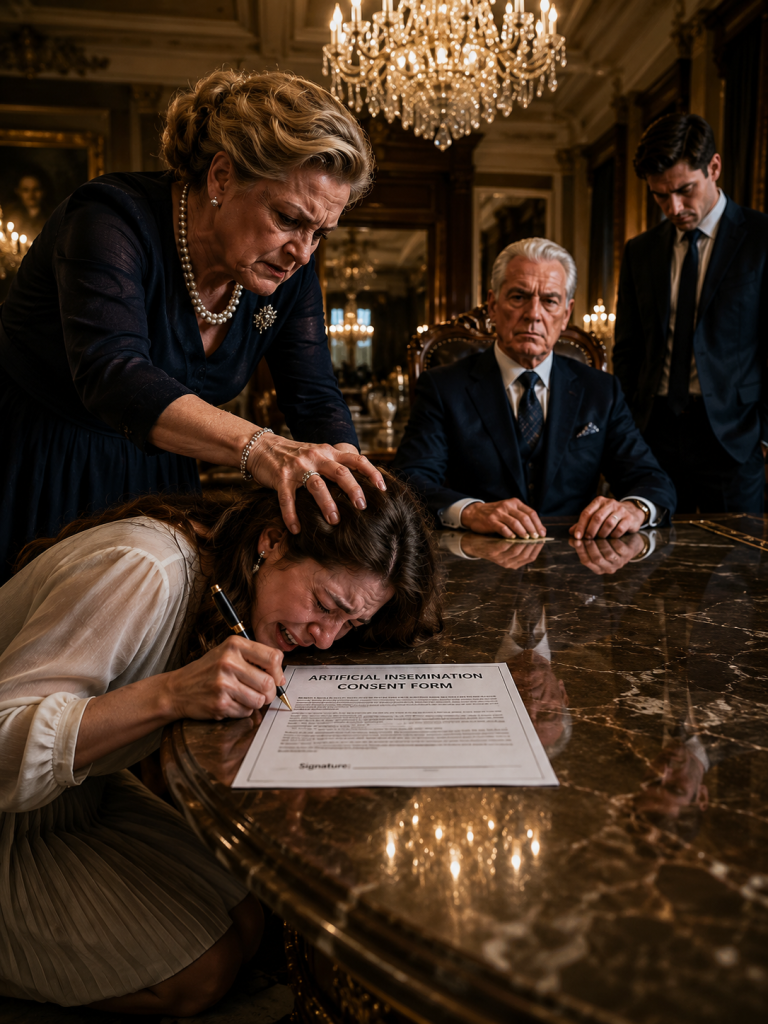
My stomach turned cold.
I kept reading.
The patient’s name was mine.
The husband’s name was Ryan Bennett.
And the donor’s name…
I stopped breathing.
Richard Bennett.
My father-in-law.
I looked up slowly.
Richard sat at the head of the table in his navy suit, calm and silent, his silver hair neatly combed, his wedding ring shining under the chandelier.
Beside him, my mother-in-law, Diane, watched me with the cold patience of a woman waiting for a servant to obey.
And next to me sat my husband.
Ryan.
The man I had loved.
The man I had defended.
The man who now stared at his plate like a coward.
“No,” I whispered.
Diane’s mouth tightened.
“Emily, don’t make this ugly.”
I laughed once.
A broken, shocked sound.
“Ugly?”
My hand shook as I pushed the paper away.
“You want me to have a baby using your husband’s sperm.”
Richard finally spoke.
“It is a medical arrangement.”
I stared at him.
“You are my husband’s father.”
Diane leaned forward.
“And this family needs an heir.”
That was the first time I understood.
They were not asking.
They had already decided.
And I was the last person in the room to know.
But before I tell you what happened in that dining room, before I tell you how they took my phone, locked the gates, and kept me inside that mansion, you need to understand how I ended up there.
Because women like me don’t wake up one morning and walk willingly into a cage.
We are led there slowly.
One small sacrifice at a time.
My name is Emily Carter.
Before I became Emily Bennett, I was a second-grade teacher in Roanoke, Virginia.
I was thirty years old, the daughter of a retired Marine, and the kind of woman who believed love meant trying harder.
When my mother died of cancer when I was sixteen, I learned how to be useful.
I cooked dinner when my father forgot to eat.
I washed the coffee mugs he left by the sink.
I sat beside him on the porch when grief made him silent.
My father, Thomas Carter, was not an emotional man.
He had spent thirty years in uniform.
But every Sunday after church, he took me to breakfast and asked the same question.
“You doing all right, sweetheart?”
And every Sunday, even when I wasn’t, I said yes.
That was my bad habit.
I made pain look manageable.
Ryan Bennett came into my life when I was twenty-six.
He visited my school during a charity event his family sponsored. Bennett Holdings had donated new books to the district, and Ryan was sent to take photos, shake hands, and smile for the local paper.
He was handsome in a soft way.
Kind eyes.
Gentle voice.
Always apologizing before he asked for anything.
When one of my students spilled orange juice all over his expensive shoes, Ryan knelt down and said, “Hey, buddy, no harm done. These shoes were too shiny anyway.”
I remember thinking, He is safe.
That was what drew me to him.
Not his money.
Not his last name.
Safety.
He brought coffee to my classroom.
He remembered that I loved lemon cake.
He asked my father for permission before proposing, even though I told him he didn’t have to.
My father liked him.
At first.
“He’s polite,” Dad said.
“That’s good, right?”
Dad looked at me over his glasses.
“Polite isn’t the same as strong.”
I laughed then.
I wish I hadn’t.
The first time I met Diane Bennett, she insulted me with a smile.
Ryan took me to his parents’ estate outside Asheville for Thanksgiving.
The house looked like something from a magazine. Tall white columns. Black shutters. A driveway so long I thought we were entering a park.
Diane met us in the foyer wearing pearls and a cream-colored dress.
She hugged Ryan.
Then she looked at me.
From my shoes to my hair.
“Well,” she said, smiling, “you’re much prettier than your photos.”
I smiled because I didn’t know yet that Diane never gave compliments.
Only warnings dressed up nicely.
At dinner, she asked about my job.
“I teach second grade,” I said.
“How sweet,” she replied. “Children that age are so forgiving. That must be comforting.”
Ryan squeezed my hand under the table.
“She doesn’t mean anything by it,” he whispered later.
That became his favorite sentence.
When Diane said my wedding dress was “simple in a humble sort of way,” Ryan said she didn’t mean anything by it.
When Diane told guests I came from “a very practical background,” Ryan said she didn’t mean anything by it.
When Diane stood in our kitchen six months after the wedding and said, “Some women are naturally maternal, and some have to work at it,” Ryan said she didn’t mean anything by it.
But she did.
Diane meant every word.
And slowly, I began changing myself to survive her.
I dressed better.
Spoke less.
Cooked more.
Smiled when I was hurt.
The more I tried to earn her love, the more she enjoyed withholding it.
The baby pressure started after our first anniversary.
At first, it was gentle.
“Any news yet?” Diane would ask.
Then sharper.
“You’re not getting younger, Emily.”
Then cruel.
“Ryan deserves to be a father.”
That sentence followed me everywhere.
Ryan deserves.
Ryan needs.
Ryan wants.
As if I didn’t ache too.
As if I didn’t cry every month in the bathroom, holding another negative test.
Ryan held me the first few times.
Then he started leaving the room.
Not angry.
Just absent.
That was Ryan’s way.
When something hurt too much, he disappeared and called it peace.
After a year of trying, Diane insisted we see specialists.
“Good doctors,” she said. “Not whatever small clinic you’re using.”
I went through every test.
Blood work.
Ultrasounds.
Hormone treatments.
Appointments that left me embarrassed and exhausted.
Every result said the same thing.
I was healthy.
No clear reason.
The doctors suggested testing Ryan.
He refused.
Not directly.
Ryan never refused directly.
He would say, “Let’s give it more time.”
Or, “I’m under a lot of stress right now.”
Or, “Mom says we should focus on you first.”
I believed him.
Because I loved him.
Because I trusted him.
Because the idea that my husband might be lying to me felt too painful to consider.
Then came the night of the dinner.
The night Diane put that paper in front of me.
And everything I had ignored became impossible to deny.

“You knew,” I said to Ryan.
My voice was quiet now.
That frightened me more than shouting.
Ryan’s face crumpled.
“Emily…”
“How long?”
He closed his eyes.
“Since college.”
The room spun.
I gripped the edge of the table.
“College?”
Diane sighed, as if I were being unreasonable.
“Ryan had a medical condition. We handled it privately.”
“You handled it?” I turned to her. “You let me sit in doctors’ offices for three years thinking I was the problem.”
Richard looked bored.
“No one said you were the problem.”
I laughed.
“You all did. Every look. Every comment. Every time Diane asked what kind of woman couldn’t give her husband a child.”
Diane’s eyes flashed.
“This family has responsibilities.”
“My body is not one of them.”
She stood.
“You married into the Bennett family.”
“I married Ryan.”
I turned to him.
“Or I thought I did.”
Ryan reached for my hand.
I pulled away.
“Emily, please. I was ashamed.”
“You were ashamed, so you let me suffer?”
Tears filled his eyes.
“I didn’t know how to tell you.”
“No,” I said. “You didn’t want to face it.”
Diane pushed the paper closer.
“This solves everything.”
I stared at her.
“No.”
Her voice hardened.
“You will think about it.”
“I don’t need to think.”
Richard finally leaned forward.
For the first time, his calm cracked.
“You should be careful before you destroy your marriage.”
I picked up the form.
Then I tore it in half.
Diane gasped.
I tore it again.
And again.
Then I dropped the pieces onto the table.
“My marriage was destroyed before I walked into this room.”
I grabbed my purse and headed for the front door.
Ryan followed me.
“Emily, wait.”
I turned.
“If you touch me, I will scream.”
He stopped.
His face looked like a boy’s.
Lost.
Weak.
But not innocent.
I opened the front door and stepped into the night.
At the time, I thought I had won.
I didn’t know Diane Bennett had never allowed anyone to leave her house without permission.
The next morning, I woke up in the guest bedroom.
My phone was gone.
So was my laptop.
So were my car keys.
At first, I thought I had misplaced them. Then I found my purse on the dresser, emptied and neatly arranged like evidence.
Wallet.
Lip balm.
Tissues.
No phone.
No keys.
No cards.
I ran downstairs.
Diane was sitting in the sunroom, drinking coffee.
“Where is my phone?”
She didn’t look up.
“Good morning.”
“Where is it?”
“You were hysterical last night.”
“I was leaving.”
“You were making a scene.”
I felt my pulse pounding in my ears.
“Give me my phone.”
Diane turned a page in her magazine.
“Not until you calm down.”
I ran to the front door.
Locked.
The back door.
Locked.
The garage.
Locked.
I punched in the gate code.
Denied.
Ryan appeared behind me in sweatpants and a wrinkled shirt.
“Emily…”
I spun around.
“Open the door.”
He rubbed his face.
“We just need to talk.”
“No. You need to open the door.”
“Mom thinks—”
“I don’t care what your mother thinks.”
He flinched.
That was the problem.
Ryan always flinched.
Diane could control him with a look.
“Emily, please,” he said. “You’re upset.”
“I am being held inside this house.”
“No one is holding you.”
I pointed to the locked door.
“Then open it.”
Ryan looked at the keypad.
Then back at me.
“I can’t.”
Those two words told me everything.
Not I won’t.
I can’t.
Because in Ryan’s world, Diane’s wishes were stronger than right and wrong.
I stepped closer.
“If you don’t open that door, you are choosing them.”
His eyes filled with tears.
“Don’t make me pick sides.”
I stared at the man I had slept beside for three years.
“There are no sides when your wife is trapped.”
He looked down.
And I knew.
He had already chosen.
The Bennett estate became a beautiful prison.
Fifty acres of manicured lawns.
A greenhouse.
A pool.
A private road.
Security cameras tucked beneath eaves and trees.
No neighbors close enough to hear me.
No staff brave enough to help me.
At breakfast, Diane acted as if nothing had happened.
She placed toast on my plate.
“You’ll feel better once you stop fighting.”
I pushed the plate away.
“I want to call my father.”
“That would only upset him.”
“He should be upset.”
Diane smiled.
“Your father is a simple man. He wouldn’t understand families like ours.”
My hand curled into a fist under the table.
“My father understands honor.”
Richard laughed softly.
“How noble.”
Ryan sat between us, pale and silent.
That silence became his weapon.
Diane used sharp words.
Richard used power.
Ryan used nothing.
And nothing, I learned, can hurt just as badly.
Days passed.
Then a week.
I tried to leave through the garden gate.
A guard stopped me.
“Mrs. Bennett, I can’t allow that.”
“Can’t or won’t?”
He looked uncomfortable.
“Please don’t make this difficult.”
I almost laughed.
Everyone in that house used the same language.
Calm down.
Don’t be difficult.
Think of the family.
As if politeness could make a cage less cruel.
My father called Ryan during the second week.
I know because I heard the phone ring while Ryan was outside my bedroom door.
“Hey, Tom,” Ryan said, voice shaking.
My heart slammed against my ribs.
I ran to the door and pressed my ear against it.
Ryan listened.
Then said, “She’s resting.”
I banged on the door.
“Dad! Dad, I’m here!”
Ryan’s voice rose.
“She’s been under stress. The doctor said she needs quiet.”
I screamed louder.
“Dad!”
Ryan moved away from the door.
I heard his footsteps retreating down the hall.
When he returned later, his face was gray.
“He’s worried,” Ryan said.
“Good.”
“Emily, you have to stop making this worse.”
I looked at him in disbelief.
“I am locked in your parents’ house, and you think I’m making it worse?”
He sat on the edge of the bed.
“I’m trying to keep everyone calm.”
“No. You’re trying to keep yourself comfortable.”
He looked wounded.
I didn’t care.
“You let your mother tell my father I’m unstable.”
Ryan swallowed.
“She didn’t say unstable.”
“What did she say?”
He said nothing.
I nodded.
“There it is.”
He reached for me.
I stepped away.
“Don’t.”
“Emily, I love you.”
“No,” I said. “You love the version of me that forgives you.”
That sentence broke something in him.
For a second, I thought he might finally stand up.
Finally open the door.
Finally choose me.
Instead, he whispered, “I’m sorry.”
Then he left.
I sat on the floor and cried until my throat hurt.
Not because I missed him.
Because I finally understood I had been sleeping beside a locked door long before the real one closed.
My first escape attempt happened at 2:13 in the morning.
I had noticed Diane left her phone charging in the smaller sitting room off the kitchen.
She always used the same path to bed.
Always turned off the same lamps.
Always left the phone on the same side table.
Control made Diane predictable.
I waited until the house went dark.
Then I slipped out of my room.
The hallway floor was cold under my bare feet.
Every portrait on the wall seemed to watch me.
I moved slowly.
Past Ryan’s old bedroom.
Past the library.
Down the back stairs.
The sitting room door was open.
Diane’s phone glowed faintly beside a crystal lamp.
My hand shook as I picked it up.
Password.
I tried Ryan’s birthday.
Wrong.
Their anniversary.
Wrong.
Richard’s birthday.
Wrong.
My hands were slick with sweat.
Then the lights came on.
Diane stood in the doorway in a silk robe.
In her hand was my phone.
“Looking for this?”
For a moment, I couldn’t move.
She had been waiting.
She smiled.
“You really are predictable.”
I lunged for my phone.
Diane stepped back and slapped me across the face.
The sound cracked through the room.
My cheek burned.
Ryan appeared behind her, frozen.
He had seen it.
I looked at him.
“Are you going to let her hit me?”
His lips parted.
“Mom…”
Diane turned.
“Go upstairs, Ryan.”
He looked at me.
I begged him with my eyes.
Please.
For once.
Be my husband.
He turned away.
That was the moment my love for Ryan died.
Not slowly.
Not with sadness.
It died right there in that sitting room while his mother held my phone and my cheek burned from her hand.
The next morning, Diane served me breakfast herself.
A bruise had bloomed along my jaw.
She looked at it and smiled.
“You bruise easily.”
I stared at her.
“You hit me.”
“You attacked me.”
“I reached for my phone.”
“You’re twisting events.”
That was Diane’s gift.
She could wound you, then accuse you of bleeding incorrectly.
Richard entered carrying a folder.
He placed it beside my plate.
Another consent form.
Fresh.
Untorn.
“You will sign eventually,” he said.
I didn’t touch it.
Richard sat across from me.
For a dying man, he still looked powerful. But now I noticed things I hadn’t before.
His hands trembled slightly.
His skin looked gray around the mouth.
His breath caught when he sat too quickly.
Richard Bennett was not immortal.
He just wanted everyone to think he was.
“Why me?” I asked.
Diane’s eyes narrowed.
“What do you mean?”
“There are surrogates. Clinics. Lawyers. If this were legal and normal, why trap me?”
The silence changed.
Just slightly.
But I felt it.
Richard closed the folder.
“This is private.”
“No,” I said. “It’s dirty.”
Diane stood so quickly her chair scraped back.
“You ungrateful little nobody.”
I smiled faintly.
“Then let me go.”
Her face hardened.
“Not until you give this family what it needs.”
And there it was.
The truth.
Not what Ryan needed.
Not what I wanted.
What the family needed.
I was not a wife to them.
I was a means to an end.
Two hundred miles away, my father stopped believing polite explanations.
Thomas Carter was not a man who panicked.
He had seen war.
Loss.
Bad news delivered at midnight.
But nothing frightened him like unanswered calls from his only child.
He called the Asheville police and requested a wellness check.
Two officers went to the Bennett estate.
Diane met them at the door.
I learned this later.
She wore a soft blue sweater and looked every inch the concerned mother-in-law.
She told them I was resting.
She said fertility stress had caused “emotional instability.”
She presented a doctor’s note.
She said I did not want contact with anyone, including my father.
The officers left.
My father read the report once.
Then twice.
Then he opened a drawer in his study and pulled out an old leather notebook.
Inside were names.
Private investigators.
Former military police.
Attorneys.
People who knew how to find things hidden behind money.
He called the first number.
“My daughter is missing,” he said.
The man on the other end asked, “How long?”
My father looked at the calendar.
“Long enough.”
Inside the mansion, the only person who looked at me with kindness was Martha Hale.
Martha had worked for the Bennetts for twenty-eight years.
She was seventy-one, quiet, with silver hair pinned neatly at the back of her neck.
To Diane, Martha was furniture.
Useful.
Silent.
Replaceable.
But servants hear what families hide.
One afternoon Martha brought fresh towels to my room.
She placed them on the bed, then walked to the bathroom and turned on the shower.
Water thundered against the tile.
I watched her, confused.
She came back and whispered, “There are no cameras in the bathroom. The water covers sound.”
My heart stopped.
“Why are you telling me this?”
Martha’s eyes filled with an old sadness.
“Because I didn’t help the first one soon enough.”
“The first one?”
She glanced at the door.
“Clara.”
Ryan’s first fiancée.
He had told me about her once.
Barely.
“She left,” he said.
“She wasn’t ready for marriage.”
That was all.
Now Martha’s face told me there was more.
“What happened to Clara?” I whispered.
Martha looked toward the running shower.
“She found out why they needed a child so badly.”
My skin went cold.
“Tell me.”
Martha took a folded paper from inside her apron.
It was a copy of part of a trust agreement.
I read the highlighted line.
Controlling interest shall pass only through the direct biological line of Richard Bennett.
I looked up.
“I don’t understand.”
Martha’s voice shook.
“Ryan is not Richard’s biological son.”
The room seemed to tilt.
“What?”
“Diane had an affair before Ryan was born. Richard raised him to protect the family name. But the trust was written by Richard’s father. Bloodline only.”
I sank onto the bed.
“So Ryan can’t inherit control.”
“No.”
“And Richard…”
“Is sick,” Martha said. “Sicker than they admit.”
I covered my mouth.
Suddenly the horror became clear.
This wasn’t about giving Ryan a baby.
It wasn’t even about Diane wanting a grandchild.
They needed Richard to have a biological descendant before he died.
A child tied to the Bennett name.
A child they could control.
And I was the body they had chosen.
I whispered, “What happened to Clara?”
Martha’s eyes filled with tears.
“She ran before they locked things down. I gave her cash. Not enough. But enough to get a bus ticket.”
“Where is she now?”
“I don’t know.”
Then Martha took something else from her apron.
A small prepaid phone.
My breath caught.
“Can I call my father?”
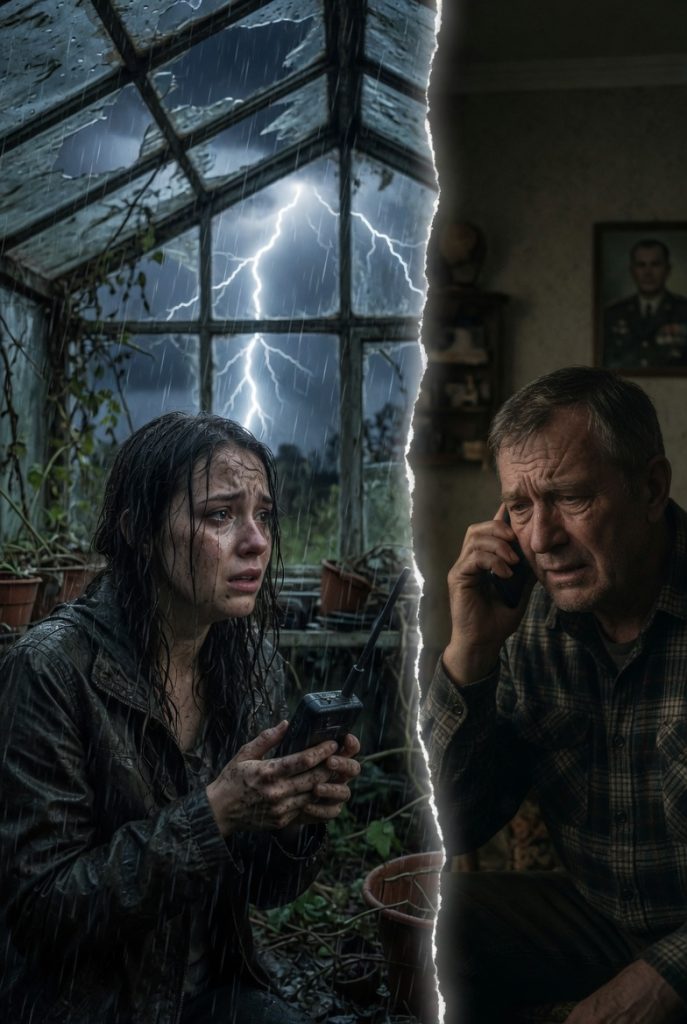
“Not in the house. The signal is blocked in most rooms. But near the old greenhouse, sometimes it works.”
“When?”
“Tomorrow night. During the storm.”
For the first time in weeks, hope hurt more than fear.
The next night, rain fell hard enough to shake the windows.
Martha came after midnight.
No words.
Just a nod.
I followed her down the service stairs.
Every sound felt too loud.
My breath.
My heartbeat.
The creak of old wood.
We passed the kitchen, slipped through the mudroom, and stepped into the storm.
Cold rain hit my face.
I almost cried from the feeling of open air.
The old greenhouse stood beyond the garden, half swallowed by vines.
Martha handed me the phone.
“Two minutes.”
My fingers shook so badly I almost dropped it.
I dialed my father’s number.
It rang.
Once.
Twice.
Three times.
“Hello?”
My knees nearly gave out.
“Dad.”
Silence.
Then a sharp breath.
“Emily?”
I pressed my hand over my mouth, sobbing.
“Dad, help me.”
His voice changed instantly.
Low.
Controlled.
“Where are you?”
“The Bennett estate. They took my phone. They won’t let me leave. They’re trying to force me to sign medical papers. Ryan knows. Dad, I’m scared.”
“Are you hurt?”
“I’m okay.”
“Are you in immediate danger?”
A light turned on at the back of the house.
Martha grabbed my arm.
“We have to go.”
“Emily,” Dad said. “Stay on the line.”
“I can’t. They’re coming.”
“Emily—”
Martha pulled me into the rain.
The phone slipped from my hand into the mud.
We ran.
But when we reached the mudroom, Ryan was standing there.
Barefoot.
Soaked from the open doorway.
His face was white.
“What did you do?”
I backed away.
Martha stood in front of me.
Ryan looked at her.
Then at me.
Then at the phone in the mud outside.
“Emily,” he whispered. “You shouldn’t have done that.”
I stared at him.
“My father knows.”
Diane’s voice came from behind him.
“Does he?”
She stepped into the doorway.
Her face was calm.
Too calm.
“Then I suppose we’ll have to move faster.”
They locked me in the east bedroom after that.
No books.
No walks.
No Martha.
No Ryan.
The windows were sealed.
The door opened only when Diane brought food.
On the second day, Richard came in with another form.
I was sitting on the floor by the bed.
He placed it on the dresser.
“You are running out of options.”
I laughed quietly.
He frowned.
“What is funny?”
“You.”
His face hardened.
I stood slowly.
“You built this empire. This house. This perfect family name. And you still need a woman you despise to save it.”
His eyes turned cold.
“You know nothing about sacrifice.”
“I know everything about sacrifice. I sacrificed my body to doctors because your son lied. I sacrificed my dignity to your wife’s insults. I sacrificed years loving a man who was too weak to love me back.”
Richard stepped closer.
“Careful.”
“No,” I said. “You be careful.”
His nostrils flared.
For the first time, I saw it.
Fear.
Not of me.
Of time.
Of death.
Of his name ending.
“You will sign,” he said.
I looked him straight in the eye.
“I would rather die in this room.”
He stared at me for a long moment.
Then he picked up the paper and left.
When the door locked behind him, I slid to the floor.
I was terrified.
But I was still mine.
And they hated that most of all.
My father arrived in North Carolina before dawn.
By then, he had already found Clara.
A private investigator tracked her to Oregon, where she lived under her married name.
When Dad called, he said only one sentence.
“My daughter married Ryan Bennett.”
Clara began to cry.
Then she told him everything.
The pressure.
The strange medical conversations.
The trust.
Diane’s threats.
Richard’s obsession with blood.
Ryan’s silence.
“I ran,” Clara said. “I always wondered if they would try again.”
“They did,” Dad said.
By sunrise, he sat in a county office with a sheriff, a prosecutor, and a federal investigator.
He laid out phone records.
Financial documents.
The false doctor’s note.
Clara’s statement.
Proof my car had never left the Bennett property.
Proof my accounts had been accessed from inside the estate.
The sheriff looked at him.
“You understand who this family is?”
My father leaned forward.
“Yes. Do they understand who I am?”
No one asked him again.
The raid happened on a Thursday evening.
Diane was in my room when the first siren sounded.
She had brought soup I had no intention of eating.
“You look awful,” she said.
“Captivity does that.”
She set the tray down.
“You always choose ugly words.”
“I choose accurate ones.”
Her eyes narrowed.
“You could have had everything.”
“No,” I said. “You wanted to take everything.”
Diane stepped close.
“You think anyone will believe you over us?”
Before I could answer, red and blue lights flashed against the window.
Diane turned.
Her face drained of color.
Another siren wailed.
Then another.
I stood.
A slow smile touched my lips.
“You should have let me call my father.”
For the first time since I had met her, Diane Bennett looked afraid.
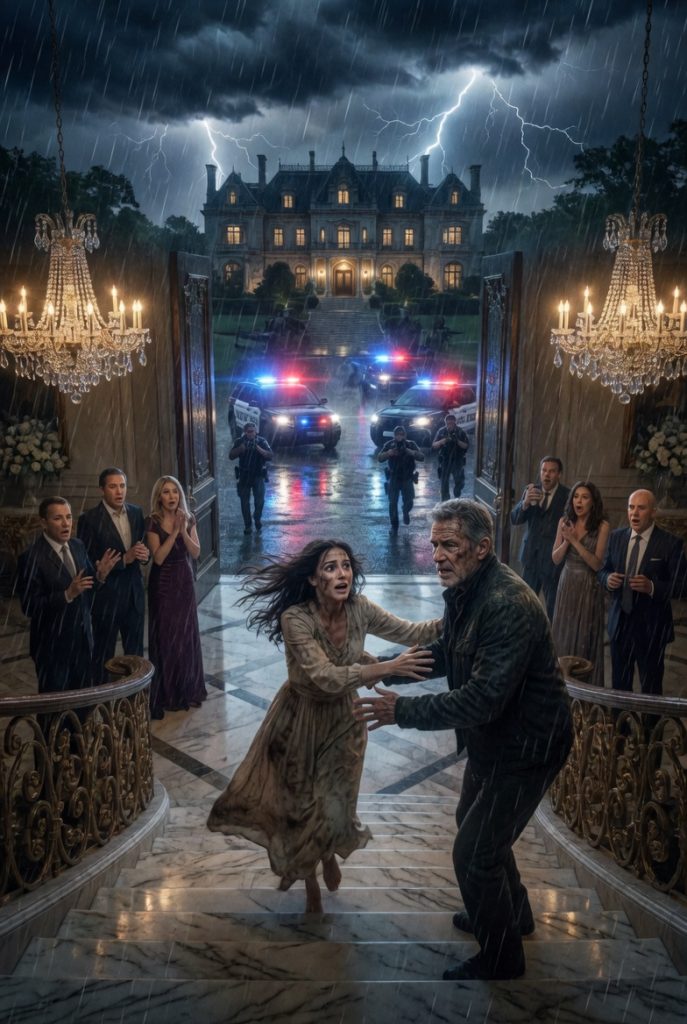
Deputies entered through the front gate with a warrant.
Richard shouted about lawyers.
Diane shouted about privacy.
Ryan said nothing.
He stood on the staircase like a man watching his life collapse and still waiting for someone else to tell him what to do.
The east bedroom door opened.
A female deputy stood there.
“Emily Bennett?”
I could barely speak.
“Yes.”
“You’re safe now.”
I stepped into the hallway.
And there, in the foyer below, stood my father.
Gray hair wet from the rain.
Jaw tight.
Eyes searching until they found me.
“Daddy,” I whispered.
He came up the stairs faster than I had ever seen him move.
When he reached me, I fell into his arms.
For a moment, I was not thirty years old.
I was sixteen again.
Motherless.
Scared.
Held together by the one person who had never failed me.
“I’m sorry,” I sobbed.
His arms tightened around me.
“No, sweetheart. You survived.”
Over his shoulder, I saw Ryan.
He was crying.
“Emily,” he said.
I looked at him.
Really looked.
At the man I had once thought was safe.
“You let them,” I said.
His face crumpled.
“I was scared.”
“So was I.”
He had no answer.
Because there was none.
The trial lasted months.
The Bennetts tried everything.
They called me unstable.
Then confused.
Then vengeful.
Diane wore pearls to court every day.
Richard arrived with expensive attorneys.
Ryan looked smaller each time I saw him.
But evidence does not care about family names.
They found my phone in Diane’s safe.
They found my car hidden in a locked garage.
They found camera footage of me trying to leave.
They found copies of the consent forms.
They found the trust.
They found Clara.
When Clara testified, the courtroom went silent.
“I ran before they could trap me,” she said. “Emily didn’t get that chance.”
Martha testified too.
Her voice was soft but clear.
“I served that family for twenty-eight years,” she said. “And I learned that silence can be bought. But guilt cannot.”
Then came Ryan.
My attorney asked him one question that mattered.
“Did you know your wife wanted to leave?”
Ryan cried.
“Yes.”
“Did you help her?”
“No.”
“Why?”
He looked at Diane.
Then at me.
“Because I was afraid of my mother.”
The courtroom was silent.
I thought hearing that would hurt.
But it didn’t.
It freed me.
Because finally, the whole world could see what I had lived with.
Ryan was not a monster.
He was something sadder.
A man who let monsters win because standing up to them cost too much.
A year later, I stood on the porch of my father’s house in Virginia.
My divorce was final.
The criminal cases were still moving.
The Bennett empire was broken into lawsuits, investigations, and frozen accounts.
Diane lost the society friends she had spent her life impressing.
Richard lost control of the company he had tried so hard to protect.
Ryan sent me letters.
I never opened them.
That evening, Dad brought me tea and sat beside me.
“You doing all right, sweetheart?”
For the first time in a long time, I didn’t lie.
“I’m getting there.”
He nodded.
We watched the sun sink behind the trees.
After a while, I said, “I keep wondering why I didn’t see it sooner.”
Dad looked at me.
“Because you were loving them. They were studying how to use that love.”
Tears filled my eyes.
He was right.
That was the hardest lesson.
Some people do not love you back.
They learn you.
They learn where you bend.
Where you forgive.
Where you blame yourself.
Then they press there.
Again and again.
Until one day, you mistake obedience for peace.
Six months later, I spoke at a support group for women leaving abusive homes.
My hands shook as I stood at the front of the room.
“My name is Emily Carter,” I said. “And I used to think abuse had to be loud.”
The women watched me quietly.
“But sometimes abuse wears pearls. Sometimes it lives in a mansion. Sometimes it says, ‘We only want what’s best for the family.’ Sometimes it comes from a husband who never raises his voice, but also never opens the door.”
A woman in the front row began to cry.
I took a breath.
“I am here because someone believed me. So if no one has believed you yet, I do.”
My voice grew stronger.
“You are not property. You are not a duty. You are not a womb for someone else’s legacy. You are a person. And you deserve to be free.”
In the back of the room, my father wiped his eyes.
I smiled at him.
For so long, the Bennetts had wanted an heir.
A legacy.
A bloodline.
But in the end, their legacy became a warning.
And mine became freedom.
Because sometimes the strongest word a woman can say is not “yes.”
Sometimes it is “no.”
And sometimes that one word is enough to bring an empire down.
